The cinema of my dreams – Was it just another surveillance job – Episode 9

I’m back home and this story has been sitting on a back burner for a few months, waiting for some more to be written.

The trouble is, there are also other stories to write, and I’m not very good at prioritising.

But, here we are, a few minutes opened up and it didn’t take long to get back into the groove.

An interrogation and a revelation.

I think I just about reached that same conclusion just seconds before she uttered it.  But, I didn’t think this was the time to air my own thoughts on the matter.

The question I did ask was, “It appears our service has been compromised.”

She glanced at me almost condescendingly.  “It appears so.  Have you got your cell phone?”

I had it with me and gave it to her.  I had it ready because I knew they would ask for it.  It had a record of orders given, and phone conversations made, before, during, and after the operation.

For a review, or in this case, a search for the guilty.

I watched her put in the passcode, and go to the messages, and bring up the one sent to me, to attend the briefing.  It was all in order, no different to the previous five, with all the right designations and protocols.

“There was no reason to suspect it was anything but a real callout.”

Another glance at the screen, she put it on the desk next to the file.  “No, it looks real enough.”

Thought best kept to myself; how the hell did someone outside our organisation, know so well our inner workings?  I wanted to ask the question but refrained from doing so.

It also explained, now that I thought about it, the reason why the target had said he was one of us.  We had been hunting him so someone else, and enemy organisation perhaps, so they could kill him.  The question was, why?  Had he made a discovery, the evidence he was referring to that a certain Alfred Nobbin might have.

Perhaps a good idea, for the time being, to keep that snippet of information to myself.  After all, this new person in front of me could be one of Severin’s people.

Where I was sitting was not a familiar place to me, though I had been to the building before, which is why I knew where to go for this interview.  AS for the people, everyone I’d met so far, other than the other team members, bar one, I’d known from training.

So, now another expected question from me, or at least, if I was on the other side of the table, it’s one I’d expect to be asked.  “Just who was I working for, if it was not for us?”

Assuming she was one of us.

“That’s what we intend to find out.  Who was the target?”

I gave her the description we’d been given, and a copy of his photograph that had been circulated at the briefing.  I’d kept one of them, and luckily no one noticed it missing.  It was fortuitous that’s I’d copied the photo before I had to give it to her, which was right then.

There was not a flicker of recognition in her eyes.

“So, not one of us?” I asked.

For an interrogation, she wasn’t asking many relevant questions.

She looked up.  “Why would you say that, if your mission was to keep him under surveillance?”

“Which we now know was not sanctioned, so we have to assume that we had been persuaded to find and track one of our own agents.  You look as though you didn’t recognise him?”

“I don’t try to remember every agent we have in the field, here and overseas.  There a few too many for that.  But I’ve got a request out for his identity.  He didn’t say who he was?”

“No.”

“Anything at all that might be useful?”

“That he was one of us, who’d made a mistake, and feared we’d set the dogs on him.”

“Yes.  Someone definitely did that.”

© Charles Heath 2019

“Sunday in New York”, a romantic adventure that’s not a walk in the park!

“Sunday in New York” is ultimately a story about trust, and what happens when a marriage is stretched to its limits.

When Harry Steele attends a lunch with his manager, Barclay, to discuss a promotion that any junior executive would accept in a heartbeat, it is the fact that his wife, Alison, who previously professed her reservations about Barclay, also agreed to attend that casts a small element of doubt in his mind.

From that moment, his life, in the company, in deciding what to do, his marriage, his very life, spirals out of control.

There is no one big factor that can prove Harry’s worst fears, that his marriage is over, just several small, interconnecting events, when piled on top of each other, point to a cataclysmic end to everything he had believed in.

Trust is lost firstly in his best friend and mentor, Andy, who only hints at impending disaster, Sasha, a woman whom he saved, and who appears to have motives of her own, and then in his wife, Alison, as he discovers piece by piece, damning evidence that she is about to leave him for another man.

Can we trust what we see with our eyes or trust what we hear?

Haven’t we all jumped to conclusions at least once in our lives?

Can Alison, a woman whose self-belief and confidence are about to be put to the ultimate test, find a way of proving their relationship is as strong as it has ever been?

As they say in the classics, read on!

Purchase:

http://tinyurl.com/Amazon-SundayInNewYork

The cinema of my dreams – I always wanted to go on a treasure hunt – Episode 65

Here’s the thing…

Every time I close my eyes, I see something different.

I’d like to think the cinema of my dreams is playing a double feature but it’s a bit like a comedy cartoon night on Fox.

But these dreams are nothing to laugh about.

Once again there’s a new installment of an old feature, and we’re back on the treasure hunt.

The Ormiston’s from the papers

It was a question of what was I looking for.  It would be easy to say I wanted a piece of paper that definitively said where the treasure was or finding a map that led straight to it.

Instead, there was, in one box, a dozen journals filled with the ramblings of a madman.

Searching for treasure had sent Ormiston senior mad.  For an hour, perhaps longer, I tried to decipher the spidery writing, and then gave up when it switched to German.

I assembled the journals in order of his expeditions and found the first easy to follow because it was a time of excitement and expectation, that he would find the treasure.  There were pages on exactly what he thought the treasure was worth, the sort of pieces they would find, and what he would do with the proceeds.

There were drawings of items off the map and his interpretation of what they represented.  It was a rather good description of the coastline and its anomalies as they related to map landmarks.  They were, almost all, the same as the Boggs interpretations.

When the discovery didn’t happen, when the first euphoria wore off and the search became bogged down in acrimony and arguments, and the realization the map they were using was not as clear as first believed, that was where it all began to fall apart.

Reading the words, feeling the disappointment seeping off the page, it must have been quite a blow.

The second expedition didn’t start off with the same fanfare, but almost as if they were expected to fail.  Too little time had been spent analyzing what went wrong and reidentifying the coastal landmarks.

And, when it did fail, the last comment in the diary was fairly succinct.  “What if there is no treasure?”

In another, scrawled heavily on several pages at the back, “look for the big A” was repeated several times, and much underlined.

There were five other boxes with papers, charts, notebooks, and books that belonged on a shelf but instead were neatly stacked.  They’d been in the boxes for some time, and had that aroma books got when left in the damp too long, and, in fact, when I tried to open some, the pages had stuck together.

A lot of the books were about pirates, reference texts, and fiction.  Part of one box was set aside for our particular pirate, and, reading through what could be read, a lot of the information was contradictory.  One book postulated that the said pirate wasn’t a pirate at all, casting doubt on whether he ever existed at all.

The maps were a different story, and, yes, they were all similar except for small details an observation I had made before.  None had what I would have called ‘new’ features, just a rehash of all the others.  Some were old, but most had the appearance of being made to look old.

Then, at the bottom of a box of books, were copies of newspaper articles, aged, stained, and some in various stages of disintegration.  The Bahama Argus, The Barbadian, The Antigua Herald and Gazette, The Bermuda Colonist, and the Dominica Chronicle.  All had references to Captain Johannsson, and his vessel, the Sea Serpent.

There was such a Captain, and there was such a ship, and there were reports of a vessel roving the seas, looking for prey.  And those reports covered a great deal of plunder, definitely the sort that would find its way into a number of sea chests.

But, was this the treasure that Ormiston believed was hidden somewhere in The Grove?

Something caught my attention on the first diary, the way it sat and the light reflected off it, and picking it up and looking at it showed no anomaly in the surface, not until it sat on a certain angle and in the sunlight.

A slight ripple down one edge of the spine, and with careful probing, there was a split in the material of the cover pasted back down, but in the time since it had been glued back, the glue had dissolved and the simple act of picking the book up and parted the split.

Lifting it gently, I could see a piece of paper tucked in and gently coaxed it out.

It was very thin and fragile, but the writing was clear.  Entries from what might have been a logbook.  I knew this only because I had been out of a sailing boat once when at school, and had seen the boat’s logbook, noting where the boat had been.

This page had only a few entries, the location of its departure, in latitude and longitude, a number of the daily distances traveled, and conditions, and the last, another latitude and longitude.

When I put the first coordinates into my GPS, it was near the island of Antigua, and then the destination, just up the coast near the old mall.  The name of the vessel, in almost illegible writing, the Sea Serpent.

So, there was a logbook, although it might not exist now, it did at some point in the past, and Ormiston had either found it or seen it.  The writing on the piece of paper was his. It proved, if it was authentic, there was a ship, and it did come to this coast.

I carefully folded it and hid it in my wallet, then replaced everything where I found it.  Enough research for today.  I tried not to look guilty when I left.

© Charles Heath 2020-2022

The 2am Rant: Betwixt metaphorical houses

It’s like working in two offices, one uptown, and one downtown.

I have two blogs, this one, and another which is purely for writing, and generally, a lot of starts and not a lot of finishes. I get ideas, and it’s a place to store them, and give a few people some amusement at my, sometimes, improbable situations and far-fetched stories.

Here I try to be more serious.

I have the ceiling, the cinema of my dreams. Here anything is possible, like jumping from a helicopter about to explode, and survive, and get out of a sinking ship, like Houdini. Of course, there is always one time when it doesn’t work, and Houdini knows that all too well.

Over there, I have a series which I started here, long ago, where I take a photograph and write a story inspired by it. The interesting thing about that is I could probably use the same photograph over and over, and it would inspire a different tale.

I know, if I was running a writing class, everyone would see that photograph differently.

But what amazes me sometimes is the fact the story is not directly related to the theme. It got me thinking about how we view our experiences, and what triggers memories. I’ve discovered that it doesn’t necessarily happen by correlation, say, for instance, a memory of being in New York might be triggered by a visit to a cafe in Cloncurry.

I try to do one of these every day, but sometimes it’s hard work. Writing itself can be some days, particularly when the words are lurking there, behind that invisible, impenetrable, rock wall.

OK, so I’m stuck in the middle of writing a piece over there, and I’ve come over here to whinge.

But, enough. I’ll let you know what the cinema of my dreams is showing, later.

“Echoes From The Past”, the past doesn’t necessarily stay there


What happens when your past finally catches up with you?

Christmas is just around the corner, a time to be with family. For Will Mason, an orphan since he was fourteen, it is a time for reflection on what his life could have been, and what it could be.

Until a chance encounter brings back to life the reasons for his twenty years of self-imposed exile from a life only normal people could have. From that moment, Will’s life slowly starts to unravel, and it’s obvious to him that it’s time to move on.

This time, however, there is more at stake.

Will has broken his number one rule: don’t get involved.

With his nemesis, Eddie Jamieson, suddenly within reach, and a blossoming relationship with an office colleague, Maria, about to change everything, Will has to make a choice. Quietly leave, or finally, make a stand.

But as Will soon discovers, when other people are involved, there are going to be terrible consequences no matter what choice he makes.

https://amzn.to/2CYKxu4

newechocover5rs

‘What Sets Us Apart’ – A beta reader’s view

There’s something to be said for a story that starts like a James Bond movie, throwing you straight in the deep end, a perfect way of getting to know the main character, David, or is that Alistair?

A retired spy, well, not so much a spy as a retired errand boy, David’s rather wry description of his talents, and a woman that most men would give their left arm for, not exactly the ideal couple, but there is a spark in a meeting that may or may not have been a setup.

But as the story progressed, the question I kept asking myself was why he’d bother.

And, page after unrelenting page, you find out.

Susan is exactly the sort of woman to pique his interest.  Then, inexplicably, she disappears.  That might have been the end of it, but Prendergast, that shadowy enigma, David’s ex-boss who loves playing games with real people, gives him an ultimatum: find her or come back to work.

Nothing like an offer that’s a double-edged sword!

A dragon for a mother, a sister he didn’t know about, Susan’s BFF who is not what she seems or a friend indeed, and Susan’s father, who, up till David meets her, couldn’t be less interested, his nemesis proves to be the impossible dream, and he’s always just that one step behind.

When the rollercoaster finally came to a halt, and I could start breathing again, it was an ending that was completely unexpected.

I’ve been told there’s a sequel in the works.

Bring it on!

The book can be purchased here:  http://amzn.to/2Eryfth

The cinema of my dreams – Was it just another surveillance job? – Episode 8

I’m back home and this story has been sitting on a back burner for a few months, waiting for some more to be written.

The trouble is, there are also other stories to write, and I’m not very good at prioritising.

But, here we are, a few minutes opened up and it didn’t take long to get back into the groove.

An interrogation and a revelation.


Debriefings were like interrogations, only friendlier.  We were trained to withstand interrogation, so it would be interesting to see how I reacted.   I had no doubt what some of the questions would be.

While I had a few minutes to myself, sitting down behind a bare metal table on a hard plastic and uncomfortable chair, with a warm cup of station house coffee, to consider the briefing.

Target, male, 6 foot 3 inches, 200 pounds, Caucasian, thought to be from either Russia or Bulgaria, but nothing to define his as such.  I had wondered, at the time, what that meant.  When I saw him in the alley I knew, then, what was meant, he looked the same as you or me.

No explanation for why he was under surveillance, but we did get a warning that he might be dangerous if he suspected he was being observed.  Right about that, given team casualties.

Main objective, who he met, talked to, and where he went, every place, every detail to be noted.  The unpredictable explosion threw the whole operation into chaos.

The door opened and a woman, middle-aged, conservatively dressed, walked in, closing it behind her.  She sat in the other chair opposite me.  She brought a file, thin, and put it in front of her on the table.

“Your name is Sam Jackson?”

“Yes.”

No introductions, nothing, just a start on the questions.  No nonsense, but I could see she was very, very angry.  With me, or those who had run a failed operation?

“How long have you been with us?”

“Eight months.”

She opened the file and glanced at the piece of paper on top.  A minute passed before she closed the file again.  “Closer to nine,” she said.

I said nothing.  I wasn’t counting the days.

“How many operations have you been on?”

“Six, including this one.”

“Who assigned you to this specific operation?”

“Couldn’t say.  I got the usual request via text message to attend a briefing at the midtown office.”

“What was the designated operation name?”

“Chancellery.”

For a brief second, there was a quizzical expression on her face, then it was gone.

“Who was running this operation?”

“Director Severin.”

A full three minutes of silence passed.  I thought she was looking at me, the sort of stare that would break a lesser man, but in the end, I think she was looking right through me.  I could not read her thoughts, but if I was to guess, they would be rather dark right now.

Then she spoke.

“You should know that there was no Chancellery on the books, and we certainly do not have a Director named Severin.”


© Charles Heath 2019

The cinema of my dreams – I always wanted to go on a treasure hunt – Episode 64

Here’s the thing…

Every time I close my eyes, I see something different.

I’d like to think the cinema of my dreams is playing a double feature but it’s a bit like a comedy cartoon night on Fox.

But these dreams are nothing to laugh about.

Once again there’s a new installment of an old feature, and we’re back on the treasure hunt.

The Ormiston’s from the papers

The Ormiston story and that of the thousand or so acres between the sea and the mountains are now known as Patterson’s reach, but once called The Grove, began in 1865 when the original Henrich Ormiston arrived from Germany.

Originally intending to go to Australia to grow grapes in South Australia, instead, his fate turned West to the Americas, and, eventually, this part of Florida.  He started out with the intention of growing grapes, but when that failed to materialize, he moved on to Oranges, hence the name, The Grove.

He had married before leaving Germany and had two children, Marta and Gunter before leaving, and Friedrich after he arrived in 1866.  That Friedrich died, according to the gravestone, in 1924.  Neither Marta nor Gunter stayed, leaving Friedrich to carry on the business, have an only child which he named after his father, Heinrich, born in 1899 and who died in 1976.  He in turn had a single son, which he named Friedrich, the infamous person with who Boggs father had a tempestuous business relationship.

Friedrich was born in 1932, during the depression, and it was about that time that the notion there might be buried treasure, somewhere along that coastal area of Florida, floated by a university professor, Emil Stravinsky, who specialized in old pirates.  He had published a book that basically speculated where treasure might be found, and one of those areas was right smack bang in the middle of The Grove.

This information was plucked from the paper’s births, death, and marriages column around the specified dates, the death notices giving some light on the respective Ormiston’s life and toils on their land.

Heinrich, Friedrich’s father, fell for the story hook line and sinker, and with a promise to share the proceeds of an estimated multimillion-dollar trove, invested a fair chunk of the savings he’d amassed over the years in the first of many treasure hunts.  The name Stravinsky rang a bell in my head.

A quick look forward to the most recent editions showed it was the man who had died on Rico’s boat, who was, in fact, a third-generation relative of the original professor, an archaeologist in his own right, and digging a bit further into the story, the paper had published a dozen or so extracts from the professor’s book, hinting their subject matter had been derived from a particular pirate’s log, and from notes made over the years of research by the professor.  It sounded like there was a diary.

I was going to have to find a copy of the professor’s book, which, if it had been published nearly 90 years ago, would now be out of print.

When the father, Heinrich had failed to locate the treasure, the son Friedrich continued the search, only he put more time and effort into more meticulous research rather than take the professor’s word of its whereabouts.

This was about the time Boggs’s father came into the picture.

He had lived and worked in the Caribbean and discovered quite by chance when a storm had blown his boat way off course on a weekend sailing run, the ruins of an encampment and hidden inlet on an uninhabited island where he believed the pirate had operated from.

While waiting to be rescued, the storm had damaged his boat, he took the time to explore, and although he hadn’t told anyone at the time of his rescue, he had discovered a box buried near where a building had once stood containing a map, several coins, a sextant, and a flag.  The news of those discoveries came some years later when it was revealed he’s struck a deal with Ormiston to renew the search for the treasure.

When the result of that expedition came to nothing, each of the partners blamed the other for the lack of success, with Ormiston all but telling anyone who would listen that Boggs had created the map himself for the purpose of extorting money under false pretenses.

Boggs then had to produce the map, where it was authenticated as a map that had been created at the time of the pirate’s reign, but no one could say whether it was just an invention of someone at the time, or it was real.  The fact nothing was found suggested the latter, and it marked to start of the feud between Boggs and Ormiston.

The question in my mind was whether Boggs had that particular map, and had he shown it briefly to me?  Certainly, one of the maps he had was quite old, but there were so many variations, and they all looked equally as old, it was hard to tell.

One point I was quite certain on, none of the maps I’d seen showed the treasure’s final resting place as being in a cave, and I got the impression just before when I’d run into Boggs, that it was exactly where he was going.

Had that been the clue his father had referred to?  Even with the so-called original map, if it showed the treasure hidden in a cave why did Boggs need Ormiston’s help?

Had Ormiston known that might be the final resting place of the treasure?

I would soon find out.  My next stop was the library.

© Charles Heath 2020-2022

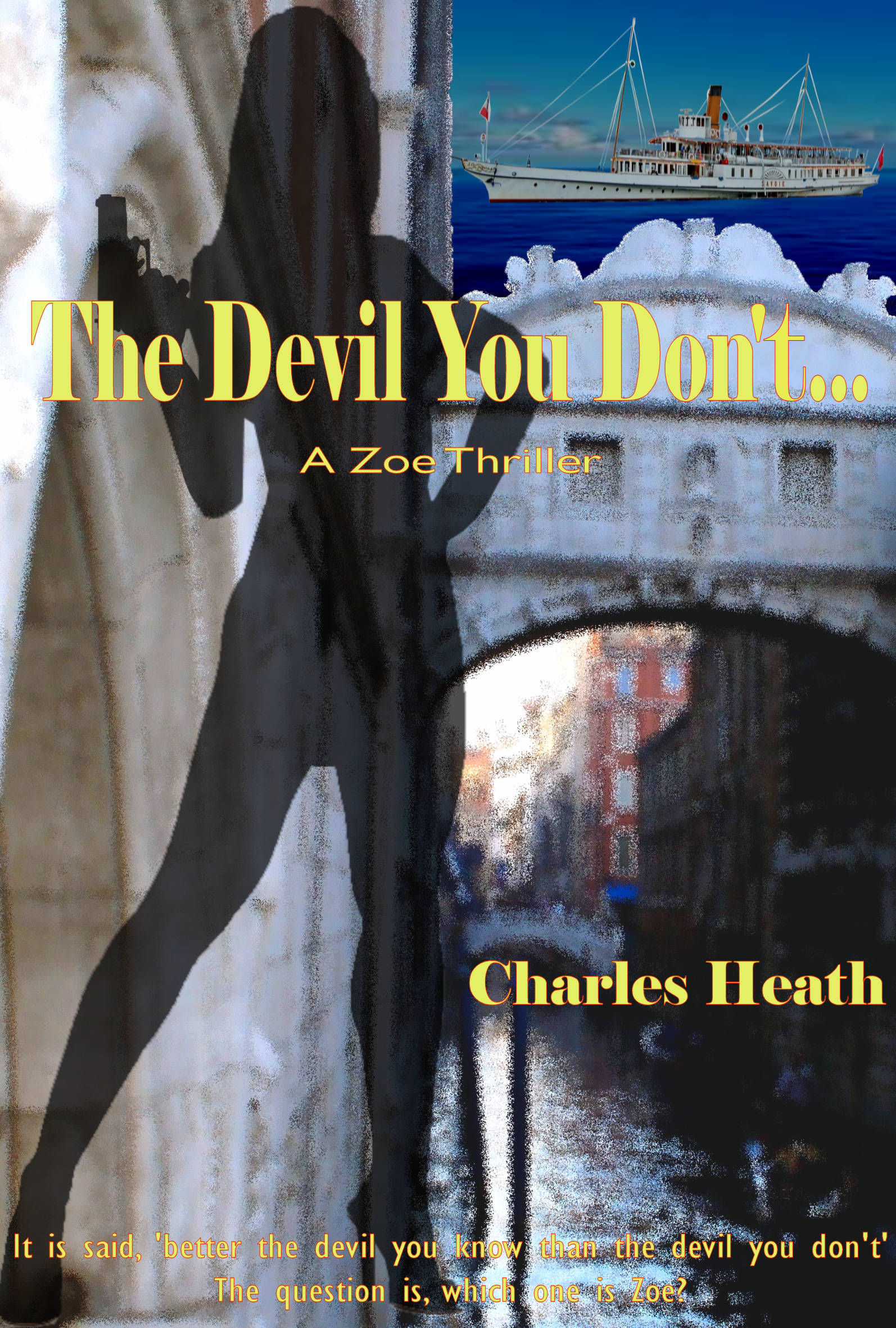
‘The Devil You Don’t’ – A beta reader’s view

It could be said that of all the women one could meet, whether contrived or by sheer luck, what are the odds it would turn out to be the woman who was being paid a very large sum to kill you?

John Pennington is a man who may be lucky in business, but not so lucky in love. He has just broken up with Phillipa Sternhaven, the woman he thought was the one, but relatives and circumstances, and perhaps because she was a ‘princess’, may also have contributed to the end result.

So, what do you do when you are heartbroken?

That is a story that slowly unfolds, from the first meeting with his nemesis on Lake Geneva, all the way to a hotel room in Sorrento, where he learns the shattering truth.

What should have been solace after disappointment turns out to be something else entirely, and from that point, everything goes to hell in a handbasket.

He suddenly realises his so-called friend Sebastian has not exactly told him the truth about a small job he asked him to do, the woman he is falling in love with is not quite who she says she is, and he is caught in the middle of a war between two men who consider people becoming collateral damage as part of their business.

The story paints the characters, cleverly displaying all their flaws and weaknesses. The locations add to the story at times, taking me back down memory lane, especially to Venice, where, in those back streets, I confess it’s not all that hard to get lost.

All in all, a thoroughly entertaining story with, for once, a satisfying end.

Available on Amazon here: https://amzn.to/2Xyh1ow

“The Things we do for Love”, the story behind the story

This story has been ongoing since I was seventeen, and just to let you know, I’m 72 this year.

Yes, it’s taken a long time to get it done.

Why, you might ask.

Well, I never gave it much interest because I started writing it after a small incident when I was 17, and working as a book packer for a book distributor in Melbourne

At the end of my first year, at Christmas, the employer had a Christmas party, and that year, it was at a venue in St Kilda.

I wasn’t going to go because at that age, I was an ordinary boy who was very introverted and basically scared of his own shadow and terrified by girls.

Back then, I would cross the street to avoid them

Also, other members of the staff in the shipping department were rough and ready types who were not backwards in telling me what happened, and being naive, perhaps they knew I’d be either shocked or intrigued.

I was both adamant I wasn’t coming and then got roped in on a dare.

Damn!

So, back then, in the early 70s, people looked the other way when it came to drinking, and of course, Dutch courage always takes away the concerns, especially when normally you wouldn’t do half the stuff you wouldn’t in a million years

I made it to the end, not as drunk and stupid as I thought I might be, and St Kilda being a salacious place if you knew where to look, my new friends decided to give me a surprise.

It didn’t take long to realise these men were ‘men about town’ as they kept saying, and we went on an odyssey.  Yes, those backstreet brothels where one could, I was told, have anything they could imagine.

Let me tell you, large quantities of alcohol and imagination were a very bad mix.

So, the odyssey in ‘The things we do’ was based on that, and then the encounter with Diana. Well, let’s just say I learned a great deal about girls that night.

Firstly, not all girls are nasty and spiteful, which seemed to be the case whenever I met one. There was a way to approach, greet, talk to, and behave.

It was also true that I could have had anything I wanted, but I decided what was in my imagination could stay there.  She was amused that all I wanted was to talk, but it was my money, and I could spend it how I liked.

And like any 17-year-old naive fool, I fell in love with her and had all these foolish notions.  Months later, I went back, but she had moved on, to where no one was saying or knew.

Needless to say, I was heartbroken and had to get over that first loss, which, like any 17-year-old, was like the end of the world.

But it was the best hour I’d ever spent in my life and would remain so until I met the woman I have been married to for the last 48 years.

As Henry, he was in part based on a rebel, the son of rich parents who despised them and their wealth, and he used to regale anyone who would listen about how they had messed up his life

If only I’d come from such a background!

And yes, I was only a run away from climbing up the stairs to get on board a ship, acting as a purser.

I worked for a shipping company and they gave their junior staff members an opportunity to spend a year at sea working as a purser on a cargo ship that sailed between Melbourne, Sydney and Hobart in Australia.

One of the other junior staff members’ turn came, and I would visit him on board when he would tell me stories about life on board, the officers, the crew, and other events. These stories, which sounded incredible to someone so impressionable, were a delight to hear.

Alas, by that time, I had tired of office work and moved on to be a tradesman at the place where my father worked.

It proved to be the right move, as that is where I met my wife.  Diana had been right; love would find me when I least expected it.

lovecoverfinal1