The cinema of my dreams – I always wanted to go on a treasure hunt – Episode 35

Here’s the thing…

Every time I close my eyes, I see something different.

I’d like to think the cinema of my dreams is playing a double feature but it’s a bit like a comedy cartoon night on Fox.

But these dreams are nothing to laugh about.

Once again there’s a new installment of an old feature, and we’re back on the treasure hunt.

It was an understatement to say I was dreading going to Boggs’ place.

In fact, in the hour it took to get through the morning chores I had time to consider how and why I was in this position.  Boggs was a friend.  We were friends at school and as best we could we had each other’s back when the bullies came out to play.

At times that didn’t amount to much because as everyone knows, bullies hunt in packs.  Six against two wasn’t much of an equation.  And it those days, the teachers spent more time hiding from the students than being in front of them.

It was simply a case of what doesn’t kill you makes you stronger.

It didn’t feel like that, not for a very long time.

But, in the end, misfortune can make strange bedfellows, and in a town that depended on a single industry, it soon became apparent that there were more people against the Benderby’s and the Cossatino’s than for, and in small-town politics, that was more than an evening up.  Out of school and separated from their acolytes, both Alex and Vince found that whatever influence they had once, was now gone, and all that was left was a grunt, and we were basically left alone.

Boggs was the dreamer.

He had idolized his father and when he went missing it broke him.

This map thing was the first signs of Boggs finally coming back to life, but the problem was, it was all pinned on false hopes.  The Sherriff was right.  Boggs was in over his head, playing with the two most vicious families from around here, and it was bad enough that his father had fallen foul of them, the Sherriff was not about to see his son go the same way.  I was going to try and talk Boggs out of it.

Yet, on the other hand, it was people like us who needed a win, just to show there was still hope in this place.  With threats every day that the factory might have to close, there were dark clouds hanging over everyone’s head.

If the factory closed, there was going to be a very large hole in the local economy and a lot of people in financial trouble.  I’m not sure how finding the treasure might solve all of that, but I suspect Boggs’ had something up his sleeve.

I knocked on the door and his mother answered.  She looked harried.  She was a nurse and looked as though she just got home from the night shift at the hospital.  

“Boggs is in his room.”

“How are you this morning?”

“Tired.  And an afternoon shift, which I might not get to if I don’t get some sleep.  You know where he is.  Try not to make any noise.”

“Will do.”

I came in and closed the door, watching her dash off down the passage to the other end of the house.

She could not work endless double shifts for much longer, but like all of us, it was not out of desire but necessity.  She had implored Boggs to get a job and help, but he seemed oblivious to the problem.  I’d tried to speak to him, but he had that insufferable way of just not listening.

Boggs was in his room, sitting on the bed and staring at the ceiling.

I looed up too, but there was nothing there.

“Don’t tell me,” I said, “but you’ve suddenly discovered you’ve got X-Ray vision.”

“If only.  I could use it right now to find something that’s missing>”

“Your cell phone?”  Boggs was always misplacing something, of forgetting it.  I’d lost count how many times he’d misplaced his phone.

“No.  An underground river.”

OK.  That was out of left field.  I had no idea any rivers were missing, or, in fact, they could actually go missing.

Apparently, they could.

“There’s two,” he said.  300 years ago five or take this part of the coastline had several rivers that ran down from the mountain range.  What we now call the hills on the edge of the coastal plain.  There was also a lake, not very large, but it used to have several streams flow into it all year round and had an aqua flow that came out along the coastline.”

“And you figured all of this out from what?  A copy of the treasure map.”

The moment he started quoting rivers, streams, and lakes, I remembered each of those geographical features appeared on several of the map versions.  I had suggested, rather comically, that it would be funny if the treasure was buried in the lake.

It wasn’t all that funny.  It was also possible.

“Imagine this.  Drop anchor out to sea, in other words on the other side of the natural sandbar that formed at the seaward side of the river, get in the longboats and row inshore to the lake, across the lake, up another river to the base of the hills.  Then do a little exploring, north or south, and find a cave.  I reckon the treasure was buried in a cave.  We know there are caves up there, not many, but I think there used to be more.”

“Someone already did a survey with some rather fancy electronic equipment with the same idea in mind.  He found three, not very long, and certainly without treasure.  Two had substantial falls inside, which is why they were buried.”

“There’s more.”

He jumped up off the bed and went over to the robe and opened the door.  Tacked on the back was a copy of an ordnance survey map of this part of the coastline, and a tracing of the treasure map, to the same scale on top.

“As you can see, I think ‘I’ve found the correlation between the real, and what was real 300 years ago.”

Except there’s no rivers and no lake.  And no sand bar as I recall.  There was a small marina in what might have been where the river met the sea, but that’s gone.  They filled it in and build a shopping mall on it.  A huge, now half empty, shopping mall.  A modern wonder 40 years ago that was supposed to bring business and shoppers to the town.  For a few years it did, until another town 50 miles away got the same idea, sold the land for half the price, and made the rents a quarter of what they were here.

They called it progress.

We called it piracy.

“Then we can hardly row our boat inshore and up the stream, if it’s not there.”

I hated to state the obvious.

“But,” he said, looking like the cat who’d swallowed the canary.  “What if it is still there, but we just can’t see it?”

© Charles Heath 2020

“Echoes From The Past”, the past doesn’t necessarily stay there


What happens when your past finally catches up with you?

…

Christmas is just around the corner, a time to be with family. For Will Mason, an orphan since he was fourteen, it is a time for reflection on what his life could have been, and what it could be.

Until a chance encounter brings back to life the reasons for his twenty years of self-imposed exile from a life only normal people could have. From that moment Will’s life slowly starts to unravel and it’s obvious to him it’s time to move on.

This time, however, there is more at stake.

Will has broken his number one rule, don’t get involved.

With his nemesis, Eddie Jamieson, suddenly within reach, and a blossoming relationship with an office colleague, Maria, about to change everything, Will has to make a choice. Quietly leave, or finally, make a stand.

But as Will soon discovers, when other people are involved there is going to be terrible consequences no matter what choice he makes.

https://amzn.to/2CYKxu4

newechocover5rs

The A to Z Challenge – 2023 — B is for “Beguiling”

…

Time and I never quite achieved that level of understanding required for me to be where I was supposed to be at the appointed time.

It was why my mother always told me my appointments were an hour earlier than the right time, and while she was alive that worked well.

At Uni I simply tagged along with the others and was rarely late for lectures tutorials and exams.

But once that ended and I was cast out into the big unhelpful world it became a problem again.  Time became my enemy.

It was that thought, along with a dozen other unrelated but equally worrisome thoughts that were uppermost in my mind.

I had an important meeting at 10am that morning, one that might just decide the course of the rest of my life.

I was lying awake staring alternately at the ceiling and that alarm clock, on one hand fearing I would go to sleep and miss waking up and on the other how unrelentingly slow time took to pass.

Only three minutes had passed since the last time I looked, and it felt like at least an hour.

Annabel had said she would stay with me and make sure I was ready, then take me, just to make sure I got there, but it seemed overkill, and surely, she had better things to do.

It wasn’t until about two hours ago that I finally realised what she really meant, and I’d been kicking myself for being so blind.

Several others had told me she liked me, but I thought she was being nice to a somewhat eccentric friend.  Now I realised it was more than that, and I would have to make amends somehow.

I just didn’t understand the nuances of romance or women for that matter.

As daylight seeped in he the cracks in the curtains I knew it was time to get up, and I’d never felt so tired before.

I looked at the clock and saw that it was after six, so nearly four hours to stew over the questions they were going to ask and the answers I’d give them.

That mock session in my head lasted precisely ten minutes when there was a knock on the door.

No one came to visit me at this hour.  No one came to visit me, period.  I crossed to the door and looked through the viewer.

Annabel.

Then panic of a different sort set in.  She’d never called by my place never expressed a desire to go there and now she was here.

I had never invited anyone home, it was always a borderline mess, but in an organised way, because I never thought that day would come, or that it be a girl who would want to.

The place was more disorganised than usual, I wasn’t dressed, and it had been impressed on me a long time ago that it would never do to be seen other than immaculately dressed, and I couldn’t leave her standing outside the door.

Whatever hope I may have had in fostering a relationship of any sort was about to go out the window.  I took a deep breath and opened the door.

“Annabel.”

“Richard.”

And then I stood there like a statue, the extent of my social small talk exhausted.

She waited about thirty seconds and then asked, “May I come in?”

“It’s a bit messy, well, a lot messy.  I wasn’t expecting visitors.”

She smiled.  “You should see my room.”

I shrugged, stood to one side, and let her pass.  I closed the door and leaned against it.

She did a 360-degree turn in the middle of the living room, ending up looking at me.

“This is what I would call a representation of you, Richard.”

I was not sure how to take that.  There were piles of papers and textbooks on the dining table and chairs.  Unlike some places I’d been, discarded clothes did not stay where they landed or languished on the backs of chairs.  The kitchen bench was crowded with appliances and food boxes.  The floors were clean, whereas stacks of books were not.

At least you could sit in the chairs.

“A place for everything, and everything in its place.  You have a lot of books.”

She’d notice the four sets of shelves filled to overflowing.

“I don’t get out much.”

“Perhaps you should.”

A hint.  Was she hinting she was available?  I had not realised then that I was still in my pyjamas, and could feel the pinkish tinge of embarrassment.

“Sorry.  Just got out of bed.  Didn’t sleep much.  Didn’t want to sleep through the alarm.”

“I thought I’d drop in.  Just to make sure you were OK.”

“I’m sorry about yesterday.  I wasn’t thinking.  I appreciated the gesture, and perhaps didn’t quite…”

“You get dressed, Richard.  I’ll make some tea and ferret out something to eat.  Then we can talk.”

About what, I wondered as I went up the passage.

I wanted to believe that it might be about her and I, but I was realistic enough to know that there were expectations of her from her parents that didn’t include people like me.

And I was fine with that.  Just to be her friend was enough.

I spent more time that I should, showering and dressing, and thinking of all the topics she might have up for discussion, and I finally came to the conclusion that this was probably the last time.

She had been mentioning the fact her parents were moving to the other side of the country, and she was to go with them.  Her studies were done, and she was now ready to take up a management role in her father’s company.

I knew she was having reservations, starting at the middle, over the top of others who had to fight their way up the ladder, and the resentment it would bring.    All I had said was it was a golden opportunity.  It hadn’t been received very well and I had wondered later if I should have not agreed with her father.

That’s the trouble with words, once they’re out there, there’s no taking them back.

When I came back, she had cleared the table and sat, a cup of tea in front of her, and one on the other side, waiting for me.

She had a pensive look on her face.  Or was it troubled?

I sat.  It felt like a seat at the inquisition.

“I’m not going.”  She used a tone that dared me to disagree.

“Going where?”

“San Francisco.  Why would I want to go there?  It’s the other side of the country, away from everyone I know, everyone I care about.”

Should I agree with her, or play devil’s advocate?  I sipped the tea instead.

Perhaps if looked closer before I might have seen the hastily repaired eye makeup, a sign that she had been crying, or maybe shed a few tears?  Had she been arguing with her father? I’d met him once and he was a force of nature, not a man I would cross.

And I just remembered last night she had been summoned to dinner with her parents and brother, an equally forceful type that I didn’t like.  He’s once warned me that his sister would never be allowed to have a boyfriend like me, and I’d assured him that had never been nor ever would be my intention.

I was just surprised he could think that.

“So dinner didn’t go well.”

“Not after I threw my pudding at Leonard.”  The seriousness left her face for a moment to allow a whimsical smile at the memory of it, then back to thunder.

“Well, that is an interesting way to decline an invitation, one I might add, most people your age would kill for.”

“I’m not a manager.”

That was another bone of contention.  She completed her MBA, as well as a few other degrees, as a means of staying here.  That was no longer a reason.

“Not what your qualifications paint you as.”

“Whose side are you on?”

“Whose side do you want me to be on?”

A ferocious glare told me I was treading on very, very thin ice.

“Alright.  I’m on your side.  Stay.”

“Where?  If I stay, no allowance, no apartment, no car, nothing.  I was virtually told that I would have to be either a checkout clerk or a waitress in a sleazy bar.”

“Why a sleazy bar?”

“Leonard obviously frequents them, enough to suggest it.”

A thought came into my head, and I cast it aside instantly.  “Would you?”

“No.  A diner maybe, I can and have been a waitress, and it’s not all bad.”

“With an MBA at your disposal?”

She made a face.

“What do you really want to do.  I mean, you have spent your life being someone else, someone who deserves more than just being a waitress.”

“There’s more.”

“How can there be more?”

“My choice of boyfriend.”

“I thought what’s his name, yes, William, was just the sort of boy who would be eminently suitable.  You took him home one weekend, and what was it you said, they loved him, more than they loved you.”

“That was the problem, he was too perfect.  I didn’t love him; I couldn’t love him.”

“Why?”

“Because… I care about someone else.  Of course, he’s too blind to see what’s right in front of him.”

A new boyfriend.  She’s been playing that one close to her chest.

“Then perhaps I should go and see him and drop some very unsubtle hints.”

Of course, it took a few more seconds for the cogs to turn, and the pieces fall into place.  It was not another boy.

“I have no real prospects, Annabel.  If it’s me you are alluding to?”

“Yet I know how you feel about me, how I feel when I’m with you, even if you are frustrating me into the middle of next week.  You’re going to get that job, Richard, and then you will have prospects, certainly enough for me.  You do love me?”

“More than you can imagine, I just never thought…”

“No.  It’s what I love about you, you never assume, and you never take me for granted.”

“Where are you going to stay?”

“Here, of course, though it could do with a woman’s touch.” She smiled.

“Are you going to survive without the Davison billions?”

“I have an MBA, you said so yourself.  I’m sure I’ll come up with something.  Besides, when I told my father anything he could do I could do better, my mother muttered under her breath, ‘good for you Annabel.’.  At least she had faith in me.”

Well, that seemed settled. 

“When are you moving out of the penthouse?”

“Now.  We have just enough time for me to move in before your appointment.”

…

©  Charles Heath 2023

“Sunday in New York”, a romantic adventure that’s not a walk in the park!

“Sunday in New York” is ultimately a story about trust, and what happens when a marriage is stretched to its limits.

When Harry Steele attends a lunch with his manager, Barclay, to discuss a promotion that any junior executive would accept in a heartbeat, it is the fact his wife, Alison, who previously professed her reservations about Barclay, also agreed to attend, that casts a small element of doubt in his mind.

From that moment, his life, in the company, in deciding what to do, his marriage, his very life, spirals out of control.

There is no one big factor that can prove Harry’s worst fears, that his marriage is over, just a number of small, interconnecting events, when piled on top of each other, points to a cataclysmic end to everything he had believed in.

Trust is lost firstly in his best friend and mentor, Andy, who only hints of impending disaster, Sasha, a woman whom he saved, and who appears to have motives of her own, and then in his wife, Alison, as he discovered piece by piece damning evidence she is about to leave him for another man.

Can we trust what we see with our eyes or trust what we hear?

Haven’t we all jumped to conclusions at least once in our lives?

Can Alison, a woman whose self-belief and confidence is about to be put to the ultimate test, find a way of proving their relationship is as strong as it has ever been?

As they say in the classics, read on!

Purchase:

http://tinyurl.com/Amazon-SundayInNewYork

The cinema of my dreams – Was it just another surveillance job – Episode 38

I’m back home and this story has been sitting on a back burner for a few months, waiting for some more to be written.

The trouble is, there are also other stories to write, and I’m not very good at prioritizing.

But, here we are, a few minutes opened up and it didn’t take long to get back into the groove.

Chasing leads, maybe

…

I’d expected more questions from her, but the ride in the train to Wimbledon, and then to the car, she had very little to say.  There was no doubt she was intrigued by the offer, but there was some trepidation too.

But it didn’t auger well for her longevity if she trusted people this easily.  I had expected a lot more questions if only to find out what the job was.  

Then, by the time we reached my car, it seemed she had time enough to think about everything.

“How do I know you’re not going to kill me too?”

She was standing on the other side of the car, yet to open the door.  I was about to get in.

I looked at her across the roof.

“I could have done that ages Ago if that was my intention.”

“Not in a public space unless absolutely necessary.”

She was quoting the manual.

“So, I’m about to take you to a quiet spot in the country and shoot you?”

“Unlikely.  You don’t have a gun with you.”

“A knife then?”

“I’m sure you don’t have one of those either.  Besides, there’s a few other ways that don’t require weapons.”

I was astonished this was the conversation.

“I asked for your help, and that wasn’t to practice my killing skills.  But, where we’re going that might happen to either of us.”

“Where are we going?”

“To a residence in Peaslake.  Do you know of it?  It’s about an hour away, southwest, I think.  I’m not expecting to find anyone, but I am looking for a USB drive.”

“This O’Connell character’s?”

“Yes.”

A few seconds passed as she took that in, then, “If you are not expecting anyone to be there, why do you need me?”

“Rule whatever number it was, expect the unexpected.  And get back up if it’s available.  And there are other people looking for these documents, and the USB.  Not friendly people I might add.  I have no idea if they have the same information I have, so I’m expecting the unexpected.  We have worked together and you know me.”

We had performed several assignments together for training purposes, as each of us had with the other four.  She hadn’t been the best, but she hadn’t been the worst.

I saw her shrug.  Acceptance?

She opened the door and got in.

It took me 15 minutes to get to the A3 and head towards Guildford.

A few minutes later she asked, “What the hell did we sign up for?”

“What do you mean?  I thought it was pretty straight forward.  Something other than a dull as ditchwater 9 to 5 job behind a desk.”

“I mean, don’t you think it’s odd we do all of this stuff for 6 months, almost to the day, then get an assignment, and it all goes wrong.”

“That our instructors were frauds?”

“We didn’t know that, and apparently they didn’t either.  Do you know if any of it was real?”

“Seemed to me it was.  And we only have this Monica’s word that Severin and Maury are frauds.  I mean, I was surprised to learn they allegedly didn’t exist, but you and I both know that in organizations like the security services have wheels within wheels, departments unknown to other departments, event MI5 or the police, so who’s to say what really happened.”

“And you say you now work for this character Dobbin, whose another department head.  As is this Monica.”

Put like that, it seemed very confusing.

“There are others that I’ve run into, working for both Dobbin and for Severin.”

“You mean Severin is still out there?”

“Yes.  He tracked me down.”

And when I said it out loud, it crossed my mind why he hadn’t come after her, but the answer to that was he might have thought I was the only one that O’Connell hadn’t killed.

“And he thinks you are still working for him?”

“It’s complicated.  I’m kind of doing a soft shoe shuffle around all of them and trying to find out what the hell is going on while keeping them at arm’s length.  That might go horribly wrong which is also a good reason why I need help.  We really should find out what we got into.”

“I’d prefer not to.  He hasn’t come after me.”

“He will.  It’s only a matter of time.  You’re in the system, and I have no doubt he has access to that system.  You’ve just been lucky so far.  And you equally know as I do, there’s no such thing as luck in our line of work.”

Another minute or so passed.

Then she said, “If you’re trying to scare the hell out of me, it’s working.”

…

© Charles Heath 2020

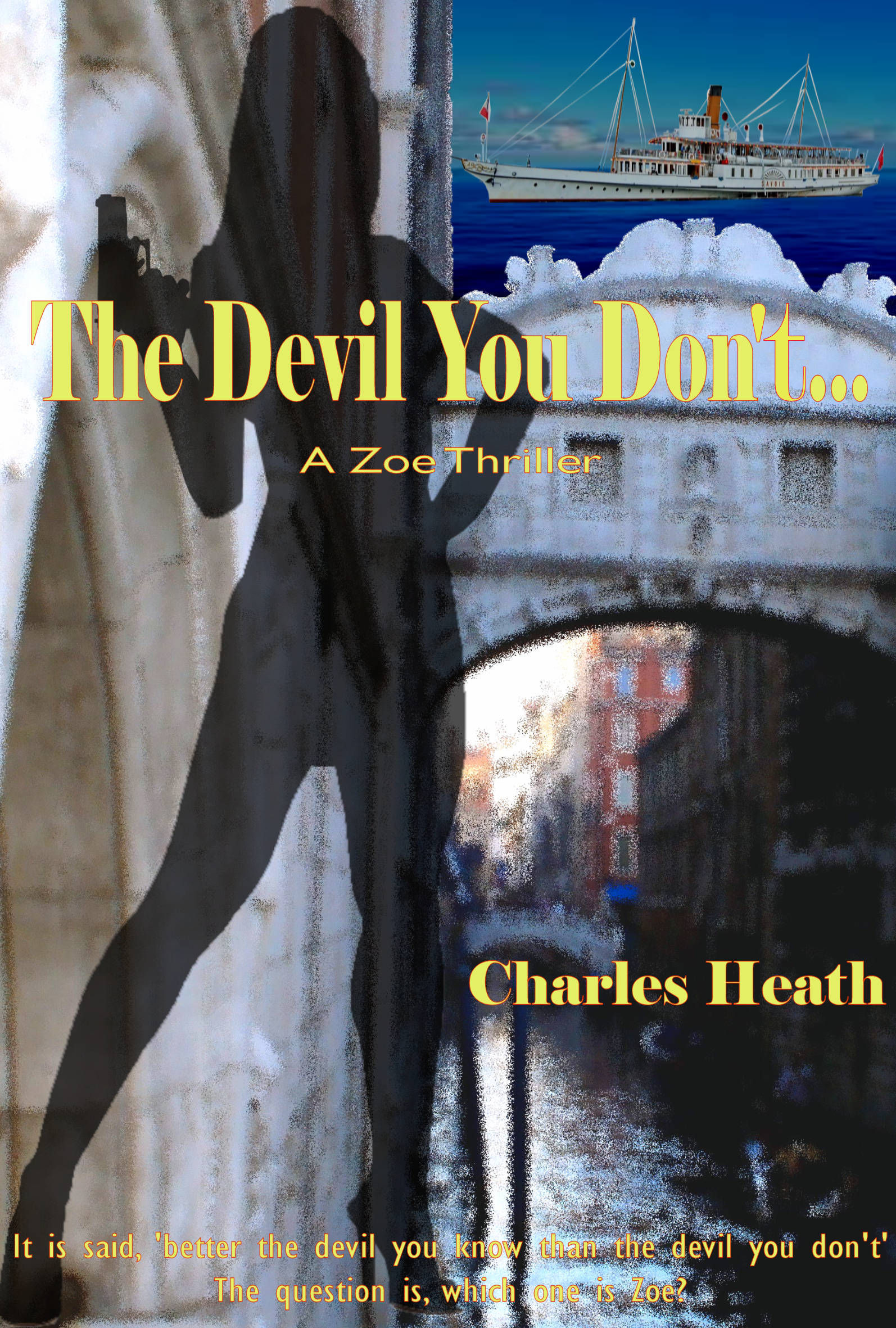
“The Devil You Don’t” – A beta readers view

It could be said that of all the women one could meet, whether contrived or by sheer luck, what are the odds it would turn out to be the woman who was being paid a very large sum to kill you.

John Pennington is a man who may be lucky in business, but not so lucky in love. He has just broken up with Phillipa Sternhaven, the woman he thought was the one, but relatives and circumstances, and perhaps because she was a ‘princess’, may also have contributed to the end result.

So, what do you do when you are heartbroken?

That is a story that slowly unfolds, from the first meeting with his nemesis on Lake Geneva, all the way to a hotel room in Sorrento, where he learns the shattering truth.

What should have been a high turns out to be something else entirely, and from that point every thing goes to hell in a handbasket.

He suddenly realises his so-called friend Sebastian has not exactly told him the truth about a small job he asked him to do, the woman he is falling in love with is not quite who she says she is, and he is caught in the middle of a war between two men who consider people becoming collateral damage as part of their business.

The story paints the characters cleverly displaying all their flaws and weaknesses. The locations add to the story at times taking me back down memory lane, especially to Venice where in those back streets I confess it’s not all that hard to get lost.

All in all a thoroughly entertaining story with, for once, a satisfying end.

…

Available on Amazon here: https://amzn.to/2Xyh1ow

…

An excerpt from “What Sets Us Apart”, a mystery with a twist

See the excerpt from the story below, just a taste of what’s in store…

http://amzn.to/2Eryfth

whatsetscover

McCallister was old school, a man who would most likely fit in perfectly campaigning on the battlefields of Europe during the Second World War. He’d been like a fish out of water in the army, post-Falklands, and while he retired a hero, he still felt he’d more to give.

He’d applied and was accepted as head of a SWAT team, and, watching him now as he and his men disembarked from the truck in almost military precision, a look passed between Annette, the police liaison officer, and I that said she’d seen it all before. I know I had.

There was a one in four chance his team would be selected for this operation, and she had been hoping it would be one of the other three. While waiting for them to arrive she filled me in on the various teams. His was the least co-operative, and the more likely to make ad-hoc decisions rather than adhere to the plan, or any orders that may come from the officer in charge.

This, she said quite bluntly, was going to end badly.

I still had no idea why Prendergast instructed me to attend the scene of what looked to be a normal domestic operation, but as the nominated expert in the field in these types of situations, it was fairly clear he wasn’t taking any chances. It was always a matter of opinion between us, and generally I lost.

In this case, it was an anonymous report identifying what the authorities believed were explosives in one of the dockside sheds where explosives were not supposed to be.

The only reason why the report was given any credence was the man, while not identifying himself by name, said he’d been an explosive expert once and recognized the boxes. That could mean anything, but the Chief Constable was a cautious man.

With his men settled and preparing their weapons, McCallister came over to the command post, not much more than the SUV my liaison and I arrived in, with weapons, bulletproof vests, and rolls of tape to cordon off the area afterward. We both had coffee, steaming in the cold early morning air. Dawn was slowly approaching and although rain had been forecast it had yet to arrive.

A man by the name of Benson was in charge. He too had groaned when he saw McCallister.

“A fine morning for it.” McCallister was the only enthusiastic one here.

He didn’t say what ‘it’ was, but I thought it might eventually be mayhem.

“Let’s hope the rain stays away. It’s going to be difficult enough without it,” Benson said, rubbing his hands together. We had been waiting for the SWAT team to arrive, and another team to take up their position under the wharf, and who was in the final stages of securing their position.

While we were waiting we drew up the plan. I’d go in first to check on what we were dealing with, and what type of explosives. The SWAT team, in the meantime, were to ensure all the exits to the shed were covered. When I gave the signal, they were to enter and secure the building. We were not expecting anyone inside or out, and no movement had been detected in the last hour since our arrival and deployment.

“What’s the current situation?”

“I’ve got eyes on the building, and a team coming in from the waterside, underneath. Its slow progress, but they’re nearly there. Once they’re in place, we’re sending McKenzie in.”

He looked in my direction.

“With due respect sir, shouldn’t it be one of us?” McCallister glared at me with the contempt that only a decorated military officer could.

“No. I have orders from above, much higher than I care to argue with, so, McCallister, no gung-ho heroics for the moment. Just be ready to move on my command, and make sure you have three teams at the exit points, ready to secure the building.”

McCallister opened his mouth, no doubt to question those orders, but instead closed it again. “Yes sir,” he muttered and turned away heading back to his men.

“You’re not going to have much time before he storms the battlements,” Benson quietly said to me, a hint of exasperation in his tone. “I’m dreading the paperwork.”

It was exactly what my liaison officer said when she saw McCallister arriving.

The water team sent their ‘in position’ signal, and we were ready to go.

In the hour or so we’d been on site nothing had stirred, no arrivals, no departures, and no sign anyone was inside, but that didn’t mean we were alone. Nor did it mean I was going to walk in and see immediately what was going on. If it was a cache of explosives then it was possible the building was booby-trapped in any number of ways, there could be sentries or guards, and they had eyes on us, or it might be a false alarm.

I was hoping for the latter.

I put on the bulletproof vest, thinking it was a poor substitute for full battle armor against an exploding bomb, but we were still treating this as a ‘suspected’ case. I noticed my liaison officer was pulling on her bulletproof vest too.

“You don’t have to go. This is my party, not yours,” I said.

“The Chief Constable told me to stick to you like glue, sir.”

I looked at Benson. “Talk some sense into her please, this is not a kindergarten outing.”

He shrugged. Seeing McCallister had taken all the fight out of him. “Orders are orders. If that’s what the Chief Constable requested …”

Madness. I glared at her, and she gave me a wan smile. “Stay behind me then, and don’t do anything stupid.”

“Believe me, I won’t be.” She pulled out and checked her weapon, chambering the first round. It made a reassuring sound.

Suited up, weapons readied, a last sip of the coffee in a stomach that was already churning from nerves and tension, I looked at the target, one hundred yards distant and thought it was going to be the longest hundred yards I’d ever traversed. At least for this week.

A swirling mist rolled in and caused a slight change in plans.

Because the front of the buildings was constantly illuminated by large overhead arc lamps, my intention had been to approach the building from the rear where there was less light and more cover. Despite the lack of movement, if there were explosives in that building, there’d be ‘enemy’ surveillance somewhere, and, after making that assumption, I believed it was going to be easier and less noticeable to use the darkness as a cover.

It was a result of the consultation, and studying the plans of the warehouse, plans that showed three entrances, the main front hangar type doors, a side entrance for truck entry and exit and a small door in the rear, at the end of an internal passage leading to several offices. I also assumed it was the exit used when smokers needed a break. Our entry would be by the rear door or failing that, the side entrance where a door was built into the larger sliding doors. In both cases, the locks would not present a problem.

The change in the weather made the approach shorter, and given the density of the mist now turning into a fog, we were able to approach by the front, hugging the walls, and moving quickly while there was cover. I could feel the dampness of the mist and shivered more than once.

It was nerves more than the cold.

I could also feel rather than see the presence of Annette behind me, and once felt her breath on my neck when we stopped for a quick reconnaissance.

It was the same for McCallister’s men. I could feel them following us, quickly and quietly, and expected, if I turned around, to see him breathing down my neck too.

It added to the tension.

My plan was still to enter by the back door.

We slipped up the alley between the two sheds to the rear corner and stopped. I heard a noise coming from the rear of the building, and the light tap on the shoulder told me Annette had heard it too. I put my hand up to signal her to wait, and as a swirl of mist rolled in, I slipped around the corner heading towards where I’d last seen the glow of a cigarette.

The mist cleared, and we saw each other at the same time. He was a bearded man in battle fatigues, not the average dockside security guard.

He was quick, but my slight element of surprise was his undoing, and he was down and unconscious in less than a few seconds with barely a sound beyond the body hitting the ground. Zip ties secured his hands and legs, and tape his mouth. Annette joined me a minute after securing him.

A glance at the body then me, “I can see why they, whoever they are, sent you.”

She’d asked who I worked for, and I didn’t answer. It was best she didn’t know.

“Stay behind me,” I said, more urgency in my tone. If there was one, there’d be another.

Luck was with us so far. A man outside smoking meant no booby traps on the back door, and quite possibly there’d be none inside. But it indicated there were more men inside, and if so, it appeared they were very well trained. If that were the case, they would be formidable opponents.

The fear factor increased exponentially.

I slowly opened the door and looked in. A pale light shone from within the warehouse itself, one that was not bright enough to be detected from outside. None of the offices had lights on, so it was possible they were vacant. I realized then they had blacked out the windows. Why hadn’t someone checked this?

Once inside, the door closed behind us, progress was slow and careful. She remained directly behind me, gun ready to shoot anything that moved. I had a momentary thought for McCallister and his men, securing the perimeter.

At the end of the corridor, the extent of the warehouse stretched before us. The pale lighting made it seem like a vast empty cavern, except for a long trestle table along one side, and, behind it, stacks of wooden crates, some opened. It looked like a production line.

To get to the table from where we were was a ten-yard walk in the open. There was no cover. If we stuck to the walls, there was equally no cover and a longer walk.

We needed a distraction.

As if on cue, the two main entrances disintegrated into flying shrapnel accompanied by a deafening explosion that momentarily disoriented both Annette and I. Through the smoke and dust kicked up I saw three men appear from behind the wooden crates, each with what looked like machine guns, spraying bullets in the direction of the incoming SWAT members.

They never had a chance, cut down before they made ten steps into the building.

By the time I’d recovered, my head heavy, eyes watering and ears still ringing, I took several steps towards them, managing to take down two of the gunmen but not the third.

I heard a voice, Annette’s I think, yell out, “Oh, God, he’s got a trigger,” just before another explosion, though all I remember in that split second was a bright flash, the intense heat, something very heavy smashing into my chest knocking the wind out of me, and then the sensation of flying, just before I hit the wall.

I spent four weeks in an induced coma, three months being stitched back together and another six learning to do all those basic actions everyone took for granted. It was twelve months almost to the day when I was released from the hospital, physically, except for a few alterations required after being hit by shrapnel, looking the same as I always had.

But mentally? The document I’d signed on release said it all, ‘not fit for active duty; discharged’.

It was in the name of David Cheney. For all intents and purposes, Alistair McKenzie was killed in that warehouse, and for the first time ever, an agent left the Department, the first to retire alive.

I was not sure I liked the idea of making history.

© Charles Heath 2016-2020

The A to Z Challenge – 2023 – C is for “Confused”

…

Here’s the thing.

I spent years listening to my brother, the perfect child in my parents’ eyes, tell me just how good life was.

For him.

He landed on his feet.  One of those students who had no learning difficulties graduated top of his class, was in the right place at the right time to get a dream job, and, yes, you guessed it, the dream wife.

His favourite line every time we met, usually at a very exclusive restaurant, or after celebrating the purchase of a new car or apartment, was “You could have all of this too…”

And, wait for it, “if only…”

His mantra relied on one factor, we both had the same genes and in his mind, we had the same possibilities in life.  To him it was simple.  And after years of the same, over and over, I began to wonder why it wasn’t so.

The simple fact was that we were as different as the proverbial chalk and cheese.

It was one of those quirks that appeared in families.  The progeny although produced by the same father and mother quite often were totally different, even when they looked so similar.

George and I were not alike in appearance although my mother always said I had my father’s hair and nose, whereas George was the spitting image of him.

My two younger sisters Elsa and Adelaide, though two years apart were almost identical twins and looked like our mother.

Our mother, long-suffering at the hands of her husband had died five years ago, and my father, in what was the longest deathbed scene ever, had finally died, the previous evening with all his children in attendance.

I was surprised my father wanted me there, and equally so when he usually spoke to me as though I was dirt under his feet. That he treated me better this time I put down to the fact in dying he had become deranged.  The others, George, Elsa, and Adelaide simply ignored me.

His death was the end.  I had no reason to stay, less reason to talk to my siblings, and muttering that my duty was done, left.

I never wanted to see any of them again.

…

Of course, we never really get what we wish for.

She had never deigned to come and see me before, and our meetings could be counted on the fingers if one hand, her wedding, my 21st birthday, fleeting as it was, and the death of our father, three times in fifteen years. Nor had I met the two mysterious children they had and wondered briefly what George had told them about me.

I could guess.

Two days later. I was getting ready to go back to my obscure job, the one George said was beneath a man of my talents, without qualifying what those talents were, when the doorbell rang.

Unlike my brother’s apartment building with a concierge and security staff, visitors simply made their way to the front door.  I was on the third floor, and the lift was out of service, so it was someone who wanted to see me.

I looked through the door viewer, I didn’t have the CCTV option, and saw it was Wendy, George’s perfect wife.

I could tell she didn’t want to be knocking on my door, much less come into the salubrious apartment, in a building that should have been condemned a long time ago.

I could just ignore her, but she looked increasingly agitated.  People sometimes lurked in the corridors, people who looked like jail escapees.

She just pushed the doorbell again when I opened the door.  She didn’t wait for me to ask her in, stopping dead in the middle of the one other room I had other than a bedroom.

I could see it written all over her face, this, to her, was how the other half lived.  I closed the door but didn’t move.

“How can you live here?”  The tone matched the shock on her face.

“When you ignore the faded and peeling wallpaper, the mould on the roof, and the aroma of damp carpets, it isn’t so bad.  There are far more of us living like this than you can imagine, almost affordable.  My neighbour has the same apartment but has three kids and a wife.”

She shook her head.

“Why are you here Wendy?  I can’t believe George would send you down here to do his dirty work.”

“George didn’t send me.  He doesn’t know I’m here.”

“Then how did you know where to find me?”

“Don’t ask.  The funeral is in three days’ time.  You should be there?”

“Why?  Everyone hates me.  Even your kids hate me, and I haven’t even been formally introduced.”

“Just come, Roger.  You don’t deserve to live like this, no one should.”

“It’s the real world, Wendy.  Not everyone can afford weekends at Disneyland, and apartments overlooking Central Park.”

She crossed the room back to the door and I opened it for her.  “I’ll think about it.”

“Do think too hard.  After all is said and done, he was your father.”

Sadly, that was true.

…

I was having dinner in the diner not far from my apartment block, when Alison, a waitress I’d known for a year or so, and like me, could not catch a break, came over to offer a second cup of coffee.

I was a favourite, not everyone got seconds.

“I heard your father died,”: she said. 

It was the end of the shift and just before closing. The last of the customers had been shooed out.

“My life hasn’t changed with him in it, or not.”

“He was your father.”

I shrugged.  “You free tomorrow?”

“Why, you finally asking me out on a date?”

“If going to a funeral is a date, yes.  The service will be boring, the people way above our station in life, and my brother and sisters will be insufferable, but there’ll be good food and top-shelf booze at the wake.  Date or not, want to come with me?”

“Why not?  I’ve never had real champagne.”

She lived in the same apartment block, and I’d walked her home a few times.  “Pick you up at 10?”

She nodded.  “I’ll even behave if you want me to.”

…

Alison looked stunning in her simple black dress.  She was wearing more black than I was, and looked like she was going to a funeral.  She had turned the drab waitress into something I didn’t realize lurked beneath the surface.

She did a pirouette.  “You like?”

I smiled, which was something given the way I felt about everything to do with my family.  “I do, very much.”

We took the train to Yonkers, upstate, where the family home was, and where my father had gone to die, as he put it.  I’d lived there, in the mausoleum until I was old enough to escape.  The catholic church would no doubt be gearing up for the service.  It was due to start at 11:30, and we made it with a few minutes to spare.

I planned it that way, I did not want to sit with the rest of the family up front.

“You should be sitting with the others,” Alison said, not understanding why I wouldn’t.

“You haven’t met them yet.  When you do, you’ll know.  Besides, I find it better to sit in the last row.  You can escape quickly.”

She shook her head, and we sat.  Not in the last row, she was adamant she would not.  It was about halfway up, on the same side as the family were situated.  From there, I could watch George and Wendy, and my two sisters looking very sombre, receive the guests.

There were quite a few, I counted nearly a hundred.  My father may have been awful to me, but a lot of people respected and liked him.

Soon after we sat two young girls came and sat in the seats in front of us.

Then they turned around and looked at me, then Alison, then back at me.

“Daddy said you wouldn’t come,” the elder of the two said.

“Are you his daughters?  If you are, you could ask him why I’ve never seen you.”

“He thinks your eccentricity would rub off on us.”

Alison couldn’t contain herself at that remark.  “Your father actually said that to you?”

“Not directly.  They’ve been talking about him since my mother went and asked you to come.  He doesn’t really think much of you, does he?”

An astute child.

“I left home and became a motor mechanic.  We are supposed to be bankers, lawyers or doctors.  If you got a car you want to be fixed, then I’m your man.  You want advice on money, don’t come to see me.”

“Are you coming to sit with us?”

“I don’t think your mother and father could handle the shame.  No, we’ll stay here and leave them in peace.”

I watched Wendy glance in the direction of her girls, they came almost running to rescue them from the monster.

The elder girl looked at her mother when she arrived, breathless.  “He’s quite normal you know.”

I had to laugh.  Wendy looked aghast.  She glared at the girl, then her sister.  “Come, the pair of you.  Enough of this nonsense.”  She grabbed their hands and almost dragged them away.

I could see George up the front of the church, glancing down in our direction.  The fact he didn’t come said a lot.  It was clear neither of them wanted me sitting with them, and that was fine by me.

“They’re lovely girls, Roger.”

“The first time I’ve seen them, but they don’t seem to belong to my brother.  They don’t have his arrogance or her disdain.”

“I’m sure, now they’ve met you, it won’t be the last time.  It seems odd that Wendy, that was Wendy, wasn’t it?” 

I nodded.

“Then it seems odd that she would ask you to come and then treat you like that.”

“No, not at all.  I’ve only met her three or four times, and that’s her.  I won’t tell you what she thought of my apartment.”

The service took an hour and various people got up to say nice things about a man who was not very nice, but that was the nature of funerals.  He was dead now, so there was no need to live in the past.

I didn’t intend to.

I had intended to leave and go back home after the service, but now I’d decided to go to the wake at the old house.  It would be nice to show Alison where I grew up and give her some context as to why I hated my family so.  I was willing to bet my room would be the same as it was the day I left.

And it would be good to see Alex and Beatrice, the manservant and housekeeper again.  There were more parents to me than my mother and father.  There were sitting up the front of the church and hadn’t yet seen me.

What I hadn’t noticed during the service, was that a woman had come in and quietly made her way to our pew and sat down.  She had given me a curious look, one that said I know you, but can’t place who you are.

But that wasn’t the only odd thing about her.  I had the feeling she was related in some way, that sort of feeling you had when you met someone who was family but you didn’t really know them.  It was hard to explain.  Perhaps she was one of my mother’s friends, there were a few in the church,  and they, like me, had a strained relationship with my father.

He had not treated her very well, in the latter stages of her life before she died.

Just before the service ended Alison leaned over and said quietly, “The woman next to you.  You and she are related in some way.  She has the same profile, perhaps an aunt.”

As far as I knew my mother was an only child, she certainly never spoke of having a sister, in fact, she rarely spoke about her family at all.  Now I thought about it, it was all very strange.

The service over we could all finally stand and stretch.  The woman slowly stood, then turned to me.

“You are Roger, aren’t you?”

“I am.”

“Shouldn’t you be up the front with the rest of the family?”

“No.  I’m the black sheep.  I didn’t like my father all that much, and he certainly hated me, so it’s a miracle I came.  Perhaps you should introduce yourself to my brother, George.”

“I’m not here to see him, Roger, I’m here to see you.”

“Were you a friend of my mother’s?  I know there are a few here, keeping their distance like I am.”  This woman was trouble, I could sense it.

“Yes, and no.  I knew your mother briefly.  I knew your father better, I used to work for him a long time ago.

“Like I said, you’re probably better off talking to George.  I rarely saw him when I was a child, and when I did, he ignored me, and as soon as I could I left, and only saw him on a few occasions since.”

“Do you know why he was like that?  Did he treat George the same way?”

“No.  George was always the favourite son who could do no wrong, the heir apparent.”

“Then I’m sorry to hear that.  That was not how it was supposed to be.”

“How would you know that?”

“Because Roger, I am your real mother.”

…

© Charles Heath  2023

A photograph from the inspirational bin – 15

It’s the obvious items in the photograph that you see first, or that your eyes go to first.

The ocean, the beach, the buildings. You can see a shopping mall with MacDonald’s sign above it.

Yes, it’s late afternoon, and you can see long shadows of the buildings.

So, if I asked you what did you see in this photo, what would your reply be?

From a thriller writer or murder mystery writer’s point of view, it’s what you don’t necessarily see.

So, for the purposes of the story, the opening line for the world-weary detective, handing the photo to his partner, “What’s is it you can’t see in this photo?”

A partner that hadn’t been on the job very long, in from the suburbs, and had seen little more than break and enters car theft, and school kids hi-jinks.

“What am I supposed to be looking for?”

“You want to be a detective, or be looking for old ladies cats?”

His partner takes the photo in hand and looks at it again.  There has to be a reason why the old man had given it to him, or perhaps there wasn’t and he was just playing with him again.

No, he thought, there has to be something…

And then he saw it, quite by accident.  A hand, a gun, and following the line of fire, at the end, what looked like someone in the bushes.

In a photo taken from a higher floor of the building over the road, looking down on what was supposed to be a rooftop recreational area.

Only there had been no report of a missing person or a gunshot wound in the last seven days.

“When was it taken?”

“Two days ago?”

“And no reports of a shooting, or a body?”

“No.  And yet the person who took this swears he saw a body, but by the time he came back, there was nothing.”

The detective handed his partner a second photo.  Time-stamped five minutes later.  With no gun and no body.

What will happen next?

The cinema of my dreams – I always wanted to go on a treasure hunt – Episode 36

Here’s the thing…

Every time I close my eyes, I see something different.

I’d like to think the cinema of my dreams is playing a double feature but it’s a bit like a comedy cartoon night on Fox.

But these dreams are nothing to laugh about.

Once again there’s a new installment of an old feature, and we’re back on the treasure hunt.


“How long have you been working on this?”

“A week. Lying in bed is boring, so I decided to look at everything I’ve got again, and then again. There were some old maps of the coastline stored with the treasure maps, so I think my father was trying to find the actual location his treasure maps were based on and came up against the same problem. Physical landmarks on the treasure maps are no longer there, and if you didn’t know any better, I would think you were looking in the wrong place.”

“So, in actual fact, what you’re saying now is that your father had no idea where the treasure was buried, that he was just producing maps for the Cossatino’s’ to sell.”

That, of course, could be looked at from a different angle, one that I wasn’t going to suggest right then because Boggs was not ready to hear it. I think the real maps Boggs had found with eh treasure maps were the basis for the treasure maps, that is, his father had to give them real-life elements to keep the punters interested.

“No, not necessarily. I think he knew it was somewhere along this coastline give or take a hundred miles, because of its proximity to the Spanish Maine, but essentially you’re right. He probably had no idea.”

So, he hadn’t come to the same conclusion I had. Yet.

And if I could come to that conclusion, surely Cossatino also would, after all, he was the one who got Boggs senior to make the maps. Why all of a sudden did he think that there was a real treasure map. It couldn’t be simply because Boggs had said there was one. He’d have to know that anything Boggs junior found was an invention commissioned by him,

Or hadn’t Vince told his father what he was doing? Surely the father would have told the son about the treasure map scam.

As for Benderby, senior could base his assumption of the fact that he’d found some old coins off the coast nearby that could be part of the trove. Alex then may have decided to usurp his father’s search with one of his own, conveniently forgetting the treasure maps were an invention of the Cossatino’s. IT was a tangled web of lies deceit and one-upmanship, one that was going to leave a trail of human wreckage in its wake.

Boggs and I were two of the first three. We had lived to tell about it, Frobisher was the first casualty.

But what I suppose was more despairing was how taken Boggs was with the notion that the treasure was real, hidden out there somewhere, and that his father had ‘the’ map. I was loath to label him delusional, but his pathological desire to prove his father’s so-called legacy was going to not end well, especially when we found nothing.

And, yet, I had to admire the lengths he had gone to, to prove his case. Even now, looking at the overlaid maps, there was no guarantee we’d find anything, but at first look, the evidence was compelling.

Except I had a feeling Boggs had something up his sleeve. I had to ask the question. “Where did you get the idea of matching the treasure map to the real map?”

“My father’s journal. It was tossed in the bottom of a box of his other stuff. There are about ten boxes stacked in the shed, stuff my mother just couldn’t be bothered sorting through after he disappeared. Again, boredom pushed me into going through everything over and over just in case I missed something.”

He reached in under the mattress of his bed and pulled out an old leather-bound notebook. It had a strap that bound it together, and by the look of it had extra papers inserted or glued to pages, as well as papers at the start and back of the volume, making it look about twice the original size.

He handed it to me. The leather was old, cracked, and had that distinctive aroma of the hide. I loosened the strap and the top cover opened. The first page was a newspaper cutting, a small piece about some old coins being found about a hundred yards offshore by some surfers. Were these the same coins that Benderby had claimed were part to the trove?

“Benderby was getting that antiquarian that was murdered to identify some coins,” I said after a quick glance through the article.

“I spoke to one of the surfers the other day,” Boggs said. “He told me he came off his board on a big wave and as he was going down saw something glinting on the seabed. He managed to pull up three coins. There were more but he had to come up for air. When he went down again, he realized he’d been dragged away by the current.”

Tides and currents along this part of the coast were particularly bad, and the undertow, at times could get surfers and swimmers alike into a lot of trouble. I’d been caught out once in a dinghy myself, finishing up ten miles further down the coast that I expected to be.

“Then, I take it he can’t remember the exact spot so he could go back.”

“He tried, but alas no. Said he sold the coins to old man Benderby for a hundred apiece and told him approximately where he thought the others were, but nothing’s been found since.”

Not that Benderby would tell anyone if he did. But it explained where the coins came from that he gave to Frobisher.

“Except we can assume that it’s off our coastline somewhere, right?”

“Five miles of coastline to be precise. He and his mate always had a few reefers before they went out, made the ride more interesting he said. He could have been off the coast of Peru for all he knew.”

Surfers, drugs and a colorful story.

“It explains why Benderby and a team of divers have been out in his new boat,” Boggs added, “probably trying to either find the location or line up landmarks on his map from the seaward side at the same time. But he doesn’t know what we know.”

What did we know? I leafed through a few more pages of the diary, but the scrawled notes were almost illegible. I picked up various words, like a marina, underground river, dry lakebed, but none of it made any sense.

“Which map did we give to Alex?”

Boggs went over to a drawer in the wardrobe and leafed through the papers in it and pulled out one and gave it to me. Like the rest it showed the shore, the hills, the lake, and two what looked to be rivers flowing into the sea. Each of the maps had those same features but in different places.

I didn’t want to say it, but it seemed to me we were playing a very dangerous game. The maps might look different in some respects, but the chances were, if Alex was smart enough to hire an expert, that we might run across him out there, and, to be honest, he would be the last person I’d want to see.

“You do realize our paths are going to cross at some point.”

“Maybe, maybe not.”

A shiver went down my spine, an omen I thought. Boggs has something up his sleeve, and I really didn’t want to know.

Not right then.


© Charles Heath 2020