An excerpt from “Mistaken Identity” – a work in progress

The odds of any one of us having a doppelganger are quite high. Whether or not you got to meet him or her, or be confronted by them was significantly lower. Except of course, unless you are a celebrity.

It was a phenomenon remarkable only for the fact, at times, certain high-profile people, notorious or not, had doubles if only to put off enemies or the general public. Sometimes we see people in the street, people who look like someone we knew, and made the mistake of approaching them like a long lost friend, only to discover an embarrassed individual desperately trying to get away for what they perceive is a stalker or worse.

And then sometimes it is a picture that looms up on a TV screen, an almost exact likeness of you. At first, you are fascinated, and then according to the circumstances, and narrative that is attached to that picture, either flattered or horrified.

For me one turned to the other when I saw an almost likeness of me flash up on the screen when I turned the TV on in my room. What looked to be my photo, with only minor differences, was in the corner of the screen, the newsreader speaking in rapid Italian, so fast I could only translate every second or third word.

But the one word I did recognize was murder. The photo of the man up on the screen was the subject of an extensive manhunt. The crime, the murder of a woman in the very same hotel I was staying, and it was being played out live several floors above me. The gist of the story, the woman had been seen with, and staying with the man who was my double, and, less than an hour ago, the body had been discovered by a chambermaid.

The killer, the announcer said, was believed to be still in the hotel because the woman had died shortly before she had been discovered.

I watched, at first fascinated at what I was seeing. I guess I should have been horrified, but at that moment it didn’t register that I might be mistaken for that man.

Not until another five minutes had passed, and I was watching the police in full riot gear, with a camera crew following behind, coming up a passage towards a room. Live action of the arrest of the suspected killer the breathless commentator said.

Then, suddenly, there was a pounding on the door. On the TV screen, plain to see, was the number of my room.
I looked through the peephole and saw an army of police officers. It didn’t take much to realize what had happened. The hotel staff identified me as the man in the photograph on the TV and called the police.

Horrified wasn’t what I was feeling right then.

It was fear.

My last memory was the door crashing open, the wood splintering, and men rushing into the room, screaming at me, waving guns, and when I put my hands up to defend myself, I heard a gunshot.

And in one very confused and probably near-death experience, I thought I saw my mother and thought what was she doing in Rome?

…

I was the archetypal nobody.

I lived in a small flat, I drove a nondescript car, had an average job in a low profile travel agency, was single, and currently not involved in a relationship, no children, and according to my workmates, no life.

They were wrong. I was one of those people who preferred their own company, I had a cat, and travelled whenever I could. And I did have a ‘thing’ for Rosalie, one of the reasons why I stayed at the travel agency. I didn’t expect anything to come of it, but one could always hope.

I was both pleased and excited to be going to the conference. It was my first, and the glimpse I had seen of it had whetted my appetite for more information about the nuances of my profession.

Some would say that a travel agent wasn’t much of a job, but to me, it was every bit as demanding as being an accountant or a lawyer. You were providing a customer with a service, and arguably more people needed a travel agent than a lawyer. At least that was what I told myself, as I watched more and more people start using the internet, and our relevance slowly dissipating.

This conference was about countering that trend.

The trip over had been uneventful. I was met at the airport and taken to the hotel where the conference was being held with a number of other delegates who had arrived on the same plane. I had mingled with a number of other delegates at the pre conference get together, including one whose name was Maryanne.

She was an unusual young woman, not the sort that I usually met, because she was the one who was usually surrounded by all the boys, the life of the party. In normal circumstances, I would not have introduced myself to her, but she had approached me. Why did I think that may have been significant? All of this ran through my mind, culminating in the last event on the highlight reel, the door bursting open, men rushing into my room, and then one of the policemen opened fire.

I replayed that last scene again, trying to see the face of my assailant, but it was just a sea of men in battle dress, bullet proof vests and helmets, accompanied by screaming and yelling, some of which I identified as “Get on the floor”.

Then came the shot.

Why ask me to get on the floor if all they were going to do was shoot me. I was putting my hands up at the time, in surrender, not reaching for a weapon.

Then I saw the face again, hovering in the background like a ghost. My mother. Only the hair was different, and her clothes, and then the image was going, perhaps a figment of my imagination brought on by pain killing drugs. I tried to imagine the scene again, but this time it played out, without the image of my mother.

I opened my eyes took stock of my surroundings. What I felt in that exact moment couldn’t be described. I should most likely be dead, the result of a gunshot wound. I guess I should be thankful the shooter hadn’t aimed at anything vital, but that was the only item on the plus side.

I was in a hospital room with a policeman by the door. He was reading a newspaper, and sitting uncomfortably on a small chair. He gave me a quick glance when he heard me move slightly, but didn’t acknowledge me with either a nod, or a greeting, just went back to the paper.

If I still had a police guard, then I was still considered a suspect. What was interesting was that I was not handcuffed to the bed. Perhaps that only happened in TV shows. Or maybe they knew I couldn’t run because my injuries were too serious. Or the guard would shoot me long before my feet hit the floor. I knew the police well enough now to know they would shoot first and ask questions later.

On the physical side, I had a large bandage over the top left corner of my chest, extending over my shoulder. A little poking and prodding determined the bullet had hit somewhere between the top of my rib cage and my shoulder. Nothing vital there, but my arm might be somewhat useless for a while, depending on what the bullet hit on the way in, or through.

It didn’t feel like there were any broken or damaged bones.

That was the good news.

On the other side of the ledger, my mental state, there was only one word that could describe it. Terrified. I was looking at a murder charge and jail time, a lot of it. Murder usually had a long time in jail attached to it.

Whatever had happened, I didn’t do it. I know I didn’t do it, but I had to try and explain this to people who had already made up their minds. I searched my mind for evidence. It was there, but in the confused state brought on by the medication, all I could think about was jail, and the sort of company I was going to have.

I think death would have been preferable.

…

Half an hour later, maybe longer, I was drifting in an out of consciousness, a nurse, or what I thought was a nurse, came into the room. The guard stood, checked her ID card, and then stood by the door.

She came over and stood beside the bed. “How are you?” she asked, first in Italian, and when I pretended I didn’t understand, she asked the same question in accented English.

“Alive, I guess,” I said. “No one has come and told what my condition is yet. You are my first visitor. Can you tell me?”

“Of course. You are very lucky to be alive. You will be fine and make a full recovery. The doctors here are excellent at their work.”

“What happens now?”

“I check you, and then you have a another visitor. He is from the British Embassy I think. But he will have to wait until I have finished my examination.”

I realized then she was a doctor, not a nurse.

…

My second visitor was a man, dressed in a suit the sort of which I associated with the British Civil Service.  He was not very old which told me he was probably a recent graduate on his first posting, the junior officer who drew the short straw.

The guard checked his ID but again did not leave the room, sitting back down and going back to his newspaper.

My visitor introduced himself as Alex Jordan from the British Embassy in Rome and that he had been asked by the Ambassador to sort out what he labelled a tricky mess.

For starters, it was good to see that someone cared about what happened to me.  But, equally, I knew the mantra, get into trouble overseas, and there is not much we can do to help you.  So, after that lengthy introduction, I had to wonder why he was here.

I said, “They think I am an international criminal by the name of Jacob Westerbury, whose picture looks just like me, and apparently for them it is an open and shut case.”  I could still hear the fragments of the yelling as the police burst through the door, at the same time telling me to get on the floor with my hands over my head.

“It’s not.  They know they’ve got the wrong man, which is why I’m here.  There is the issue of what had been described as excessive force, and the fact you were shot had made it an all-round embarrassment for them.”

“Then why are you here?  Shouldn’t they be here apologizing?”

“That is why you have another visitor.  I only took precedence because I insisted I speak with you first.  I have come, basically to ask you for a favour.  This situation has afforded us with an opportunity.  We would like you to sign the official document which basically indemnifies them against any legal proceedings.”

Curious.  What sort of opportunity was he talking about?  Was this a matter than could get difficult and I could be charged by the Italian Government, even if I wasn’t guilty, or was it one of those hush hush type deals, you do this for us, we’ll help you out with that.  “What sort of opportunity?”

“We want to get our hands on Jacob Westerbury as much as they do.  They’ve made a mistake, and we’d like to use that to get custody of him if or when he is arrested in this country.  I’m sure you would also like this man brought into custody as soon as possible so you will stop being confused with him.  I can only imagine what it was like to be arrested in the manner you were.  And I would not blame you if you wanted to get some compensation for what they’ve done.  But.  There are bigger issues in play here, and you would be doing this for your country.”

I wondered what would happen if I didn’t agree to his proposal.  I had to ask, “What if I don’t?”

His expression didn’t change.  “I’m sure you are a sensible man Mr Pargeter, who is more than willing to help his country whenever he can.  They have agreed to take care of all your hospital expenses, and refund the cost of the Conference, and travel.  I’m sure I could also get them to pay for a few days at Capri, or Sorrento if you like, before you go home.  What do you say?”

There was only one thing I could say.  Wasn’t it treason if you went against your country’s wishes?

“I’m not an unreasonable man, Alex.  Go do your deal, and I’ll sign the papers.”

“Good man.”

…

After Alex left, the doctor came back to announce the arrival of a woman, by the way she had announced herself, the publicity officer from the Italian police. When she came into the room, she was not dressed in a uniform.

The doctor left after giving a brief report to the civilian at the door. I understood the gist of it, “The patient has recovered excellently and the wounds are healing as expected. There is no cause for concern.”

That was a relief.

While the doctor was speaking to the civilian, I speculated on who she might be. She was young, not more than thirty, conservatively dressed so an official of some kind, but not necessarily with the police. Did they have prosecutors? I was unfamiliar with the Italian legal system.

She had long wavy black hair and the sort of sultry looks of an Italian movie star, and her presence made me more curious than fearful though I couldn’t say why.

The woman then spoke to the guard, and he reluctantly got up and left the room, closing the door behind him.
She checked the door, and then came back towards me, standing at the end of the bed. Now alone, she said, “A few questions before we begin.” Her English was only slightly accented. “Your name is Jack Pargeter?”

I nodded. “Yes.”

“You are in Rome to attend the Travel Agents Conference at the Hilton Hotel?”

“Yes.”

“You attended a preconference introduction on the evening of the 25th, after arriving from London at approximately 4:25 pm.”

“About that time, yes. I know it was about five when the bus came to collect me, and several others, to take us to the hotel.”

She smiled. It was then I noticed she was reading from a small notepad.

“It was ten past five to be precise. The driver had been held up in traffic. We have a number of witnesses who saw you on the plane, on the bus, at the hotel, and with the aid of closed circuit TV we have established you are not the criminal Jacob Westerbury.”

She put her note book back in her bag and then said, “My name is Vicenza Andretti and I am with the prosecutor’s office. I am here to formally apologize for the situation that can only be described as a case of mistaken identity. I assure you it is not the habit of our police officers to shoot people unless they have a very strong reason for doing so. I understand that in the confusion of the arrest one of our officers accidentally discharged his weapon. We are undergoing a very thorough investigation into the circumstances of this event.”

I was not sure why, but between the time I had spoken to the embassy official and now, something about letting them off so easily was bugging me. I could see why they had sent her. It would be difficult to be angry or annoyed with her.

But I was annoyed.

“Do you often send a whole squad of trigger happy riot police to arrest a single man?” It came out harsher than I intended.

“My men believed they were dealing with a dangerous criminal.”

“Do I look like a dangerous criminal?” And then I realized if it was mistaken identity, the answer would be yes.

She saw the look on my face, and said quietly, “I think you know the answer to that question, Mr. Pargeter.”

“Well, it was overkill.”

“As I said, we are very sorry for the circumstances you now find yourself in. You must understand that we honestly believed we were dealing with an armed and dangerous murderer, and we were acting within our mandate. My department will cover your medical expenses, and any other amounts for the inconvenience this has caused you. I believe you were attending a conference at your hotel. I am very sorry but given the medical circumstances you have, you will have to remain here for a few more days.”

“I guess, then, I should thank you for not killing me.”

Her expression told me that was not the best thing I could have said in the circumstances.

“I mean, I should thank you for the hospital and the care. But a question or two of my own. May I?”

She nodded.

“Did you catch this Jacob Westerbury character?”

“No. In the confusion created by your arrest he escaped. Once we realized we had made a mistake and reviewed the close circuit TV, we tracked him leaving by a rear exit.”

“Are you sure it was one of your men who shot me?”

I watched as her expression changed, to one of surprise.

“You don’t think it was one of my men?”

“Oddly enough no. But don’t ask me why.”

“It is very interesting that you should say that, because in our initial investigation, it appeared none of our officer’s weapons had been discharged. A forensic investigation into the bullet tells us it was one that is used in our weapons, but…”

I could see their dilemma.

“Have you any enemies that would want to shoot you Mr Pargeter?”

That was absurd because I had no enemies, at least none that I knew of, much less anyone who would want me dead.

“Not that I’m aware of.”

“Then it is strange, and will perhaps remain a mystery. I will let you know if anything more is revealed in our investigation.”

She took an envelope out of her briefcase and opened it, pulling out several sheets of paper.

I knew what it was. A verbal apology was one thing, but a signed waiver would cover them legally. They had sent a pretty girl to charm me. Perhaps using anyone else it would not have worked. There was potential for a huge litigation payout here, and someone more ruthless would jump at the chance of making a few million out of the Italian Government.

“We need a signature on this document,” she said.

“Absolving you of any wrong doing?”

“I have apologized. We will take whatever measures are required for your comfort after this event. We are accepting responsibility for our actions, and are being reasonable.”

They were. I took the pen from her and signed the documents.

“You couldn’t add dinner with you on that list of benefits?” No harm in asking.

“I am unfortunately unavailable.”

I smiled. “It wasn’t a request for a date, just dinner. You can tell me about Rome, as only a resident can. Please.”

She looked me up and down, searching for the ulterior motive. When she couldn’t find one, she said, “We shall see once the hospital discharges you in a few days.”

“Then I’ll pencil you in?”

She looked at me quizzically. “What is this pencil me in?”

“It’s an English colloquialism. It means maybe. As when you write something in pencil, it is easy to erase it.”

A momentary frown, then recognition and a smile. “I shall remember that. Thank-you for your time and co-operation Mr. Pargeter. Good morning.”

…

© Charles Heath 2015-2021

Searching for locations: The Maglev (Magnetic Levitation) Train, Shanghai, China

So, the first treat for the day is the high-speed magnetic train, something we only learned about after arriving in China and was not on any of the pre-tour documentation.

The train line connects Shanghai Pudong International Airport and Longyang Road Station (in the outskirts of central Pudong).  It is the oldest commercial maglev still in operation, and the first commercial high-speed maglev with cruising speed of 431 km/h (268 mph).  At full speed, the journey takes 7 minutes and 20 seconds to complete the distance of about 30 km.

Construction of the line began on March 1, 2001 and public services commenced on 1 January 2004.  It was built by a joint venture of Siemens and ThyssenKrupp from Kassel, Germany.

But, like visiting anything from a hotel, first we have to drive to the station and because we are leaving at 8, its peak hour traffic, and it takes 1 hour 10 minutes to get there.

The train also has a practical use and that is to take passengers from Shanghai to Pudong international airport as well as for those train enthusiasts, which is what we are.

On the train, it has the same sleek look as the bullet trains, but it is completely different, and you are able to see from the front of the train to the back.

Reputed to travel at 431 kph we take a seat and it is not long before the doors shut, and a loud humming noise is soon replaced by what sounds like an engine, then we start moving.  It sounds just like a normal train, and is a lot noisier than a normal bullet train.

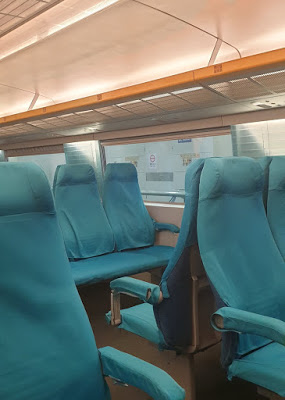
Seating on the train was nothing special, as one might expect

It didn’t take long before it hits the advertised speed of 431 kph.  This is not sustained for very long, because the distance is on 40 odd kilometers, and the whole trip takes about 7 minutes.

We go to the airport, and then we come back.  Is it worth the price, yes.  If you are a train enthusiast.

A Score to Settle – The Editors Draft – Day 1

I have the story, the editor is asking for it, and I’m putting the final touches to it

…

Or so it seems, but nothing is ever in concrete when working on a story. My first thoughts were, what led up to the start of the story, a veritable getting back in the saddle after the metaphorical horse has tossed you off with life-threatening injuries.

That’s basically the first chapter, or it might finish up as a prologue. There are arguments for and against prologues, so perhaps as the month and the story progresses, it might become clearer what is needed.

So, where are we?

Somewhere in Africa, a country that is run by the military with a so-called puppet president. A country that is ripe for revolution, where the people are plotting to take their country back.

With help, but just whose help is nebulous.

In the meantime, there’s a human rights conference about to happen, a rather ironic event in a country supposedly at the forefront of perpetrating such offences.

Why is our fractured main character there? To protect one of the keynote speakers and convenors of the conference, supposedly without her knowledge, but of course, secrets are only secrets if they remain so.

And with governments involved, nothing remains secret for long.

That’s the premise so far.

Today is much about fine-tuning the background of the main character, and what came before.

…

Today’s word count: 2,174 words, the same for the running total.

The story behind the story – Echoes from the Past

The novel ‘Echoes from the past’ started out as a short story I wrote about 30 years ago, titled ‘The birthday’.

My idea was to take a normal person out of their comfort zone and led on a short but very frightening journey to a place where a surprise birthday party had been arranged.

Thus the very large man with a scar and a red tie was created.

So was the friend with the limousine who worked as a pilot.

So were the two women, Wendy and Angelina, who were Flight Attendants that the pilot friend asked to join the conspiracy.

I was going to rework the short story, then about ten pages long, into something a little more.

And like all re-writes, especially those I have anything to do with, it turned into a novel.

There was motivation.  I had told some colleagues at the place where I worked at the time that I liked writing, and they wanted a sample.  I was going to give them the re-worked short story.  Instead, I gave them ‘Echoes from the past’

Originally it was not set anywhere in particular.

But when considering a location, I had, at the time, recently been to New York in December, and visited Brooklyn and Queens, as well as a lot of New York itself.  We were there for New Years, and it was an experience I’ll never forget.

One evening we were out late, and finished up in Brooklyn Heights, near the waterfront, and there was rain and snow, it was cold and wet, and there were apartment buildings shimmering in the street light, and I thought, this is the place where my main character will live.

It had a very spooky atmosphere, the sort where ghosts would not be unexpected.  I felt more than one shiver go up and down my spine in the few minutes I was there.

I had taken notes, as I always do, of everywhere we went so I had a ready supply of locations I could use, changing the names in some cases.

Fifth Avenue near the Rockefeller center is amazing at first light, and late at night with the Seasonal decorations and lights.

The original main character was a shy and man of few friends, hence not expecting the surprise party.  I enhanced that shyness into purposely lonely because of an issue from his past that leaves him always looking over his shoulder and ready to move on at the slightest hint of trouble.  No friends, no relationships, just a very low profile.

Then I thought, what if he breaks the cardinal rule, and begins a relationship?

But it is also as much an exploration of a damaged soul, as it is the search for a normal life, without having any idea what normal was, and how the understanding of one person can sometimes make all the difference in what we may think or feel.

And, of course, I wanted a happy ending.

Except for the bad guys.


Get it here:  https://amzn.to/2CYKxu4

newechocover5rs


The first case of PI Walthenson – “A Case of Working With the Jones Brothers”

This case has everything, red herrings, jealous brothers, femme fatales, and at the heart of it all, greed.

See below for an excerpt from the book…

Coming soon!

PIWalthJones1

An excerpt from the book:

When Harry took the time to consider his position, a rather uncomfortable position at that, he concluded that he was somehow involved in another case that meant very little to him.

Not that it wasn’t important in some way he was yet to determine, it was just that his curiosity had got the better of him, and it had led to this: sitting in a chair, securely bound, waiting for someone one of his captors had called Doug.

It was not the name that worried him so much, it was the evil laugh that had come after the name was spoken.

Doug what? Doug the ‘destroyer’, Doug the ‘dangerous’, Doug the ‘deadly’; there was any number of sinister connotations, and perhaps that was the point of the laugh, to make it more frightening than it was.

But there was no doubt about one thing in his mind right then: he’d made a mistake. A very big. and costly, mistake. Just how big the cost, no doubt he would soon find out.

His mother, and his grandmother, the wisest person he had ever known, had once told him never to eavesdrop.

At the time he couldn’t help himself and instead of minding his own business, listening to a one-sided conversation which ended with a time and a place. The very nature of the person receiving the call was, at the very least, sinister, and, because of the cryptic conversation, there appeared to be, or at least to Harry, criminal activity involved.

For several days he had wrestled with the thought of whether he should go. Stay on the fringe, keep out of sight, observe and report to the police if it was a crime. Instead, he had willingly gone down the rabbit hole.

Now, sitting in an uncomfortable chair, several heat lamps hanging over his head, he was perspiring, and if perspiration could be used as a measure of fear, then Harry’s fear was at the highest level.

Another runnel of sweat rolled into his left eye, and, having his hands tied, literally, it made it impossible to clear it. The burning sensation momentarily took his mind off his predicament. He cursed and then shook his head trying to prevent a re-occurrence. It was to no avail.

Let the stinging sensation be a reminder of what was right and what was wrong.

It was obvious that it was the right place and the right time, but in considering his current perilous situation, it definitely was the wrong place to be, at the worst possible time.

It was meant to be his escape, an escape from the generations of lawyers, what were to Harry, dry, dusty men who had been in business since George Washington said to the first Walthenson to step foot on American soil, ‘Why don’t you become a lawyer?” when asked what he could do for the great man.

Or so it was handed down as lore, though Harry didn’t think Washington meant it literally, the Walthenson’s, then as now, were not shy of taking advice.

Except, of course, when it came to Harry.

He was, Harry’s father was prone to saying, the exception to every rule. Harry guessed his father was referring to the fact his son wanted to be a Private Detective rather than a dry, dusty lawyer. Just the clothes were enough to turn Harry off the profession.

So, with a little of the money Harry inherited from one of his aunts, he leased an office in Gramercy Park and had it renovated to look like the Sam Spade detective agency, you know the one, Spade and Archer, and The Maltese Falcon.

There’s a movie and a book by Dashiell Hammett if you’re interested.

So, there it was, painted on the opaque glass inset of the front door, ‘Harold Walthenson, Private Detective’.

There was enough money to hire an assistant, and it took a week before the right person came along, or, more to the point, didn’t just see his business plan as something sinister. Ellen, a tall cool woman in a long black dress, or so the words of a song in his head told him, fitted in perfectly.

She’d seen the movie, but she said with a grin, Harry was no Humphrey Bogart.

Of course not, he said, he didn’t smoke.

Three months on the job, and it had been a few calls, no ‘real’ cases, nothing but missing animals, and other miscellaneous items. What he really wanted was a missing person. Or perhaps a beguiling, sophisticated woman who was as deadly as she was charming, looking for an errant husband, perhaps one that she had already ‘dispatched’.

Or for a tall, dark and handsome foreigner who spoke in riddles and in heavily accented English, a spy, or perhaps an assassin, in town to take out the mayor. The man was such an imbecile Harry had considered doing it himself.

Now, in a back room of a disused warehouse, that wishful thinking might be just about to come to a very abrupt end, with none of the romanticized trappings of the business befalling him. No beguiling women, no sinister criminals, no stupid policemen.

Just a nasty little man whose only concern was how quickly or how slowly Harry’s end was going to be.

© Charles Heath 2019

“Do you believe in g..g..ghosts…?”, a short story

Inside the old building, it was very quiet and almost cold.

Strange, perhaps, because outside the temperature was bordering on the record hottest day ever, nearly 45 degrees centigrade.

The people who’d built this building nearly a hundred years before must have known how to keep that heat at bay, using sandstone.

Back then, the sandstone would have looked very impressive, but now after many years of being closed off and left abandoned, the outside was stained by modern-day pollutants giving it a black streaky look, and inside layers of dust, easily stirred up as we walked slowly into the main foyer.

It was huge, the roof, ornate, with four huge chandelier lights hanging down, and wood panelling, giving way to a long counter with brass serving cages highlighting its former use; a bank.

In its day it would have conveyed power and wealth so that its customers could trust their money to. Of course, that was before the global economy, online banking, and a raft of new and different institutions all vying for that same money.

Then it was a simple choice of a few, now it was a few thousand.

“How many years had this been closed up?” I asked.

“Close to twenty, maybe twenty-five. It was supposed to be pulled down, but someone got it on the heritage list, and that put an end to it. “

Phil was the history nut. He’s spent a month looking into the building, finding construction plans, and correspondence dating back to before and during the construction.

Building methods, he said, that didn’t exist today and were far in advance of anything of its type for the period. It was the reason we were standing in the foyer now.

We were budding civil engineers, and the university had managed to organize a visit, at our own risk. The owner of the building had made sure we’d signed a health and safety waiver before granting access.

And the caretaker only took us as far as the front door. He gave us his cell number to call when we were finished. When we asked him why he didn’t want to come in with us, he didn’t say but it was clear to me he was afraid of something.

But neither of us believed in ghosts.

“You can see aspects of cathedrals in the design,” Phil said. ” You could quite easily turn this space into a church.”

“Or a very large wine cellar.” I brought a thermometer with me, and inside where we were standing it was the ideal temperature to store wine.

Behind the teller cages were four large iron doors to the vaults. They were huge, and once contained a large amount of cash, gold, and whatever else was deemed valuable.

They were all empty now, the shelves and floor had scattered pieces of bank stationery, and in a corner, several cardboard boxes were covered in even more dust.

Behind the vaults were offices, half-height with glass dividers, the desks and chairs still in place, and some with wooden filing cabinets with drawers half-open.

Others had benches, and one, set in the corner, was very large, and looked like the manager’s office. Unlike the other office which had linoleum tiles, this one had carpet. In a corner was a large mirror-backed cabinet, with several half-empty bottles on it.

“Adds a whole new meaning to aged whiskey, don’t you think.” Phil looked at it but didn’t pick it up.

“I wonder why they left it,” I muttered. The place had the feel of having been left in a hurry, not taking everything with them.

I shivered, but it was not from the cold.

We went back to the foyer and the elevator lobby. They were fine examples of the sort of caged elevators that belonged at that time, and there were very few working examples these days.

The elevators would have a driver, who would pull back an inner and outer door when the car arrived on a floor, and close both again when everyone was aboard.

Both cars were on the ground floor, with the shutter doors closed, and when I tried to open one, I found it had been welded shut. The other car was not sitting level with the floor and the reason for that, the cable that raised and lowered it was broken.

Restoring them would be a huge job and would not be in their original condition due to occupational health and safety issues.

The staircase wound around the elevator cage, going up to the mezzanine floor or down to the basement.

“Up or down?” He asked.

“Where do you want to go first?”

“Down. There’s supposed to be a large vault, probably where the safety deposit boxes are.”

And the restrooms I thought. Not that I was thinking of going.

As we descended the stairs it was like going down into a mine shaft, getting darker, and the rising odour of dampness, and mustiness. I suspect it would have been the same back when it was first built being so close to the shoreline of the bay, not more than half a mile away.

The land this building and a number of others in a similar style, was built on was originally a swamp, and it was thought that the seawater still found its way this far inshore. But the foundations were incredibly strong and extensive which was why there’d been no shifting or cracking anywhere in the ten-story structure.

At the bottom, there was a huge arch, with built-in brass caging with two huge gates, both open. It was like the entrance to a mythical Aladdin’s cave.

There was also an indefinable aura coming from the depths of that room. That, and a movement of cold air. Curiously, the air down there was not musty but had a tinge of saltiness to it.

Was there a natural air freshener effect coming from somewhere within that vault?

“Are we going in?”

I checked my torch beam, still very bright. I pointed it into the blackness and after a minute of checking, I said, “We’re here, so why not.”

We had to walk down a dozen steps and then pass under through the open gates into the room. There was a second set of gates, the same as the first, about thirty feet from the first, and, in between, a number of cubicles where customers collected their boxes.

Beyond the second set of gates was a large circular reinforced safe door high enough for us to walk through.

This cavernous space stretched back quite a distance, and along the walls, rows, and rows of safety deposit boxes, some half hanging out of their housing, and a lot more stacked haphazardly on the floor.

I checked a few but they were all empty.

I shivered again. It felt like there was a presence in the room. I turned to ask Phil, but he wasn’t there. I hadn’t heard him walk away, and there were only two sets of footprints on the floor, his and mine, and both ended where I was standing.

It was as if he had disappeared into thin air.

I called out his name, and it echoed off the walls in the confined space. No answer from him.

I went further into the room, thinking he might have ventured towards the end while my back was turned, but he hadn’t. Nor had he left because there were only footprints coming in, not going out.

I turned to retrace my steps and stopped suddenly. An old man, in clothes that didn’t belong to this era, was standing where Phil had last been.

He was looking at me, but not inclined to talk.

“Hello. I didn’t see you come down.”

Seconds later the figure dissolved in front of me and there was no one but me standing in the room.

“Joe.”

Phil, from behind me. I turned and there he was large as life.

“Where were you?”

“I’ve been here all the time. Who were you just talking to?”

“There was an old man, standing just over there,” I said pointing to somewhere between Phil and the entrance.

“I didn’t see anyone. Are you sure you’re not having me on?”

“No. He’s right behind you.” The old man had reappeared.

Phil shook his head, believing I was trying to fool him.

That changed when the man touched his shoulder, and Phil shrieked.

And almost ran out of the room. It took a few minutes for him to catch his breath and steady his palpitating heart.

“Are you real?” I asked, not quite sure what to say.

“To me, I am. To anyone else, let’s just say you are the first not to faint, or run away.”

“Are you a ghost?” Phil wasn’t exactly sure what he was saying.

“Apparently I am and will be until you find out who killed me “

Ok, so what was it called, stuck in the afterlife or limbo until closure?

“When?”

“25 years ago, just before the bank closed. It’s the reason why it’s empty now.”

“And you’re saying we find the killer and you get to leave?”

“Exactly. Now shoo. Go and find him.”

We looked at each other in surprise, or more like shock, then back to the man. Only he was no longer there.

“What the…” Phil sail. “It’s time to go.”

“What about the man and finding his killer?”

“What man? We saw nothing. We’re done here.”

I shrugged. Phil turned to leave, but only managed to take three steps before the gates at the entrance closed with a loud clang.

When he crossed the room to stand in front, he tried pulling them open.

“Locked,” he said. Flat, and without panic, he added, “I guess it looks like we have a murder to solve.”

…

© Charles Heath 2019-2020

The cinema of my dreams – It all started in Venice – Episode 2

An old acquaintance

…

I had three questions that needed answers.

First, how did Larry find out I was the one behind his brother’s death?

It begged the question of whether there was a leak in Rodby’s organization because he was the only one other than the logistics team that knew anything about that mission.

It could be that he assumed that being part of the team sent to neutralize a problem, that I was the perpetrator or I knew who was.  Either way, I didn’t like my chances of surviving an interrogation.

Or someone had been taking photos of the crime scene, even though I’d taken precautions not to be recognized, slipped up, but that would assume he had photos of everyone on the team.  I made a note to ask about the health of the other team members.

I would have to compile a list of questions to ask Larry when we finally met, what one might call a fly on the wall moment.

The second, how did Larry know of my association with Juliet.  She was a respected doctor in a respectable hospital when I last saw her.

To be known to Larry, she had to have fallen from that pedestal.  Given what the Waterville organization was known for, all of the branches of crime seemed far removed from who and what she was.

Some investigation was needed, and I sent a message to Alfie on the burner phone he left me.  It had a few other tricks up its sleeve like recording conversations and taking photos that were automatically sent back to base, and an app that detected recording equipment like those used by the security services.

If Juliet was wired, I’d know.

And speaking of Juliet, the third question was how she going to orchestrate a casual meeting between us, and could I muster the necessary surprise when we finally crossed paths.

When a message arrived later in the day in response to my query, it had a current photo and an abbreviated resume of her life since the last time I saw her.

The first sentence that caught my eye was that she was no longer a doctor.  Well, not a practicing doctor.  It seemed the stress of working endless hours in the hospital led to an accident when she had been overtired, which led to an addiction to painkillers when led to self-medicating to making a mistake.

That led to seeking other means of fulfilling the addiction, and that was a slippery slope.  Without reading the fine print, it was a simple connection from ex-doctor to addict to a soul depended on a person the likes of Larry.  To him, a doctor of her caliber would be useful in patching up criminals who couldn’t go to hospitals to be patched up after committing a crime and getting injured if not shot in the process

Now, Larry had another use for her.

The current photo of her showed a woman who had aged more than normal, perhaps as a result of drug abuse, thinner than I remembered her, and with straw blonde hair replacing the rich burgundy she used to have.

Her recent resume was more of a horror story than the life she may once have expected for herself, but desperation often led people down paths the least desired, and saying they had choices was not always true.  It would be interesting to learn if she would be willing to tell me about any of it.

There was also a footnote that told me where and when would be arriving, the airport, the following day, and I decided to go and check her out, to make sure I’d recognize her when the time came.  As she was now, I didn’t think, without the photograph Alfie had sent me, I would have recognized her on the street.

…

© Charles Heath 2022

A score to settle – The Editor’s draft – Day 2

I have the story, the editor is asking for it, and I’m putting the final touches to it

…

The story, in the planning stages, has a secondary theme running, that of the players involved in the events leading up to the assault on our main character, one that his handler was not aware of.

Why was he marked for execution, along with his previous partner?

That’s another story, one that will be teased out in this secondary theme and will run full circle and have some bearing on what happens at the end of the story.

Or not.

I’m not sure I will include any of this, and it might just become part of a novella that will stand on its own. For the most part, a lot of this story is about, and driven by, people he’s never met, but know of him, and his work.

It would be too easy to say he saw something he shouldn’t, because that’s not the case. It has to do with people he has worked with and been responsible for in the past, and whether or not there had been a conversation, without understanding the relevance of what might have been discussed at the time.

That part is nebulous at best, and you can see why it might not make the final cut.

It simply depends on how the main story goes, and the word count at the end. The rough plan calls for about 80 chapters and about 70,000 words, but I’m not one for sticking to plans.

Today’s work centres around the partner his handler has chosen for him, one that he’s not going to like when he finds out, the target he’s been tasked to watch over, and the location of the conference.

Of course, getting back to work after what happened to him is not as easy as saying he’s fine, but getting him to admit it’s anything but fine will be like getting proverbial blood from a stone.

…

Today’s word count: 1,990 words, for a running total of 4,164.

The cinema of my dreams – I always wanted to see the planets – Episode 56

Would a Mexican standoff work?

…

I couldn’t help thinking just how far behind the technological ball we were, and that even if we had to ability to travel far into space, we were always going to find people more advanced than us.

I remembered back to the time, before this mission was to get underway, an almost finished spacecraft waiting for a crew, the round table discussions that were held to talk about what we might expect and how we would react.

I said then that we would not be able to treat them like we would other nationalities on our own planet, which seemed to be the consensus for first contact.

Some thought it unlikely we’d run into anyone else.

And where we were right now was largely uncharted territory.  Of course, there was a whole team aboard whose job was specifically to handle alien encounters, and all of them had been huddled in their meeting room since day one of our first encounter with the Foroi, taking extensive notes, analysing every aspect of each encounter, and contributing information I would find useful in my dealings with them.

It was there I headed now.

I had already been admonished by their leader, Emile Jacques, over my handling of certain situations, particularly when I chose what he called the ‘death or glory’ option.

I told her it was like the nuclear option, where each side held an Armory of weapons at the ready, threatening to use them, but never with intention of doing so.  The old ‘Mexican standoff’.

I told her I based my decision on the fact we were simply dealing with more evolved human beings who’d moved beyond the corporeal life we were still stuck with.  But, for all their advances, the notion of creating a nuclear wasteland still held respect.

I doubted anyone no matter how advanced could get past the finality of a nuclear attack on a home planet.

And if they had been on ours and seen the effect of the one time our leaders had decided on pre-emptive and retaliatory attacks would see the wastelands of what London, New York, and Moscow looked like.

How much we hadn’t learned from our mistakes, beggared belief.

The table was full, a dozen experts with a lot of books, papers, and computers, all talking at once, a half dozen conversations, each trying to be heard above the others.

I came, and the noise subsided.

The leader of the team, Emile Jacques, was down the other end of the table.

I looked at each one of them, experts in fields that related to humans, and not one had any idea what an alien might be like.  They were trying to apply the human factor to the aliens and every decision they made had been based on flawed theory.

The aliens were nothing like us.

We knew nothing about them, but they knew everything about us.

When I looked at Emile, he said, “The consensus is that we should let her people take her back to her homeland.”

“What if she doesn’t want to go?”

“Is it worth possibly sacrificing this ship and crew just to make a stand?  We want to make friends with these people, not enemies.”

“Did you consider the possibility that if we let her people take her, the other group might object?  I get the impression that no matter what we do, it is going to end badly.”

Was that a possibility they hadn’t considered?

“What do you think we should do?”  Alexandra was the crew representative, and not formally a member of the team, but a person who should have a seat at the table when matters were discussed that concerned the crew.

It was a position I had insisted on before we left on this odyssey, with far-reaching authority to make decisions that would resolve crew issues in a fair and balanced manner.  That included discipline and punishment when warranted.  I did not want the crew to think that their fate rested in the hands of the ship’s officers.  I had ultimate authority but rarely intervened in any decision she made.

“She had offered to become a mediator so that we can sit down and discuss their intentions.  She has also requested what back on earth we would call asylum, she wants to not be taken by either group.  Did anyone back on earth before this began ever consider the possibility that we might be asked for asylum?”

“No.”  Jacob was the international law expert, well versed in all matters that related to problems back home, and was sent with the possibility of him learning or creating a set of rules for intergalactic relations.  “My superiors didn’t think we’d meet any alien races, but now we have, all I have as a basis is earth’s international law, and it has provisions for asylum, and as such, we should be able to extend it galactically, I can’t believe I actually said that, but we may have problems in getting these people to agree to anything we propose.”

“But there’s no reason why we can’t grant her asylum if she formally requests it.  Something that might help, these people as I understand it, have spent time on our planet, which means that aliens have been walking among us for a very long time.”

“Did she tell you that?  It might just be a ploy to gain your trust.”

“She’s not the only one.  The captain of the first vessel we encountered said the same.  They know of us, and our ways, and they’ve been watching our evolution over a very long period.”

“Why didn’t they just invade us, then.  We’re obviously technologically inferior.”  The technological expert, the person who was charged with getting his hands on alien technology, if we found any, asked.

“It explains the UFO’s then,” said another.

“You know what we would have done the moment their ships arrived.  Shoot first and ask questions later.  It’s probably what they’re expecting from us now.  We have to be better than that.” To the lawyer, I said, “Start drafting some intergalactic rules for asylum.  Everyone else, start formulating questions to ask the Princess about anything and everything.  I’m going to see the Chief Engineer.”

…

© Charles Heath 2021-2023

The cinema of my dreams – I never wanted to go to Africa – Episode 3

Dreaming I was in the desert…

But it was just another episode of the helicopter story, we’re back on the ground after that fateful jump, things are not going quite as planned.

Do they ever in life or death situations?

…
Yards were like miles, and I didn’t have the time to reach the weapon.  I could see the pickup going around the burning wreck as he of the helicopter and approach me.

But, being the optimist I was I had to try.

And fail.

The pickup was on me before I’d made it halfway, stopping about a foot from me.  Any further and it would have run me over.

I got to my knees and put my hands on my head not giving them any immediate reason to kill me.  The man who had fired the rocket got out of the vehicle moments after it stopped.

A man in military garb, not very old.  And not a foreigner.  I was expecting South American, but not ostensibly one of us.  A glance inside the vehicle showed the driver was a woman, in civilian clothes.

A surprise, yes.

“Mr. James I presume.”  English, well spoken.

Another surprise or more than one, that he spoke English and knew who I was.

“We were expecting you but not be quite so dramatic entrance.  Please stand.”

Kneeling had been difficult; I was not quite sure how standing was going to work.  I was still recovered from the impromptu exit from the helicopter.

I tried and fell back on the ground.  I looked up at him.  “Sorry, the legs are still a little rubbery.”

He simply shook his head, leaned over and dragged me to my feet, then slung me over his shoulder, carried me to the rear of the pickup and tossed me in.  I just managed to avoid hitting my head on the floor.

The man climbed in the back and then slapped the back of the cab.

Crunching gears, an over-revving engine, then a jerky start.  It was not going to be a comfortable journey.

…

© Charles Heath 2019-2022