‘The Devil You Don’t’ – A beta reader’s view

It could be said that of all the women one could meet, whether contrived or by sheer luck, what are the odds it would turn out to be the woman who was being paid a very large sum to kill you.

John Pennington is a man who may be lucky in business, but not so lucky in love. He has just broken up with Phillipa Sternhaven, the woman he thought was the one, but relatives and circumstances, and perhaps because she was a ‘princess’, may also have contributed to the end result.

So, what do you do when you are heartbroken?

That is a story that slowly unfolds, from the first meeting with his nemesis on Lake Geneva, all the way to a hotel room in Sorrento, where he learns the shattering truth.

What should have been solace after disappointment, turns out to be something else entirely, and from that point, everything goes to hell in a handbasket.

He suddenly realizes his so-called friend Sebastian has not exactly told him the truth about a small job he asked him to do, the woman he is falling in love with is not quite who she says she is, and he is caught in the middle of a war between two men who consider people becoming collateral damage as part of their business.

The story paints the characters cleverly displaying all their flaws and weaknesses. The locations add to the story at times taking me back down memory lane, especially to Venice where, in those back streets I confess it’s not all that hard to get lost.

All in all a thoroughly entertaining story with, for once, a satisfying end.

Available on Amazon here: https://amzn.to/2Xyh1ow

Writing about writing a book – Day 24, a missing piece of the puzzle

There’s always the necessity for creating backstories so that the reader doesn’t come across a part of the story that doesn’t make sense.

Perhaps one of my failings is that I have to go over what I’ve already written, sometimes to make sure there is continuity and that what I’ve written makes sense.

This collection of memories our main character is having serves the purpose of setting up later plot points, but more importantly, is supposed to give the reader an idea of what the main character has gone through before arriving at the start of the story.

This part will serve to provide a little more information on the relationship between Bill and Barry, though I rather like the nickname I gave him.

“Bastards,” Killer muttered.

We called him ‘Killer’ because it was the nickname the Army had given him.  We were sharing the guard duty and had spoken briefly over the watch, but up till then, the silence had stretched over an hour or so.  It didn’t take long for anyone to realize he was a man of few words.

He’d been in the regular army for years and asked for the posting.  He’d made Sergeant several times, only to lose those same stripes for fighting, usually after R&R and a bout of heavy drinking.  Now assigned to our platoon to lend his experience, the conscripts were expecting him to ‘look after’ them.  Other than myself and the Lieutenant, he was the only other regular soldier.  Unfortunately for them, he hated both conscripts and the Viet Cong in varying degrees and depending on his mood there was little tolerance left for the rest of us.

“The people who sent us here or the people trying to kill us?” I asked before I realized I’d spoken.

I didn’t hear the reply, the skies opening up with another torrential downpour that lasted for about five minutes and going as fast as it came.  When the sun finally came up, it would make the atmosphere steamy, hot, and unbearable.  It was quite warm now, and I was feeling both uncomfortable, and fatigued.

Killer looked just as stoic as he had before the rain.  He looked at me.  “Damn weather.  Worse than home.”

“Scotland?”

“Scapa Flow, Kirkwall.  I should have been an engineer on ships like my father, but I was too stupid.  Joined the Army and finished here.  What’s your excuse?”

“Square peg in a round hole.  The army handles us in its stride.”  It was more or less the truth.  I joined the Army to get away from my parents.

“That it does.  That it does.”

The rain came and went, during which the rest of the camp roused and went about its business.  It had been a long night for some, still getting over the shock of the attack, and the ever-pervading thought the enemy was still out there, biding their time.  It would be, for them, a waiting game, waiting for the conditions to wear us down, and lose concentration as inevitably we would.

Certainly, by the time we were relieved from sentry duty, I felt I was in no condition to match wits with a donkey, let alone the enemy on his own home ground.  When I stumbled over to the mess area and looked at the tired and haggard looks on the faces of the platoon, I realized that went for all of us.

Killer and I managed to get about an hour’s rest before the call came to move out, rain or no rain, and after a breakfast that would make anyone ill, we left.  For hours it rained.  No one spoke as we strained to listen over the rain spattering on the undergrowth, all the time expecting the unexpected.  That was the benefit of the surprise attack; we no longer took for granted we would be safe.

Water gathered in pools along the trail, hiding any chance of seeing landmines.  Rainwater and sweat ran into our eyes, making it difficult to see.  Water leaked everywhere, making it very uncomfortable.  This was not war.  This was utter stupidity.

I was about to remark on the futility of it all to the Lieutenant, who had taken the lead, when one second, he was talking to me and the next he crashed to the ground, a sniper’s bullet killing him instantly.   Someone yelled “Contact” and we all hit the ground, bullets flying all around us. 

Too late, I thought, as I felt the hit of what seemed to be a large rock, then the searing pain in my leg, just as I hit the ground…


© Charles Heath 2015-2025

The cinema of my dreams – I never wanted to go to Africa – Episode 39

Our hero knows he’s in serious trouble.

The problem is, there are familiar faces and a question of who is a friend and who is foe made all the more difficult because of the enemy, if it was the enemy, simply because it didn’t look or sound or act like the enemy.

Now, it appears, his problems stem from another operation he participated in, and because of it, he has now been roped into what might be called a suicide mission.


“Are there?  How many should I have?”

The only way he could know there was not a full complement as if he had been told by someone how many people were in our group from the outset.  I looked at Jacobi, and he shrugged.

“This is not a good time to be playing games, Sergeant James.”

The guards gripped their weapons a little tighter and looked ready to use them.

“The only one playing games here would be you.  It would be irrelevant if I had more or I had fewer people here because you have more than enough to cover us, and then some.  But you would agree it would be imprudent for me to put all my eggs in one basket as it were, and yes, there are several others, but they are waiting for me to call them, further down the track.  Not to put too fine a point on it, distrust works both ways.  We don’t come back, I can assure you, your losses will be bigger than ours.  Oh, and a word of advice, don’t go looking for them, not unless you want good men to die needlessly.”

Tough talk, and could get us killed, but I was hoping that until he had the diamonds in his hands, he would humor me.  A minute or so passed where I assumed he was making a calculation on what the odds were, then he shrugged.  There was merit in what I’d told him.  Monroe and Shurl had plenty of ammunition and would have a foxhole that wouldn’t be over-run or penetrated.

“I think you might be right, so let’s not get bogged down in an argument that’s going nowhere.  We have what you want, and you have what we want.  Let’s go inside and talk.”

Was that a sigh of relief moment?  Perhaps.  But it was clear he needed us out of the way before his men could search the cars.  I was happy to let him think he had the upper hand.

“Lead the way.”

We all filed into the building and sat down around a large table.  There were bottles of water out, and we might have drunk from them but I could see the seal had been broken on min so it looked like we would be going thirsty.

The commander drank from his, no doubt as a gesture that the water was safe.  None of my people were buying it.

“I’ll kick it off,” I said.  “Are our people in good health?”

“Of course.  Healthy enough to walk out of here of their own accord.  Did you bring the compensation with you?”

“I did.”

“Can I see it?”

“Can I see our people.”

Friendly, and time-consuming double talk.  I could see he was waiting impatiently.  “All in good time.  “Did you have any trouble getting here?” he asked casually.  “I heard there were some local militias on the road collecting road taxes earlier today.”

“If there was, we didn’t see any.  Smooth run, except for the state of the roads.  I hope the road taxes those people are collecting are to fix the roads.”

He smiled.  “It is what it is.  This is the Democratic Republic of the Congo, not the United States of America.  Things are done differently here.  We put the people first, and the roads second.”

There was a discreet knock on the door, followed by a cowering man coming into the room and walking up behind the commander.  He took a few seconds to whisper into his ear, during which the commander’s expression turned very dark.

I had to assume that they had found all the weapons we had left for them to find, and not done a very close inspection to find those we did not want them to find.  It was a bold assumption and could make a difference once we left, and if we were attacked.  I was sure that was part of the message the man had relayed to his commander.

The man almost ran out of the building, slamming the door behind him.

The commander looked at me.  “Where are the diamonds?”

That was as direct as he could get.

“At this point, that’s for me to know until I’m assured you intend to honor your part of the agreement.  Searching our cars for the diamonds tells me you are not a man to be trusted, and, you should have realized in making that discovery, you’re not dealing with fools.”

The dark expression eased, and he tried to look like the man who held all the cards.  He probably did, but it would be interesting to see to what extent he would press his advantage.  We had nothing to lose, though it didn’t send a very good message to the team that I was willing to sacrifice them.  This was after all supposed to be a suicide mission.

“What’s to stop me from just shooting your people one by one until you tell me.”

“The same reason I told you at the gate.  You will lose a lot more than I will.  Something you might not be aware of is that the people who sent me have control over satellites.  You might not be familiar with satellite technology, but be assured that we are being observed, and have been on this little odyssey.  It also means that they, sitting in a bunker somewhere in the world, also have access to nasty drones, you know, the sort that leaves craters where villages and settlements once were.  This place would not withstand a direct hit, and there would be no one left alive after it.  Killing any or all of us will incur wrath you really don’t want to deal with.  Put simply, if I don’t drive out of here with my people within half an hour this whole area will become an uninhabitable crater.”

Bamfield had said as one option, not that he could order such a strike, was to threaten them with a drone strike.  I hadn’t done that in as many words, but the commander looked as though he got the inference.

“You could do that anyway.”

“I could, but that’s not the way I work.  For some odd reason. The people I work for seem to think you might be useful to them in the future, and Jacobi here will be happy to stay and talk about it.  Now, the clock is ticking.”

He took a moment, then stood.  “Let’s go meet your people then.”


Ⓒ Charles Heath  2020

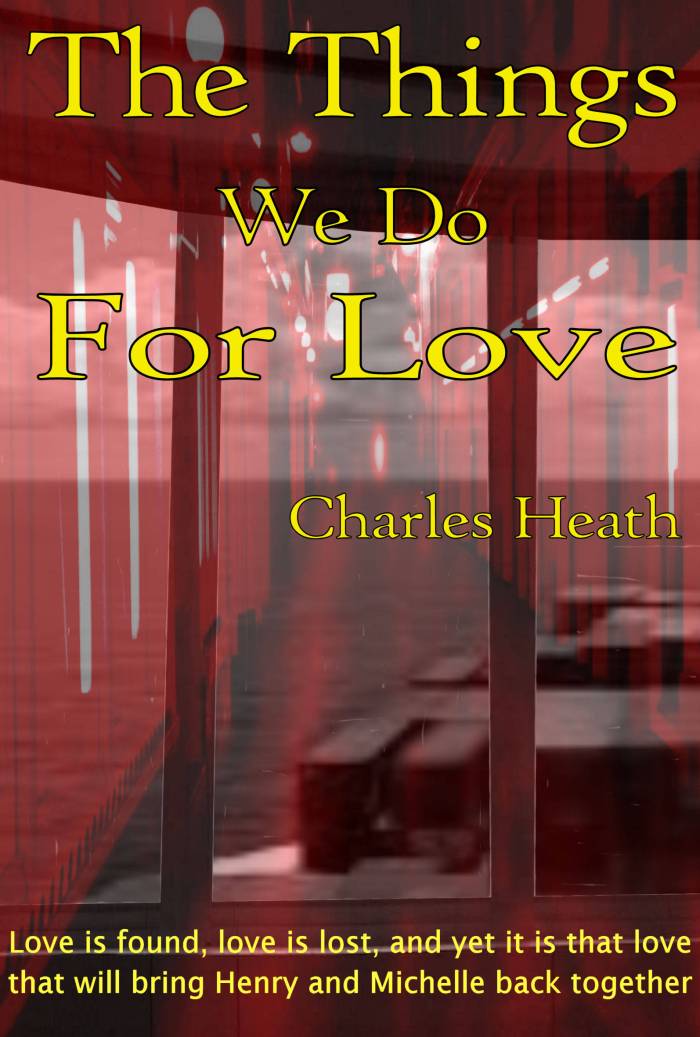
“The Things we do for Love”, the story behind the story

This story has been ongoing since I was seventeen, and just to let you know, I’m 72 this year.

Yes, it’s taken a long time to get it done.

Why, you might ask.

Well, I never gave it much interest because I started writing it after a small incident when I was 17, and working as a book packer for a book distributor in Melbourne

At the end of my first year, at Christmas, the employer had a Christmas party, and that year, it was at a venue in St Kilda.

I wasn’t going to go because at that age, I was an ordinary boy who was very introverted and basically scared of his own shadow and terrified by girls.

Back then, I would cross the street to avoid them

Also, other members of the staff in the shipping department were rough and ready types who were not backwards in telling me what happened, and being naive, perhaps they knew I’d be either shocked or intrigued.

I was both adamant I wasn’t coming and then got roped in on a dare.

Damn!

So, back then, in the early 70s, people looked the other way when it came to drinking, and of course, Dutch courage always takes away the concerns, especially when normally you wouldn’t do half the stuff you wouldn’t in a million years

I made it to the end, not as drunk and stupid as I thought I might be, and St Kilda being a salacious place if you knew where to look, my new friends decided to give me a surprise.

It didn’t take long to realise these men were ‘men about town’ as they kept saying, and we went on an odyssey.  Yes, those backstreet brothels where one could, I was told, have anything they could imagine.

Let me tell you, large quantities of alcohol and imagination were a very bad mix.

So, the odyssey in ‘The things we do’ was based on that, and then the encounter with Diana. Well, let’s just say I learned a great deal about girls that night.

Firstly, not all girls are nasty and spiteful, which seemed to be the case whenever I met one. There was a way to approach, greet, talk to, and behave.

It was also true that I could have had anything I wanted, but I decided what was in my imagination could stay there.  She was amused that all I wanted was to talk, but it was my money, and I could spend it how I liked.

And like any 17-year-old naive fool, I fell in love with her and had all these foolish notions.  Months later, I went back, but she had moved on, to where no one was saying or knew.

Needless to say, I was heartbroken and had to get over that first loss, which, like any 17-year-old, was like the end of the world.

But it was the best hour I’d ever spent in my life and would remain so until I met the woman I have been married to for the last 48 years.

As Henry, he was in part based on a rebel, the son of rich parents who despised them and their wealth, and he used to regale anyone who would listen about how they had messed up his life

If only I’d come from such a background!

And yes, I was only a run away from climbing up the stairs to get on board a ship, acting as a purser.

I worked for a shipping company and they gave their junior staff members an opportunity to spend a year at sea working as a purser on a cargo ship that sailed between Melbourne, Sydney and Hobart in Australia.

One of the other junior staff members’ turn came, and I would visit him on board when he would tell me stories about life on board, the officers, the crew, and other events. These stories, which sounded incredible to someone so impressionable, were a delight to hear.

Alas, by that time, I had tired of office work and moved on to be a tradesman at the place where my father worked.

It proved to be the right move, as that is where I met my wife.  Diana had been right; love would find me when I least expected it.

lovecoverfinal1

Skeletons in the closet, and doppelgangers

A story called “Mistaken Identity”

How many of us have skeletons in the closet that we know nothing about? The skeletons we know about generally stay there, but those we do not, well, they have a habit of coming out of left field when we least expect it.

In this case, when you see your photo on a TV screen with the accompanying text that says you are wanted by every law enforcement agency in Europe, you’re in a state of shock, only to be compounded by those same police, armed and menacing, kicking the door down.

I’d been thinking about this premise for a while after I discovered my mother had a boyfriend before she married my father, a boyfriend who was, by all accounts, the man who was the love of her life.

Then, in terms of coming up with an idea for a story, what if she had a child by him that we didn’t know about, which might mean I had a half brother or sister I knew nothing about. It’s not an uncommon occurrence from what I’ve been researching.

There are many ways of putting a spin on this story.

Then, in the back of my mind, I remembered a story an acquaintance at work was once telling us over morning tea, that a friend of a friend had a mother who had a twin sister and that each of the sisters had a son by the same father, without each knowing of the father’s actions, both growing up without the other having any knowledge of their half brother, only to meet by accident on the other side of the world.

It was an encounter that in the scheme of things might never have happened, and each would have remained oblivious of the other.

For one sister, the relationship was over before she discovered she was pregnant, and therefore had not told the man he was a father. It was no surprise the relationship foundered when she discovered he was also having a relationship with her sister, a discovery that caused her to cut all ties with both of them and never speak to either from that day.

It’s a story with more twists and turns than a country lane!

And a great idea for a story.

That story is called ‘Mistaken Identity’.

Writing about writing a book – Research

Day 24

Lost Battalions: The Vietnam Vets Who Walked Into the Wilderness and Never Came Back

We often talk about the heroes who returned from war and the ones who made the ultimate sacrifice. But history is also written in the silences—in the stories of those who simply vanished. After the Vietnam War, a curious and sombre phenomenon occurred in both Australia and the United States: a notable number of veterans returned home only to eventually disappear, opting for a life completely “off the grid.”

The question isn’t just a matter of historical curiosity: Just how many ex-servicemen from Australia and America went off-grid after dabbling in drugs in Vietnam, and why?

While the romanticised image is of a lone vet building a cabin deep in the woods, the reality is far more complex, tragic, and rooted in the unique trauma of the Vietnam experience.

The Uncountable Numbers: A Statistical Ghost Story

First, the hard truth: we will never know the exact number. By its very nature, going “off-grid” means severing ties with official institutions—no census, no veterans’ affairs paperwork, no tax records. These men became statistical ghosts.

We can, however, look at the clues:

  • Rough Estimates: Some researchers and veterans’ advocates have suggested that in the US, the number could be in the tens of thousands over the decades following the war. This doesn’t mean they all fled immediately; for many, it was a slow, painful fade from society after failed attempts to reintegrate.
  • The Australian Experience: Australia sent nearly 60,000 troops to Vietnam. While the numbers would be proportionally smaller, the pattern was strikingly similar. Reports from the time and subsequent decades tell of veterans retreating to the vast Outback, the tropical Daintree, or isolated coastal regions to escape the world they no longer recognised.

The common thread in these disappearances? For a significant number, it was intertwined with their experience with drugs during the war.

The “Why”: A Perfect Storm of Trauma

To understand the drift towards isolation, you have to understand the Vietnam War’s psychological battlefield. The decision to disappear wasn’t about a single thing; it was a cascade of factors.

1. Self-Medication for Unseen Wounds: In Vietnam, drugs—particularly marijuana and heroin—were cheap, potent, and astonishingly prevalent. For many young soldiers, substance use began as a way to cope with the unbearable daily stress of guerrilla warfare, the fear of booby traps, and the moral ambiguity of the conflict. They weren’t using it for a high; they were using it to numb the horror. This created a physical and psychological dependency that they brought home.

2. A Society That Spat, Rather Than Embraced: Unlike the heroes’ welcome of previous wars, Vietnam vets returned to a deeply divided society, often facing open hostility and being branded “baby killers.” There was no parade. There was no understanding of PTSD (a term that wouldn’t even be officially recognised until 1980). This profound rejection made “the World” feel just as hostile and alien as the jungles they had left. Why stay in a society that hates you?

3. The Failure of Traditional Support Systems: Many vets found the VA (Veterans Affairs) systems in both countries overwhelmed and ill-equipped to handle their specific trauma and substance abuse issues. Feeling failed by the very governments that sent them to war, they concluded that no one could help them. The only solution was to rely on themselves, away from everyone else.

4. The Lure of the Familiar Unknown: The jungle was hell, but it was a hell they understood. It was a place of hyper-vigilance, self-reliance, and stripped-down simplicity. For some, the logical escape from the confusing noise of modern society—the traffic, the bureaucracy, the crowds—was to return to a wilderness they could control. The Australian bush or the American backcountry became a substitute for the environment where they had last felt a grim sense of purpose and competence.

5. Guilt, Shame, and the Desire for Erasure: Many veterans carried immense guilt for things they had done, things they had seen, or simply for having survived when their mates did not. Coupled with the stigma of addiction, this created a powerful desire to erase themselves. Going off-grid was the ultimate form of penance; a self-imposed exile to escape the demons within and the judgmental eyes of the world without.

Beyond the Myth

It’s crucial to move beyond the romanticised “Rambo” narrative. These were not action heroes. They were deeply wounded men, often self-medicating with the drugs they first encountered in the war, failed by their societies, and crushed by a trauma they had no name for. Their flight to the wilderness was not an adventure; it was a last resort—a desperate attempt to find a peace that society could not, or would not, provide.

Their legacy is a stark lesson. It underscores the critical importance of mental health support, the devastating cost of societal rejection, and the lifelong battle soldiers face long after the final shot is fired. They are the starkest reminder that some wounds are invisible, and some battles are fought not in foreign jungles, but in the silent, lonely woods of a soldier’s mind.

The cinema of my dreams – I never wanted to go to Africa – Episode 38

Our hero knows he’s in serious trouble.

The problem is, there are familiar faces and a question of who is a friend and who is foe made all the more difficult because of the enemy, if it was the enemy, simply because it didn’t look or sound or act like the enemy.

Now, it appears, his problems stem from another operation he participated in, and because of it, he has now been roped into what might be called a suicide mission.


“So, Jacobi, tell me what I don’t know.”

I was taking the track slowly and keeping within a short distance of the cars behind me.  The road was little more than a dirt track, and in places, there were almost un-navigable ruts.  We would not have got a truck down this road.

He looked sideways at me.  “You know as much as I do.”

“That’s not possible.  I know nothing.  You set this up.  Tell me about the leader of this group.  Is he the heard of his own militia group?”

“An area commander of a larger group spread out across the top of the Republic, bordering onto Sudan.  They get their guns and other military hardware across that border.  Where we’re going, it’s their main camp in this location.”

“How many men will be here?”

“Twenty, thirty.  Sometimes they train new recruits.”

“Those militia back there, were they his people?”

“I don’t know.”

“I think you do, Jacobi.  And I think if you want to come out of this alive, you might consider giving me all the facts.  If they were his men, there could be ramifications if they don’t report back, especially if he was expecting to add to his payday.”

“Even if they were, there’s no communication lines out here.  They would have to report back to the camp first.  And then there’s the possibility with all the money they were supposed to collect, there might be a detour.  It’s why I think they asked for 10,000 rather than the 5,000.  The commander was going to take a cut.  Loyalty only goes so far in these places.”

“No likely surprises?”

“None that I’m aware of.  You killed them all anyway.  Dead men do not get up, walk back to come and inform.”

No, they didn’t.


A mile to go I saw the rear car stop for a few seconds and Monroe and Stark get out and disappear into the bush.  The chances were they could walk through the bush faster than we could drive on the track, and beat us there.

And, then, the checkpoint was in sight, a pair of empty petrol drums with a piece of wood across the road, each end resting on a drum.  Behind the barrier were three men, one I presumed to be the commander, the other two, guns at the ready, his guard.  Behind them was a clearing with several buildings and to one side several huts that might belong to some villagers.  There were a truck and two Toyota tray utilities parked to one side.

All in all, I could see about ten men.

When I reached the barrier, I stopped but left the engine running.  Just before we arrived, I gave the order to hide the hand weapons.  It was risky going in unarmed, but the chances were they’d take the guns if we were wearing them.  This way, if we needed them, there was a slight chance we might be able to retrieve them.

Both Jacobi and I got out.  I left my door open.  Jacobi closed his.

“Sergeant James, I presume.”  Good English, beaming smile, friendly manner.

“I think I know how Dr. Livingston felt.  I am he.”

A puzzled look for a moment, then the resumption of good nature.  He didn’t understand the nuances of British history in Africa.

There was no handshake, none was expected.  Jacobi stepped forward.  “I assume the packages are here, and in good condition.”

“Of course.  I assume that you have brought the exchange material.”

“We have.  Now, if we can just park these cars, we can get on with the exchange.”

“In a hurry, Jacobi?  Somewhere else to be?”

“Yes, as it happens.  I’m a busy man, as you are aware.”

Politeness disappeared from his face as quickly as the sun sometimes went behind a cloud.

The commander looked over towards a hut just back from the road, one I hadn’t seen from the car because it was hidden by a grove of bushes.  Two men came out.

“Move the barrier.”

As they did, he said to me, “Tell your men to get out of the vehicles and come slowly up the track.  My men will bring the vehicles into the camp.  Tell them also not to make any sudden or suspicious moves, or there will be trouble.”

A glance back showed another four of his men, also armed, appearing out of the bush towards the driver’s side of the cars.

I’d brought the radio and gave them the instructions the commander had given me.

Five minutes later we were standing outside one of the huts, the cars were parked neatly in a row, and each of us had been frisked as I thought we would.  The four who acted as drivers were now our guards, not with weapons trained on us, but they could be very quickly.

The commander waited until the guards at the checkpoint had replaced the barrier, then came striding towards us.  I could see he was counting heads and seemed perplexed by the time he reached us.

“There are men missing.  Where are they?”
© Charles Heath 2019-2020

“The Devil You Don’t”, she was the girl you would not take home to your mother!

Now only $0.99 at https://amzn.to/2Xyh1ow

John Pennington’s life is in the doldrums. Looking for new opportunities, and prevaricating about getting married, the only joy on the horizon was an upcoming visit to his grandmother in Sorrento, Italy.

Suddenly he is left at the check-in counter with a message on his phone telling him the marriage is off, and the relationship is over.

If only he hadn’t promised a friend he would do a favour for him in Rome.

At the first stop, Geneva, he has a chance encounter with Zoe, an intriguing woman who captures his imagination from the moment she boards the Savoire, and his life ventures into uncharted territory in more ways than one.

That ‘favour’ for his friend suddenly becomes a life-changing event, and when Zoe, the woman who he knows is too good to be true, reappears, danger and death follow.

Shot at, lied to, seduced, and drawn into a world where nothing is what it seems, John is dragged into an adrenaline-charged undertaking, where he may have been wiser to stay with the ‘devil you know’ rather than opt for the ‘devil you don’t’.

newdevilcvr6

Another excerpt from “Strangers We’ve Become” – A sequel to ‘What Sets Us Apart’

It was the first time in almost a week that I made the short walk to the cafe alone.  It was early, and the chill of the morning was still in the air.  In summer, it was the best time of the day.  When Susan came with me, it was usually much later, when the day was much warmer and less tolerable.

On the morning of the third day of her visit, Susan said she was missing the hustle and bustle of London, and by the end of the fourth she said, in not so many words, she was over being away from ‘civilisation’.  This was a side of her I had not seen before, and it surprised me.

She hadn’t complained, but it was making her irritable.  The Susan that morning was vastly different to the Susan on the first day.  So much, I thought, for her wanting to ‘reconnect’, the word she had used as the reason for coming to Greve unannounced.

It was also the first morning I had time to reflect on her visit and what my feelings were towards her.  It was the reason I’d come to Greve: to soak up the peace and quiet and think about what I was going to do with the rest of my life.

I sat in my usual corner.  Maria, one of two waitresses, came out, stopped, and there was no mistaking the relief in her manner.  There was an air of tension between Susan and Maria I didn’t understand, and it seemed to emanate from Susan rather than the other way around.  I could understand her attitude if it was towards Alisha, but not Maria.  All she did was serve coffee and cake.

When Maria recovered from the momentary surprise, she said, smiling, “You are by yourself?”  She gave a quick glance in the direction of my villa, just to be sure.

“I am this morning.  I’m afraid the heat, for one who is not used to it, can be quite debilitating.  I’m also afraid it has had a bad effect on her manners, for which I apologise.  I cannot explain why she has been so rude to you.”

“You do not have to apologise for her, David, but it is of no consequence to me.  I have had a lot worse.  I think she is simply jealous.”

It had crossed my mind, but there was no reason for her to be.  “Why?”

“She is a woman, I am a woman, she thinks because you and I are friends, there is something between us.”

It made sense, even if it was not true.  “Perhaps if I explained…”

Maria shook her head.  “If there is a hole in the boat, you should not keep bailing but try to plug the hole.  My grandfather had many expressions, David.  If I may give you one piece of advice, as much as it is none of my business, you need to make your feelings known, and if they are not as they once were, and I think they are not, you need to tell her.  Before she goes home.”

Interesting advice.  Not only a purveyor of excellent coffee, but Maria was also a psychiatrist who had astutely worked out my dilemma.  What was that expression, ‘not just a pretty face’?

“Is she leaving soon?” I asked, thinking Maria knew more about Susan’s movements than I did.

“You would disappoint me if you had not suspected as much.  Susan was having coffee and talking to someone in her office on a cell phone.  It was an intense conversation.  I should not eavesdrop, but she said being here was like being stuck in hell.  It is a pity she does not share your love for our little piece of paradise, is it not?”

“It is indeed.  And you’re right.  She said she didn’t have a phone, but I know she has one.  She just doesn’t value the idea of getting away from the office.  Perhaps her role doesn’t afford her that luxury.”

And perhaps Alisha was right about Maria, that I should be more careful.  She had liked Maria the moment she saw her.  We had sat at this very table, the first day I arrived.  I would have travelled alone, but Prendergast, my old boss, liked to know where ex-employees of the Department were, and what they were doing.

She sighed.  “I am glad I am just a waitress.  Your usual coffee and cake?”

“Yes, please.”

Several months had passed since we had rescued Susan from her despotic father; she had recovered faster than we had thought, and settled into her role as the new Lady Featherington, though she preferred not to use that title, but go by the name of Lady Susan Cheney.

I didn’t get to be a Lord, or have any title, not that I was expecting one.  What I had expected was that Susan, once she found her footing as head of what seemed to be a commercial empire, would not have time for details like husbands, particularly when our agreement made before the wedding gave either of us the right to end it.

There was a moment when I visited her recovering in the hospital, where I was going to give her the out, but I didn’t, and she had not invoked it.  We were still married, just not living together.

This visit was one where she wanted to ‘reconnect’ as she called it, and invite me to come home with her.  She saw no reason why we could not resume our relationship, conveniently forgetting she indirectly had me arrested for her murder, charges both her mother and Lucy vigorously pursued, and had the clone not returned to save me, I might still be in jail.

It was not something I would forgive or forget any time soon.

There were other reasons why I was reluctant to stay with her, like forgetting small details, an irregularity in her character I found odd.  She looked the same, she sounded the same, she basically acted the same, but my mind was telling me something was not right.  It was not the Susan I first met, even allowing for the ordeal she had been subjected to.

But, despite those misgivings, there was no question in my mind that I still loved her, and her clandestine arrival had brought back all those feelings.  But as the days passed, I began to get the impression my feelings were one-sided and she was just going through the motions.

Which brought me to the last argument, earlier, where I said if I went with her, it would be business meetings, social obligations, and quite simply her ‘celebrity’ status that would keep us apart.  I reminded her that I had said from the outset I didn’t like the idea of being in the spotlight, and when I reiterated it, she simply brushed it off as just part of the job, adding rather strangely that I always looked good in a suit.  The flippancy of that comment was the last straw, and I left before I said something I would regret.

I knew I was not a priority.  Maybe somewhere inside me, I had wanted to be a priority, and I was disappointed when I was not.

And finally, there was Alisha.  Susan, at the height of the argument, had intimated she believed I had an affair with her, but that elephant was always in the room whenever Alisha was around.  It was no surprise when I learned Susan had asked Prendergast to reassign her to other duties. 

At least I knew what my feelings for Alisha were, and there were times when I had to remember she was persona non grata.  Perhaps that was why Susan had her banished, but, again, a small detail; jealousy was not one of Susan’s traits when I first knew her.

Perhaps it was time to set Susan free.

When I swung around to look in the direction of the lane where my villa was, I saw Susan.  She was formally dressed, not in her ‘tourist’ clothes, which she had bought from one of the local clothing stores.  We had fun that day, shopping for clothes, a chore I’d always hated.  It had been followed by a leisurely lunch, lots of wine and soul searching.

It was the reason why I sat in this corner; old habits die hard.  I could see trouble coming from all directions, not that Susan was trouble or at least I hoped not, but it allowed me the time to watch her walking towards the cafe in what appeared to be short, angry steps; perhaps the culmination of the heat wave and our last argument.

She glared at me as she sat, dropping her bag beside her on the ground, where I could see the cell phone sitting on top.  She followed my glance down, and then she looked unrepentant back at me.

Maria came back at the exact moment she was going to speak.  I noticed Maria hesitate for a second when she saw Susan, then put her smile in place to deliver my coffee.

Neither spoke nor looked at each other.  I said, “Susan will have what I’m having, thanks.”

Maria nodded and left.

“Now,” I said, leaning back in my seat, “I’m sure there’s a perfectly good explanation as to why you didn’t tell me about the phone, but that first time you disappeared, I’d guessed you needed to keep in touch with your business interests.  I thought it somewhat unwisethat you should come out when the board of one of your companies was trying to remove you, because of what was it, an unexplained absence?  All you had to do was tell me there were problems and you needed to remain at home to resolve them.”

My comment elicited a sideways look, with a touch of surprise.

“It was unfortunate timing on their behalf, and I didn’t want you to think everything else was more important than us.  There were issues before I came, and I thought the people at home would be able to manage without me for at least a week, but I was wrong.”

“Why come at all.  A phone call would have sufficed.”

“I had to see you, talk to you.  At least we have had a chance to do that.  I’m sorry about yesterday.  I once told you I would not become my mother, but I’m afraid I sounded just like her.  I misjudged just how much this role would affect me, and truly, I’m sorry.”

An apology was the last thing I expected.

“You have a lot of work to do catching up after being away, and of course, in replacing your mother and gaining the requisite respect as the new Lady Featherington.  I think it would be for the best if I were not another distraction.  We have plenty of time to reacquaint ourselves when you get past all these teething issues.”

“You’re not coming with me?”  She sounded disappointed.

“I think it would be for the best if I didn’t.”

“Why?”

“It should come as no surprise to you that I’ve been keeping an eye on your progress.  You are so much better doing your job without me.  I told your mother once that when the time came I would not like the responsibilities of being your husband.  Now that I have seen what it could possibly entail, I like it even less.  You might also want to reconsider our arrangement, after all, we only had a marriage of convenience, and now that those obligations have been fulfilled, we both have the option of terminating it.  I won’t make things difficult for you if that’s what you want.”

It was yet another anomaly, I thought; she should look distressed, and I would raise the matter of that arrangement.  Perhaps she had forgotten the finer points.  I, on the other hand, had always known we would not last forever.  The perplexed expression, to me, was a sign she might have forgotten.

Then, her expression changed.  “Is that what you want?”

“I wasn’t madly in love with you when we made that arrangement, so it was easy to agree to your terms, but inexplicably, since then, my feelings for you changed, and I would be sad if we parted ways.  But the truth is, I can’t see how this is going to work.”

“In saying that, do you think I don’t care for you?”

That was exactly what I was thinking, but I wasn’t going to voice that opinion out loud.  “You spent a lot of time finding new ways to make my life miserable, Susan.  You and that wretched friend of yours, Lucy.  While your attitude improved after we were married, that was because you were going to use me when you went to see your father, and then almost let me go to prison for your murder.”

“I had nothing to do with that, other than to leave, and I didn’t agree with Lucy that you should be made responsible for my disappearance.  I cannot be held responsible for the actions of my mother.  She hated you; Lucy didn’t understand you, and Millie told me I was stupid for not loving you in return, and she was right.  Why do you think I gave you such a hard time?  You made it impossible not to fall in love with you, and it nearly changed my mind about everything I’d been planning so meticulously.  But perhaps there was a more subliminal reason why I did because after I left, I wanted to believe, if anything went wrong, you would come and find me.”

“How could you possibly know that I’d even consider doing something like that, given what you knew about me?”

“Prendergast made a passing comment when my mother asked him about you; he told us you were very good at finding people and even better at fixing problems.”

“And yet here we are, one argument away from ending it.”

I could see Maria hovering, waiting for the right moment to deliver her coffee, then go back and find Gianna, the café owner, instead.  Gianna was more abrupt and, for that reason, was rarely seen serving the customers.  Today, she was particularly cantankerous, banging the cake dish on the table and frowning at Susan before returning to her kitchen.  Gianna didn’t like Susan either.

Behind me, I heard a car stop, and when she looked up, I knew it was for her.  She had arrived with nothing, and she was leaving with nothing.

She stood.  “Last chance.”

“Forever?”

She hesitated and then shook away the look of annoyance on her face.  “Of course not.  I wanted you to come back with me so we could continue working on our relationship.  I agree there are problems, but it’s nothing we can’t resolve if we try.”

I had been trying.  “It’s too soon for both of us, Susan.  I need to be able to trust you, and given the circumstances, and all that water under the bridge, I’m not sure if I can yet.”

She frowned at me.  “As you wish.”  She took an envelope out of her bag and put it on the table.  “When you are ready, it’s an open ticket home.  Please make it sooner rather than later.  Despite what you think of me, I have missed you, and I have no intention of ending it between us.”

That said, she glared at me for a minute, shook her head, then walked to the car.  I watched her get in and the car drive slowly away.

No kiss, no touch, no looking back. 

© Charles Heath 2018-2025

strangerscover9

An excerpt from “If Only” – a work in progress

Investigation of crimes doesn’t always go according to plan, nor does the perpetrator get either found or punished.

That was particularly true in my case.  The murderer was incredibly careful in not leaving any evidence behind, to the extent that the police could not rule out whether it was a male or a female.

At one stage the police thought I had murdered my own wife though how I could be on a train at the time of the murder was beyond me.  I had witnesses and a cast-iron alibi.

The officer in charge was Detective First Grade Gabrielle Walters.  She came to me on the day after the murder seeking answers to the usual questions like, when was the last time you saw your wife, did you argue, the neighbors reckon there were heated discussions the day before.

Routine was the word she used.

Her fellow detective was a surly piece of work whose intention was to get answers or, more likely, a confession by any or all means possible.  I could sense the raging violence within him.  Fortunately, common sense prevailed.

Over the course of the next few weeks, once I’d been cleared of committing the crime, Gabrielle made a point of keeping me informed of the progress.

After three months the updates were more sporadic, and when, for lack of progress, it became a cold case, communication ceased.

But it was not the last I saw of Gabrielle.

The shock of finding Vanessa was more devastating than the fact she was now gone, and those images lived on in the same nightmare that came to visit me every night when I closed my eyes.

For months I was barely functioning, to the extent I had all but lost my job, and quite a few friends, particularly those who were more attached to Vanessa rather than me.

They didn’t understand how it could affect me so much, and since it had not happened to them, my tart replies of ‘you wouldn’t understand’ were met with equally short retorts.  Some questioned my sanity, even, for a time, so did I.

No one, it seemed, could understand what it was like, no one except Gabrielle.

She was by her own admission, damaged goods, having been the victim of a similar incident, a boyfriend who turned out to be an awfully bad boy.  Her story varied only in she had been made to witness his execution.  Her nightmare, in reliving that moment in time, was how she was still alive and, to this day, had no idea why she’d been spared.

It was a story she told me one night, some months after the investigation had been scaled down.  I was still looking for the bottom of a bottle and an emotional mess.  Perhaps it struck a resonance with her; she’d been there and managed to come out the other side.

What happened become our secret, a once-only night together that meant a great deal to me, and by mutual agreement, it was not spoken of again.  It was as if she knew exactly what was required to set me on the path to recovery.

And it had.

Since then, we saw each about once a month in a cafe.   I had been surprised to hear from her again shortly after that eventful night when she called to set it up, ostensibly for her to provide me with any updates on the case, but perhaps we had, after that unspoken night, formed a closer bond than either of us wanted to admit.

We generally talked for hours over wine, then dinner and coffee.  It took a while for me to realize that all she had was her work, personal relationships were nigh on impossible in a job that left little or no spare time for anything else.

She’d always said that if I had any questions or problems about the case, or if there was anything that might come to me that might be relevant, even after all this time, all I had to do was call her.

I wondered if this text message was in that category.  I was certain it would interest the police and I had no doubt they could trace the message’s origin, but there was that tiny degree of doubt, about whether or not I could trust her to tell me what the message meant.

I reached for the phone then put it back down again.  I’d think about it and decide tomorrow.

© Charles Heath 2018-2020