Writing about writing a book – a novel twist

I have decided to write about the process for me to write a book, working on the book at the same time.  The character writing the book is fictional and bears no relation to me, well, mostly not.

You will join me on the rollercoaster.

It will be appearing a bit at a time over the coming months, with the first instalment below.

Day One

I woke to a day where the sun was shining through the crack in the curtains.  It was not so much the brightness, but the fact it was moving, the gentle breeze moving the curtains and creating a strobing effect.

It was the first day of the rest of my life.

I was about to start the next Pulitzer Prize for literature.  Or something like that.

For so many years now my life had been weighed down by the monotony of a job I hated, a life that was going nowhere, and the pursuit of that no existent fortune that I believed was the answer to all my problems.

Those prayers to the great God Money were never heeded.

So, contrary to the well-meaning advice everyone gave me, I ignored them all, sold off the albatross around my neck, a house with a gigantic mortgage attached, and moved into a small but comfortable garret in a picturesque part of town.

It was called a ‘renovators’ delight.  What did it matter the wallpaper was peeling the paint fading and the carpet had seen better days.

It was mine.

Whether or not in the coming days, weeks, or months, I was a ‘renovator’ would be interesting.

My wife, Anne, had often said I wouldn’t know which end of the hammer to use.

Oh, and did I tell you, I moved on from her, or probably it was the other way around.  I’d let her down one too many times, she said, and found someone else more ‘reliable’.

Good for her, my brother had always said she deserved someone better, and it surprised me the marriage lasted as long as it did.  I still loved her, I always would.

I sprung out of bed and opened the curtains.  Spread out in front of me was a blue sky, bright sunshine casting its glow over the park and gardens opposite.

On my darkest days, I used to sit on a bench and watch the ducks swimming in the pond.  I wanted a carefree life like they had, and that was my dream.

Now I was living the dream.

Or would be till the money ran out.

I had enough for a year.

The second bedroom was the writing room.  The walls were lined with shelves, books by my favourite authors, books on writing, all dog-eared and well-read.

The typewriter was sitting on the desk waiting for the first words to be written.

I had a computer, but I was not going to use it for the second draft.

I had a supply of writing pads.  Like the great authors, I was going to write the first draft by hand, revise, and then type it.

I was going to be old school.


I sat down, picked up a pen, and scratched my head.

I began writing, ‘It was a dark and stormy night’.

That was a far as I got.

Maybe this was going to be harder than I thought.

Perhaps after coffee and toast …


© Charles Heath 2016-2019

The cinema of my dreams – I always wanted to write a war story – Episode 28

For a story that was conceived during those long boring hours flying in a steel cocoon, striving to keep away the thoughts that the plane and everyone in it could just simply disappear as planes have in the past, it has come a long way.

Whilst I have always had a fascination with what happened during the second world war, not the battles or fighting, but in the more obscure events that took place, I decided to pen my own little sidebar to what was a long and bitter war.

And, so, it continues…


By the time they reached the outskirts of Munich, what the Standartenfuhrer considered their biggest hurdle, it was quite dark and almost impossible to see where they were going.

The whole city seemed to have disappeared so effectively was the blackout.  

But there was one benefit, there was little or no traffic on the roads, which lessened the chance of running into another car or truck.

And it was time to refill the tank with two more petrol cans, leaving two remaining.  Filling up now, the Standartenfuhrer said, would get them to Innsbruck.

He sounded confident, but Mayer got the distinct impression it was mostly that he was putting on a brave face.  There had been one instance, the checkpoint before Munich where he nearly lost his nerve.  For the first time, there had been SS guards at the checkpoint, and which had been entirely unexpected.

An SS officer of the same rank had been summoned and he had requested their written orders.  They had paperwork, but Mayer wasn’t sure if it related to their current situation, further confirming his belief this had been a very carefully planned operation to get him out of Germany, and that there was a more pressing reason why.  It definitely had something to do with the V2’s, but had their intelligence services found out about something else, something he didn’t know about?

Given the level of risk to the two men with him, and that at every turn there was a possibility of capture or death, given the level of planning and the run so far, one he would have never thought of trying on his own, he didn’t have a very high level of confidence that they would get away with it.

Those in the SS were not fools, trusted no one, believed nothing they were told, and disregarded anything written on paper.  Check, double-check, then check again.  Take nothing as read.  The document he’d been given on what made a first-class SS officer in the eyes of the Reich, was fundamentally not him, nor most of the German population.

The officer at this checkpoint reminded him of the one who had shot the shooting in the hotel, and for at least ten tense minutes, during which time the other two had conferred quietly in English, one suggestion they cut and run.

That would have invited a hail of machine-gun fire that none of them would survive.

Both looked visibly relieved when he returned, having obviously called the name of the officer who had signed the order.  The only explanation he had for this was that the level of discontent among officers Military of SS must be greater than he thought.


They managed to cross over into Austria without any problems, the route they had taken, a series of back roads and tracks which had been given to them.  Once again, Mayer was surprised that so many people could be working against their own country, but, of what he’d seen, conditions were harsh no matter which part of Germany they were in.

The war was not going the way the German people were being told, and it was hard to see any resolution of the conflict any time soon.

Perhaps everyone in the high command was hoping the new V2 rockets were going to change the country’s fortunes in the war.  If they were, they were going to be bitterly disappointed.  What they needed was the jet-propelled fighters and bombers, something that remarkably had not been implemented years earlier, and would have given them air superiority.

He’d worked on those early jet engines and they were remarkable, and faster than anything the British or the Americans had.  It was hard to comprehend why high command had not pushed forward the new jet-propelled planes that Belin had finally decided to implement.  

And just when the trio had agreed that everything would work out about 100 kilometers from Innsbruck, on the road to the Italian border crossing, they took the wrong route.  It was a mistake brought on by tiredness, and a momentary lapse in concentration.

A checkpoint where there shouldn’t be one.

© Charles Heath 2020

Mistaken Identity – The Editor’s Draft – Day 21

I have been working on the story, the editor is asking for a second draft after making suggested changes – and I’m now working on it

…

Jack’s mother is missing, well, not technically missing, but dumping the package and disappearing seemed a very close equivalent.

Maryanne has finally dropped the pretence and told Jack the truth, she is working with the authorities (but will not tell him who exactly they are) and that she is only interested in the diary, which everyone now assumes was in the package.

Who does it belong to? That will be revealed soon.

Failing her mission, Maryanne tells Jack she’s been taken off the case, and when Jack tells her is going after Jacob, she decided to tag along, perhaps for his protection.

Looking like Jacob, and going to look for him has some irony attached to it, and it would not be unreasonable to assume Jack is about to find himself in some very hot water, from good people and bad alike.

Then, if that isn’t enough on his plate, McCallister, the reputed owner of the diary, and Jacob’s father, and probably likely his, calls. He wants the diary back, or Jack’s mother will be harmed.

The search is now not for Jacob, but his mother.

Today’s effort amounts to 2,186 words, for a total, so far, of 51,629.

More tomorrow.

The cinema of my dreams – I always wanted to write a war story – Episode 27

For a story that was conceived during those long boring hours flying in a steel cocoon, striving to keep away the thoughts that the plane and everyone in it could just simply disappear as planes have in the past, it has come a long way.

Whilst I have always had a fascination with what happened during the second world war, not the battles or fighting, but in the more obscure events that took place, I decided to pen my own little sidebar to what was a long and bitter war.

And, so, it continues…

…

Rolf Mayer had only ever wanted to design and build rockets for the exploration of space.

Somewhere between the germination of that desire, and where he was right now, in the back of a black Mercedes SS staff car heading south towards Nuremberg something had gone horribly wrong.

Back at Nordhausen, he may have been terrified most of the time from the demands of the Reich, and the horrors of how the Reich was achieving its goals, but he was, at least, safe.

Now he was a traitor, with stolen plans, with two Britisher spies, heading for Italy and from there to, well it hadn’t quite been specified where he might end up, but he assumed it would be England.

As yet they had not asked him whether he had the answer to stop this new weapon, and, if he really thought about it, there wasn’t an answer.  Perhaps, with a sense of irony, he could say that in kidnapping him, they might not fix the gyro guidance system which caused a lot of the rockets to go off course and miss their intended targets, but still, a large number would still reach their destination with devasting effect.

As for stopping it, he doubted it could be done.  They were fired from mobile positions, and there were no static launching sites so the enemy couldn’t bomb those sites, nor could they stop their production of them because it was underground.  A lot of lessons had been learned since Pennemunde.

And that brought another thought to mind.  Who was the enemy now, if he was willing to go with these spies?  He was German, and he loved his country, but seeing what he had seen, it was hard to balance that patriotism with the means to achieve their goals.  Perhaps the blame lay with the Fuhrer, but no one ever spoke of what they really thought, only of their undying allegiance to the mother country and its heroic leader.

No doubt, when he reached his final destination he was going to hear a lot of things that may or may not be true about Reich and its leadership.

Mayer noticed the Standartenfuhrer had a map and at various times they would stop the car and consult the map, an older touring map that predated the war.

Listening to their conversations he had learned that the car had a 50-litre tank that was full at the start of their journey.  From Nordhausen to Weimar had been 120 kilometres and had used about 18 litres of petrol.  From that, he deduced that the car would go about 300 kilometres per tankful.  This means they would need more petrol before they reached Nurnberg.

It was one thing to say they were going to take care of the details but getting one of the most heavily rationed commodities in Germany, or anywhere within the sphere of the Reich was nigh on impossible.  He knew this simply because his superiors at the Nordhausen site couldn’t get any petrol for their vehicles.

At this stage of the war, a war they were continually told they were winning, there seemed precious little of anything still available or not rationed, especially food.  Because they were SS they fared reasonably well, but the others not so much, making him feel guilty that he was not going hungry like everyone else.

In fact, he was feeling hungry now, and he didn’t remember seeing any food in the car.

Some distances from Bayreuth, after passing through another checkpoint, they stopped a further 10 kilometres up the road, in a layby that sheltered them from any other traffic, not that there had been anything other than army convoys.  Several times there had been aeroplanes overhead, either coming or going in small groups, perhaps training runs, so perhaps there was a Luftwaffe station nearby

Outside there was another consultation of the map and then the driver headed towards the rear of the car and opened the trunk.  The Standartenfuhrer opened the door.  “You can get out and stretch your legs.”

Mayer climbed out and found just how stiff and sore he was, and it hadn’t been a very long drive, but the roads were not as good as they once were, before the war.

Then he noticed the driver lugging a large can to the petrol cap, opened it, put a funnel in and with some assistance, started refilling the tank.  When he walked towards the rear of the car he saw six such cans in the trunk.  They had come prepared, and given the nature of how they had collected him, he realized that he had been targeted, which meant someone inside the Nordhausen complex was an agent working for British Intelligence.

They emptied two of the tanks into the car, and replaced the cans back in the trunk.

The Standartenfuhrer called him over to show him the map.

It had a line roughly drawn from Nordhausen down to Florence, and notes on the side in red, the most pertinent being the distance by road, if they could take the direct route, which now he knew the circumstances, they could not, was about 1,150 kilometres.

Even in the best of circumstances that would take about three days, maybe more.  And there was certainly not enough fuel in the rear truck to go the whole distance.

The Standartenfuhrer ran his finger down the line, “This is the intended route we decided on, though not exactly sticking to the main roads.  We do not anticipate problems in Germany, but once we cross into Austria and onto Innsbruck there might be a few problems.  We’re not quite sure what to expect at the border.”

“There is no border, not as far as the Reich and the Fuehrer is concerned.”

“Let’s hope you’re right.  But I think it’s about time we had a talk about what happened if anything happens to the two of us.  We’re not planning to get captured, or killed if it’s possible but there’s a lot of risks involved in an operation like this.”

“You expect me to go on alone?”

“Yes.  With the plans and drawings.  You have to get to a town called Gaiole in Chianti which is about 70 kilometres south of Florence.  There you will need to find a man named Luigi Fosini, who will take care of the rest of your journey.  There is a code you will need to give him, but we’ll talk about that later.  All you need, for now, is the destination.”

Discussion over, they got back in the car and continued on their way.

Then he realized he’d forgotten to ask about food, but judging by the dark expressions they wore, he decided to wait a little longer.

© Charles Heath 2020-2022

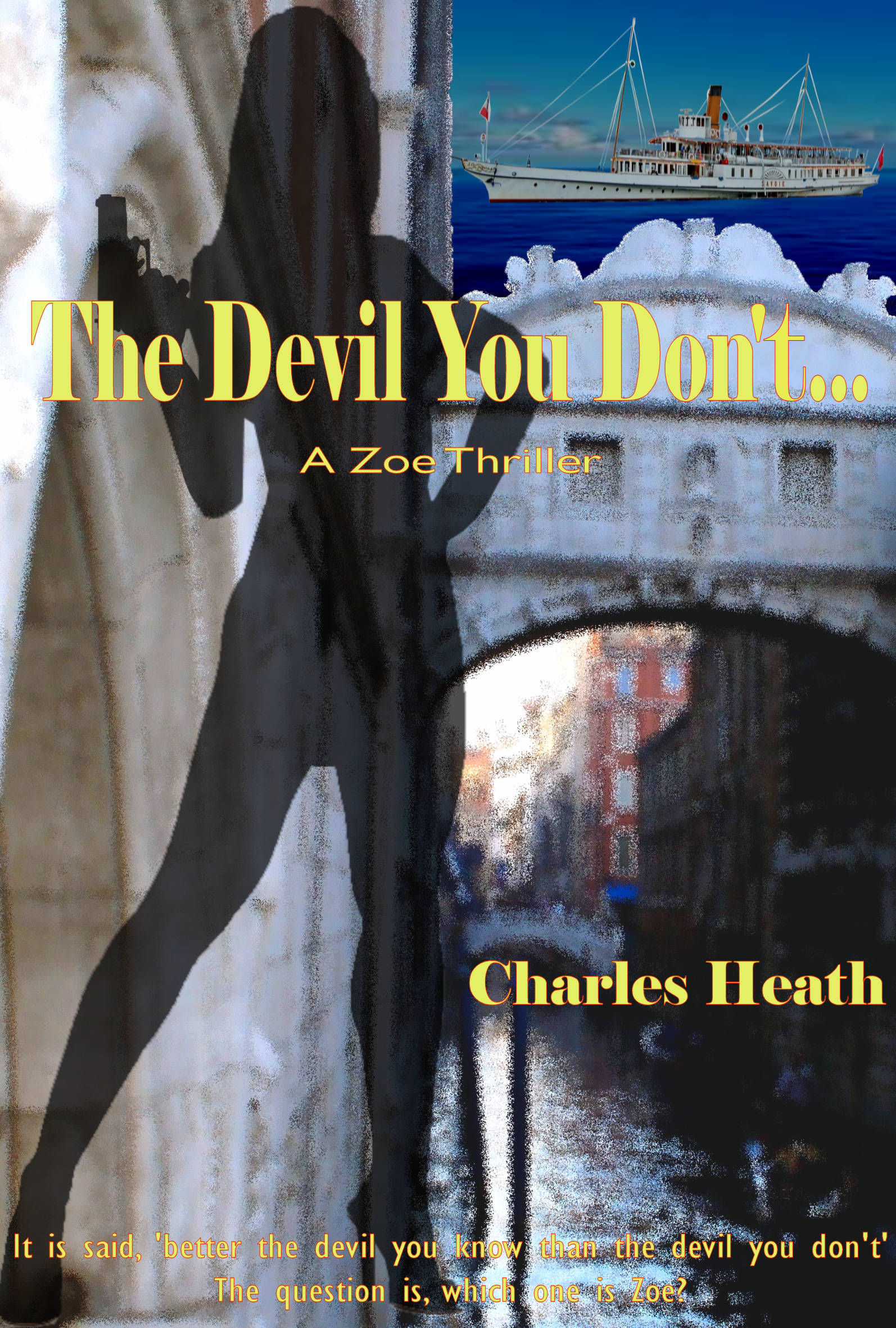
‘The Devil You Don’t’ – A beta reader’s view

It could be said that of all the women one could meet, whether contrived or by sheer luck, what are the odds it would turn out to be the woman who was being paid a very large sum to kill you.

John Pennington is a man who may be lucky in business, but not so lucky in love. He has just broken up with Phillipa Sternhaven, the woman he thought was the one, but relatives and circumstances, and perhaps because she was a ‘princess’, may also have contributed to the end result.

So, what do you do when you are heartbroken?

That is a story that slowly unfolds, from the first meeting with his nemesis on Lake Geneva, all the way to a hotel room in Sorrento, where he learns the shattering truth.

What should have been solace after disappointment, turns out to be something else entirely, and from that point, everything goes to hell in a handbasket.

He suddenly realizes his so-called friend Sebastian has not exactly told him the truth about a small job he asked him to do, the woman he is falling in love with is not quite who she says she is, and he is caught in the middle of a war between two men who consider people becoming collateral damage as part of their business.

The story paints the characters cleverly displaying all their flaws and weaknesses. The locations add to the story at times taking me back down memory lane, especially to Venice where, in those back streets I confess it’s not all that hard to get lost.

All in all a thoroughly entertaining story with, for once, a satisfying end.

…

Available on Amazon here: https://amzn.to/2Xyh1ow

…

An excerpt from “Betrayal” – a work in progress

It could have been anywhere in the world, she thought, but it wasn’t.  It was in a city where if anything were to go wrong…

She sighed and came away from the window and looked around the room.  It was quite large and expensively furnished.  It was one of several she had been visiting in the last three months.

Quite elegant too, as the hotel had its origins dating back to before the revolution in 1917.  At least, currently, there would not be a team of KGB agents somewhere in the basement monitoring everything that happened in the room.

There was no such thing as the KGB anymore, though there was an FSB, but such organisations were of no interest to her.

She was here to meet with Vladimir.

She smiled to herself when she thought of him, such an interesting man whose command of English was as good as her command of Russian, though she had not told him of that ability.

All he knew of her was that she was American, worked in the Embassy as a clerk, nothing important, whose life both at work and at home was boring.  Not that she had blurted that out the first they met, or even the second.

That first time, at a function in the Embassy, was a chance meeting, a catching of his eye as he looked around the room, looking, as he had told her later, for someone who might not be as boring as the function itself.

It was a celebration, honouring one of the Embassy officials on his service in Moscow, and the fact he was returning home after 10 years.  She had been there once, and still hadn’t met all the staff.

They had talked, Vladimir knew a great deal about England, having been stationed there for a year or two, and had politely asked questions about where she lived, her family, and of course what her role was, all questions she fended off with an air of disinterested interest.

It fascinated him, as she knew it would, a sort of mental sparring as one would do with swords if this was a fencing match.

They had said they might or might not meet again when the party was over, but she suspected there would be another opportunity.  She knew the signs of a man who was interested in her, and Vladimir was interested.

The second time came in the form of an invitation to an art gallery, and a viewing of the works of a prominent Russian artist, an invitation she politely declined.  After all, invitations issued to Embassy staff held all sorts of connotations, or so she was told by the Security officer when she told him.

Then, it went quiet for a month.  There was a party at the American embassy and along with several other staff members, she was invited.  She had not expected to meet Vladimir, but it was a pleasant surprise when she saw him, on the other side of the room, talking to several military men.

A pleasant afternoon ensued.

And it was no surprise that they kept running into each other at the various events on the diplomatic schedule.

By the fifth meeting, they were like old friends.  She had broached the subject of being involved in a plutonic relationship with him with the head of security at the embassy.  Normally for a member of her rank, it would not be allowed, but in this instance it was.

She did not work in any sensitive areas, and, as the security officer had said, she might just happen upon something that might be useful.  In that regard, she was to keep her eyes and ears open and file a report each time she met him.

After that discussion, she got the impression her superiors considered Vladimir more than just a casual visitor on the diplomatic circuit.  She also formed the impression that he might consider her an ‘asset’, a word that had been used at the meeting with security and the ambassador.

It was where the word ‘spy’ popped into her head and sent a tingle down her spine.  She was not a spy, but the thought of it, well, it would be fascinating to see what happened.

A Russian friend.  That’s what she would call him.

And over time, that relationship blossomed, until, after a visit to the ballet, late and snowing, he invited her to his apartment not far from the ballet venue.  It was like treading on thin ice, but after champagne and an introduction to caviar, she felt like a giddy schoolgirl.

Even so, she had made him promise that he remain on his best behaviour.  It could have been very easy to fall under the spell of a perfect evening, but he promised, showed her to a separate bedroom, and after a brief kiss, their first, she did not see him until the next morning.

So, it began.

It was an interesting report she filed after that encounter, one where she had expected to be reprimanded.

She wasn’t.

It wasn’t until six weeks had passed when he asked her if she would like to take a trip to the country.  It would involve staying in a hotel, that they would have separate rooms.  When she reported the invitation, no objection was raised, only a caution; keep her wits about her.

Perhaps, she had thought, they were looking forward to a more extensive report.  After all, her reports on the places, and the people, and the conversations she overheard, were no doubt entertaining reading for some.

But this visit was where the nature of the relationship changed, and it was one that she did not immediately report.  She had realised at some point before the weekend away, that she had feelings for him, and it was not that he was pushing her in that direction or manipulating her in any way.

It was just one of those moments where, after a grand dinner, a lot of champagne, and delightful company, things happen.  Standing at the door to her room, a lingering kiss, not intentional on her part, and it just happened.

And for not one moment did she believe she had been compromised, but for some reason she had not reported that subtle change in the relationship to the powers that be, and so far, no one had any inkling.

She took off her coat and placed it carefully of the back of one of the ornate chairs in the room.  She stopped for a moment to look at a framed photograph on the wall, one representing Red Square.

Then, after a minute or two, she went to the mini bar and took out the bottle of champagne that had been left there for them, a treat arranged by Vladimir for each encounter.

There were two champagne flutes set aside on the bar, next to a bowl of fruit.  She picked up the apple and thought how Eve must have felt in the garden of Eden, and the temptation.

Later perhaps, after…

She smiled at the thought and put the apple back.

A glance at her watch told her it was time for his arrival.  It was if anything, the one trait she didn’t like, and that was his punctuality.  A glance at the clock on the room wall was a minute slow.

The doorbell to the room rang, right on the appointed time.

She put the bottle down and walked over to the door.

A smile on her face, she opened the door.

It was not Vladimir.  It was her worst nightmare.

…

© Charles Heath 2020
Mistaken Identity – The Editor’s Draft – Day 19

I have been working on the story, the editor is asking for a second draft after making suggested changes – and I’m now working on it

…

Jack finally gets to spend those moments with Rosalie that were so tantalisingly close before he left.

The question is, would he had got the courage to do so if it had not been for the events that had just occurred. There always seems to be an element of danger that spurs people on to do things they might not necessarily do if life had not taken a particular turn.

But, it was everything he expected, and more.

Of course, as advised yesterday, there are problems, not of their making but of the intrepid Maryanne, who reveals herself now as an agent working for an organisation that is equally after the package that Jack’s mother had left in Rosalie’s safe keeping.

And ironically it is Rosalie who captures Maryanne in the act of trying to steal it.

So, if an effort to keep it from everyone Rosalie agrees to leave with the package and tell no one where she is. Not until Jack decided what he’s going to do with it. One possibility is to use it to get his mother back, but like all ransom exchanges, it never turns out the way it’s supposed to.

So, Maryanne is going to have to come up with a convincing plan to get Jack onside, but the lies and deception are not a very good start in forming trust.

It’s an interesting premise, and beyond the raw writing, I fear it will need some more work to get it where I want it to be.

Today’s effort amounts to 3,111 words, for a total, so far, of 46,870.

More tomorrow.

Skeletons in the closet, and doppelgangers

A story called “Mistaken Identity”

…

How many of us have skeletons in the closet that we know nothing about? The skeletons we know about generally stay there, but those we do not, well, they have a habit of coming out of left field when we least expect it.

In this case, when you see your photo on a TV screen with the accompanying text that says you are wanted by every law enforcement agency in Europe, you’re in a state of shock, only to be compounded by those same police, armed and menacing, kicking the door down.

I’d been thinking about this premise for a while after I discovered my mother had a boyfriend before she married my father, a boyfriend who was, by all accounts, the man who was the love of her life.

Then, in terms of coming up with an idea for a story, what if she had a child by him that we didn’t know about, which might mean I had a half brother or sister I knew nothing about. It’s not an uncommon occurrence from what I’ve been researching.

There are many ways of putting a spin on this story.

Then, in the back of my mind, I remembered a story an acquaintance at work was once telling us over morning tea, that a friend of a friend had a mother who had a twin sister and that each of the sisters had a son by the same father, without each knowing of the father’s actions, both growing up without the other having any knowledge of their half brother, only to meet by accident on the other side of the world.

It was an encounter that in the scheme of things might never have happened, and each would have remained oblivious of the other.

For one sister, the relationship was over before she discovered she was pregnant, and therefore had not told the man he was a father. It was no surprise the relationship foundered when she discovered he was also having a relationship with her sister, a discovery that caused her to cut all ties with both of them and never speak to either from that day.

It’s a story with more twists and turns than a country lane!

And a great idea for a story.

That story is called ‘Mistaken Identity’.

“Trouble in Store” – Short stories my way: The shopkeeper

It’s now time to look at the shopkeeper’s involvement, and there’s more to him and his activities than meets the eye.

With this event, it appears his luck is about to run out.


This wasn’t the shopkeeper’s first hold up.  In fact, over the years there had been a dozen.  But only one got reported to the police, and that was only because the robber was shot and killed.

He’d taken a bullet that night, too, which, from the police point of view, made him a concerned citizen simply defending himself.

The rest had been scared off by the double-barrel shotgun he kept under the counter for just such emergencies.

The young punk who came into the shop with his girlfriend had pulled out the pistol and told him if he reached for the shotgun he’d shoot him.  The kid looked unstable and he’d backed away.

When the kid collapsed, he should have gone for the shotgun, but instead, he thought he could get to the gun before the girl realized what was happened.  She wasn’t an addict and clearly looked like she was only along for the ride.  Her look when the kid pulled out the gun told him she’d known nothing about her partner’s true intentions.

But, he wasn’t fast enough, and she had the gun pointing at him before he’d got past the counter.

From one pair of unpredictable hands to another.

Like the girl, he was just as surprised when the customer burst in the door, just before closing time.

The situation might have been salvageable before the customer came in the door, getting the girl to go along with the robbery being about money, but there was no denying what the kid on the floor’s problem was.

Damn.

He had to try and salvage the situation simply because there was a lot of money involved, and other people depending on him.  He looked at the boy, on the floor, then the girl.

“Listen to me, young lady, you would be well advised to let this man go as he suggests.  And, please put the gun down before someone gets hurt.  Your friend needs medical help and I can call an ambulance.”

The girl switched her attention back to him.  “No one’s going anywhere, so just shut the hell up and let me think.”

The storekeeper glanced over at the customer. 

He’d seen him come into the shop once or twice, probably lived in the neighborhood, the sort who’d make a reliable witness, either a lawyer or an accountant.  Not like most of the residents just beyond the fringe of respectability.

If only he hadn’t burst into the shop when he did.


© Charles Heath 2018-2020

The cinema of my dreams – I always wanted to write a war story – Episode 28

For a story that was conceived during those long boring hours flying in a steel cocoon, striving to keep away the thoughts that the plane and everyone in it could just simply disappear as planes have in the past, it has come a long way.

Whilst I have always had a fascination with what happened during the second world war, not the battles or fighting, but in the more obscure events that took place, I decided to pen my own little sidebar to what was a long and bitter war.

And, so, it continues…


By the time they reached the outskirts of Munich, what the Standartenfuhrer considered their biggest hurdle, it was quite dark and almost impossible to see where they were going.

The whole city seemed to have disappeared so effectively was the blackout.  

But there was one benefit, there was little or no traffic on the roads, which lessened the chance of running into another car or truck.

And it was time to refill the tank with two more petrol cans, leaving two remaining.  Filling up now, the Standartenfuhrer said, would get them to Innsbruck.

He sounded confident, but Mayer got the distinct impression it was mostly that he was putting on a brave face.  There had been one instance, the checkpoint before Munich where he nearly lost his nerve.  For the first time, there had been SS guards at the checkpoint, and which had been entirely unexpected.

An SS officer of the same rank had been summoned and he had requested their written orders.  They had paperwork, but Mayer wasn’t sure if it related to their current situation, further confirming his belief this had been a very carefully planned operation to get him out of Germany, and that there was a more pressing reason why.  It definitely had something to do with the V2’s, but had their intelligence services found out about something else, something he didn’t know about?

Given the level of risk to the two men with him, and that at every turn there was a possibility of capture or death, given the level of planning and the run so far, one he would have never thought of trying on his own, he didn’t have a very high level of confidence that they would get away with it.

Those in the SS were not fools, trusted no one, believed nothing they were told, and disregarded anything written on paper.  Check, double-check, then check again.  Take nothing as read.  The document he’d been given on what made a first-class SS officer in the eyes of the Reich, was fundamentally not him, nor most of the German population.

The officer at this checkpoint reminded him of the one who had shot the shooting in the hotel, and for at least ten tense minutes, during which time the other two had conferred quietly in English, one suggestion they cut and run.

That would have invited a hail of machine-gun fire that none of them would survive.

Both looked visibly relieved when he returned, having obviously called the name of the officer who had signed the order.  The only explanation he had for this was that the level of discontent among officers Military of SS must be greater than he thought.


They managed to cross over into Austria without any problems, the route they had taken, a series of back roads and tracks which had been given to them.  Once again, Mayer was surprised that so many people could be working against their own country, but, of what he’d seen, conditions were harsh no matter which part of Germany they were in.

The war was not going the way the German people were being told, and it was hard to see any resolution of the conflict any time soon.

Perhaps everyone in the high command was hoping the new V2 rockets were going to change the country’s fortunes in the war.  If they were, they were going to be bitterly disappointed.  What they needed was the jet-propelled fighters and bombers, something that remarkably had not been implemented years earlier, and would have given them air superiority.

He’d worked on those early jet engines and they were remarkable, and faster than anything the British or the Americans had.  It was hard to comprehend why high command had not pushed forward the new jet-propelled planes that Belin had finally decided to implement.  

And just when the trio had agreed that everything would work out about 100 kilometers from Innsbruck, on the road to the Italian border crossing, they took the wrong route.  It was a mistake brought on by tiredness, and a momentary lapse in concentration.

A checkpoint where there shouldn’t be one.

© Charles Heath 2020