“Going out of my mind…” – a short story


Accidents can happen.

Sometimes they’re your fault, sometimes they’re not.

The accident I was in was not. Late at night driving home from work, a car came speeding out of a side street and T-boned my car.

It could have been worse, though the person who said it had a quite different definition of the word worse than I did.

To start with, I lost three months of my life in a coma, and even when I surfaced, it took another month to realize what had happened. Then came two months of working out my recovery plan.

If that wasn’t trial enough, what someone else might describe as the ‘last straw that broke the camel’s back’, my wife of 22 years decided to send me a text that morning, what was six months in hospital, to the day.

“I’m sorry, Joe, but enough is enough. I cannot visit you anymore, and for the sake of both our sanity, I think it’s time to draw a line in the sand. I know what happened isn’t your fault but given the prognosis, I don’t think I can cope with the situation. I need time to think about what will happen next and to do so, I’ll be going home to spend some time with family. Once again, I’m so sorry not to be doing this in person. I’ll let you know what I decide in due course. In the meantime, you have my best wishes for your recovery.”

In other words, goodbye. Her family lived in England, about 12,000 miles away in another hemisphere, and the likelihood of her returning was remote. We had meant to visit them, and had, in fact, booked the tickets shortly before the accident. I guess she couldn’t wait any longer.

My usual nurse came in for the first visit on this shift. She had become the familiar face on my journey, the one who made it worth waking up every morning.

“You look a little down in the dumps this morning. What’s up?”

She knew it couldn’t be for medical reasons because the doctor just yesterday had remarked how remarkable my recovery had been in the last week or so. Even I had been surprised given all the previous negative reports.

“Ever broken up by text?”

“What do you mean?”

“Frances has decided she no longer wants to be involved. I can’t say I blame her, she has put her whole life on hold because of this.”

“That’s surprising. She’s never shown any disappointment.”

“Six months have been a long time for everyone. We were supposed to be going home so she could see her family. Maybe that’s what it’s all about.”

I gave her the phone and she read the message.

Then she handed it back. “That’s goodbye, Tom. I’m sorry. And no, I’ve never had a breakup by text, but I guess there could always be a first time.”

She spent the next ten minutes going through the morning ritual, then said, “I’ve heard there’s a new doctor coming to visit you. Whatever has happened in the last few days had tongues wagging, and you might just become the next modern miracle. Fame and fortune await.”

“Just being able to walk again will be miracle enough.”

That had been the worst of it. The prognosis that it was likely I’d never be able to walk again, or work, and the changes to our lives that would cause. I knew Frances was bitterly disappointed that she might become the spouse who had to spend the rest of her life looking after, and though she had said it didn’t matter, that she would be there for me, deep down I knew a commitment like that took more internal fortitude than she had.

She ran her own business, managed three children into adulthood, and had a life other than what we had together. When I was fit and able, and nothing got in the way, it had worked. Stopping everything to cater to my problems had severely curtailed her life. Something had to give, and it had.

But, as I said, I didn’t blame her. She had tried, putting in a brave face day after day but once the daily visits slipped to every other day, to once a week, I knew then the ship was heading towards the rocks.

This morning it foundered.

I pondered the situation for an hour before I sent a reply. “I believe you have made the right decision. It’s time to call it, go home and take some time to consider what to do next is right. In normal circumstances, we would not be considering any of this, but these are not normal circumstances. But, just in case you are worried about the effect of all of this on me, don’t. I will get over it, whatever the result is, and what you need to do first and foremost is to concentrate on what is best for you. If that means drawing a line on this relationship, so be it. All I want for you is for you to be happy, and clearly, having to contend with this, and everything else on your plate, is not helping. I am glad we had what time we had together and will cherish the memories forever, and I will always love you, no matter what you decide.”

It was heartfelt, and I meant it. But life was not going to be the same without her.

I’d dozed off after sending the message, and only woke again when my usual doctor came into the room on his morning rounds, the usual entourage of doctors and interns in tow. I’d been a great case for sparking endless debate on the best route for my recovery among those fresh out of medical school. Some ideas were radical, others pie in the sky, but one that seemed implausible had got a hearing, and then the go-ahead, mainly because there was little else that apparently could be done.

That doctor, and now another I hadn’t seen before was standing in the front row, rather than at the back.

The doctor in charge went through the basics of the case, as he did every day, mainly because the entourage changed daily. Then, he deferred to the radical doctor as I decided to call her.

She went through the details of a discovery she had made, and the recommendation she’d made as a possible road to recovery, one which involved several radical operations which had been undertaken by the elderly man standing beside her. When I first met him, I thought he was an escaped patient from the psychiatric ward, not the pre-eminent back surgeon reputed to be the miracle worker himself.

It seemed, based on the latest x-rays that a miracle had occurred, but whether it was or not would be known for another week. Then, if all went well, I would be able to get out of bed, and, at the very least, be able to stand on my own. In the meantime, I had endless sessions of physio in the lead-up to the big event. Six months in bed had taken its toll on everything, and the week’s work was going to correct some of that.

It meant there was hope, and despite what I said and thought, hope was what I needed.

There had been ups and downs before this, fuelled by a morning when I woke up and found I could wriggle my toes. It was after the second operation, and I thought, given the number of pain killers, it had been my imagination.

When I mentioned it, there was some initial excitement, and, yes, it was true, I wasn’t going out of my mind, it was real. The downside was, I couldn’t move anything else, and other than an encouraging sign, as the days passed, and nothing more happened, the faces got longer.

Then, the physiotherapist moved in and started working on the areas that should be coming back to life. I felt little, maybe the pain killers again, until the next, and perhaps the last operation. I managed to lift my left leg a fraction of an inch.

But we’d been here before, and I wasn’t going to hold my breath.

Annabel, the daughter that lived on the other side of the country, finally arrived to visit me. I had thought, not being so far away she might have come earlier, but a few phone calls had sorted out her absence. Firstly, there was not much use visiting a coma patient, second, she was in a delicate stage of her professional career and a break might be the end of it, and thirdly, she accepted that I didn’t want to see her until I was much better.

She was not very happy about it, but it was a costly venture for her, in terms of time, being away from a young family, and just getting there.

Now, the time had come. She had a conference to attend, and I was happy to play second fiddle.

After the hugs and a few tears, she settled in the uncomfortable bedside chair.

“You don’t look very different than the last time I saw you,” she said.

“Hospitals have perfected the art of hiding the worst of it, but it’s true. The swelling had receded, the physios have revived the muscles, and I have a little movement again.”

“The injuries are not permanent?”

“Oh, they’re permanent but not as bad as first thought.”

“Pity my mother isn’t here.”

“She was, day after day, through the darkest period. I wouldn’t wish that on anyone. But your mother is an independent woman, and she has always been free to do what she wants, and I would not have had it any other way.”

“But deserting you in the middle of all this…”

“It’s been very debilitating on her. I can understand her reasons, and so should you. She will still be your mother no matter what happens to us.”

There had been a number of phone calls, from each of the children, decrying her actions after she had sent a text message to each of them telling them what she was doing. She had not told them she was leaving, in so many words, but leaving the door ajar, perhaps to allay their fears she was deserting them too. Annabel had been furious. The other two, not so much.

“And this latest development?”

I had also told her about the miracle worker, and the possibilities, without trying to get hopes up.

“On a scale of one to ten, it’s a three. We’ve been here before, so I’m going to save the excitement for when it happens, if it happens.”

“And if it doesn’t?”

It was a question I’d asked myself a number of times, one that I didn’t want an answer to. Hope was staving it off, each day a new day of discovery, and a day closer to the idea I might walk again. I had to believe it would happen, if not the next day, the next week, month, year, that it would eventually happen.

For now, all I had to do was stand on my own two feet.

It was ironic, in a way, that simple statement. ‘Stand on your own two feet’. Right then, it seemed so near, and yet, at the same time, so far away.

I didn’t answer that question, but did what I usually did with visitors, run a distraction and talk about everything else. This visit was no exception. I had a lot of catching up to do.

It’s odd how some call the day of momentous events D-Day because to me nothing would be more momentous than the invasion of France during the second world war.

Others were not quite of the same opinion. It was going to be a momentous day.

It started the same as any other.

The morning routine when the duty nurse came to do the checks. Then the physio, now a permanent fixture mid-morning, just after the tea lady arrived. Deliberate, I thought, to deprive me of my tea break, and some unbelievably delicious coconut cookies.

Then the routine changed, and the escort arrived to take me down to the room where the physio had set up an obstacle course. It looked like one, and I’d told him so when I first saw it, and he had said by the time he was finished with me, I’d be able to go from start to finish without breaking a sweat.

In my mind perhaps, but not with this broken body. I didn’t say that because I was meant to be positive.

An entourage arrived for the main event. I would have been happier to fail in front of the doctor, the miracle worker, and the physio, but it seemed everyone wanted a front-row seat. If it worked, the physio confided in me, there was fame and fortune being mentioned in Lancet, which was a prestigious medical journal.

Expectations were running high.

The physio had gone through the program at least a hundred times, and the previous day we had got to the point where I was sitting on the side of the bed. We’d tried this ordinary maneuver several times, previously without success under my own steam but this morning, for some reason it was different.

I was able to sit up, and then, with a struggle move my legs part of the way, and with a little help for the rest.

What was encouraging, was being able to swing my legs a short distance. It was those simple things that everyone could do without thinking, that had seemed impossible not a month before, that got people excited. I didn’t know how I felt other than I missed those simple things.

Then the moment had arrived. Hushed silence.

There was a structure in place. All I had to do was pull myself across, at the same time sliding off the bed and into a standing position. There was a safety harness attached so that if my grip slipped it would prevent me from falling.

It was probably not the time to tell them the pain in my lower back was getting worse.

So, like I’d been instructed, and going one step further than the day before, I reached out, grabbed the bars, and pulled myself up and over, at the same time, sliding off the side of the bed. I could feel the tug of the safety harness which told me I had left the safety of the bed, and was in mid motion.

I could feel my legs straightening, and then very softly landing on the floor, the safety harness letting my body drop down slowly.

The pain increased exponentially as the weight came down onto my legs, but my body had stopped moving. I could not feel the tightness of the harness, but a rather odd sensation in my legs.

All that time I had been concentrating so hard that I had heard nothing, not even the encouraging words from the physio.

Until I realized, from the noise around me, that it had worked. I was standing on my own two feet, albeit a little shakily.

And I heard the physio say, in his inimitable way, “Today you just landed on the moon. Tomorrow, it’s going to be one small step for mankind. Well done.”

© Charles Heath 2021

“For heaven’s sake…” – a short story

It was a combination of circumstances, not all related, but coming at me out of left field, circumstances that would prevent me from going home when I said I would.

I had every intention of getting there and as a testament to that, I had got to the airport with baggage two hours before departure time and had reached the departure gate with 20 minutes to spare, ready to board the plane.

I’d even got a business class ticket so I could travel in style.

What precipitated the set of circumstances? A simple phone call. I should have turned it off five minutes before boarding, but I didn’t but because I’d forgotten to, simply because I’d been distracted.

The call was from Penelope, my hard-working and self-sacrificing personal assistant. I had offered to take her with me so we could work on a business plan that had to be presented the day after I was scheduled to return, but she had declined, which when I thought about it, if she hadn’t it might have created problems for both of us.

With a huge restructure going on, I was running behind in getting it completed and had promised to finish it while at home.

The call: to tell me I had left a folder with vital research back on my desk, and she came to the airport to deliver it, and she was, in fact, was in the terminal building when the boarding call came.

When I met her at the gate, only a few passengers had to be loaded. Being business class had afforded me a few extra minutes. File delivered, I left her looking exasperated and headed down the boarding ramp.

I was last aboard, and seconds after being seated, the door was closed.

I quickly typed and sent a message to tell everyone I was on the plane, eliciting two responses. My mother was glad that I was finally coming, the other from my elder brother, saying he would believe it when he saw me.

It was not without reason; I’d been in this situation before; on the plane ready to go.

Last time the plane didn’t leave the gate, a small problem that caused a big delay, so much so, I couldn’t get home.

Not this time. There was a slight lurch as the push tractor started pushing the plane back from the gate. A minute or so later the pilot fired up the engines, a sure sign of a definite departure. Nothing could stop us now.

It was a reassuring vibration that ran through the plane before the engines settled into a steady whine, a sign of an older plane that had flown many miles in the past and would into the future.

We stopped while the push tractor was disengaged and then the engines picked up speed and we lurched forward, heading towards the runway for take-off. In some airports, this could take a long time, and tonight it seemed to take forever.

I looked out the window and saw a backdrop of lights against the darkness, but no indication of where we were. It didn’t look like the end of the runway because I could not see any other planes waiting to take off.

Then the engines revved louder and for a pronged period. We didn’t move but remained where we were until the engines returned to what might be called idling speed

It was followed by an announcement from the pilot, “This is the captain speaking. We have encountered an anomaly with one of the engines, so to be on the safe side, we are returning to the gate and will have the engineers have a look at it. I do not anticipate this should take longer than 30 minutes.”

A collective groan went through the airplane. Those savvy with these problems would know that the odds were we would not be leaving tonight. The airport curfew would see to that.

But a miracle could still occur.

The plane then started back to the terminal. Another message from the pilot told us we would not be going back to the gate, but to a holding area. Time to have a glass of champagne the steward was offering before going back to the terminal for what, an interminable wait.

It seemed the gods did not want me to go back home.

When we got back to the parking spot, three buses and four delays later, I headed for one of the several bars to get a drink, and perhaps something decent to eat.

Then I saw Penelope, sitting by herself, a glass of champagne sitting half drunk in front of her.

“What are you doing here?” I said as I slid onto the stool beside her.

She started, as if she had been somewhere else, and turned to see who it was. The faraway look turned into a smile when she recognized me. “Getting drunk.”

“I thought you were going home.” A nod in the direction of the bartender, followed by pointing to her glass and indicating I wanted two, got instant service.

“I saw an ex heading to a plane with his latest squeeze. Made me feel depressed. I heard your plane was returning so I decided to wait. Better to get drunk with someone you know than drink by yourself or someone you don’t. I’ve had three offers already.”

I wasn’t surprised. She was very attractive, the sort of woman who was the most popular at any of the work functions but was equally surprising was that she was not with any of those potential suitors. In fact, as far as I knew, she was not in a relationship.

“No one at home to amuse you?” It was not the sort of question I should be asking, because it was really none of my business.

It elicited a sideways glance as if I stepped over an invisible line.

“Sorry, none of my business.”

She finished off the glass in front of her, just as the new round arrived in front of her. I gave the bartender my credit card and asked him to start a tab. I’d just heard that the plane was going to be another two hours before we’d be leaving.

“I live with two other girls, but they are more interested in finding stray men and getting wasted, not necessarily in that order, and that’s not what I want to do.”

“Get wasted or find stray men?”

I was not sure how anyone had the time and inclination to do that, but a few weeks back I spent two evenings with a friend of mine whose marriage had fallen apart. The people there seemed either desperate or looking for a one-night stand. It had amused me to discover most of them were married, and not divorced, and that the girls knew what to expect.

“Both apparently.”

“How do you expect to find the man of your dreams if you don’t go looking.”

“I am, this place seems as good as any, but the man of my dreams doesn’t exist.”

The bemused expression and the tone of her voice told me she had had more than one drink before I got there. Even then, judging from several previous parties for work we had attended, she had a much greater capacity for alcohol than I had.

She finished off the glass just brought, and seconds later her eyes seemed glassy. Perhaps it was time for me to put her in a cab and send her home.

“Another,” she said, “and then you can be responsible for me.”

I had no idea what that meant, and I think, judging by the facial expressions, she didn’t really care.

“Perhaps…”

She didn’t let me finish. “Perhaps you should buy me another drink and lighten up.” And the look that came with it told me not to argue the point.

I got the bartender’s attention, and he responded by bringing two fresh glasses and a bottle. I told him to leave it. It gave me a minute or so to contemplate what she meant by ‘lighten up’. I was so used to seeing her work ethic and diligence, this was a different side to her.

I took a sip and could feel her looking at me. A glance took in the near permanent bemused expression.

“Are you going to be alright getting home?” It was probably not the question I should have asked, but in the back of my mind there was a recent briefing given to all of management on the subject of sexual harassment and intraoffice romances.

“I’m fine. It’s not as if I do this a lot, but the last week has been difficult. Not only for me, but for you too. But you have to admit you put yourself under a lot of pressure.”

She was starting to sound like my conscience. It was something I’d been thinking about on the way to the airport but decided it was part of the job, and I knew when I accepted the position what it would involve. My predecessor, much older than I was, had fallen on his sword, the pressure destroying his marriage and almost his life.

“So I said, lamely, It goes with the job, unfortunately.”

She shook her head. “No, it doesn’t. They might think it does, but they don’t care. They sit in their ivory tower and watch their minions crash and burn. There’s always someone else waiting in the wings to take your place, believe me.”

It was an interesting perspective, but where did it come from? I knew she had been at the corporation for a number of years, and I had been lucky enough to draw the long straw when having her assigned to me as my PA when I took the position. One of the other executives had lamented my good fortune, but he had also said she was one of the few who were there to guide that higher management considered were management prospects.

I just thought I was lucky.

“I might end up in that ivory tower one day.”

“Why?”

She turned to look directly at me. It made me uncomfortable now, as it had on other occasions, and I had begun to think it might have something to do with unspoken feelings. I liked her, but I doubted that was reciprocated. And, after the lecture on office romances, I promptly put those feelings in the bottom drawer and locked it.

“Doesn’t everyone aspire to be the best, and climb to the top of the corporate ladder?”

“For that, you have to be devious and ruthless, and from what I’ve seen, you’re neither. You’ve heard the expression ‘good guys come last’. It’s true.”

I was guessing from the people she had worked for, she had firsthand experience. My predecessor was a ‘good guy’ and some said he was eaten alive by the office predators. I knew who they were, and avoided them. Perhaps she knew something I didn’t, but when would she have told me? Not tonight, no one could have predicted the plane would break down.

“You’re telling me this now, why?”

“You’re smarter than all of those above you put together. You don’t need them, but they need you. But, you won’t get any concessions, not until you get near the top. By then you will have had to sell your soul to the devil.”

Good to know, on one hand, I was about to see my soul to the devil, and on the other that I was smart, just not smart enough to see the wolves in sheep’s clothing.

I noticed she hadn’t touched the latest glass of champagne. Nor was she the languid barfly she’d pretended to be earlier.

“You’re advice, if I’m listening correctly, is that I should be looking for another job.”

“Actually, you shouldn’t be listening to me at all. Too many drinks and I pontificate. Some people become happy, I become,” she shrugged, “unhappy. Take no notice.” She swung around to the front and picked up the glass.

“OK.” I turned around to look at the departures board to see my flight had been canceled, and I should go to the check-in counter. “My plane is completely broken, so it looks like I’m staying home.”

“Or you could take me to dinner.” She looked sideways again, the bemused expression back.

“Wouldn’t that be inappropriate?”

“Only if you were in upper management, married, and asking me to have an affair. Last I looked you’re not in upper management, not married, so there’s no hint of an affair. For heaven’s sake, it’s only dinner.”

She was right on all counts, and it was only dinner.

“Why not?” I said, more to myself than to her.

“Good. And you’d better get me on the plane too. We need to get that report done, and it’ll be an excuse to stay at a hotel. I know you wouldn’t want to stay in your old room at your parents’ house.”

She was right about that too, I had long outgrown them, and staying at home would only lead to arguments. “How could you possibly know that?”

She smiled. “You talk in your sleep.”

© Charles Heath 2021

“For heaven’s sake…” – a short story

It was a combination of circumstances, not all related, but coming at me out of left field, circumstances that would prevent me from going home when I said I would.

I had every intention of getting there and as a testament to that, I had got to the airport with baggage two hours before departure time and had reached the departure gate with 20 minutes to spare, ready to board the plane.

I’d even got a business class ticket so I could travel in style.

What precipitated the set of circumstances? A simple phone call. I should have turned it off five minutes before boarding, but I didn’t but because I’d forgotten to, simply because I’d been distracted.

The call was from Penelope, my hard-working and self-sacrificing personal assistant. I had offered to take her with me so we could work on a business plan that had to be presented the day after I was scheduled to return, but she had declined, which when I thought about it, if she hadn’t it might have created problems for both of us.

With a huge restructure going on, I was running behind in getting it completed and had promised to finish it while at home.

The call: to tell me I had left a folder with vital research back on my desk, and she came to the airport to deliver it, and she was, in fact, was in the terminal building when the boarding call came.

When I met her at the gate, only a few passengers had to be loaded. Being business class had afforded me a few extra minutes. File delivered, I left her looking exasperated and headed down the boarding ramp.

I was last aboard, and seconds after being seated, the door was closed.

I quickly typed and sent a message to tell everyone I was on the plane, eliciting two responses. My mother was glad that I was finally coming, the other from my elder brother, saying he would believe it when he saw me.

It was not without reason; I’d been in this situation before; on the plane ready to go.

Last time the plane didn’t leave the gate, a small problem that caused a big delay, so much so, I couldn’t get home.

Not this time. There was a slight lurch as the push tractor started pushing the plane back from the gate. A minute or so later the pilot fired up the engines, a sure sign of a definite departure. Nothing could stop us now.

It was a reassuring vibration that ran through the plane before the engines settled into a steady whine, a sign of an older plane that had flown many miles in the past and would into the future.

We stopped while the push tractor was disengaged and then the engines picked up speed and we lurched forward, heading towards the runway for take-off. In some airports, this could take a long time, and tonight it seemed to take forever.

I looked out the window and saw a backdrop of lights against the darkness, but no indication of where we were. It didn’t look like the end of the runway because I could not see any other planes waiting to take off.

Then the engines revved louder and for a pronged period. We didn’t move but remained where we were until the engines returned to what might be called idling speed

It was followed by an announcement from the pilot, “This is the captain speaking. We have encountered an anomaly with one of the engines, so to be on the safe side, we are returning to the gate and will have the engineers have a look at it. I do not anticipate this should take longer than 30 minutes.”

A collective groan went through the airplane. Those savvy with these problems would know that the odds were we would not be leaving tonight. The airport curfew would see to that.

But a miracle could still occur.

The plane then started back to the terminal. Another message from the pilot told us we would not be going back to the gate, but to a holding area. Time to have a glass of champagne the steward was offering before going back to the terminal for what, an interminable wait.

It seemed the gods did not want me to go back home.

When we got back to the parking spot, three buses and four delays later, I headed for one of the several bars to get a drink, and perhaps something decent to eat.

Then I saw Penelope, sitting by herself, a glass of champagne sitting half drunk in front of her.

“What are you doing here?” I said as I slid onto the stool beside her.

She started, as if she had been somewhere else, and turned to see who it was. The faraway look turned into a smile when she recognized me. “Getting drunk.”

“I thought you were going home.” A nod in the direction of the bartender, followed by pointing to her glass and indicating I wanted two, got instant service.

“I saw an ex heading to a plane with his latest squeeze. Made me feel depressed. I heard your plane was returning so I decided to wait. Better to get drunk with someone you know than drink by yourself or someone you don’t. I’ve had three offers already.”

I wasn’t surprised. She was very attractive, the sort of woman who was the most popular at any of the work functions but was equally surprising was that she was not with any of those potential suitors. In fact, as far as I knew, she was not in a relationship.

“No one at home to amuse you?” It was not the sort of question I should be asking, because it was really none of my business.

It elicited a sideways glance as if I stepped over an invisible line.

“Sorry, none of my business.”

She finished off the glass in front of her, just as the new round arrived in front of her. I gave the bartender my credit card and asked him to start a tab. I’d just heard that the plane was going to be another two hours before we’d be leaving.

“I live with two other girls, but they are more interested in finding stray men and getting wasted, not necessarily in that order, and that’s not what I want to do.”

“Get wasted or find stray men?”

I was not sure how anyone had the time and inclination to do that, but a few weeks back I spent two evenings with a friend of mine whose marriage had fallen apart. The people there seemed either desperate or looking for a one-night stand. It had amused me to discover most of them were married, and not divorced, and that the girls knew what to expect.

“Both apparently.”

“How do you expect to find the man of your dreams if you don’t go looking.”

“I am, this place seems as good as any, but the man of my dreams doesn’t exist.”

The bemused expression and the tone of her voice told me she had had more than one drink before I got there. Even then, judging from several previous parties for work we had attended, she had a much greater capacity for alcohol than I had.

She finished off the glass just brought, and seconds later her eyes seemed glassy. Perhaps it was time for me to put her in a cab and send her home.

“Another,” she said, “and then you can be responsible for me.”

I had no idea what that meant, and I think, judging by the facial expressions, she didn’t really care.

“Perhaps…”

She didn’t let me finish. “Perhaps you should buy me another drink and lighten up.” And the look that came with it told me not to argue the point.

I got the bartender’s attention, and he responded by bringing two fresh glasses and a bottle. I told him to leave it. It gave me a minute or so to contemplate what she meant by ‘lighten up’. I was so used to seeing her work ethic and diligence, this was a different side to her.

I took a sip and could feel her looking at me. A glance took in the near permanent bemused expression.

“Are you going to be alright getting home?” It was probably not the question I should have asked, but in the back of my mind there was a recent briefing given to all of management on the subject of sexual harassment and intraoffice romances.

“I’m fine. It’s not as if I do this a lot, but the last week has been difficult. Not only for me, but for you too. But you have to admit you put yourself under a lot of pressure.”

She was starting to sound like my conscience. It was something I’d been thinking about on the way to the airport but decided it was part of the job, and I knew when I accepted the position what it would involve. My predecessor, much older than I was, had fallen on his sword, the pressure destroying his marriage and almost his life.

“So I said, lamely, It goes with the job, unfortunately.”

She shook her head. “No, it doesn’t. They might think it does, but they don’t care. They sit in their ivory tower and watch their minions crash and burn. There’s always someone else waiting in the wings to take your place, believe me.”

It was an interesting perspective, but where did it come from? I knew she had been at the corporation for a number of years, and I had been lucky enough to draw the long straw when having her assigned to me as my PA when I took the position. One of the other executives had lamented my good fortune, but he had also said she was one of the few who were there to guide that higher management considered were management prospects.

I just thought I was lucky.

“I might end up in that ivory tower one day.”

“Why?”

She turned to look directly at me. It made me uncomfortable now, as it had on other occasions, and I had begun to think it might have something to do with unspoken feelings. I liked her, but I doubted that was reciprocated. And, after the lecture on office romances, I promptly put those feelings in the bottom drawer and locked it.

“Doesn’t everyone aspire to be the best, and climb to the top of the corporate ladder?”

“For that, you have to be devious and ruthless, and from what I’ve seen, you’re neither. You’ve heard the expression ‘good guys come last’. It’s true.”

I was guessing from the people she had worked for, she had firsthand experience. My predecessor was a ‘good guy’ and some said he was eaten alive by the office predators. I knew who they were, and avoided them. Perhaps she knew something I didn’t, but when would she have told me? Not tonight, no one could have predicted the plane would break down.

“You’re telling me this now, why?”

“You’re smarter than all of those above you put together. You don’t need them, but they need you. But, you won’t get any concessions, not until you get near the top. By then you will have had to sell your soul to the devil.”

Good to know, on one hand, I was about to see my soul to the devil, and on the other that I was smart, just not smart enough to see the wolves in sheep’s clothing.

I noticed she hadn’t touched the latest glass of champagne. Nor was she the languid barfly she’d pretended to be earlier.

“You’re advice, if I’m listening correctly, is that I should be looking for another job.”

“Actually, you shouldn’t be listening to me at all. Too many drinks and I pontificate. Some people become happy, I become,” she shrugged, “unhappy. Take no notice.” She swung around to the front and picked up the glass.

“OK.” I turned around to look at the departures board to see my flight had been canceled, and I should go to the check-in counter. “My plane is completely broken, so it looks like I’m staying home.”

“Or you could take me to dinner.” She looked sideways again, the bemused expression back.

“Wouldn’t that be inappropriate?”

“Only if you were in upper management, married, and asking me to have an affair. Last I looked you’re not in upper management, not married, so there’s no hint of an affair. For heaven’s sake, it’s only dinner.”

She was right on all counts, and it was only dinner.

“Why not?” I said, more to myself than to her.

“Good. And you’d better get me on the plane too. We need to get that report done, and it’ll be an excuse to stay at a hotel. I know you wouldn’t want to stay in your old room at your parents’ house.”

She was right about that too, I had long outgrown them, and staying at home would only lead to arguments. “How could you possibly know that?”

She smiled. “You talk in your sleep.”

© Charles Heath 2021

“Possibilities” – a short story


How many choices could one person have?

Usually, from a very early age, you have some idea of what you intend to do with your life.

Those early choices of fireman, policeman, doctor, fighter pilot, slowly disappear from the list as the education requirements become clearer, and their degree of impossibility.

Then you have to factor in academic achievement or failure, hone situation, what blows life has dealt you, and your financial ability to fund any it all of your hopes and dreams, especially for that all-important university education, and even then, it has to be the right one.

Then there are the family aspirations where parents really want you to follow in their footsteps, as a doctor or a lawyer or in the military.

And if you get past all that, and everything has fallen into place, and you’re ready to head out on that highway of life, you should be fully imbibed with the knowledge and the drive to make everything happen.

Now I was lying in a hospital bed staring at the ceiling wondering at what point it all went wrong.

Right on the starting line where everything I had worked for was about to come to fruition, it had all come to an abrupt halt.

My memory got as far as driving home from a work party where we had been celebrating the company’s most recent success, and my progression to the next level of management, when a car failed to stop at a stop sign and T-boned me.

The car was a write-off. I was still not sure what happened to me, but I had heard someone say, in that murky twilight of pain medication, that if I was a horse, they would have to shoot me. It was the only thing I remembered between the car hitting mine and waking up in the hospital bed.

But that was not all the story, and I had plenty of time to mull over everything that had happened in that last week. There was a certain symmetry to it all, as if one event led to the next, and then the next, and it was the last straw, on the last day, that broke the proverbial camel’s back.

And here’s the thing.

I would not have been in that accident had I not taken the car. I wasn’t going to, I had intended to take the train to a friend’s place and stay there for a few days, what the boss had told me would be a well-earned rest.

Even then, I might have not taken the car, except for a cryptic text message I received from my sister, about needing to be ‘rescued’ from a bad date.

Nothing unusual for her, she was currently on a dating site binge, and after half a dozen bad experiences, I thought she had given up.

That was the thought that ran through my head as I watched her curled up in the chair next to the bed, half asleep.

Her first words, on arrival, and when she was allowed to see me, was to apologize, believing it had been her fault. She knew I hated driving in the city, so coming to get her, as I always did, had been preying on her mind, and I could see the tangible effects of it in the worried expression, and unkempt manner which was so totally unlike her.

“It was simply an accident, and could have happened to anyone,” I told her.

“You were going to Jeremy’s, I should have sorted my own problem out for once. IT’s not as if I couldn’t just call up an Uber, and now look what’s happened. I’m so sorry.”

She wouldn’t accept that it was not her fault, nor would she leave until she knew I would be OK. I didn’t understand what she meant by that because in the three discussions I had with the head doctor, I was going to make a full recovery.

He had used the work lucky more than once, and seemingly the sequence of events, and other factors like the car safety features, the angle the car had struck, and where, the fact the other driver had to dodge a pedestrian, all of it played a part.

Had they not, quite simply I would be dead.

My sister and her dating was only one aspect of how my life was being driven.

Another memory returned, from that week, that of another text message, from a girl I used to know back at University.

Erica.

She was what some might have called a free soul. She didn’t conform to what I would have called normal. Her clothes sense was somewhat odd, she always looked as though her hair needed combing, and she never had any money.

And, for a while, she lived with me, in a small, cramped room ideal for single University students on a budge, but not for two. Yet, for some strange reason, she never seemed to get in the way, or mind the closeness of our existence.

In that short period, she became my first real love, but she had said that while we were together, it was fine, but she was not seeking anything permanent. Nor, she said, did she believe in monogamy. Until she left, studies completed, I wanted to believe she would stay, but a last lingering kiss goodbye and she was gone.

Now, the message said, she wondered if I was still free, and like to meet. Of course, ten years of water had passed under that bridge, so I was not sure where it would go. I hadn’t replied, and the message was still sitting on my phone.

That invitation, however, had been n my mind moments before the crash, and I had to wonder, thinking of her, contributed to it.

Then, on top of all that, there were my parents. Married for 40 years, and the epitome of the perfect marriage.

Or so I thought.

That morning, before I went to work, I had called in to see them after my mother had called the day before saying she wanted to talk to me about something.

Before I knocked on the door, I could hear yelling from behind the door, and it seemed the perfect marriage had hit a rocky stretch.

Or simply that my father had chosen to have an affair, and had been caught out by the simplest of means, my mother answered his phone when he was out of the room thinking it was important work matters, only to discover it was his ‘floozie’.

No guessing then why my mother had called me. After hearing all I wanted to, and not wanting to face an angry couple I just headed on to work.

My mother had yet to come to the hospital to see me. My father had been, but he made no mention of her, or anything else, except to tell me if there was anything I wanted, all I had to do was ask. Then he left, and hadn’t come back.

Then, last but not least, were the rumors.

The owner of the company I worked for was getting older and didn’t have an heir. One thing or another had managed to foil his succession plans, and in the end, he did not have a son or a daughter to pass the reins to.

With the latest success, the company was about to have a bigger profile which meant more work, and plans to open branches in other cities. It was too much for one man, now in his 70s, and looking to wind down.

A rumor had started about a week before the accident that he was looking to sell, and there were at least half a dozen suitors. There was supposed to be an announcement, but it hadn’t happened while I was at work, but, considering how long I’d been in hospital, and the two weeks in an induced coma, anything could have happened.

Louisa stretched and changed positions.

“You look better,” she said.

“Relative to what, or when?”

“Half an hour ago.”

I shook my head. Sometimes Louisa was prone to saying the oddest stuff. “What’s the deal between our parents. Dad was here for all of five minutes. Where’s our mother?”

“She left.”

OK. Blunt, but plausible. “Why?”

“Dad was being an ass.”

“Does she know I was in an accident?”

“I told her.”

“So, you’re seeing her?”

“She calls. I don’t know where she is. I think she might have gone to stay with one of our aunt’s.”

I sighed. Louise had an awfully bad memory, and I was sure one day she was going to forget who I was.

There were four sisters, mother the youngest. She had a love-hate relationship with the middle two, so the best bet would be the eldest sister, Jane. Jane was also the crankiest because she hated children, never got married, and was set in her ways.

Then, there was something else lurking in the back of my mind. Another item I’d overheard when I suspect I was not meant to be listening.

I might not have a job to go back to if the company had been sold, I might not have a home to go back to if my parents had split up, and I might not be able to do anything for a long, long time. Recovery might be complete, but it wasn’t going to happen overnight.

I had a sister who blamed herself for my accident, and an old girlfriend who wanted to see me, though I suspect not like this, broken and useless. What else could there be?

Oh, yes. Another snipped from the shouting match behind the door. And an explanation why my father had all but abandoned me. My mother had also had an affair, and his son, well he was not his son.

No surprise then I had a father who didn’t want to know me.

What else could go wrong?

There was movement outside the room, and raised voices, one of which was saying that whoever was out there couldn’t go into the room. It didn’t have any effect as seconds later, a man and a police officer came in. The officer stood by the door.

Louisa looked surprised, but didn’t move.

The man, obviously a detective, came over. “Your name Oliver Watkins?”

It was, and hopefully still is. “Yes.”

“I need you to answer some questions.”

“About the accident?”

He looked puzzled for a moment, then realized what I was referring to. “No. Not the accident. About the embezzlement of 50 million dollars from the company you work for. It seems you didn’t cover your tracks very well.” He turned around to look at Louisa, “You need to leave now, miss.”

“I’ll stay.”

He nodded to the officer, “You leave now, or he will remove you.”

She looked at me, a different expression, “You didn’t tell me you were a crook, Olly.”

“Because I’m not.”

The officer escorted her from the room and shut the door.

The detective sat in the recently vacated chair. “Now, Mr Watkins. It seems there is such a thing as karma.”

© Charles Heath 2021

“Possibilities” – a short story


How many choices could one person have?

Usually, from a very early age, you have some idea of what you intend to do with your life.

Those early choices of fireman, policeman, doctor, fighter pilot, slowly disappear from the list as the education requirements become clearer, and their degree of impossibility.

Then you have to factor in academic achievement or failure, hone situation, what blows life has dealt you, and your financial ability to fund any it all of your hopes and dreams, especially for that all-important university education, and even then, it has to be the right one.

Then there are the family aspirations where parents really want you to follow in their footsteps, as a doctor or a lawyer or in the military.

And if you get past all that, and everything has fallen into place, and you’re ready to head out on that highway of life, you should be fully imbibed with the knowledge and the drive to make everything happen.

Now I was lying in a hospital bed staring at the ceiling wondering at what point it all went wrong.

Right on the starting line where everything I had worked for was about to come to fruition, it had all come to an abrupt halt.

My memory got as far as driving home from a work party where we had been celebrating the company’s most recent success, and my progression to the next level of management, when a car failed to stop at a stop sign and T-boned me.

The car was a write-off. I was still not sure what happened to me, but I had heard someone say, in that murky twilight of pain medication, that if I was a horse, they would have to shoot me. It was the only thing I remembered between the car hitting mine and waking up in the hospital bed.

But that was not all the story, and I had plenty of time to mull over everything that had happened in that last week. There was a certain symmetry to it all, as if one event led to the next, and then the next, and it was the last straw, on the last day, that broke the proverbial camel’s back.

And here’s the thing.

I would not have been in that accident had I not taken the car. I wasn’t going to, I had intended to take the train to a friend’s place and stay there for a few days, what the boss had told me would be a well-earned rest.

Even then, I might have not taken the car, except for a cryptic text message I received from my sister, about needing to be ‘rescued’ from a bad date.

Nothing unusual for her, she was currently on a dating site binge, and after half a dozen bad experiences, I thought she had given up.

That was the thought that ran through my head as I watched her curled up in the chair next to the bed, half asleep.

Her first words, on arrival, and when she was allowed to see me, was to apologize, believing it had been her fault. She knew I hated driving in the city, so coming to get her, as I always did, had been preying on her mind, and I could see the tangible effects of it in the worried expression, and unkempt manner which was so totally unlike her.

“It was simply an accident, and could have happened to anyone,” I told her.

“You were going to Jeremy’s, I should have sorted my own problem out for once. IT’s not as if I couldn’t just call up an Uber, and now look what’s happened. I’m so sorry.”

She wouldn’t accept that it was not her fault, nor would she leave until she knew I would be OK. I didn’t understand what she meant by that because in the three discussions I had with the head doctor, I was going to make a full recovery.

He had used the work lucky more than once, and seemingly the sequence of events, and other factors like the car safety features, the angle the car had struck, and where, the fact the other driver had to dodge a pedestrian, all of it played a part.

Had they not, quite simply I would be dead.

My sister and her dating was only one aspect of how my life was being driven.

Another memory returned, from that week, that of another text message, from a girl I used to know back at University.

Erica.

She was what some might have called a free soul. She didn’t conform to what I would have called normal. Her clothes sense was somewhat odd, she always looked as though her hair needed combing, and she never had any money.

And, for a while, she lived with me, in a small, cramped room ideal for single University students on a budge, but not for two. Yet, for some strange reason, she never seemed to get in the way, or mind the closeness of our existence.

In that short period, she became my first real love, but she had said that while we were together, it was fine, but she was not seeking anything permanent. Nor, she said, did she believe in monogamy. Until she left, studies completed, I wanted to believe she would stay, but a last lingering kiss goodbye and she was gone.

Now, the message said, she wondered if I was still free, and like to meet. Of course, ten years of water had passed under that bridge, so I was not sure where it would go. I hadn’t replied, and the message was still sitting on my phone.

That invitation, however, had been n my mind moments before the crash, and I had to wonder, thinking of her, contributed to it.

Then, on top of all that, there were my parents. Married for 40 years, and the epitome of the perfect marriage.

Or so I thought.

That morning, before I went to work, I had called in to see them after my mother had called the day before saying she wanted to talk to me about something.

Before I knocked on the door, I could hear yelling from behind the door, and it seemed the perfect marriage had hit a rocky stretch.

Or simply that my father had chosen to have an affair, and had been caught out by the simplest of means, my mother answered his phone when he was out of the room thinking it was important work matters, only to discover it was his ‘floozie’.

No guessing then why my mother had called me. After hearing all I wanted to, and not wanting to face an angry couple I just headed on to work.

My mother had yet to come to the hospital to see me. My father had been, but he made no mention of her, or anything else, except to tell me if there was anything I wanted, all I had to do was ask. Then he left, and hadn’t come back.

Then, last but not least, were the rumors.

The owner of the company I worked for was getting older and didn’t have an heir. One thing or another had managed to foil his succession plans, and in the end, he did not have a son or a daughter to pass the reins to.

With the latest success, the company was about to have a bigger profile which meant more work, and plans to open branches in other cities. It was too much for one man, now in his 70s, and looking to wind down.

A rumor had started about a week before the accident that he was looking to sell, and there were at least half a dozen suitors. There was supposed to be an announcement, but it hadn’t happened while I was at work, but, considering how long I’d been in hospital, and the two weeks in an induced coma, anything could have happened.

Louisa stretched and changed positions.

“You look better,” she said.

“Relative to what, or when?”

“Half an hour ago.”

I shook my head. Sometimes Louisa was prone to saying the oddest stuff. “What’s the deal between our parents. Dad was here for all of five minutes. Where’s our mother?”

“She left.”

OK. Blunt, but plausible. “Why?”

“Dad was being an ass.”

“Does she know I was in an accident?”

“I told her.”

“So, you’re seeing her?”

“She calls. I don’t know where she is. I think she might have gone to stay with one of our aunt’s.”

I sighed. Louise had an awfully bad memory, and I was sure one day she was going to forget who I was.

There were four sisters, mother the youngest. She had a love-hate relationship with the middle two, so the best bet would be the eldest sister, Jane. Jane was also the crankiest because she hated children, never got married, and was set in her ways.

Then, there was something else lurking in the back of my mind. Another item I’d overheard when I suspect I was not meant to be listening.

I might not have a job to go back to if the company had been sold, I might not have a home to go back to if my parents had split up, and I might not be able to do anything for a long, long time. Recovery might be complete, but it wasn’t going to happen overnight.

I had a sister who blamed herself for my accident, and an old girlfriend who wanted to see me, though I suspect not like this, broken and useless. What else could there be?

Oh, yes. Another snipped from the shouting match behind the door. And an explanation why my father had all but abandoned me. My mother had also had an affair, and his son, well he was not his son.

No surprise then I had a father who didn’t want to know me.

What else could go wrong?

There was movement outside the room, and raised voices, one of which was saying that whoever was out there couldn’t go into the room. It didn’t have any effect as seconds later, a man and a police officer came in. The officer stood by the door.

Louisa looked surprised, but didn’t move.

The man, obviously a detective, came over. “Your name Oliver Watkins?”

It was, and hopefully still is. “Yes.”

“I need you to answer some questions.”

“About the accident?”

He looked puzzled for a moment, then realized what I was referring to. “No. Not the accident. About the embezzlement of 50 million dollars from the company you work for. It seems you didn’t cover your tracks very well.” He turned around to look at Louisa, “You need to leave now, miss.”

“I’ll stay.”

He nodded to the officer, “You leave now, or he will remove you.”

She looked at me, a different expression, “You didn’t tell me you were a crook, Olly.”

“Because I’m not.”

The officer escorted her from the room and shut the door.

The detective sat in the recently vacated chair. “Now, Mr Watkins. It seems there is such a thing as karma.”

© Charles Heath 2021

“Quickly, quickly…” – a short story


It was odd having a voice in your head, well, not really in your head as such, but in your ear, and sounding like it was in your head.

You could truthfully say you were hearing voices.

It was the next step after going through some very intensive training, having someone else as your eyes and ears when breaching a secure compound, and avoiding the enemy.

I’d signed on for this extra training thinking one day it would land me in the thick of the action. Some of the others thought I was mad, but someone had to do it, and the fact it was quite dangerous added just that extra bit to it.

But as they say, what you learn in training, and practise in a non-hostile environment, is nothing like being in that same situation in reality.

Now on was on my first assignment, part of an elite team, packed and taken to what was to everyone else, an unspecified location, but to us, it was the point of incursion.

The mission?

To rescue a government official (that was how he was described to us) who had been illegally detained in a foreign prison.

Our job?

To break him out and get out without the knowledge of the prison staff, or anyone representing that government. Yes, what we were doing was highly illegal, and yes, if we were caught it was more likely than not we would be executed as spies.

We were under cover in an abandoned farmhouse about three miles from the prison. We had been brought in under cover of darkness, and had only a few hours to set up, and then wait it out until the following night.

It was now or never, the weather people predicting that there would be sufficient cloud cover to make us invisible. Two of us were going in, and two remaining strategically placed outside to monitor the inside of the prison through a system of infrared scanners. We also had a floor plan of the building in which the prisoner was being held, and intelligence supplied, supposedly, by one of the prison guards who had been paid a lot of money for information on guard movements.

To me, it was a gigantic leap of faith to trust him, but I kept those thoughts to myself.

We had been over the plan a dozen times, and I’d gone through the passageways, rooms, and doors so many times I’d memorised where they were and would be able to traverse the building as if I had worked there for a lifetime. Having people outside, talking me through it was just an added benefit, along with alerts on how near the guards were to our position.

I was sure the other person going with me, a more seasoned professional who had a number of successful missions under his belt, was going through the same motions I was. After all, it was he who had devised and conducted the training.

There was a free period of several hours before departure, time to listen to some music, empty the head of unwanted thoughts, and get into the right mindset. It was no place to get tangled up in what-ifs, if anything went wrong, it was a simple matter of adapting.

Our training had reinforced the necessity to instantly gauge a situation and make changes on the fly. There would literally be no time to think.

I listened to the nuances of Chopin’s piano concertos, pretending to play the piano myself, having translated every note onto a piano key, and observing it in my mind’s eye.

My opposite number played games of chess in his head. We all had a different method of relaxing.

Until it was 22:00 hours, and time to go.

“Go left, no, hang on, go right.” The voice on my ear sounded confused and it was possible to get lefts and rights mixed up, if you were not careful.

It didn’t faze me, I knew from my study of the plans that once inside the perimeter fence, I had to go right, and head towards a concrete building the roof of which was barely above the ground.

It was once used as a helipad, and underneath, before the site became a prison, the space was used to make munitions. And it was an exceptionally large space that practically ran under the whole of the prison, built above ground.

All that had happened was the lower levels were sealed, covered over and the new structures built on top. Our access was going to be from under the ground.

Quite literally, they would not see, or hear, us coming.

The meteorological people had got it right, there was cloud cover, the moon hidden from view, and the whole perimeter was in inky darkness. Dressed in black from head to foot, the hope was we would be invisible.

There were two of us heading to the same spot, stairs that led down to a door that was once one of the entrances to the underground bunker. We were going separate ways in case one of the other was intercepted in an unforeseen event.

But, that part of the plan worked seamlessly, and we both arrived at the same place nearly at the same time.

Without the planning, we might easily have missed it because I didn’t think it would be discernable even in daylight.

I followed the Sergeant downstairs, keeping a watchful eye behind us. I stooped at the point where I could see down, and across the area we had just traversed.

Nothing else was stirring.

As expected, the door was seamless and without an apparent handle. It may have had one once, but not anymore, so anyone who did stumble across it, couldn’t get in.

Except us. We had special explosives that were designed to break the lock, and once set, would not make a lot of noise. Sixty seconds later we were inside, and the door closed so no one would know we’d broken in.

I was carrying a beacon so that the voice in my head could follow my progress. The sergeant had one too, and he led.

“Straight ahead, 200 yards, then another door. It shouldn’t be locked, but it might be closed.”

In other words, we had no way of knowing. Our informant had said no one had been down in the dungeons, as he called them, since the munition factory closed, and had been sealed up soon after the prison building had been handed over for use.

We were using night goggles, and there was a lot of rubbish strewn over the floor area so we had to carefully pick our way through which took time we really didn’t have. It looked as though our informant was right, no one had been down there for a long time. We were leaving boot prints in the dust.

We reached the door ten minutes later than estimated. Losing time would have a flow-on effect, and this operation was on a very tight time constraint.

“Once you are through the door, there’s a passage. Turn left and go about 50 paces. There should be another passage to your right.”

“Anyone down here?”

“No, but there is a half dozen prison officers above you. Standard patrol, from guardhouse to guardhouse. Unless they can hear you through five feet of solid concrete, you’re safe.”

My instincts told me five feet of concrete were not enough, but I’ll let it ride for the moment.

The door was slightly ajar and it took the two of us to pull it open so that we could get past. Behind it was the passage, going left and right. Trusting my invisible guide was not getting mixed up again, I motioned right, and we headed down the passage.

Despite the fact we should be alone, both of us were careful not to make any noise, and trod carefully.

At 50 or so paces, the passage came into sight. The sergeant went ahead. I stayed back and kept an eye in both directions. The passage before us was the one that would take us under the cell of the captive we were sent to retrieve.

There would be no blasting our way in. The floor to the cell had a grate, and when removed, a person could drop down into the ‘dungeon’. Currently, the grate was immovable, but we had the tools to fix that.

The sergeant would verify the grate was where it was supposed to be, then come back to get me.

Five minutes passed, then ten. It was not that far away.

I was about to go search when the voice in my head returned, but with panic. “We’ve been compromised. Get the hell out of there, now. Quickly…”

Then I heard what sounded like gunshots, then nothing.

A minute later there was a new voice. “I don’t know who you are, but I’d strongly advise you give yourself up to the guards. Failure to do so within one hour, I’ll execute the two men I now have in custody.”

Ahead of me there was a sudden explosion, followed by a cloud of dust and fine debris.

Hand grenade, or mine, it didn’t matter. The sergeant wouldn’t be coming back.

I sighed.

Plan B it was.

© Charles Heath 2021

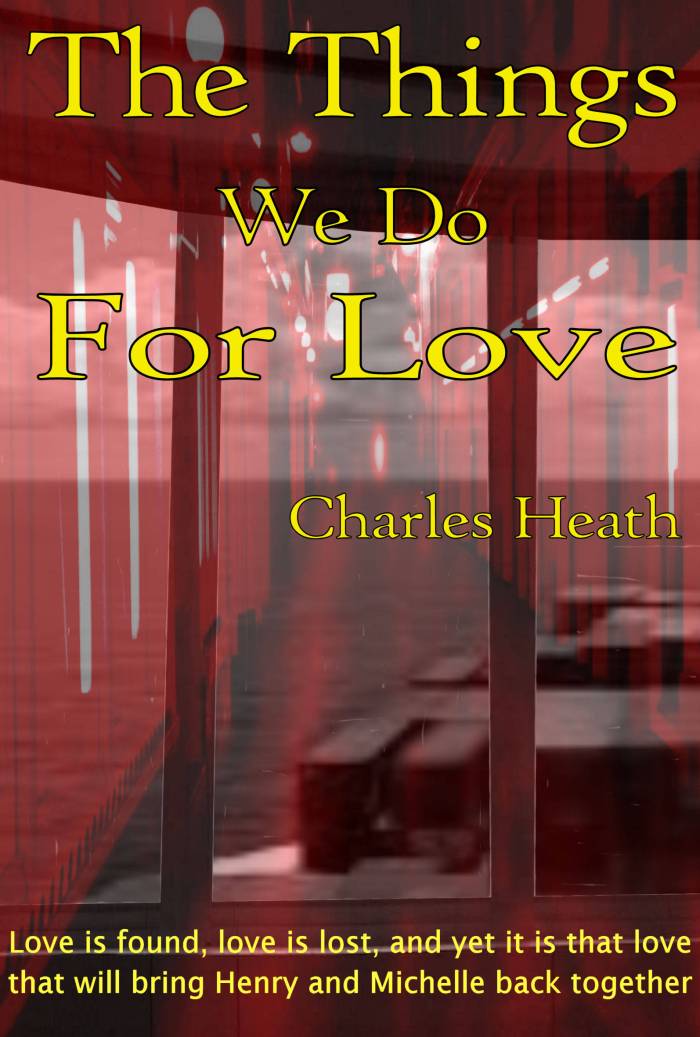
An excerpt from “The Things We Do For Love”; In love, Henry was all at sea!

In the distance he could hear the dinner bell ringing and roused himself.  Feeling the dampness of the pillow, and fearing the ravages of pent up emotion, he considered not going down but thought it best not to upset Mrs. Mac, especially after he said he would be dining.

In the event, he wished he had reneged, especially when he discovered he was not the only guest staying at the hotel.

Whilst he’d been reminiscing, another guest, a young lady, had arrived.  He’d heard her and Mrs. Mac coming up the stairs, and then shown to a room on the same floor, perhaps at the other end of the passage.

Henry caught his first glimpse of her when she appeared at the door to the dining room, waiting for Mrs. Mac to show her to a table.

She was about mid-twenties, slim, long brown hair, and the grace and elegance of a woman associated with countless fashion magazines.  She was, he thought, stunningly beautiful with not a hair out of place, and make-up flawlessly applied.  Her clothes were black, simple, elegant, and expensive, the sort an heiress or wife of a millionaire might condescend to wear to a lesser occasion than dinner.

Then there was her expression; cold, forbidding, almost frightening in its intensity.  And her eyes, piercingly blue and yet laced with pain.  Dracula’s daughter was his immediate description of her.

All in all, he considered, the only thing they had in common was, like him, she seemed totally out of place.

Mrs. Mac came out of the kitchen, wiping her hands on her apron.  She was, she informed him earlier, chef, waitress, hotelier, barmaid, and cleaner all rolled into one.  Coming up to the new arrival she said, “Ah, Miss Andrews, I’m glad you decided to have dinner.  Would you like to sit with Mr. Henshaw, or would you like to have a table of your own?”

Henry could feel her icy stare as she sized up his appeal as a dining companion, making the hair on the back on his neck stand up.  He purposely didn’t look back.  In his estimation, his appeal rating was minus six.  Out of a thousand!

“If Mr. Henshaw doesn’t mind….”  She looked at him, leaving the query in mid-air.

He didn’t mind and said so.  Perhaps he’d underestimated his rating.

“Good.”  Mrs. Mac promptly ushered her over.  Henry stood, made sure she was seated properly and sat.

“Thank you.  You are most kind.”  The way she said it suggested snobbish overtones.

“I try to be when I can.”  It was supposed to nullify her sarcastic tone but made him sound a little silly, and when she gave him another of her icy glares, he regretted it.

Mrs. Mac quickly intervened, asking, “Would you care for the soup?”

They did, and, after writing the order on her pad, she gave them each a look, imperceptibly shook her head, and returned to the kitchen.

Before Michelle spoke to him again, she had another quick look at him, trying to fathom who and what he might be.  There was something about him.

His eyes, they mirrored the same sadness she felt, and, yes, there was something else, that it looked like he had been crying?  There was a tinge of redness.

Perhaps, she thought, he was here for the same reason she was.

No.  That wasn’t possible.

Then she said, without thinking, “Do you have any particular reason for coming here?”  Seconds later she realized she’s spoken it out loud, had hadn’t meant to actually ask, it just came out.

It took him by surprise, obviously not the first question he was expecting her to ask of him.

“No, other than it is as far from civilization, and home, as I could get.”

At least we agree on that, she thought.

It was obvious he was running away from something as well.

Given the isolation of the village and lack of geographic hospitality, it was, from her point of view, ideal.  All she had to do was avoid him, and that wouldn’t be difficult.

After getting through this evening first.

“Yes,” she agreed.  “It is that.”

A few seconds passed, and she thought she could feel his eyes on her and wasn’t going to look up.

Until he asked, “What’s your reason?”

Slight abrupt in manner, perhaps as a result of her question, and the manner in which she asked it.

She looked up.  “Rest.  And have some time to myself.”

She hoped he would notice the emphasis she had placed on the word ‘herself’ and take due note.  No doubt, she thought,  she had completely different ideas of what constituted a holiday than he, not that she had actually said she was here for a holiday.

Mrs. Mac arrived at a fortuitous moment to save them from further conversation.


Over the entree, she wondered if she had made a mistake coming to the hotel.  Of course, there had been no possible way she could know than anyone else might have booked the same hotel, but realized it was foolish to think she might end up in it by herself.

Was that what she was expecting?

Not a mistake then, but an unfortunate set of circumstances, which could be overcome by being sensible.

Yet, there he was, and it made her curious, not that he was a man, by himself, in the middle of nowhere, hiding like she was, but for very different reasons.

On discreet observance whilst they ate, she gained the impression his air of light-heartedness was forced and he had no sense of humor.

This feeling was engendered by his looks, unruly dark hair, and permanent frown.  And then there was his abysmal taste in clothes on a tall, lanky frame.  They were quality but totally unsuited to the wearer.

Rebellion was written all over him.

The only other thought crossing her mind, and rather incongruously, was he could do with a decent feed.  In that respect, she knew now from the mountain of food in front of her, he had come to the right place.

“Mr. Henshaw?”

He looked up.  “Henshaw is too formal.  Henry sounds much better,” he said, with a slight hint of gruffness.

“Then my name is Michelle.”

Mrs. Mac came in to take their order for the only main course, gather up the entree dishes, then return to the kitchen.

“Staying long?” she asked.

“About three weeks.  Yourself?”

“About the same.”

The conversation dried up.

Neither looked at the other, rather at the walls, out the window, towards the kitchen, anywhere.  It was, she thought, almost unbearably awkward.


Mrs. Mac returned with a large tray with dishes on it, setting it down on the table next to theirs.

“Not as good as the usual cook,” she said, serving up the dinner expertly, “but it comes a good second, even if I do say so myself.  Care for some wine?”

Henry looked at Michelle.  “What do you think?”

“I’m used to my dining companions making the decision.”

You would, he thought.  He couldn’t help but notice the cutting edge of her tone.  Then, to Mrs. Mac, he named a particular White Burgundy he liked and she bustled off.

“I hope you like it,” he said, acknowledging her previous comment with a smile that had nothing to do with humor.

“Yes, so do I.”

Both made a start on the main course, a concoction of chicken and vegetables that were delicious, Henry thought, when compared to the bland food he received at home and sometimes aboard my ship.

It was five minutes before Mrs. Mac returned with the bottle and two glasses.  After opening it and pouring the drinks, she left them alone again.

Henry resumed the conversation.  “How did you arrive?  I came by train.”

“By car.”

“Did you drive yourself?”

And he thought, a few seconds later, that was a silly question, otherwise she would not be alone, and certainly not sitting at this table. With him.

“After a fashion.”

He could see that she was formulating a retort in her mind, then changed it, instead, smiling for the first time, and it served to lighten the atmosphere.

And in doing so, it showed him she had another more pleasant side despite the fact she was trying not to look happy.

“My father reckons I’m just another of ‘those’ women drivers,” she added.

“Whatever for?”

“The first and only time he came with me I had an accident.  I ran up the back of another car.  Of course, it didn’t matter to him the other driver was driving like a startled rabbit.”

“It doesn’t help,” he agreed.

“Do you drive?”

“Mostly people up the wall.”  His attempt at humor failed.  “Actually,” he added quickly, “I’ve got a very old Morris that manages to get me where I’m going.”

The apple pie and cream for dessert came and went and the rapport between them improved as the wine disappeared and the coffee came.  Both had found, after getting to know each other better, their first impressions were not necessarily correct.

“Enjoy the food?” Mrs. Mac asked, suddenly reappearing.

“Beautifully cooked and delicious to eat,” Michelle said, and Henry endorsed her remarks.

“Ah, it does my heart good to hear such genuine compliments,” she said, smiling.  She collected the last of the dishes and disappeared yet again.

“What do you do for a living,” Michelle asked in an off-hand manner.

He had a feeling she was not particularly interested and it was just making conversation.

“I’m a purser.”

“A what?”

“A purser.  I work on a ship doing the paperwork, that sort of thing.”

“I see.”

“And you?”

“I was a model.”

“Was?”

“Until I had an accident, a rather bad one.”

“Oh, I’m sorry.”

So that explained the odd feeling he had about her.

As the evening had worn on, he began to think there might be something wrong, seriously wrong with her because she didn’t look too well.  Even the carefully applied makeup, from close up, didn’t hide the very pale, and tired look, or the sunken, dark ringed eyes.

“I try not to think about it, but it doesn’t necessarily work.  I’ve come here for peace and quiet, away from doctors and parents.”

“Then you will not have to worry about me annoying you.  I’m one of those fall-asleep-reading-a-book types.”

Perhaps it would be like ships passing in the night and then smiled to himself about the analogy.

Dinner now over, they separated.

Henry went back to the lounge to read a few pages of his book before going to bed, and Michelle went up to her room to retire for the night.

But try as he might, he was unable to read, his mind dwelling on the unusual, yet the compellingly mysterious person he would be sharing the hotel with.

Overlaying that original blurred image of her standing in the doorway was another of her haunting expressions that had, he finally conceded, taken his breath away, and a look that had sent more than one tingle down his spine.

She may not have thought much of him, but she had certainly made an impression on him.


© Charles Heath 2015-2020
lovecoverfinal1

“Quickly, quickly…” – a short story


It was odd having a voice in your head, well, not really in your head as such, but in your ear, and sounding like it was in your head.

You could truthfully say you were hearing voices.

It was the next step after going through some very intensive training, having someone else as your eyes and ears when breaching a secure compound, and avoiding the enemy.

I’d signed on for this extra training thinking one day it would land me in the thick of the action. Some of the others thought I was mad, but someone had to do it, and the fact it was quite dangerous added just that extra bit to it.

But as they say, what you learn in training, and practise in a non-hostile environment, is nothing like being in that same situation in reality.

Now on was on my first assignment, part of an elite team, packed and taken to what was to everyone else, an unspecified location, but to us, it was the point of incursion.

The mission?

To rescue a government official (that was how he was described to us) who had been illegally detained in a foreign prison.

Our job?

To break him out and get out without the knowledge of the prison staff, or anyone representing that government. Yes, what we were doing was highly illegal, and yes, if we were caught it was more likely than not we would be executed as spies.

We were under cover in an abandoned farmhouse about three miles from the prison. We had been brought in under cover of darkness, and had only a few hours to set up, and then wait it out until the following night.

It was now or never, the weather people predicting that there would be sufficient cloud cover to make us invisible. Two of us were going in, and two remaining strategically placed outside to monitor the inside of the prison through a system of infrared scanners. We also had a floor plan of the building in which the prisoner was being held, and intelligence supplied, supposedly, by one of the prison guards who had been paid a lot of money for information on guard movements.

To me, it was a gigantic leap of faith to trust him, but I kept those thoughts to myself.

We had been over the plan a dozen times, and I’d gone through the passageways, rooms, and doors so many times I’d memorised where they were and would be able to traverse the building as if I had worked there for a lifetime. Having people outside, talking me through it was just an added benefit, along with alerts on how near the guards were to our position.

I was sure the other person going with me, a more seasoned professional who had a number of successful missions under his belt, was going through the same motions I was. After all, it was he who had devised and conducted the training.

There was a free period of several hours before departure, time to listen to some music, empty the head of unwanted thoughts, and get into the right mindset. It was no place to get tangled up in what-ifs, if anything went wrong, it was a simple matter of adapting.

Our training had reinforced the necessity to instantly gauge a situation and make changes on the fly. There would literally be no time to think.

I listened to the nuances of Chopin’s piano concertos, pretending to play the piano myself, having translated every note onto a piano key, and observing it in my mind’s eye.

My opposite number played games of chess in his head. We all had a different method of relaxing.

Until it was 22:00 hours, and time to go.

“Go left, no, hang on, go right.” The voice on my ear sounded confused and it was possible to get lefts and rights mixed up, if you were not careful.

It didn’t faze me, I knew from my study of the plans that once inside the perimeter fence, I had to go right, and head towards a concrete building the roof of which was barely above the ground.

It was once used as a helipad, and underneath, before the site became a prison, the space was used to make munitions. And it was an exceptionally large space that practically ran under the whole of the prison, built above ground.

All that had happened was the lower levels were sealed, covered over and the new structures built on top. Our access was going to be from under the ground.

Quite literally, they would not see, or hear, us coming.

The meteorological people had got it right, there was cloud cover, the moon hidden from view, and the whole perimeter was in inky darkness. Dressed in black from head to foot, the hope was we would be invisible.

There were two of us heading to the same spot, stairs that led down to a door that was once one of the entrances to the underground bunker. We were going separate ways in case one of the other was intercepted in an unforeseen event.

But, that part of the plan worked seamlessly, and we both arrived at the same place nearly at the same time.

Without the planning, we might easily have missed it because I didn’t think it would be discernable even in daylight.

I followed the Sergeant downstairs, keeping a watchful eye behind us. I stooped at the point where I could see down, and across the area we had just traversed.

Nothing else was stirring.

As expected, the door was seamless and without an apparent handle. It may have had one once, but not anymore, so anyone who did stumble across it, couldn’t get in.

Except us. We had special explosives that were designed to break the lock, and once set, would not make a lot of noise. Sixty seconds later we were inside, and the door closed so no one would know we’d broken in.

I was carrying a beacon so that the voice in my head could follow my progress. The sergeant had one too, and he led.

“Straight ahead, 200 yards, then another door. It shouldn’t be locked, but it might be closed.”

In other words, we had no way of knowing. Our informant had said no one had been down in the dungeons, as he called them, since the munition factory closed, and had been sealed up soon after the prison building had been handed over for use.

We were using night goggles, and there was a lot of rubbish strewn over the floor area so we had to carefully pick our way through which took time we really didn’t have. It looked as though our informant was right, no one had been down there for a long time. We were leaving boot prints in the dust.

We reached the door ten minutes later than estimated. Losing time would have a flow-on effect, and this operation was on a very tight time constraint.

“Once you are through the door, there’s a passage. Turn left and go about 50 paces. There should be another passage to your right.”

“Anyone down here?”

“No, but there is a half dozen prison officers above you. Standard patrol, from guardhouse to guardhouse. Unless they can hear you through five feet of solid concrete, you’re safe.”

My instincts told me five feet of concrete were not enough, but I’ll let it ride for the moment.

The door was slightly ajar and it took the two of us to pull it open so that we could get past. Behind it was the passage, going left and right. Trusting my invisible guide was not getting mixed up again, I motioned right, and we headed down the passage.

Despite the fact we should be alone, both of us were careful not to make any noise, and trod carefully.

At 50 or so paces, the passage came into sight. The sergeant went ahead. I stayed back and kept an eye in both directions. The passage before us was the one that would take us under the cell of the captive we were sent to retrieve.

There would be no blasting our way in. The floor to the cell had a grate, and when removed, a person could drop down into the ‘dungeon’. Currently, the grate was immovable, but we had the tools to fix that.

The sergeant would verify the grate was where it was supposed to be, then come back to get me.

Five minutes passed, then ten. It was not that far away.

I was about to go search when the voice in my head returned, but with panic. “We’ve been compromised. Get the hell out of there, now. Quickly…”

Then I heard what sounded like gunshots, then nothing.

A minute later there was a new voice. “I don’t know who you are, but I’d strongly advise you give yourself up to the guards. Failure to do so within one hour, I’ll execute the two men I now have in custody.”

Ahead of me there was a sudden explosion, followed by a cloud of dust and fine debris.

Hand grenade, or mine, it didn’t matter. The sergeant wouldn’t be coming back.

I sighed.

Plan B it was.

© Charles Heath 2021

An excerpt from “The Things We Do For Love”; In love, Henry was all at sea!

In the distance he could hear the dinner bell ringing and roused himself.  Feeling the dampness of the pillow, and fearing the ravages of pent up emotion, he considered not going down but thought it best not to upset Mrs. Mac, especially after he said he would be dining.

In the event, he wished he had reneged, especially when he discovered he was not the only guest staying at the hotel.

Whilst he’d been reminiscing, another guest, a young lady, had arrived.  He’d heard her and Mrs. Mac coming up the stairs, and then shown to a room on the same floor, perhaps at the other end of the passage.

Henry caught his first glimpse of her when she appeared at the door to the dining room, waiting for Mrs. Mac to show her to a table.

She was about mid-twenties, slim, long brown hair, and the grace and elegance of a woman associated with countless fashion magazines.  She was, he thought, stunningly beautiful with not a hair out of place, and make-up flawlessly applied.  Her clothes were black, simple, elegant, and expensive, the sort an heiress or wife of a millionaire might condescend to wear to a lesser occasion than dinner.

Then there was her expression; cold, forbidding, almost frightening in its intensity.  And her eyes, piercingly blue and yet laced with pain.  Dracula’s daughter was his immediate description of her.

All in all, he considered, the only thing they had in common was, like him, she seemed totally out of place.

Mrs. Mac came out of the kitchen, wiping her hands on her apron.  She was, she informed him earlier, chef, waitress, hotelier, barmaid, and cleaner all rolled into one.  Coming up to the new arrival she said, “Ah, Miss Andrews, I’m glad you decided to have dinner.  Would you like to sit with Mr. Henshaw, or would you like to have a table of your own?”

Henry could feel her icy stare as she sized up his appeal as a dining companion, making the hair on the back on his neck stand up.  He purposely didn’t look back.  In his estimation, his appeal rating was minus six.  Out of a thousand!

“If Mr. Henshaw doesn’t mind….”  She looked at him, leaving the query in mid-air.

He didn’t mind and said so.  Perhaps he’d underestimated his rating.

“Good.”  Mrs. Mac promptly ushered her over.  Henry stood, made sure she was seated properly and sat.

“Thank you.  You are most kind.”  The way she said it suggested snobbish overtones.

“I try to be when I can.”  It was supposed to nullify her sarcastic tone but made him sound a little silly, and when she gave him another of her icy glares, he regretted it.

Mrs. Mac quickly intervened, asking, “Would you care for the soup?”

They did, and, after writing the order on her pad, she gave them each a look, imperceptibly shook her head, and returned to the kitchen.

Before Michelle spoke to him again, she had another quick look at him, trying to fathom who and what he might be.  There was something about him.

His eyes, they mirrored the same sadness she felt, and, yes, there was something else, that it looked like he had been crying?  There was a tinge of redness.

Perhaps, she thought, he was here for the same reason she was.

No.  That wasn’t possible.

Then she said, without thinking, “Do you have any particular reason for coming here?”  Seconds later she realized she’s spoken it out loud, had hadn’t meant to actually ask, it just came out.

It took him by surprise, obviously not the first question he was expecting her to ask of him.

“No, other than it is as far from civilization, and home, as I could get.”

At least we agree on that, she thought.

It was obvious he was running away from something as well.

Given the isolation of the village and lack of geographic hospitality, it was, from her point of view, ideal.  All she had to do was avoid him, and that wouldn’t be difficult.

After getting through this evening first.

“Yes,” she agreed.  “It is that.”

A few seconds passed, and she thought she could feel his eyes on her and wasn’t going to look up.

Until he asked, “What’s your reason?”

Slight abrupt in manner, perhaps as a result of her question, and the manner in which she asked it.

She looked up.  “Rest.  And have some time to myself.”

She hoped he would notice the emphasis she had placed on the word ‘herself’ and take due note.  No doubt, she thought,  she had completely different ideas of what constituted a holiday than he, not that she had actually said she was here for a holiday.

Mrs. Mac arrived at a fortuitous moment to save them from further conversation.


Over the entree, she wondered if she had made a mistake coming to the hotel.  Of course, there had been no possible way she could know than anyone else might have booked the same hotel, but realized it was foolish to think she might end up in it by herself.

Was that what she was expecting?

Not a mistake then, but an unfortunate set of circumstances, which could be overcome by being sensible.

Yet, there he was, and it made her curious, not that he was a man, by himself, in the middle of nowhere, hiding like she was, but for very different reasons.

On discreet observance whilst they ate, she gained the impression his air of light-heartedness was forced and he had no sense of humor.

This feeling was engendered by his looks, unruly dark hair, and permanent frown.  And then there was his abysmal taste in clothes on a tall, lanky frame.  They were quality but totally unsuited to the wearer.

Rebellion was written all over him.

The only other thought crossing her mind, and rather incongruously, was he could do with a decent feed.  In that respect, she knew now from the mountain of food in front of her, he had come to the right place.

“Mr. Henshaw?”

He looked up.  “Henshaw is too formal.  Henry sounds much better,” he said, with a slight hint of gruffness.

“Then my name is Michelle.”

Mrs. Mac came in to take their order for the only main course, gather up the entree dishes, then return to the kitchen.

“Staying long?” she asked.

“About three weeks.  Yourself?”

“About the same.”

The conversation dried up.

Neither looked at the other, rather at the walls, out the window, towards the kitchen, anywhere.  It was, she thought, almost unbearably awkward.


Mrs. Mac returned with a large tray with dishes on it, setting it down on the table next to theirs.

“Not as good as the usual cook,” she said, serving up the dinner expertly, “but it comes a good second, even if I do say so myself.  Care for some wine?”

Henry looked at Michelle.  “What do you think?”

“I’m used to my dining companions making the decision.”

You would, he thought.  He couldn’t help but notice the cutting edge of her tone.  Then, to Mrs. Mac, he named a particular White Burgundy he liked and she bustled off.

“I hope you like it,” he said, acknowledging her previous comment with a smile that had nothing to do with humor.

“Yes, so do I.”

Both made a start on the main course, a concoction of chicken and vegetables that were delicious, Henry thought, when compared to the bland food he received at home and sometimes aboard my ship.

It was five minutes before Mrs. Mac returned with the bottle and two glasses.  After opening it and pouring the drinks, she left them alone again.

Henry resumed the conversation.  “How did you arrive?  I came by train.”

“By car.”

“Did you drive yourself?”

And he thought, a few seconds later, that was a silly question, otherwise she would not be alone, and certainly not sitting at this table. With him.

“After a fashion.”

He could see that she was formulating a retort in her mind, then changed it, instead, smiling for the first time, and it served to lighten the atmosphere.

And in doing so, it showed him she had another more pleasant side despite the fact she was trying not to look happy.

“My father reckons I’m just another of ‘those’ women drivers,” she added.

“Whatever for?”

“The first and only time he came with me I had an accident.  I ran up the back of another car.  Of course, it didn’t matter to him the other driver was driving like a startled rabbit.”

“It doesn’t help,” he agreed.

“Do you drive?”

“Mostly people up the wall.”  His attempt at humor failed.  “Actually,” he added quickly, “I’ve got a very old Morris that manages to get me where I’m going.”

The apple pie and cream for dessert came and went and the rapport between them improved as the wine disappeared and the coffee came.  Both had found, after getting to know each other better, their first impressions were not necessarily correct.

“Enjoy the food?” Mrs. Mac asked, suddenly reappearing.

“Beautifully cooked and delicious to eat,” Michelle said, and Henry endorsed her remarks.

“Ah, it does my heart good to hear such genuine compliments,” she said, smiling.  She collected the last of the dishes and disappeared yet again.

“What do you do for a living,” Michelle asked in an off-hand manner.

He had a feeling she was not particularly interested and it was just making conversation.

“I’m a purser.”

“A what?”

“A purser.  I work on a ship doing the paperwork, that sort of thing.”

“I see.”

“And you?”

“I was a model.”

“Was?”

“Until I had an accident, a rather bad one.”

“Oh, I’m sorry.”

So that explained the odd feeling he had about her.

As the evening had worn on, he began to think there might be something wrong, seriously wrong with her because she didn’t look too well.  Even the carefully applied makeup, from close up, didn’t hide the very pale, and tired look, or the sunken, dark ringed eyes.

“I try not to think about it, but it doesn’t necessarily work.  I’ve come here for peace and quiet, away from doctors and parents.”

“Then you will not have to worry about me annoying you.  I’m one of those fall-asleep-reading-a-book types.”

Perhaps it would be like ships passing in the night and then smiled to himself about the analogy.

Dinner now over, they separated.

Henry went back to the lounge to read a few pages of his book before going to bed, and Michelle went up to her room to retire for the night.

But try as he might, he was unable to read, his mind dwelling on the unusual, yet the compellingly mysterious person he would be sharing the hotel with.

Overlaying that original blurred image of her standing in the doorway was another of her haunting expressions that had, he finally conceded, taken his breath away, and a look that had sent more than one tingle down his spine.

She may not have thought much of him, but she had certainly made an impression on him.


© Charles Heath 2015-2020

lovecoverfinal1

“Many have come, few have stayed” – a short story


It was true to say that very few people knew our department existed. In fact, I was not sure quite who it was I worked for, but when I’d been first tasked with the assignment, a transfer precipitated by a transgression that might have ended my career, I was certain I had been sent to purgatory.

At least, that’s what the sign on the door said.

The office, if it could be called that, was in the basement, around so many twists and turns in the passages that it was easy to believe you had entered another dimension. It wasn’t located in the building you walked through the front door of, but somewhere else nearby. Through the walls, you could hear the sounds of cars, but whether it was a nearby road above the ceiling, or they were parking, it was not easy to say.

On another side, the sounds of trains passing through tunnels were barely discernible, and sometimes only noticeable by a slight vibration of the coffee mug on the desktop, of which there were four, the maximum number of occupants in the small area, but I have never seen who two of the other four were.

Such was the nature of our job. We operated in secret, hidden from the world, and the others. I was never quite sure why.

The interview, when I thought was going to be fired, was given by an old man in a pinstripe suit, long past the age of retirement. In fact, had I not known better, I would have said he was dead, and all that was missing was the cobwebs. He had no sense of humor and got straight to the point.

“You are being transferred to PIB effective immediately.”

He didn’t say what PIB stood for, and the no-nonsense tone told me this was not the time to ask.

“Many have come, but few have stayed. It’s not a job to be taken lightly, and a word of advice, the work you are about to undertake is not to be discussed with anyone but the person you have been assigned to work with.”

He then handed me an envelope, sealed, and that was the end of the interview.

I did not get to speak a word. I had this speech memorized, ready to explain why I had failed so badly, and what I was prepared to do to make up for it, but I was not given the opportunity. Perhaps I should just be grateful I was given another chance.

I waited until I was out of the building, and a block away in a small cafe, and the cheerful waitress had brought my coffee and cake. It was, in a small way, a celebration I still had a job, working for the organization I had set my sights on way back when I was in school.

Making sure no one was sitting too close; I opened the envelope and took out the neatly folded sheet of paper.

It was blank.

Was this some sort of joke?

There was a loud noise outside in the street, a car backfiring, and it caused a few anxious moments, particularly for me in case it was trouble, but it wasn’t. When normality returned I went back to the sheet of paper, picking it up off the top of the coffee cup where it had fallen, and something caught my eye.

Writing. Specifically, numbers, but what I thought I’d seen had disappeared, or hadn’t been there at all.

A shake of the head, perplexed, to say the least, I took a sip of the coffee. As the cup passed under the sheet, a pattern was discernible, displaying then disappearing. Bringing the cup back under the sheet, numbers suddenly appeared. It was a telephone number. It was also very cloak and daggers.

Was it a test? Because at that moment when I saw the blank sheet of paper, the meaning was very clear. It was a puzzle, and if I didn’t work it out, then I didn’t get the job. I’d simply been told to turn up at an anonymous building to see a man whom I doubted would answer to the name I’d been given to ask for again after I left.

I entered the number then pressed ‘call’.

Seven rings before a woman’s voice answered, “Yes?”

No names, no identification.

“Mr McCall gave me an envelope with this number in it.”

“You worked it out?” She sounded surprised.

“By accident, yes.”

“Well, four out of five candidates don’t. Consider this to be your lucky morning, the day is not over yet. Where are you?”

I told her.

“Then you’re not far from Central Park. Go to the souvenir store and wait.”

“How will I know you?”

“You won’t, I’ll recognize you.”

Then the phone went dead, and I was left looking at it as if I had the ability to see, via the phone, who that person was. I shrugged. How many others had failed even the most basic test, to figure out what was on the sheet of paper, and, was it an indication of the work I would be doing?

I spent the better part of an hour watching the squirrels at play. They scuttled around on the ground chasing each other or their imaginary friends or leaping from branch to branch in the shrubs and trees. They didn’t seem to have a care in the world, and I wondered what that would be like.

Unfortunately, I had to pay the rent, bills, and eat, all of which required having a paying job. I had been looking at having to return home a dismal failure and fulfil the destiny my father had predicted for me.

“David Jackson, I presume?”

I looked sideways to see a woman about my own age, dressed so that she would look anonymous in a crowd. It was anyone’s guess how long she had been there, but that, I guess was the point. She had been observing me, and no doubt assessing my suitability.

Could I blend in? Perhaps not if I was that easily identifiable.

“I am.”

“What if anything has been explained to you about the job?”

“Nothing. I was asked to meet a nameless man in an anonymous office and was handed an envelope which led to my call to you.”

After I said it out loud it sounded crazy.

“If you don’t mind me asking but how did you work out how to read the letter?”

Moment of truth, was there a right or wrong answer? Most if not all the people who received it would not work it out.

“Quite by accident.”

She smiled. “The truth is a rare commodity in our business. But then, you’re one of a very select group of people who made it to this level.”

“Just out of curiosity, what happens to those who done work out how to read the number?”

“They don’t get to stand where you are. Welcome aboard.”

© Charles Heath 2021