An excerpt from “The Things We Do For Love”; In love, Henry was all at sea!

In the distance he could hear the dinner bell ringing and roused himself.  Feeling the dampness of the pillow, and fearing the ravages of pent up emotion, he considered not going down but thought it best not to upset Mrs. Mac, especially after he said he would be dining.

In the event, he wished he had reneged, especially when he discovered he was not the only guest staying at the hotel.

Whilst he’d been reminiscing, another guest, a young lady, had arrived.  He’d heard her and Mrs. Mac coming up the stairs, and then shown to a room on the same floor, perhaps at the other end of the passage.

Henry caught his first glimpse of her when she appeared at the door to the dining room, waiting for Mrs. Mac to show her to a table.

She was about mid-twenties, slim, long brown hair, and the grace and elegance of a woman associated with countless fashion magazines.  She was, he thought, stunningly beautiful with not a hair out of place, and make-up flawlessly applied.  Her clothes were black, simple, elegant, and expensive, the sort an heiress or wife of a millionaire might condescend to wear to a lesser occasion than dinner.

Then there was her expression; cold, forbidding, almost frightening in its intensity.  And her eyes, piercingly blue and yet laced with pain.  Dracula’s daughter was his immediate description of her.

All in all, he considered, the only thing they had in common was, like him, she seemed totally out of place.

Mrs. Mac came out of the kitchen, wiping her hands on her apron.  She was, she informed him earlier, chef, waitress, hotelier, barmaid, and cleaner all rolled into one.  Coming up to the new arrival she said, “Ah, Miss Andrews, I’m glad you decided to have dinner.  Would you like to sit with Mr. Henshaw, or would you like to have a table of your own?”

Henry could feel her icy stare as she sized up his appeal as a dining companion, making the hair on the back on his neck stand up.  He purposely didn’t look back.  In his estimation, his appeal rating was minus six.  Out of a thousand!

“If Mr. Henshaw doesn’t mind….”  She looked at him, leaving the query in mid-air.

He didn’t mind and said so.  Perhaps he’d underestimated his rating.

“Good.”  Mrs. Mac promptly ushered her over.  Henry stood, made sure she was seated properly and sat.

“Thank you.  You are most kind.”  The way she said it suggested snobbish overtones.

“I try to be when I can.”  It was supposed to nullify her sarcastic tone but made him sound a little silly, and when she gave him another of her icy glares, he regretted it.

Mrs. Mac quickly intervened, asking, “Would you care for the soup?”

They did, and, after writing the order on her pad, she gave them each a look, imperceptibly shook her head, and returned to the kitchen.

Before Michelle spoke to him again, she had another quick look at him, trying to fathom who and what he might be.  There was something about him.

His eyes, they mirrored the same sadness she felt, and, yes, there was something else, that it looked like he had been crying?  There was a tinge of redness.

Perhaps, she thought, he was here for the same reason she was.

No.  That wasn’t possible.

Then she said, without thinking, “Do you have any particular reason for coming here?”  Seconds later she realized she’s spoken it out loud, had hadn’t meant to actually ask, it just came out.

It took him by surprise, obviously not the first question he was expecting her to ask of him.

“No, other than it is as far from civilization, and home, as I could get.”

At least we agree on that, she thought.

It was obvious he was running away from something as well.

Given the isolation of the village and lack of geographic hospitality, it was, from her point of view, ideal.  All she had to do was avoid him, and that wouldn’t be difficult.

After getting through this evening first.

“Yes,” she agreed.  “It is that.”

A few seconds passed, and she thought she could feel his eyes on her and wasn’t going to look up.

Until he asked, “What’s your reason?”

Slight abrupt in manner, perhaps as a result of her question, and the manner in which she asked it.

She looked up.  “Rest.  And have some time to myself.”

She hoped he would notice the emphasis she had placed on the word ‘herself’ and take due note.  No doubt, she thought,  she had completely different ideas of what constituted a holiday than he, not that she had actually said she was here for a holiday.

Mrs. Mac arrived at a fortuitous moment to save them from further conversation.


Over the entree, she wondered if she had made a mistake coming to the hotel.  Of course, there had been no possible way she could know than anyone else might have booked the same hotel, but realized it was foolish to think she might end up in it by herself.

Was that what she was expecting?

Not a mistake then, but an unfortunate set of circumstances, which could be overcome by being sensible.

Yet, there he was, and it made her curious, not that he was a man, by himself, in the middle of nowhere, hiding like she was, but for very different reasons.

On discreet observance whilst they ate, she gained the impression his air of light-heartedness was forced and he had no sense of humor.

This feeling was engendered by his looks, unruly dark hair, and permanent frown.  And then there was his abysmal taste in clothes on a tall, lanky frame.  They were quality but totally unsuited to the wearer.

Rebellion was written all over him.

The only other thought crossing her mind, and rather incongruously, was he could do with a decent feed.  In that respect, she knew now from the mountain of food in front of her, he had come to the right place.

“Mr. Henshaw?”

He looked up.  “Henshaw is too formal.  Henry sounds much better,” he said, with a slight hint of gruffness.

“Then my name is Michelle.”

Mrs. Mac came in to take their order for the only main course, gather up the entree dishes, then return to the kitchen.

“Staying long?” she asked.

“About three weeks.  Yourself?”

“About the same.”

The conversation dried up.

Neither looked at the other, rather at the walls, out the window, towards the kitchen, anywhere.  It was, she thought, almost unbearably awkward.


Mrs. Mac returned with a large tray with dishes on it, setting it down on the table next to theirs.

“Not as good as the usual cook,” she said, serving up the dinner expertly, “but it comes a good second, even if I do say so myself.  Care for some wine?”

Henry looked at Michelle.  “What do you think?”

“I’m used to my dining companions making the decision.”

You would, he thought.  He couldn’t help but notice the cutting edge of her tone.  Then, to Mrs. Mac, he named a particular White Burgundy he liked and she bustled off.

“I hope you like it,” he said, acknowledging her previous comment with a smile that had nothing to do with humor.

“Yes, so do I.”

Both made a start on the main course, a concoction of chicken and vegetables that were delicious, Henry thought, when compared to the bland food he received at home and sometimes aboard my ship.

It was five minutes before Mrs. Mac returned with the bottle and two glasses.  After opening it and pouring the drinks, she left them alone again.

Henry resumed the conversation.  “How did you arrive?  I came by train.”

“By car.”

“Did you drive yourself?”

And he thought, a few seconds later, that was a silly question, otherwise she would not be alone, and certainly not sitting at this table. With him.

“After a fashion.”

He could see that she was formulating a retort in her mind, then changed it, instead, smiling for the first time, and it served to lighten the atmosphere.

And in doing so, it showed him she had another more pleasant side despite the fact she was trying not to look happy.

“My father reckons I’m just another of ‘those’ women drivers,” she added.

“Whatever for?”

“The first and only time he came with me I had an accident.  I ran up the back of another car.  Of course, it didn’t matter to him the other driver was driving like a startled rabbit.”

“It doesn’t help,” he agreed.

“Do you drive?”

“Mostly people up the wall.”  His attempt at humor failed.  “Actually,” he added quickly, “I’ve got a very old Morris that manages to get me where I’m going.”

The apple pie and cream for dessert came and went and the rapport between them improved as the wine disappeared and the coffee came.  Both had found, after getting to know each other better, their first impressions were not necessarily correct.

“Enjoy the food?” Mrs. Mac asked, suddenly reappearing.

“Beautifully cooked and delicious to eat,” Michelle said, and Henry endorsed her remarks.

“Ah, it does my heart good to hear such genuine compliments,” she said, smiling.  She collected the last of the dishes and disappeared yet again.

“What do you do for a living,” Michelle asked in an off-hand manner.

He had a feeling she was not particularly interested and it was just making conversation.

“I’m a purser.”

“A what?”

“A purser.  I work on a ship doing the paperwork, that sort of thing.”

“I see.”

“And you?”

“I was a model.”

“Was?”

“Until I had an accident, a rather bad one.”

“Oh, I’m sorry.”

So that explained the odd feeling he had about her.

As the evening had worn on, he began to think there might be something wrong, seriously wrong with her because she didn’t look too well.  Even the carefully applied makeup, from close up, didn’t hide the very pale, and tired look, or the sunken, dark ringed eyes.

“I try not to think about it, but it doesn’t necessarily work.  I’ve come here for peace and quiet, away from doctors and parents.”

“Then you will not have to worry about me annoying you.  I’m one of those fall-asleep-reading-a-book types.”

Perhaps it would be like ships passing in the night and then smiled to himself about the analogy.

Dinner now over, they separated.

Henry went back to the lounge to read a few pages of his book before going to bed, and Michelle went up to her room to retire for the night.

But try as he might, he was unable to read, his mind dwelling on the unusual, yet the compellingly mysterious person he would be sharing the hotel with.

Overlaying that original blurred image of her standing in the doorway was another of her haunting expressions that had, he finally conceded, taken his breath away, and a look that had sent more than one tingle down his spine.

She may not have thought much of him, but she had certainly made an impression on him.


© Charles Heath 2015-2020
lovecoverfinal1

‘Sunday in New York’ – A beta reader’s view

I’m not a fan of romance novels but …

There was something about this one that resonated with me.

This is a novel about a world generally ruled by perception, and how people perceive what they see, what they are told, and what they want to believe.

I’ve been guilty of it myself as I’m sure we all gave one time or another.

For the the main characters Harry and Alison there is others issues driving their relationship.

For Alison, it is a loss of self worth through losing her job and from losing her mother and, in a sense, her sister.

For Harry it is the fact he has a beautiful and desirable wife, and his belief she is the object of other men’s desires, and one in particular, his immediate superior.

Between observation, the less than honest motives of his friends, a lot of jumping to conclusions based on very little fact, and you have the basis of one very interesting story.

When it all come to a head, Alison finds herself in a desperate situation, she realises only the truth will save their marriage.

But is it all the truth?

What would we do in similar circumstances?

Rarely does a book have me so enthralled that I could not put it down until I knew the result. They might be considered two people who should have known better, but as is often the case, they had to get past what they both thought was the truth.

And the moral of this story, if it could be said there is one, nothing is ever what it seems.

Available on Amazon here: amzn.to/2H7ALs8

The A to Z Challenge – M is for “Many have come, few have stayed”


It was true to say that very few people knew our department existed. In fact, I was not sure quite who it was I worked for, but when I’d been first tasked with the assignment, a transfer precipitated by a transgression that might have ended my career, I was certain I had been sent to purgatory.

At least, that’s what the sign on the door said.

The office, if it could be called that, was in the basement, around so many twists and turns in the passages that it was easy to believe you had entered another dimension. It wasn’t located in the building you walked through the front door of, but somewhere else nearby. Through the walls, you could hear the sounds of cars, but whether it was a nearby road above the ceiling, or they were parking, it was not easy to say.

On another side, the sounds of trains passing through tunnels were barely discernible, and sometimes only noticeable by a slight vibration of the coffee mug on the desktop, of which there were four, the maximum number of occupants in the small area, but I have never seen who two of the other four were.

Such was the nature of our job. We operated in secret, hidden from the world, and the others. I was never quite sure why.

The interview, when I thought was going to be fired, was given by an old man in a pinstripe suit, long past the age of retirement. In fact, had I not known better, I would have said he was dead, and all that was missing was the cobwebs. He had no sense of humor and got straight to the point.

“You are being transferred to PIB effective immediately.”

He didn’t say what PIB stood for, and the no-nonsense tone told me this was not the time to ask.

“Many have come, but few have stayed. It’s not a job to be taken lightly, and a word of advice, the work you are about to undertake is not to be discussed with anyone but the person you have been assigned to work with.”

He then handed me an envelope, sealed, and that was the end of the interview.

I did not get to speak a word. I had this speech memorized, ready to explain why I had failed so badly, and what I was prepared to do to make up for it, but I was not given the opportunity. Perhaps I should just be grateful I was given another chance.

I waited until I was out of the building, and a block away in a small cafe, and the cheerful waitress had brought my coffee and cake. It was, in a small way, a celebration I still had a job, working for the organization I had set my sights on way back when I was in school.

Making sure no one was sitting too close; I opened the envelope and took out the neatly folded sheet of paper.

It was blank.

Was this some sort of joke?

There was a loud noise outside in the street, a car backfiring, and it caused a few anxious moments, particularly for me in case it was trouble, but it wasn’t. When normality returned I went back to the sheet of paper, picking it up off the top of the coffee cup where it had fallen, and something caught my eye.

Writing. Specifically, numbers, but what I thought I’d seen had disappeared, or hadn’t been there at all.

A shake of the head, perplexed, to say the least, I took a sip of the coffee. As the cup passed under the sheet, a pattern was discernible, displaying then disappearing. Bringing the cup back under the sheet, numbers suddenly appeared. It was a telephone number. It was also very cloak and daggers.

Was it a test? Because at that moment when I saw the blank sheet of paper, the meaning was very clear. It was a puzzle, and if I didn’t work it out, then I didn’t get the job. I’d simply been told to turn up at an anonymous building to see a man whom I doubted would answer to the name I’d been given to ask for again after I left.

I entered the number then pressed ‘call’.

Seven rings before a woman’s voice answered, “Yes?”

No names, no identification.

“Mr McCall gave me an envelope with this number in it.”

“You worked it out?” She sounded surprised.

“By accident, yes.”

“Well, four out of five candidates don’t. Consider this to be your lucky morning, the day is not over yet. Where are you?”

I told her.

“Then you’re not far from Central Park. Go to the souvenir store and wait.”

“How will I know you?”

“You won’t, I’ll recognize you.”

Then the phone went dead, and I was left looking at it as if I had the ability to see, via the phone, who that person was. I shrugged. How many others had failed even the most basic test, to figure out what was on the sheet of paper, and, was it an indication of the work I would be doing?

I spent the better part of an hour watching the squirrels at play. They scuttled around on the ground chasing each other or their imaginary friends or leaping from branch to branch in the shrubs and trees. They didn’t seem to have a care in the world, and I wondered what that would be like.

Unfortunately, I had to pay the rent, bills, and eat, all of which required having a paying job. I had been looking at having to return home a dismal failure and fulfil the destiny my father had predicted for me.

“David Jackson, I presume?”

I looked sideways to see a woman about my own age, dressed so that she would look anonymous in a crowd. It was anyone’s guess how long she had been there, but that, I guess was the point. She had been observing me, and no doubt assessing my suitability.

Could I blend in? Perhaps not if I was that easily identifiable.

“I am.”

“What if anything has been explained to you about the job?”

“Nothing. I was asked to meet a nameless man in an anonymous office and was handed an envelope which led to my call to you.”

After I said it out loud it sounded crazy.

“If you don’t mind me asking but how did you work out how to read the letter?”

Moment of truth, was there a right or wrong answer? Most if not all the people who received it would not work it out.

“Quite by accident.”

She smiled. “The truth is a rare commodity in our business. But then, you’re one of a very select group of people who made it to this level.”

“Just out of curiosity, what happens to those who done work out how to read the number?”

“They don’t get to stand where you are. Welcome aboard.”

© Charles Heath 2021

The A to Z Challenge – L is for “Long time, no see…”


You can pick your friends but you can’t pick your relatives.

So sayeth my sister, who for years refused to acknowledge I was her brother.

The point is, as I was trying to tell Nancy, the woman who had agreed to marry me, “my family has long been ashamed of me because I refused to become a doctor.”

“That’s no excuse, I’m fact that’s the most ridiculous thing I’ve ever heard.”

To most people, it would. I agreed with her. But then, her family had not had a forebear who stood shoulder to shoulder with George Washington at the Siege of Yorktown.

It was a statement my mother had often pulled out of nowhere at dinner parties, and sometimes in general conversation, just to impress. I thought of trotting out as another example of ridiculous statements, but though better of it.

It was a situation I had not bargained for, and probably why it took so long to find someone to share the rest of my life with.

Perhaps I hadn’t quite thought through what would happen once I asked the question, and it was a yes.

It was not as if Nancy and I hadn’t taken the long road with our relationship. She had been burned a few times, and I always had my family in the back of my mind as the biggest obstacle.

In fact, I always had considered it insurmountable, and because of that, rarely made a commitment. But Nancy was different. She was very forgiving and had the sort of temperament saints were blessed with.

Her family sounded like very reasonable people who lived up state out of Yonkers on a farm she simply said had been in the family forever.

She didn’t have big city aspirations, was not impressed by wealth, travel, large houses, or a resume a mile long with achievements. It was everything I didn’t have and didn’t want, and my job as storeman and fork life driver was one where I could go to work and leave it there.

Nancy on the other hand, was a checkout clerk at a large supermarket, with no aspirations to be a boss or run the place. She had a run in with a tractor early on in life and could manage a lot of the farming basics.

Her parents sent her to the big city to learn a different trade, but she just wasn’t interested. She was a country girl and would never change.

We met when she was attending the same pre wedding party that I was, both with different partners at the time, and both of whom were more party animals that we were.

A week later we ran into each other in the same bar, and it grew from there, and after a rather interesting six months or so, we had ended up making the ultimate commitment.

“I guess, now, we have to tell our parents,” she said, stating what was to her, the obvious.

Such a simple statement with so many connotations. I had deliberately steered the conversation away from all of them, and so, at this point in time, she knew I had parents, grandparents, and three other siblings. And that they lived on the other side of the country.

Asked why I had moved so far away, I told her that I’d failed to meet their expectations and preferred to be as far away as possible. My brothers more than made up for my failings, so it was not necessary I stay there.

It was only recently I’d told her those expectations were of me following the family tradition into medicine. It was when I told her my father was a pre-eminent thoracic heart surgeon, my brothers top of whatever field they’d chosen and my sister, a well-regarded general practitioner.

When she asked in what way I’d failed, I said it was not in the education because like all Foresdale’s, we were always top of the class, and as much as I tried to fail, the teachers knew better.

I just refused to go to University. Instead, I tried to disappear, but my father had the best private detective at his disposal. It took a very long, loud, screaming match to sever that tie, get disinherited, and leave to make my own way in the world.

Perhaps, I said, it would be best to just say I was an orphan.

That, of course, to Nancy, was not an option. She came from practical people who always found a solution to any problem, and they had had a few really difficult ones over the years.

But, for the first time, there was an look of perplexing on her face. Maybe she was thinking that she should have asked more probing questions about my family before agreeing to be my wife.

“I think I can safely say that your parents will be more approachable than mine. Those expectations on me will also fall on you.”

And having said it aloud, it sounded so much more like a threat. The problem was, I knew what there were like, living in that rarefied air where the upper classes lived.

I might be a forklift driving storeman, but I was still a Foresdale, and my match had to be commensurate to the family values.

“Then we’re just going to have to go visit them and lower those expectations. I’m not afraid of them.”

No, I expect she was not. I’d seen her deal with all types of miscreants at the checkout counter, rich and poor alike. She had the sort of gumption I always had wanted but was too much of a coward to confront the problem.

Perhaps now, it would be the perfect opportunity.

“We should go next week. I’ve got some vacation days owing, and I’m sure the boss will let you go if you tell him the reason.”

Practical as ever. Confront the beast and get it over with.

“Sure. I’ll talk to the boss, arrange the tickers, and let someone know we’re coming. But I will not be staying at the house. That way if it gets too intense, we can leave.”

I saw her shrug. I’m not sure she agreed that was a good idea, but I didn’t want to see them corner they way they had a habit of when any of us children brought anyone home. I did once, and never again.

“It will be fine.”

Famous last words.

I had the phone number of my sister Eric’s, stored on my phone, not that I’d ever intended to call her. It was there because she had called me, I had made the mistake of giving it to her when I left, because she asked me for it.

I hadn’t spoken to her since I left home all those years ago, nearly ten by my reckoning, and perhaps it was a testament to my father that not one of them had called, or even reached out.

Being cut off literally meant that. But it was not something that irked me. I was glad not to see them. I could easily keep up with them in the newspapers and magazines, such was their visibility.

I was surprised Nancy hadn’t made the association.

I don’t know how long it was that I stared at that number, finger hovering over the green button. My first concern was whether I’d remain civil, or how long it would take before I disconnected the call.

Then, courage summoned, I pressed the button.

An anticlimax might occur is there was no answer, or the number had been disconnected, but such was not the case. It rang.

Almost for the full number of rings before a familiar voice answered. “Good morning, this is Erica speaking.”

If only I’d learned to answer a phone properly like that.

“It’s Perry.” Damn, I hated that name, and once I left home, I adopted my middle name, James.

“Now that’s a blast from the past. Never expected to hear from you again.”

“Believe me, if I had my way, you wouldn’t, but there’s a person who insists she meets the family. I tried to talk her out of it, but she’s a force to be reckoned with.”

“Good for her. I always knew you’d meet a sensible girl who wouldn’t put up with your nonsense. I’m assuming you asked her to marry you?”

“I’m beginning to wonder if I should have just outright lied and said I was an orphan.”

“Yes, and how would that have worked when we finally ran you to ground. Besides, your father has known where you’ve been hiding all along. You are still a Foresdale, and that will never change.”

“Even when I’ve been ex-communicated from the family.”

“That’s only your assumption. Everyone here might have expected you to change your minds somewhat earlier, but we never doubted you would return. Now, just who is this Nancy, and who does she belong to?”

© Charles Heath 2021

The A to Z Challenge – K is for “Kill or be killed”


There’s a saying, no good deed goes unpunished, and it’s true.

Perhaps when I had the time to sit down and think about the events of the previous week, I might strongly consider minding my own business, but there is that strong sense of obligation instilled in me by my mother all those years ago that if we ate on a position to help someone, we should.

The fact this person didn’t want help, even where they clearly did, should have been a warning sign. It would be next time.

I was working late, as usual. Everyone had left the office early to partake in a minor birthday celebration for one of the team members, and I said I would get there after I wrapped up the presentation, due in a day or so.

That, of course, everyone knew, was the code for not turning up. To be honest, I hated going to parties, mingling, making small talk, and generally being sociable.

For someone who had to standing in front of large crowds making sales presentations, that sounded odd and it probably was. I couldn’t explain it, and no one else could either.

When I finally turned the computer off it wasn’t far off midnight. I brief gave a thought to the party, but by that time everyone would have gone home. Time for me to do the same.

Sometimes I would get a cab, others, if the weather was fine, I would walk. It had been one 9f those early summer days with the promise of more to come, so I decided to walk.

There were people about, those who had been to the theatres or after a long leisurely dinner and were taking in the last moments of what might have been a day to remember, each for different reasons.

When I stopped at the lights before crossing the road and making the last leg of the walk hone, a shortcut through central park, and yawned. It had been a long day, and bed was beckoning.

Perhaps if I had been more alert, I would have noticed several people acting strangely, well I had to admit it was a big call to say they were acting strangely when that could define just about everyone including myself.

Normally I would walk through central park after midnight, or not alone anyway. But there were other people around, so I didn’t give it a second thought.

Those other people disappeared one by one as I got further in, until it got to the point where I was the only one, and suddenly the place took on a more surreal feeling.

Sound was amplified, the bark of a dog somewhere nearby, the rustling of branches most likely being brushed against by animals like squirrels, and a few muted conversations, with indistinguishable words.

Until I heard someone yell ‘stop’.

I did.

I was not sure what I was feeling right then, but it was a frightening sensation with a mind running through a number of different scenarios, all of them bad.

I turned around.

No one.

I did a 360-degree turn, and still nothing, except, the voice again, that of a female, “Look, no means no, so stop it.”

I couldn’t quite get a fix on what direction it was coming from, so I waited.

A man’s voice this time, “You should not have led me on.”

“I said nothing of the sort. I said I would walk home with you, there was nothing else implied or otherwise.”

Got it. I heard a rustling sound to my left, abs an opening between shrubs, and crossed the lawn.

On the other side about 20 yards up the path, a man and a girl, probably mid 20s were sitting close together.

She said, “stop it,” and pushed his hand away.

I saw him grab, and twist it.

She yelped in surprise, and pain.

I took a dozen steps towards them and said, “I don’t think she wants or needs the attention. Let her go.”

He did, then stood. Not a man to be trifling with, he was taller and heavier that I was, and suddenly I was questioning my bravado.

“This is none of your business. Take a hike or you’ll regret it.”

I looked at the girl, who just realised I was standing there, a look of terror on her face.

“Is this man assaulting you?”

She said nothing, just glanced at the man, and then away.

“There is no problem here. Keep walking.”

I asked her again, “is this man assaulting you?”

She looked at me again. “No. Please go away.”

“There. You should be minding your own business. There’s no problem here.”

I could see from her expression there was, and it might have something to do with the man she was with.

I had done what I could, so it was time to leave. I just had to hope there was not going ti be an addition to the crime statistics overnight.

“As you wish.”

I turned and retraced my steps to the other side of the shrubbery but instead of moving on, I stayed. The was something dreadfully wrong with what was happening, and I couldn’t let it end badly. Of course, if or when I interfered, it could end worse than that.

He spoke again. “You were smart not to cause trouble. You’d be smarter to just give me what I want.”

“You’re nothing but a disgusting pig.”

The sound of was might have been a slap in the face reverberated on the night air, assaulting of a different kind.

I went back.

The girl was on the ground, and the man was leaning over her, going through the contents of her bag.

“Hey,” I yelled, catching his attention.

Enough time to make the short distance between him and and expect a running tackle, rugby style. Mt momentum would counterbalance his excess size and weight.

But I hadn’t considered my next move, had I. Or the fact for his size he was very agile.

I did see something that had been in his hand as we tumbled, and that was a gun, small but lethal. This guy had to be a criminal picking off lone women in the park.

The gun had been jolted from his hand in the tackle and he and I were roughly the same distance from it, but he had the added knowledge that it existed whereas I was still processing the information.

He reached it first, I got to it, and him a second later, as he was raising it to aim at me. I had microseconds to think, react, and consider whether the next second or so was going to be my last.

I got my hand on the gun, not thinking to pull it away from him because that might help pull the trigger but push it towards him in the hope if he did pull the trigger, the bullet wouldn’t hit anyone.

Too late. There was a loud explosion as the gun went off, and I closed my eyes and waited for the seating pain, and possible death. Mt life did not flash before my eyes, not like some said it would.

One second, two seconds, three.

I was still alive.

But any sign of resistance had gone, and the man had slumped backwards on the ground.

I rolled off him and could see the blood seeping through his shirt in an area near where his heart would be. I felt for a pulse but there was none.

His face was stuck on a permanent look of surprise.

Behind me the girl had come back to life and was on her knees, staring at the man, and then me. “What have you done?”

“I didn’t do anything. He had a gun and was trying to shoot me.”

“Oh my God, oh my God, oh my God. This is, oh my God.” She scrambled to her feet, hurried tried to put everything back in her bag. “Get out of here, now. Run, and don’t look back.”

“Why. The police should be told he was assaulting you.”

“You fool. He is the police, and when they get here, we’re both going to die.”

She grabbed her bag, took a last look, and then ran.

A few seconds more to consider just how bad this looked, not that I had put together the pieces yet, I could see what she meant.

A dead cop.

I got up and started heading back to the other path.

“Stop.”

Not this again.

I turned.

Two police in uniform, guns drawn. A dead police office on the ground and a suspect leaving the scene.

Two plus two equals four, any day of the week.

© Charles Heath 2021

The A to Z Challenge – L is for “Long time, no see…”


You can pick your friends but you can’t pick your relatives.

So sayeth my sister, who for years refused to acknowledge I was her brother.

The point is, as I was trying to tell Nancy, the woman who had agreed to marry me, “my family has long been ashamed of me because I refused to become a doctor.”

“That’s no excuse, I’m fact that’s the most ridiculous thing I’ve ever heard.”

To most people, it would. I agreed with her. But then, her family had not had a forebear who stood shoulder to shoulder with George Washington at the Siege of Yorktown.

It was a statement my mother had often pulled out of nowhere at dinner parties, and sometimes in general conversation, just to impress. I thought of trotting out as another example of ridiculous statements, but though better of it.

It was a situation I had not bargained for, and probably why it took so long to find someone to share the rest of my life with.

Perhaps I hadn’t quite thought through what would happen once I asked the question, and it was a yes.

It was not as if Nancy and I hadn’t taken the long road with our relationship. She had been burned a few times, and I always had my family in the back of my mind as the biggest obstacle.

In fact, I always had considered it insurmountable, and because of that, rarely made a commitment. But Nancy was different. She was very forgiving and had the sort of temperament saints were blessed with.

Her family sounded like very reasonable people who lived up state out of Yonkers on a farm she simply said had been in the family forever.

She didn’t have big city aspirations, was not impressed by wealth, travel, large houses, or a resume a mile long with achievements. It was everything I didn’t have and didn’t want, and my job as storeman and fork life driver was one where I could go to work and leave it there.

Nancy on the other hand, was a checkout clerk at a large supermarket, with no aspirations to be a boss or run the place. She had a run in with a tractor early on in life and could manage a lot of the farming basics.

Her parents sent her to the big city to learn a different trade, but she just wasn’t interested. She was a country girl and would never change.

We met when she was attending the same pre wedding party that I was, both with different partners at the time, and both of whom were more party animals that we were.

A week later we ran into each other in the same bar, and it grew from there, and after a rather interesting six months or so, we had ended up making the ultimate commitment.

“I guess, now, we have to tell our parents,” she said, stating what was to her, the obvious.

Such a simple statement with so many connotations. I had deliberately steered the conversation away from all of them, and so, at this point in time, she knew I had parents, grandparents, and three other siblings. And that they lived on the other side of the country.

Asked why I had moved so far away, I told her that I’d failed to meet their expectations and preferred to be as far away as possible. My brothers more than made up for my failings, so it was not necessary I stay there.

It was only recently I’d told her those expectations were of me following the family tradition into medicine. It was when I told her my father was a pre-eminent thoracic heart surgeon, my brothers top of whatever field they’d chosen and my sister, a well-regarded general practitioner.

When she asked in what way I’d failed, I said it was not in the education because like all Foresdale’s, we were always top of the class, and as much as I tried to fail, the teachers knew better.

I just refused to go to University. Instead, I tried to disappear, but my father had the best private detective at his disposal. It took a very long, loud, screaming match to sever that tie, get disinherited, and leave to make my own way in the world.

Perhaps, I said, it would be best to just say I was an orphan.

That, of course, to Nancy, was not an option. She came from practical people who always found a solution to any problem, and they had had a few really difficult ones over the years.

But, for the first time, there was an look of perplexing on her face. Maybe she was thinking that she should have asked more probing questions about my family before agreeing to be my wife.

“I think I can safely say that your parents will be more approachable than mine. Those expectations on me will also fall on you.”

And having said it aloud, it sounded so much more like a threat. The problem was, I knew what there were like, living in that rarefied air where the upper classes lived.

I might be a forklift driving storeman, but I was still a Foresdale, and my match had to be commensurate to the family values.

“Then we’re just going to have to go visit them and lower those expectations. I’m not afraid of them.”

No, I expect she was not. I’d seen her deal with all types of miscreants at the checkout counter, rich and poor alike. She had the sort of gumption I always had wanted but was too much of a coward to confront the problem.

Perhaps now, it would be the perfect opportunity.

“We should go next week. I’ve got some vacation days owing, and I’m sure the boss will let you go if you tell him the reason.”

Practical as ever. Confront the beast and get it over with.

“Sure. I’ll talk to the boss, arrange the tickers, and let someone know we’re coming. But I will not be staying at the house. That way if it gets too intense, we can leave.”

I saw her shrug. I’m not sure she agreed that was a good idea, but I didn’t want to see them corner they way they had a habit of when any of us children brought anyone home. I did once, and never again.

“It will be fine.”

Famous last words.

I had the phone number of my sister Eric’s, stored on my phone, not that I’d ever intended to call her. It was there because she had called me, I had made the mistake of giving it to her when I left, because she asked me for it.

I hadn’t spoken to her since I left home all those years ago, nearly ten by my reckoning, and perhaps it was a testament to my father that not one of them had called, or even reached out.

Being cut off literally meant that. But it was not something that irked me. I was glad not to see them. I could easily keep up with them in the newspapers and magazines, such was their visibility.

I was surprised Nancy hadn’t made the association.

I don’t know how long it was that I stared at that number, finger hovering over the green button. My first concern was whether I’d remain civil, or how long it would take before I disconnected the call.

Then, courage summoned, I pressed the button.

An anticlimax might occur is there was no answer, or the number had been disconnected, but such was not the case. It rang.

Almost for the full number of rings before a familiar voice answered. “Good morning, this is Erica speaking.”

If only I’d learned to answer a phone properly like that.

“It’s Perry.” Damn, I hated that name, and once I left home, I adopted my middle name, James.

“Now that’s a blast from the past. Never expected to hear from you again.”

“Believe me, if I had my way, you wouldn’t, but there’s a person who insists she meets the family. I tried to talk her out of it, but she’s a force to be reckoned with.”

“Good for her. I always knew you’d meet a sensible girl who wouldn’t put up with your nonsense. I’m assuming you asked her to marry you?”

“I’m beginning to wonder if I should have just outright lied and said I was an orphan.”

“Yes, and how would that have worked when we finally ran you to ground. Besides, your father has known where you’ve been hiding all along. You are still a Foresdale, and that will never change.”

“Even when I’ve been ex-communicated from the family.”

“That’s only your assumption. Everyone here might have expected you to change your minds somewhat earlier, but we never doubted you would return. Now, just who is this Nancy, and who does she belong to?”

© Charles Heath 2021

An excerpt from “The Things We Do For Love”; In love, Henry was all at sea!

In the distance he could hear the dinner bell ringing and roused himself.  Feeling the dampness of the pillow, and fearing the ravages of pent up emotion, he considered not going down but thought it best not to upset Mrs. Mac, especially after he said he would be dining.

In the event, he wished he had reneged, especially when he discovered he was not the only guest staying at the hotel.

Whilst he’d been reminiscing, another guest, a young lady, had arrived.  He’d heard her and Mrs. Mac coming up the stairs, and then shown to a room on the same floor, perhaps at the other end of the passage.

Henry caught his first glimpse of her when she appeared at the door to the dining room, waiting for Mrs. Mac to show her to a table.

She was about mid-twenties, slim, long brown hair, and the grace and elegance of a woman associated with countless fashion magazines.  She was, he thought, stunningly beautiful with not a hair out of place, and make-up flawlessly applied.  Her clothes were black, simple, elegant, and expensive, the sort an heiress or wife of a millionaire might condescend to wear to a lesser occasion than dinner.

Then there was her expression; cold, forbidding, almost frightening in its intensity.  And her eyes, piercingly blue and yet laced with pain.  Dracula’s daughter was his immediate description of her.

All in all, he considered, the only thing they had in common was, like him, she seemed totally out of place.

Mrs. Mac came out of the kitchen, wiping her hands on her apron.  She was, she informed him earlier, chef, waitress, hotelier, barmaid, and cleaner all rolled into one.  Coming up to the new arrival she said, “Ah, Miss Andrews, I’m glad you decided to have dinner.  Would you like to sit with Mr. Henshaw, or would you like to have a table of your own?”

Henry could feel her icy stare as she sized up his appeal as a dining companion, making the hair on the back on his neck stand up.  He purposely didn’t look back.  In his estimation, his appeal rating was minus six.  Out of a thousand!

“If Mr. Henshaw doesn’t mind….”  She looked at him, leaving the query in mid-air.

He didn’t mind and said so.  Perhaps he’d underestimated his rating.

“Good.”  Mrs. Mac promptly ushered her over.  Henry stood, made sure she was seated properly and sat.

“Thank you.  You are most kind.”  The way she said it suggested snobbish overtones.

“I try to be when I can.”  It was supposed to nullify her sarcastic tone but made him sound a little silly, and when she gave him another of her icy glares, he regretted it.

Mrs. Mac quickly intervened, asking, “Would you care for the soup?”

They did, and, after writing the order on her pad, she gave them each a look, imperceptibly shook her head, and returned to the kitchen.

Before Michelle spoke to him again, she had another quick look at him, trying to fathom who and what he might be.  There was something about him.

His eyes, they mirrored the same sadness she felt, and, yes, there was something else, that it looked like he had been crying?  There was a tinge of redness.

Perhaps, she thought, he was here for the same reason she was.

No.  That wasn’t possible.

Then she said, without thinking, “Do you have any particular reason for coming here?”  Seconds later she realized she’s spoken it out loud, had hadn’t meant to actually ask, it just came out.

It took him by surprise, obviously not the first question he was expecting her to ask of him.

“No, other than it is as far from civilization, and home, as I could get.”

At least we agree on that, she thought.

It was obvious he was running away from something as well.

Given the isolation of the village and lack of geographic hospitality, it was, from her point of view, ideal.  All she had to do was avoid him, and that wouldn’t be difficult.

After getting through this evening first.

“Yes,” she agreed.  “It is that.”

A few seconds passed, and she thought she could feel his eyes on her and wasn’t going to look up.

Until he asked, “What’s your reason?”

Slight abrupt in manner, perhaps as a result of her question, and the manner in which she asked it.

She looked up.  “Rest.  And have some time to myself.”

She hoped he would notice the emphasis she had placed on the word ‘herself’ and take due note.  No doubt, she thought,  she had completely different ideas of what constituted a holiday than he, not that she had actually said she was here for a holiday.

Mrs. Mac arrived at a fortuitous moment to save them from further conversation.


Over the entree, she wondered if she had made a mistake coming to the hotel.  Of course, there had been no possible way she could know than anyone else might have booked the same hotel, but realized it was foolish to think she might end up in it by herself.

Was that what she was expecting?

Not a mistake then, but an unfortunate set of circumstances, which could be overcome by being sensible.

Yet, there he was, and it made her curious, not that he was a man, by himself, in the middle of nowhere, hiding like she was, but for very different reasons.

On discreet observance whilst they ate, she gained the impression his air of light-heartedness was forced and he had no sense of humor.

This feeling was engendered by his looks, unruly dark hair, and permanent frown.  And then there was his abysmal taste in clothes on a tall, lanky frame.  They were quality but totally unsuited to the wearer.

Rebellion was written all over him.

The only other thought crossing her mind, and rather incongruously, was he could do with a decent feed.  In that respect, she knew now from the mountain of food in front of her, he had come to the right place.

“Mr. Henshaw?”

He looked up.  “Henshaw is too formal.  Henry sounds much better,” he said, with a slight hint of gruffness.

“Then my name is Michelle.”

Mrs. Mac came in to take their order for the only main course, gather up the entree dishes, then return to the kitchen.

“Staying long?” she asked.

“About three weeks.  Yourself?”

“About the same.”

The conversation dried up.

Neither looked at the other, rather at the walls, out the window, towards the kitchen, anywhere.  It was, she thought, almost unbearably awkward.


Mrs. Mac returned with a large tray with dishes on it, setting it down on the table next to theirs.

“Not as good as the usual cook,” she said, serving up the dinner expertly, “but it comes a good second, even if I do say so myself.  Care for some wine?”

Henry looked at Michelle.  “What do you think?”

“I’m used to my dining companions making the decision.”

You would, he thought.  He couldn’t help but notice the cutting edge of her tone.  Then, to Mrs. Mac, he named a particular White Burgundy he liked and she bustled off.

“I hope you like it,” he said, acknowledging her previous comment with a smile that had nothing to do with humor.

“Yes, so do I.”

Both made a start on the main course, a concoction of chicken and vegetables that were delicious, Henry thought, when compared to the bland food he received at home and sometimes aboard my ship.

It was five minutes before Mrs. Mac returned with the bottle and two glasses.  After opening it and pouring the drinks, she left them alone again.

Henry resumed the conversation.  “How did you arrive?  I came by train.”

“By car.”

“Did you drive yourself?”

And he thought, a few seconds later, that was a silly question, otherwise she would not be alone, and certainly not sitting at this table. With him.

“After a fashion.”

He could see that she was formulating a retort in her mind, then changed it, instead, smiling for the first time, and it served to lighten the atmosphere.

And in doing so, it showed him she had another more pleasant side despite the fact she was trying not to look happy.

“My father reckons I’m just another of ‘those’ women drivers,” she added.

“Whatever for?”

“The first and only time he came with me I had an accident.  I ran up the back of another car.  Of course, it didn’t matter to him the other driver was driving like a startled rabbit.”

“It doesn’t help,” he agreed.

“Do you drive?”

“Mostly people up the wall.”  His attempt at humor failed.  “Actually,” he added quickly, “I’ve got a very old Morris that manages to get me where I’m going.”

The apple pie and cream for dessert came and went and the rapport between them improved as the wine disappeared and the coffee came.  Both had found, after getting to know each other better, their first impressions were not necessarily correct.

“Enjoy the food?” Mrs. Mac asked, suddenly reappearing.

“Beautifully cooked and delicious to eat,” Michelle said, and Henry endorsed her remarks.

“Ah, it does my heart good to hear such genuine compliments,” she said, smiling.  She collected the last of the dishes and disappeared yet again.

“What do you do for a living,” Michelle asked in an off-hand manner.

He had a feeling she was not particularly interested and it was just making conversation.

“I’m a purser.”

“A what?”

“A purser.  I work on a ship doing the paperwork, that sort of thing.”

“I see.”

“And you?”

“I was a model.”

“Was?”

“Until I had an accident, a rather bad one.”

“Oh, I’m sorry.”

So that explained the odd feeling he had about her.

As the evening had worn on, he began to think there might be something wrong, seriously wrong with her because she didn’t look too well.  Even the carefully applied makeup, from close up, didn’t hide the very pale, and tired look, or the sunken, dark ringed eyes.

“I try not to think about it, but it doesn’t necessarily work.  I’ve come here for peace and quiet, away from doctors and parents.”

“Then you will not have to worry about me annoying you.  I’m one of those fall-asleep-reading-a-book types.”

Perhaps it would be like ships passing in the night and then smiled to himself about the analogy.

Dinner now over, they separated.

Henry went back to the lounge to read a few pages of his book before going to bed, and Michelle went up to her room to retire for the night.

But try as he might, he was unable to read, his mind dwelling on the unusual, yet the compellingly mysterious person he would be sharing the hotel with.

Overlaying that original blurred image of her standing in the doorway was another of her haunting expressions that had, he finally conceded, taken his breath away, and a look that had sent more than one tingle down his spine.

She may not have thought much of him, but she had certainly made an impression on him.


© Charles Heath 2015-2020

lovecoverfinal1

‘Sunday in New York’ – A beta reader’s view

I’m not a fan of romance novels but …

There was something about this one that resonated with me.

This is a novel about a world generally ruled by perception, and how people perceive what they see, what they are told, and what they want to believe.

I’ve been guilty of it myself as I’m sure we all gave one time or another.

For the the main characters Harry and Alison there is others issues driving their relationship.

For Alison, it is a loss of self worth through losing her job and from losing her mother and, in a sense, her sister.

For Harry it is the fact he has a beautiful and desirable wife, and his belief she is the object of other men’s desires, and one in particular, his immediate superior.

Between observation, the less than honest motives of his friends, a lot of jumping to conclusions based on very little fact, and you have the basis of one very interesting story.

When it all come to a head, Alison finds herself in a desperate situation, she realises only the truth will save their marriage.

But is it all the truth?

What would we do in similar circumstances?

Rarely does a book have me so enthralled that I could not put it down until I knew the result. They might be considered two people who should have known better, but as is often the case, they had to get past what they both thought was the truth.

And the moral of this story, if it could be said there is one, nothing is ever what it seems.

Available on Amazon here: amzn.to/2H7ALs8

The A to Z Challenge – J is for “Just do it…”


I had heard that word workaholic twice in the same week and had I listened carefully, I would have realized the people using it were referring to me.

The problem was, I was so focused on work that it was to the exclusion of all else.

Of course, it hadn’t been my choice to get ill, but, sitting in front of the doctor, a man whom I rarely saw because I was rarely ill, I was still trying to come to terms with his explanation.

“You’ve been working too hard, forgetting to eat or sleep, and the toll it has taken has weakened your immune system to the point where that last bout of influenza nearly killed you.”

Yes. There might be some truth to that statement, because for the last three weeks I was told I was hovering between life and death, and, at one stage, there had been grave fears I was not going to make it.

No, it wasn’t COVID 19, like a good many others in the hospital, it was just simply influenza.

“I didn’t think it could happen to me,” I said lamely, now realizing it could, simply because of my own stupidity.

At least it didn’t affect anyone else, well, except perhaps my sister, Eileen, who was devastated to learn I was gravely ill, and had been called with the news I was likely to die. Sitting in the chair beside me, she was still incredibly angry with me.

“He has always been a moronic fool that never listens to anyone. Thinks he’s invincible.” The statement was delivered along with a suitable look of disdain and annoyance.

The doctor transferred his admonishing stare to me. “It’s time you started taking care of yourself. I’ll be sending a report to your company telling them that you have to take two months off work to recover. Going back to work is not an option.”

“But there is so much to do.” I could practically see the pile of folders on my desk waiting for my return.

“Then someone else will have to do it.”

“Don’t worry,” my sister said, “I’ll make sure he does as he’s told.”

I had been fiercely independent ever since I left hone when I was just 18. I’d had a bitter argument with my father over working in the family business, a profession I had no interest in and certainly didn’t want to spend the rest of my life doing.

It had kept me from going home after returning once, some months later, in an attempt to appease him, but only making matters worse. It had affected my mother more than my sister, but that hadn’t stopped her from trying to resolve our issues.

But it was not to be. About five years later he died of a heart attack, brought on by the same work ethic I’d inherited from him. I came home from the funeral at a bad time, the end of a relationship that I thought was the one, and at a time where heavy drinking and drugs had made me a horrible person.

In the end, my sister sent me home, and, because of my bad behaviour, my mother stopped speaking to me.

Ten years ago, my mother died, Eileen said it was from a broken heart, and it was the first time I’d returned home since my father’s death. Not much had changed, it was still the town that a lot of my generation and since wanted to leave on the belief there was something better out there.

That time, because of my bad behaviour, being inconvenienced by another funeral at a time when I had been working hard towards a promotion, this time Eileen’s daughters sent me away after seeing how much I’d distressed their mother.

I could see now how bad my history was, and it was shameful. Perhaps my first words to all of them would be to apologise, but sadly, it would be too little too late.

Yes, happy families indeed.

Going home was, Eileen said, the best place for my recovery. Away from the rat race, her oft used expression for New York, and back to the tranquillity and peaceful town where I was born, went to school, and lived half my life.

The people were not the same as those indifferent city dwellers who would happily step over your dying body without a care to help or even call for help. She had read the newspapers, seen what happens, people dying all the time, in the streets, of drug overdoses, and at the end of a knife or a gun.

She was surprised I’d lasted so long, given my alienating disposition, all of this homily delivered as I packed a few belongings for the road trip. She was however momentarily distracted by the opulence of the lot apartment, and the fact I owned it. I refused to tell her how much it cost when she asked. Twice.

But it was too remote, too sterile, and not a place to recover. And it needed the ministrations of a good cleaning lady.

No, the best place for me to recover was home and home was where we were going. After the hospital had agreed to send me home, she had made the decision I would be staying with her.

That might have held a great deal of trepidation had her husband still been there, but he wasn’t. In keeping with the Walton family tradition, marriages and relationships didn’t last, and Eileen’s was no exception.

I’d thought Will, the man she’d met at school, known all her life, and who was her soul mate, had been the one, but whatever I and Eileen may have thought, he didn’t agree.

Now, she lived in the old family home, left to both of us after out parents passing, with her two children, twin girls. I’d met them a few times, and though they projected this air of daintiness, they were pure evil.

But I guess that opinion was fuelled by the lack of understanding children or wanting to know. That notion of being a father, at any time in my life, was not something I aspired to. Besides, I was never going to find a suitable woman who would be willing to put up with me, children, or no children.

It was a thousand plus mile drive from New York to our hometown in Iowa. My first question had been why she would drive and not get on a plane, but that was tempered by the realisation my sister was not a rich woman.

She had borne the brunt of both our parents passing and having to manage the sale of the business and home. She hadn’t complained, but I could feel the resentment simmering beneath the surface.

I had dumped it all on her, and she was right to be resentful. It was another of my traits, inherited from my father, selfishness.

The first few hours of that drive were in silence. It was not surprising, I had said something stupid, also another thing I was prone to doing. I apologised three times before she would speak to me again.

“You’re going to have to improve your manners. The girls will not put up with your attitude or behaviour, not again.”

The girls. My worst fear was meeting them again after so long. I had no doubt they hated me, and with good reason.

They were now out of the troublesome teens and had found jobs that saw them able to spend more time at home, as well as pursue a career in their chosen fields.

“I’m surprised they agreed to let you bring me home.”

“They are not the same children as they were the last time you were here, what is it, nine, ten years ago. It was an impossible time, and you were not exactly the ideal or understanding uncle, but Itold them you were more like our father and he was a horrid man at best. They were lucky they don’t remember him. I also told them, both times you were here, that you were not yourself then, not the brother I once knew before you got those delusions that made you leave.”

“Delusions?”

“Why would anyone want to leave a beautiful place like our hometown. It has everything.”

“Except high paying jobs and be able to meet lots of diversely different people.”

“We have diversity.”

Yes, there I go again, unable to reign in the small-town resentment factor, even after all the intervening years. It was a chip on the shoulder that would need to be surgically removed, if I was ever going to get past it.

I let another half hour pass before I said, ” I’m sure your daughters are every bit as remarkable as you are, Eileen. You were always going to be a wonderful mother, whereas I don’t think I’d make any sort of father a child would want.”

I could feel rather than see the sideways glance.

“It doesn’t have to be that way.”

“I have the same genes my father had. I always said I was nothing like him, but if I’ve learned anything over the last 20 years, I’m exactly like him.”

“Then think about that statement. The fact you realise that is just the first step.”

That made two very large assumptions, that I knew how to change, and that I wanted to. Climbing the hill of success had robbed me of a lot of things because to succeed you had to be ruthless. And I had taken it to a whole new level.

Another hour passed, and we stopped for lunch. My phone rang, and as I went to pick it up off my car seat, Eileen got there first. I just managed to see it was the VP of Administration calling, another problem to be resolved.

“I thought I said no phones, computers, means of communicating with work. They know you’re ill and the agreed to give you time off.”

She killed the call, then threw the phone in the first rubbish bin we passed.

“No phone, no calls, no work. You keep answering, they’ll keep calling.”

A shake of the head, a look of disdain. She might yet regret volunteering to rehabilitate me.

We stayed overnight it a quaint hotel, it being too far to go the whole thousand plus miles in one day.

It was a wise decision because although I would profess otherwise, I was not very well. It was another wise decision to get a room where she could keep an eye on me, no doubt on the advice of the doctor, who, I suspected, had given her a fuller briefing on my condition that he gave me.

And because I wasn’t well, we delayed leaving. It gave me pause the think of what it was I wanted out of life. It would be truthful to say that until I tried to drag myself out of bed, telling myself that this was just a blip on the radar, I was treating this whole episode too lightly.

Maybe it wasn’t, but I hadn’t quite got the message yet.

When I sat down in the dining room for breakfast, suddenly, a tiredness came over me, and it finally hit home. Maybe what I was doing with my life wasn’t as important as I thought it was.

“You’re looking pale, should I be worried?”

It was about the sixth time she asked, and the concern was genuine. I guess I had to ask myself why after all those years of being a bad brother, she would really care. Maybe she understood the value of family where I didn’t and it was bothering me that after saying I was never going to be like my father, it was exactly who I was.

“Long day yesterday. Longer night. The battle will be not so much getting through this, whatever it is,
But changing a lifelong mindset.”

“The first step is always the hardest, they say.”

“Have you met any of the infamous ‘they’?”

“That’s for me to know, and for you to find out.”

The rest of the road trip was in silence, except for the odd comment or question, until we reached the outskirts of town, and the memory kicked in.

Some things never changed, but where once I would have said that was exactly why I left the place 20 years ago, it was now what some would say was one of its endearing qualities.

There were mixed feelings, that I’d said more than once, with conviction, that I would have to die before I came back, to why had I waited so long. It was an odd reaction.

“The more things change, the more they stay the same,” she said.

“Did you swallow a book of idioms?”

“I can read, you know. I went to the same schools as you did.”

And got higher grades and was the smarter of the two of us. Yet she never did anything with it, that was my biggest disappointment with her. Our father had considered her place was at home, that old fashioned 1950s thinking, and whenever he had said it, she snorted in derision and told him to drag himself into the twentieth century.

He didn’t, wouldn’t or couldn’t was a question without answer but she never stopped trying.

“And never stopped interfering in my life.”

“You needed help because you didn’t know what to do. Marjorie was always the one, you know it, and she knew it. It was just you and the desire to leave that screwed everything up.”

I was wondering how long it would take to get to Marjorie. I did think of her, from time to time, but not as the one that got away. That had been on me, not her. But it was not going to go anywhere because she was the prom queen and I was the geek suffering from unrequited love, despite what Eileen thought.

“She was out of my league Eileen. You know as well as I the she and the future NBA draft pick were always going to be together.”

I could see her shaking her head.

“You never thought to ask, did you?”

I did as it happened and had picked a moment when I thought she would be alone, only it wasn’t. Sean’s friends had been waiting and I never made it. I could still remember, in nightmares that beating.

“You do understand what the word humiliation means?”

The house was in the other side of town so I got the tour of main street, and inverting else, what some might call a trip down memory lane. Even outer once family business was still there, exactly as it was before except a new coat of paint and proprietor name. Dougal. He had his own rival business but was never a threat. I guess he was a happy man when Eileen sold it to him.

Then, in the blink of an eye 8 was back home, and it was as if I had never left. The house, the street, everything was as it had been, which if one thought about, was almost impossible. Things do change, constantly. We were, we had to be in a time warp.

She pulled into the driveway, switched off the engine, leaned back in the seat and sighed. “Welcome home, Daniel.”

I closed my eyes and opened them again just in case this was a dream.

It wasn’t.

The front door opened and a tall, lanky young girl who looked unmissable like her mother when she was that age, came out, down the stoop to the car. Eileen got out and the girl hugged her.

It made me feel jealous that she had someone there to greet her in such a fashion. When I got home it was to an empty loft.

The girl looked over at me, now that I’d got out of the car too.

“Hello again.”

There was not a lot of warmth in it, and a look of wariness.

“I’m sorry to cause your family do much inconvenience.” It wasn’t what I should have said, but that’s what came out.

“It’s not. If mom thinks you should be here, then this is where you should be.”

“Your mom was always smarter than me.”

I plucked my overnight bag, as we’ll as Eileen’s suitcase, from the back of the car and shut the trunk. I saw another person come out the door and thought it was the other girl.

As twins I hadn’t been able to tell them apart previously, so I hadn’t used a name. One was Elise, the other Eliza.

The person was not the other twin.

I had gone around to give Eileen her case. It was then I recognised the woman.

“Oh, by the way, your doctor told me I should have a nurse standing by in case you had a relapse, but more to make sure you took your meds. He apparently has the same faith in you I have. None. But I got you the best. You might remember her.

I did. The frenetic increase in my heart rate was testament to that. She had always had that effect on me.

She smiled. “It’s good to see you again Daniel.”

It was the only person I would have expected from a meddlesome sister, even 20 years later.

Marjorie.

© Charles Heath 2021

“The Things We Do For Love” – Coming soon

Is love the metaphorical equivalent to ‘walking the plank’; a dive into uncharted waters?

For Henry the only romance he was interested in was a life at sea, and when away from it, he strived to find sanctuary from his family and perhaps life itself.  It takes him to a small village by the sea, s place he never expected to find another just like him, Michelle, whom he soon discovers is as mysterious as she is beautiful.

Henry had long since given up the notion of finding romance, and Michelle couldn’t get involved for reasons she could never explain, but in the end both acknowledge that something happened the moment they first met.  

Plans were made, plans were revised, and hopes were shattered.

A chance encounter causes Michelle’s past to catch up with her, and whatever hope she had of having a normal life with Henry, or anyone else, is gone.  To keep him alive she has to destroy her blossoming relationship, an act that breaks her heart and shatters his.

But can love conquer all?

It takes a few words of encouragement from an unlikely source to send Henry and his friend Radly on an odyssey into the darkest corners of the red light district in a race against time to find and rescue the woman he finally realizes is the love of his life.

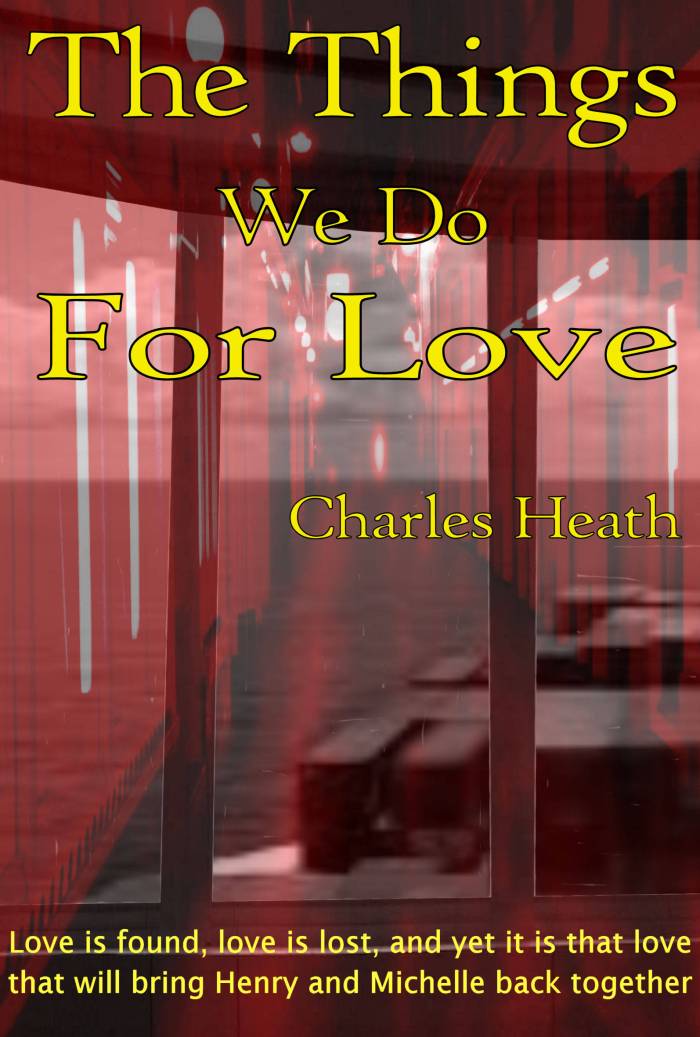
The cover, at the moment, looks like this:

lovecoverfinal1