On an early morning walk, I discovered the Brooklyn Diner, a small restaurant tucked away in a street not far from Columbus Circle, perhaps a piece of history from the American past.
After all, if you’re going to take in the sights, sounds, and food of a country what better way to do it than visiting what was once a tradition.
This one was called the Brooklyn Diner. It had a combination of booths and counter sit down, though the latter was not a very big space, so we opted for a booth.
The object of going to a Diner is the fact they serve traditional American food, which when you get past the hot dogs and hamburgers and fries, takes the form of turkey and chicken pot pies among a variety of other choices.
Still looking for a perfectly cooked turkey, something I’ve never been able to do myself, I opted for the Teadition Turkey Lunch, which the menu invitingly said was cooked especially at the diner and was succulent. I couldn’t wait.
We also ordered a hamburger, yes, yet another, and a chicken pot pie, on the basis the last one I had in Toronto was absolutely delicious (and cooked the same way since the mid-1930s)
While waiting we got to look at a slice of history belonging to another great American tradition, Baseball, a painting on the wall of the Brooklyn Dodgers at Ebbets field, long since gone from their home.
The Turnkey lunch looked like this
which didn’t seem to be much, and had this odd pasta slice on the plate, but the turkey was amazing and lived up to the menu description.
The Chicken Pot Pie looked like this
And looked a lot larger in reality than the photo shows.
But, sadly while it was not bad, it was a little dry, and could possibly do with using the more succulent thigh part of the chicken.
All of this was washed down by Long Island Ice Teas and Brooklyn Lager.
AS for the Diner experience, it’s definitely a 10 out of 10 for me.
On an early morning walk, I discovered the Brooklyn Diner, a small restaurant tucked away in a street not far from Columbus Circle, perhaps a piece of history from the American past.
After all, if you’re going to take in the sights, sounds, and food of a country what better way to do it than visiting what was once a tradition.
This one was called the Brooklyn Diner. It had a combination of booths and counter sit down, though the latter was not a very big space, so we opted for a booth.
The object of going to a Diner is the fact they serve traditional American food, which when you get past the hot dogs and hamburgers and fries, takes the form of turkey and chicken pot pies among a variety of other choices.
Still looking for a perfectly cooked turkey, something I’ve never been able to do myself, I opted for the Teadition Turkey Lunch, which the menu invitingly said was cooked especially at the diner and was succulent. I couldn’t wait.
We also ordered a hamburger, yes, yet another, and a chicken pot pie, on the basis the last one I had in Toronto was absolutely delicious (and cooked the same way since the mid-1930s)
While waiting we got to look at a slice of history belonging to another great American tradition, Baseball, a painting on the wall of the Brooklyn Dodgers at Ebbets field, long since gone from their home.
The Turnkey lunch looked like this
which didn’t seem to be much, and had this odd pasta slice on the plate, but the turkey was amazing and lived up to the menu description.
The Chicken Pot Pie looked like this
And looked a lot larger in reality than the photo shows.
But, sadly while it was not bad, it was a little dry, and could possibly do with using the more succulent thigh part of the chicken.
All of this was washed down by Long Island Ice Teas and Brooklyn Lager.
AS for the Diner experience, it’s definitely a 10 out of 10 for me.
To start with, we first joined this tour at stop number 6.
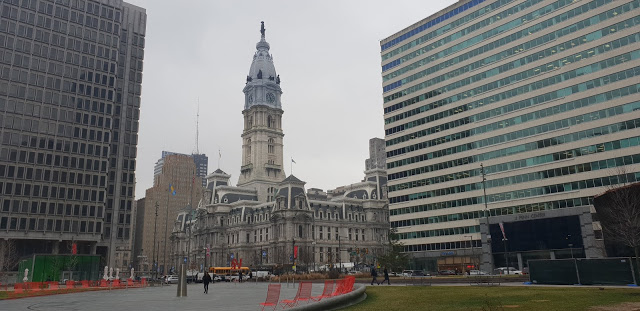
We had to find it first and that meant some pedestrian navigation, which took us first to the City Hall, a rather imposing structure, which we found later had a profound effect on Philadelphia sports teams.
According to the map, stop number 6 is Reading Terminal Market, Convention Centre, on 12th street on Filbert. This was where we bought the tickets and boarded the bus that had a rather interesting guide aboard.
His favorite says was “And we’re good to go.”
Soon we would discover that his commentary was more orientated towards a younger audience, not that it bothered us.
Given the time restraints, we had, this was always going to be about looking and learning.
Stop number 7
City hall, Love Park.
This we had seen on our walk from where we left the car at the Free Library, near the Swann Memorial Fountain in Logan Park, the landmark that Rebecca had remembered from her last visit to Philadelphia. Of course, then, it was not quite so frozen.
Love park, of course, was only notable to us in that it had a sculpture in place with the word Love rather stylized. Apart from that, you’d hardly know it as a park
The city hall, well, that was something else, and when we looked at it, before going on the tour, it was a rather magnificent stone edifice.
After, well the guide filled us in, tallest building, highest and largest monument on William Penn, you get the gist. 37 feet tall, when eclipsed, the Philly sports teams all suffered slumps of one kind or another, until the problem was rectified. Interesting story.
Stop number 8
18th Street and the Benjamin Franklin Parkway, or Logan Circle
This is the location of the Cathedral Basilica of Saints Peter and Paul. A place where the Pope decided to give an audience and sent the city into a spin.
The same church has very high windows for the reason in the early days there was a problem with people wanting to throw Molotov cocktails through the windows. A bit hard when they’re so high up.
Benjamin Franklin Parkway, of course, is interesting in itself as an avenue, not only for all of the flags of many nations of those who chose to live in Philadelphia. We found ours, the one for Australia
This was also the stop where we needed to get off once the tour was finished, and time to head to the car, and go home, but that’s another story.
Stop number 10
Is that the stature of the Thinker, made famous, at least for me, from the old Dobie Gillis episodes, of God knows how many years ago?
Or, maybe it’s just the Rodin Museum on Benjamin Franklin Parkway.
There’s a whole story to go with that Statue and the fact it is one of many all over the world.
This one was made in France, cast in 1919 in Bronze, and is approximately 200cm x 130 cm by 140cm.
Stop number 11
Eastern State Penitentiary. NW corner of 22nd Street and Fairmont Avenue.
This had a rather interesting story attached to it and had something to do with ghosts, but I wasn’t listening properly to the guide’s monologue.
But, later research shows, the fact it was once the most famous and expensive prison in the world. Many also think it is haunted and is a favorite for visiting paranormal visitors.
Built around 1829, it was the first prison to have separate cells for prisoners. It held, at various times, the likes of Al Capone and Willie Sutt
Stop number 18
The Philadelphia Museum of art, where we stop for a few minutes and look at the steps which were immortalized in the movie Rocky, yes he ran god knows how far to end up on the top of these steps.
Sorry, but I’m not that fit that I would attempt walking up them. The view is just fine from inside the bus. Of course, they might consider cleaning the windows a little so the view was clearer, but because it’s basically Perspex and scratched so that might not be possible.
Stop number 17
Back at Logan Circle, or Square if you prefer, but on the other side, closer to the Franklin Institute. Benjamin Franklin’s name is used a lot in this city.
After that, it’s a blur, the Academy of Music, the University of the Arts, Pennsylvania Hospital, South Street, Vietnam Veterans Memorial, the USS Olympia, Penn’s Landing, and past the National Liberty Museum. I’m sure somewhere in that blur was the intention of seeing the Liberty Bell, but I think I heard that it was not on show, and only a replica could be seen.
So much for the getting as an opportunity to see the real liberty bell, crack and all..
We get off and stop number 27, or Number 1, I was not quite sure.
What were we after? The definitive Philly Cheese Steak.
You know, the sort of day where you have the best of intentions, you get up ready to start attacking the agenda you’ve told yourself you’re finally going to sit down and get on with.
The same set of words you’ve been using to fire up the enthusiasm you really don’t feel much of the time, but this time, have worked yourself into a high degree of positivity just before going to bed.
Everything is set up. All you have to do is bound out of bed, bright-eyed and bushy-tailed, ready to go.
That was the first mistake. You went to be very late, around 2 am, and when you woke up, it feels like death warmed up. No bright eyes, and definitely no bushy tail.
But, there’s work to be done.
Before that, there’s other stuff, and as each succeeding chore is down, the less enthusiasm feels. I have to clean up the dining room, which, at the moment, is the go-to for all the tools, paint, tile glue, tiles, and everything that’s being used in the latest round of renovations.
Frankly, the room is a mess. I can move a lot of the tools out to the shed now that I’ve finished with them, and the rest, a few pain brushes and the tiling equipment, we be used over the next week.
An hour and a half later, the room is now clean.
I go out to the writing room and look at the list. Good thing I’d didn’t put a time against anything, because if I have, I was now looking at being at least four hours behind.
A phone call made that timeline worse. People always call when you don’t need any calls to distract you. It’s one of the reasons why I have seriously considered getting the landline cut off. And if it wasn’t for the grandchildren, who know they can call on that line, with a number that’s easier to remember than a mobile, I would.
But that of course leaves me open to the half dozen scam calls a day, trying to sell cladding, and solar panels, defend myself from a car crash that I never had, fend off illicit charges from Telcos, and now Amazon. Not forgetting my friend from the NBN who rings once, sometimes twice a day telling me my internet is about to be cut off.
To be honest, I wish they would, but as much as I tell them to cut it off they never do, perhaps knowing that if they do, they can’t scam call me anymore.
By the time I get back to my office, it’s time for a cup of tea.
Or something stronger.
The morning has gone, and the afternoon is half over, and all I’ve done is look at the list.
And since blog posts are on the list, this is why I’m writing this whinge.
How is your day going? I hope it’s better than mine.
To start with, we first joined this tour at stop number 6.
We had to find it first and that meant some pedestrian navigation, which took us first to the City Hall, a rather imposing structure, which we found later had a profound effect on Philadelphia sports teams.
According to the map, stop number 6 is Reading Terminal Market, Convention Centre, on 12th street on Filbert. This was where we bought the tickets and boarded the bus that had a rather interesting guide aboard.
His favorite says was “And we’re good to go.”
Soon we would discover that his commentary was more orientated towards a younger audience, not that it bothered us.
Given the time restraints, we had, this was always going to be about looking and learning.
Stop number 7
City hall, Love Park.
This we had seen on our walk from where we left the car at the Free Library, near the Swann Memorial Fountain in Logan Park, the landmark that Rebecca had remembered from her last visit to Philadelphia. Of course, then, it was not quite so frozen.
Love park, of course, was only notable to us in that it had a sculpture in place with the word Love rather stylized. Apart from that, you’d hardly know it as a park
The city hall, well, that was something else, and when we looked at it, before going on the tour, it was a rather magnificent stone edifice.
After, well the guide filled us in, tallest building, highest and largest monument on William Penn, you get the gist. 37 feet tall, when eclipsed, the Philly sports teams all suffered slumps of one kind or another, until the problem was rectified. Interesting story.
Stop number 8
18th Street and the Benjamin Franklin Parkway, or Logan Circle
This is the location of the Cathedral Basilica of Saints Peter and Paul. A place where the Pope decided to give an audience and sent the city into a spin.
The same church has very high windows for the reason in the early days there was a problem with people wanting to throw Molotov cocktails through the windows. A bit hard when they’re so high up.
Benjamin Franklin Parkway, of course, is interesting in itself as an avenue, not only for all of the flags of many nations of those who chose to live in Philadelphia. We found ours, the one for Australia
This was also the stop where we needed to get off once the tour was finished, and time to head to the car, and go home, but that’s another story.
Stop number 10
Is that the stature of the Thinker, made famous, at least for me, from the old Dobie Gillis episodes, of God knows how many years ago?
Or, maybe it’s just the Rodin Museum on Benjamin Franklin Parkway.
There’s a whole story to go with that Statue and the fact it is one of many all over the world.
This one was made in France, cast in 1919 in Bronze, and is approximately 200cm x 130 cm by 140cm.
Stop number 11
Eastern State Penitentiary. NW corner of 22nd Street and Fairmont Avenue.
This had a rather interesting story attached to it and had something to do with ghosts, but I wasn’t listening properly to the guide’s monologue.
But, later research shows, the fact it was once the most famous and expensive prison in the world. Many also think it is haunted and is a favorite for visiting paranormal visitors.
Built around 1829, it was the first prison to have separate cells for prisoners. It held, at various times, the likes of Al Capone and Willie Sutt
Stop number 18
The Philadelphia Museum of art, where we stop for a few minutes and look at the steps which were immortalized in the movie Rocky, yes he ran god knows how far to end up on the top of these steps.
Sorry, but I’m not that fit that I would attempt walking up them. The view is just fine from inside the bus. Of course, they might consider cleaning the windows a little so the view was clearer, but because it’s basically Perspex and scratched so that might not be possible.
Stop number 17
Back at Logan Circle, or Square if you prefer, but on the other side, closer to the Franklin Institute. Benjamin Franklin’s name is used a lot in this city.
After that, it’s a blur, the Academy of Music, the University of the Arts, Pennsylvania Hospital, South Street, Vietnam Veterans Memorial, the USS Olympia, Penn’s Landing, and past the National Liberty Museum. I’m sure somewhere in that blur was the intention of seeing the Liberty Bell, but I think I heard that it was not on show, and only a replica could be seen.
So much for the getting as an opportunity to see the real liberty bell, crack and all..
We get off and stop number 27, or Number 1, I was not quite sure.
What were we after? The definitive Philly Cheese Steak.
After arriving latish from Toronto, and perhaps marginally disappointed that while in Toronto, the ice hockey didn’t go our way, we slept in.
Of course, the arrival was not without its own problems. The room we were allocated was on the 22nd floor and was quite smallish. Not a surprise, but we needed space for three, and with the fold-out bed, it was tight but livable.
Except…
We needed the internet to watch the Maple Leafs ice hockey game. We’d arrive just in time to stream it to the tv.
But…
There was no internet. It was everywhere else in the hotel except our floor.
First, I went to the front desk and they directed me to call tech support.
Second, we called tech support and they told us that the 22nd-floor router had failed and would get someone to look at it.
When?
It turns out it didn’t seem to be a priority. Maybe no one else on the floor had complained
Third, I went downstairs and discussed the lack of progress with the night duty manager, expressing disappointment with the lack of progress.
I also asked if they could not provide the full service that I would like a room rate reduction or a privilege in its place as compensation.
He said he would check it himself.
Fourth, after no further progress, we called the front desk to advise there was still no internet. This time we were asked if we wanted a room on another floor, where the internet is working. We accepted the offer.
The end result, a slightly larger, less cramped room, and the ability to watch the last third of the Maple Leaf’s game. I can’t remember if we won.
We all went to bed reasonably happy.
After all, we didn’t have to get up early to go up or down to breakfast because it was not included in the room rate, a bone of contention considering the cost.
I’ll be booking with them directly next time, at a somewhat cheaper rate, a thing I find after using a travel wholesaler to book it for me.
As always every morning while Rosemary gets ready, I go out for a walk and check out where we are.
It seems we are practically in the heart of theaterland New York. Walk one way or the other you arrive at 7th Avenue or Broadway.
Walk uptown and you reach 42nd Street and Times Square, little more than a 10-minute leisurely stroll. On the way down Broadway, you pass a number of theatres, some recognizable, some not.
Times Square is still a huge collection of giant television screens advertising everything from confectionary to TV shows on the cable networks.
A short walk along 42nd street takes you to the Avenue of the Americas and tucked away, The Rockefeller center and its winter ice rink.
A few more steps take you to 5th Avenue and the shops like Saks of Fifth Avenue, shops you could one day hope to afford to buy something.
In the opposite direction, over Broadway and crossing 8th Avenue is an entrance to Central Park. The approach is not far from what is called the Upper West Side, home to the rich and powerful.
Walk one way in the park, which we did in the afternoon, takes you towards the gift shop and back along a labyrinth of laneways to 5th Avenue. It was a cold, but pleasant, stroll looking for the rich and famous, but, discovering, they were not foolish enough to venture out into the cold.
Before going back to the room, we looked for somewhere to have dinner and ended up in Cassidy’s Irish pub. There was a dining room down the back and we were one of the first to arrive for dinner service.
The first surprise, our waitress was from New Zealand.
The second, the quality of the food.
I had a dish called Steak Lyonnaise which was, in plain words, a form of mince steak in an elongated patty. It was cooked rare as I like my steak and was perfect. It came with a baked potato.
As an entree, we had shrimp, which in our part of the world are prawns, and hot chicken wings, the sauce is hot and served on the side.
The beer wasn’t bad either. Overall given atmosphere, service, and food, it’s a nine out of ten.
After arriving latish from Toronto, and perhaps marginally disappointed that while in Toronto, the ice hockey didn’t go our way, we slept in.
Of course, the arrival was not without its own problems. The room we were allocated was on the 22nd floor and was quite smallish. Not a surprise, but we needed space for three, and with the fold-out bed, it was tight but livable.
Except…
We needed the internet to watch the Maple Leafs ice hockey game. We’d arrive just in time to stream it to the tv.
But…
There was no internet. It was everywhere else in the hotel except our floor.
First, I went to the front desk and they directed me to call tech support.
Second, we called tech support and they told us that the 22nd-floor router had failed and would get someone to look at it.
When?
It turns out it didn’t seem to be a priority. Maybe no one else on the floor had complained
Third, I went downstairs and discussed the lack of progress with the night duty manager, expressing disappointment with the lack of progress.
I also asked if they could not provide the full service that I would like a room rate reduction or a privilege in its place as compensation.
He said he would check it himself.
Fourth, after no further progress, we called the front desk to advise there was still no internet. This time we were asked if we wanted a room on another floor, where the internet is working. We accepted the offer.
The end result, a slightly larger, less cramped room, and the ability to watch the last third of the Maple Leaf’s game. I can’t remember if we won.
We all went to bed reasonably happy.
After all, we didn’t have to get up early to go up or down to breakfast because it was not included in the room rate, a bone of contention considering the cost.
I’ll be booking with them directly next time, at a somewhat cheaper rate, a thing I find after using a travel wholesaler to book it for me.
As always every morning while Rosemary gets ready, I go out for a walk and check out where we are.
It seems we are practically in the heart of theaterland New York. Walk one way or the other you arrive at 7th Avenue or Broadway.
Walk uptown and you reach 42nd Street and Times Square, little more than a 10-minute leisurely stroll. On the way down Broadway, you pass a number of theatres, some recognizable, some not.
Times Square is still a huge collection of giant television screens advertising everything from confectionary to TV shows on the cable networks.
A short walk along 42nd street takes you to the Avenue of the Americas and tucked away, The Rockefeller center and its winter ice rink.
A few more steps take you to 5th Avenue and the shops like Saks of Fifth Avenue, shops you could one day hope to afford to buy something.
In the opposite direction, over Broadway and crossing 8th Avenue is an entrance to Central Park. The approach is not far from what is called the Upper West Side, home to the rich and powerful.
Walk one way in the park, which we did in the afternoon, takes you towards the gift shop and back along a labyrinth of laneways to 5th Avenue. It was a cold, but pleasant, stroll looking for the rich and famous, but, discovering, they were not foolish enough to venture out into the cold.
Before going back to the room, we looked for somewhere to have dinner and ended up in Cassidy’s Irish pub. There was a dining room down the back and we were one of the first to arrive for dinner service.
The first surprise, our waitress was from New Zealand.
The second, the quality of the food.
I had a dish called Steak Lyonnaise which was, in plain words, a form of mince steak in an elongated patty. It was cooked rare as I like my steak and was perfect. It came with a baked potato.
As an entree, we had shrimp, which in our part of the world are prawns, and hot chicken wings, the sauce is hot and served on the side.
The beer wasn’t bad either. Overall given atmosphere, service, and food, it’s a nine out of ten.
I have a passion for visiting transport museums, to see old trains, planes, buses, cars, even ships if it’s possible.
This has led to taking a number of voyages on the TSS Earnslaw in Queenstown, New Zealand.
Many, many, many years ago on Puffing Billy, a steam train in the Dandenongs, Victoria, Australia.
The steam train in Kingston, New Zealand, before it was closed down, but hopefully it will reopen sometime in the future.
The London Transport Museum in London England, which had a lot of buses.
The Workshops Railway Museum in Ipswich, Queensland, where once the many steam engines were built and maintained, and now had only a handful of engines remaining.
However, in the quest for finding and experiencing old transportation methods, we came across the Mary Valley Rattler, which runs out of Gympie, Queensland, Australia.
The ride begins in Gympie at the old Gympie Railway station, and as can be seen below, is one of the relics of the past, and, nothing like the new more modern stations. Thankfully.
If you’re going to have a vintage train, then you have to have a vintage station.
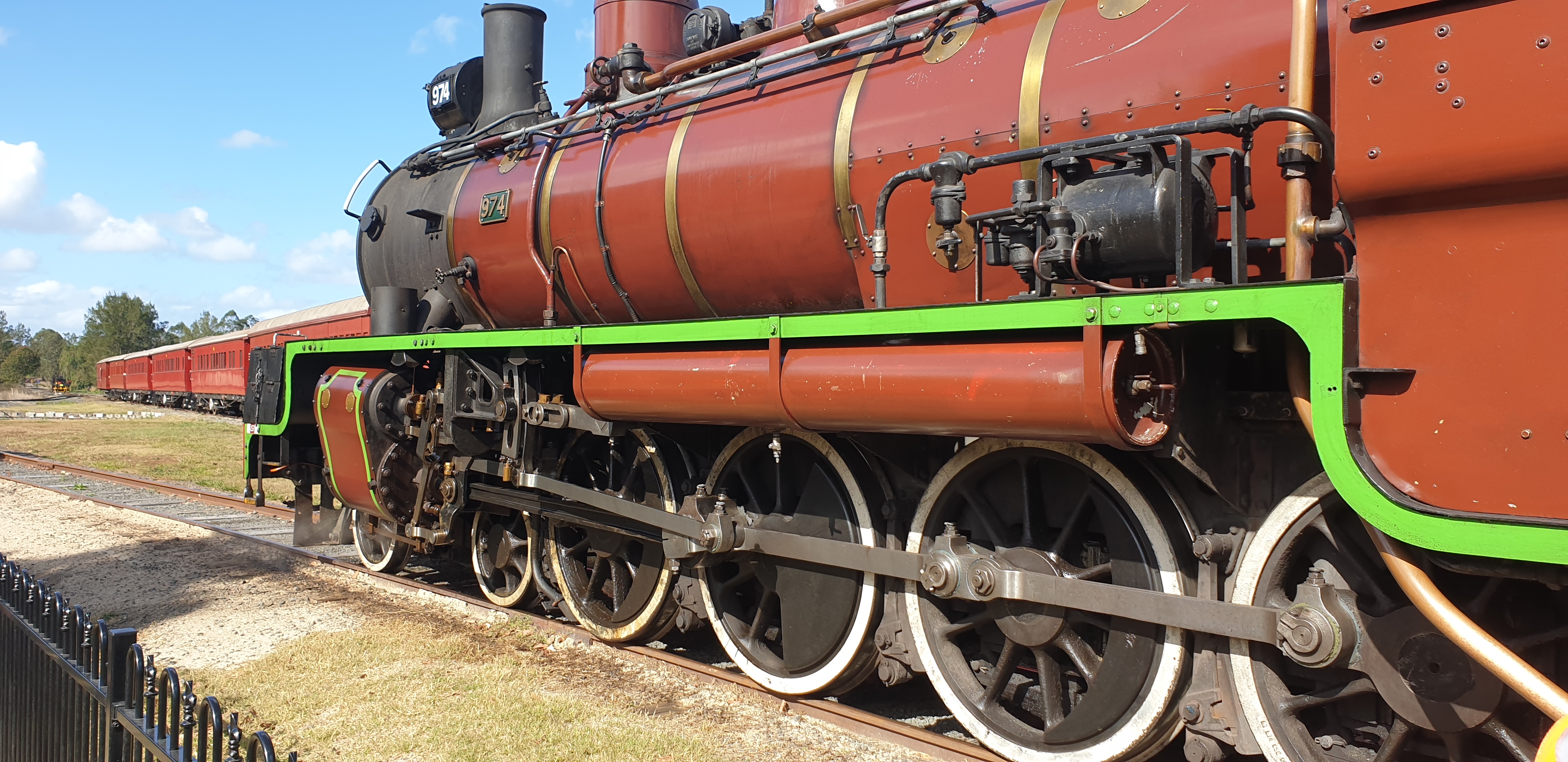
The Class of engine, seen below, is the C17, a superheated upgrade to the C16 it was based on, and first run in 1903. This particular engine was built in 1951, although the first of its type was seen in 1920 and the last of 227 made in 1953. It was the most popular of the steam engines used by Queensland Railways.
The C designation meant it had four driving axels and 17 was the diameter of the cylinder, 17 inches. It is also known as a 4-8-0 steam locomotive and nicknamed one of the “Brown Bombers” because of its livery, brown with green and red trimming.
Also, this engine was built in Maryborough, not far from Gympie by Walkers Limited, one of 138.
This photo was taken as the train returned from Amamoor, a trip that takes up to an hour.
The locomotive is detached from the carriages, then driven to the huge turntable to turn around for the return journey to Amamoor.
This is the locomotive heading down to the water station, and then taking on water. After that, it will switch lines, and reverse back to reconnect the carriages for the trip to Amamoor.
The carriages are completely restored and are extremely comfortable. It brings back, for me, many memories of riding in older trains in Melbourne when I was a child.
The trains, then, were called Red Rattlers.
This is the locomotive climbing one of the hilly parts of the line before crossing over the Mary River on a trestle bridge.
This is the engine at Amamoor near the picnic area where young children and excited parents and grandparents can get on the locomotive itself and look inside where the driver sits.
And, no, I didn’t volunteer to shovel coal.
This particular locomotive spent most of its working life between Townsville and Mount Isa and was based in Cloncurry, Charters Towers, and Townsville, before being sent, at the end of its useful days in the late 1960s, to the Ipswich Railway Workshops.
I have a passion for visiting transport museums, to see old trains, planes, buses, cars, even ships if it’s possible.
This has led to taking a number of voyages on the TSS Earnslaw in Queenstown, New Zealand.
Many, many, many years ago on Puffing Billy, a steam train in the Dandenongs, Victoria, Australia.
The steam train in Kingston, New Zealand, before it was closed down, but hopefully it will reopen sometime in the future.
The London Transport Museum in London England, which had a lot of buses.
The Workshops Railway Museum in Ipswich, Queensland, where once the many steam engines were built and maintained, and now had only a handful of engines remaining.
However, in the quest for finding and experiencing old transportation methods, we came across the Mary Valley Rattler, which runs out of Gympie, Queensland, Australia.
The ride begins in Gympie at the old Gympie Railway station, and as can be seen below, is one of the relics of the past, and, nothing like the new more modern stations. Thankfully.
If you’re going to have a vintage train, then you have to have a vintage station.
The Class of engine, seen below, is the C17, a superheated upgrade to the C16 it was based on, and first run in 1903. This particular engine was built in 1951, although the first of its type was seen in 1920 and the last of 227 made in 1953. It was the most popular of the steam engines used by Queensland Railways.
The C designation meant it had four driving axels and 17 was the diameter of the cylinder, 17 inches. It is also known as a 4-8-0 steam locomotive and nicknamed one of the “Brown Bombers” because of its livery, brown with green and red trimming.
Also, this engine was built in Maryborough, not far from Gympie by Walkers Limited, one of 138.
This photo was taken as the train returned from Amamoor, a trip that takes up to an hour.
The locomotive is detached from the carriages, then driven to the huge turntable to turn around for the return journey to Amamoor.
This is the locomotive heading down to the water station, and then taking on water. After that, it will switch lines, and reverse back to reconnect the carriages for the trip to Amamoor.
The carriages are completely restored and are extremely comfortable. It brings back, for me, many memories of riding in older trains in Melbourne when I was a child.
The trains, then, were called Red Rattlers.
This is the locomotive climbing one of the hilly parts of the line before crossing over the Mary River on a trestle bridge.
This is the engine at Amamoor near the picnic area where young children and excited parents and grandparents can get on the locomotive itself and look inside where the driver sits.
And, no, I didn’t volunteer to shovel coal.
This particular locomotive spent most of its working life between Townsville and Mount Isa and was based in Cloncurry, Charters Towers, and Townsville, before being sent, at the end of its useful days in the late 1960s, to the Ipswich Railway Workshops.