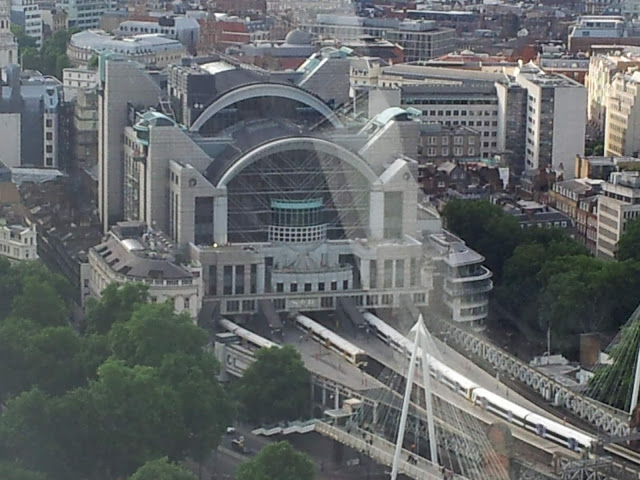
We were in London in Summer, it was a fine afternoon, going into the evening and we decided to get on the London Eye. As you can see from the clock it was near 7:00 pm.
This photo was taken as we were coming down.
Those long evenings were quite remarkable, not in the least going to a pub and sinking a few pints! There was one such pub not far from Charing Cross Station
Deal or no deal. That was a game show on TV once, involving briefcases.
Then, if you win…
It’s a big deal!
Or, of course, it is if you get in on the ground floor, which is to say, you’re one of the original investors, it becomes a great deal; it’s meaning, taking part in a financial transaction.
The word ‘deal’ along with big, great, tremendous, and once in a lifetime, feature prominently, but if you are like me by the time you invest the pyramid is about to collapse!
Then you’re in a great deal of trouble, meaning a lot of trouble — at the time, it feels catastrophic.
Or you’re working impossibly long hours to enrich the others above you, it a good deal of effort on your part for no reward.
Or deal with a problem, which is to say cope with or control, though if it’s a problem child, good luck with that.
But enough of the depressing descriptions,
When you play a card game, the first thing to happen is to deal the cards.
The second is to ask yourself if the dealer is dealing from the bottom of the deck, even if it looks like the top.
My father called these dealers ‘card sharps’.
Then there is a piece of wood commonly called deal, usually thin and square though not always so; it can also be a plank of pine or fir.
We were in London in Summer, it was a fine afternoon, going into the evening and we decided to get on the London Eye. As you can see from the clock it was near 7:00 pm.
This photo was taken as we were coming down.
Those long evenings were quite remarkable, not in the least going to a pub and sinking a few pints! There was one such pub not far from Charing Cross Station
Deal or no deal. That was a game show on TV once, involving briefcases.
Then, if you win…
It’s a big deal!
Or, of course, it is if you get in on the ground floor, which is to say, you’re one of the original investors, it becomes a great deal; it’s meaning, taking part in a financial transaction.
The word ‘deal’ along with big, great, tremendous, and once in a lifetime, feature prominently, but if you are like me by the time you invest the pyramid is about to collapse!
Then you’re in a great deal of trouble, meaning a lot of trouble — at the time, it feels catastrophic.
Or you’re working impossibly long hours to enrich the others above you, it a good deal of effort on your part for no reward.
Or deal with a problem, which is to say cope with or control, though if it’s a problem child, good luck with that.
But enough of the depressing descriptions,
When you play a card game, the first thing to happen is to deal the cards.
The second is to ask yourself if the dealer is dealing from the bottom of the deck, even if it looks like the top.
My father called these dealers ‘card sharps’.
Then there is a piece of wood commonly called deal, usually thin and square though not always so; it can also be a plank of pine or fir.
Firstly, of course, means definitely so, and can be said when a revelation is realised, or sarcastically if the answer is obvious.
Then there’s a course, like a golf course where people chase a small usually white ball, sometimes to be found on a fairway, but more often than not in a bunker, in the water, or in the thicket.
It’s meant to be calming, but I’m betting more than one heart attack has been brought on by a slice, a six shot bunker exit, or any more than three putts on the green.
There’s also mini golf courses, less challenging, sometimes.
That course could also be the part of a creek or a river.
It can be a set of classes that makes up a course, I did a course in English literature
Then, rather topically, over the course of the election there was [you fill in the rest]
Then there’s my favourite, a four course dinner
Or when I’m unwell a course of antibiotics.
And lastly, in a supermarket how often does the trolley in front of you unexpectedly and randomly change course?
This is not to be confused with coarse
Which to be honest can be used sometimes to describe people who swear or are abrupt. They were coarse people, that is unrefined. These people often use coarse language and tell course jokes, meaning crude and offensive
It had a coarse texture, ie it was rough not smooth
And then there’s Corse which is not exactly an English word, but can refer to a corpse or dead body.
I have a passion for visiting transport museums, to see old trains, planes, buses, cars, even ships if it’s possible.
This has led to taking a number of voyages on the TSS Earnslaw in Queenstown, New Zealand.
Many, many, many years ago on Puffing Billy, a steam train in the Dandenongs, Victoria, Australia.
The steam train in Kingston, New Zealand, before it was closed down, but hopefully it will reopen sometime in the future.
The London Transport Museum in London England, which had a lot of buses.
The Workshops Railway Museum in Ipswich, Queensland, where once the many steam engines were built and maintained, and now had only a handful of engines remaining.
However, in the quest for finding and experiencing old transportation methods, we came across the Mary Valley Rattler, which runs out of Gympie, Queensland, Australia.
The ride begins in Gympie at the old Gympie Railway station, and as can be seen below, is one of the relics of the past, and, nothing like the new more modern stations. Thankfully.
If you’re going to have a vintage train, then you have to have a vintage station.
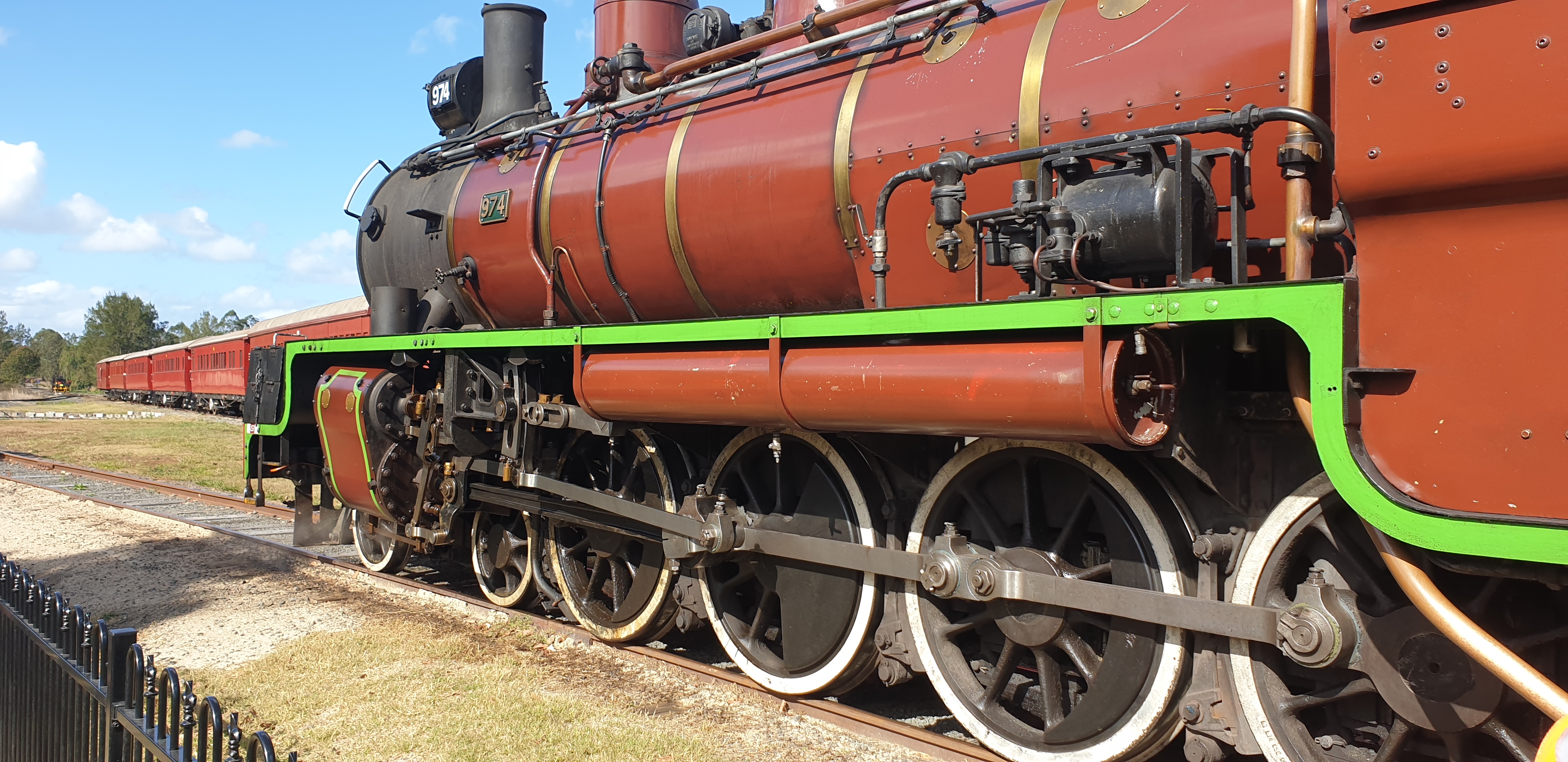
The Class of engine, seen below, is the C17, a superheated upgrade to the C16 it was based on, and first run in 1903. This particular engine was built in 1951, although the first of its type was seen in 1920 and the last of 227 made in 1953. It was the most popular of the steam engines used by Queensland Railways.
The C designation meant it had four driving axels and 17 was the diameter of the cylinder, 17 inches. It is also known as a 4-8-0 steam locomotive and nicknamed one of the “Brown Bombers” because of its livery, brown with green and red trimming.
Also, this engine was built in Maryborough, not far from Gympie by Walkers Limited, one of 138.
This photo was taken as the train returned from Amamoor, a trip that takes up to an hour.
The locomotive is detached from the carriages, then driven to the huge turntable to turn around for the return journey to Amamoor.
This is the locomotive heading down to the water station, and then taking on water. After that, it will switch lines, and reverse back to reconnect the carriages for the trip to Amamoor.
The carriages are completely restored and are extremely comfortable. It brings back, for me, many memories of riding in older trains in Melbourne when I was a child.
The trains, then, were called Red Rattlers.
This is the locomotive climbing one of the hilly parts of the line before crossing over the Mary River on a trestle bridge.
This is the engine at Amamoor near the picnic area where young children and excited parents and grandparents can get on the locomotive itself and look inside where the driver sits.
And, no, I didn’t volunteer to shovel coal.
This particular locomotive spent most of its working life between Townsville and Mount Isa and was based in Cloncurry, Charters Towers, and Townsville, before being sent, at the end of its useful days in the late 1960s, to the Ipswich Railway Workshops.
Firstly, of course, means definitely so, and can be said when a revelation is realised, or sarcastically if the answer is obvious.
Then there’s a course, like a golf course where people chase a small usually white ball, sometimes to be found on a fairway, but more often than not in a bunker, in the water, or in the thicket.
It’s meant to be calming, but I’m betting more than one heart attack has been brought on by a slice, a six shot bunker exit, or any more than three putts on the green.
There’s also mini golf courses, less challenging, sometimes.
That course could also be the part of a creek or a river.
It can be a set of classes that makes up a course, I did a course in English literature
Then, rather topically, over the course of the election there was [you fill in the rest]
Then there’s my favourite, a four course dinner
Or when I’m unwell a course of antibiotics.
And lastly, in a supermarket how often does the trolley in front of you unexpectedly and randomly change course?
This is not to be confused with coarse
Which to be honest can be used sometimes to describe people who swear or are abrupt. They were coarse people, that is unrefined. These people often use coarse language and tell course jokes, meaning crude and offensive
It had a coarse texture, ie it was rough not smooth
And then there’s Corse which is not exactly an English word, but can refer to a corpse or dead body.
In the current times, the word needle is very polarising.
Will you have the vaccine, or not. Is one of the reasons simply because you hate needles?
I know I do and have a fear factor of 100%. Fortunately, I got very sick a few years ago and spent 10 days in the hospital, and was forced to have multiple needles every day.
Now it’s not so hard
But, I digress.
A needle is one of those things used in the medical profession mainly to deliver vaccines and medicine. It is a very small cylinder.
A needle can be used to sew up a garment or make repairs. This is a smallish piece of metal with an eyelet.
A needle can also be used to stitch up wounds, though it’s best you have a local anesthetic first.
Another way of using needles is to describe tiny icicles which hurt when they hit your face or your eyes. It is called a needle effect.
Then, another use of the word, is to needle someone, that is to say, bombard them with questions, or annoy them.
It’s a pointer on a dial, like that of a fuel gauge, which for me, always seems to hover just above empty. It can also be on a compass, where heading north is not always clear especially where magnets are nearby.
A fir tree’s leaves are more like needles.
You need one to play a record on a gramophone, not that they exist anymore.
Paradoxically it can also be used to describe a pointy rock or an obelisk-like “Cleopatra’s Needle”






 Thrills, Spills, and just a dash of Romance