This is in a very scenic area and on the first impression; it is absolutely stunning in concept and in viewing.
As for the idea of walking on it, well, that first view of the mountain climb when getting off the bus, my first question was where the elevator is? Sorry, there is none. It’s walk on up or stay down the bottom.
Walk it is. As far as you feel you are able. There are quite a few who don’t make it to the top. I didn’t. I only made it to the point where the steps narrowed.
But as for the logistics, there’s the gradual incline to the starting point, and what will be the end meeting place. From there, it’s a few steps up to the guard station no 7, and a few more to get up to the start of the main climb. The top of the wall is guard station no 12.
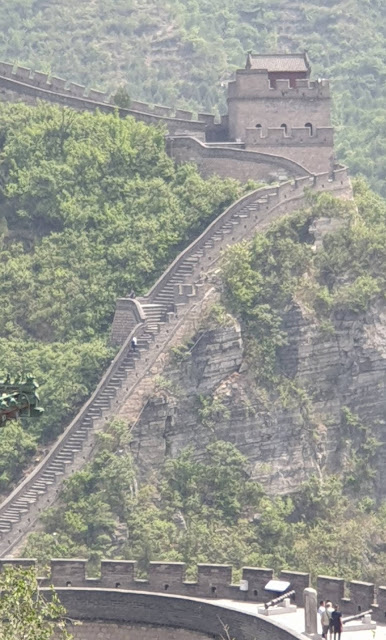
Ok, those first few steps are a good indication of what it’s was going to be like and it’s more the awkwardness of the uneven heights of the steps that’s the killer, some as high as about 15 inches. This photo paints an illusion, that it’s easy. It’s not.
If you make it to the first stage, then it augers well you will get about 100 steps before you both start feeling it in your legs, particularly the knees, and then suffering from the height if you have a problem with heights as the air is thinner. And if you have a thing with heights, never look down.
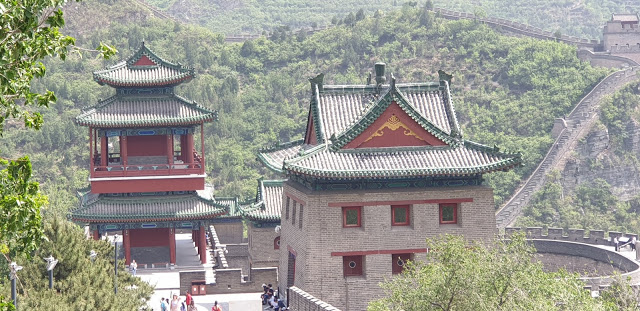
This was from where we stopped, about a third of the way up. The one below, from almost at the bottom. One we’re looking almost down on the buildings, the other, on the same level.
It requires rest before you come down, and that’s when you start to feel it in the knees, our tour guide called it jelly legs, but it’s more in the knees down. Descending should be slow, and it can be more difficult negotiating the odd height steps, and particularly those high ones. You definitely need to hang onto the rail, even try going backward.
And, no, that rail hasn’t been there as long as the wall.
While you are waiting for the guide to return to the meeting place at the appointed time, there should be time to have some jasmine tea. Highly refreshing after the climb.
In the current times, the word needle is very polarising.
Will you have the vaccine, or not. Is one of the reasons simply because you hate needles?
I know I do and have a fear factor of 100%. Fortunately, I got very sick a few years ago and spent 10 days in the hospital, and was forced to have multiple needles every day.
Now it’s not so hard
But, I digress.
A needle is one of those things used in the medical profession mainly to deliver vaccines and medicine. It is a very small cylinder.
A needle can be used to sew up a garment or make repairs. This is a smallish piece of metal with an eyelet.
A needle can also be used to stitch up wounds, though it’s best you have a local anesthetic first.
Another way of using needles is to describe tiny icicles which hurt when they hit your face or your eyes. It is called a needle effect.
Then, another use of the word, is to needle someone, that is to say, bombard them with questions, or annoy them.
It’s a pointer on a dial, like that of a fuel gauge, which for me, always seems to hover just above empty. It can also be on a compass, where heading north is not always clear especially where magnets are nearby.
A fir tree’s leaves are more like needles.
You need one to play a record on a gramophone, not that they exist anymore.
Paradoxically it can also be used to describe a pointy rock or an obelisk-like “Cleopatra’s Needle”
This is in a very scenic area and on the first impression; it is absolutely stunning in concept and in viewing.
As for the idea of walking on it, well, that first view of the mountain climb when getting off the bus, my first question was where the elevator is? Sorry, there is none. It’s walk on up or stay down the bottom.
Walk it is. As far as you feel you are able. There are quite a few who don’t make it to the top. I didn’t. I only made it to the point where the steps narrowed.
But as for the logistics, there’s the gradual incline to the starting point, and what will be the end meeting place. From there, it’s a few steps up to the guard station no 7, and a few more to get up to the start of the main climb. The top of the wall is guard station no 12.
Ok, those first few steps are a good indication of what it’s was going to be like and it’s more the awkwardness of the uneven heights of the steps that’s the killer, some as high as about 15 inches. This photo paints an illusion, that it’s easy. It’s not.
If you make it to the first stage, then it augers well you will get about 100 steps before you both start feeling it in your legs, particularly the knees, and then suffering from the height if you have a problem with heights as the air is thinner. And if you have a thing with heights, never look down.
This was from where we stopped, about a third of the way up. The one below, from almost at the bottom. One we’re looking almost down on the buildings, the other, on the same level.
It requires rest before you come down, and that’s when you start to feel it in the knees, our tour guide called it jelly legs, but it’s more in the knees down. Descending should be slow, and it can be more difficult negotiating the odd height steps, and particularly those high ones. You definitely need to hang onto the rail, even try going backward.
And, no, that rail hasn’t been there as long as the wall.
While you are waiting for the guide to return to the meeting place at the appointed time, there should be time to have some jasmine tea. Highly refreshing after the climb.
One the first things you notice when driving around Beijing, other than the roads are congested with traffic, is the number of trees and flowers that have been planted, in the median strip as well as along the edges of the road.
What you also notice is the large number of multi-story apartment blocks, which are needed to house the millions of Beijing residents. What we have, so far, rarely seen, is single-story houses. These continuous areas of trees and rose bushes are, every now and then, broken up by very colorful garden beds:
Nearer to the square we are able to get up close to the flowers. These, we are told, are a variation on the rose, one that flowers for nine months of the year.
They come in a variety of colors.
And they are literally everywhere you go, on the side of the roadway, often blotting out the concrete jungle behind them.
Beijing Zoo Founded in 1906 during the late Qing dynasty, it is the oldest Zoo in China. It also has an aquarium and has 450 land-based species, some of which are rare and endemic to China like the Giant Panda, and 500 marine-based species. Other rare animals to be seen are the Red Panda, the Golden Snub-nosed Monkey, the South China Tiger, the White Lipped deer, the Chinese alligator, the Yak, and the Snow Leopard.
Most of the original animals were bought in 1908 from Germany by the viceroy of Liangjiang Duanfang. The Zoo first opened on June 16th, 1908. Currently, the Zoo grounds resemble classical Chinese gardens, and among the attractions are a number of Qing dynasty buildings to view, as well as an Elephant hall, a Lion and tiger hall, a Monkey hall, and a Panda hall. In all, there are 30 halls. The Zoo is located at 137 Xizhimen WaiDajie in Xicheng district, near the 2nd ring road.
We are primarily at the Zoo to see the Pandas, and there is a specific hall devoted to them, and by the way, it costs extra to see them. Everyone in our group is particularly interested in seeing them because it’s rare that any can be found anywhere else in the world. Perhaps if there had been more time, another hour, maybe, it might have made all the difference, but I think that extra time might have clashed with the pearl factory, and that, for obvious reasons, was deemed to be more important.
Our first stop is in the Panda hall.
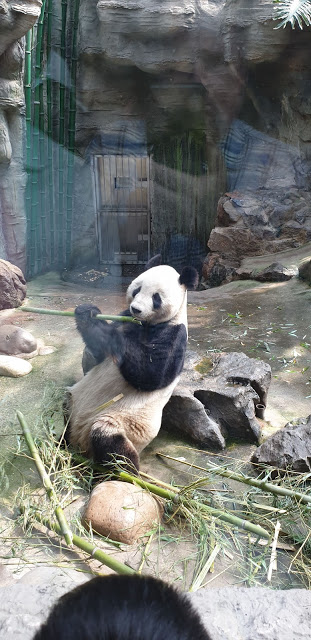
There are two pandas that we can see, one of whom is a little camera shy, and the other, above, who is demonstrating how pandas eat bamboo. They are behind a large glass wall, and you have to wait for the opportunity to get a good photo, and sometimes, only enough to include the top of the head of the person in front of you. Unfortunately, the Chinese visitors don’t understand the polite excuse me in English and can, at times, be rude enough to shove their way to the front.
What is also a problem is the uncooperativeness of the pandas to pose for photos. I guess there’s no surprise there, given the thousands of visitors every day with only one purpose in mind. We counted ourselves lucky to get the photos we did.
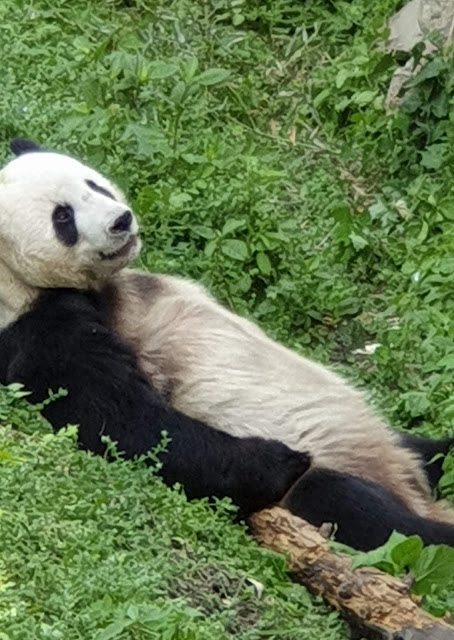
The hall itself is built onto the external enclosure, where there are several giant pandas, some of whom were on show, and were relatively lethargic, as though they had a big weekend, and we’re sleeping it off, like this panda below:
Then, remarkably, we came across one that decided to be a little more energetic and did a walk in front of hundreds of Chinese who had undoubtedly come to show their children the animals.
This Panda was also easier to photograph, whereas the other panda, one chewing on a morning feast of bamboo, saw a lot of pushing and shoving by the spectators to get the best spot to take his photograph. Having manners just doesn’t cut it here, so do what you have to get that photograph.
We also saw a couple of monkeys that were in the panda enclosure, but they were not much of a side benefit. They may have been there to use the Panda’s exercise equipment, though it was not quite like what we use. There was no time really to wander off to see much else, but apparently, there were also red pandas, and surprisingly, a category called Australian animals. But who goes to another country to view their own animals? The cutest animals were the stuffed pandas, and they were quite reasonably priced.
Instead of making a grand entrance, arriving in style and being greeted by important dignitaries, we are slinking in via an airplane, late at night. It’s hardly the entrance I’d envisaged. At 9:56 the plane touches down on the runway. Outside the plane, it is dark and gloomy and from what I could see, it had been raining. That could, of course, simply be condensation.
Once on the ground, everyone was frantically gathering together everything from seat pockets and sending pillows and blankets to the floor. A few were turning their mobile phones back on, and checking for a signal, and, perhaps, looking for messages sent to them during the last 12 hours. Or perhaps they were just suffering from mobile phone deprivation.
It took 10 minutes for the plane to arrive at the gate. That’s when everyone moves into overdrive, unbuckling belts, some before the seatbelt sign goes off, and are first out of their seats and into the overhead lockers. Most are not taking care that their luggage may have moved, but fortunately, no bags fall out onto someone’s head. The flight had been relatively turbulence-free.
When as many people and bags have squeezed into that impossibly small aisle space, we wait for the door to open, and then the privileged few business and first-class passengers to depart before we can begin to leave. As we are somewhere near the middle of the plane, our wait will not be as long as it usually is. This time we avoided being at the back of the plane. Perhaps that privilege awaits us on the return trip.
Once off the plane, it is a matter of following the signs, some of which are not as clear as they could be. It’s why it took another 30 odd minutes to get through immigration, but that was not necessarily without a few hiccups along the way. We got sidetracked at the fingerprint machines, which seemed to have a problem if your fingers were not straight, not in the center of the glass, and then if it was generally cranky, which ours were, continue to tell you to try again, and again, and again, and again…That took 10 to 15 minutes before we joined an incredibly long queue of other arrivals.
A glance at the time, and suddenly it’s nearly an hour from the moment we left the plane.
And…
That’s when we got to the immigration officer, and it became apparent we were going to have to do the fingerprints yet again. Fortunately, this time, it didn’t take as long. Once that was done, we collected our bags, cleared customs by putting our bags through a huge X-ray machine, and it was off to find our tour guide.
We found several tour guides with their trip-a-deal flags waiting for us to come out of the arrivals hall. It wasn’t a difficult process in the end. We were in the blue group. Other people we had met on the plane were in the red group or the yellow group. The tour guide found, or as it turned out, she found us; it was simply a matter of waiting for the rest of the group, of which there were eventually 28. Gathered, we were told we would be taking the bags to one place and then ourselves to the bus in another. A glance in the direction of the bus park, there were a lot of buses.
Here’s a thought: imagine being told your bus is the white one with blue writing on the side.
Yes, yours is, and 25 others, because all of the tourist coaches are the same. An early reminder, so that you do not get lost, or, God forbid, get on the wrong bus, for the three days in Beijing, is to get the last five numbers of the bus registration plate and commit them to memory. It’s important. Failing that, the guide’s name is in the front passenger window.
Also, don’t be alarmed if your baggage goes in one direction, and you go in another. In a rather peculiar setup, the bags are taken to the hotel by what the guide called the baggage porter. It is an opportunity to see how baggage handlers treat your luggage; much better than the airlines, it appears.
That said, if you’re staying at the Beijing Friendship Hotel, be prepared for a long drive from the airport. It took us nearly an hour, and bear in mind that it was very late on a Sunday night.
Climbing out of the bus after what seemed a convoluted drive through a park with buildings, we arrive at the building that will be our hotel for the next three days. From the outside, it looks quite good, and once inside the foyer, that first impression is good. Lots of space, marble, and glass. If you are not already exhausted by the time you arrive, the next task is to get your room key, find your bags, get to your room, and try to get ready the next morning at a reasonable hour.
Sorry, that boat has sailed.
We were lucky, we were told, that our plane arrived on time, and we still arrived at the hotel at 12:52. Imagine if the incoming plane is late.
This was taken the following morning. It didn’t look half as bland late at night.
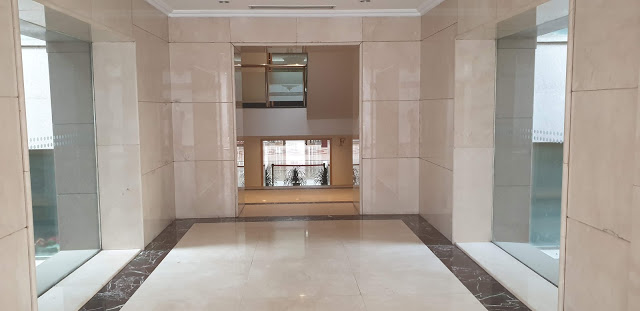
This is the back entrance to Building No. 4, but is quite representative of the whole foyer, made completely of marble and glass. It all looked very impressive under the artificial lights, but not so much in the cold, hard light of early morning.
This is the foyer of the floor where our room was. Marble with interesting carpet designs. Those first impressions of it being a plush hotel were slowly dissipating as we got nearer and nearer to the room. From the elevator, it was a long, long walk.
So…Did I tell you about the bathroom in our room?
The shower and the toilet both share the same space with no divide, and the shower curtain doesn’t reach the floor. Water pressure is phenomenal. Having a shower floods the whole shower plus toilet area, so when you go to the toilet, you’re basically underwater.
Don’t leave your book or magazine on the floor, or it will end up a watery mess.
And the water pressure is so hard that it could cut you in half. Only a small turn of the tap is required to get that tingling sensation going.