I went to school and learned a lesson. We often hope that our children learn from these lessons, but sometimes the lesson learned was not the one intended.
This could be called a useful piece of practical wisdom, and for me that was, don’t get into fights at the back of the schoolyard.
The former lesson can be, on one hand, a section of school work, from a larger continuous topic, or, part of a book, which can be an exercise.
Then there’s the study of the past and the hope that we can learn from the lessons of the past.
Sadly, in a lot of cases, we don’t and are therefore doomed to repeat the past, only with far more devastating consequences.
A lesson can also be a passage from the bible.
Or is it lessen, where we reduce the costs which means lessen means reduce, to make less.
I could lessen the load if I gave someone else some of the work.
Or if I stopped eating candy, I could lessen the chances of clotting arteries.
It’s halfway, but it doesn’t feel like it in terms of getting the story done. It’s certainly more than halfway in terms of getting words on paper.
The problem is, at this point, I should be reasonably happy with not only the progress but the quality of the story.
The thing is, I’m going to bed completely dissatisfied with the direction it’s going, and the characters. Of course, this is usual, I always have misgivings about everything while deep in the throes of getting the initial story down.
I know I/m not going to have a masterpiece in the first draft, but that still doesn’t mean I can’t have high expectations.
Maybe I need to take a step back.
Maybe I need to go back over some of the writing and see what it is that’s making me doubt myself.
Any other time, I would put it to one side and work on something else, let the story go round and round in my head until it works itself out. That sometimes takes months, and there’s a reason why some books take a year, or more, to write.
Unfortunately, I don’t have the time.
It’s going to be an uneasy sleep, if I get any.
…
Today’s word count: 3,387 words, for the running total of 36,754.
In Beijing Hutongs are formed by lines of traditional courtyard residences, called siheyuan. Neighborhoods were formed by joining many hutongs together. These siheyuan are the traditional residences, usually occupied by a single or extended family, signifying wealth, and prosperity.
Over 500 of these still exist.Many of these hutongs have been demolished, but recently they have become protected places as a means of preserving some Chinese cultural history. They were first established in the Yuan Dynasty (1279-1368)Many of these Hutongs had their main buildings and gates built facing south, and lanes connecting them to other hutongs also ran north to south.
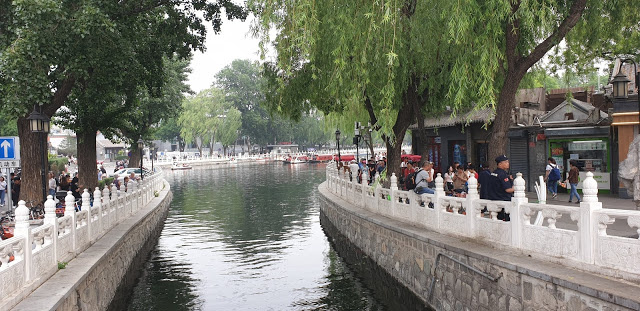
Many hutongs, some several hundred years old, in the vicinity of the Bell Tower and Drum Tower and Shichahai Lake are preserved and abound with tourists, many of which tour the quarter in pedicabs.
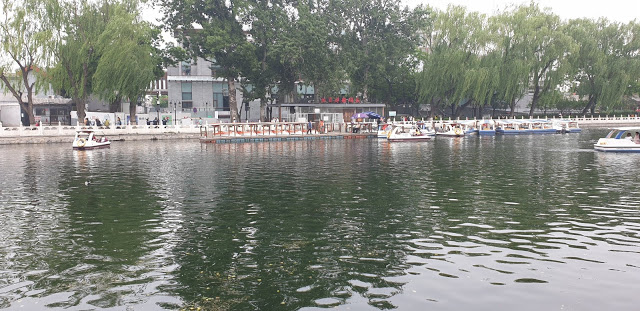
The optional tour also includes a visit to Shichahai, a historic scenic area consisting of three lakes (Qianhai, meaning Front Sea; Houhai, meaning Back Sea and Xihai, meaning West Sea), surrounding places of historic interest and scenic beauty and remnants of old-style local residences, Hutong and Courtyard.
First, we had a short walk through the more modern part of the Hutong area and given some free time for shopping, but we prefer just to meander by the canal.
There is a lake, and if we had the time, there were boats you could take.
With some time to spare, we take a quick walk down one of the alleyways where on the ground level are small shops, and above, living quarters.
Then we go to the bell and drum towers before walking through some more alleys was to where the rickshaws were waiting. The Bell tower
And the Drum tower. Both still working today.
The rickshaw ride took us through some more back streets where it was clear renovations were being made so that the area could apply for world heritage listing. Seeing inside some of the houses shows that they may look dumpy outside but that’s not the case inside.
The rickshaw ride ends outside the house where dinner will be served, and is a not so typical hose but does have all the elements of how the Chinese live, the boy’s room, the girl’s room, the parent’s room, the living area, and the North-south feng shui.
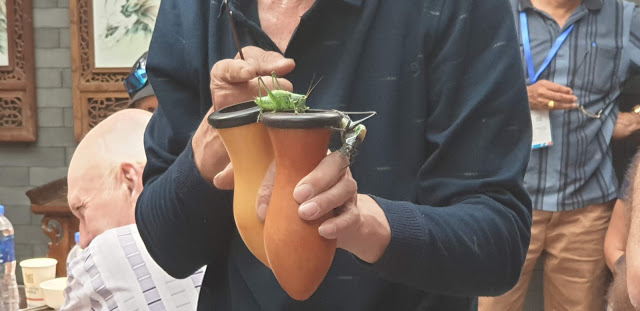
Shortly after we arrive, the cricket man, apparently someone quite famous in Beijing arrives and tells us all about crickets and then grasshoppers, then about cricket racing. He is animated and clearly enjoys entertaining us westerners.
I’m sorry but the cricket stuff just didn’t interest me. Or the grasshoppers.
As for dinner, it was finally a treat to eat what the typical Chinese family eats, and everything was delicious, and the endless beer was a nice touch.
And the last surprise, the food was cooked by a man.
I went to school and learned a lesson. We often hope that our children learn from these lessons, but sometimes the lesson learned was not the one intended.
This could be called a useful piece of practical wisdom, and for me that was, don’t get into fights at the back of the schoolyard.
The former lesson can be, on one hand, a section of school work, from a larger continuous topic, or, part of a book, which can be an exercise.
Then there’s the study of the past and the hope that we can learn from the lessons of the past.
Sadly, in a lot of cases, we don’t and are therefore doomed to repeat the past, only with far more devastating consequences.
A lesson can also be a passage from the bible.
Or is it lessen, where we reduce the costs which means lessen means reduce, to make less.
I could lessen the load if I gave someone else some of the work.
Or if I stopped eating candy, I could lessen the chances of clotting arteries.
The fortification walls, both an inner wall and an outer wall, surrounding Beijing city were built from the early 1400s to 1553.
The dimensions of the Inner city wall are: Length: 24 kilometers or 15 miles Height: 25 meters or 49 feet high Thickness, at ground level: 20 meters or 66 feet at the top: 12 meters or 29 feet
It had nine gates. The fortifications included gate towers, archways, watchtowers, barbicans, barbican towers, sluice gates, sluice gate towers, enemy sighting towers, corner guard towers, and a moat system.
The outer city wall had a length of 28 kilometers or 17 miles.
From 1911, after the collapse of the Qing Dynasty, the dismantling of the fortifications began.
In 1965, major deconstruction of the fortifications was commenced to allow for the construction of the 2nd wrong road, and Line 2 or the Beijing underground railway.
In 1979, the government called off the demolition of the remaining city walls and named them cultural heritage sites. By this time, the only intact sections were the gate tower and watchtower at Zhengyangmen, the watchtower at Deshengmen, the guard tower at the southeast corner, the northern moats of the Inner city, the section of the Inner city wall south of the Beijing railway station, and a small section of Inner-city wall near Xibianmen.
As for our guide’s explanation of the fortifications: Leaving the Square to go to the Golden Mask Dynasty Show, we pass remnants of the wall that used to surround Beijing.
This wall was built in the early 15th century and was about 24 km long, up to 15 meters high and about 20 meters thick, and had nine gates, one of which still exists today. In 1965 most of it was removed so that the second ring road and an underground railway line could be built.
The course of a story could go in almost any direction, other than the one you planned, and despair could easily set in.
Sunday, of course, is the day for lunch or dinner, and the family get together, and we try to do this every week. Covid put a dent in it, but now we are purportedly out of the woods, it’s back on.
And, like weddings and funerals, discussions can get heated. It’s not the distraction I was looking for, just a leisurely lunch, several glasses of wine, and congenial conversation.
It was anything but congenial, and a stark reminder of how divided a nation we have become. Covid has a lot to answer for, along with those who are peddling misinformation.
But, there’s writing to be done, and I have to get off my soapbox now.
Things are going to liven up from now on, and the various parties, good bad or indifferent are going to be pulled into the fray, willingly or not.
I’ve decided the main character will run into the anonymous gitl in white, just before he discovers who she is.
And, this is the point where the lead in to the revolution begins.
…
Today’s word count: 2,713 words, for the running total of 33,367.
The fortification walls, both an inner wall and an outer wall, surrounding Beijing city were built from the early 1400s to 1553.
The dimensions of the Inner city wall are: Length: 24 kilometers or 15 miles Height: 25 meters or 49 feet high Thickness, at ground level: 20 meters or 66 feet at the top: 12 meters or 29 feet
It had nine gates. The fortifications included gate towers, archways, watchtowers, barbicans, barbican towers, sluice gates, sluice gate towers, enemy sighting towers, corner guard towers, and a moat system.
The outer city wall had a length of 28 kilometers or 17 miles.
From 1911, after the collapse of the Qing Dynasty, the dismantling of the fortifications began.
In 1965, major deconstruction of the fortifications was commenced to allow for the construction of the 2nd wrong road, and Line 2 or the Beijing underground railway.
In 1979, the government called off the demolition of the remaining city walls and named them cultural heritage sites. By this time, the only intact sections were the gate tower and watchtower at Zhengyangmen, the watchtower at Deshengmen, the guard tower at the southeast corner, the northern moats of the Inner city, the section of the Inner city wall south of the Beijing railway station, and a small section of Inner-city wall near Xibianmen.
As for our guide’s explanation of the fortifications: Leaving the Square to go to the Golden Mask Dynasty Show, we pass remnants of the wall that used to surround Beijing.
This wall was built in the early 15th century and was about 24 km long, up to 15 meters high and about 20 meters thick, and had nine gates, one of which still exists today. In 1965 most of it was removed so that the second ring road and an underground railway line could be built.
The course of a story could go in almost any direction, other than the one you planned, and despair could easily set in.
Sunday, of course, is the day for lunch or dinner, and the family get together, and we try to do this every week. Covid put a dent in it, but now we are purportedly out of the woods, it’s back on.
And, like weddings and funerals, discussions can get heated. It’s not the distraction I was looking for, just a leisurely lunch, several glasses of wine, and congenial conversation.
It was anything but congenial, and a stark reminder of how divided a nation we have become. Covid has a lot to answer for, along with those who are peddling misinformation.
But, there’s writing to be done, and I have to get off my soapbox now.
Things are going to liven up from now on, and the various parties, good bad or indifferent are going to be pulled into the fray, willingly or not.
I’ve decided the main character will run into the anonymous gitl in white, just before he discovers who she is.
And, this is the point where the lead in to the revolution begins.
…
Today’s word count: 2,713 words, for the running total of 33,367.
Beijing Zoo Founded in 1906 during the late Qing dynasty, it is the oldest Zoo in China. It also has an aquarium and has 450 land-based species, some of which are rare and endemic to China like the Giant Panda, and 500 marine-based species. Other rare animals to be seen are the Red Panda, the Golden Snub-nosed Monkey, the South China Tiger, the White Lipped deer, the Chinese alligator, the Yak,, and the Snow Leopard. Most of the original animals were bought in 1908 from Germany by the viceroy of Liangjiang Duanfang. The Zoo first opened on June 16th, 1908. Currently, the Zoo grounds resemble classical Chinese gardens, and among the attractions are a number of Qing dynasty buildings to view, as well as an Elephant hall, a Lion and tiger hall, a Monkey hall, and a Panda hall. In all, there are 30 halls. The Zoo is located at 137 Xizhimen WaiDajie in Xicheng district, near the 2nd ring road.
We are primarily at the Zoo to see the Pandas, and there is a specific hall devoted to them, and by the way, it costs extra to see them. Everyone in our group is particularly interested in seeing them because it’s rare that any can be found anywhere else in the world. Perhaps if there had been more time, another hour, maybe, it might have made all the difference, but I think that extra time might have clashed with the pearl factory, and that, for obvious reasons, was deemed to be more important.
Our first stop is in the Panda hall.
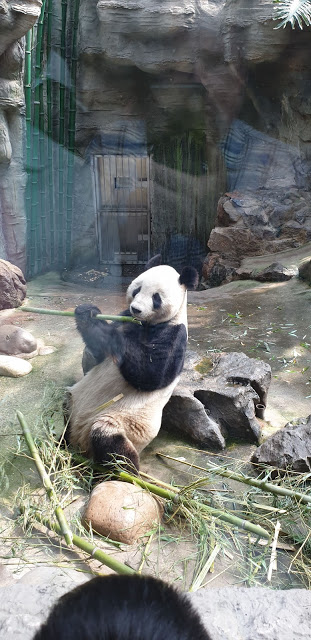
There are two pandas that we can see, one of whom is a little camera shy, and the other, above, who is demonstrating how pandas eat bamboo. They are behind a large glass wall, and you have to wait for the opportunity to get a good photo, and, sometimes only enough to include the top of the head of the person in front of you. Unfortunately, the Chinese visitors don’t understand the polite excuse me in English, and, can at times, be rude enough to shove their way to the front.
What is also a problem is the uncooperativeness of the pandas to pose for photos. I guess there’s no surprise there given the thousands of visitors every day with only one purpose in mind. We counted ourselves lucky to get the photos we did.
The hall itself is built on to the external enclosure where there are a number of giant pandas some of whom that were on show were relatively lethargic, as though they had a big weekend, and we’re sleeping it off, like this panda below:
Then, remarkably, we came across one that decided to be a little more energetic and did a walk in front of hundreds of Chinese who had undoubtedly come to show their children the animals.
This Panda was also easier to photograph whereas the other panda, one chewing on a morning feast of bamboo, saw a lot of pushing and shoving by the spectators to get the best spot to take his photograph. Having manners just doesn’t cut it here, so do what you have to to get that photograph.
We also saw a couple of monkeys that were also in the panda enclosure, but they were not much of a side benefit. They may have been there to use the Panda’s exercise equipment, though it was not quite like what we use.There was no time really to wander off to see much else, but apparently, there were also red pandas, and surprisingly, a category call Australian animals. But, who goes to another country to view your own animals?The cutest animals were the stuffed pandas, and they were quite reasonably priced.
It’s 13 days in, and unlike many in the workforce, there is no chance of taking a break. Writing, for most of us, is not a nine-to-five job where at the end of the day you throw everything in the top drawer of your desk and go home.
Chances are, you’re already home, papers, research, and a whole lot more scattered around you. You look at the clock, and think any normal sensible person would be anywhere but where you are.
My say is nowhere bring done. After 8 hours of distractions, and trying to focus on what is important, for the umpteenth time, I’ve failed.
I haven’t written the required word count.
13 days in, I’m starting to feel the effects of working continuously on the job at hand. It’s not the physical part of the job, it’s the mental effect.
5 pm, and you can see that the day is not going to end well, or worse, that’s it’s never going to end. Perhaps having a proper plan which all but allows the story to write itself.
Even then, quite often things don’t go according to plan. Stories have a habit of going in directions that never seemed possible at the beginning.
Of course, that’s your fault because you gave the character life, and it chose to go its own way.
Damn characters.
So, I’m calling the characters into a meeting and telling them they need to reign in this free will I keep hearing about, and follow the path assigned to them.
I’ll let you know how it went tomorrow.
…
Today’s word count: 2,736 words, for the running total of 30,654.s, for the running total of 5,751.