Nearly every city has a high building, a tower, or a large Ferris wheel.
London had the London eye Paris has the Eiffel tower The Galata in Istanbul The CN Tower in Toronto The towers of San Gimignano Pisa has a leaning tower
We’ve managed to see all of the above bar the Galata in Istanbul. One day we might get there.
But, on this side of the world, there are two, the Sydney Tower, and the Sky Tower in Auckland, which we just visited recently.
It’s not a tall tower, but it definitely gives great vies of Auckland, particularly to the north
The mountain in the background at the top of the photo is of a volcano on Rangitoto Island. When we were visiting, there were reports that it might become active again.
To give a height perspective, it didn’t seem all that far down to the apartment building and gardens nearby.
All the worries we thought we might have in getting from Lake Louise to Calgary, in the end, it was just like driving to work, only a little longer.
When we left the Fairmont, the car had two frozen bottles of water and a frozen donut, left in the car for the two days we were there, so hiding in the garage might not be a good idea.
At the garage where we refueled, it was so cold I could barely clean the windows and glad to get back into the warmth inside the car.
Thankfully as we got closer to Calgary, it got warmer.
We bypass the city going to the airport, but, as it turns out, we would not have had much time to look around anyway.It’s nice to go to an airport and actually find the car rental returns first go with adequate signing to get there.
Returning the car took a few extra minutes because we were at the end of a dozen or so others who turned up at the same time. All good, they remembered giving us a half full petrol tank.
At the check-in, it is very smooth sailing, the kiosk working and once the booking reference was entered, it spat out the desired number of boarding passes and baggage tags.
Then to baggage drop, through customs where I managed to lose my jacket, which is amazing that you would be allowed to leave anything behind.
So…
We have an hour and a half to kill, so a long soda and two long island teas settle the pre-flight nerves if we had any to start with.
Time to consider the vagaries of the flight.
Today we’re on an Airbus a320, and we are seated in the very last row, row 33. It’s always a bad thing to look up planes on seatguru.com, because it has painted them as the worst on the plane.
What’s the downside, sometimes the seat pitch is less than further up the plane, the seats don’t recline and you get the seat in front in your face, and you get the constant flushing of the toilets. And my major bugbear there’s no overhead luggage space.
What’s the reality?
To begin with, the seats recline, but not very much. We’ll wait till the plane is cruising before judging how far the seats recline in front of us.
The seat pitch is good and it doesn’t feel like were cramped into a small space, but again this is relative to what happens with the seat in front.
Overhead baggage space, none whatsoever, so if you don’t get on first you are basically screwed. We were almost first to the rear of the plane so I suspect others also know about the lack of overhead bin space.
Being at the read most part of the plane affords you a view of how the baggage handlers treat your baggage, and it’s interesting, to say the least. They smile a lot, so I suspect that a few bags might get the ‘treatment’.
Enough already.
We’re now backing out of the bay ready to leave.
We’re getting endless announcements in foreign languages so when next I fly with Air Canada I should at least learn French.
Or not…
Ah, the smell of kerosene floods our end of the plane. So much for air quality, which so it happens is being covered in the safety video at the exact same time.
This morning started with a visit to the car rental place in Vancouver. It reinforced the notion that you can be given the address and still not find the place. It happened in Washington where it was hiding in the back of the main railway station, and it happened again in Vancouver when it was hidden inside a hotel.
We simply walked straight past it. Pity there wasn’t a sign to let people know.
However…
We went in expecting a Grand Jeep Cherokee and walked out with a Ford Flex, suitable for three people and four large suitcases. It actually seats 7, but forget the baggage, you’d be lucky to get two large suitcases in that configuration.
It is more than adequate for our requirements.
Things to note, it was delivered with just over a quarter of a tank of gas, and it had only done about 11,000 km, so it’s relatively new. It’s reasonably spacious, and when the extra seats are folded down, there is plenty of baggage space.
So far, so good.
We finally leave the hotel about half-past ten, and it is raining. It is a simple task to get on Highway 1, the TransCanada Highway, initially, and then onto Highway 5, the Coquihalla highway for the trip to Kamloops.
It rains all the way to the top of the mountain, progress hampered from time to time by water sprays from both vehicles and trucks. The rain is relentless. At the top of the mountain, the rain turns into snow and the road surface to slush. It’s 0 degrees, but being the afternoon, I was not expecting it to turn to ice very quickly.
On the other side of the mountain, closer to Kamloops, there was sleet, then rain, then nothing, the last 100kms or so, in reasonably dry conditions.
Outside Kamloops, and in the town itself, there was evidence of snow recently cleared, and slushy roads. Cars in various places were covered in snow, indicating the most recent falls had been the night before.
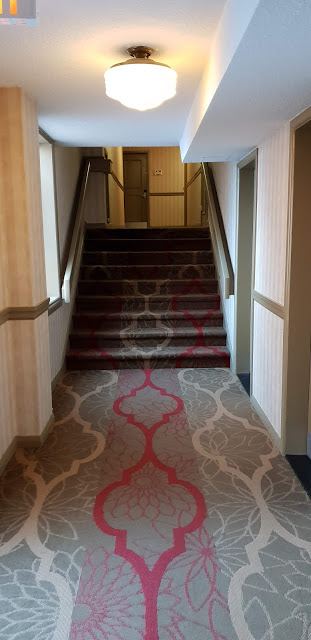
We’re staying at the Park Hotel, a heritage building, apparently built in the later 1920s. In the style of the time, it is a little like a rabbit warren with passages turning off in a number of directions, and showing it is spread across a number of different buildings.
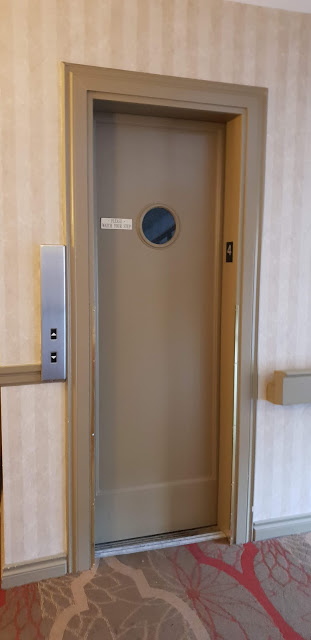
It has the original Otis elevator that can take a maximum of four passengers, and a sign on the wall that says “no horseplay inside the elevator” which is a rather interesting expression that only someone of my vintage would understand. And, for those without a sense of humor, you definitely couldn’t fit a horse in it to play with.
The thing is, how do you find a balance between keeping the old world charm with modern day expectations. You can’t. Some hotels try valiantly to get that balance. Here, it is simply old world charm, which I guess we should be grateful for because sooner rather than later it’s going to disappear forever.
In my writer’s mind, given the importance of the railways, this was probably a thriving place for travelers and once upon a time, there were a lot more hotels like this one.
This morning started with a visit to the car rental place in Vancouver. It reinforced the notion that you can be given the address and still not find the place. It happened in Washington where it was hiding in the back of the main railway station, and it happened again in Vancouver when it was hidden inside a hotel.
We simply walked straight past it. Pity there wasn’t a sign to let people know.
However…
We went in expecting a Grand Jeep Cherokee and walked out with a Ford Flex, suitable for three people and four large suitcases. It actually seats 7, but forget the baggage, you’d be lucky to get two large suitcases in that configuration.
It is more than adequate for our requirements.
Things to note, it was delivered with just over a quarter of a tank of gas, and it had only done about 11,000 km, so it’s relatively new. It’s reasonably spacious, and when the extra seats are folded down, there is plenty of baggage space.
So far, so good.
We finally leave the hotel about half-past ten, and it is raining. It is a simple task to get on Highway 1, the TransCanada Highway, initially, and then onto Highway 5, the Coquihalla highway for the trip to Kamloops.
It rains all the way to the top of the mountain, progress hampered from time to time by water sprays from both vehicles and trucks. The rain is relentless. At the top of the mountain, the rain turns into snow and the road surface to slush. It’s 0 degrees, but being the afternoon, I was not expecting it to turn to ice very quickly.
On the other side of the mountain, closer to Kamloops, there was sleet, then rain, then nothing, the last 100kms or so, in reasonably dry conditions.
Outside Kamloops, and in the town itself, there was evidence of snow recently cleared, and slushy roads. Cars in various places were covered in snow, indicating the most recent falls had been the night before.
We’re staying at the Park Hotel, a heritage building, apparently built in the later 1920s. In the style of the time, it is a little like a rabbit warren with passages turning off in a number of directions, and showing it is spread across a number of different buildings.
It has the original Otis elevator that can take a maximum of four passengers, and a sign on the wall that says “no horseplay inside the elevator” which is a rather interesting expression that only someone of my vintage would understand. And, for those without a sense of humor, you definitely couldn’t fit a horse in it to play with.
The thing is, how do you find a balance between keeping the old world charm with modern day expectations. You can’t. Some hotels try valiantly to get that balance. Here, it is simply old world charm, which I guess we should be grateful for because sooner rather than later it’s going to disappear forever.
In my writer’s mind, given the importance of the railways, this was probably a thriving place for travelers and once upon a time, there were a lot more hotels like this one.
Staying at Hampton Inn and Suites downtown, whatever that means because it looks like we are in the middle of nowhere.
But, judging by the crowd in the breakfast room, it’s a popular hotel. Of course, it is Sunday morning so this could be the weekend escape people.
Two things I remember about staying in Hampton Inns is firstly the waffles and whipped butter. It’s been five years but nothing has changed, they are as delicious as ever. The other, its where I discovered vanilla flavored milk for coffee, and it, too, is addictive.
They also used to have flat burgers that were made out of sausage meat which was delicious, but on the first day, they were not on the menu.
Nevertheless, it was still a very yummy breakfast.
After some research into where we might find this pixmi unicorn, it appears that it is available at a ‘toys are us’ store in one of the suburbs of Vancouver. So, resuming the quest, we took a taxi to West Broadway, the street the store is located.
A quick search of the store finds where the toys we’re looking for are, after asking one of the sales staff, and we find there are at least a dozen of them. Apparently, they are not as popular in Canada as the might be in America. Cheaper too, because the exchange rate for Canadian dollars is much better than for American dollars. Still, 70 dollars for a stuffed toy is a lot of money.
We also get some slime, stuff that our middle granddaughter seems to like playing with.
After shopping we set off down West Broadway, the way we had come, looking for a taxi to return us to the hotel. There’s no question of walking back to the hotel.
A few hours later we walk to the observation tower, which was not very far from the hotel,
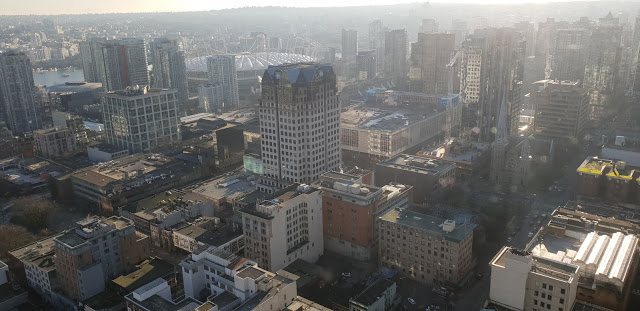
a place where we could get a 360-degree view of the city of Vancouver although it was very difficult to see any of the old buildings because they were hidden by the newer buildings, nor could we see the distant mountains because of the haze.
After leaving the tower we walked down Water Street to see the steam clock and the old world charm of a cobbled street and old buildings
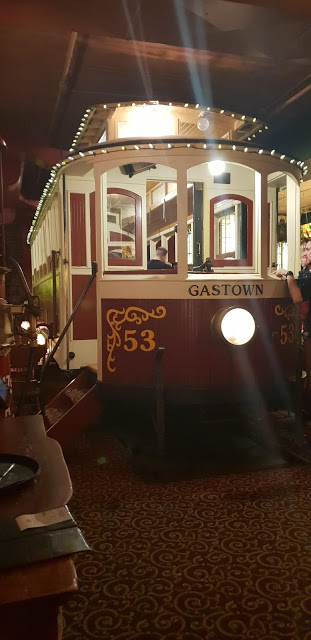
We stopped at the Spaghetti Factory Italian restaurant for dinner and is so popular that we have to wait, 10 minutes to start with. It doesn’t take all that long to order and have the food delivered to the table. Inside the restaurant, there is an actual cable car but we didn’t get to sit in it.
I have steak, rare, mushrooms, and spaghetti with marinara sauce. No, marinara doesn’t mean seafood sauce but a very tasty tomato-based sauce. The steak was absolutely delicious and extremely tender which made it more difficult to cut with a steak knife.
The write up for the marinara sauce is, ‘it tastes so fresh because it is made directly from vine-ripened tomatoes, not from concentrate, packed within 6 hours of harvest. We combine them with fresh, high-quality ingredients such as caramelised onions, roasted garlic and extra virgin olive oil’.
Oh, and did I mention they have a streetcar right there in the middle of the restaurant
I’m definitely going to try and make this when we get home.
After dinner, we return to the observation tower, the ticket allowing us to go back more than once, and see the sights at night time. I can’t say it was all that spectacular.
Another day has gone, we are heading home tomorrow.
Staying at Hampton Inn and Suites downtown, whatever that means because it looks like we are in the middle of nowhere.
But, judging by the crowd in the breakfast room, it’s a popular hotel. Of course, it is Sunday morning so this could be the weekend escape people.
Two things I remember about staying in Hampton Inns is firstly the waffles and whipped butter. It’s been five years but nothing has changed, they are as delicious as ever. The other, its where I discovered vanilla flavored milk for coffee, and it, too, is addictive.
They also used to have flat burgers that were made out of sausage meat which was delicious, but on the first day, they were not on the menu.
Nevertheless, it was still a very yummy breakfast.
After some research into where we might find this pixmi unicorn, it appears that it is available at a ‘toys are us’ store in one of the suburbs of Vancouver. So, resuming the quest, we took a taxi to West Broadway, the street the store is located.
A quick search of the store finds where the toys we’re looking for are, after asking one of the sales staff, and we find there are at least a dozen of them. Apparently, they are not as popular in Canada as the might be in America. Cheaper too, because the exchange rate for Canadian dollars is much better than for American dollars. Still, 70 dollars for a stuffed toy is a lot of money.
We also get some slime, stuff that our middle granddaughter seems to like playing with.
After shopping we set off down West Broadway, the way we had come, looking for a taxi to return us to the hotel. There’s no question of walking back to the hotel.
A few hours later we walk to the observation tower, which was not very far from the hotel,
a place where we could get a 360-degree view of the city of Vancouver although it was very difficult to see any of the old buildings because they were hidden by the newer buildings, nor could we see the distant mountains because of the haze.
After leaving the tower we walked down Water Street to see the steam clock and the old world charm of a cobbled street and old buildings
We stopped at the Spaghetti Factory Italian restaurant for dinner and is so popular that we have to wait, 10 minutes to start with. It doesn’t take all that long to order and have the food delivered to the table. Inside the restaurant, there is an actual cable car but we didn’t get to sit in it.
I have steak, rare, mushrooms, and spaghetti with marinara sauce. No, marinara doesn’t mean seafood sauce but a very tasty tomato-based sauce. The steak was absolutely delicious and extremely tender which made it more difficult to cut with a steak knife.
The write up for the marinara sauce is, ‘it tastes so fresh because it is made directly from vine-ripened tomatoes, not from concentrate, packed within 6 hours of harvest. We combine them with fresh, high-quality ingredients such as caramelised onions, roasted garlic and extra virgin olive oil’.
Oh, and did I mention they have a streetcar right there in the middle of the restaurant
I’m definitely going to try and make this when we get home.
After dinner, we return to the observation tower, the ticket allowing us to go back more than once, and see the sights at night time. I can’t say it was all that spectacular.
Another day has gone, we are heading home tomorrow.
It’s always a given that whatever city you stay in unless it’s overnight, you go on a tour and see the sights.
Even when you’re staying a short distance from the city, you may make the effort to catch a train or bus, then get on the hop on hop off tour. There’s always one in just about every city you visit.
Vancouver was no exception.
Except…
We arrived in the rain, went to sleep while the rain came down, woke up to the rain, and a heavy dose of jet lag or perhaps it was more that we had spent 24 and a half hours traveling from Brisbane to Vancouver via Shanghai.
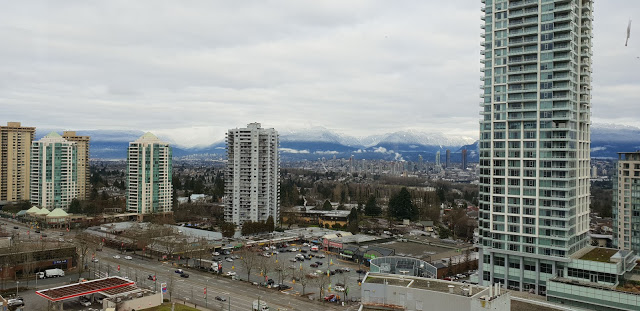
We had an excellent view out the window of our room looking towards the shopping mall, and the steady falling rain.
I felt sorry watching the construction workers on the building site that was the main vista we had to look at.
It could have been worse. Endless mountains with snow on them.
What to do. Venture out in the rain and go on the tour, on pop over to the shopping mall and pick up a few boxing day bargains, no, sorry, boxing week bargains.
We have had some experience going on hop on hop off tours in open-top buses in the rain. And the last time was not a pleasant experience, even though we learned a valuable lesson, not to stand in front of a cannon and yell ‘fire’. Apparently, that’s how Admiral Nelson lost his arm.
But…
The shopping mall won.
We’d wait and see if the weather improved. Hang on, isn’t Vancouver near Seattle and doesn’t it rain 300 days of the year?
Not holding my breath.
I feel sorry for the construction workers again. Still raining, still cold, and still no reason to get out of bed.
Day 2 in Vancouver turned out to be the same as day 1.
Hang on, there’s a development.
We’re on the 16th floor and up at those lofty heights, we can see not only the rain but intermingled with it a few flakes of snow.
Whilst we procrastinate about what we’re going to do, the snowflakes increase into small flurries.
Yep, we’re off to the mall again and go for a walk in the snow.
On the way back we drop into the Boston Pizza, which has a sports bar and there you can sit, drink, eat, and watch the ice hockey, or whatever sort is going at the time.
Today it’s a junior ice hockey tournament, but Canada was not playing. Just the same, a long cold beer and ice hockey? How close to heaven is that?
I can now cross that off the bucket list.
Day 3, we’re going on a great rail journey, well, we are going to get the train to the city and collect the rental car, a car on the booking form that was supposedly a Jeep Grand Cherokee or similar.
Of course, ‘or similar’ are the words to be feared here because in truth the rental company can throw anything at you, so long as it matches the brief, three people and three large suitcases.
And, you guessed it…
The ‘or similar’ got us a Fort Flex.
Sounded like some place where exhausted soldiers were fending of the Indians in a last ditch battle.
Perhaps one or two too many American movies I think.
It’s always a given that whatever city you stay in unless it’s overnight, you go on a tour and see the sights.
Even when you’re staying a short distance from the city, you may make the effort to catch a train or bus, then get on the hop on hop off tour. There’s always one in just about every city you visit.
Vancouver was no exception.
Except…
We arrived in the rain, went to sleep while the rain came down, woke up to the rain, and a heavy dose of jet lag or perhaps it was more that we had spent 24 and a half hours traveling from Brisbane to Vancouver via Shanghai.
We had an excellent view out the window of our room looking towards the shopping mall, and the steady falling rain.
I felt sorry watching the construction workers on the building site that was the main vista we had to look at.
It could have been worse. Endless mountains with snow on them.
What to do. Venture out in the rain and go on the tour, on pop over to the shopping mall and pick up a few boxing day bargains, no, sorry, boxing week bargains.
We have had some experience going on hop on hop off tours in open-top buses in the rain. And the last time was not a pleasant experience, even though we learned a valuable lesson, not to stand in front of a cannon and yell ‘fire’. Apparently, that’s how Admiral Nelson lost his arm.
But…
The shopping mall won.
We’d wait and see if the weather improved. Hang on, isn’t Vancouver near Seattle and doesn’t it rain 300 days of the year?
Not holding my breath.
I feel sorry for the construction workers again. Still raining, still cold, and still no reason to get out of bed.
Day 2 in Vancouver turned out to be the same as day 1.
Hang on, there’s a development.
We’re on the 16th floor and up at those lofty heights, we can see not only the rain but intermingled with it a few flakes of snow.
Whilst we procrastinate about what we’re going to do, the snowflakes increase into small flurries.
Yep, we’re off to the mall again and go for a walk in the snow.
On the way back we drop into the Boston Pizza, which has a sports bar and there you can sit, drink, eat, and watch the ice hockey, or whatever sort is going at the time.
Today it’s a junior ice hockey tournament, but Canada was not playing. Just the same, a long cold beer and ice hockey? How close to heaven is that?
I can now cross that off the bucket list.
Day 3, we’re going on a great rail journey, well, we are going to get the train to the city and collect the rental car, a car on the booking form that was supposedly a Jeep Grand Cherokee or similar.
Of course, ‘or similar’ are the words to be feared here because in truth the rental company can throw anything at you, so long as it matches the brief, three people and three large suitcases.
And, you guessed it…
The ‘or similar’ got us a Fort Flex.
Sounded like some place where exhausted soldiers were fending of the Indians in a last ditch battle.
Perhaps one or two too many American movies I think.