Searching for locations: A bus tour of Philadelphia, USA

The Philadelphia Bus Tour, what we did see

To start with, we first joined this tour at stop number 6.

We had to find it first and that meant some pedestrian navigation, which took us first to the City Hall, a rather imposing structure, which we found later had a profound effect on Philadelphia sports teams.

According to the map, stop number 6 is Reading Terminal Market, Convention Centre, on 12th street on Filbert.  This was where we bought the tickets and boarded the bus that had a rather interesting guide aboard.

His favorite says was “And we’re good to go.”

Soon we would discover that his commentary was more orientated towards a younger audience, not that it bothered us.

Given the time restraints, we had, this was always going to be about looking and learning.

Stop number 7

City hall, Love Park.

This we had seen on our walk from where we left the car at the Free Library, near the Swann Memorial Fountain in Logan Park, the landmark that Rebecca had remembered from her last visit to Philadelphia.  Of course, then, it was not quite so frozen.

Love park, of course, was only notable to us in that it had a sculpture in place with the word Love rather stylized.  Apart from that, you’d hardly know it as a park

The city hall, well, that was something else, and when we looked at it, before going on the tour, it was a rather magnificent stone edifice.
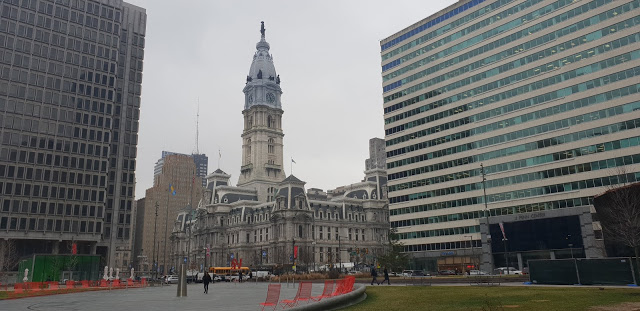
After, well the guide filled us in, tallest building, highest and largest monument on William Penn, you get the gist.  37 feet tall, when eclipsed, the Philly sports teams all suffered slumps of one kind or another, until the problem was rectified.  Interesting story.

Stop number 8

18th Street and the Benjamin Franklin Parkway, or Logan Circle

This is the location of the Cathedral Basilica of Saints Peter and Paul.  A place where the Pope decided to give an audience and sent the city into a spin.

The same church has very high windows for the reason in the early days there was a problem with people wanting to throw Molotov cocktails through the windows.  A bit hard when they’re so high up.

Benjamin Franklin Parkway, of course, is interesting in itself as an avenue, not only for all of the flags of many nations of those who chose to live in Philadelphia.  We found ours, the one for Australia

This was also the stop where we needed to get off once the tour was finished, and time to head to the car, and go home, but that’s another story.

Stop number 10

Is that the stature of the Thinker, made famous, at least for me, from the old Dobie Gillis episodes, of God knows how many years ago?

Or, maybe it’s just the Rodin Museum on Benjamin Franklin Parkway.

There’s a whole story to go with that Statue and the fact it is one of many all over the world.

This one was made in France, cast in 1919 in Bronze, and is approximately 200cm x 130 cm by 140cm.

Stop number 11

Eastern State Penitentiary.  NW corner of 22nd Street and Fairmont Avenue.

This had a rather interesting story attached to it and had something to do with ghosts, but I wasn’t listening properly to the guide’s monologue.

But, later research shows, the fact it was once the most famous and expensive prison in the world.  Many also think it is haunted and is a favorite for visiting paranormal visitors.

Built around 1829, it was the first prison to have separate cells for prisoners.  It held, at various times, the likes of Al Capone and Willie Sutt

Stop number 18

The Philadelphia Museum of art, where we stop for a few minutes and look at the steps which were immortalized in the movie Rocky, yes he ran god knows how far to end up on the top of these steps.

Sorry, but I’m not that fit that I would attempt walking up them.  The view is just fine from inside the bus.  Of course, they might consider cleaning the windows a little so the view was clearer, but because it’s basically Perspex and scratched so that might not be possible.

Stop number 17

Back at Logan Circle, or Square if you prefer, but on the other side, closer to the Franklin Institute.  Benjamin Franklin’s name is used a lot in this city.

After that, it’s a blur, the Academy of Music, the University of the Arts, Pennsylvania Hospital, South Street, Vietnam Veterans Memorial, the USS Olympia, Penn’s Landing, and past the National Liberty Museum.  I’m sure somewhere in that blur was the intention of seeing the Liberty Bell, but I think I heard that it was not on show, and only a replica could be seen.

So much for the getting as an opportunity to see the real liberty bell, crack and all..

We get off and stop number 27, or Number 1, I was not quite sure.

What were we after?  The definitive Philly Cheese Steak.

Searching for locations: New York, USA

After arriving latish from Toronto, and perhaps marginally disappointed that while in Toronto, the ice hockey didn’t go our way, we slept in.

Of course, the arrival was not without its own problems. The room we were allocated was on the 22nd floor and was quite smallish. Not a surprise, but we needed space for three, and with the fold-out bed, it was tight but livable.

Except…

We needed the internet to watch the Maple Leafs ice hockey game. We’d arrive just in time to stream it to the tv.

But…

There was no internet. It was everywhere else in the hotel except our floor.

First, I went to the front desk and they directed me to call tech support.

Second, we called tech support and they told us that the 22nd-floor router had failed and would get someone to look at it.

When?

It turns out it didn’t seem to be a priority. Maybe no one else on the floor had complained

Third, I went downstairs and discussed the lack of progress with the night duty manager, expressing disappointment with the lack of progress.

I also asked if they could not provide the full service that I would like a room rate reduction or a privilege in its place as compensation.

He said he would check it himself.

Fourth, after no further progress, we called the front desk to advise there was still no internet. This time we were asked if we wanted a room on another floor, where the internet is working. We accepted the offer.

The end result, a slightly larger, less cramped room, and the ability to watch the last third of the Maple Leaf’s game. I can’t remember if we won.

We all went to bed reasonably happy.

After all, we didn’t have to get up early to go up or down to breakfast because it was not included in the room rate, a bone of contention considering the cost.

I’ll be booking with them directly next time, at a somewhat cheaper rate, a thing I find after using a travel wholesaler to book it for me.

As always every morning while Rosemary gets ready, I go out for a walk and check out where we are.

It seems we are practically in the heart of theaterland New York. Walk one way or the other you arrive at 7th Avenue or Broadway.

Walk uptown and you reach 42nd Street and Times Square, little more than a 10-minute leisurely stroll. On the way down Broadway, you pass a number of theatres, some recognizable, some not.

Times Square is still a huge collection of giant television screens advertising everything from confectionary to TV shows on the cable networks.

A short walk along 42nd street takes you to the Avenue of the Americas and tucked away, The Rockefeller center and its winter ice rink.

A few more steps take you to 5th Avenue and the shops like Saks of Fifth Avenue, shops you could one day hope to afford to buy something.

In the opposite direction, over Broadway and crossing 8th Avenue is an entrance to Central Park. The approach is not far from what is called the Upper West Side, home to the rich and powerful.

Walk one way in the park, which we did in the afternoon, takes you towards the gift shop and back along a labyrinth of laneways to 5th Avenue. It was a cold, but pleasant, stroll looking for the rich and famous, but, discovering, they were not foolish enough to venture out into the cold.

Before going back to the room, we looked for somewhere to have dinner and ended up in Cassidy’s Irish pub. There was a dining room down the back and we were one of the first to arrive for dinner service.

The first surprise, our waitress was from New Zealand.

The second, the quality of the food.

I had a dish called Steak Lyonnaise which was, in plain words, a form of mince steak in an elongated patty. It was cooked rare as I like my steak and was perfect. It came with a baked potato.

As an entree, we had shrimp, which in our part of the world are prawns, and hot chicken wings, the sauce is hot and served on the side.

The beer wasn’t bad either. Overall given atmosphere, service, and food, it’s a nine out of ten.

It was an excellent way to end the day.

Searching for locations: New York, USA

After arriving latish from Toronto, and perhaps marginally disappointed that while in Toronto, the ice hockey didn’t go our way, we slept in.

Of course, the arrival was not without its own problems. The room we were allocated was on the 22nd floor and was quite smallish. Not a surprise, but we needed space for three, and with the fold-out bed, it was tight but livable.

Except…

We needed the internet to watch the Maple Leafs ice hockey game. We’d arrive just in time to stream it to the tv.

But…

There was no internet. It was everywhere else in the hotel except our floor.

First, I went to the front desk and they directed me to call tech support.

Second, we called tech support and they told us that the 22nd-floor router had failed and would get someone to look at it.

When?

It turns out it didn’t seem to be a priority. Maybe no one else on the floor had complained

Third, I went downstairs and discussed the lack of progress with the night duty manager, expressing disappointment with the lack of progress.

I also asked if they could not provide the full service that I would like a room rate reduction or a privilege in its place as compensation.

He said he would check it himself.

Fourth, after no further progress, we called the front desk to advise there was still no internet. This time we were asked if we wanted a room on another floor, where the internet is working. We accepted the offer.

The end result, a slightly larger, less cramped room, and the ability to watch the last third of the Maple Leaf’s game. I can’t remember if we won.

We all went to bed reasonably happy.

After all, we didn’t have to get up early to go up or down to breakfast because it was not included in the room rate, a bone of contention considering the cost.

I’ll be booking with them directly next time, at a somewhat cheaper rate, a thing I find after using a travel wholesaler to book it for me.

As always every morning while Rosemary gets ready, I go out for a walk and check out where we are.

It seems we are practically in the heart of theaterland New York. Walk one way or the other you arrive at 7th Avenue or Broadway.

Walk uptown and you reach 42nd Street and Times Square, little more than a 10-minute leisurely stroll. On the way down Broadway, you pass a number of theatres, some recognizable, some not.

Times Square is still a huge collection of giant television screens advertising everything from confectionary to TV shows on the cable networks.

A short walk along 42nd street takes you to the Avenue of the Americas and tucked away, The Rockefeller center and its winter ice rink.

A few more steps take you to 5th Avenue and the shops like Saks of Fifth Avenue, shops you could one day hope to afford to buy something.

In the opposite direction, over Broadway and crossing 8th Avenue is an entrance to Central Park. The approach is not far from what is called the Upper West Side, home to the rich and powerful.

Walk one way in the park, which we did in the afternoon, takes you towards the gift shop and back along a labyrinth of laneways to 5th Avenue. It was a cold, but pleasant, stroll looking for the rich and famous, but, discovering, they were not foolish enough to venture out into the cold.

Before going back to the room, we looked for somewhere to have dinner and ended up in Cassidy’s Irish pub. There was a dining room down the back and we were one of the first to arrive for dinner service.

The first surprise, our waitress was from New Zealand.

The second, the quality of the food.

I had a dish called Steak Lyonnaise which was, in plain words, a form of mince steak in an elongated patty. It was cooked rare as I like my steak and was perfect. It came with a baked potato.

As an entree, we had shrimp, which in our part of the world are prawns, and hot chicken wings, the sauce is hot and served on the side.

The beer wasn’t bad either. Overall given atmosphere, service, and food, it’s a nine out of ten.

It was an excellent way to end the day.

What I learned about writing: The murky art of plotting (2)

Truth is stranger than fiction

The Unseen Shadows: When “Not Suspicious” Hides a Deadly Truth

In the quiet hum of suburban life, where hedges are trimmed and routines are sacred, sometimes the most chilling stories unfold not with a bang, but with a whisper. A seemingly ordinary day, an ordinary house, and a tragedy that, on the surface, appears tragically straightforward.

This week, a news blurb, easily missed, caught my eye. It spoke of a man and a woman, new in their courtship, found deceased in an ordinary suburban home following a welfare call. Their bodies lay side-by-side on the floor. The initial report was stark, almost dismissive: police were not treating the deaths as suspicious.

And that, my friends, is exactly where our story truly begins.

Because what if “not suspicious” is merely the first layer of a far more intricate, and sinister, narrative? What if that seemingly benign conclusion is precisely the moment when a seasoned investigator should lean a little closer, peer beyond the immediate, and ask: “But what if…?”

In our hypothetical deep dive, the scene, initially dismissed as a tragic dual overdose, starts to sing a different tune – one of carefully orchestrated deception.

The Discordant Notes Begin to Play

For a keen eye, particularly one belonging to someone like Detective Chief Inspector Barnes, the “simple case” quickly unravels:

  1. The Implausible Overdose: The immediate assumption was drugs. Yet, friends of the deceased knew them as anything but recreational users. And even if they were, “lying on the floor at home” didn’t align with their known habits. Most tellingly? No drugs were found in the house, save for residual traces on the bodies themselves. Sniffer dogs confirmed this, finding nothing else. This isn’t just unusual; it suggests a planting of evidence, a narrative carefully constructed.
  2. The Selective Theft: In an upstairs office, a laptop was missing – not the charger or the mouse, just the computer itself. Both their cell phones were also gone. Yet, amidst this targeted disappearance, a significant sum of cash, around £500, was left untouched. If this was a robbery, it was remarkably selective, focusing not on valuables, but on information. A thief with a very particular agenda.
  3. The Silent Bruise: A preliminary examination of the woman’s body revealed bruising on her neck. A subtle mark, easily overlooked, but one that strongly suggested a struggle, a chokehold perhaps. This detail alone pushes the needle firmly away from “natural causes” or “accidental overdose” and towards something far more violent. The coroner’s report would confirm, but the suspicion was planted.
  4. The Ghost in the System: And then, the final, chilling piece of the puzzle. A routine check on the male victim’s name returned an “access denied” flag. In our interconnected world, such a block isn’t accidental. It screams of a hidden identity, a past carefully shielded, perhaps even a life lived undercover.

From Misadventure to Murder

For Detective Chief Inspector Barnes, these four seemingly disparate points converged into a single, inescapable truth. What began as a welfare check, initially deemed tragic but benign, was rapidly transforming into something far more sinister: a potential double murder. The scene, far from being straightforward, was a meticulously staged tableau designed to mislead, to funnel investigators down a path of false assumptions.

This fictional scenario, drawn from the briefest of news items and a “what if” musing, serves as a powerful reminder: appearances can be deceiving. The most unassuming details often hold the key, and sometimes, the loudest silence speaks volumes. It’s a testament to the fact that true investigation isn’t about accepting the obvious, but about questioning everything, about looking for the unseen shadows lurking just beneath the surface of the “not suspicious.”

What I learned about writing: The murky art of plotting! (1)

Truth is stranger than fiction

Google Maps: More Than Just Directions – A Portal to Phantom Mysteries?

We all use Google Maps. It’s our trusty co-pilot, guiding us through unfamiliar streets, helping us find the nearest coffee shop, and even letting us snoop on our old childhood homes (admit it, you’ve done it!). But what if I told you that sometimes, beneath the familiar satellite imagery, Google Maps offers a glimpse into something far stranger than your aunt’s meticulously manicured lawn?

Lately, chatter has been building around peculiar anomalies popping up on the platform – digital specters appearing where they absolutely shouldn’t. Imagine panning over a dense, untouched forest, far from any airport, only to find a colossal Airbus A320 or Boeing 737 perfectly intact, sitting in a clearing. No missing plane reports, no emergency landings, just a commercial jetliner chilling amongst the trees. How did it get there? And more importantly, why?

This isn’t an isolated incident. There are numerous reports of cars, sometimes multiple vehicles, resting eerily at the bottom of lakes, visible from above. While many of these are indeed phantom images, some chillingly prove to be real. You might recall the story of the car discovered in a lake in Florida, which, upon investigation, contained the remains of a man who had been missing for over two decades. The digital anomaly led to a very real, very tragic discovery.

So, before we reach for our tinfoil hats, there’s a rational explanation for most of these ghostly appearances. The phenomenon is often an instance of image overlay or “ghosting.” Google Maps stitches together countless satellite and aerial photographs taken at different times. When an object, like a low-flying aircraft, is captured in one image over a particular spot, and a later, object-free image of the same spot is layered on top, a faint “ghost” of the original object can remain visible. The plane in the forest? It’s highly probable it was just flying incredibly low when the initial photograph was taken, leaving its digital imprint on the landscape.

Mystery solved, right? Well, mostly.

But what if, just what if, these digital echoes aren’t always mere glitches? What if, sometimes, they are whispers of something more, waiting to be heard?


Mick knew all about those lonely leisure hours when there was nothing else to do. He wasn’t one for idly scrolling social media; Mick was a tramper, a genuine trailblazer. His idea of relaxation was poring over topographical maps, looking for untouched corners of the world, sketching out potential new paths through forests, and dreaming of odd discoveries. Years ago, one such expedition had led him to uncover a lost village of significant archaeological value. He had a knack for finding things.

One drizzly afternoon, with the rain drumming against his window, Mick found himself drifting through Google Maps, exploring remote stretches of a national forest known for its dense, ancient foliage. He zoomed in, panned around, his cursor tracing imaginary trails. He wasn’t looking for glitches, but for inspiration, for the subtle hints of untamed beauty.

Then he saw it.

Not a ghost, not a blur, but what seemed to be distinct wreckage dispersed in a clearing. Glimpses of what looked like metal fragments, incongruous against the deep green canopy. It wasn’t the clean, whole plane of famous internet anomalies, but a scattering, undeniably man-made and out of place. He noted the date of the photograph – nearly a year prior.

A chill ran down his spine. He immediately checked local news archives, aviation reports, anything about missing small planes or crashes in the area. Nothing. Not a single mention. It was too remote for a simple crash to go unnoticed, yet too significant to be naturally occurring.

He kept the location saved, revisiting it over the next few days. It gnawed at him. Was it a trick of the light? A bizarre anomaly of the photo processing? He called a friend, an equally seasoned bushwalker, and explained his digital discovery, asking him to verify it on his own map.

“Right, mate, I’m looking,” came his friend’s voice over the phone a few minutes later. “Where exactly did you say?”

Mick guided him, pixel by pixel. “See it? Right there, by that cluster of three oaks…”

There was a pause. “Uh, Mick? There’s just… trees.”

Mick’s stomach dropped. He clicked back to his own map. The wreckage was gone. The clearing was pristine, just an unbroken expanse of forest. He felt a wave of self-doubt. Had his mind been playing tricks, wanting to find something remarkable, perhaps fabricating the whole thing?

But then he noticed it. The date of the photograph displayed on his screen had updated. It was no longer the nearly-a-year-old image. It was a new one, taken just a few weeks ago.

The digital ghost had vanished, but the seed of a real-world mystery had been planted. With the rain still falling and nothing better to do, Mick knew exactly what his next walking holiday would entail. He wasn’t just going to look at maps anymore. He was going to see what was really there.

What I learned about writing: Writers must read

If there is one thing I cannot resist is walking into a book store wherever it might be.

It usually elicits a groan from everyone I’m with because for them, watching grass grow is a more fascinating exercise.

But…

The best bookshops are the pop-up ones that appear in various shopping centres where there are empty spaces, and these have a wide variety of books for just $7 each.

And there are lots of bargains…

As you can see, I have been on a few bargain hunts lately and like any writer’s room, tucked away with the boxes of drinks, gardening equipment and everything else that just doesn’t fit in the house, are the piles of books awaiting being put into the shelves

As you can see, the shelves are almost full so it’s going to be an uphill battle to find spaces for them.

By the way, there are eight such book cases on the surrounding walls, as well as a new one, recently discarded from the lounge room, to house the reference books

Along with a few stuffed bears.

The job of putting books on shelves falls to the grandchildren, whom I am trying to convince that when they get older, they should too embrace the idea of having a reading room, which my writing room will also be when I eventually get to throw out the accumulation of years of discarded homewares.

Perhaps one day next year…

Searching for locations: The Mary Valley Rattler, Gympie, Queensland, Australia

I have a passion for visiting transport museums, to see old trains, planes, buses, cars, even ships if it’s possible.

This has led to taking a number of voyages on the TSS Earnslaw in Queenstown, New Zealand.

Many, many, many years ago on Puffing Billy, a steam train in the Dandenongs, Victoria, Australia.

The steam train in Kingston, New Zealand, before it was closed down, but hopefully it will reopen sometime in the future.

The London Transport Museum in London England, which had a lot of buses.

The Workshops Railway Museum in Ipswich, Queensland, where once the many steam engines were built and maintained, and now had only a handful of engines remaining.

However, in the quest for finding and experiencing old transportation methods, we came across the Mary Valley Rattler, which runs out of Gympie, Queensland, Australia.

The ride begins in Gympie at the old Gympie Railway station, and as can be seen below, is one of the relics of the past, and, nothing like the new more modern stations.  Thankfully.

If you’re going to have a vintage train, then you have to have a vintage station.

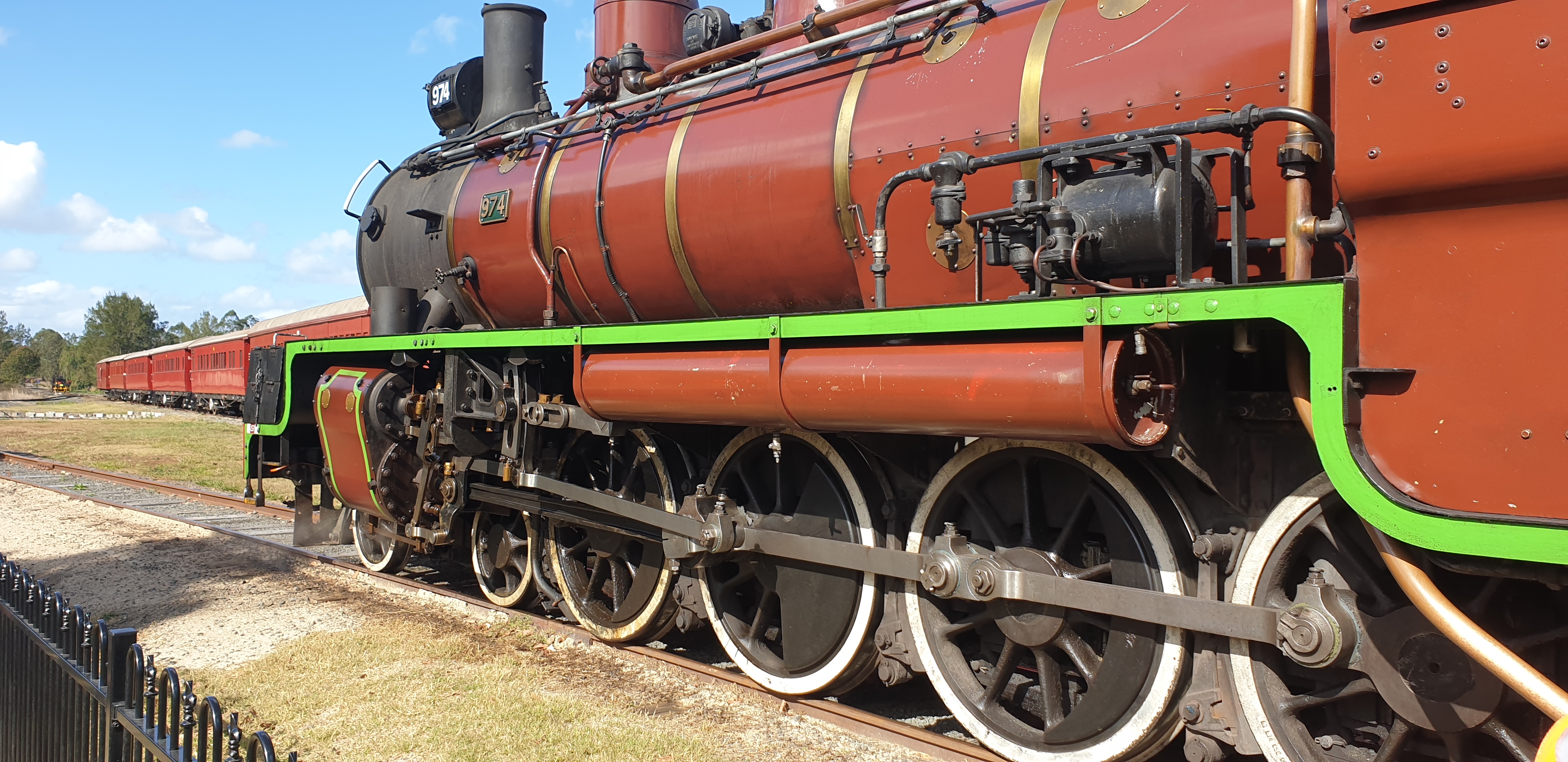
The Class of engine, seen below, is the C17, a superheated upgrade to the C16 it was based on, and first run in 1903.  This particular engine was built in 1951, although the first of its type was seen in  1920 and the last of 227 made in 1953.  It was the most popular of the steam engines used by Queensland Railways.

The C designation meant it had four driving axels and 17 was the diameter of the cylinder, 17 inches.  It is also known as a 4-8-0 steam locomotive
 and nicknamed one of the “Brown Bombers” because of its livery, brown with green and red trimming.

Also, this engine was built in Maryborough, not far from Gympie by Walkers Limited, one of 138.

This photo was taken as the train returned from Amamoor, a trip that takes up to an hour.

The locomotive is detached from the carriages, then driven to the huge turntable to turn around for the return journey to Amamoor.

This is the locomotive heading down to the water station, and then taking on water.  After that, it will switch lines, and reverse back to reconnect the carriages for the trip to Amamoor.

The carriages are completely restored and are extremely comfortable.  It brings back, for me, many memories of riding in older trains in Melbourne when I was a child.

The trains, then, were called Red Rattlers.

This is the locomotive climbing one of the hilly parts of the line before crossing over the Mary River on a trestle bridge.

This is the engine at Amamoor near the picnic area where young children and excited parents and grandparents can get on the locomotive itself and look inside where the driver sits.

And, no, I didn’t volunteer to shovel coal.

This particular locomotive spent most of its working life between Townsville and Mount Isa and was based in Cloncurry, Charters Towers, and Townsville, before being sent, at the end of its useful days in the late 1960s, to the Ipswich Railway Workshops.

In a word: Toe

A toe is one of five at the end of your foot, and from time to time you wriggle.  It’s also one of the first things to go when you get frostbite.

And when was the last time you stubbed your toe?  It hurts!

It can also mean something at the tip or point, such as the toe of a country like Italy, or England.

What does it mean when someone treads on your toes?   You upset or annoy them.

What if you go toe to toe with someone?  Two people having a ‘robust discussion’.

What about that boss that keeps you on your toes, especially when he’s looking over your shoulder!

And what about a toe-poke, a hard kick of the football with your toe?

Of course, it’s not to be confused with the word tow, which basically means to pull something behind you.

Like a tow truck, pulling a broken down, or smashed up, vehicle.

But, do you toe the line, or tow the line?  Or both at different times?

It seems that to toe the line means to do as you are told, or conform to a standard.

Sadly, that doesn’t describe me!

Searching for locations: The Mary Valley Rattler, Gympie, Queensland, Australia

I have a passion for visiting transport museums, to see old trains, planes, buses, cars, even ships if it’s possible.

This has led to taking a number of voyages on the TSS Earnslaw in Queenstown, New Zealand.

Many, many, many years ago on Puffing Billy, a steam train in the Dandenongs, Victoria, Australia.

The steam train in Kingston, New Zealand, before it was closed down, but hopefully it will reopen sometime in the future.

The London Transport Museum in London England, which had a lot of buses.

The Workshops Railway Museum in Ipswich, Queensland, where once the many steam engines were built and maintained, and now had only a handful of engines remaining.

However, in the quest for finding and experiencing old transportation methods, we came across the Mary Valley Rattler, which runs out of Gympie, Queensland, Australia.

The ride begins in Gympie at the old Gympie Railway station, and as can be seen below, is one of the relics of the past, and, nothing like the new more modern stations.  Thankfully.

If you’re going to have a vintage train, then you have to have a vintage station.

The Class of engine, seen below, is the C17, a superheated upgrade to the C16 it was based on, and first run in 1903.  This particular engine was built in 1951, although the first of its type was seen in  1920 and the last of 227 made in 1953.  It was the most popular of the steam engines used by Queensland Railways.

The C designation meant it had four driving axels and 17 was the diameter of the cylinder, 17 inches.  It is also known as a 4-8-0 steam locomotive
 and nicknamed one of the “Brown Bombers” because of its livery, brown with green and red trimming.

Also, this engine was built in Maryborough, not far from Gympie by Walkers Limited, one of 138.

This photo was taken as the train returned from Amamoor, a trip that takes up to an hour.

The locomotive is detached from the carriages, then driven to the huge turntable to turn around for the return journey to Amamoor.

This is the locomotive heading down to the water station, and then taking on water.  After that, it will switch lines, and reverse back to reconnect the carriages for the trip to Amamoor.

The carriages are completely restored and are extremely comfortable.  It brings back, for me, many memories of riding in older trains in Melbourne when I was a child.

The trains, then, were called Red Rattlers.

This is the locomotive climbing one of the hilly parts of the line before crossing over the Mary River on a trestle bridge.

This is the engine at Amamoor near the picnic area where young children and excited parents and grandparents can get on the locomotive itself and look inside where the driver sits.

And, no, I didn’t volunteer to shovel coal.

This particular locomotive spent most of its working life between Townsville and Mount Isa and was based in Cloncurry, Charters Towers, and Townsville, before being sent, at the end of its useful days in the late 1960s, to the Ipswich Railway Workshops.

Searching for locations: Brisbane botanical gardens, Australia

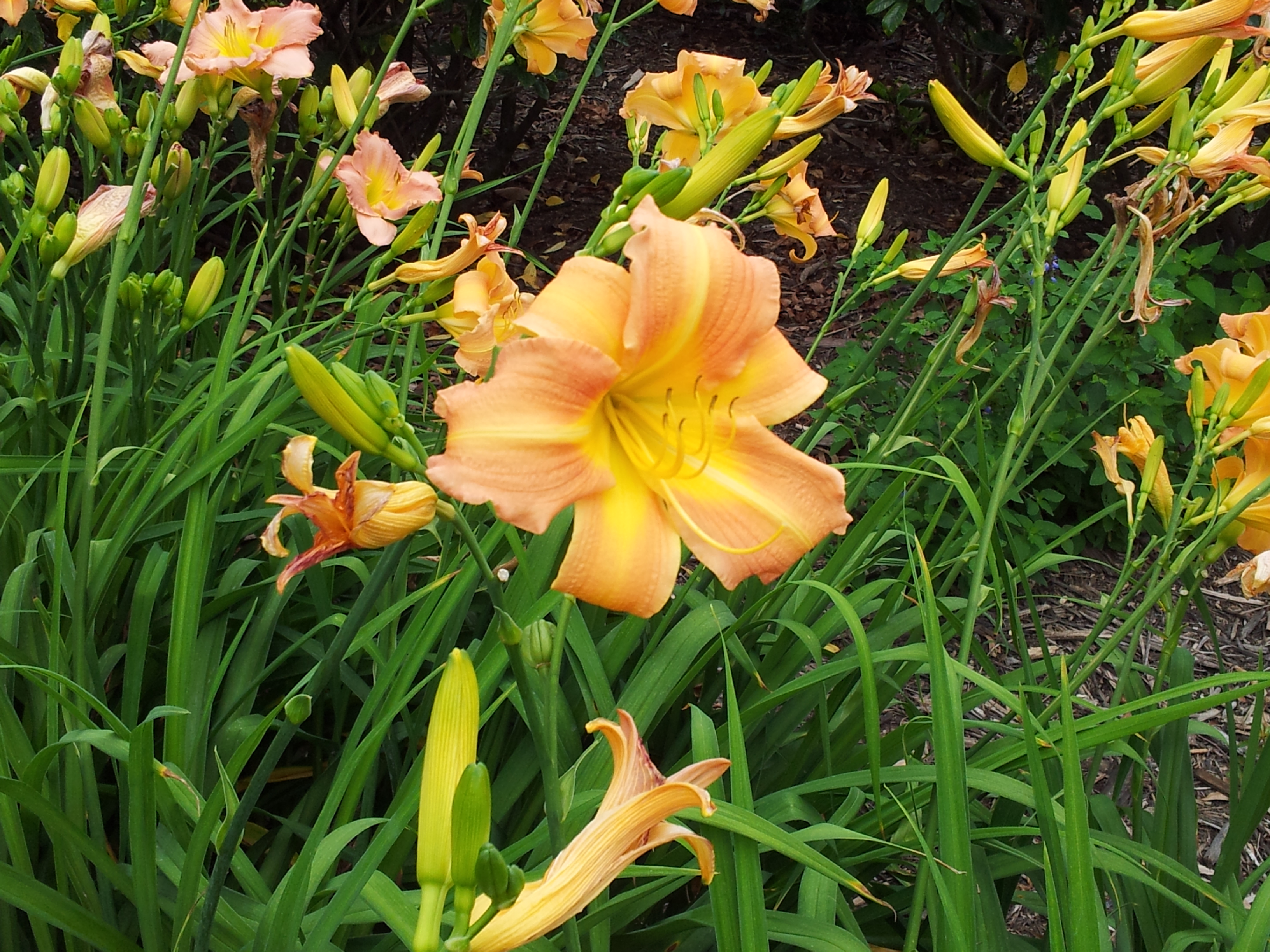
The flowers were out in full bloom the day we took the grandchildren for ‘a walk in the park’.

2011-10-29-12-13-31
2011-10-29-12-14-24
2011-10-29-12-14-01

Of particular interest was the Japanese garden with a trail with rocks,and mini waterfalls

2011-10-29-12-27-02

And as a fitting end to the day, a chance to feed a family of ducks

2011-10-29-13-15-41