Searching for locations: New York to Vancouver

The flight from Newark via Air Canada to Vancouver is about 5:30pm so we are slated to be picked up by the limousine about 2:30.

We have to be out of our room by 11am so we decided the day before that on our last day in New York we’d go to the Times Square red lobster.
It gives us about three hours to get there, eat, and get back.

It’s always fun packing bags the day you leave, so most of the hard work was done earlier. This time it’s particularly a trial because we have so much stuff to fit into a small space, and weight considerations are always paramount because of the 23kg limit.

Outside is has gone from minus four to minus two in the two hours before we leave the hotel at 11:30, but that’s not so much of a problem because we have a long walk from 56th street to 41st street to warm us up.

At least today it’s not so cold, as it has been previously.

At Red Lobster it’s not difficult to make a decision on what to have, the mix and match special, with Lobster alfredo, filet mignon, and parrot island coconut shrimp, with walts special, though what that will remain a surprise until it is served.

To drink, it was the Blue moon beer, wheat type.

For appetizers, we had scones that are supposedly bread but to me are dipped in garlic butter and baked like a scone. Australian style. They are absolutely delicious.

There is an expression a one drink screamer and we’ve got one, but the truth is the drinks are very lethal. Pure alcohol and ice with a touch of soda.

The meals at this Red Lobster are definitely better than those we had in Vancouver, except for the pasta with lobster I had which was little more than a tasteless congealed mess after it reached the table. This did not detract from the deliciously cooked and served seafood that accompanied it.

All in all, after such a great lunch and the thought of having to walk ten blocks the decision was unanimous to get a cab which took us back to the hotel by a rather interesting, if not exactly the most direct, route. I think the driver guessed we were tourists.

We are picked up at the hotel by a driver in a large Toyota which had enough space for 3 passengers and all our bags. The driver was chatty and being foreign, preferred soccer to the other traditional American sport. Don’t ask me how the conversation turned to sports, but we may have mentioned we went to the ice hockey.

At Newark airport, all I have room for is a glass of burned beer, whatever that means, though it has an odd taste, and a Samuel Adams 76 special which was rather tasty.

Today we are flying in a Boeing 787-9 Dreamliner with a maximum of 298 passengers in three classes.

It looks very new even though it is about 6 months old. It has seating of 3 x 3 x 3, and we are in row 19, just behind the premium economy cabin, and the closest to the front of the plane of all the Air Canada flights.

Engine startup is loud at the lower revolutions with the vibration going through the airframe. Like all planes, the flaps being extended, it is very noisy. All of the vibrations go away when the engines are up to speed. On take off the engines at max are not as noisy and other planes and relatively quiet. It will be interesting to see what the landing is like.

In flight when not experiencing turbulence the ride is very smooth and reasonably quiet which is better than the other planes with seeming continuous engine whining and the flow of air past the fuselage.

The seats are comfortable but still just a little small and the middle passenger can be tightly squeezed in if the two on either side are larger than normal. The seats fully recline but the seatback is not completely in your face, and bearable when you recline your own seat.

There are several seats by the toilets that would be terrible on a long-distance flight because the passenger inevitably comes very close to the seat when entering and leaving. As for the toilets, they are larger than any of the other airplanes, and so too, coincidentally, are the windows.

The plane also makes the same amount of noise when it lands so I’m failing to see what’s so good about it. I’ve also been in an Airbus A350 and those planes are nothing to write home about either.

I suspect the only advantage of having planes is for airlines. Fewer costs and more sardined passengers.

It’s something else I can write off my bucket list.

When we arrive back in Vancouver it’s the same reasonably simple process to get through immigration.

Outside our driver is waiting and this time we have an Escalade picking us up. A very large SUV that fits us all and our luggage.

But…

We were lucky because we were supposed to be picked up in a sedan and the baggage would not have fitted which would have involved one of us taking a cab with the extra luggage.

He was in the neighborhood and picked up the call. His advice, called the service and request a bigger car and pay the difference. We did. It was going to cost another 20 dollars.

As for the hotel, what is it with hotels and late-night arrivals? We get in, the check-in was smooth, we get to the room. Very large with a separate bedroom. But only a sofa bed.

It was not a desirable option, not before 24 hours in relatively squashed plane seats, so it necessitated a change of rooms to one a bit smaller, but a corner room with a reasonable view, and two proper beds.

Late night, need rest, but we have free breakfast so there will be no tarrying next morning. We have to be down by 9am being Sunday.

Besides, we have a mission. There is a toys-are-us nearby and it does have the toy we want. All we need to find is a cab.

What will happen in the future?

I don’t think anyone can predict the future, not anymore, and definitely, now it is a distinct possibility that someone can create a virus that will in essence shut down the whole world, and quite possibly destroy it

This is patently clear after the recent troubles with COVID 19 and although a remedy has been found, it is not a perfect solution, or a means of eradicating it. It has shown that while we might be able to combat one version of it, it’s the mutations that will throw up questions about ever getting back to some sort of normal.

And that begs the question, what is, or was, normal?

It’s been a year or more, and I think we’ve forgotten. What we have discovered, though, is the disparate states of the various nations and ethnic groups, and how they have fared in the wake of the pandemic.

It has highlighted systemic problems the world over, problems that have always been there but simmering below the surface. Problems that could be resolved, but perhaps will not.

But as a first-world nation, we have not been immune to external forces, forces that have tried to break us while reeling from the ravaging of a virus that was brought here, and through no fault of our own.

But from the outset, we seem to have been in a different bubble here.

I will admit that I live in a country with about 26 million people whereas the United States has about 330 million, there is a significant difference in numbers, whereas the US is only 1.3 times larger in size.

All this means that the US has a much larger problem in containing the COVID 19 virus, and probably why, down here, we are having a lot more success in getting the infection rates under control.

One thing we have all learned in the last month or so is that lockdowns, such as those hated by, and rallied against in the US, do actually work when you have much less population to deal with. This is why the actions taken by smaller populated countries such as Australia and New Zealand have been so successful.

Yes, we have had outbreaks, but it has been proved these can be contained. We have rigidly been adhering to the science, and the advice of our medical specialists without political interference, to keep the infection rates down.

Yes, we have limited freedom, but nearly everyone, except those from overseas who came here as immigrants and refuse to accept any form of ‘control’, has adhered to the medical-based requests. Those that don’t, those that have railed against the rules, they are predominantly people who have come here from other countries.

I’m happy for anyone to come here and get away from whatever horrors they leave behind, but only on the condition they leave those horrors behind and try in some small way to assimilate with us, without having to give up their cultural and religious beliefs. When they use that as an excuse for their bad behavior, they should be sent home. Obviously, this country isn’t good enough for them.

We are an island, so it is much easier to guard our borders. No one can get into this country without going through quarantine, and that who try to lie their way in are promptly returned on the next plane out. We cannot leave without a valid reason, and if we do, when we come back, we have to spend a fortnight in quarantine, guarded by the defense force personnel.

For countries like the US, it is so much harder to maintain borders. There will be problems in the future with travelers coming from overseas, especially if the science behind the vaccines being touted doesn’t stand up to a very high standard. I suspect that anyone claiming to have a vaccine and using it as an excuse to re-enable overseas travel will find their pleas falling on deaf ears.

That’s because, as we are learning, vaccines are not infallible, there will be the transmission, and not everyone will be willing to have a vaccine, so even here, as anywhere else, we will not be rid of the scourge for a long time. Travel might be possible, but who will want to take a risk going to another country where it’s not completely under control?

I guess, at this time of our lives, our chance to see the rest of the world is over, and it’s time to tour our own country.

Whether we live long and prosper, well, that’s a story for another day.

Searching for locations: Lake Louise to Toronto, via Calgary

All the worries we thought we might have in getting from Lake Louise to Calgary, in the end, it was just like driving to work, only a little longer.

When we left the Fairmont, the car had two frozen bottles of water and a frozen donut, left in the car for the two days we were there, so hiding in the garage might not be a good idea.

At the garage where we refueled, it was so cold I could barely clean the windows and glad to get back into the warmth inside the car.

Thankfully as we got closer to Calgary, it got warmer.

We bypass the city going to the airport, but, as it turns out, we would not have had much time to look around anyway.It’s nice to go to an airport and actually find the car rental returns first go with adequate signing to get there.

Returning the car took a few extra minutes because we were at the end of a dozen or so others who turned up at the same time.  All good, they remembered giving us a half full petrol tank.

At the check-in, it is very smooth sailing, the kiosk working and once the booking reference was entered, it spat out the desired number of boarding passes and baggage tags.

Then to baggage drop, through customs where I managed to lose my jacket, which is amazing that you would be allowed to leave anything behind.

So…

We have an hour and a half to kill, so a long soda and two long island teas settle the pre-flight nerves if we had any to start with.

Time to consider the vagaries of the flight.

Today we’re on an Airbus a320, and we are seated in the very last row, row 33.  It’s always a bad thing to look up planes on seatguru.com, because it has painted them as the worst on the plane.

What’s the downside, sometimes the seat pitch is less than further up the plane, the seats don’t recline and you get the seat in front in your face, and you get the constant flushing of the toilets.  And my major bugbear there’s no overhead luggage space.

What’s the reality?

To begin with, the seats recline, but not very much.  We’ll wait till the plane is cruising before judging how far the seats recline in front of us.

The seat pitch is good and it doesn’t feel like were cramped into a small space, but again this is relative to what happens with the seat in front.

Overhead baggage space, none whatsoever, so if you don’t get on first you are basically screwed.  We were almost first to the rear of the plane so I suspect others also know about the lack of overhead bin space.

Being at the read most part of the plane affords you a view of how the baggage handlers treat your baggage, and it’s interesting, to say the least.  They smile a lot, so I suspect that a few bags might get the ‘treatment’.

Enough already.

We’re now backing out of the bay ready to leave.

We’re getting endless announcements in foreign languages so when next I fly with Air Canada I should at least learn French.

Or not…

Ah, the smell of kerosene floods our end of the plane.  So much for air quality, which so it happens is being covered in the safety video at the exact same time.

But as it turned out, the flight was uneventful.

What will happen in the future?

I don’t think anyone can predict the future, not anymore, and definitely, now it is a distinct possibility that someone can create a virus that will in essence shut down the whole world, and quite possibly destroy it

This is patently clear after the recent troubles with COVID 19 and although a remedy has been found, it is not a perfect solution, or a means of eradicating it. It has shown that while we might be able to combat one version of it, it’s the mutations that will throw up questions about ever getting back to some sort of normal.

And that begs the question, what is, or was, normal?

It’s been a year or more, and I think we’ve forgotten. What we have discovered, though, is the disparate states of the various nations and ethnic groups, and how they have fared in the wake of the pandemic.

It has highlighted systemic problems the world over, problems that have always been there but simmering below the surface. Problems that could be resolved, but perhaps will not.

But as a first-world nation, we have not been immune to external forces, forces that have tried to break us while reeling from the ravaging of a virus that was brought here, and through no fault of our own.

But from the outset, we seem to have been in a different bubble here.

I will admit that I live in a country with about 26 million people whereas the United States has about 330 million, there is a significant difference in numbers, whereas the US is only 1.3 times larger in size.

All this means that the US has a much larger problem in containing the COVID 19 virus, and probably why, down here, we are having a lot more success in getting the infection rates under control.

One thing we have all learned in the last month or so is that lockdowns, such as those hated by, and rallied against in the US, do actually work when you have much less population to deal with. This is why the actions taken by smaller populated countries such as Australia and New Zealand have been so successful.

Yes, we have had outbreaks, but it has been proved these can be contained. We have rigidly been adhering to the science, and the advice of our medical specialists without political interference, to keep the infection rates down.

Yes, we have limited freedom, but nearly everyone, except those from overseas who came here as immigrants and refuse to accept any form of ‘control’, has adhered to the medical-based requests. Those that don’t, those that have railed against the rules, they are predominantly people who have come here from other countries.

I’m happy for anyone to come here and get away from whatever horrors they leave behind, but only on the condition they leave those horrors behind and try in some small way to assimilate with us, without having to give up their cultural and religious beliefs. When they use that as an excuse for their bad behavior, they should be sent home. Obviously, this country isn’t good enough for them.

We are an island, so it is much easier to guard our borders. No one can get into this country without going through quarantine, and that who try to lie their way in are promptly returned on the next plane out. We cannot leave without a valid reason, and if we do, when we come back, we have to spend a fortnight in quarantine, guarded by the defense force personnel.

For countries like the US, it is so much harder to maintain borders. There will be problems in the future with travelers coming from overseas, especially if the science behind the vaccines being touted doesn’t stand up to a very high standard. I suspect that anyone claiming to have a vaccine and using it as an excuse to re-enable overseas travel will find their pleas falling on deaf ears.

That’s because, as we are learning, vaccines are not infallible, there will be the transmission, and not everyone will be willing to have a vaccine, so even here, as anywhere else, we will not be rid of the scourge for a long time. Travel might be possible, but who will want to take a risk going to another country where it’s not completely under control?

I guess, at this time of our lives, our chance to see the rest of the world is over, and it’s time to tour our own country.

Whether we live long and prosper, well, that’s a story for another day.

An editorial of sorts

I always wanted to write an editorial.

A long time ago when I spent time at a newspaper, I wondered what it was like to get to write what essentially was an opinion piece.  Did it have to tow the newspaper owners’ point of view?

I was idealistic then.  I believed in freedom of the press, and that cornerstone of democracy, freedom of speech.

I did not realize then that freedom of speech also meant the freedom to spread ‘plausible’ lies, dressed up to be the truth, to achieve a particular result.  In just one instance, and editorial, and the editorial line of a newspaper had the opportunity to influence an election, favoring one party over another.

With age came wisdom?  Perhaps it was more cynicism because now I tend not to believe anything I read in the papers, when I deign to buy a paper which isn’t often, or read online, or listen to on the television or radio.

What happened to factual reporting?

What happened to opinion pieces being labeled as such so that we know that it is not a representative opinion, just the columnists?

What we all tend to forget is that everyone makes mistakes.  Whether they’re deliberate, or stupid, they happen, and they can cause a large number of casualties, or cost a lot of money.

What’s lost in all the screaming and yelling is the fact we should be looking for answers so that it doesn’t happen again, not blame every man and his dog, or those in opposition, for everything that is wrong in the world, and, quite likely, your own mistake.

What’s also lost is the truth.

In every ten tons of rubbish that are coming out of the media, so-called reported directly from the horse’s mouth, there are just a few grains of truth.  That’s what we should be listening to.

But, drowned out in all the lies, half-truths, and outrageous statements that on the surface doesn’t make any sense, we get to a point where we no longer know what the truth is.

Or do we?

We all have one thing in spades, common sense.

Unfortunately, we sometimes suspend it, because we all have our biases and idiosyncrasies, and beliefs and these can sometimes get it not the way.  Now is not the time to forget that common sense or the fact we should be using it to filter out what is not relevant and get to what is.

And what is relevant?

You.

You matter.

Your life matters.

The life of others, whether you like them or not, those lives also matter.

And when we all realize we are in this together, and then rise above the petty and stupid lies and fear-mongering that is being peddled, will the world, yes, the whole world, finally overcome the worst assault on it ever devised.

Searching for locations: The Silk Factory, Suzhou, China

China is renowned for its exquisite silk, so naturally, a visit to the Silk Spinning Factory is part of today’s tour.

After that, we will be heading downtown to an unspecified location where we’re getting a boat ride, walk through a typical Chinese shopping experience, and coffee at a coffee shop that is doubling as the meeting place, after we soak up the local atmosphere.

The problem with that is that if the entire collective trip a deal tourists take this route then the savvy shopkeepers will jack up their prices tenfold because we’re tourists with money.  It’ll be interesting to see how expensive everything is.

So…

Before we reach the silk factory, we are told that Suzhou is the main silk area of China, and we will be visiting a nearly 100 years old, Suzhou No 1 Silk Mill, established in 1926.  Suzhou has a 4,700-year history of making silk products.  It is located at No. 94, Nanmen Road, Suzhou, Jiangsu, China.

Then we arrive at the Silk Factory, another government-owned establishment with a castiron guarantee of quality and satisfaction.

The look and feel of the doona cover certainly backs up that claim

And the colors and variety is amazing (as is the cost of those exquisite sets)

We get to see the silk cocoon stretched beyond imagination, and see how the silk thread is extracted, then off to the showroom for the sales pitch.

It isn’t a hard sell, and the sheets, doonas, pillows, and pillowcases, are reasonably priced, and come with their own suitcase (for free) so you can take them with you, or free shipping, by slow boat, if you prefer not to take the goods with you.

We opt for the second choice, as there’s no room left in our baggage after packing the Chinese Medicine.

Searching for locations: Vancouver to Kamloops, Canada

This morning started with a visit to the car rental place in Vancouver.  It reinforced the notion that you can be given the address and still not find the place.  It happened in Washington where it was hiding in the back of the main railway station, and it happened again in Vancouver when it was hidden inside a hotel.

We simply walked straight past it.  Pity there wasn’t a sign to let people know.

However…

We went in expecting a Grand Jeep Cherokee and walked out with a Ford Flex, suitable for three people and four large suitcases.  It actually seats 7, but forget the baggage, you’d be lucky to get two large suitcases in that configuration.

It is more than adequate for our requirements.

Things to note, it was delivered with just over a quarter of a tank of gas, and it had only done about 11,000 km, so it’s relatively new.  It’s reasonably spacious, and when the extra seats are folded down, there is plenty of baggage space.

So far, so good.

We finally leave the hotel about half-past ten, and it is raining.  It is a simple task to get on Highway 1, the TransCanada Highway, initially, and then onto Highway 5, the Coquihalla highway for the trip to Kamloops.

It rains all the way to the top of the mountain, progress hampered from time to time by water sprays from both vehicles and trucks.  The rain is relentless.  At the top of the mountain, the rain turns into snow and the road surface to slush.  It’s 0 degrees, but being the afternoon, I was not expecting it to turn to ice very quickly.

On the other side of the mountain, closer to Kamloops, there was sleet, then rain, then nothing, the last 100kms or so, in reasonably dry conditions.

Outside Kamloops, and in the town itself, there was evidence of snow recently cleared, and slushy roads.  Cars in various places were covered in snow, indicating the most recent falls had been the night before.

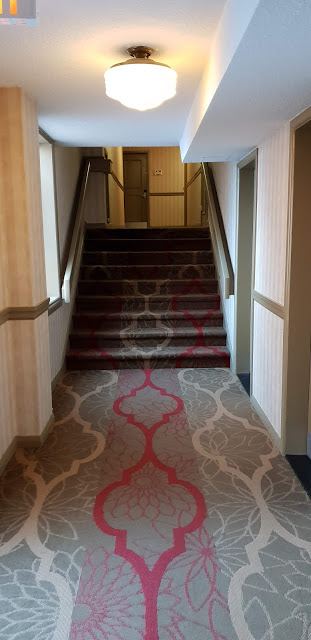
We’re staying at the Park Hotel, a heritage building, apparently built in the later 1920s.  In the style of the time, it is a little like a rabbit warren with passages turning off in a number of directions, and showing it is spread across a number of different buildings.

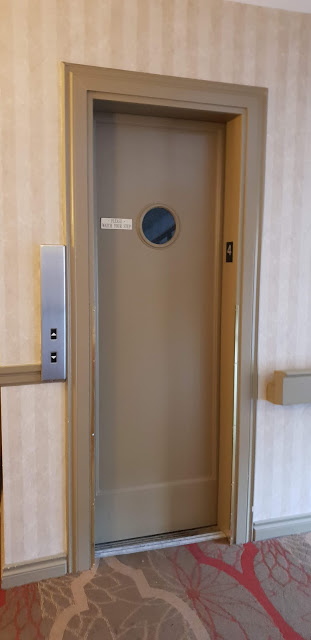
It has the original Otis elevator that can take a maximum of four passengers, and a sign on the wall that says “no horseplay inside the elevator” which is a rather interesting expression that only someone of my vintage would understand.  And, for those without a sense of humor, you definitely couldn’t fit a horse in it to play with.

The thing is, how do you find a balance between keeping the old world charm with modern day expectations.  You can’t.  Some hotels try valiantly to get that balance.  Here, it is simply old world charm, which I guess we should be grateful for because sooner rather than later it’s going to disappear forever.

In my writer’s mind, given the importance of the railways, this was probably a thriving place for travelers and once upon a time, there were a lot more hotels like this one.

A new way of doing things

Well, welcome to the new world.

Perhaps in a lot of things, we should have been there a long time ago, but I suspect complacency and laziness has a lot to do with some of the issues.

Like washing your hands. It’s usually hell on earth to get a child to do anything and you have to be at them and at them to do anything.

I’m not sure about social distancing, but I’ve long wanted people in the supermarket to stop leaning over me to get stuff off the shelves when they could wait one minute longer.

Or being crowded into a restaurant where you can practically eat off the plate of the person at the next table. I like the distance, and the privacy it brings.

I’m also a fan of the new click and collect phenomenon where I don’t have to go out to get something I want; just get it delivered.

Of course, there’s still the necessity to go to a shop and physically see an item before you buy it, in my case clothes and shoes, but online sales for a lot of things are so much better, especially books and magazines.

I guess future traffic jams won’t be cars but delivery trucks.

I like the idea of working from home. Aside from having to face time with colleagues every now and then, if you don’t have to be in an office, then give it up. It will reduce pressure on roads, public transport, and reduce the concentration of the population in one place. You might even get to work on time, and get something to eat before you arrive!

As long as they get the internet right, which in this country is a pretty big if.

And perhaps now people will stop blaming 5g for the COVID virus.

Perhaps this homeschooling thing might work as well, as over the last few weeks I’ve seen it in action, and in most cases it works. Of course the isolation of students could be a problem, and there is always a need for face time for teachers and other students for interaction with contemporaries, but perhaps a compromise could be found.

Among the negatives in a time like this is the fear of using public transport, a fear no one is taking lightly, leading to children having to be taken to and brought home from school, and the fact there are potentially 800 cars needed to do it.

I used to leave home 30 mins before school end and was first in the pickup queue. Now I leave 45 minutes before and the closest I can get in nearly a mile from the school. And the traffic is a dangerous hazard in the main street, blocking driveways, bus stops, and lanes. It’s basically a mess, and it cannot continue without more organization.

Or we find a cure, or at the very least, a vaccine.

But there’s another problem. The anti-vaxxers. Everywhere in the world, it seems, not more than 50% of the population will get vaccinated, so it means that we may NEVER get past where we are now.

And the very worst problem that this new world has sprung on us, we may never travel again. Anywhere.

Perhaps we really do need a miracle.

Searching for locations: The Silk Factory, Suzhou, China

China is renowned for its exquisite silk, so naturally, a visit to the Silk Spinning Factory is part of today’s tour.

After that, we will be heading downtown to an unspecified location where we’re getting a boat ride, walk through a typical Chinese shopping experience, and coffee at a coffee shop that is doubling as the meeting place, after we soak up the local atmosphere.

The problem with that is that if the entire collective trip a deal tourists take this route then the savvy shopkeepers will jack up their prices tenfold because we’re tourists with money.  It’ll be interesting to see how expensive everything is.

So…

Before we reach the silk factory, we are told that Suzhou is the main silk area of China, and we will be visiting a nearly 100 years old, Suzhou No 1 Silk Mill, established in 1926.  Suzhou has a 4,700-year history of making silk products.  It is located at No. 94, Nanmen Road, Suzhou, Jiangsu, China.

Then we arrive at the Silk Factory, another government-owned establishment with a castiron guarantee of quality and satisfaction.

The look and feel of the doona cover certainly backs up that claim

And the colors and variety is amazing (as is the cost of those exquisite sets)

We get to see the silk cocoon stretched beyond imagination, and see how the silk thread is extracted, then off to the showroom for the sales pitch.

It isn’t a hard sell, and the sheets, doonas, pillows, and pillowcases, are reasonably priced, and come with their own suitcase (for free) so you can take them with you, or free shipping, by slow boat, if you prefer not to take the goods with you.

We opt for the second choice, as there’s no room left in our baggage after packing the Chinese Medicine.

Searching for locations: Lake Louise to Toronto, via Calgary

All the worries we thought we might have in getting from Lake Louise to Calgary, in the end, it was just like driving to work, only a little longer.

When we left the Fairmont, the car had two frozen bottles of water and a frozen donut, left in the car for the two days we were there, so hiding in the garage might not be a good idea.

At the garage where we refueled, it was so cold I could barely clean the windows and glad to get back into the warmth inside the car.

Thankfully as we got closer to Calgary, it got warmer.

We bypass the city going to the airport, but, as it turns out, we would not have had much time to look around anyway.It’s nice to go to an airport and actually find the car rental returns first go with adequate signing to get there.

Returning the car took a few extra minutes because we were at the end of a dozen or so others who turned up at the same time.  All good, they remembered giving us a half full petrol tank.

At the check-in, it is very smooth sailing, the kiosk working and once the booking reference was entered, it spat out the desired number of boarding passes and baggage tags.

Then to baggage drop, through customs where I managed to lose my jacket, which is amazing that you would be allowed to leave anything behind.

So…

We have an hour and a half to kill, so a long soda and two long island teas settle the pre-flight nerves if we had any to start with.

Time to consider the vagaries of the flight.

Today we’re on an Airbus a320, and we are seated in the very last row, row 33.  It’s always a bad thing to look up planes on seatguru.com, because it has painted them as the worst on the plane.

What’s the downside, sometimes the seat pitch is less than further up the plane, the seats don’t recline and you get the seat in front in your face, and you get the constant flushing of the toilets.  And my major bugbear there’s no overhead luggage space.

What’s the reality?

To begin with, the seats recline, but not very much.  We’ll wait till the plane is cruising before judging how far the seats recline in front of us.

The seat pitch is good and it doesn’t feel like were cramped into a small space, but again this is relative to what happens with the seat in front.

Overhead baggage space, none whatsoever, so if you don’t get on first you are basically screwed.  We were almost first to the rear of the plane so I suspect others also know about the lack of overhead bin space.

Being at the read most part of the plane affords you a view of how the baggage handlers treat your baggage, and it’s interesting, to say the least.  They smile a lot, so I suspect that a few bags might get the ‘treatment’.

Enough already.

We’re now backing out of the bay ready to leave.

We’re getting endless announcements in foreign languages so when next I fly with Air Canada I should at least learn French.

Or not…

Ah, the smell of kerosene floods our end of the plane.  So much for air quality, which so it happens is being covered in the safety video at the exact same time.

But as it turned out, the flight was uneventful.