We need a central character around whom the story will revolve. For the moment, it is in the first person. This might change later.
We need a reason for him to travel on the ship, other than it was the same one my grandmother on my father’s side travelled to Australia on. I have access to diaries, and I have a very good idea of what it was like on board, where everything is, samples of the menu for dining, and activities.
I know when it was stormy, when it was calm, what ports they stopped at, and when it was hot. I can also see in my mind what it was like travelling from Port Said to Aden through both the Suez Canal and the Red Sea, and how hot it could be.
When I close my eyes, I am on the ship.
But we’re not there yet.
Our third son of a duke, is home for Christmas when he gets the news he’s going to Australia to check on his father’s investment, and one in particular, a cattle station in remote Queensland.
His girlfriend, the woman that his parents had made arrangements for him to marry, is there, knows of his travel plans, and she is not going with him. It is, perhaps, the death knell of that arranged marriage.
When we arrive at the embarkation site we find at least 100 buses all lined up and parked, and literally thousands of Chinese and other Asians streaming through the turnstiles to get on another boat leaving earlier than ours.
Buses were just literally arriving one after the other stopping near where we were standing with a dozen or so other groups waiting patiently, and with people were everywhere it could only be described as organized chaos.
Someone obviously knew where everyone was supposed to go, and when it was our turn, we joined the queue. There were a lot of people in front of us, and a lot more behind, so I had to wonder just how big the boat was.
We soon found out.
And it was amusing to watch people running, yes, they were actually running, to get to the third level, or found available seating. Being around the first to board, we had no trouble finding a seat on the second level.
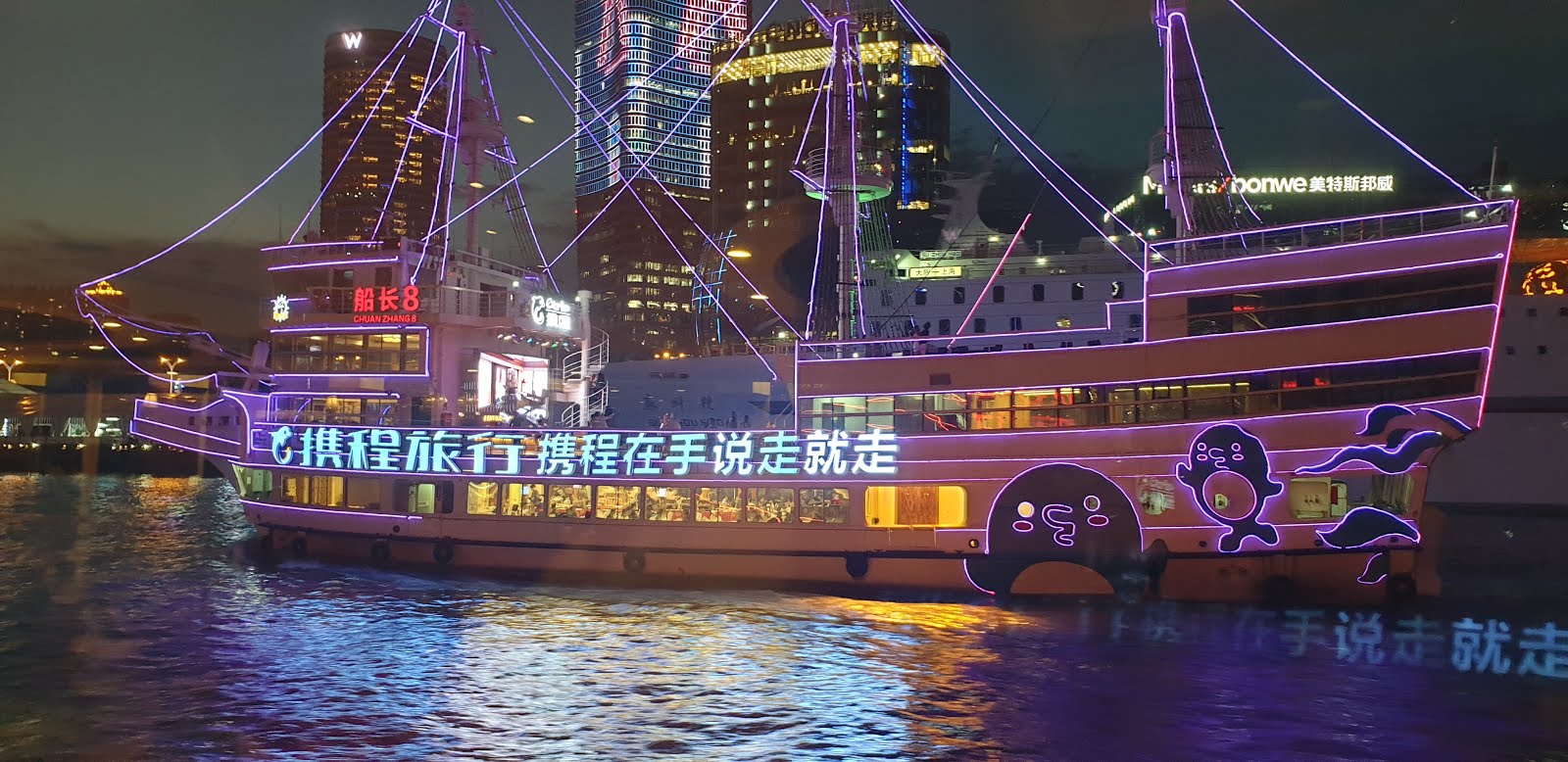
I was not quite sure what the name of the boat was, but it had 3 decks and VIP rooms and it was huge, with marble staircases, the sort you could make a grand entrance on. The last such ornate marble staircase we had seen was in a hotel in Hong Kong, and that was some staircase.
But who has marble staircases in a boat?
We’re going out across the water as far as the Bund and then turn around and come back about 30 to 40 minutes. By the time everyone was on board, there was no room left on the third level, no seats on the second level nor standing room at the end of the second level where the stairs up to the third level were.
No one wanted to pay the extra to go into the VIP lounge.
We were sitting by very large windows where it was warm enough watching the steady procession of the colored lights of other vessels, and outside the buildings.
It was quite spectacular, as were some of the other boats going out on the harbor.
All the buildings of the Bund were lit up
And along that part of the Bund was a number of old English style buildings made from sandstone, and very impressive to say the least.
On the other side of the harbour were the more modern buildings, including the communications tower, a rather impressive structure.
I had to go to the rear of the vessel to get a photo, a very difficult proposition given here was no space on the railing, not even on the stairs going up or down. It was just luck I managed to get some photos between passengers heads.
And, another view of that communications tower:
There was no doubt this was one of the most colourful night-time boat tours I’ve ever been on. Certainly, when we saw the same buildings the following day, they were not half as spectacular in daylight.
I never did get up to the third level to see what the view was like.
When we arrive at the embarkation site we find at least 100 buses all lined up and parked, and literally thousands of Chinese and other Asians streaming through the turnstiles to get on another boat leaving earlier than ours.
Buses were just literally arriving one after the other stopping near where we were standing with a dozen or so other groups waiting patiently, and with people were everywhere it could only be described as organized chaos.
Someone obviously knew where everyone was supposed to go, and when it was our turn, we joined the queue. There were a lot of people in front of us, and a lot more behind, so I had to wonder just how big the boat was.
We soon found out.
And it was amusing to watch people running, yes, they were actually running, to get to the third level, or found available seating. Being around the first to board, we had no trouble finding a seat on the second level.
I was not quite sure what the name of the boat was, but it had 3 decks and VIP rooms and it was huge, with marble staircases, the sort you could make a grand entrance on. The last such ornate marble staircase we had seen was in a hotel in Hong Kong, and that was some staircase.
But who has marble staircases in a boat?
We’re going out across the water as far as the Bund and then turn around and come back about 30 to 40 minutes. By the time everyone was on board, there was no room left on the third level, no seats on the second level nor standing room at the end of the second level where the stairs up to the third level were.
No one wanted to pay the extra to go into the VIP lounge.
We were sitting by very large windows where it was warm enough watching the steady procession of the colored lights of other vessels, and outside the buildings.
It was quite spectacular, as were some of the other boats going out on the harbor.
All the buildings of the Bund were lit up
And along that part of the Bund was a number of old English style buildings made from sandstone, and very impressive to say the least.
On the other side of the harbour were the more modern buildings, including the communications tower, a rather impressive structure.
I had to go to the rear of the vessel to get a photo, a very difficult proposition given here was no space on the railing, not even on the stairs going up or down. It was just luck I managed to get some photos between passengers heads.
And, another view of that communications tower:
There was no doubt this was one of the most colourful night-time boat tours I’ve ever been on. Certainly, when we saw the same buildings the following day, they were not half as spectacular in daylight.
I never did get up to the third level to see what the view was like.
So, in writing the outline, I came up with a premise that might change, but it seems a likely scenario, given that the title of the book is The Third Son of a Duke. It means that he is like having a spare tyre, or in the same position as the younger brother who is heir to the throne.
Here, it’s nothing quite so radical, just that he will inherit the title or the estate, which goes to the eldest son, yes, no equality, because I set it to start in the year 1913, that is, the Christmas before the First World War. Remember, I was going to wrap something big around the story, and you can’t get any bigger than a world war.
It’s a time when the classes were starting to break down and the aristocracy was becoming less relevant to everyone else. It’s the Edwardian Era, and everyone is clinging to the last vestiges of the ruling class and the working class. What was eminently workable in the 1800s is no longer viable. Nobility is finding it harder or impossible to maintain their lifestyles, fortunes are being lost, and a new class of wealthy people are emerging.
In 1913, there were still first class, second class, and third class. On ships, on trains, and in life. And something else is in the air, the coming of the Suffragette. Women no longer want to stay at home, do as they were told and have no say over their lives.
We are going to start in that small world of classes, travelling together on a ship, one of the biggest for that time, with over 1300 passengers.
West Lake is a freshwater lake in Hangzhou, China. It is divided into five sections by three causeways. There are numerous temples, pagodas, gardens, and artificial islands within the lake.
Measuring 3.2 kilometers (2 miles) in length, 2.8 kilometers (1.7 miles) in width, and 2.3 meters (7.5 feet) in average depth, the lake spreads itself in an area totaling 6.5 square kilometers (2.5 square miles).
The earliest recorded name for West Lake was the “Wu Forest River”, but over time it changed to two distinct names. One is “Qiantang Lake”, due to the fact that Hangzhou was called “Qiantang” in ancient times. The other, “West Lake”, due to the lake being west of the city
It’s about to get busy, with a number of activities planned, and the warmth of the day is starting to make an impact.
The tour starts in the car park about a kilometer away, but the moment we left the car park we were getting a taste of the park walking along a tree-lined avenue.
When we cross the road, once again dicing with death with the silent assassins on motor scooters.
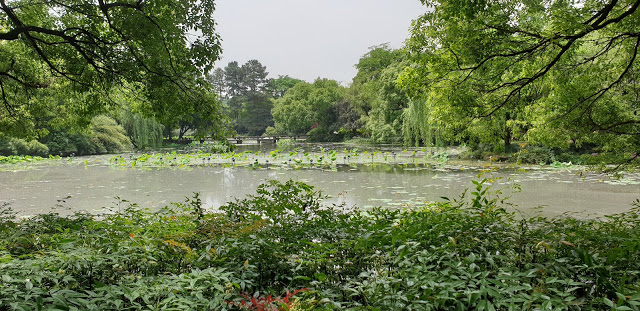
We are in the park proper, and it is magnificent, with flowers, mostly at the start hydrangeas and then any number of other trees and shrubs, some carved into other flower shapes like a lotus.
Then there was the lake and the backdrop of bridges and walkways.
.
And if you can tune out the background white noise the place would be great for serenity and relaxation.
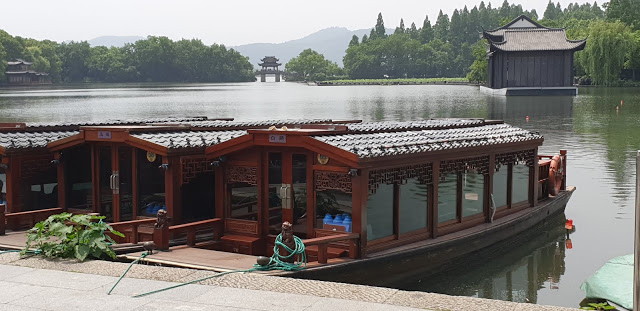
That, in fact, was how the boat ride panned out, about half an hour or more gliding across the lake in an almost silent boat, by an open window, with the air and the majestic scenery.
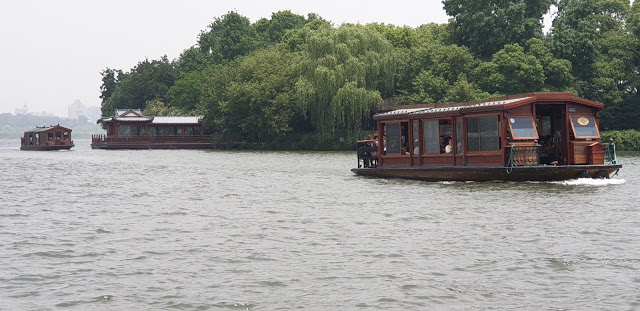
No, not that boat, which would be great to have lunch on while cruising, but the boat below:
Not quite in the same class, but all the same, very easy to tune out and soak it in.
It was peaceful, amazingly quiet, on a summery day
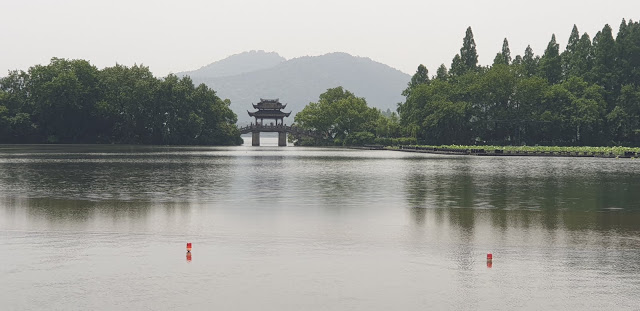
A pagoda in the hazy distance, an island we were about to circumnavigate.
Of all the legends, the most touching one is the love story between Bai Suzhen and Xu Xi’an. Bai Suzhen was a white snake spirit and Xu Xi’an was a mortal man.
They fell in love when they first met on a boat on the West Lake, and got married very soon after.
However, the evil monk Fa Hai attempted to separate the couple by imprisoning Xu Xi’an. Bai Suzhen fought against Fa Hai and tried her best to rescue her husband, but she failed and was imprisoned under the Leifeng Pagoda by the lake.
Years later the couple was rescued by Xiao Qing, the sister of Baisuzhen, and from then on, Bai Suzhen and Xu Xi’an lived together happily.
The retelling of the story varied between tour guides, and on the cruise boat, we had two. Our guide kept to the legend, the other tour guide had a different ending.
Suffice to say it had relevance to the two pagodas on the far side of the lake.
There was a cafe or restaurant on the island, but that was not our lunch destination.
Nor were the buildings further along from where we disembarked.
All in all the whole cruise took about 45 minutes and was an interesting break from the hectic nature of the tour.
Oh yes, and the boat captain had postcards for sale. We didn’t buy any.
Lunch
At the disembarkation point there was a mall that sold souvenirs and had a few ‘fast food’ shops, and a KFC, not exactly what we came to China for, but it seemed like the only place in town a food cautious Australian could eat at.
And when tried to get in the door, that’s where at least 3 busloads were, if they were not in the local Starbucks. Apparently, these were the places of first choice wherever we went.
The chicken supply by the time we got to the head of the line amounted to pieces at 22.5 RMB a piece and nuggets. Everything else had run out, and for me, there were only 5 pieces left. Good thing there were chips.
And Starbucks with coffee and cheesecake.
At least the setting for what could have been a picnic lunch was idyllic.
Like the words to a song, it’s just getting the ball rolling.
Perhaps at times, the easiest part of writing the story is to have that one paragraph premise around which all else revolves.
So,
A chance encounter brings together a group of people who in other circumstances may never have met. The time they spend together changes some in ways they could never have imagined possible, and others, a chance to be someone else, if only for a short time. In one case, however, it brings together two unlikely people who will find that anything that can keep them apart will. Until, of course, fate intervenes.
Sounds good, and I could see myself pitching this to a movie studio because as I was writing it, I could see the characters assembling, I can see the expressions of both curiosity and interest, but not in a bad way, and then the ongoing interactions where the wall begins to fall, just a little.
It needs to have something big wrapped around it, but today, it will just be an outline of how it will start, and maybe a few lines, just to get the feel of pen in hand again.
Yes, we’ll be writing the first draft in longhand.
West Lake is a freshwater lake in Hangzhou, China. It is divided into five sections by three causeways. There are numerous temples, pagodas, gardens, and artificial islands within the lake.
Measuring 3.2 kilometers (2 miles) in length, 2.8 kilometers (1.7 miles) in width, and 2.3 meters (7.5 feet) in average depth, the lake spreads itself in an area totaling 6.5 square kilometers (2.5 square miles).
The earliest recorded name for West Lake was the “Wu Forest River”, but over time it changed to two distinct names. One is “Qiantang Lake”, due to the fact that Hangzhou was called “Qiantang” in ancient times. The other, “West Lake”, due to the lake being west of the city
It’s about to get busy, with a number of activities planned, and the warmth of the day is starting to make an impact.
The tour starts in the car park about a kilometer away, but the moment we left the car park we were getting a taste of the park walking along a tree-lined avenue.
When we cross the road, once again dicing with death with the silent assassins on motor scooters.
We are in the park proper, and it is magnificent, with flowers, mostly at the start hydrangeas and then any number of other trees and shrubs, some carved into other flower shapes like a lotus.
Then there was the lake and the backdrop of bridges and walkways.
.
And if you can tune out the background white noise the place would be great for serenity and relaxation.
That, in fact, was how the boat ride panned out, about half an hour or more gliding across the lake in an almost silent boat, by an open window, with the air and the majestic scenery.
No, not that boat, which would be great to have lunch on while cruising, but the boat below:
Not quite in the same class, but all the same, very easy to tune out and soak it in.
It was peaceful, amazingly quiet, on a summery day
A pagoda in the hazy distance, an island we were about to circumnavigate.
Of all the legends, the most touching one is the love story between Bai Suzhen and Xu Xi’an. Bai Suzhen was a white snake spirit and Xu Xi’an was a mortal man.
They fell in love when they first met on a boat on the West Lake, and got married very soon after.
However, the evil monk Fa Hai attempted to separate the couple by imprisoning Xu Xi’an. Bai Suzhen fought against Fa Hai and tried her best to rescue her husband, but she failed and was imprisoned under the Leifeng Pagoda by the lake.
Years later the couple was rescued by Xiao Qing, the sister of Baisuzhen, and from then on, Bai Suzhen and Xu Xi’an lived together happily.
The retelling of the story varied between tour guides, and on the cruise boat, we had two. Our guide kept to the legend, the other tour guide had a different ending.
Suffice to say it had relevance to the two pagodas on the far side of the lake.
There was a cafe or restaurant on the island, but that was not our lunch destination.
Nor were the buildings further along from where we disembarked.
All in all the whole cruise took about 45 minutes and was an interesting break from the hectic nature of the tour.
Oh yes, and the boat captain had postcards for sale. We didn’t buy any.
Lunch
At the disembarkation point there was a mall that sold souvenirs and had a few ‘fast food’ shops, and a KFC, not exactly what we came to China for, but it seemed like the only place in town a food cautious Australian could eat at.
And when tried to get in the door, that’s where at least 3 busloads were, if they were not in the local Starbucks. Apparently, these were the places of first choice wherever we went.
The chicken supply by the time we got to the head of the line amounted to pieces at 22.5 RMB a piece and nuggets. Everything else had run out, and for me, there were only 5 pieces left. Good thing there were chips.
And Starbucks with coffee and cheesecake.
At least the setting for what could have been a picnic lunch was idyllic.
China is renowned for its exquisite silk, so naturally, a visit to the Silk Spinning Factory is part of today’s tour.
After that, we will be heading downtown to an unspecified location where we’re getting a boat ride, walk through a typical Chinese shopping experience, and coffee at a coffee shop that is doubling as the meeting place, after we soak up the local atmosphere.
The problem with that is that if the entire collective trip a deal tourists take this route then the savvy shopkeepers will jack up their prices tenfold because we’re tourists with money. It’ll be interesting to see how expensive everything is.
So…
Before we reach the silk factory, we are told that Suzhou is the main silk area of China, and we will be visiting a nearly 100 years old, Suzhou No 1 Silk Mill, established in 1926. Suzhou has a 4,700-year history of making silk products. It is located at No. 94, Nanmen Road, Suzhou, Jiangsu, China.
Then we arrive at the Silk Factory, another government-owned establishment with a castiron guarantee of quality and satisfaction.
The look and feel of the doona cover certainly backs up that claim
And the colors and variety is amazing (as is the cost of those exquisite sets)
We get to see the silk cocoon stretched beyond imagination, and see how the silk thread is extracted, then off to the showroom for the sales pitch.
It isn’t a hard sell, and the sheets, doonas, pillows, and pillowcases, are reasonably priced, and come with their own suitcase (for free) so you can take them with you, or free shipping, by slow boat, if you prefer not to take the goods with you.
We opt for the second choice, as there’s no room left in our baggage after packing the Chinese Medicine.
China is renowned for its exquisite silk, so naturally, a visit to the Silk Spinning Factory is part of today’s tour.
After that, we will be heading downtown to an unspecified location where we’re getting a boat ride, walk through a typical Chinese shopping experience, and coffee at a coffee shop that is doubling as the meeting place, after we soak up the local atmosphere.
The problem with that is that if the entire collective trip a deal tourists take this route then the savvy shopkeepers will jack up their prices tenfold because we’re tourists with money. It’ll be interesting to see how expensive everything is.
So…
Before we reach the silk factory, we are told that Suzhou is the main silk area of China, and we will be visiting a nearly 100 years old, Suzhou No 1 Silk Mill, established in 1926. Suzhou has a 4,700-year history of making silk products. It is located at No. 94, Nanmen Road, Suzhou, Jiangsu, China.
Then we arrive at the Silk Factory, another government-owned establishment with a castiron guarantee of quality and satisfaction.
The look and feel of the doona cover certainly backs up that claim
And the colors and variety is amazing (as is the cost of those exquisite sets)
We get to see the silk cocoon stretched beyond imagination, and see how the silk thread is extracted, then off to the showroom for the sales pitch.
It isn’t a hard sell, and the sheets, doonas, pillows, and pillowcases, are reasonably priced, and come with their own suitcase (for free) so you can take them with you, or free shipping, by slow boat, if you prefer not to take the goods with you.
We opt for the second choice, as there’s no room left in our baggage after packing the Chinese Medicine.










 Thrills, Spills, and just a dash of Romance