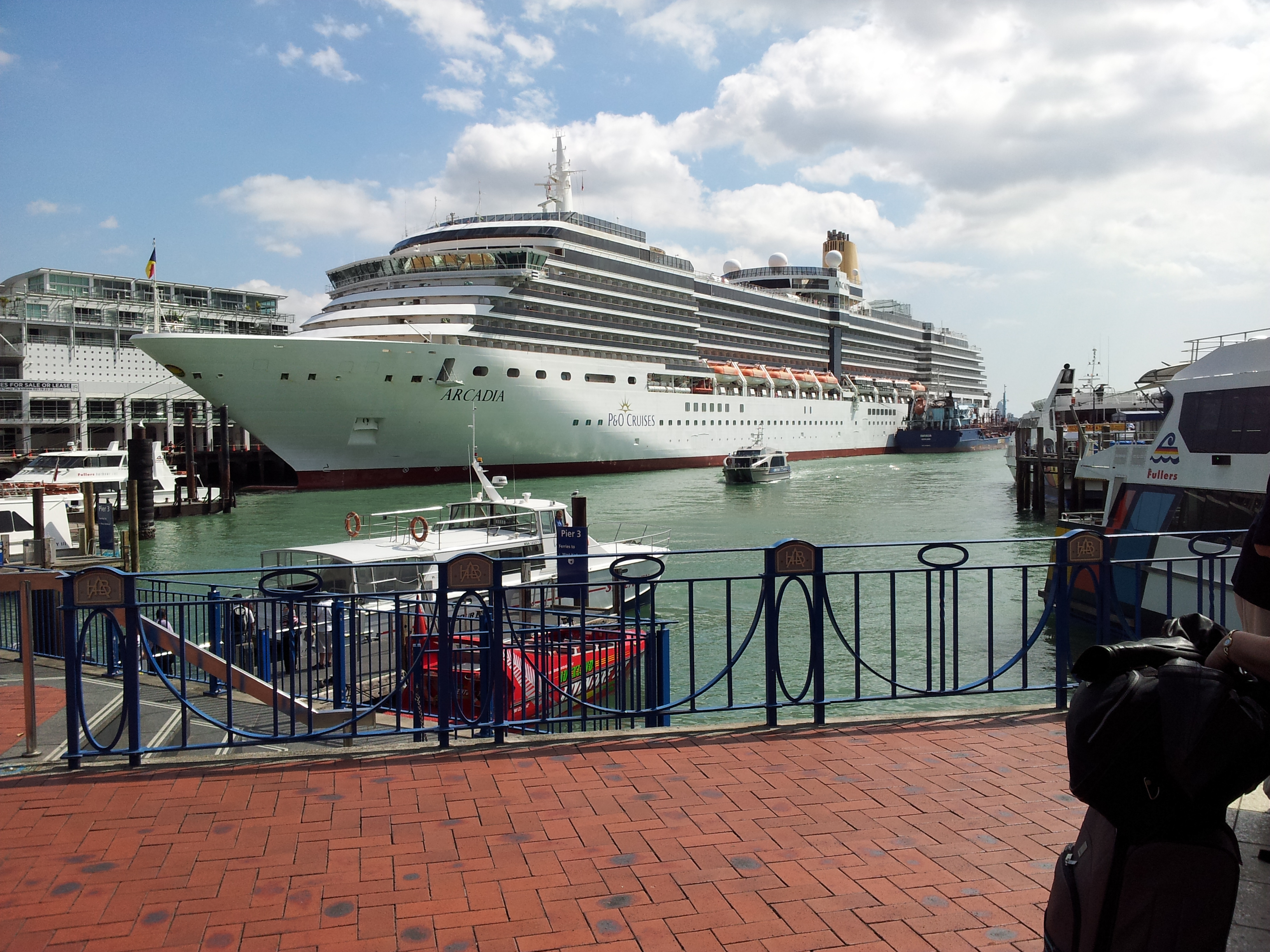
We were staying at the Hilton and advised there would be a large cruise liner berthing next to the hotel. There was the Arcadia.
This is the view from the other side of the hotel. Where our room was, we could almost walk onto the aft end of the ship.
We were also told this was a rather extraordinary day because there were two cruise ships in the port. particularly because it was near the end of the cruising season.
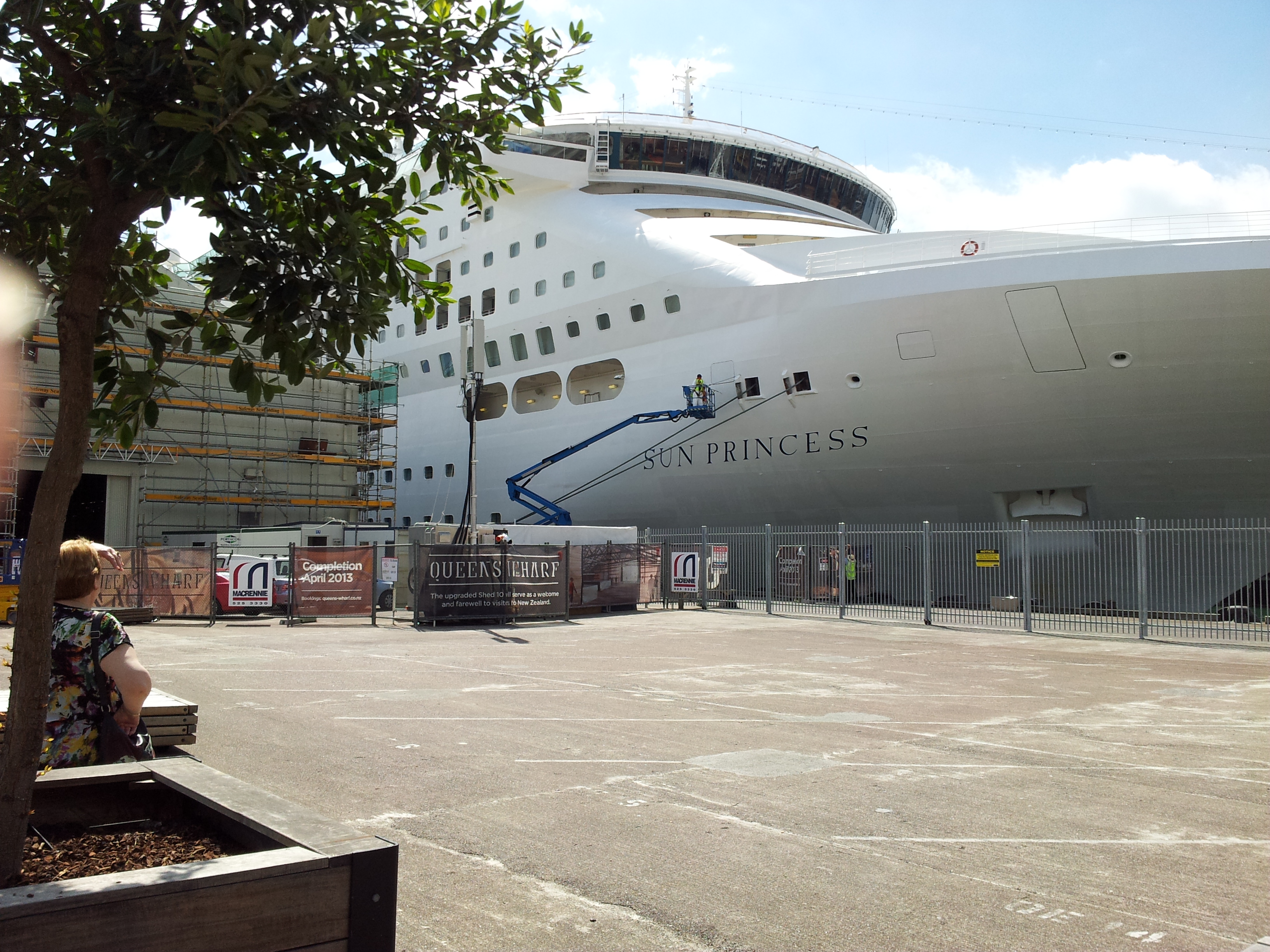
The other ship was two berths along, the Sun Princess.
Not as big as the Arcadia, up close it was still very impressive.
The Yu Gardens (or Yuyuan Gardens) are located at No. 137, Anren Street, Huangpu District, very close to the Old City God Temple, in the northeast of the Old City of Shanghai at Huangpu.
Yu Garden was first built in 1559 during the Ming Dynasty by Pan Yunduan and finished approximately 1577, created specifically as a private garden of the Pan family for Pan Yunduan’s parents to enjoy in their old age.
Yu Garden occupies an area of 5 acres, and is divided into six general areas:
-Sansui Hall which includes the Grand Rockery was originally used to entertain guests,
-Wanhua Chamber is a delicate building surrounded by derious cloisters,
-Dianchun Hall, built in 1820, includes Treasury Hall and the Hall of Harmony,
-Huijing Hall which includes Jade Water Corridor.
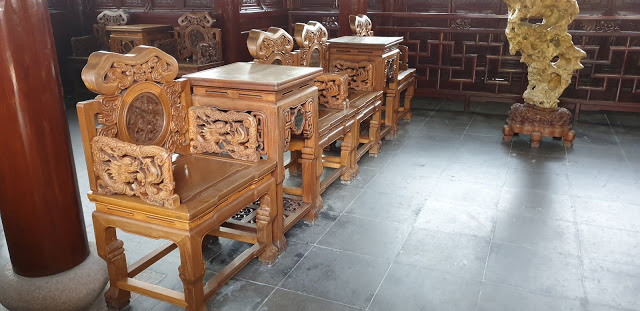
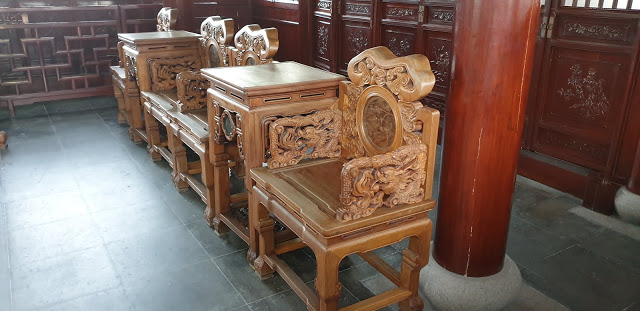
-Yuhua Hall which is furnished with rosewood pieces from the Ming Dynasty, and,
-The Inner Garden with rockeries, ponds, pavilions, and towers; first laid out in 1709. As the quietest part of Yu Gardens, it includes the Hall of Serenity and the Acting and Singing Stage.
The Mid-Lake Pavilion Teahouse, within the gardens, is the oldest teahouse in Shanghai.
A centerpiece of the gardens is the Exquisite Jade Rock, a 5-ton boulder that was originally meant for the Huizong Emperor (Northern Song Dynasty from 1100-1126 AD) but was salvaged from the Huangpu River after the boat carrying it had sunk.
These gardens house a lot of buildings that seemed to be a perfect blend of the old and the new, and if it was up to me, I’d keep the old. Both the building and the gardens they are set in are like an oasis in the middle of an industrial complex, and perhaps impractical for the number of people living in Shanghai.
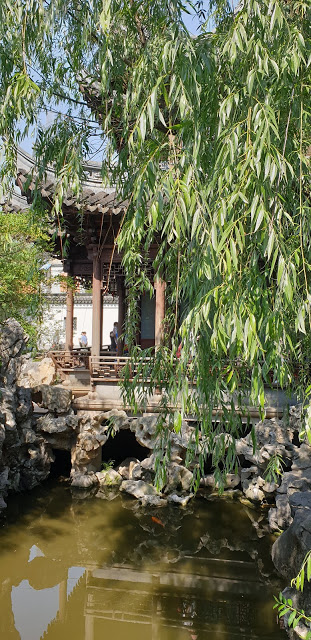
All of the ponds had a lot of fish in them
It was a pleasant afternoon, for both a stroll through the gardens
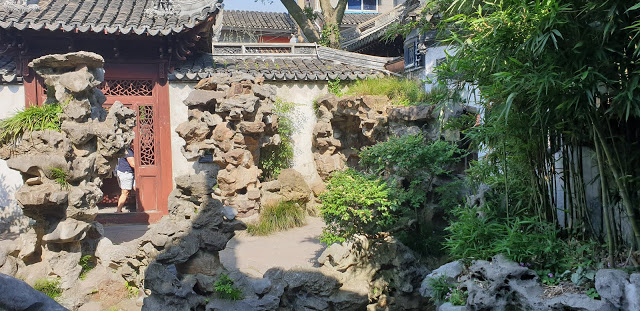
In and out of the rockery on narrow pathways
And to look inside the buildings that were sparsely furnished
There was even an area set aside for entertainment.
We were staying at the Hilton and advised there would be a large cruise liner berthing next to the hotel. There was the Arcadia.
This is the view from the other side of the hotel. Where our room was, we could almost walk onto the aft end of the ship.
We were also told this was a rather extraordinary day because there were two cruise ships in the port. particularly because it was near the end of the cruising season.
The other ship was two berths along, the Sun Princess.
Not as big as the Arcadia, up close it was still very impressive.
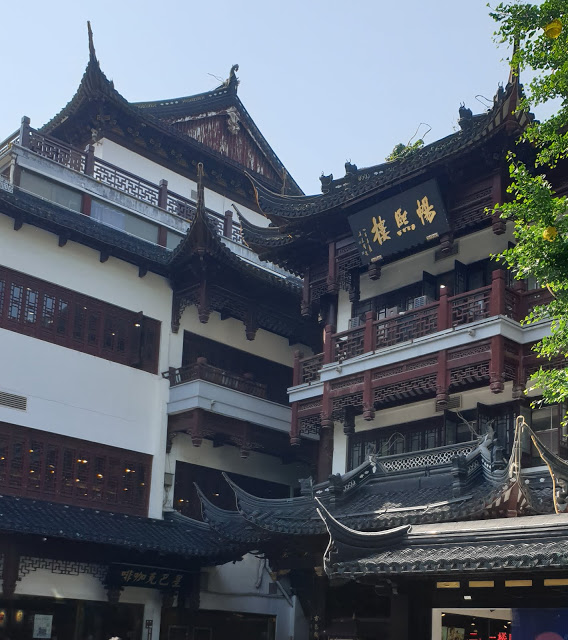
The old Shanghai refers to a small area of Shanghai that used to be walled in and remained that way until about 1912 when all but a small section of the wall was demolished. With the advent of the concessions, Old Shanghai became the administrative center until later when it became a shopping complex.
Now it has many restored historical buildings as well as new buildings in a somewhat traditional style that has become one of Shanghai’s main tourist attractions, housing many shops and restaurants.
The “Old Town” is not exclusively old, as you still have a chance to take in the atmosphere if you wander into the quaint side streets.
But, on first viewing walking down the street towards the complex, I’m not sure I’d go as far as to say this is in reality old Shanghai, except for what appears to be a true representation of it architecturally.
The buildings, which are shops and restaurants, are set out symmetrically, with streets, alleyways, and squares which may prove that it was specially built for the tourists, and no mechanized traffic.
Anyway…
The buildings are magnificent, and a photographer’s delight, and you’d finish up having hundreds of photos by the time you leave. All the buildings are exquisite representations of traditional Chinese architecture.
As for buying stuff, remember if you’re not Chinese you have the sucker tourist stamp on your forehead, so be prepared to walk away if the vendors will not bargain.
Nothing here is worth the price tag and in our group discounts like from 130 RMB to 50 RMB and from 1 for 1,200 to 2 for 950 RMB are common.
Here common t-shirts that we can get for 3 dollars back home start at 150 RMB which is roughly 35 dollars. It’s that kind of market.
We end up is a tea room, on the third floor of the meeting point below, and discover all the tour guides sitting around a table counting money, and I have to say it’s the most $50 notes I’ve ever seen in one place. It is, we were told, where they discussed ‘strategy’.
Firstly, of course, means definitely so, and can be said when a revelation is realised, or sarcastically if the answer is obvious.
Then there’s a course, like a golf course where people chase a small usually white ball, sometimes to be found on a fairway, but more often than not in a bunker, in the water, or in the thicket.
It’s meant to be calming, but I’m betting more than one heart attack has been brought on by a slice, a six shot bunker exit, or any more than three putts on the green.
There’s also mini golf courses, less challenging, sometimes.
That course could also be the part of a creek or a river.
It can be a set of classes that makes up a course, I did a course in English literature
Then, rather topically, over the course of the election there was [you fill in the rest]
Then there’s my favourite, a four course dinner
Or when I’m unwell a course of antibiotics.
And lastly, in a supermarket how often does the trolley in front of you unexpectedly and randomly change course?
This is not to be confused with coarse
Which to be honest can be used sometimes to describe people who swear or are abrupt. They were coarse people, that is unrefined. These people often use coarse language and tell course jokes, meaning crude and offensive
It had a coarse texture, ie it was rough not smooth
And then there’s Corse which is not exactly an English word, but can refer to a corpse or dead body.
The old Shanghai refers to a small area of Shanghai that used to be walled in and remained that way until about 1912 when all but a small section of the wall was demolished. With the advent of the concessions, Old Shanghai became the administrative center until later when it became a shopping complex.
Now it has many restored historical buildings as well as new buildings in a somewhat traditional style that has become one of Shanghai’s main tourist attractions, housing many shops and restaurants.
The “Old Town” is not exclusively old, as you still have a chance to take in the atmosphere if you wander into the quaint side streets.
But, on first viewing walking down the street towards the complex, I’m not sure I’d go as far as to say this is in reality old Shanghai, except for what appears to be a true representation of it architecturally.
The buildings, which are shops and restaurants, are set out symmetrically, with streets, alleyways, and squares which may prove that it was specially built for the tourists, and no mechanized traffic.
Anyway…
The buildings are magnificent, and a photographer’s delight, and you’d finish up having hundreds of photos by the time you leave. All the buildings are exquisite representations of traditional Chinese architecture.
As for buying stuff, remember if you’re not Chinese you have the sucker tourist stamp on your forehead, so be prepared to walk away if the vendors will not bargain.
Nothing here is worth the price tag and in our group discounts like from 130 RMB to 50 RMB and from 1 for 1,200 to 2 for 950 RMB are common.
Here common t-shirts that we can get for 3 dollars back home start at 150 RMB which is roughly 35 dollars. It’s that kind of market.
We end up is a tea room, on the third floor of the meeting point below, and discover all the tour guides sitting around a table counting money, and I have to say it’s the most $50 notes I’ve ever seen in one place. It is, we were told, where they discussed ‘strategy’.
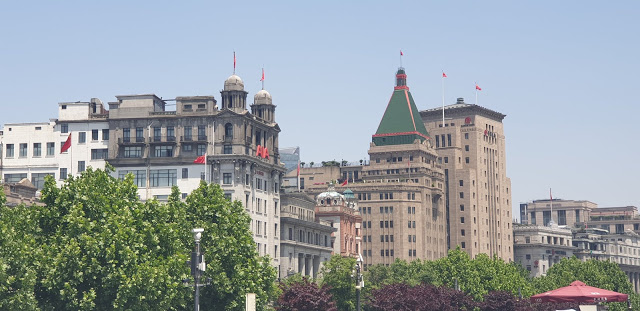
The architecture along the Bund or Waitan is a living museum of the colonial history of the 1800s. The area centers on a section of Zhongshan Road within the former Shanghai International Settlement.
The word bund means an embankment or an embanked quay. It was initially a British settlement; later the British and American settlements were combined in the International Settlement.
The Bund is a mile-long stretch of waterfront promenade along the Huangpu River. There are 52 buildings of various architectural styles, including Gothic, baroque, and neoclassical styles. The area is often referred to as “the museum of buildings”.
Building styles include Romanesque Revival, Gothic Revival, Renaissance Revival, Baroque Revival, Neo-Classical or Beaux-Arts, as well as a number in Art Deco style.
Having seen these buildings initially the night before, mostly lit up, our viewing this morning was from the land side, and particularly interesting in that the colonial architecture was really fascinating considering their location, but not surprising given Shanghai’s history. A lot of these buildings would be more at home in London, that out in the far east.
The Bund waterfront is about two kilometers long and impossible to cover in the time allowed for this part of the tour.
There was just enough time to get photos of the waterfront and the old buildings.
Some of these buildings had odd shapes, like one on the far right that looks like a bottle opener.
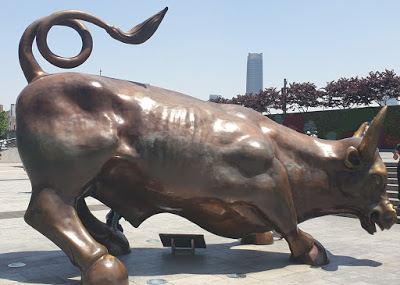
And, for some odd reason, a bull.
On the other side of the water, the sights that had been quite colorful the night before, were equally impressive though somewhat diminished by the haze.
In the current times, the word needle is very polarising.
Will you have the vaccine, or not. Is one of the reasons simply because you hate needles?
I know I do and have a fear factor of 100%. Fortunately, I got very sick a few years ago and spent 10 days in the hospital, and was forced to have multiple needles every day.
Now it’s not so hard
But, I digress.
A needle is one of those things used in the medical profession mainly to deliver vaccines and medicine. It is a very small cylinder.
A needle can be used to sew up a garment or make repairs. This is a smallish piece of metal with an eyelet.
A needle can also be used to stitch up wounds, though it’s best you have a local anesthetic first.
Another way of using needles is to describe tiny icicles which hurt when they hit your face or your eyes. It is called a needle effect.
Then, another use of the word, is to needle someone, that is to say, bombard them with questions, or annoy them.
It’s a pointer on a dial, like that of a fuel gauge, which for me, always seems to hover just above empty. It can also be on a compass, where heading north is not always clear especially where magnets are nearby.
A fir tree’s leaves are more like needles.
You need one to play a record on a gramophone, not that they exist anymore.
Paradoxically it can also be used to describe a pointy rock or an obelisk-like “Cleopatra’s Needle”
The old Shanghai refers to a small area of Shanghai that used to be walled in and remained that way until about 1912 when all but a small section of the wall was demolished. With the advent of the concessions, Old Shanghai became the administrative center until later when it became a shopping complex.
Now it has many restored historical buildings as well as new buildings in a somewhat traditional style that has become one of Shanghai’s main tourist attractions, housing many shops and restaurants.
The “Old Town” is not exclusively old, as you still have a chance to take in the atmosphere if you wander into the quaint side streets.
But, on first viewing walking down the street towards the complex, I’m not sure I’d go as far as to say this is in reality old Shanghai, except for what appears to be a true representation of it architecturally.
The buildings, which are shops and restaurants, are set out symmetrically, with streets, alleyways, and squares which may prove that it was specially built for the tourists, and no mechanized traffic.
Anyway…
The buildings are magnificent, and a photographer’s delight, and you’d finish up having hundreds of photos by the time you leave. All the buildings are exquisite representations of traditional Chinese architecture.
As for buying stuff, remember if you’re not Chinese you have the sucker tourist stamp on your forehead, so be prepared to walk away if the vendors will not bargain.
Nothing here is worth the price tag and in our group discounts like from 130 RMB to 50 RMB and from 1 for 1,200 to 2 for 950 RMB are common.
Here common t-shirts that we can get for 3 dollars back home start at 150 RMB which is roughly 35 dollars. It’s that kind of market.
We end up is a tea room, on the third floor of the meeting point below, and discover all the tour guides sitting around a table counting money, and I have to say it’s the most $50 notes I’ve ever seen in one place. It is, we were told, where they discussed ‘strategy’.
The Yu Gardens (or Yuyuan Gardens) are located at No. 137, Anren Street, Huangpu District, very close to the Old City God Temple, in the northeast of the Old City of Shanghai at Huangpu.
Yu Garden was first built in 1559 during the Ming Dynasty by Pan Yunduan and finished approximately 1577, created specifically as a private garden of the Pan family for Pan Yunduan’s parents to enjoy in their old age.
Yu Garden occupies an area of 5 acres, and is divided into six general areas:
-Sansui Hall which includes the Grand Rockery was originally used to entertain guests,
-Wanhua Chamber is a delicate building surrounded by derious cloisters,
-Dianchun Hall, built in 1820, includes Treasury Hall and the Hall of Harmony,
-Huijing Hall which includes Jade Water Corridor.
-Yuhua Hall which is furnished with rosewood pieces from the Ming Dynasty, and,
-The Inner Garden with rockeries, ponds, pavilions, and towers; first laid out in 1709. As the quietest part of Yu Gardens, it includes the Hall of Serenity and the Acting and Singing Stage.
The Mid-Lake Pavilion Teahouse, within the gardens, is the oldest teahouse in Shanghai.
A centerpiece of the gardens is the Exquisite Jade Rock, a 5-ton boulder that was originally meant for the Huizong Emperor (Northern Song Dynasty from 1100-1126 AD) but was salvaged from the Huangpu River after the boat carrying it had sunk.
These gardens house a lot of buildings that seemed to be a perfect blend of the old and the new, and if it was up to me, I’d keep the old. Both the building and the gardens they are set in are like an oasis in the middle of an industrial complex, and perhaps impractical for the number of people living in Shanghai.
All of the ponds had a lot of fish in them
It was a pleasant afternoon, for both a stroll through the gardens
In and out of the rockery on narrow pathways
And to look inside the buildings that were sparsely furnished
There was even an area set aside for entertainment.