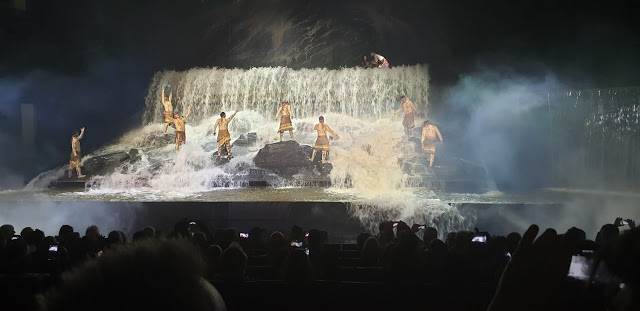
The Golden Mask Dynasty Show was located at the OCT Theatre in Beijing’s Happy Valley.
The theatre was quite full and the seats we had were directly behind the VIP area; as our guide told us, we had the best seats in the house.
The play has 20 different dance scenes that depict war, royal banquets, and romance. There are eight chapters and over 200 actors, and throughout the performance we were entertained by dancers, acrobats, costumes, lighting, and acoustics.
The story:
It is of romantic legend and historical memories, the Golden Mask Queen leads her army in defeating the invading Blue Mask King’s army, and afterwards the lands return to a leisurely pastoral life until the Queen forges a ‘mysterious tree’. When the tree has grown, the Queen has a grand celebration, and releases the captured Blue soldiers, much to the admiration of the Blue Mask King. This is followed by monstrous floods, and to save her people, and on the advice from the ‘mysterious tree’, the Queen sacrifices herself to save her people. The Queen then turns into a golden sunbird flying in the sky blessing the people and that of the dynasty.
Billed as the best live show in China, described as a large scale dramatic musical, “The Golden Mask Dynasty” it lived up to its reputation and was thoroughly enjoyed by all.
It was not just singing dancing and acrobatics, it had a story and it was told so that language and cultural issues aside, it worked. There was a narration of the story running beside the stage, but it was hard to divide attention between what was happening, and what was being related.
Then came the peacock dance, with live peacocks
And this was followed by a waterfall, well, I don’t think anyone in that audience could believe what they were seeing.
I know I was both astonished and in awe of the performance.
What a way to finish off our first day in Beijing.
Oh, sorry, that high was dented slightly when we had to go back to our room.
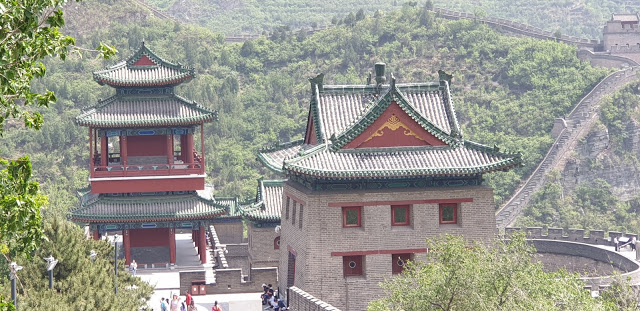
This is in a very scenic area and on the first impression; it is absolutely stunning in concept and in viewing.
As for the idea of walking on it, well, that first view of the mountain climb when getting off the bus, my first question was where the elevator is? Sorry, there is none. It’s walk on up or stay down the bottom.
Walk it is. As far as you feel you are able. There are quite a few who don’t make it to the top. I didn’t. I only made it to the point where the steps narrowed.
But as for the logistics, there’s the gradual incline to the starting point, and what will be the end meeting place. From there, it’s a few steps up to the guard station no 7, and a few more to get up to the start of the main climb. The top of the wall is guard station no 12.
Ok, those first few steps are a good indication of what it’s was going to be like and it’s more the awkwardness of the uneven heights of the steps that’s the killer, some as high as about 15 inches. This photo paints an illusion, that it’s easy. It’s not.
If you make it to the first stage, then it augers well you will get about 100 steps before you both start feeling it in your legs, particularly the knees, and then suffering from the height if you have a problem with heights as the air is thinner. And if you have a thing with heights, never look down.
This was from where we stopped, about a third of the way up. The one below, from almost at the bottom. One we’re looking almost down on the buildings, the other, on the same level.
It requires rest before you come down, and that’s when you start to feel it in the knees, our tour guide called it jelly legs, but it’s more in the knees down. Descending should be slow, and it can be more difficult negotiating the odd height steps, and particularly those high ones. You definitely need to hang onto the rail, even try going backward.
And, no, that rail hasn’t been there as long as the wall.
While you are waiting for the guide to return to the meeting place at the appointed time, there should be time to have some jasmine tea. Highly refreshing after the climb.
This is in a very scenic area and on the first impression; it is absolutely stunning in concept and in viewing.
As for the idea of walking on it, well, that first view of the mountain climb when getting off the bus, my first question was where the elevator is? Sorry, there is none. It’s walk on up or stay down the bottom.
Walk it is. As far as you feel you are able. There are quite a few who don’t make it to the top. I didn’t. I only made it to the point where the steps narrowed.
But as for the logistics, there’s the gradual incline to the starting point, and what will be the end meeting place. From there, it’s a few steps up to the guard station no 7, and a few more to get up to the start of the main climb. The top of the wall is guard station no 12.
Ok, those first few steps are a good indication of what it’s was going to be like and it’s more the awkwardness of the uneven heights of the steps that’s the killer, some as high as about 15 inches. This photo paints an illusion, that it’s easy. It’s not.
If you make it to the first stage, then it augers well you will get about 100 steps before you both start feeling it in your legs, particularly the knees, and then suffering from the height if you have a problem with heights as the air is thinner. And if you have a thing with heights, never look down.
This was from where we stopped, about a third of the way up. The one below, from almost at the bottom. One we’re looking almost down on the buildings, the other, on the same level.
It requires rest before you come down, and that’s when you start to feel it in the knees, our tour guide called it jelly legs, but it’s more in the knees down. Descending should be slow, and it can be more difficult negotiating the odd height steps, and particularly those high ones. You definitely need to hang onto the rail, even try going backward.
And, no, that rail hasn’t been there as long as the wall.
While you are waiting for the guide to return to the meeting place at the appointed time, there should be time to have some jasmine tea. Highly refreshing after the climb.
The first stop is at a Jade Museum to learn the history of jade. In Chinese, jade is pronounced as “Yu” and it has a history in China of at least four thousand years. On the way there, we are given a story about one of the guide’s relatives who had a jade bracelet, and how it saved her from countless catastrophes. It is, quite literally ‘the’ good luck charm. Chinese gamblers are known to have small pieces of jade in their hands when visiting the casinos, for good luck. I’m not sure anything could provide a gambler with any sort of luck given how the odds are always slanted towards the house.
At any rate, this is neither the time of the place to debunk a ‘well-known fact’.
On arrival, our guide hands us over to a local guide, a real staff member, and she begins with a discussion on jade while we watch a single worker working on an intricate piece, what looks to be a globe within a globe, sorry, there are two workers, and the second is working on a dragon.
At the end of the passage that passes by the workers, and before you enter the main showroom, you are dazzled by the ship and is nothing short of magnificent.
Then it’s into a small room just off the main showroom where we are taken through the colors, and the carving process in the various stages, without really being told how the magic happens.
Then it’s out into the main showroom where the sales are made, and before dispersing to look at the jade collection, she briefly tells us how to tell real and fake jade, and she does the usual trick of getting one of the tour group to model a piece.
Looks good, let’s move on. To bigger and better examples.
What interested me, other than the small zodiac signs and other smallish pieces on the ‘promotion’ table, was the jade bangle our tour guide told us about on the bus. If anyone needs one, it is my other half, with all the medical issues and her sometimes clumsiness, two particular maladies this object is supposed to prevent. Jade to the Chinese is Diamonds to westerners, and the jade bangle is often handed down to the females of the family from generation to generation, often as an engagement present, to be worn on the left hand, the one closest to the heart.
There are literally thousands of them, but, they have to be specially fitted to your wrist because if it’s too large, you might lose it if it slips off and I didn’t think it could be too small. Nor is it cheap, and needing a larger size, it is reasonably expensive. But it is jadeite, the more expensive of the types of jade, and it can only appreciate in value, not that we are interested in the monetary value, it’s more the good luck aspect.
We could use some of that.
But, just to touch on something that can be the bugbear of traveling overseas, is the subject of happy houses, a better name for toilets, and has become a recurrent theme on this tour. It’s better than blurting out the word toilet and it seems there can be some not so happy houses given that the toilets in China are usually squat rather than sit, even for women. And apparently, everyone has an unhappy house story, particularly the women, and generally in having to squat over a pit. Why is this a discussion point, it seems the jade factory had what we have come to call happy, happy houses which have more proper toilets, and a stop here before going on the great wall was recommended, as the ‘happy house’ at the wall is deemed to be not such a happy house.
Not even this dragon was within my price range. Thank heaven they had smaller more affordable models. The object of having a dragon, large or small, is that it should be placed inside the main door to the house so that money can come in.
It also seems that stuffing the dragon’s mouth with money is also good luck. We passed on doing that.
After spending a small fortune, there was a bonus, free Chinese tea. Apparently, we will be coming back, after the Great Wall visit, to have lunch upstairs.
This is an inlet near Port Macquarie in northern New South Wales. It is adjacent to a caravan and camping park, close to the ocean and parklands.
But, for our purposes, this scene is going to have a few more interesting connotations than just a few campers going for a jog along the beach, fishing in the estuary, or further out to sea on the other side of the wall in the background.
Firstly, to my favorite kind of story, a spy story…
It’s basically the evil billionaire’s backyard to his island hideaway, and our hero intends to come ashore at night and do battle with the guards, break into the underground holding cells and save the girl.
As always, saving the world comes second!
Or, it’s a place like Fantasy Island, without the landing strip on the beach, where people come to have their fantasies fulfilled. OK, to start there are no robots that are going to go berserk, that’s so ten years ago.
And, no, the hosts won’t be dressed in white safari suits. They went out in the 70s.
Then, I suppose, a story that I like, about people who have secrets, people who are broken, people who just want to get away from everyone else, come to this island where they can live in anonymity, without having to interact with anyone unless they want to.
This is in a very scenic area and on the first impression; it is absolutely stunning in concept and in viewing.
As for the idea of walking on it, well, that first view of the mountain climb when getting off the bus, my first question was where the elevator is? Sorry, there is none. It’s walk on up or stay down the bottom.
Walk it is. As far as you feel you are able. There are quite a few who don’t make it to the top. I didn’t. I only made it to the point where the steps narrowed.
But as for the logistics, there’s the gradual incline to the starting point, and what will be the end meeting place. From there, it’s a few steps up to the guard station no 7, and a few more to get up to the start of the main climb. The top of the wall is guard station no 12.
Ok, those first few steps are a good indication of what it’s was going to be like and it’s more the awkwardness of the uneven heights of the steps that’s the killer, some as high as about 15 inches. This photo paints an illusion, that it’s easy. It’s not.
If you make it to the first stage, then it augers well you will get about 100 steps before you both start feeling it in your legs, particularly the knees, and then suffering from the height if you have a problem with heights as the air is thinner. And if you have a thing with heights, never look down.
This was from where we stopped, about a third of the way up. The one below, from almost at the bottom. One we’re looking almost down on the buildings, the other, on the same level.
It requires rest before you come down, and that’s when you start to feel it in the knees, our tour guide called it jelly legs, but it’s more in the knees down. Descending should be slow, and it can be more difficult negotiating the odd height steps, and particularly those high ones. You definitely need to hang onto the rail, even try going backward.
And, no, that rail hasn’t been there as long as the wall.
While you are waiting for the guide to return to the meeting place at the appointed time, there should be time to have some jasmine tea. Highly refreshing after the climb.
One of the first things you notice when driving around Beijing, other than the roads are congested with traffic, is the number of trees and flowers that have been planted, in the median strip as well as along the edges of the road.
What you also notice is the large number of multi-story apartment blocks, which are needed to house the millions of Beijing residents. What we have, so far, rarely seen, is single-story houses. These continuous areas of trees and rose bushes are, every now and then, broken up by very colourful garden beds:
Nearer to the square we are able to get up close to the flowers. These, we are told, are a variation on the rose, one that flowers for nine months of the year.
They come in a variety of colours.
And they are literally everywhere you go, on the side of the roadway, often blotting out the concrete jungle behind them.
One the first things you notice when driving around Beijing, other than the roads are congested with traffic, is the number of trees and flowers that have been planted, in the median strip as well as along the edges of the road.
What you also notice is the large number of multi-story apartment blocks, which are needed to house the millions of Beijing residents. What we have, so far, rarely seen, is single-story houses. These continuous areas of trees and rose bushes are, every now and then, broken up by very colorful garden beds:
Nearer to the square we are able to get up close to the flowers. These, we are told, are a variation on the rose, one that flowers for nine months of the year.
They come in a variety of colors.
And they are literally everywhere you go, on the side of the roadway, often blotting out the concrete jungle behind them.
The fortification walls, both an inner wall and an outer wall, surrounding Beijing city were built from the early 1400s to 1553.
The dimensions of the Inner city wall are: Length: 24 kilometers or 15 miles Height: 25 meters or 49 feet high Thickness, at ground level: 20 meters or 66 feet at the top: 12 meters or 29 feet
It had nine gates. The fortifications included gate towers, archways, watchtowers, barbicans, barbican towers, sluice gates, sluice gate towers, enemy sighting towers, corner guard towers, and a moat system.
The outer city wall had a length of 28 kilometers or 17 miles.
From 1911, after the collapse of the Qing Dynasty, the dismantling of the fortifications began.
In 1965, major deconstruction of the fortifications was commenced to allow for the construction of the 2nd wrong road, and Line 2 or the Beijing underground railway.
In 1979, the government called off the demolition of the remaining city walls and named them cultural heritage sites. By this time, the only intact sections were the gate tower and watchtower at Zhengyangmen, the watchtower at Deshengmen, the guard tower at the southeast corner, the northern moats of the Inner city, the section of the Inner city wall south of the Beijing railway station, and a small section of Inner-city wall near Xibianmen.
As for our guide’s explanation of the fortifications: Leaving the Square to go to the Golden Mask Dynasty Show, we pass remnants of the wall that used to surround Beijing.
This wall was built in the early 15th century and was about 24 km long, up to 15 meters high and about 20 meters thick, and had nine gates, one of which still exists today. In 1965 most of it was removed so that the second ring road and an underground railway line could be built.
This is Railway Hotel in Gympie, adjacent to the old Gympie station
Just the name Railway Hotel conjured up a lot of interesting connotations. There’s one in almost every rural town that has Railway station, or perhaps a Junction Hotel, a Railway Hotel, or a Terminus Hotel.
And, once upon a time, there were nearly 600 of them, up until the 1920s, ubiquitous hotels build to house the people building the railways, and, then, when they were finished a lot disappeared, but a lot also remained to service the railway station and passengers coming and going.
These days, these old hotels that still exist are anachronisms of a bygone age, rather ornate wooden structures with big rooms and communal bathrooms, bars, saloons, and dining rooms, and only those curious about the past would stay there.
I’ve stayed in a few myself.
But, as for a story, well, the older, the better, because these would have ghosts.
They could also have infamous pasts, like a fire that destroys only part of the hotel, signs of which form part of the character.
A doorway into a now hidden room closed off because of something horrible happening there, could suddenly become a portal, where stepping through takes you back to the time of the event.
In fact, I’m in the mood to write just such a story…