The time has come to work on the second draft for the editor, taking into account all of the suggested changes, and there are quite a few. So much for thinking I could put in an almost flawless manuscript.
…
I’ve taken some time to work on a few other projects, working through the notes with ideas and getting them into some semblance of a timeline.
It seems taking time away from some of them has helped in getting a better idea of where I’m heading with them.
It seems as though I had hit an impasse on several of the stories in progress, and a lesson could be learned. I just have to realize I’ve hit a roadblock, which sometimes isn’t readily discernable because when it happens we tend to deny we need to walk away and reset the creative juices.
As for this project, I finally understand what was bugging me for the last few days – I need to make a timeline for the revolution, and figure out where everyone is going to be, and what their role is.
Yes, there is no substitute for proper planning. After all, if this was a real revolution, it would fall apart very quickly if there was no coordination.
It just brings home the magnitude of the exercise, and it will take a few days to pull it all together. It just may be the first revolution planned using Microsoft Project.
The first stop is at a Jade Museum to learn the history of jade. In Chinese, jade is pronounced as “Yu” and it has a history in China of at least four thousand years. On the way there, we are given a story about one of the guide’s relatives who had a jade bracelet, and how it has saved her from countless catastrophes.It is, quite literally ‘the’ good luck charm. Chinese gamblers are known to have small pieces of jade in their hands when visiting the casinos, for good luck. I’m not sure anything could provide a gambler with any sort of luck given how the odds are always slanted towards the house.
At any rate, this is neither the time of the place to debunk a ‘well-known fact’.
On arrival, our guide hands us over to a local guide, a real staff member, and she begins with a discussion on jade while we watch a single worker working on an intricate piece, what looks to be a globe within a globe, sorry, there are two workers, and the second is working on a dragon.
At the end of the passage that passes by the workers, and before you enter the main showroom, you are dazzled by the ship and is nothing short of magnificent.
Then it’s into a small room just off the main showroom where we are taken through the colors, and the carving process in the various stages, without really being told how the magic happens.
Then it’s out into the main showroom where the sales are made, and before dispersing to look at the jade collection, she briefly tells us how to tell real and fake jade, and she does the usual trick of getting one of the tour group to model a piece.
Looks good, let’s move on. To bigger and better examples.
What interested me, other than the small zodiac signs and other smallish pieces on the ‘promotion’ table, was the jade bangle our tour guide told us about on the bus. If anyone needs one, it is my other half, with all the medical issues and her sometimes clumsiness, two particular maladies this object is supposed to prevent. Jade to the Chinese is Diamonds to westerners, and the jade bangle is often handed down to the females of the family from generation to generation, often as an engagement present, to be worn on the left hand, the one closest to the heart.
There are literally thousands of them, but, they have to be specially fitted to your wrist because if it’s too large, you might lose it if it slips off and I didn’t think it could be too small. Nor is it cheap, and needing a larger size, it is reasonably expensive. But it is jadeite, the more expensive of the types of jade, and it can only appreciate in value, not that we are interested in the monetary value, it’s more the good luck aspect.
We could use some of that.
But, just to touch on something that can be the bugbear of traveling overseas, is the subject of happy houses, a better name for toilets, and has become a recurrent theme on this tour. It’s better than blurting out the word toilet and it seems there can be some not so happy houses given that the toilets in China are usually squat rather than sit, even for women. And apparently, everyone has an unhappy house story, particularly the women, and generally in having to squat over a pit. Why is this a discussion point, it seems the jade factory had what we have come to call happy, happy houses which have more proper toilets, and a stop here before going on the great wall was recommended, as the ‘happy house’ at the wall is deemed to be not such a happy house.
Not even this dragon was within my price range. Thank heaven they had smaller more affordable models. The object of having a dragon, large or small, is that it should be placed inside the main door to the house so that money can come in.
It also seems that stuffing the dragon’s mouth with money is also good luck. We passed on doing that.
After spending a small fortune, there was a bonus, free Chinese tea. Apparently, we will be coming back, after the Great Wall visit, to have lunch upstairs.
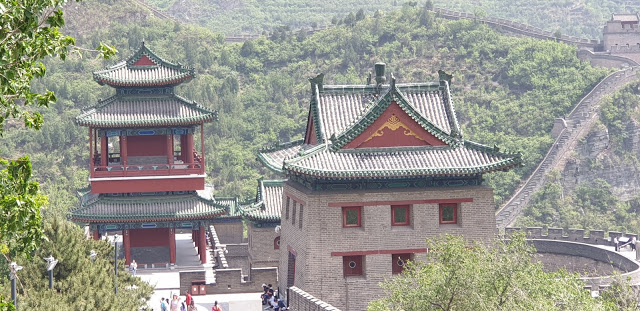
This is in a very scenic area and on the first impression; it is absolutely stunning in concept and in viewing.
As for the idea of walking on it, well, that first view of the mountain climb when getting off the bus, my first question was where the elevator is? Sorry, there is none. It’s walk on up or stay down the bottom.
Walk it is. As far as you feel you are able. There are quite a few who don’t make it to the top. I didn’t. I only made it to the point where the steps narrowed.
But as for the logistics, there’s the gradual incline to the starting point, and what will be the end meeting place. From there, it’s a few steps up to the guard station no 7, and a few more to get up to the start of the main climb. The top of the wall is guard station no 12.
Ok, those first few steps are a good indication of what it’s was going to be like and it’s more the awkwardness of the uneven heights of the steps that’s the killer, some as high as about 15 inches. This photo paints an illusion, that it’s easy. It’s not.
If you make it to the first stage, then it augers well you will get about 100 steps before you both start feeling it in your legs, particularly the knees, and then suffering from the height if you have a problem with heights as the air is thinner. And if you have a thing with heights, never look down.
This was from where we stopped, about a third of the way up. The one below, from almost at the bottom. One we’re looking almost down on the buildings, the other, on the same level.
It requires rest before you come down, and that’s when you start to feel it in the knees, our tour guide called it jelly legs, but it’s more in the knees down. Descending should be slow, and it can be more difficult negotiating the odd height steps, and particularly those high ones. You definitely need to hang onto the rail, even try going backward.
And, no, that rail hasn’t been there as long as the wall.
While you are waiting for the guide to return to the meeting place at the appointed time, there should be time to have some jasmine tea. Highly refreshing after the climb.
The time has come to work on the second draft for the editor, taking into account all of the suggested changes, and there are quite a few. So much for thinking I could put in an almost flawless manuscript.
…
I’ve taken some time to work on a few other projects, working through the notes with ideas and getting them into some semblance of a timeline.
It seems taking time away from some of them has helped in getting a better idea of where I’m heading with them.
It seems as though I had hit an impasse on several of the stories in progress, and a lesson could be learned. I just have to realize I’ve hit a roadblock, which sometimes isn’t readily discernable because when it happens we tend to deny we need to walk away and reset the creative juices.
As for this project, I finally understand what was bugging me for the last few days – I need to make a timeline for the revolution, and figure out where everyone is going to be, and what their role is.
Yes, there is no substitute for proper planning. After all, if this was a real revolution, it would fall apart very quickly if there was no coordination.
It just brings home the magnitude of the exercise, and it will take a few days to pull it all together. It just may be the first revolution planned using Microsoft Project.
Who hasn’t been on one of these, particularly if you have an older brother or sister, and they have nothing better to do than give you a hard time.
You know what I mean, going on a mission to find or do something, knowing full well that you won’t find it, or complete it because it was a lost cause to start with.
Yes, it goes very well with another saying, a dog chasing its tail.
We’ve seen that, too, watching the poor dog go round and round without ever achieving anything.
Sounds like my day today.
And it doesn’t stop there, the pointless search could also be described as ‘searching for a needle in a haystack’.
That is, to my mind the very definition of a living nightmare.
The origin of the idiom, well that’s a little more complicated because there isn’t just one definition.
The first:
Coined by William Shakespeare, but not necessarily in the sort of language we can read easily – it’s a bit like my ability to translate Spanish to English. It does, however, refer to a ‘wild goose chase’.
The second:
Refers to, of all things 16th Century horseracing, and because I don’t have a time machine I can’t go back to fact-check. However, it refers to the other riders following the leader around the course, in much the same formation as geese flying through the air.
…
My little story to go with it:
…
If you are good at your job, and that is beginning to be noticed, your boss will find one of these ‘wild goose chases’ just for you, in an effort to make you look bad.
It happened to me once: my task was to search the basement, where old records were stored, for a folder that a former employee had thought they had filed it in the wrong storage box, a supposition supported by the fact the folder was now needed to clear up a clerical error and the file wasn’t in the specifically marked storage box.
My job was to search every one of the other 765 boxes stored haphazardly in the basement until I found it.
It was, I was told later, sitting on his desk the whole time, and when I couldn’t find it, was going to swoop in and say he’d found it.
Of course, it went missing before he could, so he got a bollicking for not storing the files properly, and I got the job to clean up the basement. I’m not sure who got the worst punishment.
The time has come to work on the second draft for the editor, taking into account all of the suggested changes, and there are quite a few. So much for thinking I could put in an almost flawless manuscript.
…
Now the pressure to write each day is over, I can take my time over the last chapters of the story.
I took the day off yesterday and spent a little time staring at the ceiling. Well, that’s my euphemism for mentally going over the story so far in my head.
I know I’m guilty of writing chapters instead of pages, and pages instead of paragraphs, so already I can see some parts of the story could do with a bit of editing, but that’s not my focus yet.
For the last few days I’ve had big band music running around in my head, and it came to me that the ball preceding the conference should have a big band playing all of those songs from the 1940s, and, in particular, Sing, Sing, Sing by Benny Goodman, In the Mood by Glenn Miller, and a few others.
Listening to it has been inspirational.
The ending has changed, and now it focuses on the two main characters. I’ve given up the notion of exacting revenge, and gone for a more happier ending if that is possible after a rebel revolt. We’ll all have to wait and see if it succeeds, who comes out on top, and whether there are any casualties.
Certainly, there will be one person who will reappear like a messiah, a man thought to be dead at the hands of the military. More than one person has said they should have killed him rather than keep him prisoner, and a few more glad that they didn’t kill him.
And like all good authors, I’m trying to write an ending that leads into a sequel, though how I can top a revolution might be just a little difficult.
And although the word count is low for two days of work, a lot of other work has gone into changing the plan, and the ending, as well as a host of notes for changes in the middle, to accommodate the ending. I might just get around to writing a white paper on ‘how to capture airports and media stations for the purpose of taking over a country’ by the end of this project.
Beijing Zoo Founded in 1906 during the late Qing dynasty, it is the oldest Zoo in China. It also has an aquarium and has 450 land-based species, some of which are rare and endemic to China like the Giant Panda, and 500 marine-based species. Other rare animals to be seen are the Red Panda, the Golden Snub-nosed Monkey, the South China Tiger, the White Lipped deer, the Chinese alligator, the Yak, and the Snow Leopard. Most of the original animals were bought in 1908 from Germany by the viceroy of Liangjiang Duanfang. The Zoo first opened on June 16th, 1908. Currently, the Zoo grounds resemble classical Chinese gardens, and among the attractions are a number of Qing dynasty buildings to view, as well as an Elephant hall, a Lion and tiger hall, a Monkey hall, and a Panda hall. In all, there are 30 halls. The Zoo is located at 137 Xizhimen WaiDajie in Xicheng district, near the 2nd ring road.
We are primarily at the Zoo to see the Pandas, and there is a specific hall devoted to them, and by the way, it costs extra to see them. Everyone in our group is particularly interested in seeing them because it’s rare that any can be found anywhere else in the world. Perhaps if there had been more time, another hour, maybe, it might have made all the difference, but I think that extra time might have clashed with the pearl factory, and that, for obvious reasons, was deemed to be more important.
Our first stop is in the Panda hall.
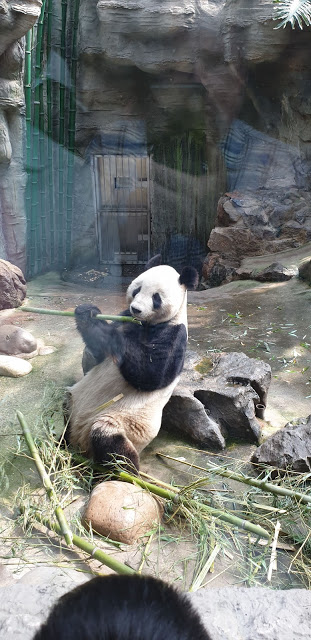
There are two pandas that we can see, one of whom is a little camera shy, and the other, above, who is demonstrating how pandas eat bamboo. They are behind a large glass wall, and you have to wait for the opportunity to get a good photo, and, sometimes only enough to include the top of the head of the person in front of you. Unfortunately, the Chinese visitors don’t understand the polite excuse me in English, and, can at times, be rude enough to shove their way to the front.
What is also a problem is the uncooperativeness of the pandas to pose for photos. I guess there’s no surprise there given the thousands of visitors every day with only one purpose in mind. We counted ourselves lucky to get the photos we did.
The hall itself is built on to the external enclosure where there are a number of giant pandas some of whom that were on show were relatively lethargic, as though they had a big weekend, and we’re sleeping it off, like this panda below:
Then, remarkably, we came across one that decided to be a little more energetic and did a walk in front of hundreds of Chinese who had undoubtedly come to show their children the animals.
This Panda was also easier to photograph whereas the other panda, one chewing on a morning feast of bamboo, saw a lot of pushing and shoving by the spectators to get the best spot to take his photograph. Having manners just doesn’t cut it here, so do what you have to to get that photograph.
We also saw a couple of monkeys that were also in the panda enclosure, but they were not much of a side benefit. They may have been there to use the Panda’s exercise equipment, though it was not quite like what we use. There was no time really to wander off to see much else, but apparently, there were also red pandas, and surprisingly, a category called Australian animals. But who goes to another country to view your own animals? The cutest animals were the stuffed pandas, and they were quite reasonably priced.
The time has come to work on the second draft for the editor, taking into account all of the suggested changes, and there are quite a few. So much for thinking I could put in an almost flawless manuscript.
…
Tis the last day, but not the last day, if that makes sense.
I did not get the story done in the 30 days, but I did knock a big hole in it. All 85,177 words of it.
I did not anticipate the story would go that long, or consider that it might even be longer, say, around 100,000 words.
But, this is what happens when the story tells itself, going down narrow alleys and ending up in dark corners you never anticipated at the start.
That and the fact the characters evolve, and some even begin to start stealing the show and have to be reined in.
It’s been an enjoyable journey though, and fun to write, but after I’ve got the first draft done, there is going to be a 6-month hiatus because so many other projects got put on hold so I could get this done.
Fortunately, at this time, we have the perfect weather for writing, continuous rain, so it makes it easy not to regret not going out.
There will be further updates until the book is done.
Who hasn’t been on one of these, particularly if you have an older brother or sister, and they have nothing better to do than give you a hard time.
You know what I mean, going on a mission to find or do something, knowing full well that you won’t find it, or complete it because it was a lost cause to start with.
Yes, it goes very well with another saying, a dog chasing its tail.
We’ve seen that, too, watching the poor dog go round and round without ever achieving anything.
Sounds like my day today.
And it doesn’t stop there, the pointless search could also be described as ‘searching for a needle in a haystack’.
That is, to my mind the very definition of a living nightmare.
The origin of the idiom, well that’s a little more complicated because there isn’t just one definition.
The first:
Coined by William Shakespeare, but not necessarily in the sort of language we can read easily – it’s a bit like my ability to translate Spanish to English. It does, however, refer to a ‘wild goose chase’.
The second:
Refers to, of all things 16th Century horseracing, and because I don’t have a time machine I can’t go back to fact-check. However, it refers to the other riders following the leader around the course, in much the same formation as geese flying through the air.
…
My little story to go with it:
…
If you are good at your job, and that is beginning to be noticed, your boss will find one of these ‘wild goose chases’ just for you, in an effort to make you look bad.
It happened to me once: my task was to search the basement, where old records were stored, for a folder that a former employee had thought they had filed it in the wrong storage box, a supposition supported by the fact the folder was now needed to clear up a clerical error and the file wasn’t in the specifically marked storage box.
My job was to search every one of the other 765 boxes stored haphazardly in the basement until I found it.
It was, I was told later, sitting on his desk the whole time, and when I couldn’t find it, was going to swoop in and say he’d found it.
Of course, it went missing before he could, so he got a bollicking for not storing the files properly, and I got the job to clean up the basement. I’m not sure who got the worst punishment.
The time has come to work on the second draft for the editor, taking into account all of the suggested changes, and there are quite a few. So much for thinking I could put in an almost flawless manuscript.
…
Now the pressure to write each day is over, I can take my time over the last chapters of the story.
I took the day off yesterday and spent a little time staring at the ceiling. Well, that’s my euphemism for mentally going over the story so far in my head.
I know I’m guilty of writing chapters instead of pages, and pages instead of paragraphs, so already I can see some parts of the story could do with a bit of editing, but that’s not my focus yet.
For the last few days I’ve had big band music running around in my head, and it came to me that the ball preceding the conference should have a big band playing all of those songs from the 1940s, and, in particular, Sing, Sing, Sing by Benny Goodman, In the Mood by Glenn Miller, and a few others.
Listening to it has been inspirational.
The ending has changed, and now it focuses on the two main characters. I’ve given up the notion of exacting revenge, and gone for a more happier ending if that is possible after a rebel revolt. We’ll all have to wait and see if it succeeds, who comes out on top, and whether there are any casualties.
Certainly, there will be one person who will reappear like a messiah, a man thought to be dead at the hands of the military. More than one person has said they should have killed him rather than keep him prisoner, and a few more glad that they didn’t kill him.
And like all good authors, I’m trying to write an ending that leads into a sequel, though how I can top a revolution might be just a little difficult.
And although the word count is low for two days of work, a lot of other work has gone into changing the plan, and the ending, as well as a host of notes for changes in the middle, to accommodate the ending. I might just get around to writing a white paper on ‘how to capture airports and media stations for the purpose of taking over a country’ by the end of this project.