The Henan Museum is one of the oldest museums in China. In June 1927, General Feng Yuxiang proposed that a museum be built, and it was completed the next year. In 1961, along with the move of the provincial capital, Henan Museum moved from Kaifeng to Zhengzhou.
It currently holds about 130,000 individual pieces, more of which are mostly cultural relics, bronze vessels of the Shang and Zhou Dynasties, and pottery and porcelain wares of the various dynasties.
Eventually, we arrive at the museum and get off the bus adjacent to a scooter track and despite the efforts of the guide, there’s no stopping them from nearly running us over.
We arrive to find the museum has been moved to a different and somewhat smaller building nearby as the existing, and rather distinctively designed, building is being renovated.
While we are waiting for the tickets to enter, we are given another view of industrial life in that there is nothing that resembles proper health and safety on worksites in this country, and the workers are basically standing on what looks to be a flimsy bamboo ladder with nothing to stop them from falling off.
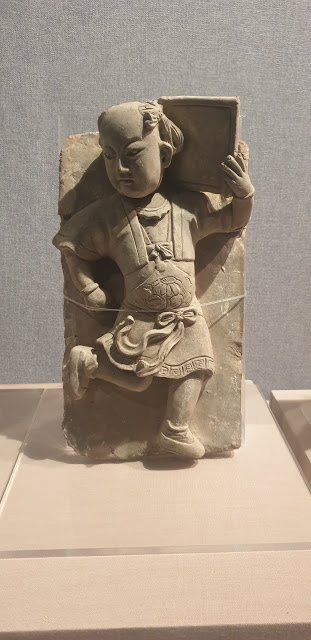
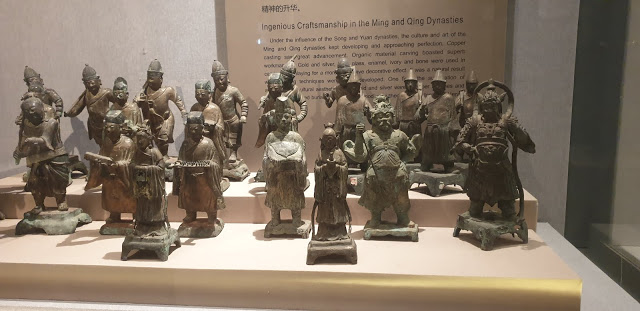
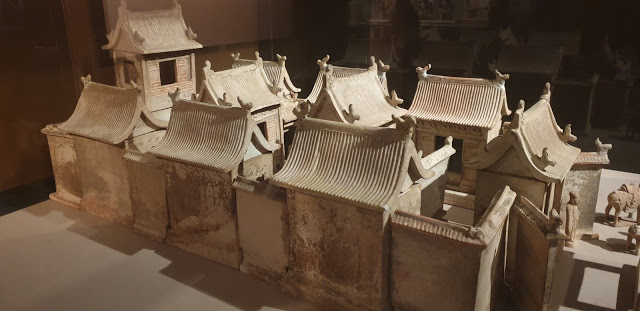
The museum itself has exhibits dating back a few thousand years and consist of bronze and ceramic items. One of the highlights was a tortoiseshell with reportedly the oldest know writing ever found.
Other than that it was a series of cooking utensils, a table, and ceramic pots, some in very good condition considering their age.
For the first time on this trip, we encounter problems with Chinese officialdom at the railway station, though we were warned that this might occur.
We had a major problem with the security staff when they pulled everyone over with aerosols and confiscated them. We lost styling mousse, others lost hair spray, and the men, their shaving cream. But, to her credit, the tour guide did warn us they were stricter here, but her suggestion to be angry they were taking our stuff was probably not the right thing to do.
As with previous train bookings, the Chinese method of placing people in seats didn’t quite manage to keep couples traveling together, together on the train. It was an odd peculiarity which few of the passengers understood, nor did they conform, swapping seat allocations.
This train ride did not seem the same as the last two and I don’t think we had the same type of high-speed train type that we had for the last two. The carriages were different, there was only one toilet per carriage, and I don’t think we were going as fast.
But aside from that, we had 753 kilometers to travel with six stops before ours, two of which were very large cities, and then our stop, about four and a half hours later. With two minutes this time, to get the baggage off the team managed it in 40 seconds, a new record.
After slight disorientation getting off the train, we locate our guide, easily found by looking for the Trip-A-Deal flag. From there it’s a matter of getting into our respective groups and finding the bus.
As usual, the trip to the hotel was a long one, but we were traveling through a much brighter, and well lit, city.
As for our guide, we have him from now until the end of the tour. There are no more train rides, we will be taking the bus from city to city until we reach Shanghai. Good thing then that the bus is brand new, with that new car smell. Only issue, no USB charging point.
The Snowy Sea hotel.
It is finally a joy to get a room that is nothing short of great. It has a bathroom and thus privacy.
Everyone had to go find a supermarket to purchase replacements for the confiscated items. Luckily there was a huge supermarket just up from the hotel that had everything but the kitchen sink.
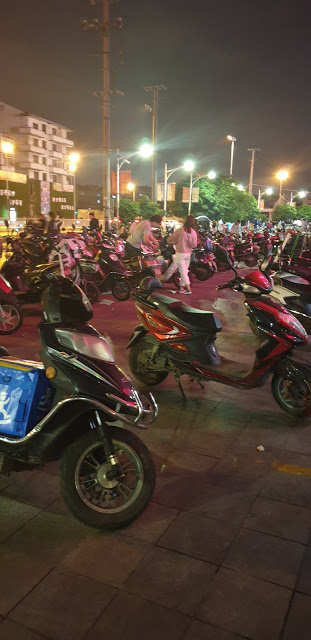
But, unlike where we live, the carpark is more of a scooter park!
It is also a small microcosm of Chinese life for the new more capitalistic oriented Chinese.
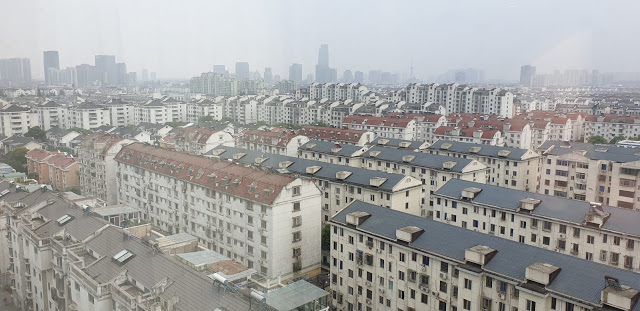
The next morning we get some idea of the scope of high-density living, though here, the buildings are not 30 stories tall, but still just as impressive.
These look like the medium density houses, but to the right of these are much larger buildings
The remarkable thing about this is those buildings stretch as far as the eye can see.
A convoluted explanation on the reasons for this memorial came down to it being about the deaths of those involved in the 1923 Erqi strike, though we’re not really sure what the strike was about.
So, after a little research, this is what I found:
The current Erqi Tower was built in 1971 and was, historically, the tallest building in the city. It is a memorial to the Erqi strike and in memory of Lin Xiangqian and other railway workers who went on strike for their rights, which happened on February 7, 1923.
It has 14 floors and is 63 meters high. One of the features of this building is the view from the top, accessed by a spiral staircase, or an elevator, when it’s working (it was not at the time of our visit).
There seems to be an affinity with the number 27 with this building, in that
It’s the 27th memorial to be built
to commemorate the 27th workers’ strike
located in the 27th plaza of Zhengzhou City.
We drive to the middle of the city where we once again find traveling in kamikaze traffic more entertaining than the tourist points
When we get to the drop-off spot, it’s a 10-minute walk to the center square where the tower is located on one side. Getting there we had to pass a choke point of blaring music and people hawking goods, each echoing off the opposite wall to the point where it was deafening. Too much of it would be torture.
But, back to the tower…
It has 14 levels, but no one seemed interested in climbing the 14 or 16 levels to get to the top. The elevator was broken, and after the great wall episode, most of us are heartily sick of stairs.
The center square was quite large but paved in places with white tiles that oddly reflected the heat rather than absorb it. In the sun it was very warm.
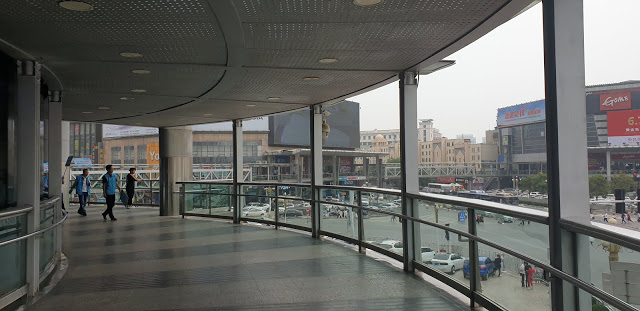
Around the outside of two-thirds of the square, and crossing the roads, was an elevated walkway, which if you go from the first shops and around to the other end, you finish up, on the ground level, at Starbucks.
This is the Chinese version and once you get past the language barrier, the mixology range of cold fruity drinks are to die for, especially after all that walking. Mine was a predominantly peach flavor, with some jelly and apricot at the bottom. I was expecting sliced peaches but I prefer and liked the apricot half.
A drink and fruit together was a surprise.
Then it was the walk back to the meeting point and then into the hotel to use the happy house before rejoining the kamikaze traffic.
We are taken then to the train station for the 2:29 to our next destination, Suzhou, the Venice of the East.
A convoluted explanation on the reasons for this memorial came down to it being about the deaths of those involved in the 1923 Erqi strike, though we’re not really sure what the strike was about.
So, after a little research, this is what I found:
The current Erqi Tower was built in 1971 and was, historically, the tallest building in the city. It is a memorial to the Erqi strike and in memory of Lin Xiangqian and other railway workers who went on strike for their rights, which happened on February 7, 1923.
It has 14 floors and is 63 meters high. One of the features of this building is the view from the top, accessed by a spiral staircase, or an elevator, when it’s working (it was not at the time of our visit).
There seems to be an affinity with the number 27 with this building, in that
It’s the 27th memorial to be built
to commemorate the 27th workers’ strike
located in the 27th plaza of Zhengzhou City.
We drive to the middle of the city where we once again find traveling in kamikaze traffic more entertaining than the tourist points
When we get to the drop-off spot, it’s a 10-minute walk to the center square where the tower is located on one side. Getting there we had to pass a choke point of blaring music and people hawking goods, each echoing off the opposite wall to the point where it was deafening. Too much of it would be torture.
But, back to the tower…
It has 14 levels, but no one seemed interested in climbing the 14 or 16 levels to get to the top. The elevator was broken, and after the great wall episode, most of us are heartily sick of stairs.
The center square was quite large but paved in places with white tiles that oddly reflected the heat rather than absorb it. In the sun it was very warm.
Around the outside of two-thirds of the square, and crossing the roads, was an elevated walkway, which if you go from the first shops and around to the other end, you finish up, on the ground level, at Starbucks.
This is the Chinese version and once you get past the language barrier, the mixology range of cold fruity drinks are to die for, especially after all that walking. Mine was a predominantly peach flavor, with some jelly and apricot at the bottom. I was expecting sliced peaches but I prefer and liked the apricot half.
A drink and fruit together was a surprise.
Then it was the walk back to the meeting point and then into the hotel to use the happy house before rejoining the kamikaze traffic.
We are taken then to the train station for the 2:29 to our next destination, Suzhou, the Venice of the East.
A convoluted explanation on the reasons for this memorial came down to it being about the deaths of those involved in the 1923 Erqi strike, though we’re not really sure what the strike was about.
So, after a little research, this is what I found:
The current Erqi Tower was built in 1971 and was, historically, the tallest building in the city. It is a memorial to the Erqi strike and in memory of Lin Xiangqian and other railway workers who went on strike for their rights, which happened on February 7, 1923.
It has 14 floors and is 63 meters high. One of the features of this building is the view from the top, accessed by a spiral staircase, or an elevator, when it’s working (it was not at the time of our visit).
There seems to be an affinity with the number 27 with this building, in that
It’s the 27th memorial to be built
to commemorate the 27th workers’ strike
located in the 27th plaza of Zhengzhou City.
We drive to the middle of the city where we once again find traveling in kamikaze traffic more entertaining than the tourist points
When we get to the drop-off spot, it’s a 10-minute walk to the center square where the tower is located on one side. Getting there we had to pass a choke point of blaring music and people hawking goods, each echoing off the opposite wall to the point where it was deafening. Too much of it would be torture.
But, back to the tower…
It has 14 levels, but no one seemed interested in climbing the 14 or 16 levels to get to the top. The elevator was broken, and after the great wall episode, most of us are heartily sick of stairs.
The center square was quite large but paved in places with white tiles that oddly reflected the heat rather than absorb it. In the sun it was very warm.
Around the outside of two-thirds of the square, and crossing the roads, was an elevated walkway, which if you go from the first shops and around to the other end, you finish up, on the ground level, at Starbucks.
This is the Chinese version and once you get past the language barrier, the mixology range of cold fruity drinks are to die for, especially after all that walking. Mine was a predominantly peach flavor, with some jelly and apricot at the bottom. I was expecting sliced peaches but I prefer and liked the apricot half.
A drink and fruit together was a surprise.
Then it was the walk back to the meeting point and then into the hotel to use the happy house before rejoining the kamikaze traffic.
We are taken then to the train station for the 2:29 to our next destination, Suzhou, the Venice of the East.
The Henan Museum is one of the oldest museums in China. In June 1927, General Feng Yuxiang proposed that a museum be built, and it was completed the next year. In 1961, along with the move of the provincial capital, Henan Museum moved from Kaifeng to Zhengzhou.
It currently holds about 130,000 individual pieces, more of which are mostly cultural relics, bronze vessels of the Shang and Zhou Dynasties, and pottery and porcelain wares of the various dynasties.
Eventually, we arrive at the museum and get off the bus adjacent to a scooter track and despite the efforts of the guide, there’s no stopping them from nearly running us over.
We arrive to find the museum has been moved to a different and somewhat smaller building nearby as the existing, and rather distinctively designed, building is being renovated.
While we are waiting for the tickets to enter, we are given another view of industrial life in that there is nothing that resembles proper health and safety on worksites in this country, and the workers are basically standing on what looks to be a flimsy bamboo ladder with nothing to stop them from falling off.
The museum itself has exhibits dating back a few thousand years and consist of bronze and ceramic items. One of the highlights was a tortoiseshell with reportedly the oldest know writing ever found.
Other than that it was a series of cooking utensils, a table, and ceramic pots, some in very good condition considering their age.
The Henan Museum is one of the oldest museums in China. In June 1927, General Feng Yuxiang proposed that a museum be built, and it was completed the next year. In 1961, along with the move of the provincial capital, Henan Museum moved from Kaifeng to Zhengzhou.
It currently holds about 130,000 individual pieces, more of which are mostly cultural relics, bronze vessels of the Shang and Zhou Dynasties, and pottery and porcelain wares of the various dynasties.
Eventually, we arrive at the museum and get off the bus adjacent to a scooter track and despite the efforts of the guide, there’s no stopping them from nearly running us over.
We arrive to find the museum has been moved to a different and somewhat smaller building nearby as the existing, and rather distinctively designed, building is being renovated.
While we are waiting for the tickets to enter, we are given another view of industrial life in that there is nothing that resembles proper health and safety on worksites in this country, and the workers are basically standing on what looks to be a flimsy bamboo ladder with nothing to stop them from falling off.
The museum itself has exhibits dating back a few thousand years and consist of bronze and ceramic items. One of the highlights was a tortoiseshell with reportedly the oldest know writing ever found.
Other than that it was a series of cooking utensils, a table, and ceramic pots, some in very good condition considering their age.
After another exhausting walk, by now the heat was beginning to take its toll on everyone, we arrived at the pagoda forest.
A little history first:
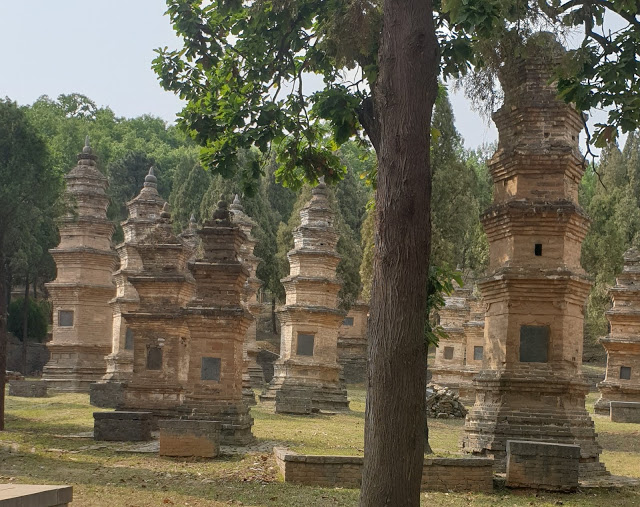
The pagoda forest is located west of the Shaolin Temple and the foot of a hill. As the largest pagoda forest in China, it covers approximately 20,000 square meters and has about 230 pagodas build from the Tang Dynasty (618-907) to the Qing Dynasty (1644-1911).
Each pagoda is the tomb of an eminent monk from the Shaolin Temple. Graceful and exquisite, they belong to different eras and constructed in different styles. The first pagoda was thought to be built in 791.
It is now a world heritage site.
No, it’s not a forest with trees it’s a collection of over 200 pagodas, each a tribute to a head monk at the temple and it goes back a long time. The tribute can have one, three, five, or a maximum of seven layers. The ashes of the individual are buried under the base of the pagoda.
The size, height, and story of the pagoda indicate its accomplishments, prestige, merits, and virtues. Each pagoda was carved with the exact date of construction and brief inscriptions and has its own style with various shapes such as a polygonal, cylindrical, vase, conical and monolithic.
This is one of the more recently constructed pagodas
There are pagodas for eminent foreign monks also in the forest.
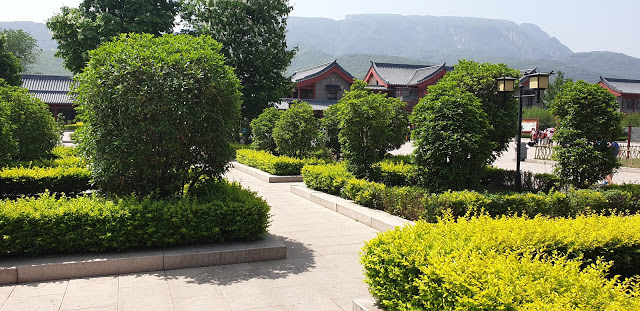
From there we get a ride back on the back of a large electric wagon
to the front entrance courtyard where drinks and ice creams can be bought, and a visit to the all-important happy place.
The Henan Museum is one of the oldest museums in China. In June 1927, General Feng Yuxiang proposed that a museum be built, and it was completed the next year. In 1961, along with the move of the provincial capital, Henan Museum moved from Kaifeng to Zhengzhou.
It currently holds about 130,000 individual pieces, more of which are mostly cultural relics, bronze vessels of the Shang and Zhou Dynasties, and pottery and porcelain wares of the various dynasties.
Eventually, we arrive at the museum and get off the bus adjacent to a scooter track and despite the efforts of the guide, there’s no stopping them from nearly running us over.
We arrive to find the museum has been moved to a different and somewhat smaller building nearby as the existing, and rather distinctively designed, building is being renovated.
While we are waiting for the tickets to enter, we are given another view of industrial life in that there is nothing that resembles proper health and safety on worksites in this country, and the workers are basically standing on what looks to be a flimsy bamboo ladder with nothing to stop them from falling off.
The museum itself has exhibits dating back a few thousand years and consist of bronze and ceramic items. One of the highlights was a tortoiseshell with reportedly the oldest know writing ever found.
Other than that it was a series of cooking utensils, a table, and ceramic pots, some in very good condition considering their age.
After leaving the hotel in Zhengzhou, which was once one of the eight ancient capitals of China, we are going to Dengfeng city, the home of China’s most famous martial art – Shaolin Kung Fu.
The Shaolin Temple nearby is the origin of Chinese Zen Buddhism, and the Songyang Academy, called “the Centre of Heaven and Earth” is located 87 Km from Zhengzhou, or, as we were advised, a 2-hour drive. It will be scenic because we are heading towards the mountains.
As one of the four ancient Song Dynasty Academies, Songyang Academy is one of many schools in the province. It is both on a large scale, is quite spectacular, and is a comprehensive Wushu training base where students are trained to spread the Shaolin Wushu Kung fu style at home and abroad.
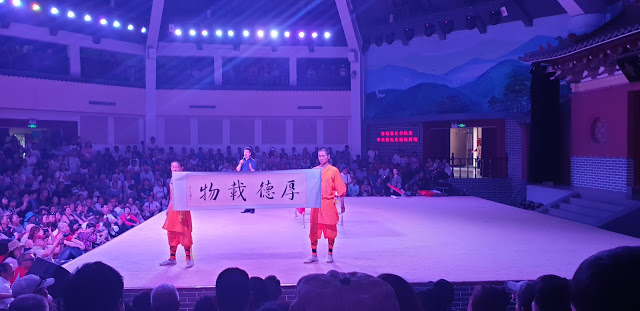
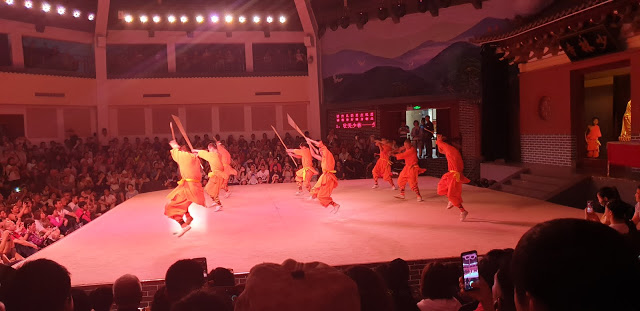
There is a 500-seat demonstration hall where you are able to observe 30 minutes of various martial arts in shows starting on the hour.
Outside there is a specific area that generally has about 600 trainees learning kung fu elements during the day but can hold 5,000 people when outdoor performances are required.
The kung fu school
The thing you notice most about the kung fu school is its size and then the number of buses which tells you that it is a popular tourist stop.
And with that size comes long distances between the car park and the venues we need to go to, the first of which is about half a km, and that’s just to get to the ticket plaza.
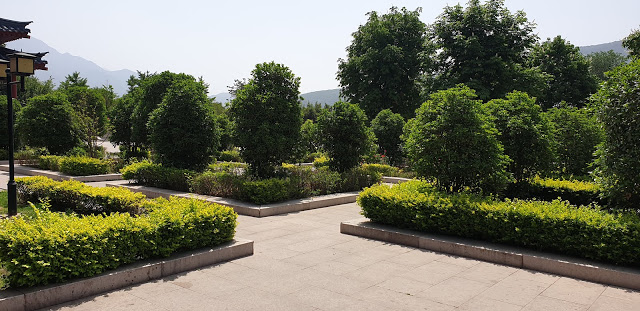
But, it is pleasantly set out and is quite a large number of shops for both souvenirs and food
We pass by some of the students going through their paces
From there it’s another long, long walk to the show arena, where we’re supposed to see various kung fu elements on display. We watched this for a few minutes, then headed off towards the hall for a more intense demonstration of kung fu, and because there is limited seating we have to start lining up at the head of the queue to get a seat.
But…
Everyone else has the same idea and we join the throng which then becomes a ride, and true to the Chinese they start finding ways to push in, even using the imaginary friend somewhere ahead in the queue.
The doors open and then it’s open slather, with the hoards pushing from behind and sliding up the side to get in first. We go with the tide, and manage to get in and find a seat though we were separated from three of our group.
It was an interesting show even though not one word of English was spoken, which from our point of view was a disappointment because we had no idea what was going on.
However…
It wasn’t hard to follow
What the performers were doing was relatively self-explanatory, and quite fascinating, especially the guy who broke a sword over his head, and the guy who stopped two spears penetrating the neck, both examples of very disciplined men.
Boys gave a demonstration of kung fu moves, and intensity and age increased as this progressed to the end.
Next, we were taken in hand by an instructor in Tai chi or an equivalent, I was not quite sure what it was called, and went through the twelve or maybe more moves that constituted a morning or afternoon exercise session or it could be just for relaxation. I lasted the first session but it was a little difficult to do with my sore limbs and a bad back.
Not that I could remember any of it now other than hands overhead, hands in front, bent knees, and a few gentle kung fu hand moves.
Perhaps when I get home I might seek out someone to show me the moves.
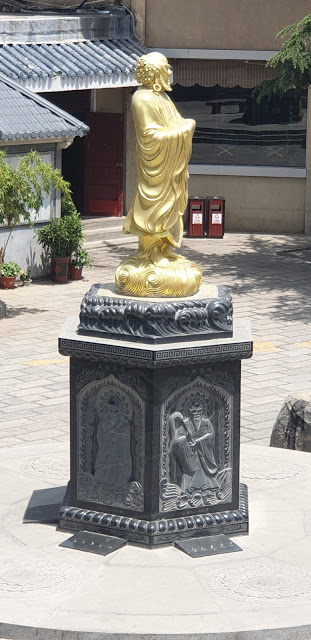
Whilst the others were following their training instructor, I wandered about, finding a large statue
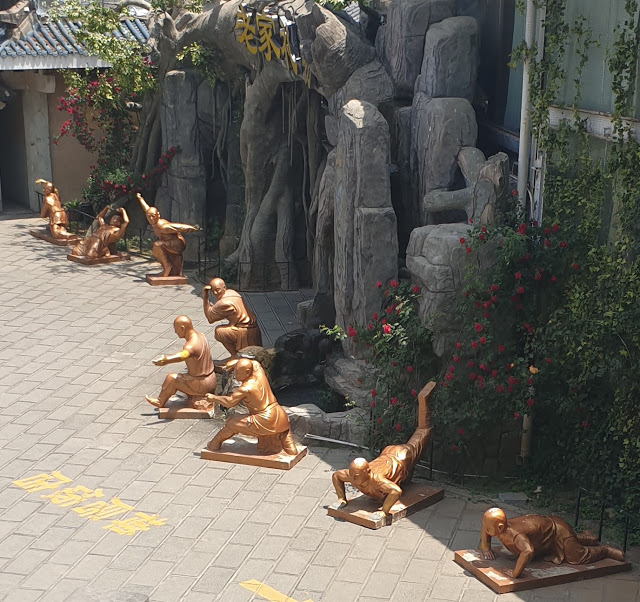
And some smaller statues
Lunch in the Zen Restaurant
After all that exercise it was time to have lunch purportedly the same food as the king fu masters. It’s in the Zen restaurant, aptly named, and the food when it came, came thick and fast, but some of it wasn’t very nice, meat with bones, tofu, a tasteless soup, but some good dishes like the vegetables and noodles with meat, without bones.
The only problem was nothing to drink except a pot of hot water. No tea, no cold water, and if you wanted a cold drink you had to pay for it. After paying 550 yuan why should we have to pay more for a drink when we have not had to so far.
But no cold water? That was just not on, and when we brought this to the attention of the tour guide she just simply ignored us. We just didn’t get anything.
That basically tainted the whole experience.
After lunch, there was the Shaolin Temple and the Pogoda Forest to visit.