The old Shanghai refers to a small area of Shanghai that used to be walled in and remained that way until about 1912 when all but a small section of the wall was demolished. With the advent of the concessions, Old Shanghai became the administrative center until later when it became a shopping complex.
Now it has many restored historical buildings as well as new buildings in a somewhat traditional style that has become one of Shanghai’s main tourist attractions, housing many shops and restaurants.
The “Old Town” is not exclusively old, as you still have a chance to take in the atmosphere if you wander into the quaint side streets.
But, on first viewing walking down the street towards the complex, I’m not sure I’d go as far as to say this is in reality old Shanghai, except for what appears to be a true representation of it architecturally.
The buildings, which are shops and restaurants, are set out symmetrically, with streets, alleyways, and squares which may prove that it was specially built for the tourists, and no mechanized traffic.
Anyway…
The buildings are magnificent, and a photographer’s delight, and you’d finish up having hundreds of photos by the time you leave. All the buildings are exquisite representations of traditional Chinese architecture.
As for buying stuff, remember if you’re not Chinese you have the sucker tourist stamp on your forehead, so be prepared to walk away if the vendors will not bargain.
Nothing here is worth the price tag and in our group discounts like from 130 RMB to 50 RMB and from 1 for 1,200 to 2 for 950 RMB are common.
Here common t-shirts that we can get for 3 dollars back home start at 150 RMB which is roughly 35 dollars. It’s that kind of market.
We end up is a tea room, on the third floor of the meeting point below, and discover all the tour guides sitting around a table counting money, and I have to say it’s the most $50 notes I’ve ever seen in one place. It is, we were told, where they discussed ‘strategy’.
In keeping with the new travel plan, we are picking places in Australia, where we can exchange our timeshare week.
Some people consider timeshares as a waste of time and money, and the process of getting one is very painful, which it can be.
Certainly, in some of the places we have gone, they tried hard to sell you another which can be a downside to staying, but the fact we get to stay in a three-bedroom fully kitted apartment of bungalow for $200 for the week far outweighs the small inconveniences.
Previously, we stayed at Coffs Harbour, but this time, we decided to stay at Port Macquarie.
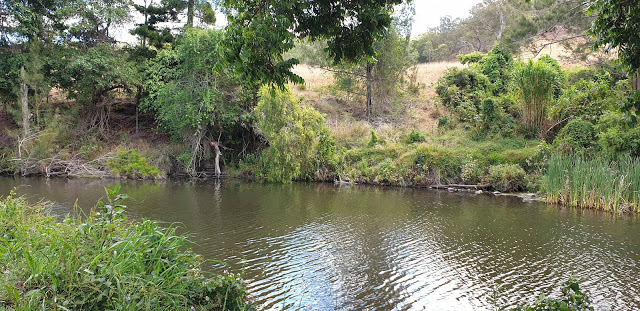
Our bungalow, as they are called, is on the edge of the lagoon, which has an island and has been stocked with fish, though I doubt we would be allowed to go fishing in it.
For the more adventurous, there are canoes. I think I would prefer the BBQ, and watch the planes taking off and landing at the airport just on the other side of the tree line on the other side of the lagoon.
At least they are only smaller planes like the De Havilland Dash 8.
And, knowing the airport was only minutes away, we dropped in for a quick photo op and got the following
In keeping with the new plan for travel, we are picking places in Australia, where we can exchange our time share week.
Some people consider time shares as a waste of time and money, and the process of getting one very painful, which it can be.
Certainly some of the places we have gone they ti hard sell you another which can be a downside to staying, but tge fact we get to stay in a three bedroom fully kitted apartment of bungalow for $200 for the week far outweighs the small inconveniences.
Previously, we stayed at Coffs Harbour, but this time, we decided to stay at Port Macquarie.
Our bungalow, as they are called, is on the edge of the lagoon, which had an island and has been stocked with fish, though I doubt we would be allowed to go fishing in it.
For the more adventurous, there are canoes. I think I would prefer the BBQ, and watch the planes taking off and landing at the airport just on the other side of the tree line on the other side of the lagoon.
At least they are only smaller planes like the De Havilland Dash 8.
And, knowing the airport was only minutes away, we dropped in for a quick photo op and got the following
In keeping with the new plan for travel, we are picking places in Australia, where we can exchange our time share week.
Some people consider time shares as a waste of time and money, and the process of getting one very painful, which it can be.
Certainly some of the places we have gone they ti hard sell you another which can be a downside to staying, but tge fact we get to stay in a three bedroom fully kitted apartment of bungalow for $200 for the week far outweighs the small inconveniences.
Previously, we stayed at Coffs Harbour, but this time, we decided to stay at Port Macquarie.
Our bungalow, as they are called, is on the edge of the lagoon, which had an island and has been stocked with fish, though I doubt we would be allowed to go fishing in it.
For the more adventurous, there are canoes. I think I would prefer the BBQ, and watch the planes taking off and landing at the airport just on the other side of the tree line on the other side of the lagoon.
At least they are only smaller planes like the De Havilland Dash 8.
And, knowing the airport was only minutes away, we dropped in for a quick photo op and got the following
The old Shanghai refers to a small area of Shanghai that used to be walled in and remained that way until about 1912 when all but a small section of the wall was demolished. With the advent of the concessions, Old Shanghai became the administrative center until later when it became a shopping complex.
Now it has many restored historical buildings as well as new buildings in a somewhat traditional style that has become one of Shanghai’s main tourist attractions, housing many shops and restaurants.
The “Old Town” is not exclusively old, as you still have a chance to take in the atmosphere if you wander into the quaint side streets.
But, on first viewing walking down the street towards the complex, I’m not sure I’d go as far as to say this is in reality old Shanghai, except for what appears to be a true representation of it architecturally.
The buildings, which are shops and restaurants, are set out symmetrically, with streets, alleyways, and squares which may prove that it was specially built for the tourists, and no mechanized traffic.
Anyway…
The buildings are magnificent, and a photographer’s delight, and you’d finish up having hundreds of photos by the time you leave. All the buildings are exquisite representations of traditional Chinese architecture.
As for buying stuff, remember if you’re not Chinese you have the sucker tourist stamp on your forehead, so be prepared to walk away if the vendors will not bargain.
Nothing here is worth the price tag and in our group discounts like from 130 RMB to 50 RMB and from 1 for 1,200 to 2 for 950 RMB are common.
Here common t-shirts that we can get for 3 dollars back home start at 150 RMB which is roughly 35 dollars. It’s that kind of market.
We end up is a tea room, on the third floor of the meeting point below, and discover all the tour guides sitting around a table counting money, and I have to say it’s the most $50 notes I’ve ever seen in one place. It is, we were told, where they discussed ‘strategy’.
The old Shanghai refers to a small area of Shanghai that used to be walled in and remained that way until about 1912 when all but a small section of the wall was demolished. With the advent of the concessions, Old Shanghai became the administrative center until later when it became a shopping complex.
Now it has many restored historical buildings as well as new buildings in a somewhat traditional style that has become one of Shanghai’s main tourist attractions, housing many shops and restaurants.
The “Old Town” is not exclusively old, as you still have a chance to take in the atmosphere if you wander into the quaint side streets.
But, on first viewing walking down the street towards the complex, I’m not sure I’d go as far as to say this is in reality old Shanghai, except for what appears to be a true representation of it architecturally.
The buildings, which are shops and restaurants, are set out symmetrically, with streets, alleyways, and squares which may prove that it was specially built for the tourists, and no mechanized traffic.
Anyway…
The buildings are magnificent, and a photographer’s delight, and you’d finish up having hundreds of photos by the time you leave. All the buildings are exquisite representations of traditional Chinese architecture.
As for buying stuff, remember if you’re not Chinese you have the sucker tourist stamp on your forehead, so be prepared to walk away if the vendors will not bargain.
Nothing here is worth the price tag and in our group discounts like from 130 RMB to 50 RMB and from 1 for 1,200 to 2 for 950 RMB are common.
Here common t-shirts that we can get for 3 dollars back home start at 150 RMB which is roughly 35 dollars. It’s that kind of market.
We end up is a tea room, on the third floor of the meeting point below, and discover all the tour guides sitting around a table counting money, and I have to say it’s the most $50 notes I’ve ever seen in one place. It is, we were told, where they discussed ‘strategy’.
The Yu Gardens (or Yuyuan Gardens) are located at No. 137, Anren Street, Huangpu District, very close to the Old City God Temple, in the northeast of the Old City of Shanghai at Huangpu.
Yu Garden was first built in 1559 during the Ming Dynasty by Pan Yunduan and finished approximately 1577, created specifically as a private garden of the Pan family for Pan Yunduan’s parents to enjoy in their old age.
Yu Garden occupies an area of 5 acres, and is divided into six general areas:
-Sansui Hall which includes the Grand Rockery was originally used to entertain guests,
-Wanhua Chamber is a delicate building surrounded by derious cloisters,
-Dianchun Hall, built in 1820, includes Treasury Hall and the Hall of Harmony,
-Huijing Hall which includes Jade Water Corridor.
-Yuhua Hall which is furnished with rosewood pieces from the Ming Dynasty, and,
-The Inner Garden with rockeries, ponds, pavilions, and towers; first laid out in 1709. As the quietest part of Yu Gardens, it includes the Hall of Serenity and the Acting and Singing Stage.
The Mid-Lake Pavilion Teahouse, within the gardens, is the oldest teahouse in Shanghai.
A centerpiece of the gardens is the Exquisite Jade Rock, a 5-ton boulder that was originally meant for the Huizong Emperor (Northern Song Dynasty from 1100-1126 AD) but was salvaged from the Huangpu River after the boat carrying it had sunk.
These gardens house a lot of buildings that seemed to be a perfect blend of the old and the new, and if it was up to me, I’d keep the old. Both the building and the gardens they are set in are like an oasis in the middle of an industrial complex, and perhaps impractical for the number of people living in Shanghai.
All of the ponds had a lot of fish in them
It was a pleasant afternoon, for both a stroll through the gardens
In and out of the rockery on narrow pathways
And to look inside the buildings that were sparsely furnished
There was even an area set aside for entertainment.
The old Shanghai refers to a small area of Shanghai that used to be walled in and remained that way until about 1912 when all but a small section of the wall was demolished. With the advent of the concessions, Old Shanghai became the administrative center until later when it became a shopping complex.
Now it has many restored historical buildings as well as new buildings in a somewhat traditional style that has become one of Shanghai’s main tourist attractions, housing many shops and restaurants.
The “Old Town” is not exclusively old, as you still have a chance to take in the atmosphere if you wander into the quaint side streets.
But, on first viewing walking down the street towards the complex, I’m not sure I’d go as far as to say this is in reality old Shanghai, except for what appears to be a true representation of it architecturally.
The buildings, which are shops and restaurants, are set out symmetrically, with streets, alleyways, and squares which may prove that it was specially built for the tourists, and no mechanized traffic.
Anyway…
The buildings are magnificent, and a photographer’s delight, and you’d finish up having hundreds of photos by the time you leave. All the buildings are exquisite representations of traditional Chinese architecture.
As for buying stuff, remember if you’re not Chinese you have the sucker tourist stamp on your forehead, so be prepared to walk away if the vendors will not bargain.
Nothing here is worth the price tag and in our group discounts like from 130 RMB to 50 RMB and from 1 for 1,200 to 2 for 950 RMB are common.
Here common t-shirts that we can get for 3 dollars back home start at 150 RMB which is roughly 35 dollars. It’s that kind of market.
We end up is a tea room, on the third floor of the meeting point below, and discover all the tour guides sitting around a table counting money, and I have to say it’s the most $50 notes I’ve ever seen in one place. It is, we were told, where they discussed ‘strategy’.