Searching for locations: The Longjing Pearl Factory, Beijing, China

The Longjing Pearl Factory is located at:
No.2 Zuoan Gate Inner Street, ChongWen District, Beijing 100061 China.

This Pearl Center specializes in both freshwater and seawater pearls, with a reputation backed by the government of China, with a big selection and of the highest quality.  There were all kinds of jewelry made of pearls in different colors, shapes, and sizes.

They also had, as an interesting sideline, famous Chinese traditional cosmetics such as pearl cream and pearl powder, reputed to make your skin smoother, tendered and most importantly, younger.

We were advised of all of this well before we arrived at the factory, and of course, one suspected the glowing review, with emphasis on the fact it was a government operation and therefore trustworthy, suggested we should buy, meant the tour guide would receive a commission on each sale.

This is nothing new, it’s the same the world over, so it’s up to the visitor to buy or not to buy.

As soon as you get in the door you are taken to the group’s guide for the tour (and afterward, available for help on making purchases). who gives you a rundown on the different types and colors of pearls.  This briefly is,

Pearls come in two main categories: freshwater cultured pearls and saltwater cultured pearls. Various types of pearls are the result of the environment in which they live, and different cultivation techniques used by the pearl farmers. 

Freshwater cultured pearls are grown in lakes and rivers, whereas saltwater cultured pearls are grown in bodies of saltwater such as bays.  The most commonly used pearls are Freshwater pearls. 

Freshwater Pearls come in various pastel shades of white, pink, peach, lavender, plum, purple, and tangerine.  
South Sea cultured pearls come in shades of lustrous white, often with silver or rose overtones. 

Black pearls are known as Tahitian pearls and come most often in shades of black and gray. While a Tahitian pearl has a black body color, it will vary in its overtones, which most often will be green or pink.

Then there’s a demonstration, where one of the tour group is selected to pick an oyster out of the tank, and then there’s the guessing game as to how many pearls are in the shell, with the winner getting a pearl.

Guesses ranged from 1 to 23 and the answer was 26.  Nearest wins, and one for the person who picked the oyster out of the tank.  After this demonstration, we move on to the ways we can tell the difference between real and fake pearls.

It seems strange that they would, but we were guaranteed by both the tour guide and the lady delivering the lecture that the pearls we were about to buy were real, so how could we suspect there was anything dodgy about them?  Besides, now we could tell real from fake!

We then move onto the showroom floor where there are casements of pearl products, in the form of necklaces, earrings, and any number of variations and uses.  And, just to let you know, the prices are very, very expensive, even if they say they have a special.

Perhaps the best products, and those that found favor with many of the women on the tour, was the pearl cremes and powders.  These were not expensive, and, as we discovered later, actually worked as described.

Searching for locations: The Jade Factory, Beijing, China

The first stop is at a Jade Museum to learn the history of jade. In Chinese, jade is pronounced as “Yu” and it has a history in China of at least four thousand years.  On the way there, we are given a story about one of the guide’s relatives who had a jade bracelet, and how it has saved her from countless catastrophes.It is, quite literally ‘the’ good luck charm.  Chinese gamblers are known to have small pieces of jade in their hands when visiting the casinos, for good luck.  I’m not sure anything could provide a gambler with any sort of luck given how the odds are always slanted towards the house.

At any rate, this is neither the time of the place to debunk a ‘well-known fact’.

 On arrival, our guide hands us over to a local guide, a real staff member, and she begins with a discussion on jade while we watch a single worker working on an intricate piece, what looks to be a globe within a globe, sorry, there are two workers, and the second is working on a dragon.

At the end of the passage that passes by the workers, and before you enter the main showroom, you are dazzled by the ship and is nothing short of magnificent.

Then it’s into a small room just off the main showroom where we are taken through the colors, and the carving process in the various stages, without really being told how the magic happens.

Then it’s out into the main showroom where the sales are made, and before dispersing to look at the jade collection, she briefly tells us how to tell real and fake jade, and she does the usual trick of getting one of the tour group to model a piece.

Looks good, let’s move on.  To bigger and better examples.

What interested me, other than the small zodiac signs and other smallish pieces on the ‘promotion’ table, was the jade bangle our tour guide told us about on the bus.  If anyone needs one, it is my other half, with all the medical issues and her sometimes clumsiness, two particular maladies this object is supposed to prevent.
Jade to the Chinese is Diamonds to westerners, and the jade bangle is often handed down to the females of the family from generation to generation, often as an engagement present, to be worn on the left hand, the one closest to the heart.

There are literally thousands of them, but, they have to be specially fitted to your wrist because if it’s too large, you might lose it if it slips off and I didn’t think it could be too small.  
Nor is it cheap, and needing a larger size, it is reasonably expensive.  But it is jadeite, the more expensive of the types of jade, and it can only appreciate in value, not that we are interested in the monetary value, it’s more the good luck aspect.

We could use some of that.

But, just to touch on something that can be the bugbear of traveling overseas, is the subject of happy houses, a better name for toilets, and has become a recurrent theme on this tour.  It’s better than blurting out the word toilet and it seems there can be some not so happy houses given that the toilets in China are usually squat rather than sit, even for women.
And apparently, everyone has an unhappy house story, particularly the women, and generally in having to squat over a pit.  Why is this a discussion point, it seems the jade factory had what we have come to call happy, happy houses which have more proper toilets, and a stop here before going on the great wall was recommended, as the ‘happy house’ at the wall is deemed to be not such a happy house.

Not even this dragon was within my price range.  Thank heaven they had smaller more affordable models.  The object of having a dragon, large or small, is that it should be placed inside the main door to the house so that money can come in.

It also seems that stuffing the dragon’s mouth with money is also good luck.  We passed on doing that.

After spending a small fortune, there was a bonus, free Chinese tea.  Apparently, we will be coming back, after the Great Wall visit, to have lunch upstairs.


Searching for locations: The Golden Mask Dynasty Show, Beijing, China

The Golden Mask Dynasty Show was located at the OCT Theatre in Beijing’s Happy Valley. 

The theatre was quite full and the seats we had were directly behind the VIP area; as our guide told us, we had the best seats in the house. 

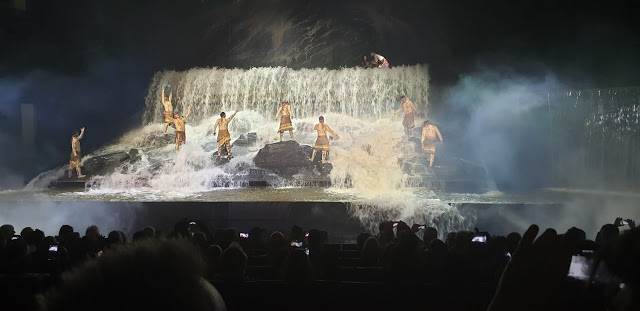
The play has 20 different dance scenes that depict war, royal banquets, and romance.  There are eight chapters and over 200 actors, and throughout the performance we were entertained by dancers, acrobats, costumes, lighting, and acoustics.

The story:

It is of romantic legend and historical memories, the Golden Mask Queen leads her army in defeating the invading Blue Mask King’s army, and afterwards the lands return to a leisurely pastoral life until the Queen forges a ‘mysterious tree’.  When the tree has grown, the Queen has a grand celebration, and releases the captured Blue soldiers, much to the admiration of the Blue Mask King.
This is followed by monstrous floods, and to save her people, and on the advice from the ‘mysterious tree’, the Queen sacrifices herself to save her people.  The Queen then turns into a golden sunbird flying in the sky blessing the people and that of the dynasty.

Billed as the best live show in China, described as a large scale dramatic musical, “The Golden Mask Dynasty” it lived up to its reputation and was thoroughly enjoyed by all.

It was not just singing dancing and acrobatics, it had a story and it was told so that language and cultural issues aside, it worked.  There was a narration of the story running beside the stage, but it was hard to divide attention between what was happening, and what was being related.

Then came the peacock dance, with live peacocks

And this was followed by a waterfall, well, I don’t think anyone in that audience could believe what they were seeing.

I know I was both astonished and in awe of the performance.

What a way to finish off our first day in Beijing.

Oh, sorry, that high was dented slightly when we had to go back to our room.

Searching for locations: The Great Wall of China, near Beijing, China

This is in a very scenic area and on the first impression; it is absolutely stunning in concept and in viewing.

As for the idea of walking on it, well, that first view of the mountain climb when getting off the bus, my first question was where the elevator is?  Sorry, there is none.  It’s walk on up or stay down the bottom.

Walk it is.  As far as you feel you are able.  There are quite a few who don’t make it to the top.  I didn’t.  I only made it to the point where the steps narrowed.

But as for the logistics, there’s the gradual incline to the starting point, and what will be the end meeting place.  From there, it’s a few steps up to the guard station no 7, and a few more to get up to the start of the main climb.  The top of the wall is guard station no 12.

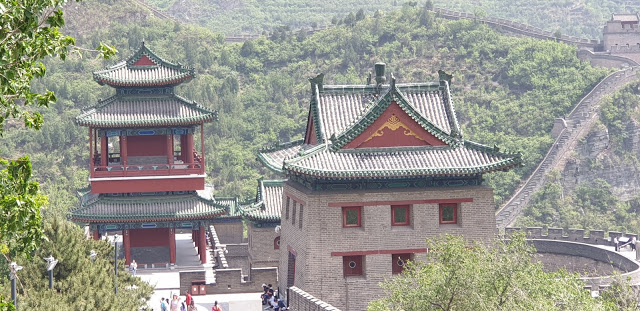
Ok, those first few steps are a good indication of what it’s was going to be like and it’s more the awkwardness of the uneven heights of the steps that’s the killer, some as high as about 15 inches.  This photo paints an illusion, that it’s easy.  It’s not.

If you make it to the first stage, then it augers well you will get about 100 steps before you both start feeling it in your legs, particularly the knees, and then suffering from the height if you have a problem with heights as the air is thinner.  And if you have a thing with heights, never look down.

This was from where we stopped, about a third of the way up.  The one below, from almost at the bottom.  One we’re looking almost down on the buildings, the other, on the same level.

It requires rest before you come down, and that’s when you start to feel it in the knees, our tour guide called it jelly legs, but it’s more in the knees down.  Descending should be slow, and it can be more difficult negotiating the odd height steps, and particularly those high ones.  You definitely need to hang onto the rail, even try going backward.

And, no, that rail hasn’t been there as long as the wall.

While you are waiting for the guide to return to the meeting place at the appointed time, there should be time to have some jasmine tea.  Highly refreshing after the climb.

Searching for locations: The Golden Mask Dynasty Show, Beijing, China

The Golden Mask Dynasty Show was located at the OCT Theatre in Beijing’s Happy Valley. 

The theatre was quite full and the seats we had were directly behind the VIP area; as our guide told us, we had the best seats in the house. 

The play has 20 different dance scenes that depict war, royal banquets, and romance.  There are eight chapters and over 200 actors, and throughout the performance we were entertained by dancers, acrobats, costumes, lighting, and acoustics.

The story:

It is of romantic legend and historical memories, the Golden Mask Queen leads her army in defeating the invading Blue Mask King’s army, and afterwards the lands return to a leisurely pastoral life until the Queen forges a ‘mysterious tree’.  When the tree has grown, the Queen has a grand celebration, and releases the captured Blue soldiers, much to the admiration of the Blue Mask King.
This is followed by monstrous floods, and to save her people, and on the advice from the ‘mysterious tree’, the Queen sacrifices herself to save her people.  The Queen then turns into a golden sunbird flying in the sky blessing the people and that of the dynasty.

Billed as the best live show in China, described as a large scale dramatic musical, “The Golden Mask Dynasty” it lived up to its reputation and was thoroughly enjoyed by all.

It was not just singing dancing and acrobatics, it had a story and it was told so that language and cultural issues aside, it worked.  There was a narration of the story running beside the stage, but it was hard to divide attention between what was happening, and what was being related.

Then came the peacock dance, with live peacocks

And this was followed by a waterfall, well, I don’t think anyone in that audience could believe what they were seeing.

I know I was both astonished and in awe of the performance.

What a way to finish off our first day in Beijing.

Oh, sorry, that high was dented slightly when we had to go back to our room.

Searching for locations: The Jade Factory, Beijing, China

The first stop is at a Jade Museum to learn the history of jade. In Chinese, jade is pronounced as “Yu” and it has a history in China of at least four thousand years.  On the way there, we are given a story about one of the guide’s relatives who had a jade bracelet, and how it has saved her from countless catastrophes.It is, quite literally ‘the’ good luck charm.  Chinese gamblers are known to have small pieces of jade in their hands when visiting the casinos, for good luck.  I’m not sure anything could provide a gambler with any sort of luck given how the odds are always slanted towards the house.

At any rate, this is neither the time of the place to debunk a ‘well-known fact’.

 On arrival, our guide hands us over to a local guide, a real staff member, and she begins with a discussion on jade while we watch a single worker working on an intricate piece, what looks to be a globe within a globe, sorry, there are two workers, and the second is working on a dragon.

At the end of the passage that passes by the workers, and before you enter the main showroom, you are dazzled by the ship and is nothing short of magnificent.

Then it’s into a small room just off the main showroom where we are taken through the colors, and the carving process in the various stages, without really being told how the magic happens.

Then it’s out into the main showroom where the sales are made, and before dispersing to look at the jade collection, she briefly tells us how to tell real and fake jade, and she does the usual trick of getting one of the tour group to model a piece.

Looks good, let’s move on.  To bigger and better examples.

What interested me, other than the small zodiac signs and other smallish pieces on the ‘promotion’ table, was the jade bangle our tour guide told us about on the bus.  If anyone needs one, it is my other half, with all the medical issues and her sometimes clumsiness, two particular maladies this object is supposed to prevent.
Jade to the Chinese is Diamonds to westerners, and the jade bangle is often handed down to the females of the family from generation to generation, often as an engagement present, to be worn on the left hand, the one closest to the heart.

There are literally thousands of them, but, they have to be specially fitted to your wrist because if it’s too large, you might lose it if it slips off and I didn’t think it could be too small.  
Nor is it cheap, and needing a larger size, it is reasonably expensive.  But it is jadeite, the more expensive of the types of jade, and it can only appreciate in value, not that we are interested in the monetary value, it’s more the good luck aspect.

We could use some of that.

But, just to touch on something that can be the bugbear of traveling overseas, is the subject of happy houses, a better name for toilets, and has become a recurrent theme on this tour.  It’s better than blurting out the word toilet and it seems there can be some not so happy houses given that the toilets in China are usually squat rather than sit, even for women.
And apparently, everyone has an unhappy house story, particularly the women, and generally in having to squat over a pit.  Why is this a discussion point, it seems the jade factory had what we have come to call happy, happy houses which have more proper toilets, and a stop here before going on the great wall was recommended, as the ‘happy house’ at the wall is deemed to be not such a happy house.

Not even this dragon was within my price range.  Thank heaven they had smaller more affordable models.  The object of having a dragon, large or small, is that it should be placed inside the main door to the house so that money can come in.

It also seems that stuffing the dragon’s mouth with money is also good luck.  We passed on doing that.

After spending a small fortune, there was a bonus, free Chinese tea.  Apparently, we will be coming back, after the Great Wall visit, to have lunch upstairs.


Searching for locations: The Jade Factory, Beijing, China

The first stop is at a Jade Museum to learn the history of jade. In Chinese, jade is pronounced as “Yu” and it has a history in China of at least four thousand years.  On the way there, we are given a story about one of the guide’s relatives who had a jade bracelet, and how it has saved her from countless catastrophes.It is, quite literally ‘the’ good luck charm.  Chinese gamblers are known to have small pieces of jade in their hands when visiting the casinos, for good luck.  I’m not sure anything could provide a gambler with any sort of luck given how the odds are always slanted towards the house.

At any rate, this is neither the time of the place to debunk a ‘well-known fact’.

 On arrival, our guide hands us over to a local guide, a real staff member, and she begins with a discussion on jade while we watch a single worker working on an intricate piece, what looks to be a globe within a globe, sorry, there are two workers, and the second is working on a dragon.

At the end of the passage that passes by the workers, and before you enter the main showroom, you are dazzled by the ship and is nothing short of magnificent.

Then it’s into a small room just off the main showroom where we are taken through the colors, and the carving process in the various stages, without really being told how the magic happens.

Then it’s out into the main showroom where the sales are made, and before dispersing to look at the jade collection, she briefly tells us how to tell real and fake jade, and she does the usual trick of getting one of the tour group to model a piece.

Looks good, let’s move on.  To bigger and better examples.

What interested me, other than the small zodiac signs and other smallish pieces on the ‘promotion’ table, was the jade bangle our tour guide told us about on the bus.  If anyone needs one, it is my other half, with all the medical issues and her sometimes clumsiness, two particular maladies this object is supposed to prevent.
Jade to the Chinese is Diamonds to westerners, and the jade bangle is often handed down to the females of the family from generation to generation, often as an engagement present, to be worn on the left hand, the one closest to the heart.

There are literally thousands of them, but, they have to be specially fitted to your wrist because if it’s too large, you might lose it if it slips off and I didn’t think it could be too small.  
Nor is it cheap, and needing a larger size, it is reasonably expensive.  But it is jadeite, the more expensive of the types of jade, and it can only appreciate in value, not that we are interested in the monetary value, it’s more the good luck aspect.

We could use some of that.

But, just to touch on something that can be the bugbear of traveling overseas, is the subject of happy houses, a better name for toilets, and has become a recurrent theme on this tour.  It’s better than blurting out the word toilet and it seems there can be some not so happy houses given that the toilets in China are usually squat rather than sit, even for women.
And apparently, everyone has an unhappy house story, particularly the women, and generally in having to squat over a pit.  Why is this a discussion point, it seems the jade factory had what we have come to call happy, happy houses which have more proper toilets, and a stop here before going on the great wall was recommended, as the ‘happy house’ at the wall is deemed to be not such a happy house.

Not even this dragon was within my price range.  Thank heaven they had smaller more affordable models.  The object of having a dragon, large or small, is that it should be placed inside the main door to the house so that money can come in.

It also seems that stuffing the dragon’s mouth with money is also good luck.  We passed on doing that.

After spending a small fortune, there was a bonus, free Chinese tea.  Apparently, we will be coming back, after the Great Wall visit, to have lunch upstairs.


Searching for locations: The Great Wall of China, near Beijing, China

This is in a very scenic area and on the first impression; it is absolutely stunning in concept and in viewing.

As for the idea of walking on it, well, that first view of the mountain climb when getting off the bus, my first question was where the elevator is?  Sorry, there is none.  It’s walk on up or stay down the bottom.

Walk it is.  As far as you feel you are able.  There are quite a few who don’t make it to the top.  I didn’t.  I only made it to the point where the steps narrowed.

But as for the logistics, there’s the gradual incline to the starting point, and what will be the end meeting place.  From there, it’s a few steps up to the guard station no 7, and a few more to get up to the start of the main climb.  The top of the wall is guard station no 12.

Ok, those first few steps are a good indication of what it’s was going to be like and it’s more the awkwardness of the uneven heights of the steps that’s the killer, some as high as about 15 inches.  This photo paints an illusion, that it’s easy.  It’s not.

If you make it to the first stage, then it augers well you will get about 100 steps before you both start feeling it in your legs, particularly the knees, and then suffering from the height if you have a problem with heights as the air is thinner.  And if you have a thing with heights, never look down.

This was from where we stopped, about a third of the way up.  The one below, from almost at the bottom.  One we’re looking almost down on the buildings, the other, on the same level.

It requires rest before you come down, and that’s when you start to feel it in the knees, our tour guide called it jelly legs, but it’s more in the knees down.  Descending should be slow, and it can be more difficult negotiating the odd height steps, and particularly those high ones.  You definitely need to hang onto the rail, even try going backward.

And, no, that rail hasn’t been there as long as the wall.

While you are waiting for the guide to return to the meeting place at the appointed time, there should be time to have some jasmine tea.  Highly refreshing after the climb.

Searching for locations: The Great Wall of China, near Beijing, China

This is in a very scenic area and on the first impression; it is absolutely stunning in concept and in viewing.

As for the idea of walking on it, well, that first view of the mountain climb when getting off the bus, my first question was where the elevator is?  Sorry, there is none.  It’s walk on up or stay down the bottom.

Walk it is.  As far as you feel you are able.  There are quite a few who don’t make it to the top.  I didn’t.  I only made it to the point where the steps narrowed.

But as for the logistics, there’s the gradual incline to the starting point, and what will be the end meeting place.  From there, it’s a few steps up to the guard station no 7, and a few more to get up to the start of the main climb.  The top of the wall is guard station no 12.

Ok, those first few steps are a good indication of what it’s was going to be like and it’s more the awkwardness of the uneven heights of the steps that’s the killer, some as high as about 15 inches.  This photo paints an illusion, that it’s easy.  It’s not.

If you make it to the first stage, then it augers well you will get about 100 steps before you both start feeling it in your legs, particularly the knees, and then suffering from the height if you have a problem with heights as the air is thinner.  And if you have a thing with heights, never look down.

This was from where we stopped, about a third of the way up.  The one below, from almost at the bottom.  One we’re looking almost down on the buildings, the other, on the same level.

It requires rest before you come down, and that’s when you start to feel it in the knees, our tour guide called it jelly legs, but it’s more in the knees down.  Descending should be slow, and it can be more difficult negotiating the odd height steps, and particularly those high ones.  You definitely need to hang onto the rail, even try going backward.

And, no, that rail hasn’t been there as long as the wall.

While you are waiting for the guide to return to the meeting place at the appointed time, there should be time to have some jasmine tea.  Highly refreshing after the climb.

Searching for locations: The Beijing Zoo, and Pandas, China

Beijing Zoo

Founded in 1906 during the late Qing dynasty, it is the oldest Zoo in China.  It also has an aquarium and has 450 land-based species, some of which are rare and endemic to China like the Giant Panda, and 500 marine-based species.  Other rare animals to be seen are the Red Panda, the Golden Snub-nosed Monkey, the South China Tiger, the White Lipped deer, the Chinese alligator, the Yak, and the Snow Leopard.
Most of the original animals were bought in 1908 from Germany by the viceroy of Liangjiang Duanfang.  The Zoo first opened on June 16th, 1908.
Currently, the Zoo grounds resemble classical Chinese gardens, and among the attractions are a number of Qing dynasty buildings to view, as well as an Elephant hall, a Lion and tiger hall, a Monkey hall, and a Panda hall.  In all, there are 30 halls.
The Zoo is located at 137 Xizhimen WaiDajie in Xicheng district, near the 2nd ring road.

We are primarily at the Zoo to see the Pandas, and there is a specific hall devoted to them, and by the way, it costs extra to see them.  Everyone in our group is particularly interested in seeing them because it’s rare that any can be found anywhere else in the world.
Perhaps if there had been more time, another hour, maybe, it might have made all the difference, but I think that extra time might have clashed with the pearl factory, and that, for obvious reasons, was deemed to be more important.

Our first stop is in the Panda hall.

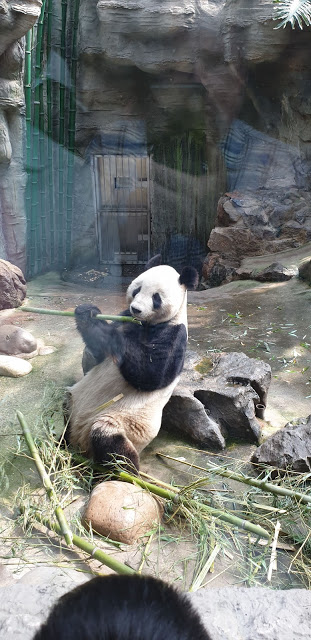
There are two pandas that we can see, one of whom is a little camera shy, and the other, above, who is demonstrating how pandas eat bamboo.  They are behind a large glass wall, and you have to wait for the opportunity to get a good photo, and, sometimes only enough to include the top of the head of the person in front of you.  Unfortunately, the Chinese visitors don’t understand the polite excuse me in English, and, can at times, be rude enough to shove their way to the front.

What is also a problem is the uncooperativeness of the pandas to pose for photos.  I guess there’s no surprise there given the thousands of visitors every day with only one purpose in mind.  We counted ourselves lucky to get the photos we did.

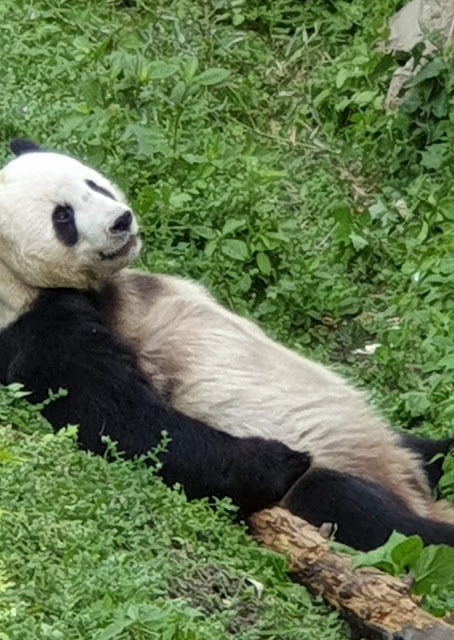
The hall itself is built on to the external enclosure where there are a number of giant pandas some of whom that were on show were relatively lethargic, as though they had a big weekend, and we’re sleeping it off, like this panda below:

Then, remarkably, we came across one that decided to be a little more energetic and did a walk in front of hundreds of Chinese who had undoubtedly come to show their children the animals.

This Panda was also easier to photograph whereas the other panda, one chewing on a morning feast of bamboo, saw a lot of pushing and shoving by the spectators to get the best spot to take his photograph.  Having manners just doesn’t cut it here, so do what you have to to get that photograph.

We also saw a couple of monkeys that were also in the panda enclosure, but they were not much of a side benefit.  They may have been there to use the Panda’s exercise equipment, though it was not quite like what we use. There was no time really to wander off to see much else, but apparently, there were also red pandas, and surprisingly, a category called Australian animals.  But who goes to another country to view your own animals? The cutest animals were the stuffed pandas, and they were quite reasonably priced.