So, the first treat for the day is the high-speed magnetic train, something we only learned about after arriving in China and was not on any of the pre-tour documentation.
The train line connects Shanghai Pudong International Airport and Longyang Road Station (in the outskirts of central Pudong). It is the oldest commercial maglev still in operation, and the first commercial high-speed maglev with cruising speed of 431 km/h (268 mph). At full speed, the journey takes 7 minutes and 20 seconds to complete the distance of about 30 km.
Construction of the line began on March 1, 2001 and public services commenced on 1 January 2004. It was built by a joint venture of Siemens and ThyssenKrupp from Kassel, Germany.
But, like visiting anything from a hotel, first we have to drive to the station and because we are leaving at 8, its peak hour traffic, and it takes 1 hour 10 minutes to get there.
The train also has a practical use and that is to take passengers from Shanghai to Pudong international airport as well as for those train enthusiasts, which is what we are.
On the train, it has the same sleek look as the bullet trains, but it is completely different, and you are able to see from the front of the train to the back.
Reputed to travel at 431 kph we take a seat and it is not long before the doors shut, and a loud humming noise is soon replaced by what sounds like an engine, then we start moving. It sounds just like a normal train, and is a lot noisier than a normal bullet train.
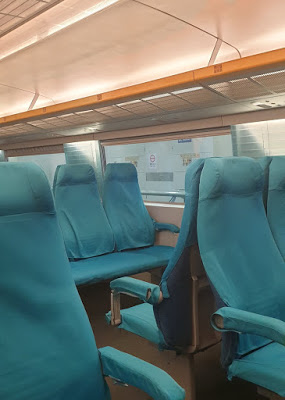
Seating on the train was nothing special, as one might expect
It didn’t take long before it hits the advertised speed of 431 kph. This is not sustained for very long, because the distance is on 40 odd kilometers, and the whole trip takes about 7 minutes.
We go to the airport, and then we come back. Is it worth the price, yes. If you are a train enthusiast.
So, the first treat for the day is the high-speed magnetic train, something we only learned about after arriving in China and was not on any of the pre-tour documentation.
The train line connects Shanghai Pudong International Airport and Longyang Road Station (in the outskirts of central Pudong). It is the oldest commercial maglev still in operation, and the first commercial high-speed maglev with cruising speed of 431 km/h (268 mph). At full speed, the journey takes 7 minutes and 20 seconds to complete the distance of about 30 km.
Construction of the line began on March 1, 2001 and public services commenced on 1 January 2004. It was built by a joint venture of Siemens and ThyssenKrupp from Kassel, Germany.
But, like visiting anything from a hotel, first we have to drive to the station and because we are leaving at 8, its peak hour traffic, and it takes 1 hour 10 minutes to get there.
The train also has a practical use and that is to take passengers from Shanghai to Pudong international airport as well as for those train enthusiasts, which is what we are.
On the train, it has the same sleek look as the bullet trains, but it is completely different, and you are able to see from the front of the train to the back.
Reputed to travel at 431 kph we take a seat and it is not long before the doors shut, and a loud humming noise is soon replaced by what sounds like an engine, then we start moving. It sounds just like a normal train, and is a lot noisier than a normal bullet train.
Seating on the train was nothing special, as one might expect
It didn’t take long before it hits the advertised speed of 431 kph. This is not sustained for very long, because the distance is on 40 odd kilometers, and the whole trip takes about 7 minutes.
We go to the airport, and then we come back. Is it worth the price, yes. If you are a train enthusiast.
When we arrive at the embarkation site we find at least 100 buses all lined up and parked, and literally thousands of Chinese and other Asians streaming through the turnstiles to get on another boat leaving earlier than ours.
Buses were just literally arriving one after the other stopping near where we were standing with a dozen or so other groups waiting patiently, and with people were everywhere it could only be described as organized chaos.
Someone obviously knew where everyone was supposed to go, and when it was our turn, we joined the queue. There were a lot of people in front of us, and a lot more behind, so I had to wonder just how big the boat was.
We soon found out.
And it was amusing to watch people running, yes, they were actually running, to get to the third level, or found available seating. Being around the first to board, we had no trouble finding a seat on the second level.
I was not quite sure what the name of the boat was, but it had 3 decks and VIP rooms and it was huge, with marble staircases, the sort you could make a grand entrance on. The last such ornate marble staircase we had seen was in a hotel in Hong Kong, and that was some staircase.
But who has marble staircases in a boat?
We’re going out across the water as far as the Bund and then turn around and come back about 30 to 40 minutes. By the time everyone was on board, there was no room left on the third level, no seats on the second level nor standing room at the end of the second level where the stairs up to the third level were.
No one wanted to pay the extra to go into the VIP lounge.
We were sitting by very large windows where it was warm enough watching the steady procession of the colored lights of other vessels, and outside the buildings.
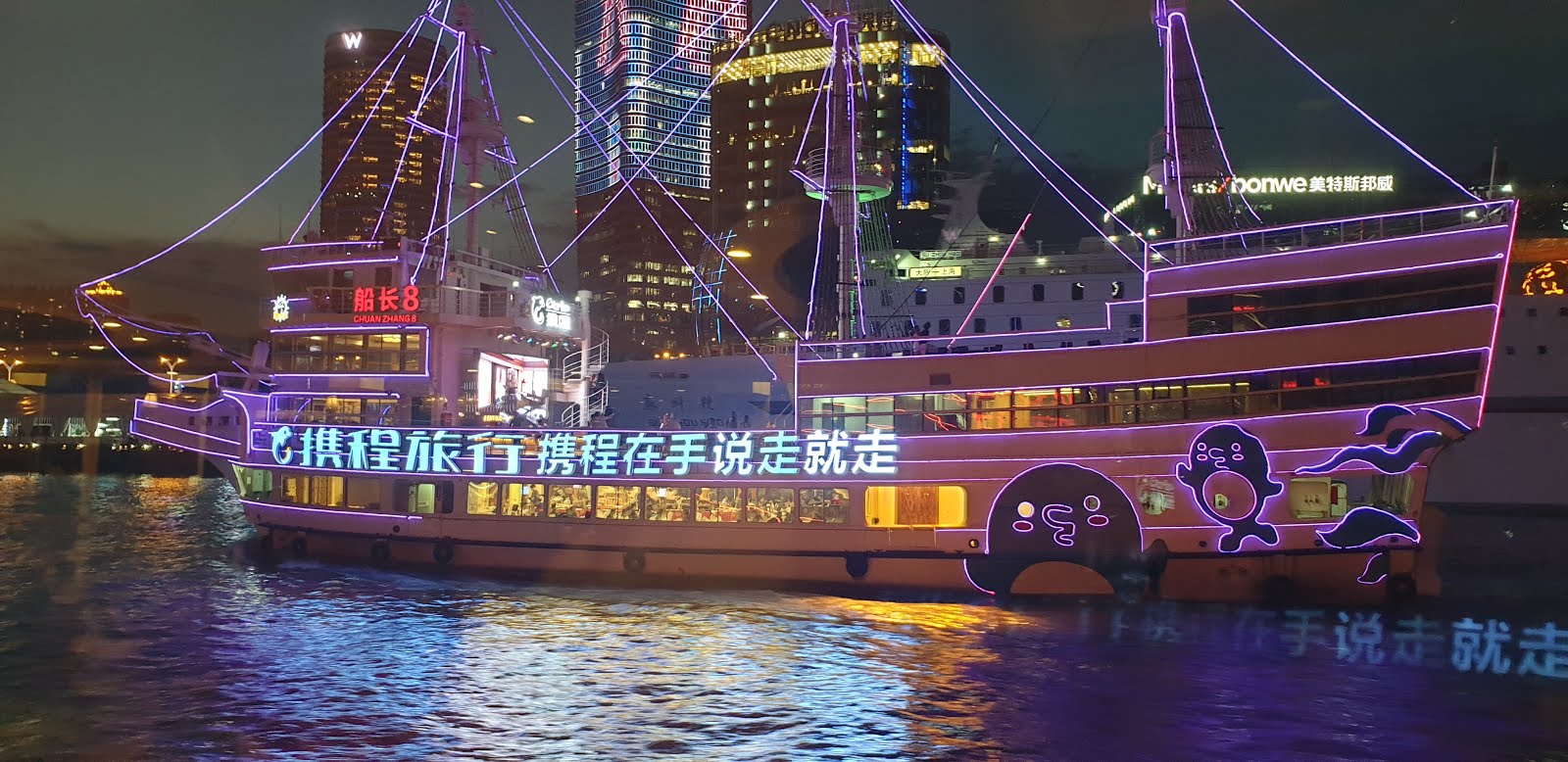
It was quite spectacular, as were some of the other boats going out on the harbor.
All the buildings of the Bund were lit up
And along that part of the Bund was a number of old English style buildings made from sandstone, and very impressive to say the least.
On the other side of the harbour were the more modern buildings, including the communications tower, a rather impressive structure.
I had to go to the rear of the vessel to get a photo, a very difficult proposition given here was no space on the railing, not even on the stairs going up or down. It was just luck I managed to get some photos between passengers heads.
And, another view of that communications tower:
There was no doubt this was one of the most colourful night-time boat tours I’ve ever been on. Certainly, when we saw the same buildings the following day, they were not half as spectacular in daylight.
I never did get up to the third level to see what the view was like.
This is an inlet near Port Macquarie in northern New South Wales. It is adjacent to a caravan and camping park, close to the ocean and parklands.
But, for our purposes, this scene is going to have a few more interesting connotations than just a few campers going for a jog along the beach, fishing in the estuary, or further out to sea on the other side of the wall in the background.
Firstly, to my favorite kind of story, a spy story…
It’s basically the evil billionaire’s backyard to his island hideaway, and our hero intends to come ashore at night and do battle with the guards, break into the underground holding cells and save the girl.
As always, saving the world comes second!
Or, it’s a place like Fantasy Island, without the landing strip on the beach, where people come to have their fantasies fulfilled. OK, to start there are no robots that are going to go berserk, that’s so ten years ago.
And, no, the hosts won’t be dressed in white safari suits. They went out in the 70s.
Then, I suppose, a story that I like, about people who have secrets, people who are broken, people who just want to get away from everyone else, come to this island where they can live in anonymity, without having to interact with anyone unless they want to.
When we arrive at the embarkation site we find at least 100 buses all lined up and parked, and literally thousands of Chinese and other Asians streaming through the turnstiles to get on another boat leaving earlier than ours.
Buses were just literally arriving one after the other stopping near where we were standing with a dozen or so other groups waiting patiently, and with people were everywhere it could only be described as organized chaos.
Someone obviously knew where everyone was supposed to go, and when it was our turn, we joined the queue. There were a lot of people in front of us, and a lot more behind, so I had to wonder just how big the boat was.
We soon found out.
And it was amusing to watch people running, yes, they were actually running, to get to the third level, or found available seating. Being around the first to board, we had no trouble finding a seat on the second level.
I was not quite sure what the name of the boat was, but it had 3 decks and VIP rooms and it was huge, with marble staircases, the sort you could make a grand entrance on. The last such ornate marble staircase we had seen was in a hotel in Hong Kong, and that was some staircase.
But who has marble staircases in a boat?
We’re going out across the water as far as the Bund and then turn around and come back about 30 to 40 minutes. By the time everyone was on board, there was no room left on the third level, no seats on the second level nor standing room at the end of the second level where the stairs up to the third level were.
No one wanted to pay the extra to go into the VIP lounge.
We were sitting by very large windows where it was warm enough watching the steady procession of the colored lights of other vessels, and outside the buildings.
It was quite spectacular, as were some of the other boats going out on the harbor.
All the buildings of the Bund were lit up
And along that part of the Bund was a number of old English style buildings made from sandstone, and very impressive to say the least.
On the other side of the harbour were the more modern buildings, including the communications tower, a rather impressive structure.
I had to go to the rear of the vessel to get a photo, a very difficult proposition given here was no space on the railing, not even on the stairs going up or down. It was just luck I managed to get some photos between passengers heads.
And, another view of that communications tower:
There was no doubt this was one of the most colourful night-time boat tours I’ve ever been on. Certainly, when we saw the same buildings the following day, they were not half as spectacular in daylight.
I never did get up to the third level to see what the view was like.
West Lake is a freshwater lake in Hangzhou, China. It is divided into five sections by three causeways. There are numerous temples, pagodas, gardens, and artificial islands within the lake.
Measuring 3.2 kilometers (2 miles) in length, 2.8 kilometers (1.7 miles) in width, and 2.3 meters (7.5 feet) in average depth, the lake spreads itself in an area totaling 6.5 square kilometers (2.5 square miles).
The earliest recorded name for West Lake was the “Wu Forest River”, but over time it changed to two distinct names. One is “Qiantang Lake”, due to the fact that Hangzhou was called “Qiantang” in ancient times. The other, “West Lake”, due to the lake being west of the city
It’s about to get busy, with a number of activities planned, and the warmth of the day is starting to make an impact.
The tour starts in the car park about a kilometer away, but the moment we left the car park we were getting a taste of the park walking along a tree-lined avenue.
When we cross the road, once again dicing with death with the silent assassins on motor scooters.
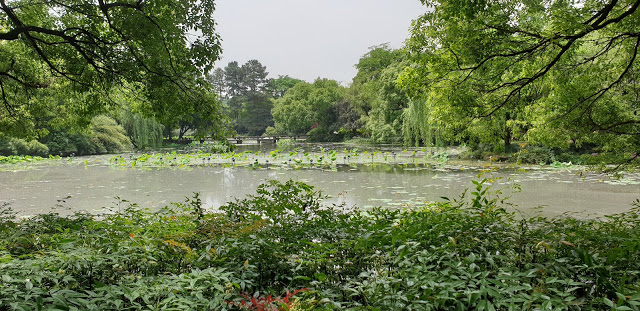
We are in the park proper, and it is magnificent, with flowers, mostly at the start hydrangeas and then any number of other trees and shrubs, some carved into other flower shapes like a lotus.
Then there was the lake and the backdrop of bridges and walkways.
.
And if you can tune out the background white noise the place would be great for serenity and relaxation.
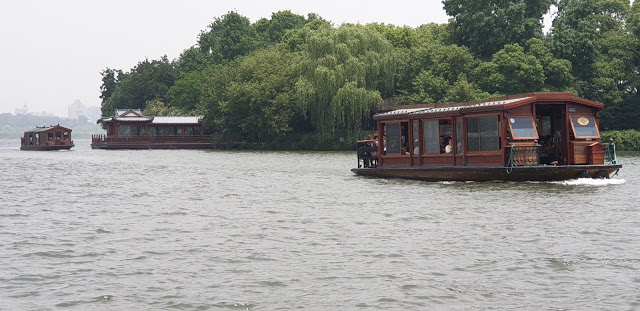
That, in fact, was how the boat ride panned out, about half an hour or more gliding across the lake in an almost silent boat, by an open window, with the air and the majestic scenery.
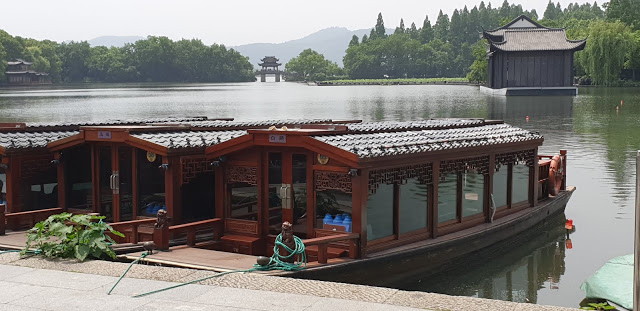
No, not that boat, which would be great to have lunch on while cruising, but the boat below:
Not quite in the same class, but all the same, very easy to tune out and soak it in.
It was peaceful, amazingly quiet, on a summery day
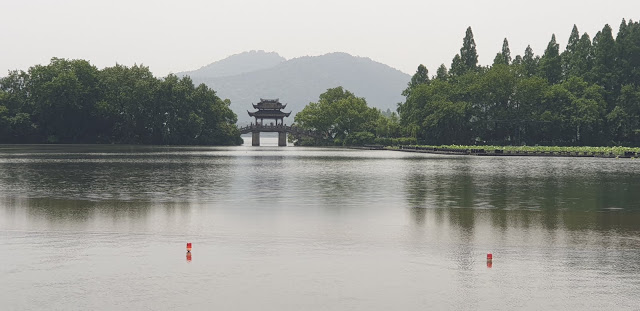
A pagoda in the hazy distance, an island we were about to circumnavigate.
Of all the legends, the most touching one is the love story between Bai Suzhen and Xu Xi’an. Bai Suzhen was a white snake spirit and Xu Xi’an was a mortal man.
They fell in love when they first met on a boat on the West Lake, and got married very soon after.
However, the evil monk Fa Hai attempted to separate the couple by imprisoning Xu Xi’an. Bai Suzhen fought against Fa Hai and tried her best to rescue her husband, but she failed and was imprisoned under the Leifeng Pagoda by the lake.
Years later the couple was rescued by Xiao Qing, the sister of Baisuzhen, and from then on, Bai Suzhen and Xu Xi’an lived together happily.
The retelling of the story varied between tour guides, and on the cruise boat, we had two. Our guide kept to the legend, the other tour guide had a different ending.
Suffice to say it had relevance to the two pagodas on the far side of the lake.
There was a cafe or restaurant on the island, but that was not our lunch destination.
Nor were the buildings further along from where we disembarked.
All in all the whole cruise took about 45 minutes and was an interesting break from the hectic nature of the tour.
Oh yes, and the boat captain had postcards for sale. We didn’t buy any.
Lunch
At the disembarkation point there was a mall that sold souvenirs and had a few ‘fast food’ shops, and a KFC, not exactly what we came to China for, but it seemed like the only place in town a food cautious Australian could eat at.
And when tried to get in the door, that’s where at least 3 busloads were, if they were not in the local Starbucks. Apparently, these were the places of first choice wherever we went.
The chicken supply by the time we got to the head of the line amounted to pieces at 22.5 RMB a piece and nuggets. Everything else had run out, and for me, there were only 5 pieces left. Good thing there were chips.
And Starbucks with coffee and cheesecake.
At least the setting for what could have been a picnic lunch was idyllic.
This is an inlet near Port Macquarie in northern New South Wales. It is adjacent to a caravan and camping park, close to the ocean and parklands.
But, for our purposes, this scene is going to have a few more interesting connotations than just a few campers going for a jog along the beach, fishing in the estuary, or further out to sea on the other side of the wall in the background.
Firstly, to my favorite kind of story, a spy story…
It’s basically the evil billionaire’s backyard to his island hideaway, and our hero intends to come ashore at night and do battle with the guards, break into the underground holding cells and save the girl.
As always, saving the world comes second!
Or, it’s a place like Fantasy Island, without the landing strip on the beach, where people come to have their fantasies fulfilled. OK, to start there are no robots that are going to go berserk, that’s so ten years ago.
And, no, the hosts won’t be dressed in white safari suits. They went out in the 70s.
Then, I suppose, a story that I like, about people who have secrets, people who are broken, people who just want to get away from everyone else, come to this island where they can live in anonymity, without having to interact with anyone unless they want to.
When we arrive at the embarkation site we find at least 100 buses all lined up and parked, and literally thousands of Chinese and other Asians streaming through the turnstiles to get on another boat leaving earlier than ours.
Buses were just literally arriving one after the other stopping near where we were standing with a dozen or so other groups waiting patiently, and with people were everywhere it could only be described as organized chaos.
Someone obviously knew where everyone was supposed to go, and when it was our turn, we joined the queue. There were a lot of people in front of us, and a lot more behind, so I had to wonder just how big the boat was.
We soon found out.
And it was amusing to watch people running, yes, they were actually running, to get to the third level, or found available seating. Being around the first to board, we had no trouble finding a seat on the second level.
I was not quite sure what the name of the boat was, but it had 3 decks and VIP rooms and it was huge, with marble staircases, the sort you could make a grand entrance on. The last such ornate marble staircase we had seen was in a hotel in Hong Kong, and that was some staircase.
But who has marble staircases in a boat?
We’re going out across the water as far as the Bund and then turn around and come back about 30 to 40 minutes. By the time everyone was on board, there was no room left on the third level, no seats on the second level nor standing room at the end of the second level where the stairs up to the third level were.
No one wanted to pay the extra to go into the VIP lounge.
We were sitting by very large windows where it was warm enough watching the steady procession of the colored lights of other vessels, and outside the buildings.
It was quite spectacular, as were some of the other boats going out on the harbor.
All the buildings of the Bund were lit up
And along that part of the Bund was a number of old English style buildings made from sandstone, and very impressive to say the least.
On the other side of the harbour were the more modern buildings, including the communications tower, a rather impressive structure.
I had to go to the rear of the vessel to get a photo, a very difficult proposition given here was no space on the railing, not even on the stairs going up or down. It was just luck I managed to get some photos between passengers heads.
And, another view of that communications tower:
There was no doubt this was one of the most colourful night-time boat tours I’ve ever been on. Certainly, when we saw the same buildings the following day, they were not half as spectacular in daylight.
I never did get up to the third level to see what the view was like.
This is Railway Hotel in Gympie, adjacent to the old Gympie station
Just the name Railway Hotel conjured up a lot of interesting connotations. There’s one in almost every rural town that has Railway station, or perhaps a Junction Hotel, a Railway Hotel, or a Terminus Hotel.
And, once upon a time, there were nearly 600 of them, up until the 1920s, ubiquitous hotels build to house the people building the railways, and, then, when they were finished a lot disappeared, but a lot also remained to service the railway station and passengers coming and going.
These days, these old hotels that still exist are anachronisms of a bygone age, rather ornate wooden structures with big rooms and communal bathrooms, bars, saloons, and dining rooms, and only those curious about the past would stay there.
I’ve stayed in a few myself.
But, as for a story, well, the older, the better, because these would have ghosts.
They could also have infamous pasts, like a fire that destroys only part of the hotel, signs of which form part of the character.
A doorway into a now hidden room closed off because of something horrible happening there, could suddenly become a portal, where stepping through takes you back to the time of the event.
In fact, I’m in the mood to write just such a story…
West Lake is a freshwater lake in Hangzhou, China. It is divided into five sections by three causeways. There are numerous temples, pagodas, gardens, and artificial islands within the lake.
Measuring 3.2 kilometers (2 miles) in length, 2.8 kilometers (1.7 miles) in width, and 2.3 meters (7.5 feet) in average depth, the lake spreads itself in an area totaling 6.5 square kilometers (2.5 square miles).
The earliest recorded name for West Lake was the “Wu Forest River”, but over time it changed to two distinct names. One is “Qiantang Lake”, due to the fact that Hangzhou was called “Qiantang” in ancient times. The other, “West Lake”, due to the lake being west of the city
It’s about to get busy, with a number of activities planned, and the warmth of the day is starting to make an impact.
The tour starts in the car park about a kilometer away, but the moment we left the car park we were getting a taste of the park walking along a tree-lined avenue.
When we cross the road, once again dicing with death with the silent assassins on motor scooters.
We are in the park proper, and it is magnificent, with flowers, mostly at the start hydrangeas and then any number of other trees and shrubs, some carved into other flower shapes like a lotus.
Then there was the lake and the backdrop of bridges and walkways.
.
And if you can tune out the background white noise the place would be great for serenity and relaxation.
That, in fact, was how the boat ride panned out, about half an hour or more gliding across the lake in an almost silent boat, by an open window, with the air and the majestic scenery.
No, not that boat, which would be great to have lunch on while cruising, but the boat below:
Not quite in the same class, but all the same, very easy to tune out and soak it in.
It was peaceful, amazingly quiet, on a summery day
A pagoda in the hazy distance, an island we were about to circumnavigate.
Of all the legends, the most touching one is the love story between Bai Suzhen and Xu Xi’an. Bai Suzhen was a white snake spirit and Xu Xi’an was a mortal man.
They fell in love when they first met on a boat on the West Lake, and got married very soon after.
However, the evil monk Fa Hai attempted to separate the couple by imprisoning Xu Xi’an. Bai Suzhen fought against Fa Hai and tried her best to rescue her husband, but she failed and was imprisoned under the Leifeng Pagoda by the lake.
Years later the couple was rescued by Xiao Qing, the sister of Baisuzhen, and from then on, Bai Suzhen and Xu Xi’an lived together happily.
The retelling of the story varied between tour guides, and on the cruise boat, we had two. Our guide kept to the legend, the other tour guide had a different ending.
Suffice to say it had relevance to the two pagodas on the far side of the lake.
There was a cafe or restaurant on the island, but that was not our lunch destination.
Nor were the buildings further along from where we disembarked.
All in all the whole cruise took about 45 minutes and was an interesting break from the hectic nature of the tour.
Oh yes, and the boat captain had postcards for sale. We didn’t buy any.
Lunch
At the disembarkation point there was a mall that sold souvenirs and had a few ‘fast food’ shops, and a KFC, not exactly what we came to China for, but it seemed like the only place in town a food cautious Australian could eat at.
And when tried to get in the door, that’s where at least 3 busloads were, if they were not in the local Starbucks. Apparently, these were the places of first choice wherever we went.
The chicken supply by the time we got to the head of the line amounted to pieces at 22.5 RMB a piece and nuggets. Everything else had run out, and for me, there were only 5 pieces left. Good thing there were chips.
And Starbucks with coffee and cheesecake.
At least the setting for what could have been a picnic lunch was idyllic.












 Thrills, Spills, and just a dash of Romance