An excerpt from “Echoes from the Past”

Available on Amazon Kindle here:  https://amzn.to/2CYKxu4

…

With my attention elsewhere, I walked into a man who was hurrying in the opposite direction.  He was a big man with a scar running down the left side of his face from eye socket to mouth, and who was also wearing a black shirt with a red tie.

That was all I remembered as my heart almost stopped.

He apologized as he stepped to one side, the same way I stepped, as I also muttered an apology.

I kept my eyes down.  He was not the sort of man I wanted to recognize later in a lineup.  I stepped to the other side and so did he.  It was one of those situations.  Finally getting out of sync, he kept going in his direction, and I towards the bus, which was now pulling away from the curb.

Getting my breath back, I just stood riveted to the spot watching it join the traffic.  I looked back over my shoulder, but the man I’d run into had gone.  I shrugged and looked at my watch.  It would be a few minutes before the next bus arrived.

Wait, or walk?  I could also go by subway, but it was a long walk to the station.  What the hell, I needed the exercise.

At the first intersection, the ‘Walk’ sign had just flashed to ‘Don’t Walk’.  I thought I’d save a few minutes by not waiting for the next green light.  As I stepped onto the road, I heard the screeching of tires.

A yellow car stopped inches from me.

It was a high powered sports car, perhaps a Lamborghini.  I knew what they looked like because Marcus Bartleby owned one, as did every other junior executive in the city with a rich father.

Everyone stopped to look at me, then the car.  It was that sort of car.  I could see the driver through the windscreen shaking his fist, and I could see he was yelling too, but I couldn’t hear him.  I stepped back onto the sidewalk, and he drove on.  The moment had passed and everyone went back to their business.

My heart rate hadn’t come down from the last encounter.   Now it was approaching cardiac arrest, so I took a few minutes and several sets of lights to regain composure.

At the next intersection, I waited for the green light, and then a few seconds more, just to be sure.  I was no longer in a hurry.

At the next, I heard what sounded like a gunshot.  A few people looked around, worried expressions on their faces, but when it happened again, I saw it was an old car backfiring.  I also saw another yellow car, much the same as the one before, stopped on the side of the road.  I thought nothing of it, other than it was the second yellow car I’d seen.

At the next intersection, I realized I was subconsciously heading towards Harry’s new bar.   It was somewhere on 6th Avenue, so I continued walking in what I thought was the right direction.

I don’t know why I looked behind me at the next intersection, but I did.  There was another yellow car on the side of the road, not far from me.  It, too, looked the same as the original Lamborghini, and I was starting to think it was not a coincidence.

Moments after crossing the road, I heard the roar of a sports car engine and saw the yellow car accelerate past me.  As it passed by, I saw there were two people in it, and the blurry image of the passenger; a large man with a red tie.

Now my imagination was playing tricks.

It could not be the same man.  He was going in a different direction.

In the few minutes I’d been standing on the pavement, it had started to snow; early for this time of year, and marking the start of what could be a long cold winter.  I shuddered, and it was not necessarily because of the temperature.

I looked up and saw a neon light advertising a bar, coincidentally the one Harry had ‘found’ and, looking once in the direction of the departing yellow car, I decided to go in.  I would have a few drinks and then leave by the back door if it had one.

Just in case.

© Charles Heath 2015-2020

newechocover5rs

Inspiration, maybe – Volume 1

50 photographs, 50 stories, of which there is one of the 50 below.

They all start with –

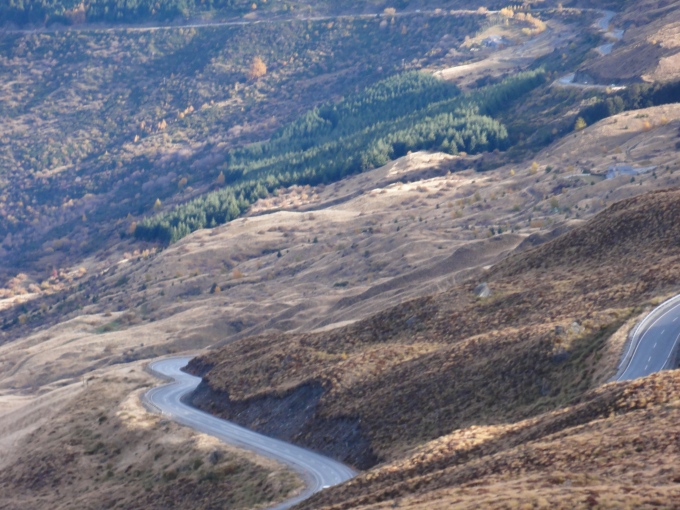
A picture paints … well, as many words as you like.  For instance:

lookingdownfromcoronetpeak

And the story:

It was once said that a desperate man has everything to lose.

The man I was chasing was desperate, but I, on the other hand, was more desperate to catch him.

He’d left a trail of dead people from one end of the island to the other.

The team had put in a lot of effort to locate him, and now his capture was imminent.  We were following the car he was in, from a discrete distance, and, at the appropriate time, we would catch up, pull him over, and make the arrest.

There was nowhere for him to go.

The road led to a dead-end, and the only way off the mountain was back down the road were now on.  Which was why I was somewhat surprised when we discovered where he was.

Where was he going?

“Damn,” I heard Alan mutter.  He was driving, being careful not to get too close, but not far enough away to lose sight of him.

“What?”

“I think he’s made us.”

“How?”

“Dumb bad luck, I’m guessing.  Or he expected we’d follow him up the mountain.  He’s just sped up.”

“How far away?”

“A half-mile.  We should see him higher up when we turn the next corner.”

It took an eternity to get there, and when we did, Alan was right, only he was further on than we thought.”

“Step on it.  Let’s catch him up before he gets to the top.”

Easy to say, not so easy to do.  The road was treacherous, and in places just gravel, and there were no guard rails to stop a three thousand footfall down the mountainside.

Good thing then I had the foresight to have three agents on the hill for just such a scenario.

Ten minutes later, we were in sight of the car, still moving quickly, but we were going slightly faster.  We’d catch up just short of the summit car park.

Or so we thought.

Coming quickly around another corner we almost slammed into the car we’d been chasing.

“What the hell…” Aland muttered.

I was out of the car, and over to see if he was in it, but I knew that it was only a slender possibility.  The car was empty, and no indication where he went.

Certainly not up the road.  It was relatively straightforward for the next mile, at which we would have reached the summit.  Up the mountainside from here, or down.

I looked up.  Nothing.

Alan yelled out, “He’s not going down, not that I can see, but if he did, there’s hardly a foothold and that’s a long fall.”

Then where did he go?

Then a man looking very much like our quarry came out from behind a rock embedded just a short distance up the hill.

“Sorry,” he said quite calmly.  “Had to go if you know what I mean.”

I’d lost him.

It was as simple as that.

I had been led a merry chase up the hill, and all the time he was getting away in a different direction.

I’d fallen for the oldest trick in the book, letting my desperation blind me to the disguise that anyone else would see through in an instant.

It was a lonely sight, looking down that road, knowing that I had to go all that way down again, only this time, without having to throw caution to the wind.

“Maybe next time,” Alan said.

“We’ll get him.  It’s just a matter of time.”

© Charles Heath 2019-2021

Find this and other stories in “Inspiration, maybe”  available soon.

InspirationMaybe1v1

An excerpt from “Strangers We’ve Become” – Coming Soon

I wandered back to my villa.

It was in darkness.  I was sure I had left several lights on, especially over the door so I could see to unlock it.

I looked up and saw the globe was broken.

Instant alert.

I went to the first hiding spot for the gun, and it wasn’t there.  I went to the backup and it wasn’t there either.  Someone had found my carefully hidden stash of weapons and removed them.

Who?

There were four hiding spots and all were empty.  Someone had removed the weapons.  That could only mean one possibility.

I had a visitor, not necessarily here for a social call.

But, of course, being the well-trained agent I’d once been and not one to be caught unawares, I crossed over to my neighbor and relieved him of a weapon that, if found, would require a lot of explaining.

Suitably armed, it was time to return the surprise.

There were three entrances to the villa, the front door, the back door, and a rather strange escape hatch.  One of the more interesting attractions of the villa I’d rented was its heritage.  It was built in the late 1700s, by a man who was, by all accounts, a thief.  It had a hidden underground room which had been in the past a vault but was now a wine cellar, and it had an escape hatch by which the man could come and go undetected, particularly if there was a mob outside the door baying for his blood.

It now gave me the means to enter the villa without my visitors being alerted, unless, of course, they were near the vicinity of the doorway inside the villa, but that possibility was unlikely.  It was not where anyone could anticipate or expect a doorway to be.

The secret entrance was at the rear of the villa behind a large copse, two camouflaged wooden doors built into the ground.  I move aside some of the branches that covered them and lifted one side.  After I’d discovered the doors and rusty hinges, I’d oiled and cleaned them, and cleared the passageway of cobwebs and fallen rocks.  It had a mildew smell, but nothing would get rid of that.  I’d left torches at either end so I could see.

I closed the door after me, and went quietly down the steps, enveloped in darkness till I switched on the torch.  I traversed the short passage which turned ninety degrees about halfway to the door at the other end.  I carried the key to this door on the keyring, found it and opened the door.  It too had been oiled and swung open soundlessly.

I stepped in the darkness and closed the door.

I was on the lower level under the kitchen, now the wine cellar, the ‘door’ doubling as a set of shelves which had very little on them, less to fall and alert anyone in the villa.

Silence, an eerie silence.

I took the steps up to the kitchen, stopping when my head was level with the floor, checking to see if anyone was waiting.  There wasn’t.  It seemed to me to be an unlikely spot for an ambush.

I’d already considered the possibility of someone coming after me, especially because it had been Bespalov I’d killed, and I was sure he had friends, all equally as mad as he was.  Equally, I’d also considered it nigh on impossible for anyone to find out it was me who killed him because the only people who knew that were Prendergast, Alisha, a few others in the Department, and Susan.

That raised the question of who told them where I was.

If I was the man I used to be, my first suspect would be Susan.  The departure this morning, and now this was too coincidental.  But I was not that man.

Or was I?

I reached the start of the passageway that led from the kitchen to the front door and peered into the semi-darkness.  My eyes had got used to the dark, and it was no longer an inky void.  Fragments of light leaked in around the door from outside and through the edge of the window curtains where they didn’t fit properly.  A bone of contention upstairs in the morning, when first light shone and invariably woke me up hours before I wanted to.

Still nothing.

I took a moment to consider how I would approach the visitor’s job.  I would get a plan of the villa in my head, all entrances, where a target could be led to or attacked where there would be no escape.

Coming in the front door.  If I was not expecting anything, I’d just open the door and walk-in.  One shot would be all that was required.

Contract complete.

I sidled quietly up the passage staying close to the wall, edging closer to the front door.  There was an alcove where the shooter could be waiting.  It was an ideal spot to wait.

Crunch.

I stepped on some nutshells.

Not my nutshells.

I felt it before I heard it.  The bullet with my name on it.

And how the shooter missed, from point-blank range, and hit me in the arm, I had no idea.  I fired off two shots before a second shot from the shooter went wide and hit the door with a loud thwack.

I saw a red dot wavering as it honed in on me and I fell to the floor, stretching out, looking up where the origin of the light was coming and pulled the trigger three times, evenly spaced, and a second later I heard the sound of a body falling down the stairs and stopping at the bottom, not very far from me.

Two assassins.

I’d not expected that.

The assassin by the door was dead, a lucky shot on my part.  The second was still breathing.

I checked the body for any weapons and found a second gun and two knives.  Armed to the teeth!

I pulled off the balaclava; a man, early thirties, definitely Italian.  I was expecting a Russian.

I slapped his face, waking him up.  Blood was leaking from several slashes on his face when his head had hit the stairs on the way down.  The awkward angle of his arms and legs told me there were broken bones, probably a lot worse internally.  He was not long for this earth.

“Who employed you?”

He looked at me with dead eyes, a pursed mouth, perhaps a smile.  “Not today my friend.  You have made a very bad enemy.”  He coughed and blood poured out of his mouth.  “There will be more …”

Friends of Bespalov, no doubt.

I would have to leave.  Two unexplainable bodies, I’d have a hard time explaining my way out of this mess.  I dragged the two bodies into the lounge, clearing the passageway just in case someone had heard anything.

Just in case anyone was outside at the time, I sat in the dark, at the foot of the stairs, and tried to breathe normally.  I was trying not to connect dots that led back to Susan, but the coincidence was worrying me.

A half-hour passed and I hadn’t moved.  Deep in thought, I’d forgotten about being shot, unaware that blood was running down my arm and dripping onto the floor.

Until I heard a knock on my front door.

Two thoughts, it was either the police, alerted by the neighbors, or it was the second wave, though why would they be knocking on the door?

I stood, and immediately felt a stabbing pain in my arm.  I took out a handkerchief and turned it into a makeshift tourniquet, then wrapped a kitchen towel around the wound.

If it was the police, this was going to be a difficult situation.  Holding the gun behind my back, I opened the door a fraction and looked out.

No police, just Maria.  I hoped she was not part of the next ‘wave’.

“You left your phone behind on the table.  I thought you might be looking for it.”  She held it out in front of her.

When I didn’t open the door any further, she looked at me quizzically, and then asked, “Is anything wrong?”

I was going to thank her for returning the phone, but I heard her breathe in sharply, and add, breathlessly, “You’re bleeding.”

I looked at my arm and realized it was visible through the door, and not only that, the towel was soaked in blood.

“You need to go away now.”

Should I tell her the truth?  It was probably too late, and if she was any sort of law-abiding citizen she would go straight to the police.

She showed no signs of leaving, just an unnerving curiosity.  “What happened?”

I ran through several explanations, but none seemed plausible.  I went with the truth.  “My past caught up with me.”

“You need someone to fix that before you pass out from blood loss.  It doesn’t look good.”

“I can fix it.  You need to leave.  It is not safe to be here with me.”

The pain in my arm was not getting any better, and the blood was starting to run down my arm again as the tourniquet loosened.  She was right, I needed it fixed sooner rather than later.

I opened the door and let her in.  It was a mistake, a huge mistake, and I would have to deal with the consequences.  Once inside, she turned on the light and saw the pool of blood just inside the door and the trail leading to the lounge.  She followed the trail and turned into the lounge, turned on the light, and no doubt saw the two dead men.

I expected her to scream.  She didn’t.

She gave me a good hard look, perhaps trying to see if I was dangerous.  Killing people wasn’t something you looked the other way about.  She would have to go to the police.

“What happened here?”

“I came home from the cafe and two men were waiting for me.  I used to work for the Government, but no longer.  I suspect these men were here to repay a debt.  I was lucky.”

“Not so much, looking at your arm.”

She came closer and inspected it.

“Sit down.”

She found another towel and wrapped it around the wound, retightening the tourniquet to stem the bleeding.

“Do you have medical supplies?”

I nodded.  “Upstairs.”  I had a medical kit, and on the road, I usually made my own running repairs.  Another old habit I hadn’t quite shaken off yet.

She went upstairs, rummaged, and then came back.  I wondered briefly what she would think of the unmade bed though I was not sure why it might interest her.

She helped me remove my shirt, and then cleaned the wound.  Fortunately, she didn’t have to remove a bullet.  It was a clean wound but it would require stitches.

When she’d finished she said, “Your friend said one day this might happen.”

No prizes for guessing who that friend was, and it didn’t please me that she had involved Maria.

“Alisha?”

“She didn’t tell me her name, but I think she cares a lot about you.  She said trouble has a way of finding you, gave me a phone and said to call her if something like this happened.”

“That was wrong of her to do that.”

“Perhaps, perhaps not.  Will you call her?”

“Yes.  I can’t stay here now.  You should go now.  Hopefully, by the time I leave in the morning, no one will ever know what happened here, especially you.”

She smiled.  “As you say, I was never here.”

…

© Charles Heath 2018-2022

strangerscover9

“Sunday in New York”, a romantic adventure that’s not a walk in the park!

“Sunday in New York” is ultimately a story about trust, and what happens when a marriage is stretched to its limits.

When Harry Steele attends a lunch with his manager, Barclay, to discuss a promotion that any junior executive would accept in a heartbeat, it is the fact his wife, Alison, who previously professed her reservations about Barclay, also agreed to attend, that casts a small element of doubt in his mind.

From that moment, his life, in the company, in deciding what to do, his marriage, his very life, spirals out of control.

There is no one big factor that can prove Harry’s worst fears, that his marriage is over, just a number of small, interconnecting events, when piled on top of each other, points to a cataclysmic end to everything he had believed in.

Trust is lost firstly in his best friend and mentor, Andy, who only hints of impending disaster, Sasha, a woman whom he saved, and who appears to have motives of her own, and then in his wife, Alison, as he discovered piece by piece damning evidence she is about to leave him for another man.

Can we trust what we see with our eyes or trust what we hear?

Haven’t we all jumped to conclusions at least once in our lives?

Can Alison, a woman whose self-belief and confidence is about to be put to the ultimate test, find a way of proving their relationship is as strong as it has ever been?

As they say in the classics, read on!

Purchase:

http://tinyurl.com/Amazon-SundayInNewYork

The cinema of my dreams – I always wanted to write a war story – Episode 50

For a story that was conceived during those long boring hours flying in a steel cocoon, striving to keep away the thoughts that the plane and everyone in it could just simply disappear as planes have in the past, it has come a long way.

Whilst I have always had a fascination in what happened during the second worlds war, not the battles or fighting, but in the more obscure events that took place, I decided to pen my own little sidebar to what was a long and bitter war.

And, so, it continues…

…

Meyer was cramping, having been confined to a relatively small space in the box car for far too long.

He had considered when the train was moving to come out to stretch, but then the train had stopped several times for lengthy periods when soldiers had searched all of the cars.

There had been one time when he had almost been discovered, a soldier getting a little too close for comfort, and had been called away a few moments before he lifted the palings that covered his hiding spot.

Then, at another siding, the soldiers brought dogs, and one had stopped near the carriage sniffing and making moaning sounds before then doing what dogs do against the wheels.

Expletives and laughter from the soldiers, relief from Meyer.  He knew if he was caught, the chances were he’d be shot.

Now, it was night, very, very late and the train had arrived at Florence and some time was spent unconnected the wagons then reconnecting to a shunting engine and pushed into a siding one across from the last.  From the crack in the back wall, he could see the station platforms in the distance, where only a few lights were on.

Next to where the boxcar sat was a wall, or houses or warehouses he didn’t know, but safety was just 30 meters away.  All he had to do was get from the car, and through or over that wall.

He waited, and during the next hour there was a train arrival, where the lights were turned on just before, during and after it left, back the way it had come, most of the time taken putting the locomotive on the other end.

It was going to be a problem if he chose to leave, and a train was arriving.  All the advance notice was the whistle.

The other problem was the sporadic nature of the patrols, two German soldiers wandering up and down the tracks, aiming their torches at walls and windows, loading telling each other war stories and crude stories.  They were bored, which would work in his favour.

There was, he noted, about an hour between each one.

Figuring it was about three in the morning after the second patrol had returned to the station, he came out of his hiding spot.  He tried not to make any noise which meant the harder he tried, the more it happened.

Once out he peered through the rear guard’s window at the station and it was deserted.  There were no lights up the lines where the wagons were parked.  There was no sign of the shunting locomotive.

He went over to the door and pulled.  It was stiff and at first, didn’t move.  A harder tug loosened the track and the door slid sideways about 30 centimetres.  He put his head out to check.  The moon was out, and it was quite light, light enough to see up and down the track.

There were about 20 wagons on the siding.  The wall ran for most of that distance, with what appeared to be an opening opposite the tenth or eleventh wagon.  That’s where he would go.

He pushed the door open wide enough to squeeze through and climbed down onto the tracks.  Once down he closed the door.  If anyone had checked, it had been closed before.  Keeping close to the side of the wagons, he headed away from the station.

About three wagons along, a light came on almost opposite him, illuminating the tracks,, the wagons and him.  Several seconds later, a whistle sounded, not a train whistle but one like a guard.

Then a man yelled out “Halt!”

He looked back towards the station and could see two soldiers running awkwardly in the middle of the tracks towards him.

Meyer started running for the gap in the wall, keeping as close to the wagons as he could.

When he looked back over his shoulder, he could see they were gaining on him.  He was still stiff and sore from being in that confined space for so long.

Another light came on further along.

He stopped and looked around.  The soldiers were raising their guns.

He saw only one way out, and climbed under the train and over to the other side of the train, away from his objective.

He ran harder and was nearly at the end of the wagons when a man stepped out in front of him.  He was not in a uniform.

Meyer almost stumbled and fell trying to stop crashing into him.

“Meyer?”

The man knew his name.  He looked Italian, was he from the resistance?

“Who are you?” he asked in halting Italian.

“What is the doe word?”

Code word?  What code word?  The piece of paper in his pocket, given to him by the British officer.  He pulled it out.  “Winston.”

“Right, you’re the one I’m here for.  Follow me if you want to live.”

The man then ran across the tracks to the opposite side, and Meyer followed as quickly as he could.  Then just short of the stone wall, there was an opening in the ground where another man was half in, half out.

“This way,” he said, then disappeared down the hole.

The soldiers had been held up crossing under the train to follow and were now so far behind they were out of sight. 

Meyer saw the hold, with a ladder and climbed down.  The man who had led him there followed and put the lid back over the top.

“Where are we?” Meyer asked.

“The sewers.  A little smelly, but you’re safe.  For the moment.”

…

© Charles Heath 2021-2023

The cinema of my dreams – Was it just another surveillance job – Episode 30

I’m back home and this story has been sitting on a back burner for a few months, waiting for some more to be written.

The trouble is, there are also other stories to write, and I’m not very good at prioritizing.

But, here we are, a few minutes opened up and it didn’t take long to get back into the groove.

Chasing leads, maybe


Collecting the car was easy because it was not kept near my flat.  I could not afford to park nearby, and couldn’t get a permit to park on the street.  I had cursed my bad luck at the time, but now it was very useful.

I spend a few hours resting in the car, stopping along the way at a park, and then, well past nightfall, I drove to the block in Oakwood Avenue, easily recognizable from the exterior photo also provided by the realtor.

Twice around the block, I stopped around the corner, past the block, and noted that I could walk back and then take cover from the trees and shrubs growing in front of, and around the building.  To reach the right flat, I would have to pass down the inner side towards the rear where, hopefully, there might be a door.

Otherwise, it would have to be the hard way.

At 00:45, I left the car, and walked back to the block, keeping an eye out form people walking, or looking out their windows on either side of the street.  Then, satisfied I hadn’t been seen, I ducked through the trees and quickly walked the distance from the front to the side where I stopped and waited.  After a few minutes, and nothing had stirred, I started down the side of the building.

Several flats had lights on, but the curtains were drawn.  Being the ground floor, I doubted whether those curtains would be open at night.  It didn’t take long to be alongside the flat in question.

It was in total darkness, and the curtains had been drawn.

First problem.  There was no back door.  The traditional entry point would be the front door, and no doubt there was a communal back door as well.  Next, I checked the windows, and those that I could see were complete glass and non-opening.  Worse still they had a metal grilled across them to deter thieves.

Near the corner, leading to the rear of the building was a window, higher up and ajar.  By its location, I guessed this was the bathroom or the toilet.  I was hoping for the former.

It took a few minutes to unlatch the window and several more to scramble up the wall, and it through the window opening, which wasn’t much wider than me.  I had to be careful not to drop any of the bottles on the inner ledge.

Once down of the other side, inside the room, it was a narrow bathroom, without a bath, and almost impossible to see.  I fixed the window and put everything back on the ledge, just in case someone did a circuit of the building at a security measure.

Once inside, and after one in the morning, little stirred.

I could just faintly hear the flat owners above, hardly enough noise to be concerned about, and bringing a thought; shouldn’t they be asleep like everyone else.

It was certainly a quiet neighborhood.

I brought a small torch from the car with me and sparingly used it to find my way around.  When my eyes got used to the semi-darkness, I found that the flow from small lights of appliances adequately lit the rooms.

It had two bedrooms, one empty and being used as a storeroom, a lounge room, a dining area, and the bathroom, and kitchen area.  It was big enough for a couple, or even a couple with one child.

Inside what I assumed was the front door, I found several letters shoved under the door.  They were addressed to Mr. Adam Quinley.

I hoped that I’d not made a mistake and broken into a flat belonging to another person.  O’Connell didn’t see to me to be a Quinley, because it was an unusual name.

The dates on the letters went back a week and told me whoever the flat belonged to, they hadn’t visited it for a while.  I went back to the lounge room and over to a desk.  There were the familiar cords leading to no computer, but there was a printer.  It meant he had a laptop he carried with him.

A laptop that no one had found.  It suggested to me that he had it somewhere near him, perhaps in a car, which may be still parked in a garage, or parking station somewhere.

I searched through the neat pile of documents on the desk, and in a folder marked ‘Accounts’ and found one for the car registration, in the name of Quigley.  I noted the registration and type of car, and just in case I forgot it, folded the piece of paper and put it in my pocket.  It would be the subject of my next search if nothing showed up.

The next half hour I made a thorough search of the flat and found nothing of use.  I checked for all the spots he might have hidden the USB, but it was not there.  He had kept it somewhere else.

Done, I left the flat by the front door, and for good measure, checked his mailbox, outside, and found a number of letters.  I took them and would look at them back in the car.  Just as I made the tree line to walk back, a car stopped outside the building.

The door opened and I watched the driver get out of the car, stop and look up and down the street, then walk towards the front door,

By chance, the occupant of the flat above the door switched on a light in the room which, uncurtained, spilled out to shed light on the person now at the front entrance.

I recognized her immediately, just before the light was switched off and darkness took over.

It was Jan.


© Charles Heath 2020

The story behind the story: A Case of Working With the Jones Brothers

To write a private detective serial has always been one of the items at the top of my to-do list, though trying to write novels and a serial, as well as a blog, and maintain a social media presence, well, you get the idea.

But I made it happen, from a bunch of episodes I wrote a long, long time ago, used these to start it, and then continue on, then as now, never having much of an idea where it was going to end up, or how long it would take to tell the story.

That, I think is the joy of ad hoc writing, even you, as the author, have as much idea of where it’s going as the reader does.

It’s basically been in the mill since 1990, and although I finished it last year, it looks like the beginning to end will have taken exactly 30 years.  Had you asked me 30 years ago if I’d ever get it finished, the answer would be maybe?

My private detective, Harry Walthenson

I’d like to say he’s from that great literary mold of Sam Spade, or Mickey Spillane, or Phillip Marlow, but he’s not.

But, I’ve watched Humphrey Bogart play Sam Spade with much interest, and modelled Harry and his office on it.  Similarly, I’ve watched Robert Micham play Phillip Marlow with great panache, if not detachment, and added a bit of him to the mix.

Other characters come into play, and all of them, no matter what period they’re from, always seem larger than life.  I’m not above stealing a little of Mary Astor, Peter Lorre or Sidney Greenstreet, to breathe life into beguiling women and dangerous men alike.

Then there’s the title, like

The Case of the Unintentional Mummy – this has so many meanings in so many contexts, though I imagine that back in Hollywood in the ’30s and ’40s, this would be excellent fodder for Abbott and Costello

The Case of the Three-Legged Dog – Yes, I suspect there may be a few real-life dogs with three legs, but this plot would involve something more sinister.  And if made out of plaster, yes, they’re always something else inside.

But for mine, to begin with, it was “The Case of the …”, because I had no idea what the case was going to be about, well, I did, but not specifically.

Then I liked the idea of calling it “The Case of the Brother’s Revenge” because I began to have a notion there was a brother no one knew about, but that’s stuff for other stories, not mine, so then went the way of the others.

Now it’s called ‘A Case of Working With the Jones Brothers’, finished the first three drafts, and at the editor for the last.

I have high hopes of publishing it in early 2021.  It even has a cover.

PIWalthJones1

‘Sunday in New York’ – A beta reader’s view

I’m not a fan of romance novels but …

There was something about this one that resonated with me.

This is a novel about a world generally ruled by perception, and how people perceive what they see, what they are told, and what they want to believe.

I’ve been guilty of it myself as I’m sure we all have at one time or another.

For the main characters Harry and Alison there are other issues driving their relationship.

For Alison, it is a loss of self-worth through losing her job and from losing her mother and, in a sense, her sister.

For Harry, it is the fact he has a beautiful and desirable wife, and his belief she is the object of other men’s desires, and one in particular, his immediate superior.

Between observation, the less than honest motives of his friends, a lot of jumping to conclusions based on very little fact, and you have the basis of one very interesting story.

When it all comes to a head, Alison finds herself in a desperate situation, she realises only the truth will save their marriage.

But is it all the truth?

What would we do in similar circumstances?

Rarely does a book have me so enthralled that I could not put it down until I knew the result. They might be considered two people who should have known better, but as is often the case, they had to get past what they both thought was the truth.

And the moral of this story, if it could be said there is one, nothing is ever what it seems.

…

Available on Amazon here: amzn.to/2H7ALs8

…

Writing about writing a book – Day 14 starts

Colonel Davenport, the evil mastermind as I like to think of him, but in reality, he was a tortured soul on a number of fronts.

I’d like to say what happened to him was not his fault, but to a certain extent, people can go one way or the other, choose between right and wrong, choose the easy path or the hard path, and most of all, never take advantage of a situation for personal gain.

Most people.

But try having a reputation to live up to, and the expectations of everyone put on your shoulders, and you knew you would never be able to carry the load?

That was Archibald Davenport, first son of General Horace Davenport, the great, great, great, so many times grandson of the fearless and famous Walter Davenport, who was with General Grant, serving with honor and valor in the Civil War.

No such weight was ever passed on to his younger brother, Leslie, so, free to live his own life, and in doing so, far surpassing his older brother in respect and accomplishment.

Archibald Davenport managed to miss the Second World War, much to the disappointment of his father, kept to the fringes of the Korean War, but unluckily was in the wrong place at the wrong time when serving officers were sought to go over as advisors to the Vietnamese in the years before the conflict escalated.

Or, speaking plainly, his commander wanted to move the problem on by obtaining a promotion to Major and recommending him for service in Vietnam.  It was either that or dishonorable discharge and a few years in the stockade.

Knowing how it would affect his father, he took the commission.

But for an operator like Davenport, a man who could seek out and at the same time have trouble finding him, saw the conflict as a means to an end, and has latched onto an operative that he assumed was working covertly with the CIA, realized the potential for a man of his talents.

It didn’t take long before he was unofficially attached to the CIA, his army commander willingly signing the orders to ‘get rid of what will become a major (pardon the pun) problem’.  So began the empire, arms, drugs, information, whatever was needed by whoever had the wherewithal, he was the man to see.

How did Bill find himself under Davenport’s command?

You’ll have to wait and see.

A story inspired by Castello di Briolio – Episode 49

For a story that was conceived during those long boring hours flying in a steel cocoon, striving to keep away the thoughts that the plane and everyone in it could just simply disappear as planes have in the past, it has come a long way.

Whilst I have always had a fascination with what happened during the second world war, not the battles or fighting, but in the more obscure events that took place, I decided to pen my own little sidebar to what was a long and bitter war.

And, so, it continues…

——

SS Standartenfuhrer Wilhelm Schmidt and his men were looking forward to some rest and recreation, after they completed one small but vitally important job for the Reichsfuhrer: retrieve a traitor named Meyer and bring him back to Berlin so an example could be made of him to deter others.

A simple job, several days at best, very much a holiday in itself after several long years in various campaigns.

He always wanted to visit Italy and particularly Tuscany, and they would be staying in a castle, with, he had been told, a very refined wine cellar.

He had also been told there was a possibility that the column might be attacked on its way to the castle, and he had all of his men on high alert.  He was almost disappointed nothing happened.  He didn’t think it would.  Few resistance fighters would hardly go up against the might of a panzer, and his crack troops.

He’d said as much to the castle commander, a double agent by the name of Wallace, known as British to the British and German to the high command.  Schmidt had no interest in double agents, or agents of any kind, along with the intelligence services or the Gestapo for that matter.  He was here for the traitor and then gone.

They made it without incident, the main gates opened for their arrival, then closed after the panzer and trucks were parked inside.

Wallace was waiting for him.

Salutes, then, “No trouble along the way?”

“No.  Should there be?  I know we were warned, but all we saw were war-weary Italian women and children, and a few old men.”

“The resistance is out there, led by an Englishman by the name of Atherton.  I wouldn’t underestimate him and the few resistance left.”

Schmidt thought Wallace looked rattled, a man at the end of his tether.  He’d seen quite a few like him, too long at the front, jumping at shadows.

“It won’t be a problem.  I’ll send out a squad of 10 and they’ll mop up anyone left.  They’re probably hiding in the woods, or, if they saw the tank, shaking in their boots.  Chances are they will have left if they had any sense.”

Wallace hated arrogance, and Schmidt had it in spades.  There would be little point telling him that this wasn’t a battlefield, but guerilla warfare against an enemy on their home ground.  The fact Jackerby had not come back, or Fernando and his men told him Atherton was picking them off, one by one, if they left the castle.

If Schmidt wanted to go wandering around outside, that was his choice.  Wallace was staying inside and waiting until they mounted an attack.  Or for them to realise it was going to be a stalemate.  He was now no longer interested in Meyer, that was Schmidt’s problem.

Schmidt selected 9 soldiers and put his second in command in charge of them with very specific orders.  If anything, other than one of their men moved, shoot it.  He did not want prisoners.

The rest of the men were sent to the makeshift barracks, a building that was used as a chapel not far from where the tank and trucks were parked.  The rest of the castle’s men were also there, except for those on guard duty on the ramparts, and in the cellars where there were entrances from outside.

Not that anyone could get through the iron gates that were currently locked.  Atherton and whomever he had with him would not be gaining entrance to the castle from below, and those on the ramparts would pick them off long before they reached the main gate, or the walls.

At strategic points on the rampart, machine guns had been set up, and a box or two of hand grenades were available.  Wallace was fairly confident there was nowhere where Atherton could gain access, despite his clandestine exploration of the castle when he first arrived.

Wallace personally checked the sentry points and alertness of the guards.

Then he went down to the cellar and the gate where the soldiers involved in what was now called ‘operation mop-up’ were waiting for darkness to fall before leaving.

Wallace came down to see them leave, not surprised by the buoyed spirits and camaraderie of men who had been working together for a long time.  He envied them.  With the sort of work he and the few members of his team did, there was no time for any bonding, and each lived with the fact that they could not really trust anyone, even those they worked with.

Then, in a matter of minutes, in almost silence, they were gone, and the gate was locked.  With any luck, the area would be cleared of resistance and locked down in preparation for the arrival of Meyer.  His handler would be captured and would inform them of the pipeline further up the chain of command, and then he could put an end to the traitors escaping.

With any luck, he might still get back to Germany as a hero.

——-

© Charles Heath 2020-2023