‘Sunday in New York’ – A beta reader’s view

I’m not a fan of romance novels but …

There was something about this one that resonated with me.

This is a novel about a world generally ruled by perception, and how people perceive what they see, what they are told, and what they want to believe.

I’ve been guilty of it myself as I’m sure we all have at one time or another.

For the main characters Harry and Alison there are other issues driving their relationship.

For Alison, it is a loss of self-worth through losing her job and from losing her mother and, in a sense, her sister.

For Harry, it is the fact he has a beautiful and desirable wife, and his belief she is the object of other men’s desires, and one in particular, his immediate superior.

Between observation, the less than honest motives of his friends, a lot of jumping to conclusions based on very little fact, and you have the basis of one very interesting story.

When it all comes to a head, Alison finds herself in a desperate situation, she realises only the truth will save their marriage.

But is it all the truth?

What would we do in similar circumstances?

Rarely does a book have me so enthralled that I could not put it down until I knew the result. They might be considered two people who should have known better, but as is often the case, they had to get past what they both thought was the truth.

And the moral of this story, if it could be said there is one, nothing is ever what it seems.

…

Available on Amazon here: amzn.to/2H7ALs8

…

“Do you believe in g..g..ghosts…?”, a short story

Inside the old building, it was very quiet and almost cold.

Strange, perhaps, because outside the temperature was bordering on the record hottest day ever, nearly 45 degrees centigrade.

The people who’d built this building nearly a hundred years before must have known how to keep that heat at bay, using sandstone.

Back then, the sandstone would have looked very impressive, but now after many years of being closed off and left abandoned, the outside was stained by modern-day pollutants giving it a black streaky look, and inside layers of dust, easily stirred up as we walked slowly into the main foyer.

It was huge, the roof, ornate, with four huge chandelier lights hanging down, and wood paneling, giving way to a long counter with brass serving cages highlighting its former use; a bank.

In its day it would have conveyed the power and wealth so that its customers could trust the money to. Of course, that was before the global economy, online banking, and a raft of the new and different institutions all vying for that same money.

Then it was a simple choice of a few, now it was a few thousand.

“How many years had this been closed up?” I asked.

“Close to twenty, maybe twenty-five. It was supposed to be pulled down, but someone got it on the heritage list, and that put an end to it. “

Phil was the history nut. He’s spent a month looking into the building, finding construction plans, and correspondence dating back to before and during the construction.

Building methods, he said, that didn’t exist today and were far in advance of anything of its type for the period. It was the reason we were standing in the foyer now.

We were budding civil engineers, and the university had managed to organize a visit, at our own risk. The owner of the building had made sure we’d signed a health and safety waiver before granting access.

And the caretaker only took us as far as the front door. He gave us his cell number to call when we were finished. When we asked him why he didn’t want to come in with us, he didn’t say but it was clear to me he was afraid of something.

But neither of us believed in ghosts.

“You can see aspects of cathedrals in the design,” Phil said. ” You could quite easily turn this space into a church.”

“Or a very large wine cellar.” I brought a thermometer with me, and inside where we were standing it was the ideal temperature to store wine.

Behind the teller cages were four large iron doors to the vaults. They were huge, and once contained a large amount of cash, gold, and whatever else was deemed valuable.

They were all empty now, the shelves and floor had scattered pieces of bank stationery, and in a corner, several cardboard boxes, covered in even more dust.

Behind the vaults were offices, half-height with glass dividers, the desks and chairs still in place, and some with wooden filing cabinets drawers half-open.

Others had benches, and one, set in the corner, very large, and looked like the manager’s office. Unlike the other office which had linoleum tiles, this one had carpet. In a corner was a large mirror backed cabinet, with several half-empty bottles on it.

“Adds a whole new meaning to aged whiskey, don’t you think.” Phil looked at it but didn’t pick it up.

“I wonder why they left it,” I muttered. The place had the feel of having been left in a hurry, not taking everything with them.

I shivered, but it was not from the cold.

We went back to the foyer and the elevator lobby. They were fine examples of the sort of caged elevators that belonged in that time, and which there were very few working examples these days.

The elevators would have a driver, he would pull back an inner and outer door when the car arrived on a floor, and close both again when everyone was aboard.

Both cars were on the ground floor, with the shutter doors closed, and when I tried to open one, I found it had been welded shut. The other car was not sitting level with the floor and the reason for that, the cable that raised and lowered it was broken.

Restoring them would be a huge job and would not be in their original condition due to occupational health and safety issues.

The staircase wound around the elevator cage, going up to the mezzanine floor or down to the basement.

“Up or down?” He asked.

“Where do you want to go first?”

“Down. There’s supposed to be a large vault, probably where the safety deposit boxes are.”

And the restrooms I thought. Not that I was thinking of going.

As we descended the stairs it was like going down into a mine shaft, getting darker, and the rising odor of damp, and mustiness. I suspect it would have been the same back when it was first built being so close to the shoreline of the bay, not more than half a mile away.

The land this building and a number of others in a similar style, was built on was originally a swamp, and it was thought that the seawater still found its way this far inshore. But the foundations were incredibly strong and extensive which was why there’d been no shifting or cracking anywhere in the ten-story structure.

At the bottom, there was a huge arch, with built-in brass caging with two huge gates, both open. It was like the entrance to a mythical Aladdin’s cave.

There was also an indefinable aura coming from the depths of that room. That, and a movement of cold air. Curiously, the air down there was not musty but had a tinge of saltiness to it.

Was there a natural air freshener effect coming from somewhere within that vault.

“Are we going in?”

I checked my torch beam, still very bright. I pointed it into the blackness and after a minute checking, I said, “We’re here, so why not.”

We had to walk down a dozen steps then pass under through the open gates into the room. There was a second set of gates, the same as the first, about thirty feet from the first, and, in between, a number of cubicles where customers collected their boxes.

Beyond the second set of gates was a large circular reinforced safe door high enough for us to walk through.

This cavernous space stretched back quite a distance, and along the walls, rows, and rows of safety deposit boxes, some half hanging out of their housing, and a lot more stacked haphazardly on the floor.

I checked a few but they were all empty.

I shivered again. It felt like there was a presence in the room. I turned to ask Phil, but he wasn’t there. I hadn’t heard him walk away, and there were only two sets of footprints on the floor, his and mine, and both ended where I was standing.

It was as if he had disappeared into thin air.

I called out his name, and it echoed off the walls in the confined space. No answer from him.

I went further into the room, thinking he might have ventured towards the end while my back was turned, but he hadn’t. Nor had he left because there were only footprints coming in, not going out.

I turned to retrace my steps and stopped suddenly. An old man, in clothes that didn’t belong to this era, was standing where Phil had last been.

He was looking at me, but not inclined to talk.

“Hello. I didn’t see you come down.”

Seconds later the figure dissolved in front of me and there was no one but me standing in the room.

“Joe.”

Phil, from behind me. I turned and there he was large as life.

“Where were you?”

“I’ve been here all the time. Who were you just talking to?”

“There was an old man, standing just over there,” I said pointing to somewhere between Phil and the entrance.

“I didn’t see anyone. Are you sure you’re not having me on?”

“No. He’s right behind you.” The old man had reappeared.

Phil shook his head, believing I was trying to fool him.

That changed when the man touched his shoulder, and Phil shrieked.

And almost ran out of the room. It took a few minutes for him to catch his breath and steady the palpitating heart.

“Are you real?” I asked, not quite sure what to say.

“To me, I am. To anyone else, let’s just say you are the first not got faint, or run away.”

“Are you a ghost?” Phil wasn’t exactly sure what he was saying.

“Apparently I am and will be until you find out who killed me “

Ok, so what was it called, stuck in the afterlife or limbo until closure?

“When?”

“25 years ago, just before the bank closed. It’s the reason why it’s empty now.”

“And you’re saying we find the killer and you get to leave?”

“Exactly. Now shoo. Go and find him.”

We looked at each other in surprise, or more like shock, then back to the man. Only he was no longer there.

“What the…” Phil sail. “It’s time to go.”

“What about the man and finding his killer?”

“What man? We saw nothing. We’re done here.”

I shrugged. Phil turned to leave, but only managed to take three steps before the gates at the entrance closed with a loud clang.

When he crossed the room to stand in front, he tried pulling them open.

“Locked,” he said. Flat, and without panic, he added, “I guess it looks like we have a murder to solve.”

© Charles Heath 2019-202

The cinema of my dreams – I always wanted to see the planets – Episode 21

There’s no swashbuckling for the captain

…

I turned, and saw what appeared to be a relatively unkempt man standing behind me.

Jerome Kennedy. Astro physicist.  A man who was mocked rather than revered for his theories on space, and in particular, space travel.

And those theories were, to put it mildly, interesting.

It was probably why the Admiral conscripted him for this voyage into the unknown.

“I though that was only in the imagination of television script writers.”

“Possibly, but we just witnessed something that none of us can rationally explain.  One minute they were there, the next, poof.”

“That’s why you are along for the ride, to find explanations for the unexplainable.  I look forward to your report.”  Then, turning back to the navigator, “are we still in touch with the original alien vessel?”

“Just, and still heading towards Uranus.”

“Then let’s get after it, maximum speed when possible.”

I left the newly promoted number one in charge and went into the captains day room.  I was still getting used to the idea of actually bring captain, because the aura of previous inhabitant of this room was still there.  And it felt like he was in the room watching everything I did.

I shook my head, as if that would cast off the jitters I felt, and sat down behind the imposing desk, one thathad been made over a hundred years before, and from a vessel with the same name. 

I still didn’t have a lot to put in any report to the Admiral, but had a lot to think about.

I brought up the navigation screen and looked at the suggested path from where we were to Uranus, and the time it would take.

There was a buzzing sound, and a face appeared on my screen.  It was the Captain’s personal assistant for want of a better name, Louise Chalmers, an ex Lieutenant Colonel from the military, but not by much.  She had retired into this position, and, I suspect, another was for the military to keep up to date on the Captain’s decisions.

“Come in.”

The door opened, she came in, and it closed behind her.  There was no open door policy on this ship.

“Sir.”

“What can I do for you?”

“I’m not sure if you are aware, but I am here to serve whomever the current Captain is, and since Captain V is not here, that would be you in his stead.”

I had read that she was his choice for P A, and that it was a personal matter, as usually Captains didn’t have such staff members.

“I thought you were on board to serve only the previous captain “

“Not so.  If you read standing order 207615, you will realise my position was ratified as general crew member, serving the ship rather than an individual.  My job is to make your job easier.”

While she was speaking, I fetched the standing orders, and the one she referred, and a quick scan proved such to be the case.

“In what way?”

“Paperwork, the vane of any officers existence I’m told, and to organise all activities of a non urgent nature, like bring the daily reports to you.”

I knew that captain had to be appraised of everything that happened on board, just not every day.

“I take it you have the reports?”

“I have, and unfortunately, as per regulations, I have to make sure you have received them.  Your predecessor wanted me to summarise.  I can do the same for you.”

There would be no escaping it.  “Please.”

…

© Charles Heath 2021

My disdain for some reporters, and reporting these days

It is sometimes quite trashy and that’s saying something!

Having been a journalist in a previous lifetime, and one that always believed that the truth mattered, it didn’t take long to realize that journalists should never let the truth get in the way of a good story.

Newspapers, and all other forms of media, will only write what they believe will sell, or what they think the public wants to read. The truth, sadly, is not the first thing on the reader’s mind, only that someone is to blame for something they have no control over, and it doesn’t matter who.

And the more outlandish the situation, the more the public will buy into it.

This, I guess, is why we like reading about celebrities and royalty, not for the good they might do, but the fact they stumble and make mistakes, and that somehow makes us feel better about ourselves.

Similarly, if the media can beat up a subject, like the coronavirus, and make it worse than it is, then people will lap up the continuing saga, as it relates to them, and will take one of two stances, that they believe the horror of it, and do as they’re asked, or disbelieve it because nothing can be that bad, and ignore it and the consequences of disobedience. knowing the government will not press too hard against the non-compliers simply because of democracy issues it will stir up.

That is, then the media will get a hold of this angle and push it, and people will start to think disobedience is a good thing, not a bad one.

So, our problem of trying to get a fair and balanced look at what the coronavirus is all about is nigh on impossible. We are continuously bombarded with both right and wrong information, and the trouble is, both sides are very plausibly supported by facts.

And that’s the next problem we have in reporting. We can get facts to prove anything we want. It’s called the use and abuse of statistics and was an interesting part of the journalism degree I studied for. We were told all about statistics, good and bad, and using them to prove the veracity of our piece.

I remember writing a piece for the tutor extolling the virtues of a particular person who was probably the worst human since Vlad the Impaler, using only the facts that suited my narrative. I also remember the bollocking he gave me for doing so but had to acknowledge that sometimes that would happen.

The integrity of reporting only went as far as the editor, and if the editor hated something, you had to hate it too. This is infamously covered in various texts where newspaper publishers pick sides and can influence elections, and governments. It still happens.

So, the bottom line is, when I’m reading an article in the media, I always take it with a grain of salt, and do my own fact-checking, remembering, of course, not just to fact check to prove the bias one way of the other, but then get a sense of balance.

We have state elections coming up where I live, but it does not sink to the personal sniping level as it does in the US, we haven’t sunk that low yet, but we haven’t got past the sniping about all the wrongs and failed promises of the government of the day, or the endless tirade against the opposition and how bad a job they did when they were previously in government.

You can see, no one is talking about what they’re going to do for us, no one is telling us what their policies are. It’s simply schoolyard tit for tat garbage speak. What happened to the town hall meeting, a long and winding speech encompassing the policies, what the government plans to do for its people in the next three years, and then genuinely answering questions?

Perhaps we should ban campaigning, and just get each party to write a book about what they intend to do, and keep them away from the papers, the TV, and any other form of media, in other words, don’t let them speak!

And don’t get me started about the drivel they speak in the parliament. Five-year-olds could do a better job.

OK, rant over.

The cinema of my dreams – Was it just another surveillance job – Episode 55

This story is now on the list to be finished so over the new few weeks, expect a new episode every few days.

The reason why new episodes have been sporadic, there are also other stories to write, and I’m not very good at prioritizing.

But, here we are, a few minutes opened up and it didn’t take long to get back into the groove.

Things are about to get complicated…


We took the underground to Lancaster Gate and parted company before crossing the road and going into Hyde Park.  Severin had designated the meeting place as the rotunda, as he called it, in the Italian Gardens.

It was dark, although there was adequate lighting, which made it a good cover for anyone else skulking nearby.  And making it easier for Jennifer, who sensibly dressed in black, to scout.

It took my time heading slowly towards the stone building.  I was deliberately early so he might not be there yet.  In the intervening time I could hear the odd comment from Jennifer, as she looked over the various suspects who were also taking in the aesthetic beauty of the gardens, which would look so much better in daylight.

Oddly enough in all the times I’d been to Hyde Park, these gardens had never been a point of visiting, such was the allure of the pedal boats on the Serpentine.

I did a slow circuit of the building and saw three people seated inside.  Two women, together, and a man on one side.  It could be him.

“I think he’s already here, just going to check.”

“Nothing stirring out here, so far.”

“Keep alert.”

It was odd hearing a voice almost in my head as if she was next to me.

I came up to the seat in full view of the person sitting on one end of the bench, so as not to alarm them.  I could feel their eyes on me as I sat down.  If it was him, he would talk to me.  I was not going to talk to him.

Something else I noted, there was no direct line of fire from anywhere hidden, so if there was an assassin out there, he would have to do it in the open.  Severin had scouted the place earlier.

“You alone?”  The man spoke after about three, or four minutes.  I’d seen him look around, checking for himself I was not followed.

“As far as I’m aware.”

I moved a little closer.  He was talking very softly.

“What happened to Maury?”

“Tortured and murdered by Dobbin I believe.  If he knew where the device was, he didn’t give up its location.”

“He wouldn’t.   Dobbin you say?”

“As far as I can tell.  He was running O’Connell, but you knew that already.”  To save time dancing around the truth, and lessen the time being a target I added, “Everyone believes O’Connell is still alive.  He didn’t have the device when I searched him.  Who shot him?”

“Not us.  If he is alive Dobbin must have usurped our cleaners, and spirited him away, which means it’s likely Dobbin has the device.”

“He doesn’t.  He co-opted me into his section.  O’Connell appears to have done a runner from him too.  Did you know O’Connell was on mission to pick up the device from an intermediary?”

“Yes.”

“Did you know that Anna Jacovich was there too?”

“Then you know what’s on the device?”

“I wish I didn’t.  Or that you two were security guards at the Laboratory where Erich stole the data.  What took so long for him to decide to sell it?

“When he was fired by the company after they lost the military contract.   He had no intention of selling it, just getting it into the hands of the public so they would be forced to stop.”

“Except he was killed, and Anna decided she needed an escape plan.”

“Which O’Connell provided by wire transfer.  The money’s gone, and the data didn’t arrive.  It’s still out there.”

“Who was you boss in all this?  Monica?”

“Who.  No.  It’s….”

I heard the phutt sound of a bullet passing through a silencer, and just caught the edge of the barrel retracting from behind one of the pillars.  No need to check him, he was dead, still sitting upright as if nothing had happened.

I got out of the seat and moved towards where the gun had been, trying not to alert the other two sitting on the other side, facing the other way, fortunately.

When I reached the outside, there was no one.  A quick scan in the darkness, my eyesight hampered by going from light to dark making images blurry at best.

Then I heard a thunk, and a triumphant “Gotcha.”

I hoped that was Jennifer with the shooter.

…

© Charles Heath 2020-2023

‘What Sets Us Apart’ – A beta readers view

There’s something to be said for a story that starts like a James Bond movie, throwing you straight in the deep end, a perfect way of getting to know the main character, David, or is that Alistair?

A retired spy, well not so much a spy as a retired errand boy, David’s rather wry description of his talents, and a woman that most men would give their left arm for, not exactly the ideal couple, but there is a spark in a meeting that may or may not have been a setup.

But as the story progressed, the question I kept asking myself was why he’d bother.

And, page after unrelenting page, you find out.

Susan is exactly the sort of woman to pique his interest.  Then, inexplicably, she disappears.  That might have been the end to it, but Prendergast, that shadowy enigma, David’s ex-boss who loves playing games with real people, gives him an ultimatum, find her or come back to work.

Nothing like an offer that’s a double-edged sword!

A dragon for a mother, a sister he didn’t know about, Susan’s BFF who is not what she seems or a friend indeed, and Susan’s father who, up till David meets her, couldn’t be less interested, his nemesis proves to be the impossible dream, and he’s always just that one step behind.

When the rollercoaster finally came to a halt, and I could start breathing again, it was an ending that was completely unexpected.

I’ve been told there’s a sequel in the works.

Bring it on!

…

The book can be purchased here:  http://amzn.to/2Eryfth

…

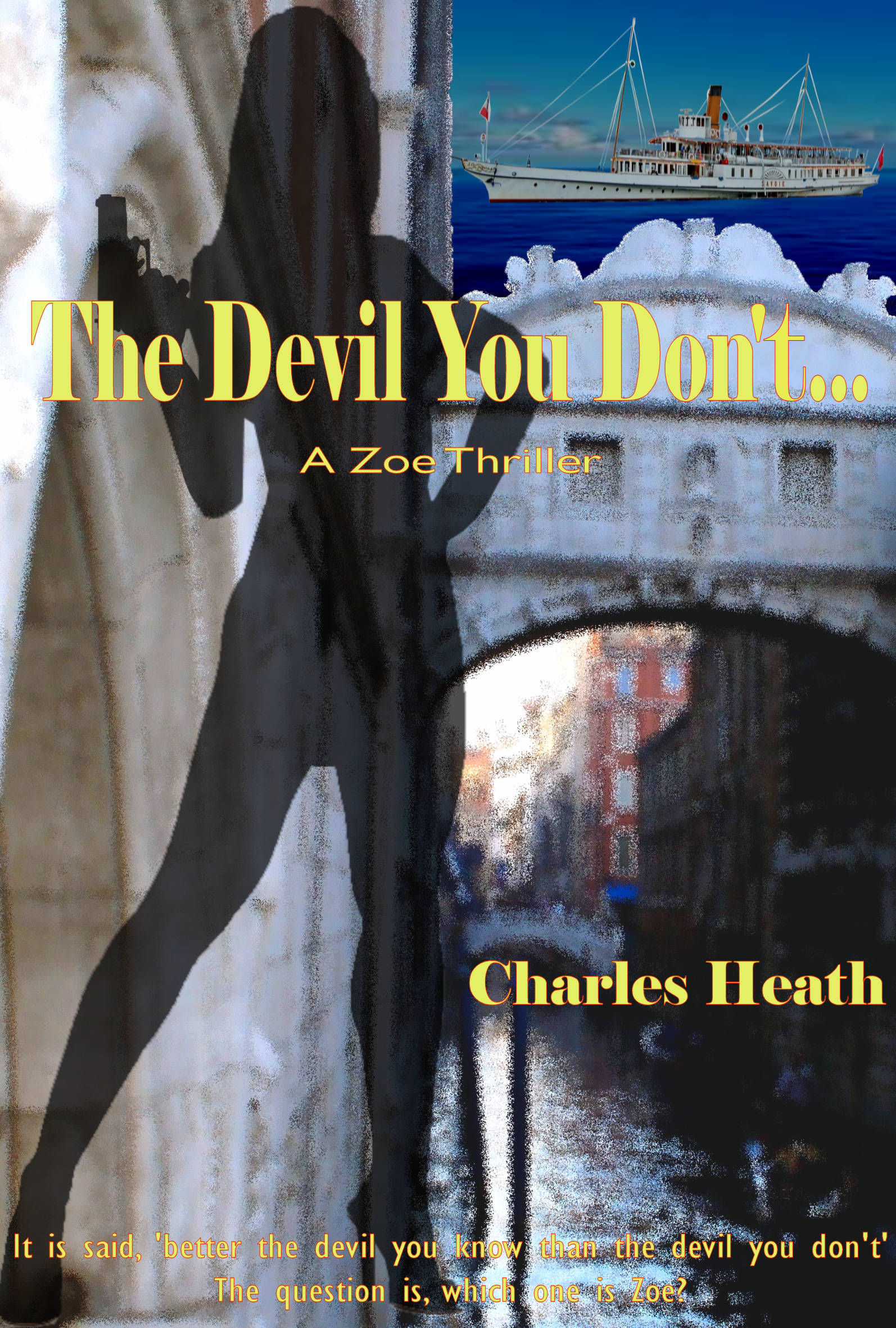
‘The Devil You Don’t’ – A beta reader’s view

It could be said that of all the women one could meet, whether contrived or by sheer luck, what are the odds it would turn out to be the woman who was being paid a very large sum to kill you.

John Pennington is a man who may be lucky in business, but not so lucky in love. He has just broken up with Phillipa Sternhaven, the woman he thought was the one, but relatives and circumstances, and perhaps because she was a ‘princess’, may also have contributed to the end result.

So, what do you do when you are heartbroken?

That is a story that slowly unfolds, from the first meeting with his nemesis on Lake Geneva, all the way to a hotel room in Sorrento, where he learns the shattering truth.

What should have been solace after disappointment, turns out to be something else entirely, and from that point, everything goes to hell in a handbasket.

He suddenly realizes his so-called friend Sebastian has not exactly told him the truth about a small job he asked him to do, the woman he is falling in love with is not quite who she says she is, and he is caught in the middle of a war between two men who consider people becoming collateral damage as part of their business.

The story paints the characters cleverly displaying all their flaws and weaknesses. The locations add to the story at times taking me back down memory lane, especially to Venice where, in those back streets I confess it’s not all that hard to get lost.

All in all a thoroughly entertaining story with, for once, a satisfying end.

…

Available on Amazon here: https://amzn.to/2Xyh1ow

…

Writing a book about a book – Day 35

Time now to bring in the police and this is in the form of Chief Inspector Gator, an odd sort of man who fits the mold of those ubiquitous policemen who don’t look like policemen but have a very sharp mind.

I guess watching too many Columbo episodes has had an effect on me.

…

The police officer who came to interview Aitchison arrived as I was leaving.   He nodded at me and announced himself as Chief Inspector Gator as I closed the door behind him.  My only thought of him was that he didn’t look like a policeman, and didn’t give him another thought.

Merrilyn’s expression had transformed into one of dismay, like the moment the sun went behind a cloud, and no doubt the result of learning Richardson’s fate.

“Shocking news isn’t it?” she said.

“Not good for the company.  Who found him?”

“One of the building security guards doing his rounds.  He literally fell over him, or so I heard.  There was a blackout or power failure and the lights failed to go back on.  We have been advised it was something to do with a circuit breaker.”

“So there was power everywhere, except that floor?”

“I don’t know.  But news has also just come through advising there was a burglary attempt in the basement computer storeroom.  No one can tell if any equipment has been stolen yet.  I’m sure you will be informed about it soon.”

“Another excuse for Benton to pester me,” I sighed.  “Security must have had a rough night last night.”

“That, and pleading that they are understaffed.  Mr. Aitchison thinks they are trying to use that as an excuse to draw attention away from their lack of responsibility.”  She looked at me with a serious expression, and lowered her voice, “I have to organize an emergency board meeting, and to be honest, I don’t know where to start.  On top of everything, Mr. Halligan is also dead, in tragic circumstances.  I could not imagine dying at home, alone.”

“It’s a terrible business.  By the way, I didn’t get that promotion.  You were right.  There’s a very long list ahead of me.  Until I am summoned again, try not to let it upset you.”

She tried to smile, but her heart was not in it.

When I stepped into the elevator and reached for the 18th-floor button, I realized I had acquired a case of the shakes.  Aitchison’s fear was infections, and perhaps I should have had a drink before I left his office.

As the doors closed, I felt a shiver go down my spine as a thought came into my head, the ramifications of which had many possibilities.  In the greater scheme of things, it would not have registered, not until now.

There was an instance when this new, or other, network could have been installed.

Some months ago we had the telephone system re-engineered to move away from the conventional land-based systems offered by the major Telcos and moved to VOIP, a less expensive option.  These new desktop phones, though looking exactly like those they replaced, used the network connection to run.

I had not been asked to supervise their installation, which had been done by a team of experts from the United States, flown out especially to do the work, and at the time, the whole building had been closed off for the entire weekend in order to carry it out.  I came in, just to make sure nothing on our network system had been compromised, but it would have been a perfect opportunity to lay down the foundations of another system.

Whether it was the case or not, the installation crew had given me full access to look over their work, and I’d not seen any indications of anything other than the installation of the telephones.  Of course, I was not looking for anything else, and it was possible they could install almost anything, and I would be none the wiser, simply because I was not a wiring expert.  Even if I looked now, I was not sure what I’d be looking for.

And then there was the ongoing office refurbishment, where whole floors were being evacuated, gutted, and rebuilt.  It had recently been our turn, but our renovation had one minor difference.  The refurbishment had worked around the server room.  It could not be moved or taken offline.

But during the renovation our movements to that floor and the server room had been restricted, and, at times, we had not been allowed near it.

Planned, coincidental, or something else.

Now away from Aitchison, I was able to think more rationally and consider the points he made.

It was common knowledge Halligan had a bad heart and scheduled to have surgery soon.  His death would not surprise some considering his workload and stress factor, and it was understandable he could have died of a heart attack.  The fact it had occurred now was probably the only reason why it appeared suspicious.

The question was, did Aitchison know more about Halligan than he was letting on?

The elevator arrived on my floor, and I sent those thoughts to the back of my mind.  I’d worry about them later.

…

© Charles Heath 2016-2023

The cinema of my dreams – I always wanted to see the planets – Episode 21

There’s no swashbuckling for the captain

…

I turned, and saw what appeared to be a relatively unkempt man standing behind me.

Jerome Kennedy. Astro physicist.  A man who was mocked rather than revered for his theories on space, and in particular, space travel.

And those theories were, to put it mildly, interesting.

It was probably why the Admiral conscripted him for this voyage into the unknown.

“I though that was only in the imagination of television script writers.”

“Possibly, but we just witnessed something that none of us can rationally explain.  One minute they were there, the next, poof.”

“That’s why you are along for the ride, to find explanations for the unexplainable.  I look forward to your report.”  Then, turning back to the navigator, “are we still in touch with the original alien vessel?”

“Just, and still heading towards Uranus.”

“Then let’s get after it, maximum speed when possible.”

I left the newly promoted number one in charge and went into the captains day room.  I was still getting used to the idea of actually bring captain, because the aura of previous inhabitant of this room was still there.  And it felt like he was in the room watching everything I did.

I shook my head, as if that would cast off the jitters I felt, and sat down behind the imposing desk, one thathad been made over a hundred years before, and from a vessel with the same name. 

I still didn’t have a lot to put in any report to the Admiral, but had a lot to think about.

I brought up the navigation screen and looked at the suggested path from where we were to Uranus, and the time it would take.

There was a buzzing sound, and a face appeared on my screen.  It was the Captain’s personal assistant for want of a better name, Louise Chalmers, an ex Lieutenant Colonel from the military, but not by much.  She had retired into this position, and, I suspect, another was for the military to keep up to date on the Captain’s decisions.

“Come in.”

The door opened, she came in, and it closed behind her.  There was no open door policy on this ship.

“Sir.”

“What can I do for you?”

“I’m not sure if you are aware, but I am here to serve whomever the current Captain is, and since Captain V is not here, that would be you in his stead.”

I had read that she was his choice for P A, and that it was a personal matter, as usually Captains didn’t have such staff members.

“I thought you were on board to serve only the previous captain “

“Not so.  If you read standing order 207615, you will realise my position was ratified as general crew member, serving the ship rather than an individual.  My job is to make your job easier.”

While she was speaking, I fetched the standing orders, and the one she referred, and a quick scan proved such to be the case.

“In what way?”

“Paperwork, the vane of any officers existence I’m told, and to organise all activities of a non urgent nature, like bring the daily reports to you.”

I knew that captain had to be appraised of everything that happened on board, just not every day.

“I take it you have the reports?”

“I have, and unfortunately, as per regulations, I have to make sure you have received them.  Your predecessor wanted me to summarise.  I can do the same for you.”

There would be no escaping it.  “Please.”

…

© Charles Heath 2021

My disdain for some reporters, and reporting these days

It is sometimes quite trashy and that’s saying something!

Having been a journalist in a previous lifetime, and one that always believed that the truth mattered, it didn’t take long to realize that journalists should never let the truth get in the way of a good story.

Newspapers, and all other forms of media, will only write what they believe will sell, or what they think the public wants to read. The truth, sadly, is not the first thing on the reader’s mind, only that someone is to blame for something they have no control over, and it doesn’t matter who.

And the more outlandish the situation, the more the public will buy into it.

This, I guess, is why we like reading about celebrities and royalty, not for the good they might do, but the fact they stumble and make mistakes, and that somehow makes us feel better about ourselves.

Similarly, if the media can beat up a subject, like the coronavirus, and make it worse than it is, then people will lap up the continuing saga, as it relates to them, and will take one of two stances, that they believe the horror of it, and do as they’re asked, or disbelieve it because nothing can be that bad, and ignore it and the consequences of disobedience. knowing the government will not press too hard against the non-compliers simply because of democracy issues it will stir up.

That is, then the media will get a hold of this angle and push it, and people will start to think disobedience is a good thing, not a bad one.

So, our problem of trying to get a fair and balanced look at what the coronavirus is all about is nigh on impossible. We are continuously bombarded with both right and wrong information, and the trouble is, both sides are very plausibly supported by facts.

And that’s the next problem we have in reporting. We can get facts to prove anything we want. It’s called the use and abuse of statistics and was an interesting part of the journalism degree I studied for. We were told all about statistics, good and bad, and using them to prove the veracity of our piece.

I remember writing a piece for the tutor extolling the virtues of a particular person who was probably the worst human since Vlad the Impaler, using only the facts that suited my narrative. I also remember the bollocking he gave me for doing so but had to acknowledge that sometimes that would happen.

The integrity of reporting only went as far as the editor, and if the editor hated something, you had to hate it too. This is infamously covered in various texts where newspaper publishers pick sides and can influence elections, and governments. It still happens.

So, the bottom line is, when I’m reading an article in the media, I always take it with a grain of salt, and do my own fact-checking, remembering, of course, not just to fact check to prove the bias one way of the other, but then get a sense of balance.

We have state elections coming up where I live, but it does not sink to the personal sniping level as it does in the US, we haven’t sunk that low yet, but we haven’t got past the sniping about all the wrongs and failed promises of the government of the day, or the endless tirade against the opposition and how bad a job they did when they were previously in government.

You can see, no one is talking about what they’re going to do for us, no one is telling us what their policies are. It’s simply schoolyard tit for tat garbage speak. What happened to the town hall meeting, a long and winding speech encompassing the policies, what the government plans to do for its people in the next three years, and then genuinely answering questions?

Perhaps we should ban campaigning, and just get each party to write a book about what they intend to do, and keep them away from the papers, the TV, and any other form of media, in other words, don’t let them speak!

And don’t get me started about the drivel they speak in the parliament. Five-year-olds could do a better job.

OK, rant over.