Writing about writing a book – Day 32

I used to have these strange ideas about upper management, and in some cases, how they lived in offices up in the clouds.

The perks, I guess, of making it to the top, a combination, sometimes, of good luck and in others hard work.

Perhaps I make too much of it, but it is only an observation from someone who never quite made it to the top of the pile.  Alas, I didn’t have that killer instinct, nor the desire to use others on my way to the top.

But, those notions stuck with me and had found their way into this story.

It also introduces a new character, one that has an idea he might be in trouble though not quite why.

I stopped for a moment to take in the vista   It was like stepping into a different world.  Everything was new, clean and fresh.  Strategically placed flowers, carpets deep piled and clean, expensive landscape paintings adorned the walls, and the support staff tucked away on various nooks and crannies, usually smiling and happy.  And why not?  They were far, far away from the problematic day to day running of the company.  Here the tea, coffee, and sugar didn’t come from tiny paper packets and taste like floor sweepings.

Merrilyn, Aitchison’s personal assistant, had the gift of being able to dress to suit the weather or mood.  This particular day, the bright colors were in deference to the coming of spring.  Added to this was her impeccable manner and attitude.  It was hard to believe she was still in her early twenties.

She smiled as I turned the corner and headed towards Aitchison’s office, in a manner that infused all who came near her with equal joy and enthusiasm.  It brightened my morning.

“How do you di it?” I asked.  It was a standard question.

“Do what?”  It was the standard reply.

“Manage to look so good on a Monday morning.”

“It’s called grooming, Bill.  “What can we do for you?”

“Mr. Aitchison wishes to see me.  Perhaps it will finally be a promotion to these lofty heights.”

“There’s a long queue before you.”

“Sad, but true.”  I shrugged.  “But you never know. I live in hope if only to be near you.”

She smiled again.  “Perhaps one day.”  Then, in an instant, she switched to somber, efficient, business mode, “Go on in.  I’m sure he’s expecting you.”

I knocked on his door, waited for the muffled “Enter”, and went in.

Thick carpet, velvet wallpaper, mahogany furniture, the best examples of comfortable easy chairs arranged around a coffee table, the office was one of the perks of the job.  There was a carefully hidden private bar somewhere in the room, and the subject of much lower floor speculation.  Everyone who lived on the lower floors aspired to this level of luxury and recognition of personal achievement.

He pointed to the chair in front of his desk without looking up from the file he was reading.  On his desk were two glasses and a bottle of Scotch.  He leaned forward, took a sip out of one, and then returned his original position, leaning back as far as the large, leather-covered and padded seat would let him.  He looked agitated, far from his usual self-assured and calm demeanor.

He was one of the very few in the executive who frequently came down to visit us, and always had an amicable manner, whether the news was good or bad.  That amiable manner was missing this morning, replaced by something I’d not seen in him before.

Or in anyone else for a long, long time.  Fear.

He looked up, took his reading glasses off and placed them carefully on the desk.  “Did Benton tell you what happened?”  His tone was constricted, tinged with worry.  Yes.  The eyes gave it away.  I’d seen the look before, in a momentary flash, a detail in memory rising to the surface.

“Yes.  Briefly.  He said it was something to do with Richardson.  Rather melodramatic to be suiciding in his office, or words to that effect.”

“Well, the police might be calling it a suicide, and that fool Benton would like it to be suicide, but in my opinion, it’s a case of murder.”  He emptied the glass and poured another.  The rim of the bottle rattled on the rim of the glass.  He was shaking and trying to keep it under control.  “He’s dead.  Very dead.”

It took a few moments before I realized the importance of his statement.  Dead was serious, very dead was very serious.

“How?”  My voice moved up one octave.  I wondered where this was heading.  Why he was telling me?

“One shot to the head.  He was supposedly holding the gun when they found him, making it look a perfectly normal suicide.”

I quickly reviewed the rest of what I knew about Richardson, albeit second hand.

His wife had walked out on him.  He spent a few months trying to climb into the bottle, came out of it fairly well, and had recently struck up a friendship with one of the many middle-aged women who worked in the office.  Speculation had it she was already married.  It was not a course I would take in similar circumstances, but he was closer to a number of them than most.  Suicide seemed a bit out of character.

Was Aitchison also was suggesting that might be the case?

Or did he know something about Richardson the rest of us didn’t?

“He didn’t seem the type,” I said, expecting a rebuke.  I was not sure if Aitchison was asking for an opinion.

“No he was not, and I agree you.  Everyone seems to have thrown caution to the wind, and want this case settled, and the police out of here.  But, not at the expense of a good man’s name.”

“So, I take it you think otherwise?”

© Charles Heath 2015-2021

Questions, sometimes without answers

At what point does a writer become a journalist?

Quite often journalists become writers because of their vast experience in observing and writing about the news, sometimes in the category of ‘truth is stranger than fiction’.

I did journalism at University and thought I would never get to use it.  I had to interview people, write articles, and act as an editor.  The hardest part was the headlines.

How much does that resemble the job of coming up with a title for your book?

Well, several opportunities arose over the last few months to dig out the journalist hat, put it on, and go to work.

Where?

Hospital.  I’ve had to go there a few times more in the last few months than I have in recent years.

And I’d forgotten just how hospitals are interesting places, especially the waiting room in Emergency.

After the second or third visit, I started to observe the people who were waiting and ran through various scenarios as to the reason for their visit.  None may have been true, but it certainly was an exercise in creative writing and would make an excellent article.

Similarly, once we got inside the inner sanctum, where the real work is done, there is any number of crises and operations going on, and plenty of material for when I might need to include a hospital scene in one of my stories.

Or I could write a volume in praise of the people who work there and what they have to endure.  Tending the sick, injured and badly injured is not a job for the faint-hearted.

Research, if it could be called that, turns up in the unlikeliest of places.  Doctors who answer questions, not necessarily about the malady, nurses who tell you about what it’s like in Emergency on nights you really don’t want to be there, and other patients and their families, all of whom have a story to tell, or just wait patiently for a diagnosis and then treatment so they can go home.

We get to go this time at about four in the morning.  Everyone is tired.  More people are waiting.  Outside it is cool and the first rays of light are coming over the horizon as dawn is about to break.

I ponder the question without an answer, a question one of the nurses asked a youngish doctor, tossed out in conversation, but was there a more intent to it; what he was doing on Saturday night.

He didn’t answer.  Another crisis, another patient.

I suspect he was on duty in Emergency.

The first case of PI Walthenson – “A Case of Working With the Jones Brothers”

This case has everything, red herrings, jealous brothers, femme fatales, and at the heart of it all, greed.

See below for an excerpt from the book…

Coming soon!

PIWalthJones1

An excerpt from the book:

When Harry took the time to consider his position, a rather uncomfortable position at that, he concluded that he was somehow involved in another case that meant very little to him.

Not that it wasn’t important in some way he was yet to determine, it was just that his curiosity had got the better of him, and it had led to this: sitting in a chair, securely bound, waiting for someone one of his captors had called Doug.

It was not the name that worried him so much, it was the evil laugh that had come after the name was spoken.

Doug what? Doug the ‘destroyer’, Doug the ‘dangerous’, Doug the ‘deadly’; there was any number of sinister connotations, and perhaps that was the point of the laugh, to make it more frightening than it was.

But there was no doubt about one thing in his mind right then: he’d made a mistake. A very big. and costly, mistake. Just how big the cost, no doubt he would soon find out.

His mother, and his grandmother, the wisest person he had ever known, had once told him never to eavesdrop.

At the time he couldn’t help himself and instead of minding his own business, listening to a one-sided conversation which ended with a time and a place. The very nature of the person receiving the call was, at the very least, sinister, and, because of the cryptic conversation, there appeared to be, or at least to Harry, criminal activity involved.

For several days he had wrestled with the thought of whether he should go. Stay on the fringe, keep out of sight, observe and report to the police if it was a crime. Instead, he had willingly gone down the rabbit hole.

Now, sitting in an uncomfortable chair, several heat lamps hanging over his head, he was perspiring, and if perspiration could be used as a measure of fear, then Harry’s fear was at the highest level.

Another runnel of sweat rolled into his left eye, and, having his hands tied, literally, it made it impossible to clear it. The burning sensation momentarily took his mind off his predicament. He cursed and then shook his head trying to prevent a re-occurrence. It was to no avail.

Let the stinging sensation be a reminder of what was right and what was wrong.

It was obvious that it was the right place and the right time, but in considering his current perilous situation, it definitely was the wrong place to be, at the worst possible time.

It was meant to be his escape, an escape from the generations of lawyers, what were to Harry, dry, dusty men who had been in business since George Washington said to the first Walthenson to step foot on American soil, ‘Why don’t you become a lawyer?” when asked what he could do for the great man.

Or so it was handed down as lore, though Harry didn’t think Washington meant it literally, the Walthenson’s, then as now, were not shy of taking advice.

Except, of course, when it came to Harry.

He was, Harry’s father was prone to saying, the exception to every rule. Harry guessed his father was referring to the fact his son wanted to be a Private Detective rather than a dry, dusty lawyer. Just the clothes were enough to turn Harry off the profession.

So, with a little of the money Harry inherited from one of his aunts, he leased an office in Gramercy Park and had it renovated to look like the Sam Spade detective agency, you know the one, Spade and Archer, and The Maltese Falcon.

There’s a movie and a book by Dashiell Hammett if you’re interested.

So, there it was, painted on the opaque glass inset of the front door, ‘Harold Walthenson, Private Detective’.

There was enough money to hire an assistant, and it took a week before the right person came along, or, more to the point, didn’t just see his business plan as something sinister. Ellen, a tall cool woman in a long black dress, or so the words of a song in his head told him, fitted in perfectly.

She’d seen the movie, but she said with a grin, Harry was no Humphrey Bogart.

Of course not, he said, he didn’t smoke.

Three months on the job, and it had been a few calls, no ‘real’ cases, nothing but missing animals, and other miscellaneous items. What he really wanted was a missing person. Or perhaps a beguiling, sophisticated woman who was as deadly as she was charming, looking for an errant husband, perhaps one that she had already ‘dispatched’.

Or for a tall, dark and handsome foreigner who spoke in riddles and in heavily accented English, a spy, or perhaps an assassin, in town to take out the mayor. The man was such an imbecile Harry had considered doing it himself.

Now, in a back room of a disused warehouse, that wishful thinking might be just about to come to a very abrupt end, with none of the romanticized trappings of the business befalling him. No beguiling women, no sinister criminals, no stupid policemen.

Just a nasty little man whose only concern was how quickly or how slowly Harry’s end was going to be.

© Charles Heath 2019

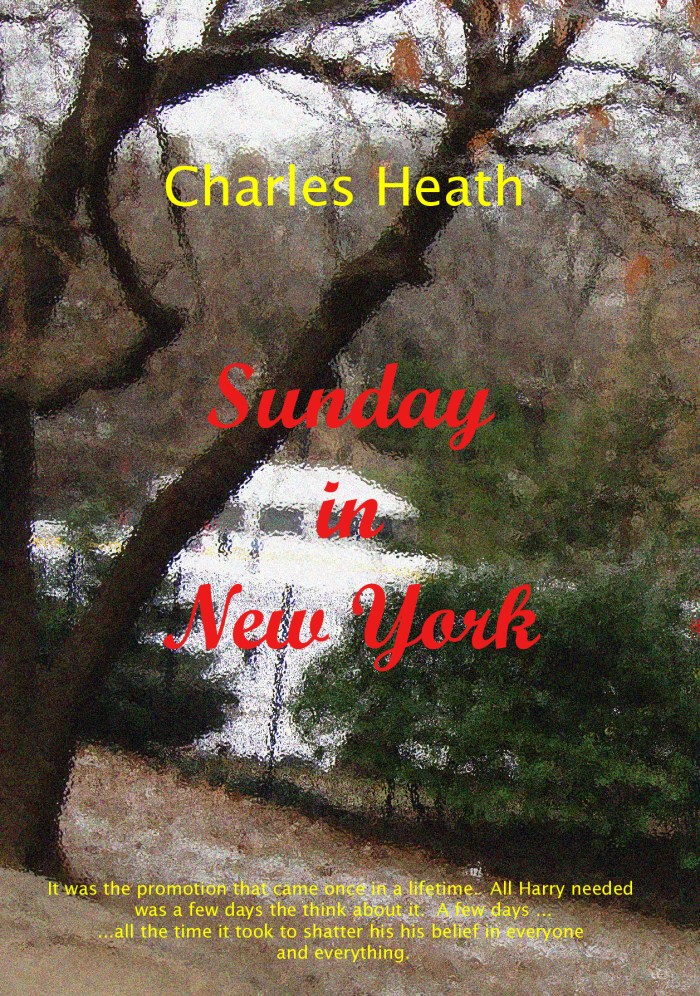
‘Sunday in New York’ – A beta reader’s view

I’m not a fan of romance novels but …

There was something about this one that resonated with me.

This is a novel about a world generally ruled by perception, and how people perceive what they see, what they are told, and what they want to believe.

I’ve been guilty of it myself as I’m sure we all have at one time or another.

For the main characters Harry and Alison there are other issues driving their relationship.

For Alison, it is a loss of self-worth through losing her job and from losing her mother and, in a sense, her sister.

For Harry, it is the fact he has a beautiful and desirable wife, and his belief she is the object of other men’s desires, and one in particular, his immediate superior.

Between observation, the less than honest motives of his friends, a lot of jumping to conclusions based on very little fact, and you have the basis of one very interesting story.

When it all comes to a head, Alison finds herself in a desperate situation, she realises only the truth will save their marriage.

But is it all the truth?

What would we do in similar circumstances?

Rarely does a book have me so enthralled that I could not put it down until I knew the result. They might be considered two people who should have known better, but as is often the case, they had to get past what they both thought was the truth.

And the moral of this story, if it could be said there is one, nothing is ever what it seems.

Available on Amazon here: amzn.to/2H7ALs8

An excerpt from “Echoes from the Past”

Available on Amazon Kindle here:  https://amzn.to/2CYKxu4

With my attention elsewhere, I walked into a man who was hurrying in the opposite direction.  He was a big man with a scar running down the left side of his face from eye socket to mouth, and who was also wearing a black shirt with a red tie.

That was all I remembered as my heart almost stopped.

He apologized as he stepped to one side, the same way I stepped, as I also muttered an apology.

I kept my eyes down.  He was not the sort of man I wanted to recognize later in a lineup.  I stepped to the other side and so did he.  It was one of those situations.  Finally getting out of sync, he kept going in his direction, and I towards the bus, which was now pulling away from the curb.

Getting my breath back, I just stood riveted to the spot watching it join the traffic.  I looked back over my shoulder, but the man I’d run into had gone.  I shrugged and looked at my watch.  It would be a few minutes before the next bus arrived.

Wait, or walk?  I could also go by subway, but it was a long walk to the station.  What the hell, I needed the exercise.

At the first intersection, the ‘Walk’ sign had just flashed to ‘Don’t Walk’.  I thought I’d save a few minutes by not waiting for the next green light.  As I stepped onto the road, I heard the screeching of tires.

A yellow car stopped inches from me.

It was a high powered sports car, perhaps a Lamborghini.  I knew what they looked like because Marcus Bartleby owned one, as did every other junior executive in the city with a rich father.

Everyone stopped to look at me, then the car.  It was that sort of car.  I could see the driver through the windscreen shaking his fist, and I could see he was yelling too, but I couldn’t hear him.  I stepped back onto the sidewalk, and he drove on.  The moment had passed and everyone went back to their business.

My heart rate hadn’t come down from the last encounter.   Now it was approaching cardiac arrest, so I took a few minutes and several sets of lights to regain composure.

At the next intersection, I waited for the green light, and then a few seconds more, just to be sure.  I was no longer in a hurry.

At the next, I heard what sounded like a gunshot.  A few people looked around, worried expressions on their faces, but when it happened again, I saw it was an old car backfiring.  I also saw another yellow car, much the same as the one before, stopped on the side of the road.  I thought nothing of it, other than it was the second yellow car I’d seen.

At the next intersection, I realized I was subconsciously heading towards Harry’s new bar.   It was somewhere on 6th Avenue, so I continued walking in what I thought was the right direction.

I don’t know why I looked behind me at the next intersection, but I did.  There was another yellow car on the side of the road, not far from me.  It, too, looked the same as the original Lamborghini, and I was starting to think it was not a coincidence.

Moments after crossing the road, I heard the roar of a sports car engine and saw the yellow car accelerate past me.  As it passed by, I saw there were two people in it, and the blurry image of the passenger; a large man with a red tie.

Now my imagination was playing tricks.

It could not be the same man.  He was going in a different direction.

In the few minutes I’d been standing on the pavement, it had started to snow; early for this time of year, and marking the start of what could be a long cold winter.  I shuddered, and it was not necessarily because of the temperature.

I looked up and saw a neon light advertising a bar, coincidentally the one Harry had ‘found’ and, looking once in the direction of the departing yellow car, I decided to go in.  I would have a few drinks and then leave by the back door if it had one.

Just in case.

© Charles Heath 2015-2020

newechocover5rs

Writing about writing a book – Day 30

I’m having fun with chapter one.

Can you reach a point where you are never satisfied with what you’ve written?

What more can I say?

Looking at the mess constituting my room and my life, slob may have been an appropriate description.  I considered myself old, overweight though not necessarily fat, hair graying at the edges, and few wrinkles around the eyes, there were no real pluses in my description.

Some said I had a kindly face, but perhaps I had the look of a paternalistic grandfather.  There were several men in the office who were the same age and had grandchildren.  And some who had children at a time when they should be planning for retirement, not parenthood.

World-weary and perpetually tired, I’d passed the mid-life crisis, wondering what it was that affected other men my age.  Twenty-odd years later, I was still wondering.

I used to think I’d missed a lot in half a lifetime.

Now, I didn’t know what to think.

Did I deserve pity?  No.

Did I deserve sympathy?  No!

The only person who could get me out of the rut was myself.  For years I’d traded on Ellen’s good nature.  She deserved better, left me, and was now happier in the arms of a man who I wanted to believe treated her far better than I.  She had told me so herself, and judging by her manner, it had to be true.  Only recently had she got her smile back, the one that lit her face up, one that infectiously spread happiness to anyone near her.

There were reasons why I became the person I was now.  Some might say they were valid.  In the cold, hard light of dawn, I could see it was time I stopped using my past as a crutch and got on with the business of living.

Perhaps today would be the first day of the rest of my life.

I took the bus rather than drove.  At that hour of the morning, the traffic would be bad, and there would be no parking spaces left.  And I was using public transport more and more, have become accustomed to the convenience.  Time to read the paper, or a good book, or just dream about a different life.

This morning I thought about Ellen.  I hadn’t for a while, but that might have been fueled by the arrival of the divorce papers she wanted me to sign.  I’d had my time to be angry, and disappointed, she’d said, and she was right.  It was time to move on.

And she had stuck by me through thick and thin, coming back from overseas service a basket case after nine months in a POW camp, after a war that was more horrible than anyone could imagine.  Two mental breakdowns, periods of indolence and lassitude, leaving her to bring up the girls on her own.  I had not been a great father, and much less a husband.

I remembered that argument word for word.

I could see the looks of pain in the girl’s faces.

I remembered the hug, the kiss on the cheek, the tears.  It had not been out of hate, but a necessity.  For her and the children.  Until I found some lasting peace, they were better off at arm’s length.  Away from the arguing, the silences, the absences.

And disappointment.

After she left I tried to get my life in order.  Drugs, professional help, alcohol, meditation, then work.

Over ten years ago, it took a year, perhaps a little more before sanity returned.

She did not.

By then I knew she had found someone else, a mystery man, whom neither she would tell me who, and the girls honestly didn’t know.  She’d promised that much, any new man in her life would not get to meet the girls.  And she would tell me, and then when she was ready.

Then, suddenly, the children were no longer children but young adults and out in the world on their own, and I had become more a banker than a father, an observer rather than a participant, and it was as if we were more like ships passing in the night.  And overnight, the ships had sailed to the other side of the world.

My own fault, of course, and a bit late now to change history.  I could see Ellen’s influence over them, her prejudices and dislikes, and their contempt, like their mother, for me, simmering beneath the surface, but in fairness to them, I really hadn’t been much of a help as a parent should be.

And now I was getting my life back in order, perhaps I could try and make it up to them, and that first meeting, with them and Ellen, nearly a month ago, had been a step in the right direction.  They’d agreed to see me again, without her, during the holidays, which had now arrived.  All I had to do was make the call, and get on a plane.

This mess I was heading into, it would not take long.  I pulled out my phone and after searching for a travel agent near where I worked, I made an appointment to see about going overseas.

She had spoken to me about the divorce papers several days ago, alternately pleading with, and then abusing, me.  There had been some very strong language in the conversation, words I’d thought her incapable of using, but I confess, finally, I didn’t really know her all that well anymore.

Since then I had been calling her to arrange a meeting.  She had not yet replied.  With some distance to go before I reached the office, I tried calling her again.  I was almost glad when she didn’t answer.

I never realized just how hard it was to revise and re-write, and how much time it takes.

Perhaps that’s why first novels take so long to write!

© Charles Heath 2016-2023

Questions, sometimes without answers

At what point does a writer become a journalist?

Quite often journalists become writers because of their vast experience in observing and writing about the news, sometimes in the category of ‘truth is stranger than fiction’.

I did journalism at University and thought I would never get to use it.  I had to interview people, write articles, and act as an editor.  The hardest part was the headlines.

How much does that resemble the job of coming up with a title for your book?

Well, several opportunities arose over the last few months to dig out the journalist hat, put it on, and go to work.

Where?

Hospital.  I’ve had to go there a few times more in the last few months than I have in recent years.

And I’d forgotten just how hospitals are interesting places, especially the waiting room in Emergency.

After the second or third visit, I started to observe the people who were waiting and ran through various scenarios as to the reason for their visit.  None may have been true, but it certainly was an exercise in creative writing and would make an excellent article.

Similarly, once we got inside the inner sanctum, where the real work is done, there is any number of crises and operations going on, and plenty of material for when I might need to include a hospital scene in one of my stories.

Or I could write a volume in praise of the people who work there and what they have to endure.  Tending the sick, injured and badly injured is not a job for the faint-hearted.

Research, if it could be called that, turns up in the unlikeliest of places.  Doctors who answer questions, not necessarily about the malady, nurses who tell you about what it’s like in Emergency on nights you really don’t want to be there, and other patients and their families, all of whom have a story to tell, or just wait patiently for a diagnosis and then treatment so they can go home.

We get to go this time at about four in the morning.  Everyone is tired.  More people are waiting.  Outside it is cool and the first rays of light are coming over the horizon as dawn is about to break.

I ponder the question without an answer, a question one of the nurses asked a youngish doctor, tossed out in conversation, but was there a more intent to it; what he was doing on Saturday night.

He didn’t answer.  Another crisis, another patient.

I suspect he was on duty in Emergency.

The cinema of my dreams – Was it just another surveillance job – Episode 51

This story is now on the list to be finished so over the new few weeks, expect a new episode every few days.

The reason why new episodes have been sporadic, there are also other stories to write, and I’m not very good at prioritizing.

But, here we are, a few minutes opened up and it didn’t take long to get back into the groove.

Things are about to get complicated…


Once out of the elevator I could see another security desk halfway up the corridor.  There were no doors before the desk, only after, so my destination was past the desk.

I pulled out my card in readiness, and as I approached, a woman came out of a door behind the desk and joined the security guard.

She spoke to the guard, then looked at me.  “My name is Joanne, I have been assigned to help you, and in accordance with security measures in place on the floor, I will be accompanying you.  One of the conditions of access is to not be anywhere on your own.”

“Except in the restroom, I hope.”

A momentary frown, “Common sense applies, you know.”

OK, try not to be flippant.

She handed me a form, I read it, ticked several boxes, and signed it.  I gave the guard my card and he scanned it.  Logging my movements, was not unexpected.  Having a shadow was.

But, there was nothing I was going to look at, that I didn’t want anyone not to know about.

“Good,”: she said when I handed the form back.  She in turn passed it to the guard, then said, “Follow me.”

A gate opened to let me through, then jolted shit behind me.  Either the mechanism was broken, or the thud was just to remind people going through it, it was not a toy.

We went three doors up the corridor where she stopped, opened the door, and ushered me in.

It was a reasonable-sized room with a desk, a computer with three screens, and two chairs, one I guess for me, and one for her.

We sat.

I thought I’d ask a couple of questions first.  “Do you always look after incoming researchers?”

“Yes.”

“And when there is none?”

“I work in with the research team, creating or updating breeding papers for agents in the field.”

“Do agents normally come in to look stuff up?”

“No.  Generally, they request it through secure channels.”

“Secure channels?”

“Usually, one of our consulates or embassies scattered all over the world.”

Good to remember.

“You’re just going to sit there?”

“Yes.”

I shrugged.  So be it.

I logged in and typed in Severin’s original name David Westcott.

The search engine brought back over a million hits, the first dozen relating to a violinist who seemed to be having a relationship and drug problems.

To narrow that search down, I added ‘Military service” in the hope that he may have been in the military before joining the intelligence services.

He was.  I did the same for Bernie Salvin and found the two of them had served roughly at the same time, in the same places, and were among the last people out in 2014.

When I added “Intelligence” to the search, the computer sent me on a side mission, bringing up documents relating to both men’s service in various branches of the intelligence services, for 5 years, after which it seemed they had just up and left, their service sheet marked ‘retired’, which could have meant anything, but I think it was a euphemism for ‘dead’.

I thought about asking my shadow, but that would lead to too many other questions that I didn’t want to answer.  As it was, I could see she was very interested in the two names I’d just searched on.

It explained how both men were so knowledgeable about the operations and facilities.  A quick search on the training facility we had used showed it had been closed, and abandoned, 6 years before.  I’d always thought it had that abandoned feel about it, and we were using it for the atmosphere value.

Then came searches on Severin and Maury and Arche Laboratories, and that too brought up the Security profiles of both men, but their prior history had been manufactured, though no doubt based on their real experience, being in the military in Afghanistan, and in a branch of the intelligence services, though not mentioning the specifics.

There was information on several security breaches and the computer systems being hacked reportedly by a foreign country, but nothing had been taken, a story perhaps to allay the fears of people who might think dangerous material might have fallen into the wrong hands.

At the very least, it was reported the facility would be shut down, due to its age and everyone being reassigned to a new more secure facility.  The fact Severin and Maury didn’t transfer told me they had either been caught, or they ad jumped before the fingers of accusation were pointed at them.  Either way, both had disappeared off the face of the earth.

Until I and others have become their unwitting recruits.

Everything O’Connell said was true, and it was all there, so Dobbin was as well versed on the pair as I now was.  And, now I had some background before I met Severin later in the day.

When Joanne finally plucked up the courage to ask me about my searches, I told her I had been reading up on a lot of old laboratories that used to contract government research and had narrowed the place where the information came from to several candidates and struck it luck the first search.  Arche Laboratories.

Previously I had got a list of the security staff from half a dozen labs that had closed unexpectedly, looking for possible matches to Severin and Maury, because I thought they would have a military and intelligence background, but the two I’d used, didn’t seem to fir the profile.  Their photographs, those that were posted for Arche Laboratories looked nothing like the Severin and Maury today, but I’d expected that.

She didn’t need to know that and looked satisfied with my answers.

Now it was time to look at some CCTV feeds.

© Charles Heath 2020-2022

An excerpt from “The Things We Do For Love”; In love, Henry was all at sea!

In the distance he could hear the dinner bell ringing and roused himself.  Feeling the dampness of the pillow, and fearing the ravages of pent up emotion, he considered not going down but thought it best not to upset Mrs. Mac, especially after he said he would be dining.

In the event, he wished he had reneged, especially when he discovered he was not the only guest staying at the hotel.

Whilst he’d been reminiscing, another guest, a young lady, had arrived.  He’d heard her and Mrs. Mac coming up the stairs, and then shown to a room on the same floor, perhaps at the other end of the passage.

Henry caught his first glimpse of her when she appeared at the door to the dining room, waiting for Mrs. Mac to show her to a table.

She was about mid-twenties, slim, long brown hair, and the grace and elegance of a woman associated with countless fashion magazines.  She was, he thought, stunningly beautiful with not a hair out of place, and make-up flawlessly applied.  Her clothes were black, simple, elegant, and expensive, the sort an heiress or wife of a millionaire might condescend to wear to a lesser occasion than dinner.

Then there was her expression; cold, forbidding, almost frightening in its intensity.  And her eyes, piercingly blue and yet laced with pain.  Dracula’s daughter was his immediate description of her.

All in all, he considered, the only thing they had in common was, like him, she seemed totally out of place.

Mrs. Mac came out of the kitchen, wiping her hands on her apron.  She was, she informed him earlier, chef, waitress, hotelier, barmaid, and cleaner all rolled into one.  Coming up to the new arrival she said, “Ah, Miss Andrews, I’m glad you decided to have dinner.  Would you like to sit with Mr. Henshaw, or would you like to have a table of your own?”

Henry could feel her icy stare as she sized up his appeal as a dining companion, making the hair on the back on his neck stand up.  He purposely didn’t look back.  In his estimation, his appeal rating was minus six.  Out of a thousand!

“If Mr. Henshaw doesn’t mind….”  She looked at him, leaving the query in mid-air.

He didn’t mind and said so.  Perhaps he’d underestimated his rating.

“Good.”  Mrs. Mac promptly ushered her over.  Henry stood, made sure she was seated properly and sat.

“Thank you.  You are most kind.”  The way she said it suggested snobbish overtones.

“I try to be when I can.”  It was supposed to nullify her sarcastic tone but made him sound a little silly, and when she gave him another of her icy glares, he regretted it.

Mrs. Mac quickly intervened, asking, “Would you care for the soup?”

They did, and, after writing the order on her pad, she gave them each a look, imperceptibly shook her head, and returned to the kitchen.

Before Michelle spoke to him again, she had another quick look at him, trying to fathom who and what he might be.  There was something about him.

His eyes, they mirrored the same sadness she felt, and, yes, there was something else, that it looked like he had been crying?  There was a tinge of redness.

Perhaps, she thought, he was here for the same reason she was.

No.  That wasn’t possible.

Then she said, without thinking, “Do you have any particular reason for coming here?”  Seconds later she realized she’s spoken it out loud, had hadn’t meant to actually ask, it just came out.

It took him by surprise, obviously not the first question he was expecting her to ask of him.

“No, other than it is as far from civilization, and home, as I could get.”

At least we agree on that, she thought.

It was obvious he was running away from something as well.

Given the isolation of the village and lack of geographic hospitality, it was, from her point of view, ideal.  All she had to do was avoid him, and that wouldn’t be difficult.

After getting through this evening first.

“Yes,” she agreed.  “It is that.”

A few seconds passed, and she thought she could feel his eyes on her and wasn’t going to look up.

Until he asked, “What’s your reason?”

Slight abrupt in manner, perhaps as a result of her question, and the manner in which she asked it.

She looked up.  “Rest.  And have some time to myself.”

She hoped he would notice the emphasis she had placed on the word ‘herself’ and take due note.  No doubt, she thought,  she had completely different ideas of what constituted a holiday than he, not that she had actually said she was here for a holiday.

Mrs. Mac arrived at a fortuitous moment to save them from further conversation.

Over the entree, she wondered if she had made a mistake coming to the hotel.  Of course, there had been no possible way she could know than anyone else might have booked the same hotel, but realized it was foolish to think she might end up in it by herself.

Was that what she was expecting?

Not a mistake then, but an unfortunate set of circumstances, which could be overcome by being sensible.

Yet, there he was, and it made her curious, not that he was a man, by himself, in the middle of nowhere, hiding like she was, but for very different reasons.

On discreet observance whilst they ate, she gained the impression his air of light-heartedness was forced and he had no sense of humor.

This feeling was engendered by his looks, unruly dark hair, and permanent frown.  And then there was his abysmal taste in clothes on a tall, lanky frame.  They were quality but totally unsuited to the wearer.

Rebellion was written all over him.

The only other thought crossing her mind, and rather incongruously, was he could do with a decent feed.  In that respect, she knew now from the mountain of food in front of her, he had come to the right place.

“Mr. Henshaw?”

He looked up.  “Henshaw is too formal.  Henry sounds much better,” he said, with a slight hint of gruffness.

“Then my name is Michelle.”

Mrs. Mac came in to take their order for the only main course, gather up the entree dishes, then return to the kitchen.

“Staying long?” she asked.

“About three weeks.  Yourself?”

“About the same.”

The conversation dried up.

Neither looked at the other, rather at the walls, out the window, towards the kitchen, anywhere.  It was, she thought, almost unbearably awkward.

Mrs. Mac returned with a large tray with dishes on it, setting it down on the table next to theirs.

“Not as good as the usual cook,” she said, serving up the dinner expertly, “but it comes a good second, even if I do say so myself.  Care for some wine?”

Henry looked at Michelle.  “What do you think?”

“I’m used to my dining companions making the decision.”

You would, he thought.  He couldn’t help but notice the cutting edge of her tone.  Then, to Mrs. Mac, he named a particular White Burgundy he liked and she bustled off.

“I hope you like it,” he said, acknowledging her previous comment with a smile that had nothing to do with humor.

“Yes, so do I.”

Both made a start on the main course, a concoction of chicken and vegetables that were delicious, Henry thought, when compared to the bland food he received at home and sometimes aboard my ship.

It was five minutes before Mrs. Mac returned with the bottle and two glasses.  After opening it and pouring the drinks, she left them alone again.

Henry resumed the conversation.  “How did you arrive?  I came by train.”

“By car.”

“Did you drive yourself?”

And he thought, a few seconds later, that was a silly question, otherwise she would not be alone, and certainly not sitting at this table. With him.

“After a fashion.”

He could see that she was formulating a retort in her mind, then changed it, instead, smiling for the first time, and it served to lighten the atmosphere.

And in doing so, it showed him she had another more pleasant side despite the fact she was trying not to look happy.

“My father reckons I’m just another of ‘those’ women drivers,” she added.

“Whatever for?”

“The first and only time he came with me I had an accident.  I ran up the back of another car.  Of course, it didn’t matter to him the other driver was driving like a startled rabbit.”

“It doesn’t help,” he agreed.

“Do you drive?”

“Mostly people up the wall.”  His attempt at humor failed.  “Actually,” he added quickly, “I’ve got a very old Morris that manages to get me where I’m going.”

The apple pie and cream for dessert came and went and the rapport between them improved as the wine disappeared and the coffee came.  Both had found, after getting to know each other better, their first impressions were not necessarily correct.

“Enjoy the food?” Mrs. Mac asked, suddenly reappearing.

“Beautifully cooked and delicious to eat,” Michelle said, and Henry endorsed her remarks.

“Ah, it does my heart good to hear such genuine compliments,” she said, smiling.  She collected the last of the dishes and disappeared yet again.

“What do you do for a living,” Michelle asked in an off-hand manner.

He had a feeling she was not particularly interested and it was just making conversation.

“I’m a purser.”

“A what?”

“A purser.  I work on a ship doing the paperwork, that sort of thing.”

“I see.”

“And you?”

“I was a model.”

“Was?”

“Until I had an accident, a rather bad one.”

“Oh, I’m sorry.”

So that explained the odd feeling he had about her.

As the evening had worn on, he began to think there might be something wrong, seriously wrong with her because she didn’t look too well.  Even the carefully applied makeup, from close up, didn’t hide the very pale, and tired look, or the sunken, dark ringed eyes.

“I try not to think about it, but it doesn’t necessarily work.  I’ve come here for peace and quiet, away from doctors and parents.”

“Then you will not have to worry about me annoying you.  I’m one of those fall-asleep-reading-a-book types.”

Perhaps it would be like ships passing in the night and then smiled to himself about the analogy.

Dinner now over, they separated.

Henry went back to the lounge to read a few pages of his book before going to bed, and Michelle went up to her room to retire for the night.

But try as he might, he was unable to read, his mind dwelling on the unusual, yet the compellingly mysterious person he would be sharing the hotel with.

Overlaying that original blurred image of her standing in the doorway was another of her haunting expressions that had, he finally conceded, taken his breath away, and a look that had sent more than one tingle down his spine.

She may not have thought much of him, but she had certainly made an impression on him.

© Charles Heath 2015-2020

lovecoverfinal1

“One Last Look”, nothing is what it seems

A single event can have enormous consequences.

A single event driven by fate, after Ben told his wife Charlotte he would be late home one night, he left early, and by chance discovers his wife having dinner in their favourite restaurant with another man.

A single event where it could be said Ben was in the wrong place at the wrong time.

Who was this man? Why was she having dinner with him?

A simple truth to explain the single event was all Ben required. Instead, Charlotte told him a lie.

A single event that forces Ben to question everything he thought he knew about his wife, and the people who are around her.

After a near-death experience and forced retirement into a world he is unfamiliar with, Ben finds himself once again drawn back into that life of lies, violence, and intrigue.

From London to a small village in Tuscany, little by little Ben discovers who the woman he married is, and the real reason why fate had brought them together.

It is available on Amazon here:  http://amzn.to/2CqUBcz