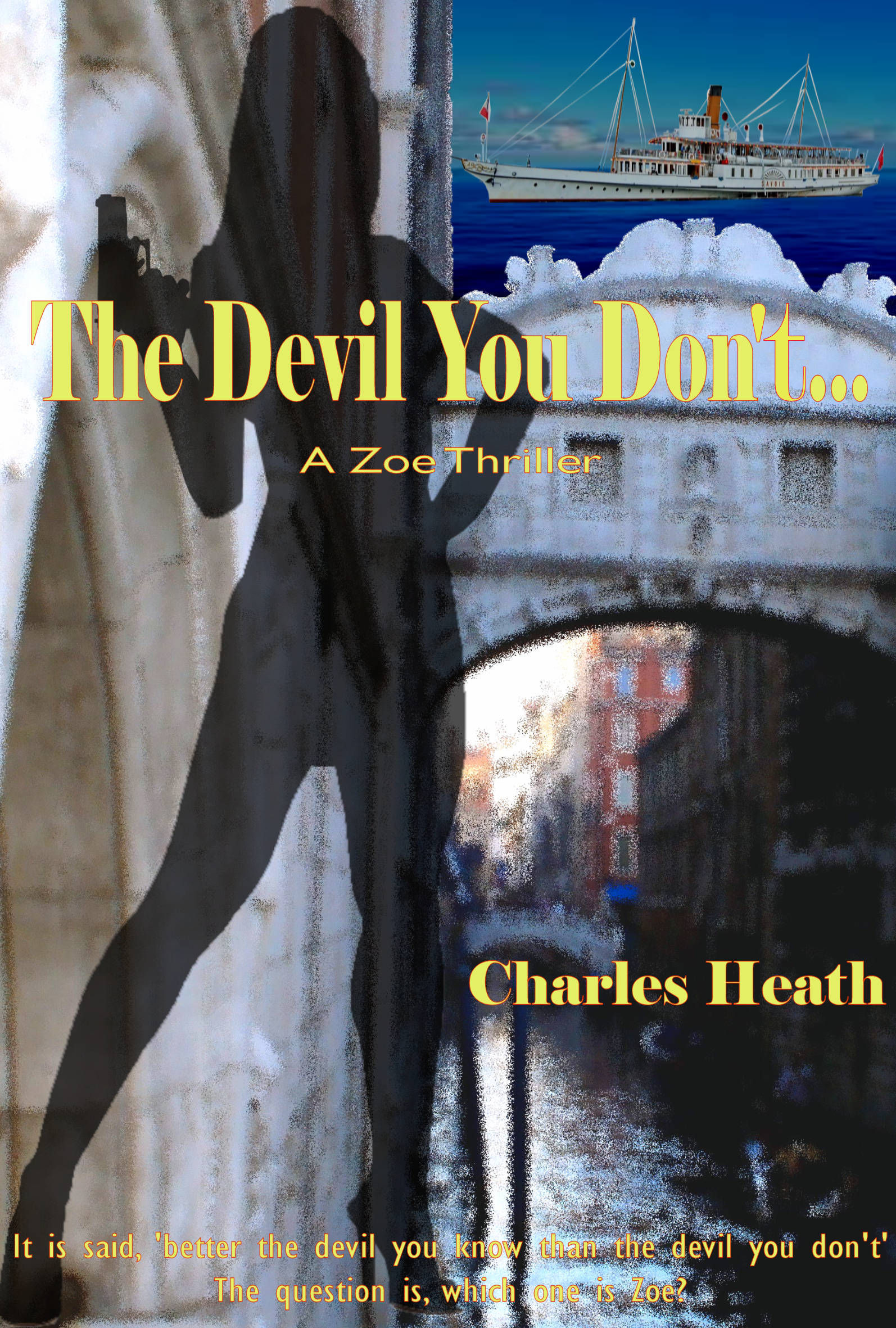
The cinema of my dreams – It ended in Sorrento – Episode 64

What is Juliet’s game?

…

Juliet was waiting for me by the car where we left it.

By that time, I was almost ready to strangle her with my bare hands.

“Where did you go?”

“Away from trouble.  I waited until I was sure you were not going to be killed, then I left.”  She held out the gun by the barrel.  “I figured you would have been able to take that guy with the gun, and there was no point being captured with it.”

She was right, but that didn’t make me any less angry.

I took it and unlocked the car.

“Where are the women?”

“He doesn’t know.  Worse still, he had no idea that another woman was taken at the same time.”

“You believe him?”

“Given the circumstances of seeing the woman that was going to solve all your problems dead on the floor had a way of making you believable.  No one is that good an actor.”

She looked at me with a strange expression.  “You have one working with you.”

“Her mother wasn’t killed in front of her.  Not the same.”

“Square one then?”

“It might be.  If he didn’t know where they were or wanted to, it’s like as not they are not on any of his properties.  If he didn’t care what happened to the countess, that doesn’t mean the same for those who are holding her, or Mrs Rodby.  They’ll know, eventually a reward will be offered., and we’re giving them one.”

I called Cecilia.  “How’s the search going.  I assume the fact you haven’t called me means you’ve found nothing?”

“Zip.  This Dicostini has a lot of dud property.  Maybe someone should tell him to build a resort rather than try to grow grapes.  There’d be a lot more money in it.”

“I think he has more problems than that to worry about right now.”

“How did you go?”

“Kept the place under surveillance waiting to see if the fake countess was hiding at his place.  She was.  She came out, and they had an argument. And he killed her.”

“What?  Shot her?”

“He hit her in a moment of temper, she fell awkwardly hitting her head on the table, dead before she hit the floor.”

“That makes things a little difficult.  I assume you didn’t get the location of the two women?”

“You assume correctly.”

“Then they could be anywhere?”

“Maybe, maybe not.  I’m going to give you a name and address.  Get onto Anthony and find out where he lives, then park yourself outside until you hear from me.  I have a hunch but be prepared to waste some time if it doesn’t pan out.  Take Alfie with you.  Leave Francesca, there’s nothing she can do now.”

“What are you planning?”

“Offering a huge reward for Mrs Rodby.  I think we can safely say the countess is either dead or will be when Dicostini calls the kidnappers.”

“Wouldn’t they just kill her too.  Faces?

“They might, but if they’re good, that won’t be a problem.  Getting a bigger payday is.  Everybody has a price.”

“Even you?”

“When I figure out how to disappear, maybe.  Go.  Times wasting.”

I thought about starting the car, then didn’t.

It was not enough that so many different scenarios were running through my head when the call finally came.  I was sure now the main game was over, they side players would be looking for a slice of the action.

There were only two candidates.  One seemed improbably, which made it the more likely, the other the logical choice, but unlikely.  It all depended on how fast Anthony could get the wanted poster out there.

In the meantime, I had another more perplexing problem.

“What are you doing here?” I asked Juliet.

She looked at me strangely.  “You asked me.”

“I mean what are you doing here in Italy?”

She kept looking at me as if I was mad.

“I was setting up for a conference.”

She looked earnest, but there was something in her manner.

“Are you really that pathologist.  I mean for a down and out doctor how could such a disgraced person get a foot back in the door?”

Her look of bemusement turned to annoyance.  “Tell me what you really think?  It took a lot of banging on doors and grovelling.”

I shook my head.  That wasn’t the whole story.

“Why so I keep running into you?”

“Fate.  Serendipity.  The universe telling us we didn’t end things properly the last time.”

Words.  Words that had a certain ring to them.  I shook my head. 

“Fate is a load of bollocks, Juliet.”

“You can call me Julie if you like.  It sounds better.”

“This is not done with, not by a long chalk.”

© Charles Heath 2023

The first case of PI Walthenson – “A Case of Working With the Jones Brothers”

This case has everything, red herrings, jealous brothers, femme fatales, and at the heart of it all, greed.

See below for an excerpt from the book…

Coming soon!

PIWalthJones1

An excerpt from the book:

When Harry took the time to consider his position, a rather uncomfortable position at that, he concluded that he was somehow involved in another case that meant very little to him.

Not that it wasn’t important in some way he was yet to determine, it was just that his curiosity had got the better of him, and it had led to this: sitting in a chair, securely bound, waiting for someone one of his captors had called Doug.

It was not the name that worried him so much, it was the evil laugh that had come after the name was spoken.

Doug what? Doug the ‘destroyer’, Doug the ‘dangerous’, Doug the ‘deadly’; there was any number of sinister connotations, and perhaps that was the point of the laugh, to make it more frightening than it was.

But there was no doubt about one thing in his mind right then: he’d made a mistake. A very big. and costly, mistake. Just how big the cost, no doubt he would soon find out.

His mother, and his grandmother, the wisest person he had ever known, had once told him never to eavesdrop.

At the time he couldn’t help himself and instead of minding his own business, listening to a one-sided conversation which ended with a time and a place. The very nature of the person receiving the call was, at the very least, sinister, and, because of the cryptic conversation, there appeared to be, or at least to Harry, criminal activity involved.

For several days he had wrestled with the thought of whether he should go. Stay on the fringe, keep out of sight, observe and report to the police if it was a crime. Instead, he had willingly gone down the rabbit hole.

Now, sitting in an uncomfortable chair, several heat lamps hanging over his head, he was perspiring, and if perspiration could be used as a measure of fear, then Harry’s fear was at the highest level.

Another runnel of sweat rolled into his left eye, and, having his hands tied, literally, it made it impossible to clear it. The burning sensation momentarily took his mind off his predicament. He cursed and then shook his head trying to prevent a re-occurrence. It was to no avail.

Let the stinging sensation be a reminder of what was right and what was wrong.

It was obvious that it was the right place and the right time, but in considering his current perilous situation, it definitely was the wrong place to be, at the worst possible time.

It was meant to be his escape, an escape from the generations of lawyers, what were to Harry, dry, dusty men who had been in business since George Washington said to the first Walthenson to step foot on American soil, ‘Why don’t you become a lawyer?” when asked what he could do for the great man.

Or so it was handed down as lore, though Harry didn’t think Washington meant it literally, the Walthenson’s, then as now, were not shy of taking advice.

Except, of course, when it came to Harry.

He was, Harry’s father was prone to saying, the exception to every rule. Harry guessed his father was referring to the fact his son wanted to be a Private Detective rather than a dry, dusty lawyer. Just the clothes were enough to turn Harry off the profession.

So, with a little of the money Harry inherited from one of his aunts, he leased an office in Gramercy Park and had it renovated to look like the Sam Spade detective agency, you know the one, Spade and Archer, and The Maltese Falcon.

There’s a movie and a book by Dashiell Hammett if you’re interested.

So, there it was, painted on the opaque glass inset of the front door, ‘Harold Walthenson, Private Detective’.

There was enough money to hire an assistant, and it took a week before the right person came along, or, more to the point, didn’t just see his business plan as something sinister. Ellen, a tall cool woman in a long black dress, or so the words of a song in his head told him, fitted in perfectly.

She’d seen the movie, but she said with a grin, Harry was no Humphrey Bogart.

Of course not, he said, he didn’t smoke.

Three months on the job, and it had been a few calls, no ‘real’ cases, nothing but missing animals, and other miscellaneous items. What he really wanted was a missing person. Or perhaps a beguiling, sophisticated woman who was as deadly as she was charming, looking for an errant husband, perhaps one that she had already ‘dispatched’.

Or for a tall, dark and handsome foreigner who spoke in riddles and in heavily accented English, a spy, or perhaps an assassin, in town to take out the mayor. The man was such an imbecile Harry had considered doing it himself.

Now, in a back room of a disused warehouse, that wishful thinking might be just about to come to a very abrupt end, with none of the romanticized trappings of the business befalling him. No beguiling women, no sinister criminals, no stupid policemen.

Just a nasty little man whose only concern was how quickly or how slowly Harry’s end was going to be.

© Charles Heath 2019

“Strangers We’ve Become” – The final countdown to publishing in 14 Days

Let the fun begin

…

Today we’re dealing with problems on all fronts.

After the assassination attempt in Russia, it was up to Boris to save them from the local security services and ensure their return home.

Alisha had not fully recovered and arrived back only to be sent to the hospital.

Prendergast and David have a very loud argument over several matters, the main one that he has been associating with a high-ranking FSB officer – Boris.

It ends with David being sent to a debriefing that was tantamount to torture, conducted by the department’s two best interrogators, oddly nicknamed Boris and Natasha.

David survives and a free to go home.

Only home is no longer the place it used to be.

There’s a new security team in place, and by accident, his name was left off the list of those with access to the Featherington London residence.

A number of broken bones and dishevelled security guards later, David makes it very clear what he thinks of them, and the fact he will not be staying with Susan. He is also sad to discover the new head of her security team is both the man he saw in Monaco with Jos, the one Susan was covertly observing before he derailed their meeting up, and the same man appearing in a set of revealing photographs of the two of them together.

Susan will, in the very near future, have some explaining to do.

There’s no doubt that despite what she might have done with the other man, David takes their relationship to another level, and makes sure his rival knows his place.

And there’s equally no doubt that rival was going to be very, very dead if he was not more careful.

…

‘Sunday in New York’ – A beta reader’s view

I’m not a fan of romance novels but …

There was something about this one that resonated with me.

This is a novel about a world generally ruled by perception, and how people perceive what they see, what they are told, and what they want to believe.

I’ve been guilty of it myself as I’m sure we all have at one time or another.

For the main characters Harry and Alison there are other issues driving their relationship.

For Alison, it is a loss of self-worth through losing her job and from losing her mother and, in a sense, her sister.

For Harry, it is the fact he has a beautiful and desirable wife, and his belief she is the object of other men’s desires, and one in particular, his immediate superior.

Between observation, the less than honest motives of his friends, a lot of jumping to conclusions based on very little fact, and you have the basis of one very interesting story.

When it all comes to a head, Alison finds herself in a desperate situation, she realises only the truth will save their marriage.

But is it all the truth?

What would we do in similar circumstances?

Rarely does a book have me so enthralled that I could not put it down until I knew the result. They might be considered two people who should have known better, but as is often the case, they had to get past what they both thought was the truth.

And the moral of this story, if it could be said there is one, nothing is ever what it seems.

…

Available on Amazon here: amzn.to/2H7ALs8

…

An excerpt from “Echoes from the Past”

Available on Amazon Kindle here:  https://amzn.to/2CYKxu4

…

With my attention elsewhere, I walked into a man who was hurrying in the opposite direction.  He was a big man with a scar running down the left side of his face from eye socket to mouth, and who was also wearing a black shirt with a red tie.

That was all I remembered as my heart almost stopped.

He apologized as he stepped to one side, the same way I stepped, as I also muttered an apology.

I kept my eyes down.  He was not the sort of man I wanted to recognize later in a lineup.  I stepped to the other side and so did he.  It was one of those situations.  Finally getting out of sync, he kept going in his direction, and I towards the bus, which was now pulling away from the curb.

Getting my breath back, I just stood riveted to the spot watching it join the traffic.  I looked back over my shoulder, but the man I’d run into had gone.  I shrugged and looked at my watch.  It would be a few minutes before the next bus arrived.

Wait, or walk?  I could also go by subway, but it was a long walk to the station.  What the hell, I needed the exercise.

At the first intersection, the ‘Walk’ sign had just flashed to ‘Don’t Walk’.  I thought I’d save a few minutes by not waiting for the next green light.  As I stepped onto the road, I heard the screeching of tires.

A yellow car stopped inches from me.

It was a high powered sports car, perhaps a Lamborghini.  I knew what they looked like because Marcus Bartleby owned one, as did every other junior executive in the city with a rich father.

Everyone stopped to look at me, then the car.  It was that sort of car.  I could see the driver through the windscreen shaking his fist, and I could see he was yelling too, but I couldn’t hear him.  I stepped back onto the sidewalk, and he drove on.  The moment had passed and everyone went back to their business.

My heart rate hadn’t come down from the last encounter.   Now it was approaching cardiac arrest, so I took a few minutes and several sets of lights to regain composure.

At the next intersection, I waited for the green light, and then a few seconds more, just to be sure.  I was no longer in a hurry.

At the next, I heard what sounded like a gunshot.  A few people looked around, worried expressions on their faces, but when it happened again, I saw it was an old car backfiring.  I also saw another yellow car, much the same as the one before, stopped on the side of the road.  I thought nothing of it, other than it was the second yellow car I’d seen.

At the next intersection, I realized I was subconsciously heading towards Harry’s new bar.   It was somewhere on 6th Avenue, so I continued walking in what I thought was the right direction.

I don’t know why I looked behind me at the next intersection, but I did.  There was another yellow car on the side of the road, not far from me.  It, too, looked the same as the original Lamborghini, and I was starting to think it was not a coincidence.

Moments after crossing the road, I heard the roar of a sports car engine and saw the yellow car accelerate past me.  As it passed by, I saw there were two people in it, and the blurry image of the passenger; a large man with a red tie.

Now my imagination was playing tricks.

It could not be the same man.  He was going in a different direction.

In the few minutes I’d been standing on the pavement, it had started to snow; early for this time of year, and marking the start of what could be a long cold winter.  I shuddered, and it was not necessarily because of the temperature.

I looked up and saw a neon light advertising a bar, coincidentally the one Harry had ‘found’ and, looking once in the direction of the departing yellow car, I decided to go in.  I would have a few drinks and then leave by the back door if it had one.

Just in case.

© Charles Heath 2015-2020

newechocover5rs

The Cinema of My Dreams – It ended in Sorrento – Episode 62

When you least expect it

…

After an hour passed, and no one had come looking for our intruder, darkness had fallen, the mother had taken the three children off in the car, and the people in the house had all left, leaving Dicostini to sit at the table reading a newspaper.

He didn’t seem to be too interested in running or working on his farm.  Maybe if he took more of an interest, it might be turning over a profit.

Behind me, I could hear our would-be assailant stirring and finding himself very tightly bound and gagged.  I turned around.  “If you know what’s good for you, I’d go back to sleep.  Either way, make any noise I will shoot you.”  I held up the silenced gun and waved it for emphasis.

“You do realise he has seen us, don’t you?”

“Do you want me to shoot him?”

“Well, you know what he’s going to do when he gets free.”

I did, but I wasn’t going to tell her.  I’d sent a text message to Alfie and he would be collected the moment we left the clearing.

Another hour passed when I noticed a shadow behind Dicostini who, now, had slumped forward, perhaps asleep.  The shadow materialised into a human form, and then a woman.  When the pale light from a wall lamp shone on her face, I recognised it instantly.

The fake countess.

She shook him by the shoulder, and when he roused, he stood and looked like he was yelling at her.

Juliet came over and lay down next to me.  “What’s happening?”

“The fake countess just came out of the woodwork.  That’s our cue?”

“For what?”

“Storming the battlements.  Taking no prisoners.  Or perhaps just ask a few questions and reasonably expect answers.”

I stood and dismantled the rifle and put the parts back in the case. 

“Grab the bag, we’re on the clock.”

“What about him?”  She nodded in the man’s direction.  His eyes told the story, he didn’t like being tied up like that.

“Hopefully he’s learned a valuable lesson, don’t go blundering around in the undergrowth.”

We stowed the gun and bag in the car and headed back towards the farmhouse by a different route.  It was dark enough that we didn’t have to try too hard to stay in the shadows.

Lucking Juliet had thought to wear black.

“When we stopped behind the wall of one of the outhouses, I could hear her in my ear, “So, do I get a gun?”

“No.”

“What do I do when the shit hits the fan?”

“The same as me.  Duck.”

She punched me, which was not unexpected.

We made it to the back of the house, and to a window that looked in over an open-plan living area.  We had heard voices as we approached the house, now they were clearer we could see them.

“…part of staying out of sight didn’t you get?”  Dicostini was angry.

“In that little hole, you put me in?”

“You’re safe there, for the time being.”

“They know, you know.  It’s just a question of whether they’ve told Von Burkhardt.”

“Do you want me to go over there and ask?”

“You should have killed them all when you had the chance, not just the son and the father.  Like everything else you’ve done, this is going to end up an utter failure.”

He was going to say something but didn’t.  Instead, filled with pent-up rage, he hit her.  I thought it had been with an open hand, but it was a fist, and so hard she spun sideways, hit her head on the solid wooden table with a sickening thud and then just flopped like a rag doll on the ground.

So engrossed in watching those events unfold, I forgot about Juliet and suddenly felt what might be the barrel of a gun in my back.

Juliet!

© Charles Heath 2023

“Strangers We’ve Become” – The final countdown to publishing in 16 Days

Third time’s the charm

…

There are three things going on here, well, that’s going on in Yaroslavl.

The first is that David’s old handler is losing it over the fact he had upped and gone to Moscow, Russia.  Old handlers always suspect their charges that go to Russia are looking to defect.  That isn’t David’s intention, but he knows Prendergast is never going to see reason.

The fact he sent one of his minders along, presumably to drag him back home is reason to suspect a major breakout of paranoia.

The second was a visit to the palace ruins, but it was going to take someone with more imagination than he had to see what the attraction is.  Whatever had been there, in that peaceful, tranquil spot must have had an air of magnificence about it.

Of course, Susan turns up, and they have words, and things might have gone smoother if it had not been for Prendergast’s minder.

Enough said, for the moment.

Back at the hotel, having missed the flight back with Susan, David gets to relive some of those lingering thoughts of Alisha, though he doesn’t act on them.

The third event, it was nearly a case of third-time lucky as the assassination attempt was almost successful.

Sadly, Alicia is nearly killed, and they need Boris to rescue them.

Two spies, a major injury and a dead body in a hotel room spell trouble in any country, but more so in Russia.

Could things get any more complicated?

…

‘The Devil You Don’t’ – A beta reader’s view

It could be said that of all the women one could meet, whether contrived or by sheer luck, what are the odds it would turn out to be the woman who was being paid a very large sum to kill you.

John Pennington is a man who may be lucky in business, but not so lucky in love. He has just broken up with Phillipa Sternhaven, the woman he thought was the one, but relatives and circumstances, and perhaps because she was a ‘princess’, may also have contributed to the end result.

So, what do you do when you are heartbroken?

That is a story that slowly unfolds, from the first meeting with his nemesis on Lake Geneva, all the way to a hotel room in Sorrento, where he learns the shattering truth.

What should have been solace after disappointment, turns out to be something else entirely, and from that point, everything goes to hell in a handbasket.

He suddenly realizes his so-called friend Sebastian has not exactly told him the truth about a small job he asked him to do, the woman he is falling in love with is not quite who she says she is, and he is caught in the middle of a war between two men who consider people becoming collateral damage as part of their business.

The story paints the characters cleverly displaying all their flaws and weaknesses. The locations add to the story at times taking me back down memory lane, especially to Venice where, in those back streets I confess it’s not all that hard to get lost.

All in all a thoroughly entertaining story with, for once, a satisfying end.

…

Available on Amazon here: https://amzn.to/2Xyh1ow

…

An excerpt from “Betrayal” – a work in progress

It could have been anywhere in the world, she thought, but it wasn’t.  It was in a city where if anything were to go wrong…

She sighed and came away from the window and looked around the room.  It was quite large and expensively furnished.  It was one of several she had been visiting in the last three months.

Quite elegant too, as the hotel had its origins dating back to before the revolution in 1917.  At least, currently, there would not be a team of KGB agents somewhere in the basement monitoring everything that happened in the room.

There was no such thing as the KGB anymore, though there was an FSB, but such organisations were of no interest to her.

She was here to meet with Vladimir.

She smiled to herself when she thought of him, such an interesting man whose command of English was as good as her command of Russian, though she had not told him of that ability.

All he knew of her was that she was American, worked in the Embassy as a clerk, nothing important, whose life both at work and at home was boring.  Not that she had blurted that out the first they met, or even the second.

That first time, at a function in the Embassy, was a chance meeting, a catching of his eye as he looked around the room, looking, as he had told her later, for someone who might not be as boring as the function itself.

It was a celebration, honouring one of the Embassy officials on his service in Moscow, and the fact he was returning home after 10 years.  She had been there once, and still hadn’t met all the staff.

They had talked, Vladimir knew a great deal about England, having been stationed there for a year or two, and had politely asked questions about where she lived, her family, and of course what her role was, all questions she fended off with an air of disinterested interest.

It fascinated him, as she knew it would, a sort of mental sparring as one would do with swords if this was a fencing match.

They had said they might or might not meet again when the party was over, but she suspected there would be another opportunity.  She knew the signs of a man who was interested in her, and Vladimir was interested.

The second time came in the form of an invitation to an art gallery, and a viewing of the works of a prominent Russian artist, an invitation she politely declined.  After all, invitations issued to Embassy staff held all sorts of connotations, or so she was told by the Security officer when she told him.

Then, it went quiet for a month.  There was a party at the American embassy and along with several other staff members, she was invited.  She had not expected to meet Vladimir, but it was a pleasant surprise when she saw him, on the other side of the room, talking to several military men.

A pleasant afternoon ensued.

And it was no surprise that they kept running into each other at the various events on the diplomatic schedule.

By the fifth meeting, they were like old friends.  She had broached the subject of being involved in a plutonic relationship with him with the head of security at the embassy.  Normally for a member of her rank, it would not be allowed, but in this instance it was.

She did not work in any sensitive areas, and, as the security officer had said, she might just happen upon something that might be useful.  In that regard, she was to keep her eyes and ears open and file a report each time she met him.

After that discussion, she got the impression her superiors considered Vladimir more than just a casual visitor on the diplomatic circuit.  She also formed the impression that he might consider her an ‘asset’, a word that had been used at the meeting with security and the ambassador.

It was where the word ‘spy’ popped into her head and sent a tingle down her spine.  She was not a spy, but the thought of it, well, it would be fascinating to see what happened.

A Russian friend.  That’s what she would call him.

And over time, that relationship blossomed, until, after a visit to the ballet, late and snowing, he invited her to his apartment not far from the ballet venue.  It was like treading on thin ice, but after champagne and an introduction to caviar, she felt like a giddy schoolgirl.

Even so, she had made him promise that he remain on his best behaviour.  It could have been very easy to fall under the spell of a perfect evening, but he promised, showed her to a separate bedroom, and after a brief kiss, their first, she did not see him until the next morning.

So, it began.

It was an interesting report she filed after that encounter, one where she had expected to be reprimanded.

She wasn’t.

It wasn’t until six weeks had passed when he asked her if she would like to take a trip to the country.  It would involve staying in a hotel, that they would have separate rooms.  When she reported the invitation, no objection was raised, only a caution; keep her wits about her.

Perhaps, she had thought, they were looking forward to a more extensive report.  After all, her reports on the places, and the people, and the conversations she overheard, were no doubt entertaining reading for some.

But this visit was where the nature of the relationship changed, and it was one that she did not immediately report.  She had realised at some point before the weekend away, that she had feelings for him, and it was not that he was pushing her in that direction or manipulating her in any way.

It was just one of those moments where, after a grand dinner, a lot of champagne, and delightful company, things happen.  Standing at the door to her room, a lingering kiss, not intentional on her part, and it just happened.

And for not one moment did she believe she had been compromised, but for some reason she had not reported that subtle change in the relationship to the powers that be, and so far, no one had any inkling.

She took off her coat and placed it carefully of the back of one of the ornate chairs in the room.  She stopped for a moment to look at a framed photograph on the wall, one representing Red Square.

Then, after a minute or two, she went to the mini bar and took out the bottle of champagne that had been left there for them, a treat arranged by Vladimir for each encounter.

There were two champagne flutes set aside on the bar, next to a bowl of fruit.  She picked up the apple and thought how Eve must have felt in the garden of Eden, and the temptation.

Later perhaps, after…

She smiled at the thought and put the apple back.

A glance at her watch told her it was time for his arrival.  It was if anything, the one trait she didn’t like, and that was his punctuality.  A glance at the clock on the room wall was a minute slow.

The doorbell to the room rang, right on the appointed time.

She put the bottle down and walked over to the door.

A smile on her face, she opened the door.

It was not Vladimir.  It was her worst nightmare.

…

© Charles Heath 2020

“Knowledge can be dangerous…” – A short story

It was, perhaps, the saddest week of my life.

It started with a phone call, and then a visit by two police officers.  It was about my parents, but the news could not be imparted over the phone, only in person.  That statement alone told me it was very bad news, so I assumed the worst.

The two police officers, standing at the front door, with grim expressions on their faces, completed the picture.  The news, my parents were dead, killed in a freak car accident.

At first, it didn’t sink in.  They were on their way back from another of their extensive holidays, one of many since my father had retired.  I’d seen them probably six months out of the last five years, and the only reason they were returning this time was that my mother needed an operation.

They hadn’t told me why, not that they ever told me very much any time since the day I’d been born, but that was who they were.  I thought them eccentric, being older when I’d come along, and others thought them, well, eccentric.

And being an only child, they packed me off to boarding school, then university, and then found me a job in London, and set me up so that I would only see them weekends if they were home.

I had once wondered if they ever cared about me, keeping me at arm’s length, but my mother some time ago had taken me aside and explained why.  It was my father’s family tradition.  The only part I’d missed was a nanny.

It most likely explained why I didn’t feel their passing as much as I should.

A week later, after a strange funeral where a great many people I’d never met before, and oddly who knew about me, I found myself sitting in the sunroom, a glass of scotch in one hand, and an envelope with my name on it, in the other.

The solicitor, a man I’d never met before, had given it to me at the funeral.   We had, as far as I knew an elderly fellow, one of my father’s old school friends, as the family solicitor, but he hadn’t shown at the funeral and wasn’t at home when I called in on my way home.

It was all very odd.

I refilled the glass and took another look at the envelope.  It was not new, in fact, it had the yellow tinge of age, with discolouration where the flap was.  The writing was almost a scrawl, but identifiable as my father’s handwriting, perhaps an early version as it was now definitely an illegible scrawl.

I’d compared it with the note he’d left me before they had embarked on their last adventure, everything I had to do while caretaking their house.  The last paragraph was the most interesting, instructing me to be present when the cleaning lady came, he’d all but accused her of stealing the candlesticks.

To be honest, I hadn’t realized there were candlesticks to steal, but there they were, on the mantlepiece over the fire in the dining room.  The whole house was almost like being in an adventure park, with stairs going up to an array of rooms, mostly no longer used, and a staircase to the attic, and then another going down to the cellar.  The attic was locked and had been for as long as I could remember, and the cellar was dank and draughty.

Much like the whole house, but not surprisingly, it was over 200 years old.

And perhaps it was now mine.  The solicitor, a man by the name of Sir Percival Algernon Bridgewater, had intimated that it might be the last will and testament and had asked me to tell him if it was.  I was surprised that Sir Percival didn’t have the document in question.

And equally. so that the man I knew as his solicitor, Lawerence Wellingham, didn’t have a copy of my father’s last will and testament either.

I finished the drink, picked up the envelope, and opened it.

It contained two sheets of paper, the will, and a letter.  A very short letter.

“If you are reading this I have died before my time.  You will need to find Albert Stritching, and ask him to help you find the murderer.”

Even the tenor of that letter didn’t faze me as it should have, because at this point nothing would surprise me.  In fact, as I  unfolded the document that proclaimed it was the will, I was ready for it to say that the whole of his estate and belongings were to be left to some charity, and I would get an annual stipend of a thousand pounds.

In fact, it didn’t.  The whole of his estate was left to my mother should she outlive him, or in the event of her prior decease, to me.

I had to put all of those surprises on hold to answer a knock on the door.

Lawerence Wellingham.

I stood to one side, let him pass, closed the door, and followed him into the front room, the one my mother called the ‘drawing room’ though I never knew why.

He sat in one of the large, comfortable lounge chairs.  I sat in the other.

I showed him the will.  I kept the other back, not knowing what to make of it.

“No surprise there,” Wellingham said.

“Did you have any idea what my father used to do, beyond being, as he put it, a freelance diplomat?”

I thought it a rather odd description but it was better than one he once proffered, ‘I do odd jobs for the government’.

“I didn’t ask.  Knowledge can be dangerous, particularly when associated with your father.  Most of us prefer not to know, but one thing I can tell you.  If anyone tries to tell you what happened to your parents was not an accident, ignore them.  Go live your life, and keep those memories you have of them in the past, and don’t look back.  They were good people, Ken, remember them as such.”

We reminisced for the next hour, making a dent in the scotch, one of my father’s favourite, and he left.

Alone again, the thoughts went back to the second note from my father.  That’s when the house phone rang.

Before I could answer it, a voice said, “My name is Stritching.  Your father might have mentioned me?  We need to talk.”

—-

© Charles Heath 2020-2021