“Strangers We’ve Become” – A final countdown to publishing in 7 Days

The plot thickens

…

David and Susan are planning and executing rendezvous, a rather odd thing to do since they are married, not illicit lovers, but Susan likes the idea of escaping her security team, something that is at odds with what Prendergast expects.

Of course, his security chief seems to think that Prendergast simply wants him to do a simple job in quid pro quo for a job Prendergast is supposed to do for him:  free his daughter from a despotic African terrorist that the man once worked for, and failed.

This is the story being peddled to David by the man who accompanied Susan’s agent to France and is backed up in part by Alisha’s investigative team.

David torments another of his team and then sets himself at odds with the man himself when Susan tries to have a discrete lunch with Prendergast.

That sets off alarm bells for David.

Prendergast is far too involved with Susan for David’s liking.

But, it seems if he is to get rid of the security at Susan’s he is going to have to find the daughter, and she is in Nigeria.

It seems that was one of Prendergast’s objectives, to get David to rescue her, but what happened to the notion that he just ask?

In the meantime, the security team’s England base is found, one of Susan’s newly acquired properties, and David has surveillance installed.

He also has new eyes on the castle, and the renovations, because he suspects something else is going on there.

And then there is Alisha at her most seductive best, injured or not.

Chess pieces being moved by various people across the globe, David sets off for Nigeria, to see a rather doubtful contact, of Prendergast’s recommendations.

Just like the old days, wheels within wheels.  All he knows for sure is that he needs three people watching his back.

…

The first case of PI Walthenson – “A Case of Working With the Jones Brothers”

This case has everything, red herrings, jealous brothers, femme fatales, and at the heart of it all, greed.

See below for an excerpt from the book…

Coming soon!

PIWalthJones1

An excerpt from the book:

When Harry took the time to consider his position, a rather uncomfortable position at that, he concluded that he was somehow involved in another case that meant very little to him.

Not that it wasn’t important in some way he was yet to determine, it was just that his curiosity had got the better of him, and it had led to this: sitting in a chair, securely bound, waiting for someone one of his captors had called Doug.

It was not the name that worried him so much, it was the evil laugh that had come after the name was spoken.

Doug what? Doug the ‘destroyer’, Doug the ‘dangerous’, Doug the ‘deadly’; there was any number of sinister connotations, and perhaps that was the point of the laugh, to make it more frightening than it was.

But there was no doubt about one thing in his mind right then: he’d made a mistake. A very big. and costly, mistake. Just how big the cost, no doubt he would soon find out.

His mother, and his grandmother, the wisest person he had ever known, had once told him never to eavesdrop.

At the time he couldn’t help himself and instead of minding his own business, listening to a one-sided conversation which ended with a time and a place. The very nature of the person receiving the call was, at the very least, sinister, and, because of the cryptic conversation, there appeared to be, or at least to Harry, criminal activity involved.

For several days he had wrestled with the thought of whether he should go. Stay on the fringe, keep out of sight, observe and report to the police if it was a crime. Instead, he had willingly gone down the rabbit hole.

Now, sitting in an uncomfortable chair, several heat lamps hanging over his head, he was perspiring, and if perspiration could be used as a measure of fear, then Harry’s fear was at the highest level.

Another runnel of sweat rolled into his left eye, and, having his hands tied, literally, it made it impossible to clear it. The burning sensation momentarily took his mind off his predicament. He cursed and then shook his head trying to prevent a re-occurrence. It was to no avail.

Let the stinging sensation be a reminder of what was right and what was wrong.

It was obvious that it was the right place and the right time, but in considering his current perilous situation, it definitely was the wrong place to be, at the worst possible time.

It was meant to be his escape, an escape from the generations of lawyers, what were to Harry, dry, dusty men who had been in business since George Washington said to the first Walthenson to step foot on American soil, ‘Why don’t you become a lawyer?” when asked what he could do for the great man.

Or so it was handed down as lore, though Harry didn’t think Washington meant it literally, the Walthenson’s, then as now, were not shy of taking advice.

Except, of course, when it came to Harry.

He was, Harry’s father was prone to saying, the exception to every rule. Harry guessed his father was referring to the fact his son wanted to be a Private Detective rather than a dry, dusty lawyer. Just the clothes were enough to turn Harry off the profession.

So, with a little of the money Harry inherited from one of his aunts, he leased an office in Gramercy Park and had it renovated to look like the Sam Spade detective agency, you know the one, Spade and Archer, and The Maltese Falcon.

There’s a movie and a book by Dashiell Hammett if you’re interested.

So, there it was, painted on the opaque glass inset of the front door, ‘Harold Walthenson, Private Detective’.

There was enough money to hire an assistant, and it took a week before the right person came along, or, more to the point, didn’t just see his business plan as something sinister. Ellen, a tall cool woman in a long black dress, or so the words of a song in his head told him, fitted in perfectly.

She’d seen the movie, but she said with a grin, Harry was no Humphrey Bogart.

Of course not, he said, he didn’t smoke.

Three months on the job, and it had been a few calls, no ‘real’ cases, nothing but missing animals, and other miscellaneous items. What he really wanted was a missing person. Or perhaps a beguiling, sophisticated woman who was as deadly as she was charming, looking for an errant husband, perhaps one that she had already ‘dispatched’.

Or for a tall, dark and handsome foreigner who spoke in riddles and in heavily accented English, a spy, or perhaps an assassin, in town to take out the mayor. The man was such an imbecile Harry had considered doing it himself.

Now, in a back room of a disused warehouse, that wishful thinking might be just about to come to a very abrupt end, with none of the romanticized trappings of the business befalling him. No beguiling women, no sinister criminals, no stupid policemen.

Just a nasty little man whose only concern was how quickly or how slowly Harry’s end was going to be.

© Charles Heath 2019

‘Sunday in New York’ – A beta reader’s view

I’m not a fan of romance novels but …

There was something about this one that resonated with me.

This is a novel about a world generally ruled by perception, and how people perceive what they see, what they are told, and what they want to believe.

I’ve been guilty of it myself as I’m sure we all have at one time or another.

For the main characters Harry and Alison there are other issues driving their relationship.

For Alison, it is a loss of self-worth through losing her job and from losing her mother and, in a sense, her sister.

For Harry, it is the fact he has a beautiful and desirable wife, and his belief she is the object of other men’s desires, and one in particular, his immediate superior.

Between observation, the less than honest motives of his friends, a lot of jumping to conclusions based on very little fact, and you have the basis of one very interesting story.

When it all comes to a head, Alison finds herself in a desperate situation, she realises only the truth will save their marriage.

But is it all the truth?

What would we do in similar circumstances?

Rarely does a book have me so enthralled that I could not put it down until I knew the result. They might be considered two people who should have known better, but as is often the case, they had to get past what they both thought was the truth.

And the moral of this story, if it could be said there is one, nothing is ever what it seems.

…

Available on Amazon here: amzn.to/2H7ALs8

…

“Trouble in Store” – Short stories my way: Adding a catalyst

Just when there’s enough complication in the story, we could leave it there with the current three protagonists and see what happens.

But I like mayhem.

So rather than another customer, it’s time to add a complication; an off-duty policeman, or more to the point, policewoman.  A beat cop, if they still exist.

Her back story in a sentence or so:

…

It had been another long day at the office for Officer Margaret O’Donnell, or, out in the streets, coping with people who either didn’t know or didn’t care about the law.

People who couldn’t cross the road where there were crossings and lights to protect them, silly girls shoplifting on a dare, and boys who thought they were men and could walk on water.

The one they scraped off the road would never get to grow up, and his mother, well, she was not doing another call on a family to give them the bad news.

That was her day.  So far.

…

What is she doing near the shop?  She lives around the corner.  Perhaps she knows the reputation of the shopkeeper or perhaps not.  It’s not relevant, then, as it is a place she avoids.

Now, she may not have the option.  She sees the shop is still open, past the usual closing time.

Let’s continue:

…

She came around the corner into the street where she lived and saw the lights were on in the corner store.

She looked at her watch and saw it was ten minutes to midnight.  Long past closing time.  She looked through the window but from the other side of the road and could only see three heads and little else.

Damn, she thought, I’m going to have to check it out.  There were rumours, and she hoped they were not true.

…

Meanwhile, back in the shop how are the others faring?

The shopkeeper is in an invidious position, he can’t supply the kids with the drugs and get them out, not in front of the customer.

The fact the girl has a gun makes the situation almost impossible.  What would happen if he suggests the customer leave?  Without him, the situation would be simpler.

Alphonse had only a few moments to sum up the situation, and the sum of those deliberations was the remove the only problem, the customer.

He could still salvage this:

…

The shopkeeper changed his expression to one more placatory, and said quietly to the girl, ‘Look, this is not this chap’s problem.’  He nodded in the direction of the customer.  ‘I’m sure he’d rather not be here, and you would be glad of one less distraction.’

He could see she was wavering, she was not holding the gun so steadily, and the longer this dragged on, the more nervous and unpredictable she would become.

And in the longer game, the customer would sing his praises no matter what happened after he left.

The girl looked at Jack.  The shopkeeper was right.  If he wasn’t here this could be over.  But there was another problem.  It didn’t look like Simmo was in any shape to get away.  In fact, this was looking more like a suicide mission.

She waved the gun in his direction.  ‘Get out now, before I change my mind.’

As the gun turned to the shopkeeper, Jack wasn’t going to wait to be asked twice and started sidling towards the door.

…

What happens next?

And the story for this section, with a few minor changes:

It had been another long day at the office for Officer Margaret O’Donnell, or, out in the streets, coping with people who either didn’t know or didn’t care about the law.

People who couldn’t cross the road where there were crossings and lights to protect them, silly girls shoplifting on a dare, and boys who thought they were men and could walk on water.

The one they scraped of the road would never get to grow up, and his mother, well, she was not doing another call on a family to give them the bad news.

That was her day.  So far.  For now, she was glad to be getting home, putting her feet up, and forgetting about everything until the next morning when it would start all over again.

Coming around that last corner, the home stretch she called it, she was directly opposite the corner shop, usually closed at this hour of the night.  It was not.  The lights were still on.

She looked at her watch and saw it was ten minutes to midnight, and long past closing time.  She looked through the window but from the other side of the road and could only see three heads and little else.

Damn, she thought, I’m going to have to check it out.  There were rumours, and she hoped they were not true.

The shopkeeper changed his expression to one more placatory, and said quietly to the girl, ‘Look, this is not this chap’s problem.’  He nodded in the direction of the customer.  ‘I’m sure he’d rather not be here, and you would be glad of one less distraction.’

He could see she was wavering, she was not holding the gun so steadily, and the longer this dragged on, the more nervous and unpredictable she would become.

And in the longer game, the customer would sing his praises no matter what happened after he left.

The girl looked at Jack.  The shopkeeper was right.  If he wasn’t here this could be over.  But there was another problem.  It didn’t look like Simmo was in any shape to get away.  In fact, this was looking more like a suicide mission.

She waved the gun in his direction.  ‘Get out now, before I change my mind.’

As the gun turned to the shopkeeper, Jack wasn’t going to wait to be asked twice and started sidling towards the door.

Next:  Actions have consequences

© Charles Heath 2016-2023

The cinema of my dreams – I always wanted to go on a treasure hunt – Episode 48

Here’s the thing…

Every time I close my eyes, I see something different.

I’d like to think the cinema of my dreams is playing a double feature but it’s a bit like a comedy cartoon night on Fox.

But these dreams are nothing to laugh about.

Once again there’s a new installment of an old feature, and we’re back on the treasure hunt.

—

Here’s the thing. Should I tell Boggs about the Ormiston’s?

Should I tell him that there was more than one lake?

Should I wait until I’d looked at the information that had been stored away? From the way Gwen was talking, no one had looked at Ormiston’s papers since the day they were deposited in the library, except perhaps Gwen herself.

And it helped that Gwen would not give any meaningful assistance to Alex Benderby or any of his cohorts. It seemed all she had given them was the briefest outline of the Ormiston story. She obviously didn’t mention that Ormiston had left anything behind.

Two tasks that I added to a list were, firstly, to start looking at old newspaper archives in the area for anything on Ormiston’s fruitless searches for the treasure, and find out, if possible, whether he works with a map of any sort. Nadia had mentioned the possibility of the pirate captain keeping a journal. Had he seen it, even owned it one time?

There was also the impression that Boggs’ father was not the only one involved with searching for the treasure. He had a map and it looked quite old. Was it possible it had been handed down from father to son, and just to take it a little further, had Ormiston and Boggs’ grandfather been rivals or cohorts? Indeed, a question for Boggs when I saw him.

Secondly, I would have to go around the various churches in the county and see what I could find about Ormiston’s relations. I would not be the only one, Alex would have people out there now doing just that. Whilst that information would be available at the County’s capital, but I knew from experience when I was looking into my own family’s history, getting information out of them was costly and time-consuming.

That was for my own family. Looking for someone else would, no doubt, be might in impossible, considering privacy regulations. There was more chance of gleaning information from tombstones in church graveyards the getting it from the local government.

It was a thought consuming exercise, considering everything after just a short talk with Gwen, and, about to cross a road to retrieve my bicycle, two things happened. The first, I was nearly run over and had only a blaring horn scaring me half to death as a timely warning, and second, the chance sighting of what looked like a man following me. He thought he’d managed to duck out of the way quick enough, but he hadn’t. It was the red check shirt that gave him away. Perhaps if he had been dressed more conservatively, I might have missed him.

I should have remembered that Alex wanted both me and Boggs followed.

Now he would know I went to the library, and if anyone asked, I hoped Gwen would not give away what we had been talking about.

It brought up another moment, one that sent a shudder through me. Had he seen me come and go to Nadia? I hadn’t seen anyone, and I was careful in both coming and going.

Now I would have to be even more careful.

As I checked before crossing the road towards the bicycle rack, I saw the man again, not exactly trying to hide the fact he was following me. At least I now had an advantage.

I delayed the arrival home until I knew my mother would have left for work. I’d worry about explaining myself to her later.

Boggs was waiting for me, sitting on the front steps to the house, absorbed by a new game on his phone. He looked up as I dropped my bike on the ground. I’d need it soon to go to work, and it was easier just to leave it outside the front door.

He had as combative look on his face, the sort he wore when things weren’t going his way. I was not sure if there was anything more I could have done for him. For a few years now, I had tried to be the best friend I could, and in the circumstances, I tried to be there for him. It was not as if I didn’t share his situation also being without a father, but the way in which we lost him was not the same as Boggs.

Perhaps in the last few days, or weeks, I’d changed a little, getting a job, whereas Boggs had no interest in doing so, and interacting with more and different people. Even just being with Nadia, even though it was a very bad idea, made a difference.

It was time that Boggs grew up and started taking some responsibility. It was just a case of I not wanting to be the one to tell him. So, in the meantime, I would just have to tolerate his attitude.

“What was more important than going to check on the other river.”

He decided to tackle me head-on. The truth is I forgot we were supposed to be going there this morning. It would not have happened if I hadn’t stayed with Nadia, but I wasn’t going to be able to use her as an excuse.

I decided to be nice and deflect his implied criticism. “Hello, and how are you?”

“Yada, yada. Now that you have a job, we have only a few hours every day to get stuff done. I could do this on my own, but I thought you would like to be included. In fact, you said that you needed something to liven up what was a very dull existence.”

I had, but that was before I got the job.

“Maybe you should try and get a job too. I’m sure that the treasure is not likely to be going anywhere.”

“You can’t be sure that Benderby or the Cossatino’s are not hot on the trail right now. Unless you saw something last night to the contrary.”

I was hoping he wouldn’t bring that up. No such luck. “Alex is going around in circles, and I’m not sure what the Cossatino’s think because they originally came up with the idea of selling fake maps which means they have no real idea where it is, a fact you told me.”

“Be that as it may for the Cossatino’s, but Alex is no fool.”

“Alex is a fool, Boggs. He was a fool as school, and just little more than a thug in a suit now. And like the people he hangs out with, and like Vince, if you look closely, they all lack the acumen of their fathers, and they are not necessarily running point for their families, I suspect neither Alex nor Vince had told their respective fathers of what they’re up to.”

That mollified him a little, but he was still looking combative.

“We still should be concentrating our efforts.”

“Well in that respect I have been doing some digging. What do you know about a man called Ormiston?”

It was like the sun just went behind a cloud.

…

© Charles Heath 2020

“Strangers We’ve Become” – A final countdown to publishing in 6 Days

I ought to be on holiday

…

Now that David has finally worked out what it is that Prendergast wants, and what is required to get back to living in the London residence, though he’s not sure he really wants to go back, arrangements are made by Alisha’s trusty assistants.

Of course, Alicia has to go too, despite the short recovery time, but it seems everyone wants to get back to work, and David realizes that being at the coal face is really what he’s been missing.

Nigeria is probably not the best place to be going, and the head of station there is a rather odd fellow who doesn’t quite understand the subtleties of secrecy.  He’s also Prendergast’s man and that means he can’t be trusted.

David pulls in some old friends he used to work with, and the team assembles in Lagos, and will be travelling to the vicinity of the guerrilla’s camp in the Nigerian Delta by float plane landing near a village whose people have been having trouble, and who will take them by boat to the ‘back door’ of the camp.

It seems the villagers have been petitioning the Queen to help them as members of the Commonwealth.  It provides David and his team a perfect excuse to go there if anyone is asking.

All of this works like clockwork.  And the means to gain entry is simply enough, they are going to present themselves at the gate, and allow themselves to be ‘detained’.  As for being shot on sight, David understands the local warlord ‘type’; he would use David and his team as a bargaining chip with the British Government.

Not that it was going to happen, the warlord was about to discover what war was really like.

…

Searching for locations: West Lake, Hangzhou, China

West Lake is a freshwater lake in Hangzhou, China. It is divided into five sections by three causeways. There are numerous temples, pagodas, gardens, and artificial islands within the lake.

Measuring 3.2 kilometers (2 miles) in length, 2.8 kilometers (1.7 miles) in width, and 2.3 meters (7.5 feet) in average depth, the lake spreads itself in an area totaling 6.5 square kilometers (2.5 square miles).

The earliest recorded name for West Lake was the “Wu Forest River”, but over time it changed to two distinct names.  One is “Qiantang Lake”, due to the fact that Hangzhou was called “Qiantang” in ancient times.  The other, “West Lake”, due to the lake being west of the city

It’s about to get busy, with a number of activities planned, and the warmth of the day is starting to make an impact.

The tour starts in the car park about a kilometer away, but the moment we left the car park we were getting a taste of the park walking along a tree-lined avenue.

When we cross the road, once again dicing with death with the silent assassins on motor scooters.

We are in the park proper, and it is magnificent, with flowers, mostly at the start hydrangeas and then any number of other trees and shrubs, some carved into other flower shapes like a lotus.

Then there was the lake and the backdrop of bridges and walkways.

.

And if you can tune out the background white noise the place would be great for serenity and relaxation.

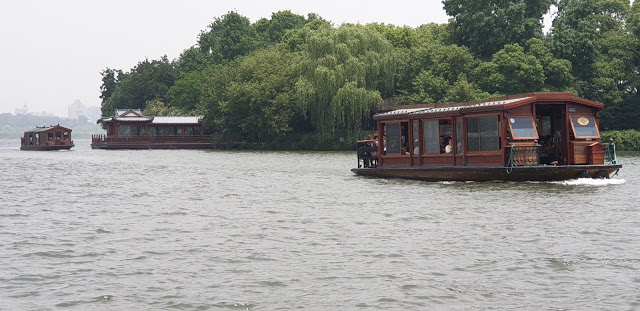
That, in fact, was how the boat ride panned out, about half an hour or more gliding across the lake in an almost silent boat, by an open window, with the air and the majestic scenery.

No, not that boat, which would be great to have lunch on while cruising, but the boat below:

Not quite in the same class, but all the same, very easy to tune out and soak it in.

It was peaceful, amazingly quiet, on a summery day

A pagoda in the hazy distance, an island we were about to circumnavigate.

Of all the legends, the most touching one is the love story between Bai Suzhen and Xu Xi’an. Bai Suzhen was a white snake spirit and Xu Xi’an was a mortal man.

They fell in love when they first met on a boat on the West Lake, and got married very soon after.

However, the evil monk Fa Hai attempted to separate the couple by imprisoning Xu Xi’an. Bai Suzhen fought against Fa Hai and tried her best to rescue her husband, but she failed and was imprisoned under the Leifeng Pagoda by the lake.

Years later the couple was rescued by Xiao Qing, the sister of Baisuzhen, and from then on, Bai Suzhen and Xu Xi’an lived together happily.

The retelling of the story varied between tour guides, and on the cruise boat, we had two.  Our guide kept to the legend, the other tour guide had a different ending.

Suffice to say it had relevance to the two pagodas on the far side of the lake.

There was a cafe or restaurant on the island, but that was not our lunch destination.

Nor were the buildings further along from where we disembarked.

All in all the whole cruise took about 45 minutes and was an interesting break from the hectic nature of the tour.

Oh yes, and the boat captain had postcards for sale.  We didn’t buy any.

Lunch

At the disembarkation point there was a mall that sold souvenirs and had a few ‘fast food’ shops, and a KFC, not exactly what we came to China for, but it seemed like the only place in town a food cautious Australian could eat at.

And when tried to get in the door, that’s where at least 3 busloads were, if they were not in the local Starbucks.  Apparently, these were the places of first choice wherever we went.

The chicken supply by the time we got to the head of the line amounted to pieces at 22.5 RMB a piece and nuggets.  Everything else had run out, and for me, there were only 5 pieces left.  Good thing there were chips.

And Starbucks with coffee and cheesecake.

At least the setting for what could have been a picnic lunch was idyllic.

An excerpt from “The Things We Do For Love”; In love, Henry was all at sea!

In the distance he could hear the dinner bell ringing and roused himself.  Feeling the dampness of the pillow, and fearing the ravages of pent up emotion, he considered not going down but thought it best not to upset Mrs. Mac, especially after he said he would be dining.

In the event, he wished he had reneged, especially when he discovered he was not the only guest staying at the hotel.

Whilst he’d been reminiscing, another guest, a young lady, had arrived.  He’d heard her and Mrs. Mac coming up the stairs, and then shown to a room on the same floor, perhaps at the other end of the passage.

Henry caught his first glimpse of her when she appeared at the door to the dining room, waiting for Mrs. Mac to show her to a table.

She was about mid-twenties, slim, long brown hair, and the grace and elegance of a woman associated with countless fashion magazines.  She was, he thought, stunningly beautiful with not a hair out of place, and make-up flawlessly applied.  Her clothes were black, simple, elegant, and expensive, the sort an heiress or wife of a millionaire might condescend to wear to a lesser occasion than dinner.

Then there was her expression; cold, forbidding, almost frightening in its intensity.  And her eyes, piercingly blue and yet laced with pain.  Dracula’s daughter was his immediate description of her.

All in all, he considered, the only thing they had in common was, like him, she seemed totally out of place.

Mrs. Mac came out of the kitchen, wiping her hands on her apron.  She was, she informed him earlier, chef, waitress, hotelier, barmaid, and cleaner all rolled into one.  Coming up to the new arrival she said, “Ah, Miss Andrews, I’m glad you decided to have dinner.  Would you like to sit with Mr. Henshaw, or would you like to have a table of your own?”

Henry could feel her icy stare as she sized up his appeal as a dining companion, making the hair on the back on his neck stand up.  He purposely didn’t look back.  In his estimation, his appeal rating was minus six.  Out of a thousand!

“If Mr. Henshaw doesn’t mind….”  She looked at him, leaving the query in mid-air.

He didn’t mind and said so.  Perhaps he’d underestimated his rating.

“Good.”  Mrs. Mac promptly ushered her over.  Henry stood, made sure she was seated properly and sat.

“Thank you.  You are most kind.”  The way she said it suggested snobbish overtones.

“I try to be when I can.”  It was supposed to nullify her sarcastic tone but made him sound a little silly, and when she gave him another of her icy glares, he regretted it.

Mrs. Mac quickly intervened, asking, “Would you care for the soup?”

They did, and, after writing the order on her pad, she gave them each a look, imperceptibly shook her head, and returned to the kitchen.

Before Michelle spoke to him again, she had another quick look at him, trying to fathom who and what he might be.  There was something about him.

His eyes, they mirrored the same sadness she felt, and, yes, there was something else, that it looked like he had been crying?  There was a tinge of redness.

Perhaps, she thought, he was here for the same reason she was.

No.  That wasn’t possible.

Then she said, without thinking, “Do you have any particular reason for coming here?”  Seconds later she realized she’s spoken it out loud, had hadn’t meant to actually ask, it just came out.

It took him by surprise, obviously not the first question he was expecting her to ask of him.

“No, other than it is as far from civilization, and home, as I could get.”

At least we agree on that, she thought.

It was obvious he was running away from something as well.

Given the isolation of the village and lack of geographic hospitality, it was, from her point of view, ideal.  All she had to do was avoid him, and that wouldn’t be difficult.

After getting through this evening first.

“Yes,” she agreed.  “It is that.”

A few seconds passed, and she thought she could feel his eyes on her and wasn’t going to look up.

Until he asked, “What’s your reason?”

Slight abrupt in manner, perhaps as a result of her question, and the manner in which she asked it.

She looked up.  “Rest.  And have some time to myself.”

She hoped he would notice the emphasis she had placed on the word ‘herself’ and take due note.  No doubt, she thought,  she had completely different ideas of what constituted a holiday than he, not that she had actually said she was here for a holiday.

Mrs. Mac arrived at a fortuitous moment to save them from further conversation.

Over the entree, she wondered if she had made a mistake coming to the hotel.  Of course, there had been no possible way she could know than anyone else might have booked the same hotel, but realized it was foolish to think she might end up in it by herself.

Was that what she was expecting?

Not a mistake then, but an unfortunate set of circumstances, which could be overcome by being sensible.

Yet, there he was, and it made her curious, not that he was a man, by himself, in the middle of nowhere, hiding like she was, but for very different reasons.

On discreet observance whilst they ate, she gained the impression his air of light-heartedness was forced and he had no sense of humor.

This feeling was engendered by his looks, unruly dark hair, and permanent frown.  And then there was his abysmal taste in clothes on a tall, lanky frame.  They were quality but totally unsuited to the wearer.

Rebellion was written all over him.

The only other thought crossing her mind, and rather incongruously, was he could do with a decent feed.  In that respect, she knew now from the mountain of food in front of her, he had come to the right place.

“Mr. Henshaw?”

He looked up.  “Henshaw is too formal.  Henry sounds much better,” he said, with a slight hint of gruffness.

“Then my name is Michelle.”

Mrs. Mac came in to take their order for the only main course, gather up the entree dishes, then return to the kitchen.

“Staying long?” she asked.

“About three weeks.  Yourself?”

“About the same.”

The conversation dried up.

Neither looked at the other, rather at the walls, out the window, towards the kitchen, anywhere.  It was, she thought, almost unbearably awkward.

Mrs. Mac returned with a large tray with dishes on it, setting it down on the table next to theirs.

“Not as good as the usual cook,” she said, serving up the dinner expertly, “but it comes a good second, even if I do say so myself.  Care for some wine?”

Henry looked at Michelle.  “What do you think?”

“I’m used to my dining companions making the decision.”

You would, he thought.  He couldn’t help but notice the cutting edge of her tone.  Then, to Mrs. Mac, he named a particular White Burgundy he liked and she bustled off.

“I hope you like it,” he said, acknowledging her previous comment with a smile that had nothing to do with humor.

“Yes, so do I.”

Both made a start on the main course, a concoction of chicken and vegetables that were delicious, Henry thought, when compared to the bland food he received at home and sometimes aboard my ship.

It was five minutes before Mrs. Mac returned with the bottle and two glasses.  After opening it and pouring the drinks, she left them alone again.

Henry resumed the conversation.  “How did you arrive?  I came by train.”

“By car.”

“Did you drive yourself?”

And he thought, a few seconds later, that was a silly question, otherwise she would not be alone, and certainly not sitting at this table. With him.

“After a fashion.”

He could see that she was formulating a retort in her mind, then changed it, instead, smiling for the first time, and it served to lighten the atmosphere.

And in doing so, it showed him she had another more pleasant side despite the fact she was trying not to look happy.

“My father reckons I’m just another of ‘those’ women drivers,” she added.

“Whatever for?”

“The first and only time he came with me I had an accident.  I ran up the back of another car.  Of course, it didn’t matter to him the other driver was driving like a startled rabbit.”

“It doesn’t help,” he agreed.

“Do you drive?”

“Mostly people up the wall.”  His attempt at humor failed.  “Actually,” he added quickly, “I’ve got a very old Morris that manages to get me where I’m going.”

The apple pie and cream for dessert came and went and the rapport between them improved as the wine disappeared and the coffee came.  Both had found, after getting to know each other better, their first impressions were not necessarily correct.

“Enjoy the food?” Mrs. Mac asked, suddenly reappearing.

“Beautifully cooked and delicious to eat,” Michelle said, and Henry endorsed her remarks.

“Ah, it does my heart good to hear such genuine compliments,” she said, smiling.  She collected the last of the dishes and disappeared yet again.

“What do you do for a living,” Michelle asked in an off-hand manner.

He had a feeling she was not particularly interested and it was just making conversation.

“I’m a purser.”

“A what?”

“A purser.  I work on a ship doing the paperwork, that sort of thing.”

“I see.”

“And you?”

“I was a model.”

“Was?”

“Until I had an accident, a rather bad one.”

“Oh, I’m sorry.”

So that explained the odd feeling he had about her.

As the evening had worn on, he began to think there might be something wrong, seriously wrong with her because she didn’t look too well.  Even the carefully applied makeup, from close up, didn’t hide the very pale, and tired look, or the sunken, dark ringed eyes.

“I try not to think about it, but it doesn’t necessarily work.  I’ve come here for peace and quiet, away from doctors and parents.”

“Then you will not have to worry about me annoying you.  I’m one of those fall-asleep-reading-a-book types.”

Perhaps it would be like ships passing in the night and then smiled to himself about the analogy.

Dinner now over, they separated.

Henry went back to the lounge to read a few pages of his book before going to bed, and Michelle went up to her room to retire for the night.

But try as he might, he was unable to read, his mind dwelling on the unusual, yet the compellingly mysterious person he would be sharing the hotel with.

Overlaying that original blurred image of her standing in the doorway was another of her haunting expressions that had, he finally conceded, taken his breath away, and a look that had sent more than one tingle down his spine.

She may not have thought much of him, but she had certainly made an impression on him.

© Charles Heath 2015-2020

lovecoverfinal1

“Strangers We’ve Become” – A final countdown to publishing in 6 Days

I ought to be on holiday

…

Now that David has finally worked out what it is that Prendergast wants, and what is required to get back to living in the London residence, though he’s not sure he really wants to go back, arrangements are made by Alisha’s trusty assistants.

Of course, Alicia has to go too, despite the short recovery time, but it seems everyone wants to get back to work, and David realizes that being at the coal face is really what he’s been missing.

Nigeria is probably not the best place to be going, and the head of station there is a rather odd fellow who doesn’t quite understand the subtleties of secrecy.  He’s also Prendergast’s man and that means he can’t be trusted.

David pulls in some old friends he used to work with, and the team assembles in Lagos, and will be travelling to the vicinity of the guerrilla’s camp in the Nigerian Delta by float plane landing near a village whose people have been having trouble, and who will take them by boat to the ‘back door’ of the camp.

It seems the villagers have been petitioning the Queen to help them as members of the Commonwealth.  It provides David and his team a perfect excuse to go there if anyone is asking.

All of this works like clockwork.  And the means to gain entry is simply enough, they are going to present themselves at the gate, and allow themselves to be ‘detained’.  As for being shot on sight, David understands the local warlord ‘type’; he would use David and his team as a bargaining chip with the British Government.

Not that it was going to happen, the warlord was about to discover what war was really like.

…

“One Last Look”, nothing is what it seems

A single event can have enormous consequences.

A single event driven by fate, after Ben told his wife Charlotte he would be late home one night, he left early, and by chance discovers his wife having dinner in their favourite restaurant with another man.

A single event where it could be said Ben was in the wrong place at the wrong time.

Who was this man? Why was she having dinner with him?

A simple truth to explain the single event was all Ben required. Instead, Charlotte told him a lie.

A single event that forces Ben to question everything he thought he knew about his wife, and the people who are around her.

After a near-death experience and forced retirement into a world he is unfamiliar with, Ben finds himself once again drawn back into that life of lies, violence, and intrigue.

From London to a small village in Tuscany, little by little Ben discovers who the woman he married is, and the real reason why fate had brought them together.

It is available on Amazon here:  http://amzn.to/2CqUBcz