Every time I close my eyes, I see something different.
I’d like to think the cinema of my dreams is playing a double feature but it’s a bit like a comedy cartoon night on Fox.
But these dreams are nothing to laugh about.
Once again there’s a new installment of an old feature, and we’re back on the treasure hunt.
…
The Ormiston’s from the papers
…
It was a question of what was I looking for. It would be easy to say I wanted a piece of paper that definitively said where the treasure was or finding a map that led straight to it.
Instead, there was, in one box, a dozen journals filled with the ramblings of a madman.
Searching for treasure had sent Ormiston senior mad. For an hour, perhaps longer, I tried to decipher the spidery writing, and then gave up when it switched to German.
I assembled the journals in order of his expeditions and found the first easy to follow because it was a time of excitement and expectation, that he would find the treasure. There were pages on exactly what he thought the treasure was worth, the sort of pieces they would find, and what he would do with the proceeds.
There were drawings of items off the map and his interpretation of what they represented. It was a rather good description of the coastline and its anomalies as they related to map landmarks. They were, almost all, the same as the Boggs interpretations.
When the discovery didn’t happen, when the first euphoria wore off and the search became bogged down in acrimony and arguments, and the realization the map they were using was not as clear as first believed, that was where it all began to fall apart.
Reading the words, feeling the disappointment seeping off the page, it must have been quite a blow.
The second expedition didn’t start off with the same fanfare, but almost as if they were expected to fail. Too little time had been spent analyzing what went wrong and reidentifying the coastal landmarks.
And, when it did fail, the last comment in the diary was fairly succinct. “What if there is no treasure?”
In another, scrawled heavily on several pages at the back, “look for the big A” was repeated several times, and much underlined.
There were five other boxes with papers, charts, notebooks, and books that belonged on a shelf but instead were neatly stacked. They’d been in the boxes for some time, and had that aroma books got when left in the damp too long, and, in fact, when I tried to open some, the pages had stuck together.
A lot of the books were about pirates, reference texts, and fiction. Part of one box was set aside for our particular pirate, and, reading through what could be read, a lot of the information was contradictory. One book postulated that the said pirate wasn’t a pirate at all, casting doubt on whether he ever existed at all.
The maps were a different story, and, yes, they were all similar except for small details an observation I had made before. None had what I would have called ‘new’ features, just a rehash of all the others. Some were old, but most had the appearance of being made to look old.
Then, at the bottom of a box of books, were copies of newspaper articles, aged, stained, and some in various stages of disintegration. The Bahama Argus, The Barbadian, The Antigua Herald and Gazette, The Bermuda Colonist, and the Dominica Chronicle. All had references to Captain Johannsson, and his vessel, the Sea Serpent.
There was such a Captain, and there was such a ship, and there were reports of a vessel roving the seas, looking for prey. And those reports covered a great deal of plunder, definitely the sort that would find its way into a number of sea chests.
But, was this the treasure that Ormiston believed was hidden somewhere in The Grove?
Something caught my attention on the first diary, the way it sat and the light reflected off it, and picking it up and looking at it showed no anomaly in the surface, not until it sat on a certain angle and in the sunlight.
A slight ripple down one edge of the spine, and with careful probing, there was a split in the material of the cover pasted back down, but in the time since it had been glued back, the glue had dissolved and the simple act of picking the book up and parted the split.
Lifting it gently, I could see a piece of paper tucked in and gently coaxed it out.
It was very thin and fragile, but the writing was clear. Entries from what might have been a logbook. I knew this only because I had been out of a sailing boat once when at school, and had seen the boat’s logbook, noting where the boat had been.
This page had only a few entries, the location of its departure, in latitude and longitude, a number of the daily distances traveled, and conditions, and the last, another latitude and longitude.
When I put the first coordinates into my GPS, it was near the island of Antigua, and then the destination, just up the coast near the old mall. The name of the vessel, in almost illegible writing, the Sea Serpent.
So, there was a logbook, although it might not exist now, it did at some point in the past, and Ormiston had either found it or seen it. The writing on the piece of paper was his. It proved, if it was authentic, there was a ship, and it did come to this coast.
I carefully folded it and hid it in my wallet, then replaced everything where I found it. Enough research for today. I tried not to look guilty when I left.
It’s like working in two offices, one uptown, and one downtown.
I have two blogs, this one, and another which is purely for writing, and generally, a lot of starts and not a lot of finishes. I get ideas, and it’s a place to store them, and give a few people some amusement at my, sometimes, improbable situations and far-fetched stories.
Here I try to be more serious.
I have the ceiling, the cinema of my dreams. Here anything is possible, like jumping from a helicopter about to explode, and survive, and get out of a sinking ship, like Houdini. Of course, there is always one time when it doesn’t work, and Houdini knows that all too well.
Over there, I have a series which I started here, long ago, where I take a photograph and write a story inspired by it. The interesting thing about that is I could probably use the same photograph over and over, and it would inspire a different tale.
I know, if I was running a writing class, everyone would see that photograph differently.
But what amazes me sometimes is the fact the story is not directly related to the theme. It got me thinking about how we view our experiences, and what triggers memories. I’ve discovered that it doesn’t necessarily happen by correlation, say, for instance, a memory of being in New York might be triggered by a visit to a cafe in Cloncurry.
I try to do one of these every day, but sometimes it’s hard work. Writing itself can be some days, particularly when the words are lurking there, behind that invisible, impenetrable, rock wall.
OK, so I’m stuck in the middle of writing a piece over there, and I’ve come over here to whinge.
But, enough. I’ll let you know what the cinema of my dreams is showing, later.
There’s something to be said for a story that starts like a James Bond movie, throwing you straight in the deep end, a perfect way of getting to know the main character, David, or is that Alistair?
A retired spy, well, not so much a spy as a retired errand boy, David’s rather wry description of his talents, and a woman that most men would give their left arm for, not exactly the ideal couple, but there is a spark in a meeting that may or may not have been a setup.
But as the story progressed, the question I kept asking myself was why he’d bother.
And, page after unrelenting page, you find out.
Susan is exactly the sort of woman to pique his interest. Then, inexplicably, she disappears. That might have been the end of it, but Prendergast, that shadowy enigma, David’s ex-boss who loves playing games with real people, gives him an ultimatum: find her or come back to work.
Nothing like an offer that’s a double-edged sword!
A dragon for a mother, a sister he didn’t know about, Susan’s BFF who is not what she seems or a friend indeed, and Susan’s father, who, up till David meets her, couldn’t be less interested, his nemesis proves to be the impossible dream, and he’s always just that one step behind.
When the rollercoaster finally came to a halt, and I could start breathing again, it was an ending that was completely unexpected.
I’m back home and this story has been sitting on a back burner for a few months, waiting for some more to be written.
The trouble is, there are also other stories to write, and I’m not very good at prioritising.
But, here we are, a few minutes opened up and it didn’t take long to get back into the groove.
An interrogation and a revelation.
Debriefings were like interrogations, only friendlier. We were trained to withstand interrogation, so it would be interesting to see how I reacted. I had no doubt what some of the questions would be.
While I had a few minutes to myself, sitting down behind a bare metal table on a hard plastic and uncomfortable chair, with a warm cup of station house coffee, to consider the briefing.
Target, male, 6 foot 3 inches, 200 pounds, Caucasian, thought to be from either Russia or Bulgaria, but nothing to define his as such. I had wondered, at the time, what that meant. When I saw him in the alley I knew, then, what was meant, he looked the same as you or me.
No explanation for why he was under surveillance, but we did get a warning that he might be dangerous if he suspected he was being observed. Right about that, given team casualties.
Main objective, who he met, talked to, and where he went, every place, every detail to be noted. The unpredictable explosion threw the whole operation into chaos.
The door opened and a woman, middle-aged, conservatively dressed, walked in, closing it behind her. She sat in the other chair opposite me. She brought a file, thin, and put it in front of her on the table.
“Your name is Sam Jackson?”
“Yes.”
No introductions, nothing, just a start on the questions. No nonsense, but I could see she was very, very angry. With me, or those who had run a failed operation?
“How long have you been with us?”
“Eight months.”
She opened the file and glanced at the piece of paper on top. A minute passed before she closed the file again. “Closer to nine,” she said.
I said nothing. I wasn’t counting the days.
“How many operations have you been on?”
“Six, including this one.”
“Who assigned you to this specific operation?”
“Couldn’t say. I got the usual request via text message to attend a briefing at the midtown office.”
“What was the designated operation name?”
“Chancellery.”
For a brief second, there was a quizzical expression on her face, then it was gone.
“Who was running this operation?”
“Director Severin.”
A full three minutes of silence passed. I thought she was looking at me, the sort of stare that would break a lesser man, but in the end, I think she was looking right through me. I could not read her thoughts, but if I was to guess, they would be rather dark right now.
Then she spoke.
“You should know that there was no Chancellery on the books, and we certainly do not have a Director named Severin.”
Every time I close my eyes, I see something different.
I’d like to think the cinema of my dreams is playing a double feature but it’s a bit like a comedy cartoon night on Fox.
But these dreams are nothing to laugh about.
Once again there’s a new installment of an old feature, and we’re back on the treasure hunt.
…
The Ormiston’s from the papers
…
The Ormiston story and that of the thousand or so acres between the sea and the mountains are now known as Patterson’s reach, but once called The Grove, began in 1865 when the original Henrich Ormiston arrived from Germany.
Originally intending to go to Australia to grow grapes in South Australia, instead, his fate turned West to the Americas, and, eventually, this part of Florida. He started out with the intention of growing grapes, but when that failed to materialize, he moved on to Oranges, hence the name, The Grove.
He had married before leaving Germany and had two children, Marta and Gunter before leaving, and Friedrich after he arrived in 1866. That Friedrich died, according to the gravestone, in 1924. Neither Marta nor Gunter stayed, leaving Friedrich to carry on the business, have an only child which he named after his father, Heinrich, born in 1899 and who died in 1976. He in turn had a single son, which he named Friedrich, the infamous person with who Boggs father had a tempestuous business relationship.
Friedrich was born in 1932, during the depression, and it was about that time that the notion there might be buried treasure, somewhere along that coastal area of Florida, floated by a university professor, Emil Stravinsky, who specialized in old pirates. He had published a book that basically speculated where treasure might be found, and one of those areas was right smack bang in the middle of The Grove.
This information was plucked from the paper’s births, death, and marriages column around the specified dates, the death notices giving some light on the respective Ormiston’s life and toils on their land.
Heinrich, Friedrich’s father, fell for the story hook line and sinker, and with a promise to share the proceeds of an estimated multimillion-dollar trove, invested a fair chunk of the savings he’d amassed over the years in the first of many treasure hunts. The name Stravinsky rang a bell in my head.
A quick look forward to the most recent editions showed it was the man who had died on Rico’s boat, who was, in fact, a third-generation relative of the original professor, an archaeologist in his own right, and digging a bit further into the story, the paper had published a dozen or so extracts from the professor’s book, hinting their subject matter had been derived from a particular pirate’s log, and from notes made over the years of research by the professor. It sounded like there was a diary.
I was going to have to find a copy of the professor’s book, which, if it had been published nearly 90 years ago, would now be out of print.
When the father, Heinrich had failed to locate the treasure, the son Friedrich continued the search, only he put more time and effort into more meticulous research rather than take the professor’s word of its whereabouts.
This was about the time Boggs’s father came into the picture.
He had lived and worked in the Caribbean and discovered quite by chance when a storm had blown his boat way off course on a weekend sailing run, the ruins of an encampment and hidden inlet on an uninhabited island where he believed the pirate had operated from.
While waiting to be rescued, the storm had damaged his boat, he took the time to explore, and although he hadn’t told anyone at the time of his rescue, he had discovered a box buried near where a building had once stood containing a map, several coins, a sextant, and a flag. The news of those discoveries came some years later when it was revealed he’s struck a deal with Ormiston to renew the search for the treasure.
When the result of that expedition came to nothing, each of the partners blamed the other for the lack of success, with Ormiston all but telling anyone who would listen that Boggs had created the map himself for the purpose of extorting money under false pretenses.
Boggs then had to produce the map, where it was authenticated as a map that had been created at the time of the pirate’s reign, but no one could say whether it was just an invention of someone at the time, or it was real. The fact nothing was found suggested the latter, and it marked to start of the feud between Boggs and Ormiston.
The question in my mind was whether Boggs had that particular map, and had he shown it briefly to me? Certainly, one of the maps he had was quite old, but there were so many variations, and they all looked equally as old, it was hard to tell.
One point I was quite certain on, none of the maps I’d seen showed the treasure’s final resting place as being in a cave, and I got the impression just before when I’d run into Boggs, that it was exactly where he was going.
Had that been the clue his father had referred to? Even with the so-called original map, if it showed the treasure hidden in a cave why did Boggs need Ormiston’s help?
Had Ormiston known that might be the final resting place of the treasure?
I would soon find out. My next stop was the library.
Who could imagine that one visit to the local hospital could fuel a medical nightmare?
Aside from the original suspicion I was having heart problems, doctors started lining up appointments for an endoscopy and colonoscopy, though I suspect these were for a different malady, and the main event, an angiogram.
I didn’t have heart problems though it was possible I had angina, the reason for the angiogram, but I did have acute kidney failure which was interesting, to say the least, and possibly attributed to ipBrufen, though it was impossible to say if the medication for psoriatic arthritis, a venomous little pill called methotrexate, was or was not a contributing factor.
But is was great to learn that my psioratic arthritis could lead to heart attack, and lung issues, a few problems my original arthritis consultant conveniently forgot to tell me about.
No sooner than I was released from the hospital after this first set of maladies, I was back three or four days later with hospital-acquired pneumonia, a devil of a problem that requires some very invasive searches for the type of bug so it could be treated properly.
It led to five days of antibiotics, a considerable inability to breathe without help from an oxygen mask, and several CT scans with and without dye to get a better look at the problem.
If only that was all that was wrong with me.
The CT scan showed up a lump or lesion on my right thyroid which led to further investigation, an ultrasound, a biopsy, and a visit to the surgeon to be told it had to come out.
But that’s not all. No, I didn’t get a set of steak knives for being one the first ten this week to be diagnosed with anything, I was told my PSA reading was twice the average for my age, a clear indication I might have prostate cancer.
Wow. Just to sort of news you need to hear before the weekend. Worse perhaps than a rainstorm when camping in a floorless tent. I had to now wait for the results of a new blood test.
Ok. I get it that things are bound to go wrong when you get older, but what I object to is everything going wrong at once.
Perhaps when we stop the aging process a lot of these issues will go away, but I fear not. The human body is surprisingly robust for quite a long time despite our attempts to test it to the limits of endurance.
It is advice too late for me to make sure my misspent youth is not wasted on being stupid or believing I’m indestructible. The plain truth is, we are not, and I didn’t get the memo.
Now, I guess, it is time to actually do everything, or as much as I can, before I start to deteriorating further and not be able to do anything. I have a few good years before arthritis sets in and makes life more difficult than it already is.
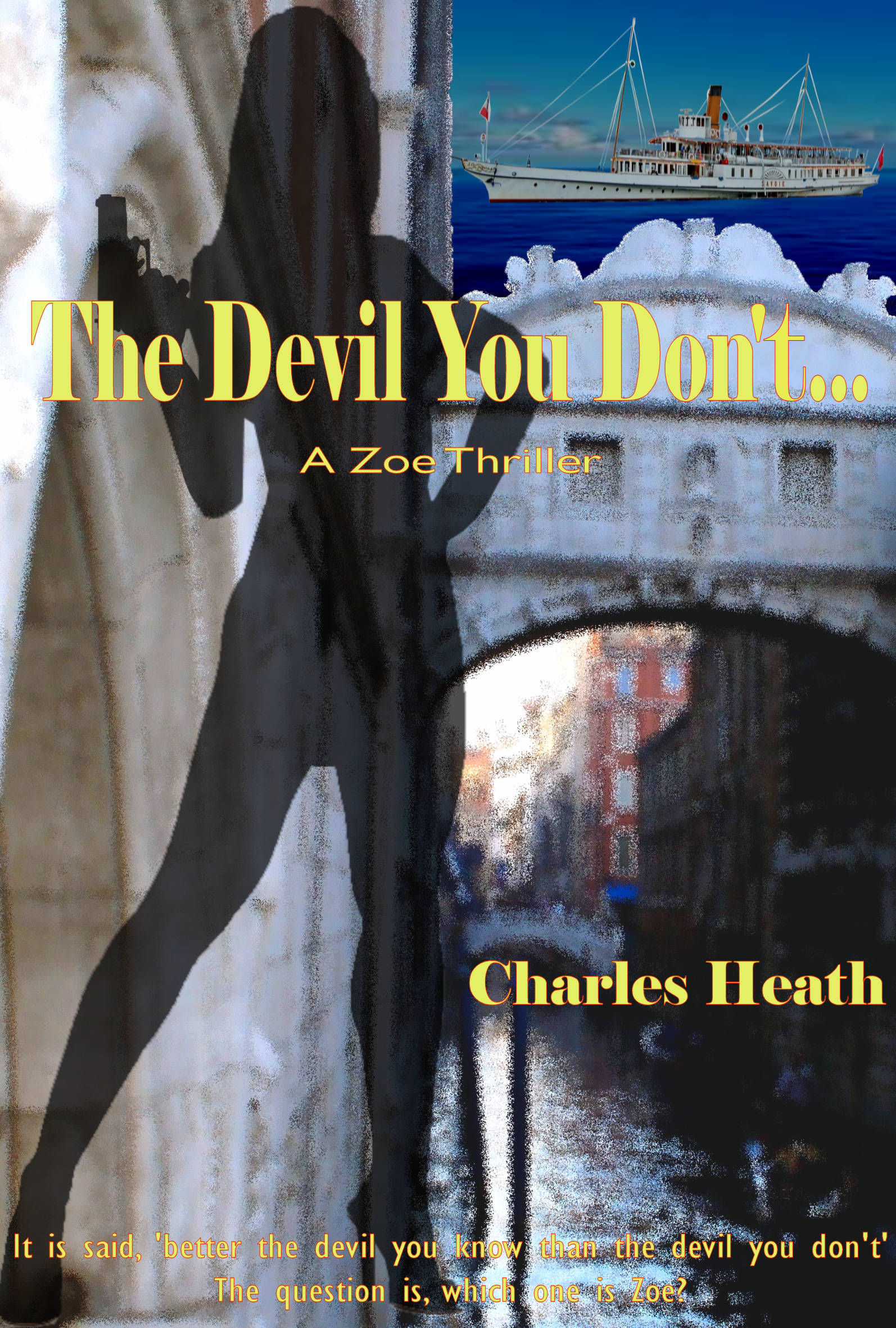
It could be said that of all the women one could meet, whether contrived or by sheer luck, what are the odds it would turn out to be the woman who was being paid a very large sum to kill you?
John Pennington is a man who may be lucky in business, but not so lucky in love. He has just broken up with Phillipa Sternhaven, the woman he thought was the one, but relatives and circumstances, and perhaps because she was a ‘princess’, may also have contributed to the end result.
So, what do you do when you are heartbroken?
That is a story that slowly unfolds, from the first meeting with his nemesis on Lake Geneva, all the way to a hotel room in Sorrento, where he learns the shattering truth.
What should have been solace after disappointment turns out to be something else entirely, and from that point, everything goes to hell in a handbasket.
He suddenly realises his so-called friend Sebastian has not exactly told him the truth about a small job he asked him to do, the woman he is falling in love with is not quite who she says she is, and he is caught in the middle of a war between two men who consider people becoming collateral damage as part of their business.
The story paints the characters, cleverly displaying all their flaws and weaknesses. The locations add to the story at times, taking me back down memory lane, especially to Venice, where, in those back streets, I confess it’s not all that hard to get lost.
All in all, a thoroughly entertaining story with, for once, a satisfying end.
I’m back home and this story has been sitting on a back burner for a few months, waiting for some more to be written.
The trouble is, there are also other stories to write, and I’m not very good at prioritising.
But, here we are, a few minutes opened up and it didn’t take long to get back into the groove.
A body and a whole bunch of questions.
A full minute passed, with only one car passing, the rest of the time there was a strange sort of silence.
The man on the ground didn’t move. Whoever shot him had shot to kill. I took the few steps to stand beside him and could see the hole and the bloodstain of the wound. Shot in the heart, instant death.
Usually, if it was a sniper, it was a head shot. Less chance of missing a vital organ and leaving the target alive.
Odd too that it was just before he told me where some ‘evidence’ was located. And who the hell was this Alfred Nobbin?
I heard a car turn into the alley and come towards me. Halfway, it stopped, the engine switched off, and the doors opened.
Two men. Maury, my handler, and Severin, the instructor. Neither was carrying a gun, so neither had shot him. That meant someone else was still in play.
I said, “I had him, but someone shot him.”
Stating the obvious, Maury’s expression told me.
“You’re not dead.”
“Perhaps I wasn’t a target.”
“Today. Did he say who he was?”
“No.”
No hesitation or they’ll think I’m lying, which I am. I was not sure why, but was it because I detected a note of sincerity in the target’s tone?
“Checked for identification yet?”
“Just about to.” I knelt down and went through his pockets. Nothing. I told Maury that.
“Pity.” He hadn’t moved from where he stopped. Severin had been looking back up the alley, no doubt looking for where the bullet came from.
Had he reached the same conclusion I had, a balcony on the third floor of the left-hand building? The shooter would be long gone by now.
A white van pulled into the lane and pulled up behind Maury’s car. The cleaners.
It raided questions. How did Maury know we’d be here, and that the target would be shot dead? Or had he assumed I’d all but kill him in revenge for what had happened to the others.
What had happened to the others?
“The rest of the team,” I asked.
“Two dead, one critical. One safe. Let’s go. We need to have a debriefing.”
I took a last look at the body, the joined Maury and Severin in the car. I had questions of my own.
“A bad day’s work,” Severin muttered, as he drove off.
“But conclusive proof we have a traitor, the last thing we need right now.”
I was surprised they were discussing high-level matters that I considered above my pay grade. And, I had to say, it worried me.
Williams’ Restaurant, East 65th Street, New York, Saturday, 8:00 p.m.
We met the Blaines at Williams’, a rather upmarket restaurant that the Blaines frequently visited and had recommended.
Of course, during the taxi ride there, Alison reminded me that with my new job, we would be able to go to many more places like Williams’. It was, at worst, more emotional blackmail, because as far as Alison was concerned, we were well on our way to posh restaurants, the Trump Tower Apartments, and the trappings of the ‘executive set’.
It would be a miracle if I didn’t strangle Elaine before the night was over. It was she who had filled Alison’s head with all this stuff and nonsense.
Aside from the half-frown, half-smile, Alison was looking stunning. It had been months since she had last dressed up, and she was especially wearing the dress I’d bought her for our 5th anniversary that cost a month’s salary. On her, it was worth it, and I would have paid more if I had to. She had adored it and me, for a week or so after.
For tonight, I think I was close to getting back on that pedestal.
She had the looks and figure to draw attention, the sort movie stars get on the red carpet, and when we walked into the restaurant, I swear there were at least five seconds of silence, and many more gasps.
I even had a sudden loss of breath earlier in the evening when she came out of the dressing room. Once more, I was reminded of how lucky I was that she had agreed to marry me. Amid all those self-doubts, I couldn’t believe she had loved me when there were so many others out there who were more appealing.
Elaine was out of her seat and came over just as the Head Waiter hovered into sight. She personally escorted Alison to the table, allowing me to follow like the Queen’s consort, while she and Alison basked in the admiring glances of the other patrons.
More than once, I heard the muted question, “Who is she?”
Jimmy stood, we shook hands, and then we sat together. It was not the usual boy, girl, boy, girl seating arrangement. Jimmy and I on one side and Elaine and Alison on the other.
The battle lines were drawn.
Jimmy was looking fashionable, with a permanent blade one beard, unkempt hair, and a designer dinner suit that looked like he’d slept in it. Alison insisted I wear a tuxedo, and I looked like the proverbial penguin or just a thinner version of Alfred Hitchcock.
The bow tie had been slightly crooked, but just before we stepped out, she had straightened it. And took the moment to look deeply into my soul. It was one of those moments when words were not necessary.
Then it was gone.
I relived it briefly as I sat and she looked at me. A penetrating look that told me to ‘behave’.
When we were settled, Elaine said, in that breathless, enthusiastic manner of hers when she was excited, “So, Harry, you are finally moving up.” It was not a question, but a statement.
I was not sure what she meant by ‘finally’, but I accepted it with good grace. Sometimes, Elaine was prone to using figures of speech I didn’t understand. I guessed she was talking about the new job. “It was supposed to be a secret.”
She smiled widely. “There are no secrets between Al and me, are there, Al?”
I looked at ‘Al’ and saw a brief look of consternation.
I was not sure Alison liked the idea of being called Al. I tried it once and was admonished. But it was interesting that her ‘best friend forever’ was allowed that distinction when I was not. It was, perhaps, another indicator of how far I’d slipped in her estimation.
Perhaps, I thought, it was a necessary evil. As I understood it, the Blaines were our mentors at the Trump Tower, because they didn’t just let ‘anyone’ in. I didn’t ask if the Blaines thought we were just ‘anyone’ before I got the job offer.
And then there was that look between Alison and Elaine, quickly stolen before Alison realised I was looking at both of them. I was out of my depth, in a place I didn’t belong, with people I didn’t understand. And yet, apparently, Alison did. I must have missed the memo.
“No,” Alison said softly, stealing a glance in my direction, “No secrets between friends.”
No secrets. Her look conveyed something else entirely.
The waiter brought champagne, Krug, and poured glasses for each of us. It was not the cheap stuff, and I was glad I brought a couple of thousand dollars with me. We were going to need it.
Then, a toast.
To a new job and a new life.
“When did you decide?” Elaine was effusive at the best of times, but with the champagne, it was worse.
Alison had a strange expression on her face. It was obvious she had told Elaine it was a done deal, even before I’d made up my mind. Perhaps she’d assumed I might be ‘refreshingly honest’ in front of Elaine, but it could also mean she didn’t really care what I might say or do.
Instead of consternation, she looked happy, and I realised it would be churlish, even silly, if I made a scene. I knew what I wanted to say. I also knew that it would serve little purpose provoking Elaine or upsetting Alison. This was not the time or the place. Alison had been looking forward to coming here, and I was not going to spoil it.
Instead, I said, smiling, “When I woke up this morning and found Alison missing. If she had been there, I would not have noticed the water stain on the roof above our bed, and decided there and then how much I hated the place.” I used my reassuring smile, the one I used with the customers when all hell was breaking loose, and the forest fire was out of control. “It’s the little things. They all add up until one day …” I shrugged. “I guess that one day was today.”
I saw an incredulous look pass between Elaine and Alison, a non-verbal question; perhaps, is he for real? Or, I told you he’d come around.
I had no idea the two were so close.
“How quaint,” Elaine said, which just about summed up her feelings towards me. I think, at that moment, I lost some brownie points. It was all I could come up with at short notice.
“Yes,” I added, with a little more emphasis than I wanted. “Alison was off to get some studying in with one of her friends.”
“Weren’t the two of you off to the Hamptons, a weekend with some friends?” Jimmy piped up and immediately got the ‘shut up, you fool’ look that cut that line of conversation dead. Someone forgot to feed Jimmy his lines.
It was followed by the condescending smile from Elaine, and “I need to powder my nose. Care to join me, Al?”
A frown, then a forced smile for her new best friend. “Yes.”
I watched them leave the table and head in the direction of the restroom, looking like they were in earnest conversation. I thought ‘Al’ looked annoyed, but I could be wrong.
I had to say Jimmy looked more surprised than I did.
There was that odd moment of silence between us, Jimmy still smarting from his death stare, and for me, the Alison and Elaine show. I was quite literally gob-smacked.
I drained my champagne glass, gathering some courage and turned to him. “By the way, we were going to have a weekend away, but this legal tutorial thing came up. You know Alison is doing her law degree.”
He looked startled when he realised I had spoken. He was looking intently at a woman several tables over from us, one who’d obviously forgotten some basic garments when getting dressed. Or perhaps it was deliberate. She’d definitely had some enhancements done.
He dragged his eyes back to me. “Yes. Elaine said something or other about it. But I thought she said the tutor was out of town and it had been postponed until next week. Perhaps I got it wrong. I usually do.”
“Perhaps I’ve got it wrong.” I shrugged as the dark thoughts started swirling in my head again. “This week or next, what does it matter?”
Of course, it mattered to me, and I digested what he said with a sinking heart. It showed there was another problem between Alison and me; she might have been telling me lies. If what he said was true and I had no reason to doubt him, where was she going tomorrow morning, and had she really been with a friend studying today?
We poured some more champagne, had a drink, then he asked, “This promotion thing, what’s it worth?”
“Trouble, I suspect. Definitely more money, but less time at home.”
“Oh,” raised eyebrows. Obviously, the women had not talked about the job in front of him, or, at least, not all the details. “You sure you want to do that?”
At last, the voice of reason. “Me? No.”
“Yet you accepted the job.”
I sucked in a breath or two while I considered whether I could trust him. Even if I couldn’t, I could see my ship was sinking, so it wouldn’t matter what I told him, or what Elaine might find out from him. “Jimmy, between you and me, I haven’t as yet decided one way or another. To be honest, I won’t know until I go up to Barclay’s office and he asks me the question.”
“Barclay?”
“My boss.”
“Elaine’s doing a job for a Barclay who recently moved into the tower a block down from us. I thought I recognised the name.”
“How did Elaine get the job?”
“Oh, Alison put him onto her.”
“When?”
“A couple of months ago. Why?”
I shrugged and tried to keep a straight face, while my insides were churning up like the wake of a supertanker. I felt sick, faint, and wanted to die all at the same moment. “Perhaps she said something about it, but it didn’t connect at the time. Too busy with work, I expect. I think I seriously need to get away for a while.”
I could hardly breathe, my throat was constricted, and I knew I had to keep it together. I could see Elaine and Alison coming back, so I had to calm down. I sucked in some deep breaths and put my ‘manage a complete and utter disaster’ look on my face.
And I had to change the subject, quickly, so I said, “Jimmy, Elaine told Alison, who told me, you were something of a guru of the cause and effects of the global economic meltdown. Now, I have a couple of friends who have been expounding this theory …”
Like flicking a switch, I launched into the well-worn practice of ‘running a distraction’, like at work when we needed to keep the customer from discovering the truth. It was one of the things I was good at, taking over a conversation and pushing it in a different direction. It was salvaging a good result from an utter disaster, and if ever there was a time that it was required, it was right here, right now.
When Alison sat down and looked at me, she knew something had happened between Jimmy and me. I might have looked pale or red-faced, or angry or disappointed, but it didn’t matter. If that didn’t seal the deal for her, the fact that I took over the dining engagement did. She knew well enough that the only time I did that was when everything was about to go to hell in a handbasket. She’d seen me in action before and had been suitably astonished.
But I got into gear, kept the champagne flowing and steered the conversation, as much as one could from a seasoned professional like Elaine, and, I think, in Jimmy’s eyes, he saw the battle lines and knew who took the crown on points. Neither Elaine nor Jimmy suspected anything, and if the truth be told, I had improved my stocks with Elaine. She was at times both surprised and interested, even willing to take a back seat.
Alison, on the other hand, tried poking around the edges, and, once when Elaine and Jimmy had got up to have a cigarette outside, questioned me directly. I chose to ignore her and pretend nothing had happened, rather than tell her how much I was enjoying the evening.
She had her ‘secrets’. I had mine.
At the end of the evening, when I got up to go to the bathroom, I was physically sick from the pent-up tension and the implications of what Jimmy had told me. It took a while for me to pull myself together; so long, in fact, that Jimmy came looking for me. I told him I’d drunk too much champagne, and he seemed satisfied with that excuse. When I returned, both Alison and Elaine noticed how pale I was, but neither made any comment.
It was a sad way to end what was supposed to be a delightful evening, which, to a large degree, it was for the other three. But I had achieved what I set out to do: to play them at their own game, watching the deception once I knew there was one, as warily as a cat watches its prey.
I had also discovered Jimmy’s real calling; a professor of economics at the same University Alison was doing her law degree. It was no surprise in the end, on a night where surprises abounded, that the world could really be that small.
We parted in the early hours of the morning, a taxi whisking us back to the Lower East Side, another taking the Blaines back to the Upper West Side. But, in our case, as Alison reminded me, it would not be for much longer. She showed concern for my health and asked me what was wrong. It took all the courage I could muster to tell her it was most likely something I ate and the champagne, and that I would be fine in the morning.
She could see quite plainly it was anything other than what I told her, but she didn’t pursue it. Perhaps she just didn’t care what I was playing at.
And yet, after everything that had happened, once inside our ‘palace’, the events of the evening were discarded, like her clothing, and she again reminded me of what we had together in the early years before the problems had set in.
It left me confused and lost.
I couldn’t sleep because my mind had now gone down that irreversible path that told me I was losing her, that she had found someone else, and that our marriage was in its last death throes.
And now I knew it had something to do with Barclay.
Every time I close my eyes, I see something different.
I’d like to think the cinema of my dreams is playing a double feature but it’s a bit like a comedy cartoon night on Fox.
But these dreams are nothing to laugh about.
Once again there’s a new installment of an old feature, and we’re back on the treasure hunt.
…
Back to the newspaper office
…
I went around to Boggs’s house on the chance that he might have come home, just as his mother was heading off to her night job. I raised the possibility that something might have happened to him but she didn’t agree, nor did she look all that concerned.
The fact he had experience in cave exploration and used to camping out with his father and later uncle Rico and had told he might not be back for a few days was not cause for concern, and we left it at that, telling her I would drop in again soon.
She didn’t seem to think that he might get into trouble considering the instability of some of the caves, nor the fact they have warning signs and or been boarded up to stop explorers concern her.
The possibility it could happen and had happened to others, bothered me, as was the fact he was starting to emulate his father with this obsession. If the story in the paper was anything to go by, at worst he could finish up just like his father, buried under a pile of rubble.
Did I believe that was where his father was?
I didn’t know what to think, because the waters were so muddied by people who were driven by self-interest.
There was so much more to this story, mostly driven by self-interest, revenge perhaps, and, worse, greed. It was perhaps a symptom of everything that had gone wrong in not only this town but what was happening on a much larger scale to the whole country. But, that was someone else’s problem. My concern was here, now, and saving Biggs from following the same destructive path his father had
And, to do that, I needed to know more. That meant, first thing the next morning, a trip to the newspaper office.
When I returned to the newspaper office Lenny was in his usual seat with a paper in hand, reading. Keeping up with the competition, he said, though the difference in circulation was counted in millions.
There was a woman behind the other desk.
“Staff journalist,” he said when he saw me looking at her. “And family. My wife, Jennifer.”
I’d not seen her before, and she didn’t come from here, or I would have recognized her.
She smiled, and there was something in that expression that struck me as familiar.
“Are you related to the Ormistons?”
It was a vague resemblance, after seeing so many pictures of the Ormistons, that everyone looked like them.
“It’s a name I don’t use anymore,” she said, “for obvious reasons. My grandfather stirred a lot of resentment.”
“And,” Lenny added, “it’s between us and these four walls, Sam.”
I nodded. I could understand the sentiment. And it explained Lenny’s depth of knowledge.
“Just to be clear, your grandfather didn’t find the treasure?”
She sighed.
Lenny said, sharply, “Sam!”
I shrugged. “Sorry. I had to ask.”
“No, he did not, and believe me, that’s a sore point with everyone whose lives he destroyed.”
“I can imagine. Does anyone know what happened to him, the real story?”
“There is no real story Sam. I tried to discover the truth and failed. For Jennifer’s peace of mind. We may never know what happened to him.”
“But surely you don’t believe he died in a cave somewhere?”
“It’s the most plausible.”
“And what about Boggs’s father?”
“He was a fool,” Jennifer said. “From what I remember of him, he was always insistent that the treasure was in a cavern up in the hills, accessible only by an underground river that flowed down to the sea. He originally thought it was the one the mall was built over, except every cave had a dead end.”
“Before or after the mall was built?”
“My father explored the cave system, with my grandfather, extensively, before the mall was built. There was no underground river.”
“How did the mall get destroyed in a flood then?”
“That was the Benderby’s cost-cutting the foundations. The flooding was man-made, not an act of nature like they said it was. That was just so they could claim the insurance. No one could really tell the difference, and the specialist the got to sign off on it lied. The same guy that turned up dead on Rico’s boat, by the way.”
“The Benderby’s cleaning up another mess, but their way.” Jennifer sounded, and probably had every right to be, resentful.
“Then there still could be an underground river somewhere along the coast?”
“If there is, I haven’t found it, and neither has Alex and that fancy boat of his. It’s another dead end, and like as not, another nail in the coffin of what was a fairy tale, to begin with. There was no treasure, just a fable invented by the Cossatinos.”
“Even so, it’s part of the folklore of this county and will have a place in the history I’m writing. I noticed over the years the treasure had a prominent place in the paper.”
“My father, and his before him thought it would be good for the town. You know, bring in tourists. It was my father’s idea to print treasure maps, and then the Cossatino’s embellished it but producing what they called ‘the real map’ each a slight variation on the other, commanding a special fee, and swearing the purchases to a promise of silence, and adding to the authenticity, demanding a 19 percent share of whatever they found. People lapped it up and my father said they’d made a fortune out of it. Boggs’s father hand-made the copies, and used that money to fund his own explorations. Everyone made money out of it, one way or another except Ormiston.”
A bitter irony if there was ever one. There was more money in the illusion of treasure than the actual treasure itself.
“And the so-called real map that Boggs reputedly found in the pirate’s hideaway?”
“No one ever saw it, except that one time it was authenticated age-wise, so no one ever got to see it. Boggs made sure of that, and never let it out of his sight. Now we’ll never know. I’m sure Boggs junior doesn’t have it, but with him, he’s as daft as his father was.”
“He had a lot of his father’s stuff he found in a box in the attic recently. I’ve seen some of it, but not an authentic map, so maybe your right.”
“Of course I am. When you have an idea of what this history of yours is going to look like, let me know. And I’ll publish it in parts if you want, maybe pass it on to the dailies. It might be worth something.”
“Thanks. I will. But more study first, you have the history of the place in that back room, maybe you should write something yourself. Being the journalist.”
“Too busy with births deaths and marriages, Sam, and the antics of the Benderby’s and Cossatino’s. You know that Benderby is demolishing the mall and putting a marina in its place? Talk of building a hotel, boosting tourism. Talking of running for mayor, you know, the first stop on the way to the presidency?”
“A crook for a mayor?”
“Wouldn’t be the first, won’t be the last. But one thing is for sure, that kind of news sells papers.”
It did, but I had a feeling the Benderby’s were all about creating a distraction, and something else was going on at that mall site.


 Thrills, Spills, and just a dash of Romance