“Because it’s not me” – a short story

If the was one fault I had, it was prevarication.

For a long time, I had always been afraid of making a mistake, after I had done exactly that.  They said our mistakes didn’t define us, but that one had.  I had lost the trust of everyone, from my parents to friends.

It was only a small lie, or so I told myself, but it had far-reaching ramifications, and almost cost someone their life.  But whilst I believed it was not all that bad, and the police had agreed that anyone who had been put in the same position would have done the same, there were those who didn’t agree.

It was a moment in time I often relived in my mind, over and over, and eventually led to several outcomes.

The first, I left home, the town where up till then I’d lived all of my life, walking away from family and those who used to be friends, knowing that what they said and what they felt were two entirely different things.  For all concerned, it was better that I left, cutting all ties, and make a fresh start, away from those whom I knew would never forget, even though they forgave me.

The second, and most dire, I changed my name, and my history, even how I looked.  Today, I was a very different person to that of thirty years ago.

The third, I moved to another country and vowed never to return, always looking constantly over my shoulder, expecting someone from the past to find me.  I instinctively knew that I would never escape, that one day a stark reminder would come back and destroy everything.

I picked the one occupation that would keep me both occupied and invisible.

Journalist.

I had started at the bottom, literally writing death notices, and worked my way up to what is ubiquitously known as ‘foreign correspondent’, going to places where no one else would go, those hotbeds of unrest, and war zones, reporting from both sides.

Perhaps it could say I had a death wish, a statement my editor had once said when he came to see me in hospital back in London after I’d been caught up in a rocket attack and repatriated.  He had come to offer me a job back home, to tell me my tour was over.

I declined the opportunity, and he left, shaking his head.

But that was not the only visitor that came to the hospital that day.  The other visitor was an elderly man, immaculately dressed in a pinstripe suit and bowler hat.  It screamed public servant, and the moment I saw him wandering up the passage, a chill ran down my spine.

Although he looked like he was looking for someone else, I knew he would eventually finish up in my doorway.

Five minutes after I first saw him.

When he appeared at the door, I thought about ignoring him, but realized that wasn’t going to change anything.  Besides that, I guess I wanted to know why he would want to see me.

“James Wilson?”

“Would it make any difference if I said no?”  Well, it didn’t mean I couldn’t spar with him, just a little.  “Who are you.”

“Do you mind if I come in?”

I got the impression he would do it anyway, irrespective of what I said.  I said no, and as I suspected he came in anyway, closing the door behind him, then took a minute or two to make himself comfortable in the visitor’s chair, which was an impossible task.

Then, settled, he said, “I understand you have just been repatriated from Syria.”

“I was in the wrong place at the wrong time.”

It wasn’t common knowledge where I’d come from, so this person knew something about me, which was immediate cause for concern.

“The bane of a reporter trying to cover a dangerous situation,” he said, with just the right amount of levity in his tone.  “I get it, by the way.  I once had that devil may care attitude you need to get the story.  I was chasing a Pulitzer, believe it or not, and used a few of those nine lives in the process.  Which one are you up to?”

I was going to say that awards didn’t matter but among those who made up the press pack in those God-forsaken places, there was an unwritten desire to be rewarded other than by pay.  For me, though, it was not a defining factor.

“Lost count.  But why would that interest you, or whoever it is you represent?  By the way, just who do you represent?”

Second attempt at finding out who this man was.  If he was dodging and weaving, it would suggest a clandestine organization.

“People who would like to use your unique talent in getting into trouble spots around the world.  We’re not asking you to come work for us exclusively, rather piggyback on the job that you already do so well.”

An unnamed man from an unnamed organization.  What he was offering wasn’t unheard of, and I had been warned, more than once, that jobs, like he was suggesting, were more often than not offered to people like me.  With that came one line of advice, turn around and run like hell.

But, with nothing to amuse me in hospital, I was curious.  “Doing what exactly?”

The fact his expression changed indicated my response had taken him by surprise.  Perhaps he was used to being told where to go.  Not yet.  I had this fanciful notion in the back of my mind that what he might offer might get me closer to the story.

“Keeping your eyes and ears open.  We’ll tell you what to look for, all you’ll be doing is looking for evidence.  There will be no need to go looking for trouble, if there’s evidence we ask you to report it, if not, no harm done.”

Not so hard.  If that was all it was.  The trouble was, if something sounds simple, which that did, but inevitably, it was going to be anything but.  I’d heard stories and the consequences.

“You’re presuming that my editor will send me back.  He just offered me a job at home.”

“I think both of us know you’re not interested in domesticity.  If he isn’t willing to adhere to your wishes, I’m sure we could find someone else who would be willing to take you on.  You have had several offers recently, have you not?”

So, without a doubt, he knew a lot about me, especially if he asked around.  I had had several offers, but I was happy where I was.  I liked the no questions about your past that my current employer had promised.

Yes, looking at the determination on this man’s face, I had no doubt they or he could do what he said.  No one comes to a meeting like this without holding all the cards.  Also, not that I wanted it to be so, It told me that my agreement was not necessarily going to be optional.

But I was happy to dither and find out.  “Since I’m not sure when the hospital is going to discharge me, and the fact I’m not exactly very mobile at the moment, can I consider the proposal.  Right now, as you can imagine, getting back to work is not exactly a priority.”

“Of course.”  He took a card out of his coat pocket and put it on the bedside table.  “By all means.  Call me on that number when you’ve decided.”

He stood.  “It will be a great opportunity.  Thank you for your time.”

Of course, the two impressions I was left with were, one, he had me mixed up with someone else, and two, that I would never see him again.

It was an impossible task, for me at least, because I did not have a poker face, and could barely carry a lie.  I would be the last person they’d want for the job.

And thinking that, I rolled over, put it out of my mind, and went back to sleep.


© Charles Heath 2021

“Trouble in Store” – Short Stories My Way:  The re-write – Part 12

Now that I’ve gone through the story and made quite a few changes, it’s time to look at the story

…

It took fifteen seconds to disentangle herself from the customer, push him away, get to her feet, and get out into the street, weapon aimed.

At nothing but air.

The girl had gone, and then she had the vague recollection of a shadow passing her as she was facing the other way getting to her feet.

And that same shadow running through the door.

Five more valuable seconds as her brain processed this piece of information before it issued the command to go out the door and see which way she went.

Another few seconds to get out the door and see the police car coming from the same direction she had earlier, screeching to a halt outside the shop, a door opening, and an officer getting out.

Margaret was gesturing for the driver to go further down the road where she assumed the girl had run, managing to yell breathlessly at the office getting out, “She’s gone that way,” and pointing.

The officer relayed the message and closed the door as the car sped off.

“What happened?”

“Shots fired by a woman, more a girl, in the process of a robbery.”

She ran back inside the officer following.

The customer had moved away from the doorway having got to his feet and was checking the damage to his coat where the bullet held felt earlier had passed through the fabric and missed everything else.

“Over behind the counter.”  She pointed at the wall where he had been standing.  There was a shopkeeper.  He was standing there.”

The policeman rounded the end of the counter and looked down.  “He’s here.  It’s not looking good.”

Margaret didn’t hear him.  She was calling an ambulance.

…

© Charles Heath 2016-2024

The cinema of my dreams – I always wanted to see the planets – Episode 9

What’s the worst that could happen?

…

Captains invariably hated the word ‘problem’. I did too, because it conjured up so many different scenarios, each more scarier than the last, and maginified exponentially because we were in space.

We took a closer look, and it was the sort of damage if it was back on Earth, one would associate with weapons fire, lasers to be exact.

Yes, in the 24th century we had ray guns, handheld, and ship bound.

The only problem was, only the cruise class vessels, like the one I was now on, were allowed to have them, and using them, well, the paperwork alone could keep a complement of 20 working day and night for a month.

Test them, yes, less paperwork, use them, no. There had never been a reason to.

But someone had, and on a freighter, which only meant one possibility, that whatever the freighter had been carrying, had been worth violating a thousand regulations and rules.

And bring their ship and selves out into the light.

It was, of course, Space Command’s worst nightmare realised, that the ideal of space exploration as a united effort by everyone, had a member who had decided against unity.

Unless, of course, the improbably had happened, there was life outside our solar system, and we were dealing with a new planet, or people.

Except I would not expect them to use something as conventional as a laser.

Myrtle had put us very close to the damaged area and taken a number of photographs, and the engineer had analysed the damaged area.

Then, cleared to enter the freighter, she took us up to the cargo doors and waited as we watched them open.

It was the same time the engineer’s hand held computer started beeping.

And a warning light on the console in front of Myrtle started flashing, accompanied by a warning klaxon.

Another vessel had just entered our proximity zone.

…

© Charles Heath 2021

A score to settle – The Second Editor’s draft – Day 11

The time has come to work on the second draft for the editor, taking into account all of the suggested changes, and there are quite a few. So much for thinking I could put in an almost flawless manuscript.

…

Lying awake in bed at 3am is bad enough, you get to hear all those strange noises that happen while you’re asleep, and, if you have an active imagination, it doesn’t take long before you start associating those noises with bad things.

That’s only part of it.

I think the main reason I’m still awake is my subconscious telling me that it doesn’t like the title.

Here’s the thing…

It was appropriate when the story was going to shift to finding out who it was that set our main character up for assassination. Yes, I’m writing the parts where those who were complicit are having their backstory relayed where it involves them in the events leading up to it, but I’m beginning to think that’s a story in itself.

I was reviewing the plan, and the chapter list as it stands, and that part of the story will add about 12 to 15 chapters at an average of 2,500 words each.

Added to the 75 others. That’s a lot of words, and work, to fit into the 30 days. So far the word count is around 20,000 for 10 days, so an end is not looking likely by the end of the month.

Not unless I give up the notion of sleep.

So, perhaps it’s not just the title that’s keeping me up.

OK, that was a loud bang and definitely not a cat or possum landing on the roof. I’m going to check, and if I don’t come back…

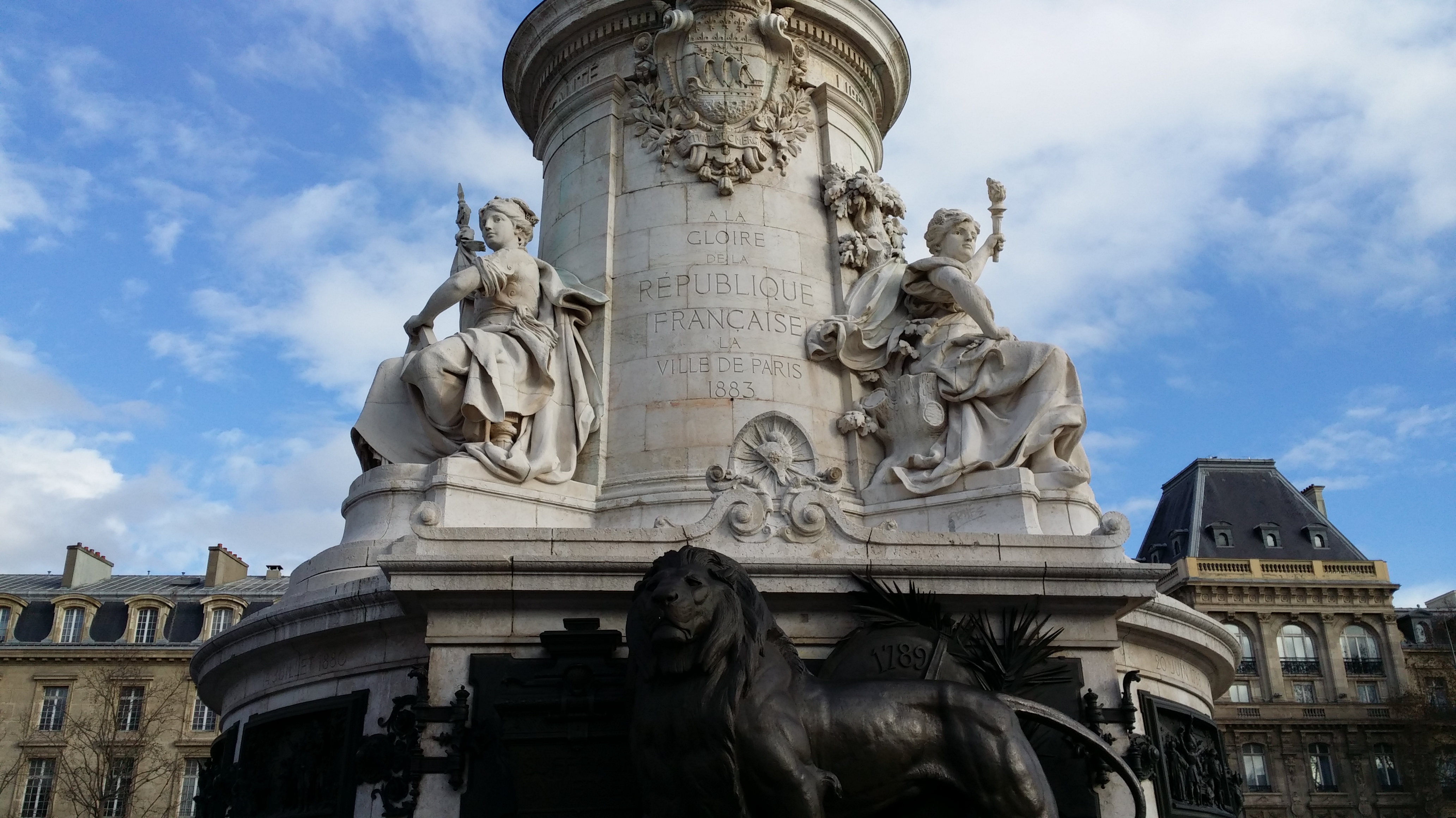
Searching for locations: Paris, France: Place de la Republique

Whilst a rather important place for the French, for us visitors, it has a convenient hotel located just behind the square, and an underground, or Metro station, underneath.

2014-01-07 11.43.05

Added to that was equally convenient cafes, one of which, The Cafe Republique, we had dinner every night.  The service and food were excellent, and we had no problems with the language barriers.

At the top of the monument is a bronze statue of Marianne, said to be the personification of France.

2014-01-07 11.43.41

Surrounding Marianne is three more statues, representing liberty, equality, and fraternity.

2014-01-07 11.43.32

At the base is a lion guarding what is said to be a ballot box.

“Sunday in New York”, a romantic adventure that’s not a walk in the park!

“Sunday in New York” is ultimately a story about trust, and what happens when a marriage is stretched to its limits.

When Harry Steele attends a lunch with his manager, Barclay, to discuss a promotion that any junior executive would accept in a heartbeat, it is the fact his wife, Alison, who previously professed her reservations about Barclay, also agreed to attend, that casts a small element of doubt in his mind.

From that moment, his life, in the company, in deciding what to do, his marriage, his very life, spirals out of control.

There is no one big factor that can prove Harry’s worst fears, that his marriage is over, just a number of small, interconnecting events, when piled on top of each other, points to a cataclysmic end to everything he had believed in.

Trust is lost firstly in his best friend and mentor, Andy, who only hints of impending disaster, Sasha, a woman whom he saved, and who appears to have motives of her own, and then in his wife, Alison, as he discovered piece by piece damning evidence she is about to leave him for another man.

Can we trust what we see with our eyes or trust what we hear?

Haven’t we all jumped to conclusions at least once in our lives?

Can Alison, a woman whose self-belief and confidence is about to be put to the ultimate test, find a way of proving their relationship is as strong as it has ever been?

As they say in the classics, read on!

Purchase:

http://tinyurl.com/Amazon-SundayInNewYork

A score to settle – The Second Editor’s draft – Day 10

The time has come to work on the second draft for the editor, taking into account all of the suggested changes, and there are quite a few. So much for thinking I could put in an almost flawless manuscript.

…

Yesterday I was immersing myself in the scenery, and formulating a plan of the city, and the various places where events will gradually unfold.

A place that will have significance will be what is locally known as the caves, a large system of passageways and caverns carved out of the hills that back onto the city’s botanical gardens, and beyond, a rabbit warren of back alleys that was once the market.

The current government moved them into a large open area where it could keep a close eye on all activity, where once, in the back alleys, crime and dissidents flourished.

In fact, the government closed off the whole area and allowed only a small part of the cave systems to be visited by tourists, and only under the guidance of special tour guides.

What is the government hiding there?

Rumors abound. People who go missing in the night are thought to be taken into the caves and ‘lost’.

Including the man who was the last president before the military took over. Is he still alive, held somewhere in a deep, dark dungeon?

Or is he a ghost?

Jump Now – A short story

It was 2 am, the ideal time to assemble a team that would be clandestinely boarding a vessel.

Dark and moonless, it was fortuitous rather than planned, and, dressed in black from head to toe, it was hard to see the others in the inky darkness.  At least something was on our side.

Up until this point, we’d had nothing but bad luck, though I was more of the opinion we had a traitor in our midst because some of the events could not have any other explanation.

It had caused me to be far more selective in who I gave details of the mission to.

Each of the four team members had arrived and let themselves into the shed.  It was not far from the ocean, and a small pier where there was a landing craft waiting.  From there, it would be a half-hour trip out to the ship in question, where, if we got close enough, we would either have to go over the side and swim, or pull alongside, but either way we’d have to go up a rope.

A lot depended on the crew member we had recruited getting a rope overboard, and given the luck we had so far, if there was a flaw in the plan, that was it.

Aside from the four people sitting in front of me, there were only three others privy to what was about to happen.  Now, with recent events, it was hard to imagine that one of them could betray us. That’s why I hadn’t completely told them what they were about to do, just that they needed to be prepared to get wet.

“I’m sure, now we’re here, you can tell us what’s going on.”  Robert was the most trusted of my team and my best friend.

“And why all the hush-hush,”  Linda added.  She had been amused at the secrecy and my explanation.

I was never very good at spinning a story.  She knew that but had not questioned why.

“It’s been touch and go for the last week.  It’s why we’ve all been on standby, with this last-minute call out.  We’ve been waiting for a particular ship to leave port, and now it has.  So, without further ado, let’s get to it.  A boat ride, just enough time to gather the courage to the sticking point, and then with any luck we won’t have to go into the water and swim, but a short shimmy up a rope.  I hope you’ve all been working out.”

The boat ride was in silence.  I’d worked with this group before and they were not big on talking.  Aside from the fact that noise traveled over water, and since we had a specially silenced motor on the boat, there was not going to be any unnecessary conversation.

We could see the ship once we reached the headland, and aside from it’s running lights, there were lights where I presumed the bridge was, and several in the crew quarters.  Closer again, I got the impression it was not moving, or if it was, it was very slow.  It was hard to tell in the darkness.  That same darkness aided our approach.

When we were within several hundred yards I could see that the ship was not moving, and, in fact, had the anchor out.

That was not expected.  Were they waiting for us?  Had they discovered the cream member who was working with us?  We’d know soon enough if there was no rope in the designated point, not far forward of the stern, a spot where we could maneuver the boat under the hull curvature.

The driver piloted the boat slowly to the designated point and the rope was there.  He would stay with the boat and wait.  The four of us would go up and collect what we came for.

I watched the three go up the rope before me, waiting for the last to stop at the top and then go over the side onto the deck.  It took nearly a minute before I got the signal it was clear to follow.

It had been too easy.

I went up the rope slowly, slower than the others, something else other than the object of the exercise on my mind.  Not three days before I had a conversation with my boss, telling him that I’d been doing the job too long and that it was time to retire.  Approaching forty wasn’t exactly retirement age, but in this job, lasting that long was almost a miracle.  The places I’d been, the sights I’d seen, and the people I’d met.  And how many lives I’d used up.

It was a dangerous thing, thinking about anything other than the job when you’re on the job.

I reached the top and pulled myself over the railing and onto the deck.  A little off balance it took a moment to stand.  By then it was too late.

Two of the three other members of the team were sitting by the superstructure, heads on their heads, two members of the crew were watching them, guns at the ready, and Linda had one pointing at me.

“I can’t imagine how MacIntyre thought he was going to convince Petra to defect.  Or how this charade of a rescue attempt was ever going to work.”

I put my hands up.  Not entirely unexpected.  “It was not the mission objective.”

“What…”

I was surprised that she had made her move so early.  If it was my operation, I would wait until we were well into the superstructure, heading to the cabin where Petra would be waiting, and then make the move.

Three seconds, three shots, two guards taken out, and Linda incapacitated.  She would not be moving or fighting back any time soon.  The Petra came out of the shadows, and I collected Linda’s gun and stood near her, just in case Petra missed the target.

Petra cut the two other’s bindings, and said, “get to the side and jump now.”

Linda looked up at me.  “What now?”

I shrugged.  “Time for us to leave.”  I gave Petra a nod, and she went over to the side, took one look back at Linda, shook her head, then jumped.

“You’re just going to leave me here?”

“If it were up to me, I’d shoot you, but MacIntire is getting a little soft in his old age.  But yes, I’m leaving you here.  Now, I really must go.”

I took a last look at Linda, who realized that if she moved it would only worsen her injury, and jumped, not exactly my preferred way of leaving the ship.

The boat came up alongside me and two hands dragged me on board, at the same time we could hear the sound of the anchor chain being pulled up, and the propellers creating a wash as the ship started moving.

Job done, and not one that pleased me.  “Let’s go home,” I told the driver, “it’s past my bedtime.”

—-

© Charles Heath 2020-2021

“Trouble in Store” – Short Stories My Way:  The re-write – Part 12

Now that I’ve gone through the story and made quite a few changes, it’s time to look at the story

…

It took fifteen seconds to disentangle herself from the customer, push him away, get to her feet, and get out into the street, weapon aimed.

At nothing but air.

The girl had gone, and then she had the vague recollection of a shadow passing her as she was facing the other way getting to her feet.

And that same shadow running through the door.

Five more valuable seconds as her brain processed this piece of information before it issued the command to go out the door and see which way she went.

Another few seconds to get out the door and see the police car coming from the same direction she had earlier, screeching to a halt outside the shop, a door opening, and an officer getting out.

Margaret was gesturing for the driver to go further down the road where she assumed the girl had run, managing to yell breathlessly at the office getting out, “She’s gone that way,” and pointing.

The officer relayed the message and closed the door as the car sped off.

“What happened?”

“Shots fired by a woman, more a girl, in the process of a robbery.”

She ran back inside the officer following.

The customer had moved away from the doorway having got to his feet and was checking the damage to his coat where the bullet held felt earlier had passed through the fabric and missed everything else.

“Over behind the counter.”  She pointed at the wall where he had been standing.  There was a shopkeeper.  He was standing there.”

The policeman rounded the end of the counter and looked down.  “He’s here.  It’s not looking good.”

Margaret didn’t hear him.  She was calling an ambulance.

…

© Charles Heath 2016-2024

The cinema of my dreams – I always wanted to see the planets – Episode 9

What’s the worst that could happen?

…

Captains invariably hated the word ‘problem’. I did too, because it conjured up so many different scenarios, each more scarier than the last, and maginified exponentially because we were in space.

We took a closer look, and it was the sort of damage if it was back on Earth, one would associate with weapons fire, lasers to be exact.

Yes, in the 24th century we had ray guns, handheld, and ship bound.

The only problem was, only the cruise class vessels, like the one I was now on, were allowed to have them, and using them, well, the paperwork alone could keep a complement of 20 working day and night for a month.

Test them, yes, less paperwork, use them, no. There had never been a reason to.

But someone had, and on a freighter, which only meant one possibility, that whatever the freighter had been carrying, had been worth violating a thousand regulations and rules.

And bring their ship and selves out into the light.

It was, of course, Space Command’s worst nightmare realised, that the ideal of space exploration as a united effort by everyone, had a member who had decided against unity.

Unless, of course, the improbably had happened, there was life outside our solar system, and we were dealing with a new planet, or people.

Except I would not expect them to use something as conventional as a laser.

Myrtle had put us very close to the damaged area and taken a number of photographs, and the engineer had analysed the damaged area.

Then, cleared to enter the freighter, she took us up to the cargo doors and waited as we watched them open.

It was the same time the engineer’s hand held computer started beeping.

And a warning light on the console in front of Myrtle started flashing, accompanied by a warning klaxon.

Another vessel had just entered our proximity zone.

…

© Charles Heath 2021