Skeletons in the closet, and doppelgangers

A story called “Mistaken Identity”

…

How many of us have skeletons in the closet that we know nothing about? The skeletons we know about generally stay there, but those we do not, well, they have a habit of coming out of left field when we least expect it.

In this case, when you see your photo on a TV screen with the accompanying text that says you are wanted by every law enforcement agency in Europe, you’re in a state of shock, only to be compounded by those same police, armed and menacing, kicking the door down.

I’d been thinking about this premise for a while after I discovered my mother had a boyfriend before she married my father, a boyfriend who was, by all accounts, the man who was the love of her life.

Then, in terms of coming up with an idea for a story, what if she had a child by him that we didn’t know about, which might mean I had a half brother or sister I knew nothing about. It’s not an uncommon occurrence from what I’ve been researching.

There are many ways of putting a spin on this story.

Then, in the back of my mind, I remembered a story an acquaintance at work was once telling us over morning tea, that a friend of a friend had a mother who had a twin sister and that each of the sisters had a son by the same father, without each knowing of the father’s actions, both growing up without the other having any knowledge of their half brother, only to meet by accident on the other side of the world.

It was an encounter that in the scheme of things might never have happened, and each would have remained oblivious of the other.

For one sister, the relationship was over before she discovered she was pregnant, and therefore had not told the man he was a father. It was no surprise the relationship foundered when she discovered he was also having a relationship with her sister, a discovery that caused her to cut all ties with both of them and never speak to either from that day.

It’s a story with more twists and turns than a country lane!

And a great idea for a story.

That story is called ‘Mistaken Identity’.

A score to settle – The Second Editor’s draft – Day 22

The time has come to work on the second draft for the editor, taking into account all of the suggested changes, and there are quite a few. So much for thinking I could put in an almost flawless manuscript.

…

It’s hard to know just how someone would react in real life to a situation that is not normally expected to happen.

Like, for instance, a gunman walks into a supermarket and suddenly starts shooting randomly.

But, in the USA, that seems to be a situation that could happen anywhere, anytime and with tragic results.

What would I do in such a situation?

It’s probably impossible to tell unless it really happened.

Why do I ask this question?

There’s a lot of effort required to plan out what each character is going to do in any given situation. What he or she might do has a lot to do with how they have been previously portrayed.

If they were nervous or frightened at the little things, it’s hardly likely that they would run into a hail of bullets unless there was a very good reason like saving a child, and even then it might be a stretch to believe they would.

So, I’m writing about a dangerous situation, and it’s taking a lot longer than I expected because my characters have to fit their previous profiles, and I have to remember them, or, what I should have done in the first place, create profiles from which to draw on when necessary.

Another lesson learned the hard way, is that planning is necessary, even if it appears tedious.

“Quickly, quickly…” – a short story


It was odd having a voice in your head, well, not really in your head as such, but in your ear, and sounding like it was in your head.

You could truthfully say you were hearing voices.

It was the next step after going through some very intensive training, having someone else as your eyes and ears when breaching a secure compound, and avoiding the enemy.

I’d signed on for this extra training thinking one day it would land me in the thick of the action. Some of the others thought I was mad, but someone had to do it, and the fact it was quite dangerous added just that extra bit to it.

But as they say, what you learn in training, and practise in a non-hostile environment, is nothing like being in that same situation in reality.

Now on was on my first assignment, part of an elite team, packed and taken to what was to everyone else, an unspecified location, but to us, it was the point of incursion.

The mission?

To rescue a government official (that was how he was described to us) who had been illegally detained in a foreign prison.

Our job?

To break him out and get out without the knowledge of the prison staff, or anyone representing that government. Yes, what we were doing was highly illegal, and yes, if we were caught it was more likely than not we would be executed as spies.

…

We were under cover in an abandoned farmhouse about three miles from the prison. We had been brought in under cover of darkness, and had only a few hours to set up, and then wait it out until the following night.

It was now or never, the weather people predicting that there would be sufficient cloud cover to make us invisible. Two of us were going in, and two remaining strategically placed outside to monitor the inside of the prison through a system of infrared scanners. We also had a floor plan of the building in which the prisoner was being held, and intelligence supplied, supposedly, by one of the prison guards who had been paid a lot of money for information on guard movements.

To me, it was a gigantic leap of faith to trust him, but I kept those thoughts to myself.

We had been over the plan a dozen times, and I’d gone through the passageways, rooms, and doors so many times I’d memorised where they were and would be able to traverse the building as if I had worked there for a lifetime. Having people outside, talking me through it was just an added benefit, along with alerts on how near the guards were to our position.

I was sure the other person going with me, a more seasoned professional who had a number of successful missions under his belt, was going through the same motions I was. After all, it was he who had devised and conducted the training.

There was a free period of several hours before departure, time to listen to some music, empty the head of unwanted thoughts, and get into the right mindset. It was no place to get tangled up in what-ifs, if anything went wrong, it was a simple matter of adapting.

Our training had reinforced the necessity to instantly gauge a situation and make changes on the fly. There would literally be no time to think.

I listened to the nuances of Chopin’s piano concertos, pretending to play the piano myself, having translated every note onto a piano key, and observing it in my mind’s eye.

My opposite number played games of chess in his head. We all had a different method of relaxing.

Until it was 22:00 hours, and time to go.

…

“Go left, no, hang on, go right.” The voice on my ear sounded confused and it was possible to get lefts and rights mixed up, if you were not careful.

It didn’t faze me, I knew from my study of the plans that once inside the perimeter fence, I had to go right, and head towards a concrete building the roof of which was barely above the ground.

It was once used as a helipad, and underneath, before the site became a prison, the space was used to make munitions. And it was an exceptionally large space that practically ran under the whole of the prison, built above ground.

All that had happened was the lower levels were sealed, covered over and the new structures built on top. Our access was going to be from under the ground.

Quite literally, they would not see, or hear, us coming.

The meteorological people had got it right, there was cloud cover, the moon hidden from view, and the whole perimeter was in inky darkness. Dressed in black from head to foot, the hope was we would be invisible.

There were two of us heading to the same spot, stairs that led down to a door that was once one of the entrances to the underground bunker. We were going separate ways in case one of the other was intercepted in an unforeseen event.

But, that part of the plan worked seamlessly, and we both arrived at the same place nearly at the same time.

Without the planning, we might easily have missed it because I didn’t think it would be discernable even in daylight.

I followed the Sergeant downstairs, keeping a watchful eye behind us. I stooped at the point where I could see down, and across the area we had just traversed.

Nothing else was stirring.

As expected, the door was seamless and without an apparent handle. It may have had one once, but not anymore, so anyone who did stumble across it, couldn’t get in.

Except us. We had special explosives that were designed to break the lock, and once set, would not make a lot of noise. Sixty seconds later we were inside, and the door closed so no one would know we’d broken in.

I was carrying a beacon so that the voice in my head could follow my progress. The sergeant had one too, and he led.

“Straight ahead, 200 yards, then another door. It shouldn’t be locked, but it might be closed.”

In other words, we had no way of knowing. Our informant had said no one had been down in the dungeons, as he called them, since the munition factory closed, and had been sealed up soon after the prison building had been handed over for use.

We were using night goggles, and there was a lot of rubbish strewn over the floor area so we had to carefully pick our way through which took time we really didn’t have. It looked as though our informant was right, no one had been down there for a long time. We were leaving boot prints in the dust.

We reached the door ten minutes later than estimated. Losing time would have a flow-on effect, and this operation was on a very tight time constraint.

“Once you are through the door, there’s a passage. Turn left and go about 50 paces. There should be another passage to your right.”

“Anyone down here?”

“No, but there is a half dozen prison officers above you. Standard patrol, from guardhouse to guardhouse. Unless they can hear you through five feet of solid concrete, you’re safe.”

My instincts told me five feet of concrete were not enough, but I’ll let it ride for the moment.

The door was slightly ajar and it took the two of us to pull it open so that we could get past. Behind it was the passage, going left and right. Trusting my invisible guide was not getting mixed up again, I motioned right, and we headed down the passage.

Despite the fact we should be alone, both of us were careful not to make any noise, and trod carefully.

At 50 or so paces, the passage came into sight. The sergeant went ahead. I stayed back and kept an eye in both directions. The passage before us was the one that would take us under the cell of the captive we were sent to retrieve.

There would be no blasting our way in. The floor to the cell had a grate, and when removed, a person could drop down into the ‘dungeon’. Currently, the grate was immovable, but we had the tools to fix that.

The sergeant would verify the grate was where it was supposed to be, then come back to get me.

Five minutes passed, then ten. It was not that far away.

I was about to go search when the voice in my head returned, but with panic. “We’ve been compromised. Get the hell out of there, now. Quickly…”

Then I heard what sounded like gunshots, then nothing.

A minute later there was a new voice. “I don’t know who you are, but I’d strongly advise you give yourself up to the guards. Failure to do so within one hour, I’ll execute the two men I now have in custody.”

Ahead of me there was a sudden explosion, followed by a cloud of dust and fine debris.

Hand grenade, or mine, it didn’t matter. The sergeant wouldn’t be coming back.

I sighed.

Plan B it was.

…

© Charles Heath 2021
Short Story Writing – Don’t try this at home! – Part 6

This is not a treatise, but a tongue in cheek, discussion on how to write short stories.   Suffice to say this is not the definitive way of doing it, just mine.  It works for me – it might not work for you.

…

Now, there’s this thing called continuity, but it covers a whole range of writing sins, most of which I eventually get caught out.  Films sometimes miss a few items, like back in the roman days, there are plane trails in the sky, in a 1920’s period piece, there’s a mobile phone sitting on a desk.

Like one minute the hero has a gun, and the next he’s fighting for his life with a knife, and, hey presto, there’s that gun again.  The error might not be that big but you can’t pull out a weapon you don’t have or wasn’t there in the first place.

Similarly, the hero pulls out a mobile phone, but there’s only one problem, it’s 1980, and there are no mobile phones.  Our problem might be that we are so used to doing and using certain things that we might forget, for a minute or two, that were not available in the past.

Then there’s places like hotels and restaurants, both of which change hands and close and reopen with a different owner like someone changes their socks.  There’s no substitute for checking, on the internet of course, whether a Hilton Hotel was in 6th Avenue, New York, in 1920.

The answer is no.  The first Hilton Hotel was in Waco in 1927.  The New York Hilton opened in 1963.

The same goes for the fashion of the day.

I’m no fashion guru, but I have to rely on Google once again to fill in the gaps.

And my all-time favourite, getting the right make and model of car.

Oh, and just for good measure, back in the old days they used acoustic couplers to attach to phones via a serial port to dial-up not a server, but a BBS, Bulletin Board Service, at a rate of 300 baud, or a little while later, 1,200 baud.

There was no internet in general use.  If you wanted to call the office when out, use a telephone box.  Or carrier pigeon.

And the use of language, there’s a lot of stuff relevant today that was not used back then, and there was a lot of stuff back then that isn’t tolerated now.  Some of it might be hard to get your head around. 

It isn’t for me, because I can remember the 1970s and 1980s, but I’m not too sure about allowing some of what happened then to creep into my work.

So, you get the picture.  Try to use the past as the past, or leave it in the past.

Unless it’s a book about time travel, then all bets are off.

The cinema of my dreams – I always wanted to see the planets – Episode 21

There’s no swashbuckling for the captain

…

I turned, and saw what appeared to be a relatively unkempt man standing behind me.

Jerome Kennedy. Astro physicist.  A man who was mocked rather than revered for his theories on space, and in particular, space travel.

And those theories were, to put it mildly, interesting.

It was probably why the Admiral conscripted him for this voyage into the unknown.

“I though that was only in the imagination of television script writers.”

“Possibly, but we just witnessed something that none of us can rationally explain.  One minute they were there, the next, poof.”

“That’s why you are along for the ride, to find explanations for the unexplainable.  I look forward to your report.”  Then, turning back to the navigator, “are we still in touch with the original alien vessel?”

“Just, and still heading towards Uranus.”

“Then let’s get after it, maximum speed when possible.”

I left the newly promoted number one in charge and went into the captains day room.  I was still getting used to the idea of actually bring captain, because the aura of previous inhabitant of this room was still there.  And it felt like he was in the room watching everything I did.

I shook my head, as if that would cast off the jitters I felt, and sat down behind the imposing desk, one thathad been made over a hundred years before, and from a vessel with the same name. 

I still didn’t have a lot to put in any report to the Admiral, but had a lot to think about.

I brought up the navigation screen and looked at the suggested path from where we were to Uranus, and the time it would take.

There was a buzzing sound, and a face appeared on my screen.  It was the Captain’s personal assistant for want of a better name, Louise Chalmers, an ex Lieutenant Colonel from the military, but not by much.  She had retired into this position, and, I suspect, another was for the military to keep up to date on the Captain’s decisions.

“Come in.”

The door opened, she came in, and it closed behind her.  There was no open door policy on this ship.

“Sir.”

“What can I do for you?”

“I’m not sure if you are aware, but I am here to serve whomever the current Captain is, and since Captain V is not here, that would be you in his stead.”

I had read that she was his choice for P A, and that it was a personal matter, as usually Captains didn’t have such staff members.

“I thought you were on board to serve only the previous captain “

“Not so.  If you read standing order 207615, you will realise my position was ratified as general crew member, serving the ship rather than an individual.  My job is to make your job easier.”

While she was speaking, I fetched the standing orders, and the one she referred, and a quick scan proved such to be the case.

“In what way?”

“Paperwork, the vane of any officers existence I’m told, and to organise all activities of a non urgent nature, like bring the daily reports to you.”

I knew that captain had to be appraised of everything that happened on board, just not every day.

“I take it you have the reports?”

“I have, and unfortunately, as per regulations, I have to make sure you have received them.  Your predecessor wanted me to summarise.  I can do the same for you.”

There would be no escaping it.  “Please.”

…

© Charles Heath 2021

A score to settle – The Second Editor’s draft – Day 23

The time has come to work on the second draft for the editor, taking into account all of the suggested changes, and there are quite a few. So much for thinking I could put in an almost flawless manuscript.

…

Between researching the locations, and creating personas for the characters, I’m exhausted. Yesterday was the longest day this month because I had underestimated the amount of work needed to bring these characters, pertinent to this story at least, to life.

Plan or no plan, there’s always something lurking in the details that is going to trip you up sooner rather than later.

Of course, not every story is pulled together and written entirely in the space of thirty days, so these sorts of logistical problems rarely cause the angst they are at the moment. You hit a roadblock, and it’s well just ho-hum, let’s do something about it, tomorrow!

This thirty-day deadline, well, it’s like the proverbial rocket you know where.

So, there was a lot of scribbling actual words on a real piece of paper, lots of crossing out, very little erasing because you can’t erase biro ink, not the cheap stuff anyway, and lots of going back and forth, turning pages.

A real page-turner of a different sort!

I can see the humour in it now, but at 2am, there was very little humour and had the shredder not been broken, a few good ideas might have gone through it.

Today is a new day.

The revolution beckons.

Character development: children in stories

It seems that there are many ways of bringing children to life in your stories.

The most obvious is your own, but those traits might seem so polarised they and others might realise who they are based on, with the distress that comes with it.

Then there are the children of your friends and relationships, definitely fodder for many stories because those children are definitely far worse than your own, or better perhaps.

It leaves you questioning where you went wrong, or why you didn’t get the manual when the hospital kicked to the kerb with this screaming bundle of joy, their words not yours.

So we start with real-life experiences.

To muddy the waters so they don’t get the impression you’re paying out on them, you can always add the traits of those you see in the shopping malls.

Shopping malls are a gold mine for behavioural traits, from the very worst tantrum thrower to the best behaved. For my money and proven time and time again, those well-dressed, very well-behaved children are purely evil.

With the tantrum thrower, what you see if what you get.

With the well-behaved, you spend all of your time watching your back and waiting for the knife to penetrate your spine between the fourth and fifth vertebrae. You just know instinctively they’re medical school prodigies.

Of course, there are one or two good children, Santa has to have a reason for existence, but they are like 1,000 ounce gold nuggets; very, very hard to find.

A score to settle – The Second Editor’s draft – Day 23

The time has come to work on the second draft for the editor, taking into account all of the suggested changes, and there are quite a few. So much for thinking I could put in an almost flawless manuscript.

…

Between researching the locations, and creating personas for the characters, I’m exhausted. Yesterday was the longest day this month because I had underestimated the amount of work needed to bring these characters, pertinent to this story at least, to life.

Plan or no plan, there’s always something lurking in the details that is going to trip you up sooner rather than later.

Of course, not every story is pulled together and written entirely in the space of thirty days, so these sorts of logistical problems rarely cause the angst they are at the moment. You hit a roadblock, and it’s well just ho-hum, let’s do something about it, tomorrow!

This thirty-day deadline, well, it’s like the proverbial rocket you know where.

So, there was a lot of scribbling actual words on a real piece of paper, lots of crossing out, very little erasing because you can’t erase biro ink, not the cheap stuff anyway, and lots of going back and forth, turning pages.

A real page-turner of a different sort!

I can see the humour in it now, but at 2am, there was very little humour and had the shredder not been broken, a few good ideas might have gone through it.

Today is a new day.

The revolution beckons.

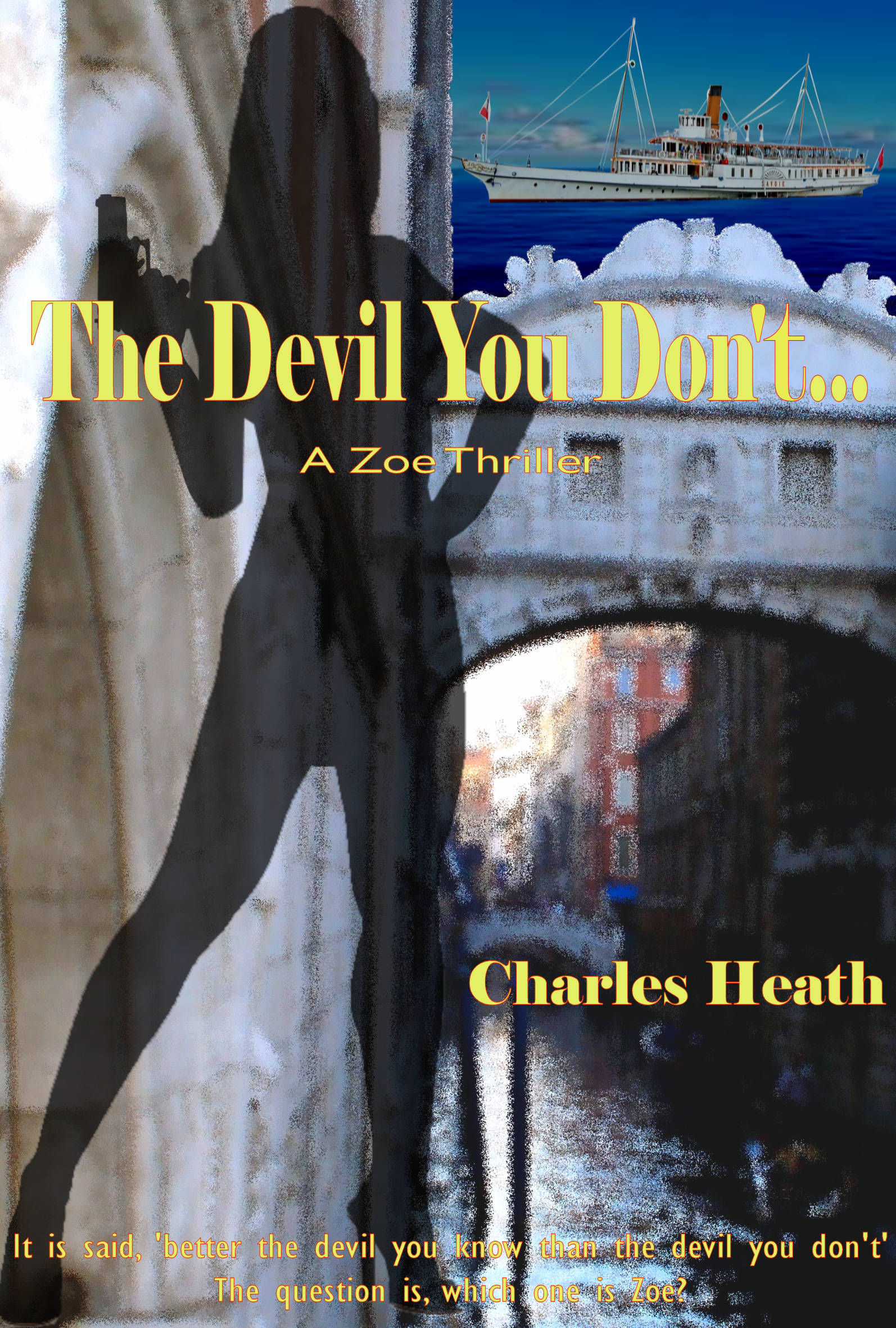
‘The Devil You Don’t’ – A beta reader’s view

It could be said that of all the women one could meet, whether contrived or by sheer luck, what are the odds it would turn out to be the woman who was being paid a very large sum to kill you.

John Pennington is a man who may be lucky in business, but not so lucky in love. He has just broken up with Phillipa Sternhaven, the woman he thought was the one, but relatives and circumstances, and perhaps because she was a ‘princess’, may also have contributed to the end result.

So, what do you do when you are heartbroken?

That is a story that slowly unfolds, from the first meeting with his nemesis on Lake Geneva, all the way to a hotel room in Sorrento, where he learns the shattering truth.

What should have been solace after disappointment, turns out to be something else entirely, and from that point, everything goes to hell in a handbasket.

He suddenly realizes his so-called friend Sebastian has not exactly told him the truth about a small job he asked him to do, the woman he is falling in love with is not quite who she says she is, and he is caught in the middle of a war between two men who consider people becoming collateral damage as part of their business.

The story paints the characters cleverly displaying all their flaws and weaknesses. The locations add to the story at times taking me back down memory lane, especially to Venice where, in those back streets I confess it’s not all that hard to get lost.

All in all a thoroughly entertaining story with, for once, a satisfying end.

…

Available on Amazon here: https://amzn.to/2Xyh1ow

…

In a word: Mine

Well, that’s his, and this is mine.  Possession is 9 points of the law, or so they say.

What’s mine is mine and what’s his is mine.  Sound like a divorce settlement?  Sure is!

There are often a lot of arguments over the possession of goods, and who they belong to.  Perhaps it’s best to own nothing, then no one can take it from you.

Sound like a lawyer contesting his own divorce?  Probably.

But that’s not the only mine.  Take for instance a land mine or a sea mine.

Devilish things to walk on, or brush up against.  It spawned a new type of ship, a minesweeper, and I’ve read a few books about the exploits of those aboard, and how close they come to death when a ship hits one.

And land mines, the damage they can cause.

Then, of course, you can go underground, way underground, into a mine.

Gold in South Africa, coal in Wales, tin in Sumatra, copper in New Guinea.

And it doesn’t have to be underground.  You can have an open cut mine, which accounts for a lot of coal mines in Australia.

Oddly, you can mine data, the sort that’s stored in databases on computers.  I’ve done a bit of that in a former life.

You can mine talent,

Or you can mine bitcoin, but that’s a whole different ballgame, and everyone seems to be in on some sort of scam when it comes to bitcoin.  It seems to me the only way you would make money out of bitcoin was to buy units the very first day it was released.

It’s not, and never will be, something I’ll dabble in.