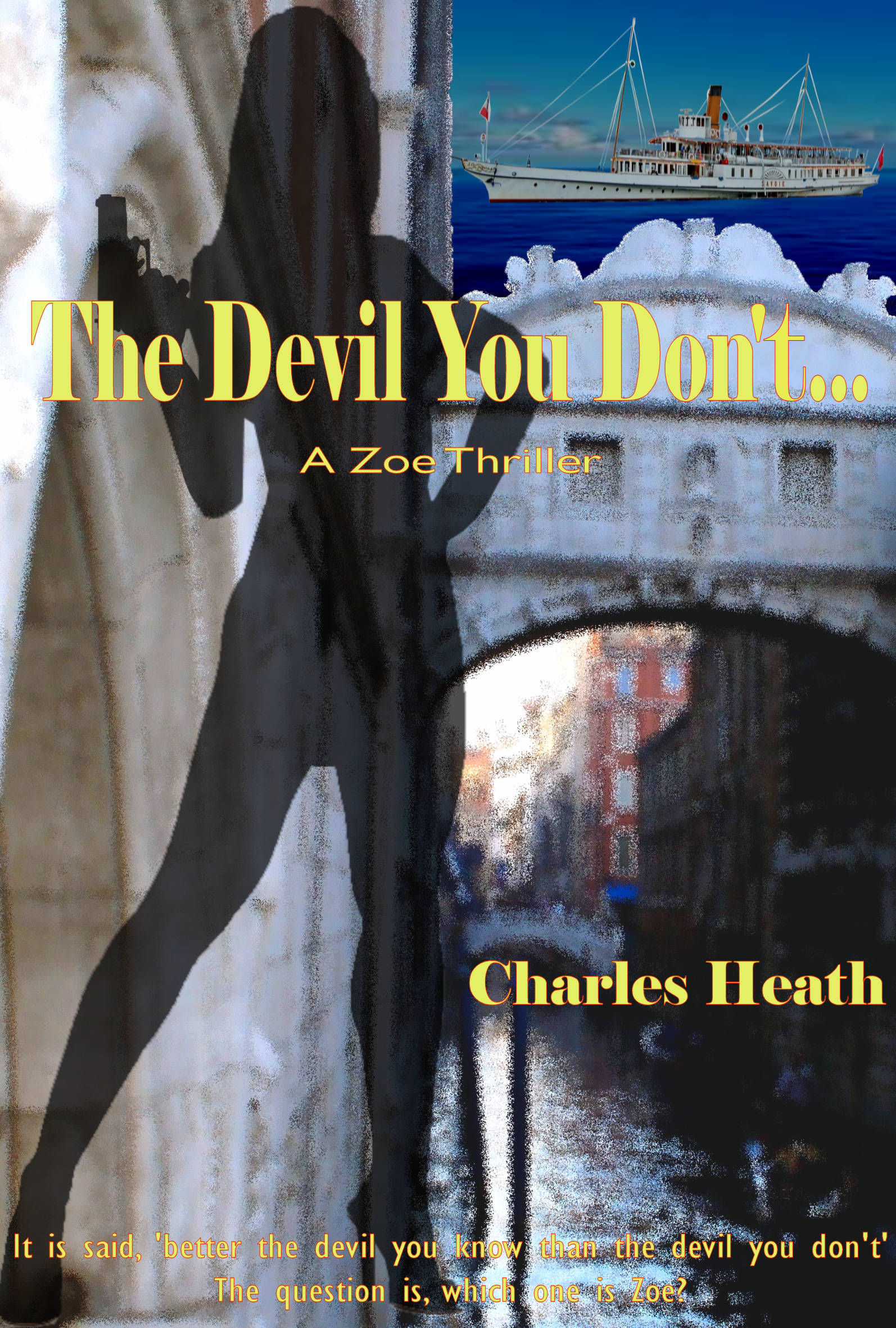
There’s something to be said for a story that starts like a James Bond movie, throwing you straight in the deep end, a perfect way of getting to know the main character, David, or is that Alistair?
A retired spy, well, not so much a spy as a retired errand boy, David’s rather wry description of his talents, and a woman that most men would give their left arm for, not exactly the ideal couple, but there is a spark in a meeting that may or may not have been a setup.
But as the story progressed, the question I kept asking myself was why he’d bother.
And, page after unrelenting page, you find out.
Susan is exactly the sort of woman to pique his interest. Then, inexplicably, she disappears. That might have been the end of it, but Prendergast, that shadowy enigma, David’s ex-boss who loves playing games with real people, gives him an ultimatum: find her or come back to work.
Nothing like an offer that’s a double-edged sword!
A dragon for a mother, a sister he didn’t know about, Susan’s BFF who is not what she seems or a friend indeed, and Susan’s father, who, up till David meets her, couldn’t be less interested, his nemesis proves to be the impossible dream, and he’s always just that one step behind.
When the rollercoaster finally came to a halt, and I could start breathing again, it was an ending that was completely unexpected.
We were monitored from the moment we left the hotel. Cecelia had taken up her vantage point, and watched as we came out the front door. Two minutes later she said, quietly, “You’ve got two, man and woman. The woman is in communication with someone. Be careful.”
Francesca didn’t seem to have a care in the world. I suspected she had her phone on so those following us could keep track of when they lost us, but I wouldn’t be dodging and weaving this morning.
“What do you think our chances are of getting snatched off the street in a white van,” I asked her, after about 10 minutes.
“Why?”
“I’ve seen a few. Of course, they might just be delivery vans, and white is a common colour. Perhaps I’m just being paranoid.”
“Perhaps you are.” She gave me a curious look, enough to make me think she might think there might be trouble.
“What happened to Cecelia?”
Juliet was outside the hotel, coming back from a café not far up the road. I noted she had not bought coffee for the other two women.
“Out on a run. She’s one of these fitness freaks, or perhaps it has something to do with keeping in shape for the movies.”
Juliet looked Francesca up and down with the eye of a jealous woman, or so I wanted to believe. It could be that she simply viewed her with suspicion, much the same as I would in her place.
She knew me well enough to know Francesca was not there simply as a visiting friend. But just how curious would she be.
“Another actress friend of yours?”
Francesca views Juliet with a similar look of contempt.
Francesca looked at me. “Who is this woman and what is she talking about. You obviously know each other.”
“Is it that recognisable? This is Juliet, and ye, far back in a long-forgotten past we did spend some time together. And lately, for some strange reason, we keep running into each other. Other than that, she’s staying with the countess and her mother.”
“You brought her to see the countess? Is that wise?”
“No. But I’ve had a long talk to Francesca, that’s her name by the way, and she’s working with people who have the same goal as I have, protecting the countess and making sure she gets to the signing.”
“Who are her people?”
“Need to know Juliet.”
“Well, this is going to be a cat amongst the pigeon’s moment, Evan. You’re up to something, I know it.”
Francesca looked at her, then me, and went to say something, then didn’t. I wished, at that moment, that I could read minds.
In my ear, I could hear Cecelia. “They’ve stopped at the café just up from the hotel and the woman is talking earnestly into the phone. She is probably calling for reinforcements.”
“A white van, no doubt,” I said.
Francesca was beside me. “What about a white van? Did you see one?”
“No. Just muttering to myself.”
Juliet went first as we went into the hotel, over to the elevator, and then up to the room floor. The short distance to the room was slow, running into several other guests who were going down to the lobby.
Juliet was on first-name terms with them.
Cecelia was back. “As you said. A white van went down the alley to the back of the hotel. The two are staying put at the café. It’s either a delivery or your ride. What do you want me to do?”
“Nothing.” Alfie’s voice came on.
“What are you doing here?”
“Joining the party. Leave the van to me. If it is involved, we’ll be on it. If they take any one of the three, and they take their phones, we’ll have a trace. At any rate, I’ve got a car, and will follow the van, if necessary.”
“Ever been told about a party, and then not get an invite,” I asked no one in general.
Juliet gave me a strange look then unlocked the door, went in, I followed, and Francesca came in last and closed the door behind her.
The countess was sitting at the table and looked up. She didn’t recognise Francesca or if she did, she was a good actress.
“Who is this?” she asked.
“A woman who claims she has been hired to protect you too. There seems to be a few of us.”
“Protect or kill?” She stood and backed away. “Why did you bring her here?”
“The old adage, keep your friends close, and your enemies closer. She’s better here than out there,” I waved my hand in the general direction of the street.
Francesca didn’t move, and, better still, didn’t produce a gun from her handbag.
“Who do you work for?” the countess asked.
“Anna von Burkehardt. She is very keen for you to make it to the signing alive. She also told us that she would like to have a chat about what you’re going to be doing with the property once the documents are signed. She would like to make you an offer. One, I believe, you can’t refuse.”
It sounded reasonable to me. What wasn’t was that she hadn’t moved from the door. That was a bad sign.
Cecelia again. “I’m on the floor, three hostiles heading to your door. Do you want me to stop them?”
“No.”
Francesca looked at me. “What do you mean no?”
“No, she can’t refuse it, like you said.”
The countess didn’t look particularly impressed with either of us. “That hag has no interest in making any offers other than putting a bullet in the back of my head. Take her away, Evan. She had no interest in protecting me. And, because of your incompetence, now Anna knows where I am.
I saw Francesca turn the handle of the door and quickly step to one side as it burst open. Standing on the side expecting such an entry, I saw the men come in weapons in hand, yelling for us to get on the floor.
Cecelia was in my ear again. “What do you want me to do?”
“Wait. But be ready.”
In the confusion, Francesca was too busy acting the part of a hostage, with adequate parts of fear and cringing on the floor.
One of the men pointed his gun at me. I was not the target.
I just realised that Vittoria was not in the room, so she was outside.
“Watch out for Vittoria,” I said.
Teo men grabbed the countess and gagged her. The one pointing the gun at me went back to the door and looked out. He waved his gun to say the coast is clear, and they quickly went out.
“Let them go. Alf, you better not lose them.”
“I won’t.”
Three minutes and it was over.
I got up and sat against the wall, and watched Francesca slowly raise her head and look around.
When her eyes reached me, she didn’t see my angry face looking at her, she saw a silenced gun pointed at her head.
“What the hell…”
The door opened again, and Cecelia came in, gun aimed, ready to shoot anything that moved. It too, ended up on Francesca.
“One chance. The next thing you tell me better be the truth or I will shoot you dead where you lie. Am I clear?”
It could be said that of all the women one could meet, whether contrived or by sheer luck, what are the odds it would turn out to be the woman who was being paid a very large sum to kill you?
John Pennington is a man who may be lucky in business, but not so lucky in love. He has just broken up with Phillipa Sternhaven, the woman he thought was the one, but relatives and circumstances, and perhaps because she was a ‘princess’, may also have contributed to the end result.
So, what do you do when you are heartbroken?
That is a story that slowly unfolds, from the first meeting with his nemesis on Lake Geneva, all the way to a hotel room in Sorrento, where he learns the shattering truth.
What should have been solace after disappointment turns out to be something else entirely, and from that point, everything goes to hell in a handbasket.
He suddenly realises his so-called friend Sebastian has not exactly told him the truth about a small job he asked him to do, the woman he is falling in love with is not quite who she says she is, and he is caught in the middle of a war between two men who consider people becoming collateral damage as part of their business.
The story paints the characters, cleverly displaying all their flaws and weaknesses. The locations add to the story at times, taking me back down memory lane, especially to Venice, where, in those back streets, I confess it’s not all that hard to get lost.
All in all, a thoroughly entertaining story with, for once, a satisfying end.
The problem is, there are familiar faces and a question of who is a friend and who is foe made all the more difficult because of the enemy, if it was the enemy, simply because it didn’t look or sound or act like the enemy.
Now, it appears, his problems stem from another operation he participated in, and because of it, he has now been roped into what might be called a suicide mission.
04:00 in Africa was an interesting time of the morning, especially after a few hours of intense rain during the night. I could see what the Colonel meant if it had been raining because outside the barracks it was very wet.
Whilst the others appeared to get some sleep, in a much better environment than the back of an aircraft, I lay awake, at first waiting for the sound of the aircraft leaving, and then listening to the rain that started an hour or so later, followed by the sounds that came afterward. It was never silent, and there was always that suspicion of being attacked when you’re at your most vulnerable. I had a weapon ready, just in case.
Outside the cloud cover had gone and it looked like it would be a fine day.
When I did the headcount, I noticed Mobley was missing as agreed, and by the time we had assembled, the cars had arrived. We would be driving ourselves in a convoy behind Monroe and the Colonel, who was no longer dressed in army fatigues, along with Jacobi and one of his guards.
For the trip, we had been supplied with the western notion of jungle wear, safari suits, that identified us not only garrulous visitors, but typical tourists hardly prepared for what was to come. It made a good cover for a group of ‘fools’ making a documentary.
All we had to do was get to the location for the exchange of the hostages reportedly between Aba, a town in the Democratic Republic of the Congo, and somewhere on the outskirts of the Park. It was going to be an easy drive from Uganda to Aba, then the situation might change.
I was going to be in the rear vehicle, with Leslie Davies. The more I thought about her being assigned to this mission, it seemed she was here solely for her ability to fly anything with wings. It was the part that was missed on her resume, perhaps for a reason, but whatever that reason was, it would become clear eventually.
We left at 04:05. Monroe had a slight problem starting her car.
Other than exchanging a few words before getting on the plane and then getting off the plane, Davies and I had not spoken. After half an hour of driving in silence, I decided to break the ice.
“What did you do to get nominated for this mission?”
A glance sideways gave me no indication of her thoughts, or what look was hidden behind the aviator sunglasses. I hadn’t seen her smile, or talk to any of the other team members other than a few brief words with Monroe, likely because she was the only other female.
Even then, I didn’t get the impression they were going to be best friends.
“Best you don’t know.”
Her reply came about three minutes after I’d asked, and at a point where I assumed she was going to ignore me.
“Let’s say I’m curious.”
“Curiosity killed the cat.”
“I’m not a cat.”
Another two minutes of silence, then, “Disobeyed a direct order.”
Not as bad as killing your immediate superior because you didn’t like him. And I could sympathize. Some orders were utterly ridiculous.
“Not a bad thing.”
“Not what the court-martial thought.”
I noticed she didn’t use sir. I could live with that.
“You volunteer?”
“In a manner of speaking. You?”
She raised her glasses slightly and gave me a sideways glance.
“In a manner of speaking. Been here before, not that it was for very long, and in a different part of the country, but the powers that be deemed my experience adequate for the mission.”
“I take it the mission isn’t to take pictures of animals?”
It might. Just not the animals you’re expecting.”
It was our lucky day. At the Vurra customs post we were met by a Ugandan official who had been forewarned of our arrival, and whom I expect was well compensated for his work, and after going through a half-hour of paperwork, we were taken to the Congo counterpart with whom Jacobi weaved his magic.
I say lucky because the border crossing was often closed, either because of the weather, the road conditions, or the fact neither country was talking to the other, though it was more to do with the Congo villagers and their dispute over lands that stretched into Uganda.
We arrived with a number of trucks, to join a long line waiting to cross, and included were several United Nations vehicles.
Everyone seemed to take the delays and administrative diligence in their stride.
We were moving again, behind several tracks, almost an hour and a half after arriving. All of the crates of equipment had been opened and inspected, as had our packs, and the raft of documents Monroe had been supplied. She had a satellite phone at the ready in case we needed to make any calls, though I was not sure what Bamfield would have been able to do.
But, after a few tense moments, everyone lost interest in the documentary crew and moved onto the next vehicle.
Jacobi said it was the easiest crossing he’d made.
About a half-hour, after we had driven on our way, then my radio crackled, and Mobley reported in. He had just crossed over and was behind us, and a number of trucks.
I got a strange look from Davies.
“Insurance,” was all I said. “Which no one else needs to know about.”
The road was not exactly in the best of condition in places and having four-wheel drives was a help. The lie of the land was quite flat, and we passed a lot of small villages and curious looks from the villagers. Some parts of the road were quite bad, and we had to drive very slowly, especially where it was damp, but for the most part, it was reasonably dry and the roads were navigable.
Other times, Jacobi said, after the rains, those same roads were impossible to drive on and would often see villagers out trying to help the truck drivers keep moving.
I had expected to run into a number of soldiers, but for the first few hours after leaving the border, there wasn’t a lot to see other than flat land, villages, and people on the side of the road, along with the occasional vehicle, belying the fact it was a major road between the border and a town called Aba, a distance that was measured at about 170 kilometers.
Anywhere else in the world it would have taken about an hour and a half, but here, it was early afternoon and finally on a stretch of reasonable road into Aba. A refuel and we’d be on our way quickly. The first of the kidnappers appointed times was 16:00 hours and I was hoping the roads would get us there by that time.
I asked Alfie to send me a track of Francesca’s movements, yes, I cloned her phone too, because I didn’t trust her, and yes, she went to see Anna at the Burkehardt’s residence.
We had a recording of her conversation, but it didn’t amount to much and Anna finished up yelling at her and kicking her out of the house. Not literally, but if she hadn’t left the house when she did…
She was sitting at the table with her computer open. By the way she shut it quickly, I suspect it was a video call to her boss.
“Your boss not happy with progress?”
She glared at me.
“You should go and have a talk to Anna Burkehardt. Charming lady.”
Cecelia snorted almost too loudly on her way to the bathroom.
Francesca shrugged. “Where have you been?”
“Looking at vines, would you believe.”
“How is that going to help?
“It’s not. But I’ve decided you can come with me to see the countess.”
“You found her?”
“Not exactly. She’s always been here, waiting for the day to sign the documents. I was going to keep her away from your lot, now I’m not so sure that’s a good idea. You can recognise her if you see her?”
“Are you saying the woman you have is not the countess?”
“No. I’m asking if you can recognise her.”
“Of course. We have a half dozen photographs we used, and some that deliberately disguise her in case she’s trying to be anonymous.”
“Good. Tomorrow morning.”
That simple conversation was to see if she called her boss and they make arrangements to ‘take’ the countess into their protective custody, or, take her to Anna von Burkehardt.
As I said to Cecelia later, we would soon find out who Francesca and her people were working for. Because of the hostility that Anne had shown towards her, I was wondering if Anna was, in fact, the one who hired them to find the countess.
“You’re going to have a busy morning tomorrow,” I said to Cecelia. “You need to watch is leave and see if anyone follows us.”
“Do you really think they’d be that unsubtle?”
“Yes. When large sums of money are involved.”
“And what will Anna do to her?”
“Nothing. She’ll know straight away it’s not the real Countess, so I’m sure after they snatch her, the Countess will escape. She can’t afford to be unmasked. Not yet.
The fact that Cecelia didn’t tell me what I was doing was risky, told me that it was risky.
During the night, tossing and turning, with various women on my mind, I went through various scenarios, each of which had a bad outcome, the worst where Francesca became collateral damage.
This whole exercise was to see the lengths the fake Countess would go to not to be identified. Or whether she thought her cover was good enough to fool everyone.
Except perhaps Anna.
A mother knows her daughter-in-law, especially after all that time. A fake could not replicate the mannerisms, the speech, the idiosyncrasies, or a lifetime of just being together.
And I was banking on Francesca’s boss being greedy and putting money before ethics. Francesca didn’t strike me as one with ethical problems, but I had read books by their covers before and been horribly wrong.
If it all blew up in my face at the very least, I could use it as an example of what not to do, but I doubt Cecelia would thank me in a hurry.
By the time I was ready to go, Cecelia had gone out for her morning run, and Francesca was ready to go and see the countess. We had just enough time to sort out how we were going to communicate, and it was going to be amusing having Cecelia’s voice in my head.
At one point I had heavy breathing in my ear and told her it was distracting. She simply replied that I should get out and join her and get rid of some of that retirement flab.
She did not have to be so mean, even if she was right.
I finished the coffee Cecelia had made in the percolator an hour before and tasted over-brewed, then finally stopped running scenarios that ended in disaster in my head.
“You ready?” I asked her.
I’d seen the transcript of the call Francesca made to her boss after I told her I was taking her to see the countess, and I knew the answer to that question. It was rhetorical, but I couldn’t tell her that.
I just hoped the team that descended on us at the hotel was not a smash-and-grab type, not afraid to leave bodies behind.
Williams’ Restaurant, East 65th Street, New York, Saturday, 8:00 p.m.
We met the Blaines at Williams’, a rather upmarket restaurant that the Blaines frequently visited and had recommended.
Of course, during the taxi ride there, Alison reminded me that with my new job, we would be able to go to many more places like Williams’. It was, at worst, more emotional blackmail, because as far as Alison was concerned, we were well on our way to posh restaurants, the Trump Tower Apartments, and the trappings of the ‘executive set’.
It would be a miracle if I didn’t strangle Elaine before the night was over. It was she who had filled Alison’s head with all this stuff and nonsense.
Aside from the half-frown, half-smile, Alison was looking stunning. It had been months since she had last dressed up, and she was especially wearing the dress I’d bought her for our 5th anniversary that cost a month’s salary. On her, it was worth it, and I would have paid more if I had to. She had adored it and me, for a week or so after.
For tonight, I think I was close to getting back on that pedestal.
She had the looks and figure to draw attention, the sort movie stars get on the red carpet, and when we walked into the restaurant, I swear there were at least five seconds of silence, and many more gasps.
I even had a sudden loss of breath earlier in the evening when she came out of the dressing room. Once more, I was reminded of how lucky I was that she had agreed to marry me. Amid all those self-doubts, I couldn’t believe she had loved me when there were so many others out there who were more appealing.
Elaine was out of her seat and came over just as the Head Waiter hovered into sight. She personally escorted Alison to the table, allowing me to follow like the Queen’s consort, while she and Alison basked in the admiring glances of the other patrons.
More than once, I heard the muted question, “Who is she?”
Jimmy stood, we shook hands, and then we sat together. It was not the usual boy, girl, boy, girl seating arrangement. Jimmy and I on one side and Elaine and Alison on the other.
The battle lines were drawn.
Jimmy was looking fashionable, with a permanent blade one beard, unkempt hair, and a designer dinner suit that looked like he’d slept in it. Alison insisted I wear a tuxedo, and I looked like the proverbial penguin or just a thinner version of Alfred Hitchcock.
The bow tie had been slightly crooked, but just before we stepped out, she had straightened it. And took the moment to look deeply into my soul. It was one of those moments when words were not necessary.
Then it was gone.
I relived it briefly as I sat and she looked at me. A penetrating look that told me to ‘behave’.
When we were settled, Elaine said, in that breathless, enthusiastic manner of hers when she was excited, “So, Harry, you are finally moving up.” It was not a question, but a statement.
I was not sure what she meant by ‘finally’, but I accepted it with good grace. Sometimes, Elaine was prone to using figures of speech I didn’t understand. I guessed she was talking about the new job. “It was supposed to be a secret.”
She smiled widely. “There are no secrets between Al and me, are there, Al?”
I looked at ‘Al’ and saw a brief look of consternation.
I was not sure Alison liked the idea of being called Al. I tried it once and was admonished. But it was interesting that her ‘best friend forever’ was allowed that distinction when I was not. It was, perhaps, another indicator of how far I’d slipped in her estimation.
Perhaps, I thought, it was a necessary evil. As I understood it, the Blaines were our mentors at the Trump Tower, because they didn’t just let ‘anyone’ in. I didn’t ask if the Blaines thought we were just ‘anyone’ before I got the job offer.
And then there was that look between Alison and Elaine, quickly stolen before Alison realised I was looking at both of them. I was out of my depth, in a place I didn’t belong, with people I didn’t understand. And yet, apparently, Alison did. I must have missed the memo.
“No,” Alison said softly, stealing a glance in my direction, “No secrets between friends.”
No secrets. Her look conveyed something else entirely.
The waiter brought champagne, Krug, and poured glasses for each of us. It was not the cheap stuff, and I was glad I brought a couple of thousand dollars with me. We were going to need it.
Then, a toast.
To a new job and a new life.
“When did you decide?” Elaine was effusive at the best of times, but with the champagne, it was worse.
Alison had a strange expression on her face. It was obvious she had told Elaine it was a done deal, even before I’d made up my mind. Perhaps she’d assumed I might be ‘refreshingly honest’ in front of Elaine, but it could also mean she didn’t really care what I might say or do.
Instead of consternation, she looked happy, and I realised it would be churlish, even silly, if I made a scene. I knew what I wanted to say. I also knew that it would serve little purpose provoking Elaine or upsetting Alison. This was not the time or the place. Alison had been looking forward to coming here, and I was not going to spoil it.
Instead, I said, smiling, “When I woke up this morning and found Alison missing. If she had been there, I would not have noticed the water stain on the roof above our bed, and decided there and then how much I hated the place.” I used my reassuring smile, the one I used with the customers when all hell was breaking loose, and the forest fire was out of control. “It’s the little things. They all add up until one day …” I shrugged. “I guess that one day was today.”
I saw an incredulous look pass between Elaine and Alison, a non-verbal question; perhaps, is he for real? Or, I told you he’d come around.
I had no idea the two were so close.
“How quaint,” Elaine said, which just about summed up her feelings towards me. I think, at that moment, I lost some brownie points. It was all I could come up with at short notice.
“Yes,” I added, with a little more emphasis than I wanted. “Alison was off to get some studying in with one of her friends.”
“Weren’t the two of you off to the Hamptons, a weekend with some friends?” Jimmy piped up and immediately got the ‘shut up, you fool’ look that cut that line of conversation dead. Someone forgot to feed Jimmy his lines.
It was followed by the condescending smile from Elaine, and “I need to powder my nose. Care to join me, Al?”
A frown, then a forced smile for her new best friend. “Yes.”
I watched them leave the table and head in the direction of the restroom, looking like they were in earnest conversation. I thought ‘Al’ looked annoyed, but I could be wrong.
I had to say Jimmy looked more surprised than I did.
There was that odd moment of silence between us, Jimmy still smarting from his death stare, and for me, the Alison and Elaine show. I was quite literally gob-smacked.
I drained my champagne glass, gathering some courage and turned to him. “By the way, we were going to have a weekend away, but this legal tutorial thing came up. You know Alison is doing her law degree.”
He looked startled when he realised I had spoken. He was looking intently at a woman several tables over from us, one who’d obviously forgotten some basic garments when getting dressed. Or perhaps it was deliberate. She’d definitely had some enhancements done.
He dragged his eyes back to me. “Yes. Elaine said something or other about it. But I thought she said the tutor was out of town and it had been postponed until next week. Perhaps I got it wrong. I usually do.”
“Perhaps I’ve got it wrong.” I shrugged as the dark thoughts started swirling in my head again. “This week or next, what does it matter?”
Of course, it mattered to me, and I digested what he said with a sinking heart. It showed there was another problem between Alison and me; she might have been telling me lies. If what he said was true and I had no reason to doubt him, where was she going tomorrow morning, and had she really been with a friend studying today?
We poured some more champagne, had a drink, then he asked, “This promotion thing, what’s it worth?”
“Trouble, I suspect. Definitely more money, but less time at home.”
“Oh,” raised eyebrows. Obviously, the women had not talked about the job in front of him, or, at least, not all the details. “You sure you want to do that?”
At last, the voice of reason. “Me? No.”
“Yet you accepted the job.”
I sucked in a breath or two while I considered whether I could trust him. Even if I couldn’t, I could see my ship was sinking, so it wouldn’t matter what I told him, or what Elaine might find out from him. “Jimmy, between you and me, I haven’t as yet decided one way or another. To be honest, I won’t know until I go up to Barclay’s office and he asks me the question.”
“Barclay?”
“My boss.”
“Elaine’s doing a job for a Barclay who recently moved into the tower a block down from us. I thought I recognised the name.”
“How did Elaine get the job?”
“Oh, Alison put him onto her.”
“When?”
“A couple of months ago. Why?”
I shrugged and tried to keep a straight face, while my insides were churning up like the wake of a supertanker. I felt sick, faint, and wanted to die all at the same moment. “Perhaps she said something about it, but it didn’t connect at the time. Too busy with work, I expect. I think I seriously need to get away for a while.”
I could hardly breathe, my throat was constricted, and I knew I had to keep it together. I could see Elaine and Alison coming back, so I had to calm down. I sucked in some deep breaths and put my ‘manage a complete and utter disaster’ look on my face.
And I had to change the subject, quickly, so I said, “Jimmy, Elaine told Alison, who told me, you were something of a guru of the cause and effects of the global economic meltdown. Now, I have a couple of friends who have been expounding this theory …”
Like flicking a switch, I launched into the well-worn practice of ‘running a distraction’, like at work when we needed to keep the customer from discovering the truth. It was one of the things I was good at, taking over a conversation and pushing it in a different direction. It was salvaging a good result from an utter disaster, and if ever there was a time that it was required, it was right here, right now.
When Alison sat down and looked at me, she knew something had happened between Jimmy and me. I might have looked pale or red-faced, or angry or disappointed, but it didn’t matter. If that didn’t seal the deal for her, the fact that I took over the dining engagement did. She knew well enough that the only time I did that was when everything was about to go to hell in a handbasket. She’d seen me in action before and had been suitably astonished.
But I got into gear, kept the champagne flowing and steered the conversation, as much as one could from a seasoned professional like Elaine, and, I think, in Jimmy’s eyes, he saw the battle lines and knew who took the crown on points. Neither Elaine nor Jimmy suspected anything, and if the truth be told, I had improved my stocks with Elaine. She was at times both surprised and interested, even willing to take a back seat.
Alison, on the other hand, tried poking around the edges, and, once when Elaine and Jimmy had got up to have a cigarette outside, questioned me directly. I chose to ignore her and pretend nothing had happened, rather than tell her how much I was enjoying the evening.
She had her ‘secrets’. I had mine.
At the end of the evening, when I got up to go to the bathroom, I was physically sick from the pent-up tension and the implications of what Jimmy had told me. It took a while for me to pull myself together; so long, in fact, that Jimmy came looking for me. I told him I’d drunk too much champagne, and he seemed satisfied with that excuse. When I returned, both Alison and Elaine noticed how pale I was, but neither made any comment.
It was a sad way to end what was supposed to be a delightful evening, which, to a large degree, it was for the other three. But I had achieved what I set out to do: to play them at their own game, watching the deception once I knew there was one, as warily as a cat watches its prey.
I had also discovered Jimmy’s real calling; a professor of economics at the same University Alison was doing her law degree. It was no surprise in the end, on a night where surprises abounded, that the world could really be that small.
We parted in the early hours of the morning, a taxi whisking us back to the Lower East Side, another taking the Blaines back to the Upper West Side. But, in our case, as Alison reminded me, it would not be for much longer. She showed concern for my health and asked me what was wrong. It took all the courage I could muster to tell her it was most likely something I ate and the champagne, and that I would be fine in the morning.
She could see quite plainly it was anything other than what I told her, but she didn’t pursue it. Perhaps she just didn’t care what I was playing at.
And yet, after everything that had happened, once inside our ‘palace’, the events of the evening were discarded, like her clothing, and she again reminded me of what we had together in the early years before the problems had set in.
It left me confused and lost.
I couldn’t sleep because my mind had now gone down that irreversible path that told me I was losing her, that she had found someone else, and that our marriage was in its last death throes.
And now I knew it had something to do with Barclay.
How many of us have skeletons in the closet that we know nothing about? The skeletons we know about generally stay there, but those we do not, well, they have a habit of coming out of left field when we least expect them.
In this case, when you see your photo on a TV screen with the accompanying text that says you are wanted by every law enforcement agency in Europe, you’re in a state of shock, only to be compounded by those same police, armed and menacing, kicking the door down.
I’d been thinking about this premise for a while after I discovered my mother had a boyfriend before she married my father, a boyfriend who was, by all accounts, the man who was the love of her life.
Then, in terms of coming up with an idea for a story, what if she had a child by him that we didn’t know about, which might mean I had a half-brother or sister I knew nothing about. It’s not an uncommon occurrence from what I’ve been researching.
There are many ways of putting a spin on this story.
Then, in the back of my mind, I remembered a story an acquaintance at work was once telling us over morning tea, that a friend of a friend had a mother who had a twin sister and that each of the sisters had a son by the same father, without each knowing of the father’s actions, both growing up without the other having any knowledge of their half brother, only to meet by accident on the other side of the world.
It was an encounter that in the scheme of things might never have happened, and each would have remained oblivious of the other.
For one sister, the relationship was over before she discovered she was pregnant, and therefore had not told the man he was a father. It was no surprise the relationship foundered when she discovered he was also having a relationship with her sister, a discovery that caused her to cut all ties with both of them and never speak to either from that day.
It’s a story with more twists and turns than a country lane!
The problem is, there are familiar faces and a question of who is a friend and who is foe made all the more difficult because of the enemy, if it was the enemy, simply because it didn’t look or sound or act like the enemy.
Now, it appears, his problems stem from another operation he participated in, and because of it, he has now been roped into what might be called a suicide mission.
…
I had hoped we’d land in daylight, but I could see the benefits of arriving at the landing strip after darkness had fallen, and a more primitive form of landing lights had been used.
Less interest from the local people and no bright lights lighting up the runway.
The only lights I could see from the air were the primitive landing lights, fires burning in used fuel drums, and a glimmer of light emanating from two of the buildings set back from the airstrip.
It did worry me, probably more than it should, that the pilots would be landing a plane of this size in virtually a paddock, flying by the seat of their pants, and all credit to them if they got the plane on the ground. I guessed they’d flown into more than one hot spot around the world, and at least at this one, they were not being shot at.
Their turn around would be quick, just enough time to take on a small amount of fuel and then leave. No one had said if it would be a fuel tanker or by drums and hand pumps.
The plane had a short distance to go from the end of the runway to what might be called terminal buildings. The moment the engines were cut, there was a flurry of movement, and after the fuselage door was quickly opened by the co-pilot, then the rear access ramp lowered and standing at the end, once it hit the ground, I could see a tanker and a Land Rover heading towards the rear of the plane, with only small headlamps on.
Monroe had joined me. Behind me was a hive of activity as the team moved the crates of camera equipment to the end of the ramp, and then the individual packs. Jacobi was escorted down on the ground by his two-man guard.
“Is this necessary,” he asked as he passed by me
I ignored him.
The Range Rover stopped just by the bottom of the ramp, and two men got out, one I assumed was Colonel Chiswick, former British Army, came over to train the local soldiers, and didn’t go home, and the other a Ugandan soldier with Sergeant stripes. Perhaps this was one of their airfields feeding supplies and troops for border patrol duties.
Monroe went down first, and I followed.
Chiswick came up to me, holding out a hand. “James, I presume?” I shook it.
I nodded towards Jill, “And Monroe.”
“Welcome to nowhere in particular.”
In the distance, another three Range Rovers were heading towards the plane and then stopped within easy distance of the ramp to easily facilitate the moving of the camera equipment into the rear. Drivers of the cars ushered them, taking their packs and putting them in the back.
I saw a meaningful look pass between Jacobi and Chiswick. They knew each other. No surprises there. If Chiswick was running this base, then he’d have to know about Jacobi whom we knew had friends in all the high places on every side of the fence.
Another car pulled up, a jeep. “For your man to get to the base. I gather he has his instructions?”
Mobley nodded, threw his pack in the back, and the jeep drove off.
“Nice night,” Chiswick said, finally, “Glad it’s not raining, or it would have been a rather sticky landing.”
“How long before the plane leave?”
“About an hour. Don’t worry. Planes come and go here all the time, so no one really cares much.”
The crates, packs and other men were loaded and taken away. Monroe had a final word to the pilot, now down on the ground and supervising the fuel loading, then joined me in the Colonel’s car.
“You’ll be leaving just before first light. Best to get away before the villagers stir. There will be one or two curious souls, but they’re harmless. The soldiers here have been informed that you are here for a training exercise, nothing unusual as we get squads from all over from time to time. As I said, your arrival will have caused little interest.”
From the locals. It was anyone else other than the locals I was worried about.
“Excellent.”
There was not much else to talk about in the few minutes it took to get to the compound at the back of the so-called terminal buildings. It consisted of about ten large barracks, an administration building, and what looked to be a mess.
Pale lights were showing from one of the barracks, and seeing the cars parked out the front, I assumed this was where we would stay until we departed.
The Colonel didn’t get out of the car. “We’ll be leaving at 04:00 tomorrow morning. Make sure you’re ready to go.”
“You’re coming too?”
“Bamfield asked me. Wants to make sure you had someone who knows the lie of the land.”
“I thought you’d delegate that to a few of the soldiers.”
“No. Can’t have them involved in an incursion or there will be trouble. This is an off the book’s operation. Looking forward to it, actually. There are a few people over there I’d like to have a talk to if we get the time.”
I shrugged. Just one more problem to deal with. The Colonel didn’t strike me as being a talker, but a man who let actions define who he was. And just because Bamfield vouched for him didn’t mean he might be not be working on his own retirement fund.
Did they know? Did Dicostini have them? He had to.
Cecilia was very disappointed she couldn’t shoot anyone. I was too, for different reasons.
Perhaps the only good thing to come out of it was that it didn’t look like Juliet was a party to the whole plan, just a part of it if Plan A didn’t work.
Cecelia packed up the rifle and I replaced everything in the hamper.
“That was fun?”
“Wasn’t it?”
“How did you guess?”
“I would have sooner if the research team had done its job properly. There was only one thing that could cause this level of trouble. Greed. It’s not what we usually deal with. I prefer power-crazy megalomaniacs trying to take over the world.”
“I could write a script. What do you think?”
“Been done to death I would think.”
“Are we going back to smash a few heads? I feel like a little gratuitous violence, especially against that lot.”
“As tempting as those sounds, no. We now have to do a search of every one of their properties, starting with those without any signs of life. Long, hard, and tedious.”
“Are you trying to make it sound exciting?”
I gave her a searching look. “You’re crazy, you know that.”
“Of course. Why do you think I’m here with you.”
We had a week, but I was hoping it would not take that long. There were less than ten other properties where the women could be located, and we started with the two closest.
The property we were on, now, would have to wait until after dark. Cecelia had noted that there were a half dozen workers tending the vines during the day, as well as office and maintenance staff. Quite a few employees for a place that wasn’t financially viable.
The nearest was another plot of vines, with a different grape variety, and I suspect possibly added from another winery that wasn’t viable. Cecelia picked them as either Trebbiano or Vermentino, using her cell phone to identify them.
That’s how boring the search was going. Three outbuildings that reeked of musty wine, quite a few old barrels, or barrels waiting to be filled, and old farm machinery that was rusting out.
There was also a vintage BMW under a tarpaulin that might be worth quite a sum of money. If it didn’t have the front smashed in. I took a photograph of the car for future reference, that thought that Anna believed Dicostini was responsible for the death of her husband.
Was that the car involved in the accident?
The second property was more of less the same as the first, but this one had a villa on it, fallen into disrepair. There were a few people working in the fields next to the property, so we had to be careful not to be seen.
It was a large house, musty, with little furniture and large open spaces. It must have been a comfortable place once. I checked for a basement while Cecelia checked for an attic, or signs of life upstairs. I found there were new locks in the doors and a room with two beds, unmade, and by the look of the dust layer, hadn’t been used in a few years.
It was an initial ray of hope very quickly snuffed out.
Day one was over, with no progress to report. I sent a message to Rodby in code, just in case his new ‘wife’ accidentally on purpose picked up his phone.
I wondered how that was going for him. It would be a situation he had not had to deal with before, and maybe this would hasten his thoughts to retiring and getting out of what was becoming a very dirty business.
On our way back to the hotel, Cecilia said, “What do you think Francesca’s been up to?”
“I’d be surprised if she didn’t go to see Anna.”
“For what purpose.”
“I’m sure her boss would like her to touch base, and assure her everything that can be done, is being done.”
“Except they’re waiting for us to do their job for them.”
“As long as we find them, it doesn’t matter. It’s going to get a little tricky if we can’t liberate them without letting anyone know. There’s no telling how much collateral damage there’ll be.”
“There never is, but I like to try and avoid it if possible. Rodby likes his ‘by any and all means possible’, but, as you know, I operate differently. You stick with me for too long you might lose your objectivity.”
“Maybe that’s why I’m here. I’m usually the exact opposite.”
I would not have pegged her for an ‘all means possible’ person, but then she was an actress and was very good at being different people. Her strength lay in being a total chameleon. Then that picture in my mind of her with the sniper rifle at Larry’s mother’s place left me with a shiver down my spine.
I would wrap this up as quickly as possible, send her home, and go back to my once quiet life.
And I don’t know how I got here. I have a sneaking suspicion that I stepped through a portal, only I didn’t recognise it as one until I reached this side.
I say this side because the world I’m in now is not the world I remember from a while back, well, perhaps a year or so. Time passes very slowly here.
Before everything made sense, China didn’t hate us, and we had just finished touring some of the most remarkable sights of that very country.
There was no coronavirus and I didn’t fear for my life, and the fact I had a compromised immune system didn’t matter a hoot, except for the constant pain in my lower back and hands, the result of psoriatic arthritis going berserk as I get older.
My grandchildren were in school, alternately loving and hating it, and every Friday I would get one from school and she would tell me how her world was hell, and I had no idea what it was like.
Another would start all her sentences with ‘basically’, and the other would end hers with ‘like’.
I would lament the fact our schools no longer teach proper English, and we could sit around and talk about the YA novel I was writing for them, and that they were the characters in this mythical kingdom. And, yes, they are princesses, if not crotchety one day, and all smiles and goodness the next.
And, in an instant, that whole world was blown away.
Am I angry? I was. A year is too long to be mad at everyone and everything.
Have I a different outlook on life? Yes, I live every day as if it was my last, because the truth is, it just might be.
Can I travel anywhere? No. There’s too much risk in a world where few people under the age of 65 care about consequences.
Is there a reason to live? You may well ask.
I have thought about this often, lying awake in bed every morning, asking myself why I would bother getting up. I can’t go anywhere, I can’t do very much.
But…
We have here an almost remarkable record in keeping the coronavirus at bay, so we have some freedom. We can’t leave the country, and every other month a state or two closes its borders, so travelling outside the state is too risky. The schools are back, and I resumed pick-up duties last Friday, and, yes, the sweetness of the complaints about school life is like music to my ears.
Have I a reason to live? Yes. There are three girls, and grandchildren, one 13, one 16, and one 19. The 13-year-old is in the first year of secondary school, the 16-year-old lamenting the fourth year of secondary school, and the 19-year-old is about to embark on the terrors of tertiary education. She can also drive herself, a shred of independence that has changed her outlook, going from a child to someone more mature.
I hadn’t realized how much their lives were in such a constant state of change. Nor had I realized how much they prefer to tell me about it rather than their parents.
So, the answer to that deep and meaningful question is, is there a reason to live?
Yes. We can have so many things we think are essential to living our lives taken away, but in the end, they are all but superficial. You can lose a car, some of your mobility, a house, or any sort of chattel, but they are insignificant. What matters most, and always will, is family. I’m lucky, and indeed, extremely grateful, to have mine so near.
Now I suppose I should be getting to bed. Tomorrow, I have just been informed, I’m rostered on in what is known as ‘poppy’s taxi’.
And ready to hear the next enthralling episode of school life these days.


 Thrills, Spills, and just a dash of Romance