An excerpt from “Strangers We’ve Become” – Coming Soon

I wandered back to my villa.

It was in darkness.  I was sure I had left several lights on, especially over the door so I could see to unlock it.

I looked up and saw the globe was broken.

Instant alert.

I went to the first hiding spot for the gun, and it wasn’t there.  I went to the backup and it wasn’t there either.  Someone had found my carefully hidden stash of weapons and removed them.

Who?

There were four hiding spots and all were empty.  Someone had removed the weapons.  That could only mean one possibility.

I had a visitor, not necessarily here for a social call.

But, of course, being the well-trained agent I’d once been and not one to be caught unawares, I crossed over to my neighbor and relieved him of a weapon that, if found, would require a lot of explaining.

Suitably armed, it was time to return the surprise.

There were three entrances to the villa, the front door, the back door, and a rather strange escape hatch.  One of the more interesting attractions of the villa I’d rented was its heritage.  It was built in the late 1700s, by a man who was, by all accounts, a thief.  It had a hidden underground room which had been in the past a vault but was now a wine cellar, and it had an escape hatch by which the man could come and go undetected, particularly if there was a mob outside the door baying for his blood.

It now gave me the means to enter the villa without my visitors being alerted, unless, of course, they were near the vicinity of the doorway inside the villa, but that possibility was unlikely.  It was not where anyone could anticipate or expect a doorway to be.

The secret entrance was at the rear of the villa behind a large copse, two camouflaged wooden doors built into the ground.  I move aside some of the branches that covered them and lifted one side.  After I’d discovered the doors and rusty hinges, I’d oiled and cleaned them, and cleared the passageway of cobwebs and fallen rocks.  It had a mildew smell, but nothing would get rid of that.  I’d left torches at either end so I could see.

I closed the door after me, and went quietly down the steps, enveloped in darkness till I switched on the torch.  I traversed the short passage which turned ninety degrees about halfway to the door at the other end.  I carried the key to this door on the keyring, found it and opened the door.  It too had been oiled and swung open soundlessly.

I stepped in the darkness and closed the door.

I was on the lower level under the kitchen, now the wine cellar, the ‘door’ doubling as a set of shelves which had very little on them, less to fall and alert anyone in the villa.

Silence, an eerie silence.

I took the steps up to the kitchen, stopping when my head was level with the floor, checking to see if anyone was waiting.  There wasn’t.  It seemed to me to be an unlikely spot for an ambush.

I’d already considered the possibility of someone coming after me, especially because it had been Bespalov I’d killed, and I was sure he had friends, all equally as mad as he was.  Equally, I’d also considered it nigh on impossible for anyone to find out it was me who killed him because the only people who knew that were Prendergast, Alisha, a few others in the Department, and Susan.

That raised the question of who told them where I was.

If I was the man I used to be, my first suspect would be Susan.  The departure this morning, and now this was too coincidental.  But I was not that man.

Or was I?

I reached the start of the passageway that led from the kitchen to the front door and peered into the semi-darkness.  My eyes had got used to the dark, and it was no longer an inky void.  Fragments of light leaked in around the door from outside and through the edge of the window curtains where they didn’t fit properly.  A bone of contention upstairs in the morning, when first light shone and invariably woke me up hours before I wanted to.

Still nothing.

I took a moment to consider how I would approach the visitor’s job.  I would get a plan of the villa in my head, all entrances, where a target could be led to or attacked where there would be no escape.

Coming in the front door.  If I was not expecting anything, I’d just open the door and walk-in.  One shot would be all that was required.

Contract complete.

I sidled quietly up the passage staying close to the wall, edging closer to the front door.  There was an alcove where the shooter could be waiting.  It was an ideal spot to wait.

Crunch.

I stepped on some nutshells.

Not my nutshells.

I felt it before I heard it.  The bullet with my name on it.

And how the shooter missed, from point-blank range, and hit me in the arm, I had no idea.  I fired off two shots before a second shot from the shooter went wide and hit the door with a loud thwack.

I saw a red dot wavering as it honed in on me and I fell to the floor, stretching out, looking up where the origin of the light was coming and pulled the trigger three times, evenly spaced, and a second later I heard the sound of a body falling down the stairs and stopping at the bottom, not very far from me.

Two assassins.

I’d not expected that.

The assassin by the door was dead, a lucky shot on my part.  The second was still breathing.

I checked the body for any weapons and found a second gun and two knives.  Armed to the teeth!

I pulled off the balaclava; a man, early thirties, definitely Italian.  I was expecting a Russian.

I slapped his face, waking him up.  Blood was leaking from several slashes on his face when his head had hit the stairs on the way down.  The awkward angle of his arms and legs told me there were broken bones, probably a lot worse internally.  He was not long for this earth.

“Who employed you?”

He looked at me with dead eyes, a pursed mouth, perhaps a smile.  “Not today my friend.  You have made a very bad enemy.”  He coughed and blood poured out of his mouth.  “There will be more …”

Friends of Bespalov, no doubt.

I would have to leave.  Two unexplainable bodies, I’d have a hard time explaining my way out of this mess.  I dragged the two bodies into the lounge, clearing the passageway just in case someone had heard anything.

Just in case anyone was outside at the time, I sat in the dark, at the foot of the stairs, and tried to breathe normally.  I was trying not to connect dots that led back to Susan, but the coincidence was worrying me.

A half-hour passed and I hadn’t moved.  Deep in thought, I’d forgotten about being shot, unaware that blood was running down my arm and dripping onto the floor.

Until I heard a knock on my front door.

Two thoughts, it was either the police, alerted by the neighbors, or it was the second wave, though why would they be knocking on the door?

I stood, and immediately felt a stabbing pain in my arm.  I took out a handkerchief and turned it into a makeshift tourniquet, then wrapped a kitchen towel around the wound.

If it was the police, this was going to be a difficult situation.  Holding the gun behind my back, I opened the door a fraction and looked out.

No police, just Maria.  I hoped she was not part of the next ‘wave’.

“You left your phone behind on the table.  I thought you might be looking for it.”  She held it out in front of her.

When I didn’t open the door any further, she looked at me quizzically, and then asked, “Is anything wrong?”

I was going to thank her for returning the phone, but I heard her breathe in sharply, and add, breathlessly, “You’re bleeding.”

I looked at my arm and realized it was visible through the door, and not only that, the towel was soaked in blood.

“You need to go away now.”

Should I tell her the truth?  It was probably too late, and if she was any sort of law-abiding citizen she would go straight to the police.

She showed no signs of leaving, just an unnerving curiosity.  “What happened?”

I ran through several explanations, but none seemed plausible.  I went with the truth.  “My past caught up with me.”

“You need someone to fix that before you pass out from blood loss.  It doesn’t look good.”

“I can fix it.  You need to leave.  It is not safe to be here with me.”

The pain in my arm was not getting any better, and the blood was starting to run down my arm again as the tourniquet loosened.  She was right, I needed it fixed sooner rather than later.

I opened the door and let her in.  It was a mistake, a huge mistake, and I would have to deal with the consequences.  Once inside, she turned on the light and saw the pool of blood just inside the door and the trail leading to the lounge.  She followed the trail and turned into the lounge, turned on the light, and no doubt saw the two dead men.

I expected her to scream.  She didn’t.

She gave me a good hard look, perhaps trying to see if I was dangerous.  Killing people wasn’t something you looked the other way about.  She would have to go to the police.

“What happened here?”

“I came home from the cafe and two men were waiting for me.  I used to work for the Government, but no longer.  I suspect these men were here to repay a debt.  I was lucky.”

“Not so much, looking at your arm.”

She came closer and inspected it.

“Sit down.”

She found another towel and wrapped it around the wound, retightening the tourniquet to stem the bleeding.

“Do you have medical supplies?”

I nodded.  “Upstairs.”  I had a medical kit, and on the road, I usually made my own running repairs.  Another old habit I hadn’t quite shaken off yet.

She went upstairs, rummaged, and then came back.  I wondered briefly what she would think of the unmade bed though I was not sure why it might interest her.

She helped me remove my shirt, and then cleaned the wound.  Fortunately, she didn’t have to remove a bullet.  It was a clean wound but it would require stitches.

When she’d finished she said, “Your friend said one day this might happen.”

No prizes for guessing who that friend was, and it didn’t please me that she had involved Maria.

“Alisha?”

“She didn’t tell me her name, but I think she cares a lot about you.  She said trouble has a way of finding you, gave me a phone and said to call her if something like this happened.”

“That was wrong of her to do that.”

“Perhaps, perhaps not.  Will you call her?”

“Yes.  I can’t stay here now.  You should go now.  Hopefully, by the time I leave in the morning, no one will ever know what happened here, especially you.”

She smiled.  “As you say, I was never here.”

…

© Charles Heath 2018-2022

strangerscover9

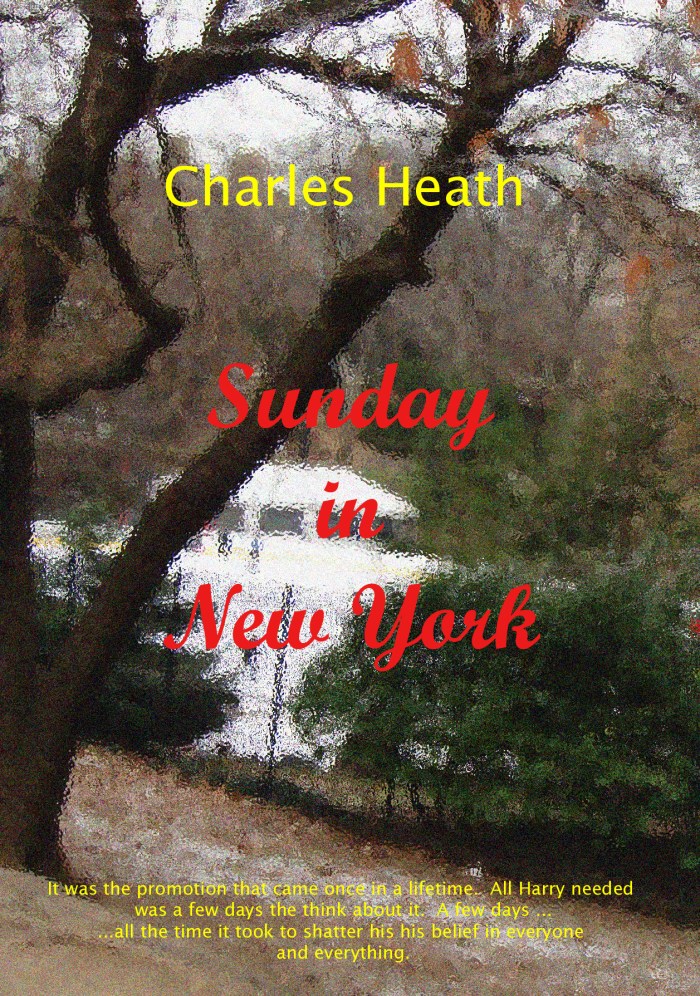
“Sunday in New York”, a romantic adventure that’s not a walk in the park!

“Sunday in New York” is ultimately a story about trust, and what happens when a marriage is stretched to its limits.

When Harry Steele attends a lunch with his manager, Barclay, to discuss a promotion that any junior executive would accept in a heartbeat, it is the fact his wife, Alison, who previously professed her reservations about Barclay, also agreed to attend, that casts a small element of doubt in his mind.

From that moment, his life, in the company, in deciding what to do, his marriage, his very life, spirals out of control.

There is no one big factor that can prove Harry’s worst fears, that his marriage is over, just a number of small, interconnecting events, when piled on top of each other, points to a cataclysmic end to everything he had believed in.

Trust is lost firstly in his best friend and mentor, Andy, who only hints of impending disaster, Sasha, a woman whom he saved, and who appears to have motives of her own, and then in his wife, Alison, as he discovered piece by piece damning evidence she is about to leave him for another man.

Can we trust what we see with our eyes or trust what we hear?

Haven’t we all jumped to conclusions at least once in our lives?

Can Alison, a woman whose self-belief and confidence is about to be put to the ultimate test, find a way of proving their relationship is as strong as it has ever been?

As they say in the classics, read on!

Purchase:

http://tinyurl.com/Amazon-SundayInNewYork

“Trouble in Store” – Short stories my way: Still working on the start

I have reworked the first part of the story with a few new elements about the characters and changed a few of the details of how the characters finish up in the shop before the policewoman makes her entrance.

This is part of the new first section that involves Jack:

Jack was staring down the barrel of a gun.

He had gone down to the corner shop to get a pack of cigarettes.

He had to hustle because he knew the shopkeeper, Alphonse, liked to close at 11:00 pm sharp.  His momentum propelled him through the door, causing the customer warning bell to ring loudly as the door bashed into it, and before the sound had died away, he knew he was in trouble.

It took a second, perhaps three, to sum up the situation. 

A young girl, about 16 or 17, scared, looking sideways at a man on the ground, then Alphonse, and then Jack.  He recognized the gun, a Luger, German, relic of WW2, perhaps her father’s souvenir, or more likely a stolen weapon, now pointing at him then Alphonse, then back to him.

Jack took another second or two to consider if he could disarm her.  No, the distance was too great.  He put his hands out where she could see them.  No sudden movements, try to remain calm, his heart rate up to the point of cardiac arrest.  No point making a bad situation worse.

Pointing with the gun, she said, “Move closer to the counter where I can see you better.”

Everything but her hand steady as a rock.  Only telltale sign of stress, the bead of perspiration on her brow.  It was 40 degrees Fahrenheit in the shop.

Jack shivered and then did as he was told. 

A few seconds more for him to decide she was in an unpredictable category.

“What’s wrong with your friend?”  Jack tried the friendly approach after he’d taken the three steps sideways necessary to reach the counter.

The shopkeeper, Alphonse, who, Jack noted seemed to have aged another ten years in the last few months, spoke instead; “I suspect he’s an addict, looking for a score.  At the end of his tether, my guess, and her to get some money.”

A simple hold up that had gone wrong.  Wrong time, wrong place, in more ways than one Jack thought, now realizing he had walked into a very dangerous situation.  She didn’t look like a user.  The boy on the ground, he did, and he looked like he was going through the beginnings of withdrawal.

Oddly, though, Jack had noticed a look pass between the shopkeeper and the girl.

 “All you had to go was give us the money, and we wouldn’t be here, now.”  She was glaring back at Alphonse.  “You can still make this right.”

A flicker of memory jumped out of the depths on Jack’s mind, something discussed at the dinner table with their neighbors, something about the shop as a pick-up point for drugs.

The boy on the floor, he was not here for the money.

Jack thought he’d try another approach.  “Look, I don’t want trouble, and you don’t want trouble.  I’ll go, forget this ever happened.  You might want to do the same.”

The girl looked like she was thinking.  The gun, though, still moved between him and the shopkeeper.

Another assessment of the girl; this was not her real home.  She was from a better class of people, a different part of town.  Caught up in a downward spiral because of her friend on the floor.

Caught in a situation she was not equipped to deal with.

That didn’t bode well for his, or anyone else in that shop right then, health.

© Charles Heath 2016-2020

The cinema of my dreams – I always wanted to see the planets – Episode 35

There’s something on the long-range scanner

…

I didn’t make it back to the leafy suburban late-night stroll, as much as I wanted to have that relaxing moment, going back to the bridge.

It was quiet, if not a subdued atmosphere, in other words, normal for the hour.  It was a skeleton crew, mostly volunteers, those without partners or couldn’t sleep. 

Sleep was one of the first problems because there was no real differentiation between night and day, a sort of hangover from those who worked night shift back on earth, only it extended to everyone.  I’d long since given up the notion of getting a good night’s sleep.

“Where are we?”  I asked, after sitting in the chair and casting a glance over the bridge in semi-darkness, and the view of empty, inky black space outside the ship.

The answer to the question, I thought wryly, was ‘in space’, but I doubt any of those on duty would have the desire to use humour in such a situation.

“In direct line with Pluto’s orbit.”

Salaman, the navigating officer, was not a man with a sense of humour, a just the facts sort of person.

“Any chance if seeing the planet?”

“If we sit here for the next 68 years, maybe.”

OK, so Salaman did have some humour in him if a little dry.

“Engineering.”  The Chief Engineer’s voice came over the loudspeaker.

“Good news, I hope?”

“Problem sorted.  Another item to take up with the inspection crew when we get home.  You’re free to resume.”

“Thank you.”  Then to the helmsman, “Let’s take it slowly, quarter speed.”

“Quarter speed it is, sir.”

There was a barely noticeable movement, then it was as if nothing had happened.  That was the disconcerting part, the fact we had no discernible way of knowing we were moving.

“Quarter speed, sir, all systems nominal.”

“Give it five minutes, then move to half, and so on “

“Yes, sir.”

I leaned back in the chair and closed my eyes.  I often tried to remember what it was like back home, before the weather changed for the worse, before people changed, not necessarily for the worse, but not as friendly or happy we once were.

That was a long time ago, though, and I’d spent more of my life in space than on earth now and wasn’t sure how I was going to survive once I had to retire.  That was, hopefully, a long time away.

“Sir, we have a long-range contact, not sure yet if it’s a meteor or a ship.”  The navigator’s voice cut into my reverie.

Did she just add the ship to the report, hoping to make a boring night into something more interesting?

“Should we hold off going to full speed, Sir?”

Probably a good idea until we identified the problem.  “OK.”

I stood, walked over to the window, and looked out, symbolically looking for the object.  Long-range meant, beyond a million or so earth kilometres, barely discernible to the scanners let alone a human eye.

“It’s moving at about half light speed, coming towards us.”

That might be a stretch assuming that we could possibly be on an intercepting course.

“Change our heading five degrees and see if it changes too.”

There was a slight movement as we changed course.  I remained by the window, watching and waiting.  There were a few flecks in the blackness, and I wondered if this was the outer rim of a meteor shower.  Were they too small for the sensors to pick up, or was the navigator concentrating on the one large object?

Five minutes passed, then ten.

“Object still on a collision course, sir.”

Which missed stating the obvious, that whatever was out there had also changed course.  Whoever or whatever was out there wanted to meet us.

“Revert back to the original course.  When will we have a clearer picture of this object?”

“Fifteen minutes, sir.”

I had read the specifications of the long-range sensors and scanners, the former mostly do we could avoid space debris that could damage the hull, though that would take a relatively large chunk.

It was our speed, and that of incoming objects that were the problem, and that’s why we had sn autopilot to help avoid these issues.

The scanners could see objects, magnify them, from a reasonable distance, so we could identify them if we had previous knowledge of them.  Alien spaceships, if we were to encounter one, might make that identification difficult but not impossible.  But, on the other hand, the specifications of every ship in space, that we knew about, of course, was in the database.

Anything else, it could be added.

Nothing more to see, I sat down again.  We were still sitting at half speed, and from what I could see on my console, everything was fine.

Then the screen switched to the long-range scan of the object.

It was a ship.

The scanner was going through the known ships list, looking for a match, until it reached the end, bringing up “unknown”.

The navigator stated the obvious, “it’s a ship sir, but not one in our database.  Do you think it might be the prototype the Russians were talking about making a dozen or so years ago?”

Everyone knew about the famous, if you won’t share we’ll build our own, bigger and better ship when the space alliance at the time baulked at bully tactics the Russians tried to use to take over running the alliance.

They had backed down in the face of a world united against them, but had they really?

“We’ll soon find out.”

…

© Charles Heath 2021-2022

Writing about writing a book – Day 7

Even God got to rest of the seventh day perhaps to admire his handiwork, but for a writer there is no rest.

I have to go to lunch with an old friend who is concerned that I have locked myself away in a garret and will wither and die, the same as not admitting myself it was time to move on.  There is the woman you marry, and your one true love, the one you can say anything to and is taken.  Marilyn is that person.  I’m not sure how this lunch will go.

Perhaps a little more work on the plot, and a few drinks to settle the nerves.


Still working on the characters (and all need a lot more work, particularly Davenport, oh, and by the way, he’s new):


Richardson – Vanilla Office worker in the wrong place at the wrong time

Gator, Inspector – Jaded policeman not far from retirement, overlooked for promotion, and always on the fringe.  Will this be his big case before he retires?

Halligan – General Manager, also a field agent who failed to complete his mission.  More on what that mission was is coming.

Bill Chandler, we seem to have him under control, except for one small detail, his memories will return.

Jennifer, Chandler’s friend, sister to Manilow, not all she appears to be.  Spoiler alert!  Manilow is another new character who will appear in Bill’s dreams (nightmares)

Benton, Chandler’s immediate superior, yes man, and eternal pessimist.

Aitchison, security chief, aka Colonel Warburton, Manilow’s old commanding officer, repatriated home after making some discoveries about wartime activities.

Wiesenthal – US management employee of Transworld

Giles – Chandler’s hardware assistant

Kowalski – executive promoted to head of security, also new, the cast is getting longer

Andy Collins –from the US, worked with Chandler around at the inception of the network installation, working with Chandler recently when updates were carried out

Davenport, aka Alphonse DeAngelo, Chandler’s old nemesis, ex-Army Colonel, and he will be a piece of work


The plotline continues but I’m not sure if this will be the eventual direction it will go.  There will be a lot of writing before now and then:


Chandler thinks he now has time for some private investigation because a lot of things about the recent events didn’t add up.  However, in the meantime, the perils of domesticity close in around Bill, the first morning with Jennifer.

A visit to the office, unscheduled, by Bill, brings to light a number of changes; new security and monitoring of movements, making it difficult for Bill to do anything.  Kowalski has replaced Aitchison as head of security, and Bill must pay him a visit.

Kowalski is full of sympathy and advises Bill that he has a lot of leave to be taken in order to get better, and a bonus as well.  He should not return until fully recovered, and then to a promotion.  In other words, Bill reads this as –’Stay Away’.

Giles gives more information of the network problems, and the disaster surrounding the backup tapes, with information that had been requested by Gator.  Of course, there was no information of the backup tapes provided, because they had been destroyed.  Was it on purpose or by accident?

Another dream and Brainless looms large and lifelike in their first meeting.

At his home to finish collecting his clothes and gear, he wakes up and remembers why he’s there.  He had removed a tape from a little-used system he’d installed for another purpose, and had brought it to his own PC to see whether there was any evidence on it – given that every other tape either proved Aitchison and Halligan guilty or had been destroyed by well-meaning but apparently incompetent consultants.  His tape has interesting information, which he notes, then hides the tape.


Dear God is that the time?  I’m late.


More tomorrow!

© Charles Heath 2016-2019

‘The Devil You Don’t’ – A beta reader’s view

It could be said that of all the women one could meet, whether contrived or by sheer luck, what are the odds it would turn out to be the woman who was being paid a very large sum to kill you.

John Pennington is a man who may be lucky in business, but not so lucky in love. He has just broken up with Phillipa Sternhaven, the woman he thought was the one, but relatives and circumstances, and perhaps because she was a ‘princess’, may also have contributed to the end result.

So, what do you do when you are heartbroken?

That is a story that slowly unfolds, from the first meeting with his nemesis on Lake Geneva, all the way to a hotel room in Sorrento, where he learns the shattering truth.

What should have been solace after disappointment, turns out to be something else entirely, and from that point, everything goes to hell in a handbasket.

He suddenly realizes his so-called friend Sebastian has not exactly told him the truth about a small job he asked him to do, the woman he is falling in love with is not quite who she says she is, and he is caught in the middle of a war between two men who consider people becoming collateral damage as part of their business.

The story paints the characters cleverly displaying all their flaws and weaknesses. The locations add to the story at times taking me back down memory lane, especially to Venice where, in those back streets I confess it’s not all that hard to get lost.

All in all a thoroughly entertaining story with, for once, a satisfying end.

…

Available on Amazon here: https://amzn.to/2Xyh1ow

…

The cinema of my dreams – I always wanted to see the planets – Episode 34

A brief moment of respite

…

The simulation of nighttime on board the ship was as realistic as I remembered it when back on earth.

I was on my usual rounds after midnight, with the 2IC of security, Nancy Woolmer, who had been a NY detective until a better offer came along.

This ship.

Like me, she had little to keep her back home, her husband who had also been a detective, had been killed on the job, and that had been the straw that broke the camel’s back.

Not blessed, or as she put it, cursed, with children, her parents had passed on, and any family left were not enough to keep her home.  This ship, she had said, would be her savior.

But she had the look of a person running away, and that, one day, would come back to bite her.  In the meantime, if we ever needed a detective, she was it.

“They’ve really got this night thing going, haven’t they.  You could almost imagine you’re in a leafy suburb out for a walk at night.”

“I doubt the streets would be as safe.”

The world we had left behind was in crisis, where there were deep divides between those in work and those who were not, and those with wealth and those without, and a bigger fight between countries over the space program.  It had started out with good intentions, but people being people, it didn’t stay that way.  

We had an international crew, but there was always the lingering doubt of what some people’s intentions were.  Out in space where everyone depended on everyone else, a small problem could become a big one very quickly.

“No, perhaps not.  But it’s good to hear the breeze rustling in the trees.”

Though the simulation lacked real trees, the projection on the passage walls of what either side of a street. With pavements, trees and houses, and for the night, the eerie glow of street lamps, was close enough.

The once around the perimeter passage on each deck took about two hours at a leisurely pace, considering there were ten decks.

I could have passed the job onto one of the watch officers, but it was about the only time I got to see the crew, those that were basically out of sight, keeping the ship running.  

I had set the lofty goal of meeting every one of the over 2,000 crew members within the first year, but a few months in, that was looking unlikely.

There was a sudden vibration emanating from the deck, followed by the sort of movement I would have associated with the ship coming off speed, like the jerk in a car when taking the foot off the accelerator.  The dampeners were designed to handle that and make increases and decreases in speed unnoticeable, but there was still an indication it had happened.

Ten seconds later my communicator vibrated.  I didn’t like the ring tone built-in, but it was more likely because most calls were bad news.

“What happened,” I asked, knowing it would be the duty officer of the watch

“Engineering are reporting a glitch, sir.”

There’s a word I hadn’t heard for a long time.  My father used to refer to anything that went wrong around the house as a glitch.

“Serious?”

“Don’t know, but you’re within a stone’s throw, so I thought you might want to pay them a visit.”

He was right, I was on that deck, and not far from the central control room.  The bridge must be tracking me, even though I’d asked them not to.  Standing orders dictated all officers and important personnel whereabouts were known at all times, I’d been told.

“I will.”

To Nancy, “You might want to continue on without me, and I’ll try to catch up later.”

She smiled.  “Tell them they should have bought the premium quality rubber bands.”

Previous conversations had highlighted a certain cynicism towards the fixtures and fittings, some of which were quite shoddy, which was disappointing but there was no doubt corners were cut in order to get the ship into service.

We all just hoped that cost-cutting didn’t extend to the main items, and if there were, it had been picked up in the trials.

As I stepped into the control room, a brightly lit room with banks of control panels and engineers sitting at them, there were a number of people huddled around one in particular, including the chief engineer.

The conversation was quite lively, and one voice stood out above the others, “… and had the builders rep actually listen to someone who knows what they’re talking about, we wouldn’t be in this situation.”

It was the same voice I’d heard in the captain’s day room my first day aboard, pontificating, as the captain put it, over a list of problems he was having with the shipbuilders representative.

“We’re in this situation,” the Chief Engineer said, “because everything we have here is new, and some of it untried.  If you’re going to push boundaries, then sometimes there’s a problem.  Rather than complain, find a resolution.”

The group broke up, and the Chief saw me coming over.  He met me halfway.

“Half this new breed they’ve sent me and more teaches rather than hands-on, always on about the code or some such.  Good, maybe, for diagnostics, but not for problem-solving.  I suspect it’s tainted coolant, seems the original batch wasn’t cleaned out after the first run, and it’s overwhelmed the filters.  It’s down to the bowels I’m afraid, and we’ll be up and running before those nincompoops work out the real problem.”

“Good.  Just let the bridge know when you’re done.”

One last look at the nincompoops, and I headed back out to resume rounds.

…

© Charles Heath 2021

You learn something new every day (2)

I got a call this morning from my brother who has been delving into the places we have lived over the years, including those before we were born.

My recollection, hazy at best, is that my father’s parents lived in Camberwell, a suburb of Melbourne, and the boys, those that survived the war, lived there too. He had three brothers, I think, and a sister. From what I’ve read, his older brother was a sensible chap and the peacemaker between him and his parents.

Later one of his brothers went to Sydney, his sister lived among orchards our Ringwood way, and another, much later, moved to Queensland. We very rarely, if ever, saw them, and the last time I did with most in one place, was after my Grandmother died. I do remember Dora, the site, visiting us once, and being young at the time, she seemed a very forbidding woman.

But, this is about where they lived.

My father, presumably before and immediately after the war, at home, and my mother at her home in Pakenham. There her father ran a service station and motor mechanic shop and was well known. Their house, at the time, was built over the road, just a short walk from home to work. The place, the first time I saw it, was a mechanics dream, with old cars and car parts outside and inside garages, and a woodworking shop with every tool imaginable.

Once the place had very elegant gardens, but by the time I got to stay there, in the 1960s, it was all overgrown, and the house was in disrepair. My mother’s brother lived there with my grandmother, and he was a fearsome, huge man who said little. All I knew about him was that, a) he was the one who found his father after he had killed himself, b) he liked fishing and went to a place called Corinella, and c) he was a mechanic like his father.

So, at some point in 1948, my father must have up and left, perhaps after an argument with his parents, and moved to Keiwa House, Bogong, where the Snowy River Hydro-Electric Scheme was being built, as a projectionist, bringing films to the workers in Town Halls.

As I’ve said, my mother stayed in a boarding house for ladies during the week and went home on weekends. I have the first letter that my father wrote to her and references the fact he went calling on her, and she was not there. We’ll never know what she thought, but there’s a second letter, after she wrote back, so a friendship was struck. He told her, almost in minute detail, what he was doing, and presumably, she told him about hers.

A year later, they married.

Now it gets interesting. We both thought that their first house, after getting married was in Carrum. It wasn’t. In the pile of letters were references to the family staying in a rented flat in Camberwell.

Sometime after that, there is a contract for a war service loan in relation to a property in Carrum, which turns out to be the first house they lived in, and where my brother, born in 1950) lived, and where I lived after I was born in 1953. I have interesting if vague memories of this house, and of the people who lived behind us because we could climb through the fence into their property. We knew them during, and after living in Carrum.

Now, today, some interesting new facts came to light about the Carrum house. We always assumed we owned it, but it seems that we didn’t. A copy of the title for that property never had the name Heath on it, so did we rent it? More information is required, and we need to dig deeper. Let’s hope there are no skeletons there.

And something else came out of a discussion with the daughter of my mothers sister, that it was believed my mother’s parents bought them a house in Chelsea, but my father, apparently, refused to live in it and sold it.

OK, I never claimed that my father was the sort that might have accepted charity, so perhaps in a moment of madness, he lost the plot. The question is, what happened to the money?
Recycle bin(0)Empty

Writing about writing a book – Day 6 continues – will it ever end?

Having finished a first draft of the words to fit the last plotline, while this is still bouncing around in my head, I need to keep the plot going.

That means I have to find a way to make Bill more interesting.  I’m not saying getting shot is just another ordinary event on another boring day at the office, but it needs something to lift into the reader’s consciousness, and want to see where he’s going to go with it.

Revenge is not on the cards because he has no idea who was shooting at him, or the fact at this time, it seems they, whoever they are, were out to assassinate Aitchison.

Why you ask.

There will be a reason, so sit back and relax, we’re not there yet.


Bill wakes up in the hospital and finds Jennifer there.  He remembers what has happened and realizes how lucky he is to survive.

After a period of recovery, Bill is questioned by Gator, the detective also now in charge of the shooting investigation, as, he tells Bill, there seems to be a connection between the two (obviously because it concerns the company Bill works for).

Bill cannot remember much of the detail of the earlier network outage and situation, but the import of Gator’s investigation is centered on the deaths of Halligan, Aitchison, and the attempts of both him and Jennifer.  I think we can safely say Jennifer was in the wrong place at the wrong time.

Gator also reveals there are still problems with the computer systems at Transworld, a question of missing files, and a security breach.  He also advises Bill of Wiesenthal’s arrival and temporary management role.

(OK, a new character, Wiesenthal, he needs to be slightly sinister, and there for reasons that are not explained straight away.)

On the mend, and with time on his hands, Bill will have two new events to think about.

Firstly, and certainly not unwelcome, but a bit of a surprise is the continual presence of Jennifer.  He discovers that Jennifer has the same feelings for him and he has for her.

Secondly, and probably the more important of the two, and cause for concern, is the return of some of his memories in relation to service in the army during various engagements overseas, and one in particular.  Worse, he cannot understand why now, of all times, these particular memories should be returning.

He knew something bad had happened to him back then but was thankful that his mind had managed to keep it at bay for as long as it had.

But the nightmares become real, and the first of many plays out in his mind like a movie, where everything and everyone is in a surreal theatre production.  There he finally remembers what his mind has blocked for so long – that he was in a camp of sorts as a prisoner, and its something to do with his days in the Army.

In light of these memories returning, a Brigadier General pays a visit and explains the missing parts of his service life.  Why he did so Bill couldn’t immediately understand but didn’t question it.  Then Ellen conveniently visits him, laments his misfortune, and goes over the reasons for not telling him about his past (now that he’s remembered it) and wished him well for the future.

Before he leaves the hospital, Gator returns to tie up loose ends, that all that appeared to be sinister was not, and could be explained rationally.  It marked the end of his investigation, albeit a little too convenient Bill thinks but again says nothing.

He finally goes home with Jennifer.

Another dream – of the beginning of a lifelong friendship with ‘Brainless’ a fellow soldier, and someone he has known off and on since Army days, but who also had not alerted him to what he now remembered, also no doubt for a very good reason.

And the remembrance of the word Starburst – but he has no idea of its significance.

Well, that’s a lot to deal with, and will keep me writing long into the night.

And more people.

This story is starting to have a list of credits as long as the end of a movie!