“Trouble in Store” – Short Stories My Way:  The re-write – Part 5

Now that I’ve gone through the story and made quite a few changes, it’s time to look at the story

Alphonse, the shopkeeper, had stayed too long missing his opportunity to sell up and retire.

By the time he had been ready to call it a day, his wife had got sick with cancer, and it had taken all their retirement funds to keep her alive for another six months, when despite the doctor’s best efforts, she died.

There was nothing left, and unable to find a buyer for the business he could not just close the door and leave.

There were complications.

Like right now.

The sideline he’d basically forced his way into was always going to come back and bite him.  Selling a little weed on the side to the upper classes forced them to downsize after the global meltdown had turned into a range of products, the worst of which was ice, the result of taking too much very evident by the boy on the floor.

It was only a matter of time when one of the more edgy clients came in and started making demands with threats.  He was asked to sell low to get the customers hooked then forced to raise the price and stop supplying those who couldn’t pay.

It might be a good plan from their perspective but from his, at the coalface, it meant nothing but trouble.

Which is why he was now looking down the barrel of a gun.

This wasn’t the shopkeeper’s first hold-up.  In fact, over the years there had been a dozen.  But only one got reported to the police, and that was only because the robber was shot and killed.

He’d taken a bullet that night, too, which, from the police point of view, made him a concerned citizen simply defending himself.

The rest had been scared off by the double-barrel shotgun he kept under the counter for just such emergencies.

The young punk who came into the shop with his girlfriend had pulled out the pistol and told him if he reached for the shotgun he’d shoot him.  The kid looked unstable, and he’d backed away.

When the kid collapsed, he should have gone for the shotgun, but instead, he thought he could get to the gun before the girl realised what had happened.  She wasn’t an addict and clearly looked like she was only along for the ride.  Her look when the kid pulled out the gun told him she’d known nothing about her partner’s true intentions.

But, he wasn’t fast enough, and she had the gun pointing at him before he’d got past the counter.

From one pair of unpredictable hands to another.

Like the girl, he was just as surprised when the customer burst in the door, just before closing time.

The situation might have been salvageable before the customer came in the door, getting the girl to go along with the robbery being about money, but there was no denying what the kid on the floor’s problem was.

Damn.

He had to try and salvage the situation simply because there was a lot of money involved, and other people depending on him.  He looked at the boy, on the floor, then the girl.

“Listen to me, young lady, you would be well advised to let this man go as he suggests.  And, please put the gun down before someone gets hurt.  Your friend needs medical help, and I can call an ambulance.”

The girl switched her attention back to him.  “No one’s going anywhere, so just shut the hell up and let me think.”

The storekeeper glanced over at the customer.

He’d seen him come into the shop once or twice, probably lived in the neighbourhood, the sort who’d make a reliable witness, either a lawyer or an accountant.  Not like most of the residents just beyond the fringe of respectability.

If only he hadn’t burst into the shop when he did.

© Charles Heath 2016-2024

The cinema of my dreams – I always wanted to see the planets – Episode 45

Back on the alien vessel

If asking for and getting what you wanted was the technology of lesser beings, what was the other world’s technology like?

It was a question I asked myself, or perhaps a moment after, if the alien people we were currently talking to had difficulties with other more advanced people in their galaxy, where would we fit into the picture?

It was a worrying thought, because through time those that were inferior, in our world, were always subjugated by the more superior.

Granted we had spaceships making us seem reasonably advanced, but theirs were not like the one I was on.  We thought we were very clever getting the ship we were on into space, but out there, now, I certainly didn’t feel clever, or superior.

There was also the revelation that we had been observed for a long time, our progress monitored, and basically rejected as likely candidates for being welcomed.  Or being told we were not alone.

It must have been a dock to see us turn up one their proverbial doorstep, but not so great as out that they knew about us.  It was a case of our reputation preceded us, and it wasn’t the good, only the bad.

It would be true to say, given everything we’d done to our world through greed and selfishness, that finding off-world destinations for colonization was a definite requirement rather than an option, and along with that, to find and learn from other civilizations, especially those that had been in the same plight.

And having found what we had always believed, well, a lot of us anyway, that there was other life in the galaxy, it wasn’t going to sit well that we were basically in the ‘cane man’ stage of development as a civilization.

It was not much of a starting point for any sort of negotiation, diplomatic or otherwise, along with the prospect of meeting the other civilizations in this quadrant if it could be called that, basically from behind that proverbial eight-ball.

We were still no wiser as to where these people came from, or that it was near our first intended destination, Proxima Centauri.  We had a list NASA had compiled, earth-like exotic plants that were thought to be able to support life.

Several of the meetings between the world’s greatest scientific minds, when they were not off on one of their theoretical rants, all concluded that there should be life out in the universe somewhere, that all the known explanations of our existence were wrong, and we were descendants of aliens, possibly more than one species. 

It was a fanciful notion that drew interesting reactions from the Darwinians who believed we descended from the apes, the church, still stuck on their Adam and Eve theory, and others that we evolved after the ‘big bang’, or that our DNA arrived via a colliding meteor, which had me puzzled.

Now, I was not sure what I believed.

The Russian captain, now free of being threatened with an alien weapon, had completed a full circuit of the bridge, taken a moment to stare out into space, and where our ships were standing off, then come and join us.

I had a hundred questions, but the first was, “What was your mission?”

“Beat you lot into space.  To be honest we never expected you’d ever get that ship out of the space dock”

A year late, and people still arguing over staffing, fittings, weapons, technology, even bragging rights, if it hadn’t been for the Admiral, we might still be there.

“You didn’t answer the question, not specifically.  No one just wants to be first, and especially not brave about it.”

“Not yet.”

“I assume you’ve been in communication back home?”

“Communication wasn’t one of the strong points since no one really knew how to make instant calls work, so not really.  We’re basically flying by the seat of our pants.”

“I can see that, applying earth mentality to alien relations.  I would have thought you and your superiors would take a more diplomatic approach.”

“We tried.  You do realize were are technically inferior to this lot, and they don’t view us as being worthy of their time and effort.  Apparently, they knew exactly who we are, and where we were from, something I find hard to believe.”

“Did you visit the planet?”

“We were stopped by a patrolling ship, and they actually fired on us.”

I was not surprised.  We would have done exactly the same, in reverse.

“So, you started on the wrong foot and it only got worse from there.”

“What would you have done in the same situation?”

“Be less confrontational, but then, we’re on an exploratory mission, not one that takes whatever we can steal or in your case kidnap.  Did you realize who those people were?”

“They approached us.  Before we got to their planet we got a distress signal from what looked like a space station, quite a distance from the planet.  We didn’t know it was a prison, only that there were people in distress.  We rescued them, as anyone else would.  That’s when the proverbial hit the fan.”

“Did you know they had specialist knowledge?”

“Eventually, when the aliens came after us, I told them I needed to know why they were being so angry about a few criminals.  I offered them sanctuary if they were willing to share their knowledge.  They agreed.”

“They didn’t want to go home?”

“No.  They said they’d be killed by their own people.   We call it treason, they call it something else, but its more or less the same thing.  Now they’re going to kill all of us.”

© Charles Heath 2021-2022

Writing about writing a book – Day 13 supplemental

I was going to say ‘Captain’s log supplemental’ and add a stardate, but the analogy might get lost because not everyone is a Star Trekker.

Needless to say, there’s always more to say about an event, especially when the mind is casting about for ideas to add or enhance a story.

It comes down to, does art imitate life, or does life imitate art?  It’s an interesting question because, in this instance, art will be imitating, to a certain extent, life.

Perhaps what is lost in the telling is the inability of newly divorced people in working out where the boundaries are, whether or not they are entitled to know about the other person’s private life, and how that will make them feel.

I’m guessing when a marriage breaks down, there’s always a cause, and while the word amicable gets bandied around a lot, it’s said, but quite often not meant.

Does mummy have a boyfriend?

Does daddy have a girlfriend?

What generally happens is the children are the only ones who know what’s really happening to each of the parents, because they get transported between the two, as neither parent would want to be seen stopping the other from seeing them/

Of course, where the children are grown up and leading their own lives, the situation should be a lot easier.

But, where does this fit in with the story I hear you asking.


Marriages fall apart for many reasons.  In the story, Bill acknowledges that it is largely his fault, and one suspects it’s probably an undiagnosed case of PTSD that back in the sixties and seventies was not really understood.

It led to both he and Ellen leading individual but separate lives whilst keeping up appearances for the sake of their children.  There’s no doubting who brought them up, Ellen, and who had the greater influence over them, although, for the sake of this story, both couldn’t wait to leave home and live somewhere else.

They do, and together.  They are not married and do not have children.  They were not the cause of the breakup, and fortunately, neither of the girls blame one or the other parent.

But that doesn’t mean, over the years, that either parent hasn’t tried to use them to glean information about the other.  It is how Bill discovered, some time ago, that Ellen had ‘a special friend’.

Yet, neither of the daughters have seen him, and not surprisingly, he had made sure that Bill has never seen him.  It’s for a particular reason, one that will become obvious later in the story.  It is, I think, a rather clever twist.

Also, Ellen is not a bad person and certainly wasn’t bad to Bill, perhaps more long-suffering.  She did stay with him for a long time, mainly for the children, but also because she genuinely cared for Bill.

And Bill had not had another woman friend, not until he discovers his feelings towards Jennifer and even then, he keeps that to himself, even when he really doesn’t have to.

Sigh.

Time to return to my fictional world.

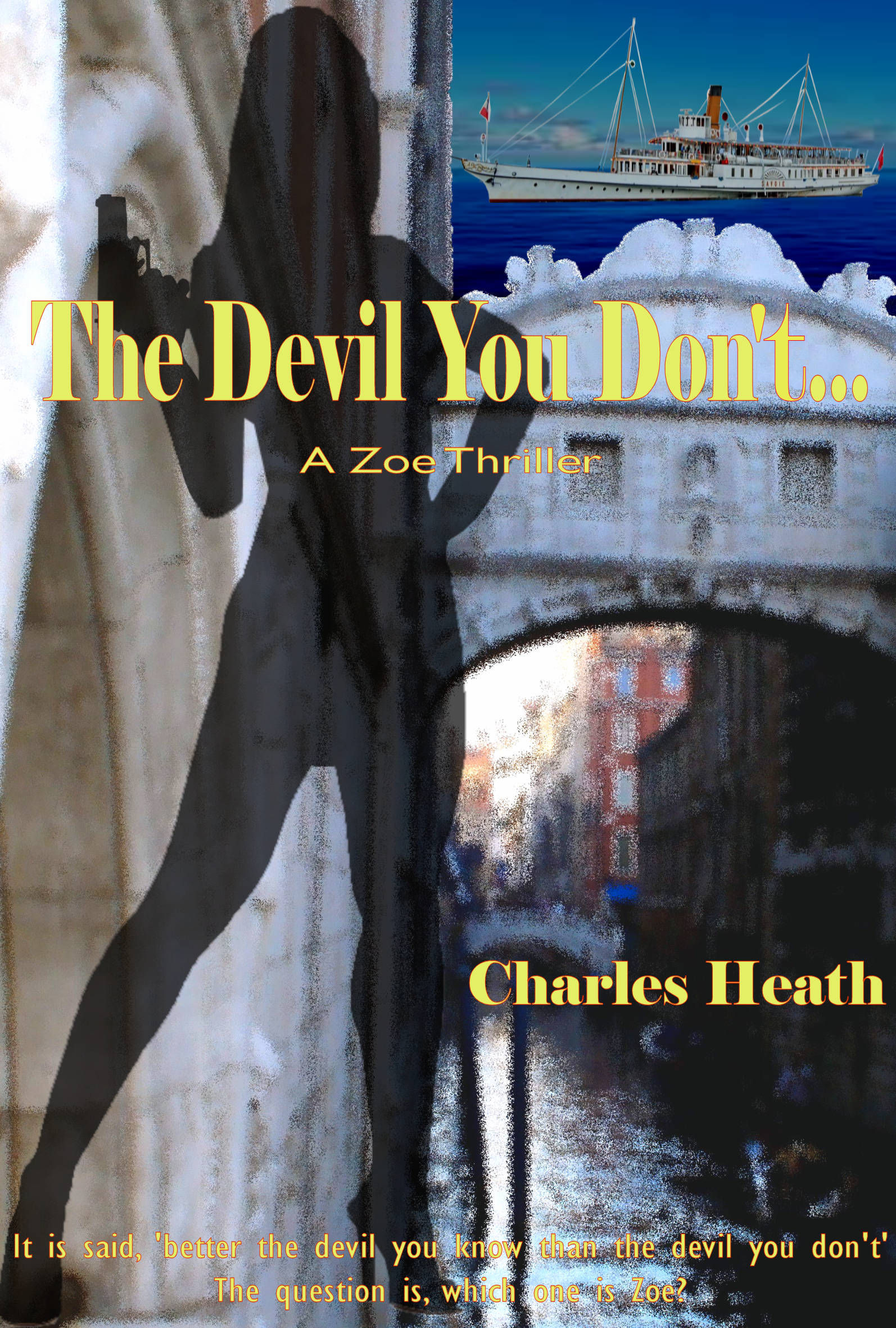
An excerpt from “The Devil You Don’t”

Available on Amazon Kindle here:  https://amzn.to/2Xyh1ow

By the time I returned to the Savoie, the rain had finally stopped, and there was a streak of blue sky to offer some hope the day would improve.

The ship was not crowded, the possibility of bad weather perhaps holding back potential passengers.  Of those I saw, a number of them would be aboard for the lunch by Phillippe Chevrier.  I thought about it, but the Concierge had told me about several restaurants in Yvoire and had given me a hand-drawn map of the village.  I think he came from the area because he spoke with the pride and knowledge of a resident.

I was looking down from the upper deck observing the last of the boarding passengers when I saw a woman, notable for her red coat and matching shoes, making a last-minute dash to get on board just before the gangway was removed.  In fact, her ungainly manner of boarding had also captured a few of the other passenger’s attention.  Now they would have something else to talk about, other than the possibility of further rain.

I saw her smile at the deckhand, but he did not smile back.  He was not impressed with her bravado, perhaps because of possible injury.  He looked at her ticket then nodded dismissively, and went back to his duties in getting the ship underway.  I was going to check the departure time, but I, like the other passengers, had my attention diverted to the woman in red.

From what I could see there was something about her.  It struck me when the light caught her as she turned to look down the deck, giving me a perfect profile.  I was going to say she looked foreign, but here, as in almost anywhere in Europe, that described just about everyone.  Perhaps I was just comparing her to Phillipa, so definitively British, whereas this woman was very definitely not.

She was perhaps in her 30’s, slim or perhaps the word I’d use was lissom, and had the look and manner of a model.  I say that because Phillipa had dragged me to most of the showings, whether in Milan, Rome, New York, London, or Paris.  The clothes were familiar, and in the back of my mind, I had a feeling I’d seen her before.

Or perhaps, to me, all models looked the same.

She looked up in my direction, and before I could divert my eyes, she locked on.  I could feel her gaze boring into me, and then it was gone as if she had been looking straight through me.  I remained out on deck as the ship got underway, watching her disappear inside the cabin.  My curiosity was piqued, so I decided to keep an eye out for her.

I could feel the coolness of the air as the ship picked up speed, not that it was going to be very fast.  With stops, the trip would take nearly two hours to get to my destination.  It would turn back almost immediately, but I was going to stay until the evening when it returned at about half eight.  It would give me enough time to sample the local fare, and take a tour of the medieval village.

Few other passengers ventured out on the deck, most staying inside or going to lunch.  After a short time, I came back down to the main deck and headed forward.  I wanted to clear my head by concentrating on the movement of the vessel through the water, breathing in the crisp, clean air, and let the peacefulness of the surroundings envelope me.

It didn’t work.

I knew it wouldn’t be long before I started thinking about why things hadn’t worked, and what part I played in it.  And the usual question that came to mind when something didn’t work out.  What was wrong with me?

I usually blamed it on my upbringing.

I had one of those so-called privileged lives, a nanny till I was old enough to go to boarding school, then sent to the best schools in the land.  There I learned everything I needed to be the son of a Duke, or, as my father called it in one of his lighter moments, nobility in waiting.

Had this been five or six hundred years ago, I would need to have sword and jousting skills, or if it had been a few hundred years later a keen military mind.  If nothing else I could ride a horse, and go on hunts, or did until they became not the thing to do.

I learned six languages, and everything I needed to become a diplomat in the far-flung British Empire, except the Empire had become the Commonwealth, and then, when no-one was looking, Britain’s influence in the world finally disappeared.  I was a man without a cause, without a vocation, and no place to go.

Computers were the new vogue and I had an aptitude for programming.  I guess that went hand in hand with mathematics, which although I hated the subject, I excelled in.  Both I and another noble outcast used to toss ideas around in school, but when it came to the end of our education, he chose to enter the public service, and I took a few of those ideas we had mulled over and turned them into a company.

About a year ago, I was made an offer I couldn’t refuse.  There were so many zeroes on the end of it I just said yes, put the money into a very grateful bank, and was still trying to come to terms with it.

Sadly, I still had no idea what I was going to do with the rest of my life.  My parents had asked me to come back home and help manage the estate, and I did for a few weeks.  It was as long as it took for my parents to drive me insane.

Back in the city, I spent a few months looking for a mundane job, but there were very few that suited the qualifications I had, and the rest, I think I intimidated the interviewer simply because of who I was.  In that time I’d also featured on the cover of the Economist, and through my well-meaning accountant, started involving myself with various charities, earning the title ‘philanthropist’.

And despite all of this exposure, even making one of those ubiquitous ‘eligible bachelor’ lists, I still could not find ‘the one’, the woman I wanted to spend the rest of my life with.  Phillipa seemed to fit the bill, but in time she proved to be a troubled soul with ‘Daddy’ issues.  I knew that in building a relationship compromise was necessary, but with her, in the end, everything was a compromise and what had happened was always going to be the end result.

It was perhaps a by-product of the whole nobility thing.  There was a certain expectation I had to fulfill, to my peers, contemporaries, parents and family, and those who either liked or hated what it represented.  The problem was, I didn’t feel like I belonged.  Not like my friend from schooldays, and now obscure acquaintance, Sebastian.  He had been elevated to his Dukedom early when his father died when he was in his twenties.  He had managed to fade from the limelight and was rarely mentioned either in the papers or the gossip columns.  He was one of the lucky ones.

I had managed to keep a similarly low profile until I met Phillipa.  From that moment, my obscurity disappeared.  It was, I could see now, part of a plan put in place by Phillipa’s father, a man who hogged the limelight with his daughter, to raise the profile of the family name and through it their businesses.  He was nothing if not the consummate self-advertisement.

Perhaps I was supposed to be the last piece of the puzzle, the attachment to the establishment, that link with a class of people he would not normally get in the front door.  There was nothing refined about him or his family, and more than once I’d noticed my contemporaries cringe at the mention of his name, or any reference of my association with him.

Yet could I truthfully say I really wanted to go back to the obscurity I had before Phillipa?  For all her faults, there were times when she had been fun to be with, particularly when I first met her when she had a certain air of unpredictability.  That had slowly disappeared as she became part of her father’s plan for the future.  She just failed to see how much he was using her.

Or perhaps, over time, I had become cynical.

I thought about calling her.  It was one of those moments of weakness when I felt alone, more alone than usual.

I diverted my attention back to my surroundings and the shoreline.  Out of the corner of my eye, I could see the woman in the red coat, making a move.  The red coat was like a beacon, a sort of fire engine red.  It was not the sort of coat most of the women I knew would wear, but on her, it looked terrific.  In fact, her sublime beauty was the one other attribute that was distinctly noticeable, along with the fact her hair was short, rather than long, and jet black.

I had to wrench my attention away from her.

A few minutes later several other passengers came out of the cabin for a walk around the deck, perhaps to get some exercise, perhaps checking up on me, or perhaps I was being paranoid.  I waited till they passed on their way forward, and I turned and headed aft.

I watched the wake sluicing out from under the stern for a few minutes, before retracing my steps to the front of the ship and there I stood against the railing, watching the bow carve its way through the water.  It was almost mesmerizing.  There, I emptied my mind of thoughts about Phillipa, and thoughts about the woman in the red coat.

Until a female voice behind me said, “Having a bad day?”

I started, caught by surprise, and slowly turned.  The woman in the red coat had somehow got very close me without my realizing it.  How did she do that?  I was so surprised I couldn’t answer immediately.

“I do hope you are not contemplating jumping.  I hear the water is very cold.”

Closer up, I could see what I’d missed when I saw her on the main deck.  There was a slight hint of Chinese, or Oriental, in her particularly around the eyes, and of her hair which was jet black.  An ancestor twice or more removed had left their mark, not in a dominant way, but more subtle, and easily missed except from a very short distance away, like now.

Other than that, she was quite possibly Eastern European, perhaps Russian, though that covered a lot of territory.  The incongruity of it was that she spoke with an American accent, and fluent enough for me to believe English was her first language.

Usually, I could ‘read’ people, but she was a clean slate.  Her expression was one of amusement, but with cold eyes.  My first thought, then, was to be careful.

“No.  Not yet.”  I coughed to clear my throat because I could hardly speak.  And blushed, because that was what I did when confronted by a woman, beautiful or otherwise.

The amusement gave way to a hint of a smile that brightened her demeanor as a little warmth reached her eyes.  “So that’s a maybe.  Should I change into my lifesaving gear, just in case?”

It conjured up a rather interesting image in my mind until I reluctantly dismissed it.

“Perhaps I should move away from the edge,” I said, moving sideways until I was back on the main deck, a few feet further away.  Her eyes had followed me, and when I stopped she turned to face me again.  She did not move closer.

I realized then she had removed her beret and it was in her left side coat pocket.  “Thanks for your concern …?”

“Zoe.”

“Thanks for your concern, Zoe.  By the way, my name is John.”

She smiled again, perhaps in an attempt to put me at ease.  “I saw you earlier, you looked so sad, I thought …”

“I might throw myself overboard?”

“An idiotic notion I admit, but it is better to be safe than sorry.”

Then she tilted her head to one side then the other, looking intently at me.  “You seem to be familiar.  Do I know you?”

I tried to think of where I may have seen her before, but all I could remember was what I’d thought earlier when I first saw her; she was a model and had been at one of the showings.  If she was, it would be more likely she would remember Phillipa, not me.  Phillipa always had to sit in the front row.

“Probably not.”  I also didn’t mention the fact she may have seen my picture in the society pages of several tabloid newspapers because she didn’t look the sort of woman who needed a daily dose of the comings and goings, and, more often than not, scandal associated with so-called celebrities.

She gave me a look, one that told me she had just realized who I was.  “Yes, I remember now.  You made the front cover of the Economist.  You sold your company for a small fortune.”

Of course.  She was not the first who had recognized me from that cover.  It had raised my profile considerably, but not the Sternhaven’s.  That article had not mentioned Phillipa or her family.  I suspect Grandmother had something to do with that, and it was, now I thought about it, another nail in the coffin that was my relationship with Phillipa.

“I wouldn’t say it was a fortune, small or otherwise, just fortunate.”  Each time, I found myself playing down the wealth aspect of the business deal.

“Perhaps then, as the journalist wrote, you were lucky.  It is not, I think, a good time for internet-based companies.”

The latter statement was an interesting fact, one she read in the Financial Times which had made that exact comment recently.

“But I am boring you.”  She smiled again.  “I should be minding my own business and leaving you to your thoughts.  I am sorry.”

She turned to leave and took a few steps towards the main cabin.

“You’re not boring me,” I said, thinking I was letting my paranoia get the better of me.  It had been Sebastian on learning of my good fortune, who had warned me against ‘a certain element here and abroad’ whose sole aim would be to separate me from my money.  He was not very subtle when he described their methods.

But I knew he was right.  I should have let her walk away.

She stopped and turned around.  “You seem nothing like the man I read about in the Economist.”

A sudden and awful thought popped into my head.  Those words were part of a very familiar opening gambit.  “Are you a reporter?”

I was not sure if she looked surprised, or amused.  “Do I look like one?”

I silently cursed myself for speaking before thinking, and then immediately ignored my own admonishment.  “People rarely look like what they are.”

I saw the subtle shake of the head and expected her to take her leave.  Instead she astonished me.

“I fear we have got off on the wrong foot.  To be honest, I’m not usually this forward, but you seemed like you needed cheering up when probably the opposite is true.  Aside from the fact this excursion was probably a bad idea.  And,” she added with a little shrug, “perhaps I talk too much.”

I was not sure what I thought of her after that extraordinary admission. It was not something I would do, but it was an interesting way to approach someone and have them ignoring their natural instinct.  I would let Sebastian whisper in my ear for a little longer and see where this was going.

“Oddly enough, I was thinking the same thing.  I was supposed to be traveling with my prospective bride.  I think you can imagine how that turned out.”

“She’s not here?”

“No.”

“She’s in the cabin?”  Her eyes strayed in that direction for a moment then came back to me.  She seemed surprised I might be traveling with someone.

“No.  She is back in England, and the wedding is off.  So is the relationship.  She dumped me by text.”

OK, why was I sharing this humiliating piece of information with her?  I still couldn’t be sure she was not a reporter.

She motioned to an empty seat, back from the edge.  No walking the plank today.  She moved towards it and sat down.  She showed no signs of being cold, nor interested in the breeze upsetting her hair.  Phillipa would be having a tantrum about now, being kept outside, and freaking out over what the breeze might be doing to her appearance.

I wondered, if only for a few seconds if she used this approach with anyone else.  I guess I was a little different, a seemingly rich businessman alone on a ferry on Lake Geneva, contemplating the way his life had gone so completely off track.

She watched as I sat at the other end of the bench, leaving about a yard between us.  After I leaned back and made myself as comfortable as I could, she said, “I have also experienced something similar, though not by text message.  It is difficult, the first few days.”

“I saw it coming.”

“I did not.”  She frowned, a sort of lifeless expression taking over, perhaps brought on by the memory of what had happened to her.  “But it is done, and I moved on.  Was she the love of your life?”

OK, that was unexpected.

When I didn’t answer, she said, “I am sorry.  Sometimes I ask personal questions without realizing what I’m doing.  It is none of my business.”  She shivered.  “Perhaps we should go back inside.”

She stood, and held out her hand.  Should I take it and be drawn into her web?  I thought of Sebastian.  What would he do in this situation?

I took her hand in mine and let her pull me gently to my feet.  “Wise choice,” she said, looking up at the sky.

It just started to rain.

© Charles Heath 2015-2023

newdevilcvr6

Writing about writing a book – Day 13 supplemental

I was going to say ‘Captain’s log supplemental’ and add a stardate, but the analogy might get lost because not everyone is a Star Trekker.

Needless to say, there’s always more to say about an event, especially when the mind is casting about for ideas to add or enhance a story.

It comes down to, does art imitate life, or does life imitate art?  It’s an interesting question because, in this instance, art will be imitating, to a certain extent, life.

Perhaps what is lost in the telling is the inability of newly divorced people in working out where the boundaries are, whether or not they are entitled to know about the other person’s private life, and how that will make them feel.

I’m guessing when a marriage breaks down, there’s always a cause, and while the word amicable gets bandied around a lot, it’s said, but quite often not meant.

Does mummy have a boyfriend?

Does daddy have a girlfriend?

What generally happens is the children are the only ones who know what’s really happening to each of the parents, because they get transported between the two, as neither parent would want to be seen stopping the other from seeing them/

Of course, where the children are grown up and leading their own lives, the situation should be a lot easier.

But, where does this fit in with the story I hear you asking.


Marriages fall apart for many reasons.  In the story, Bill acknowledges that it is largely his fault, and one suspects it’s probably an undiagnosed case of PTSD that back in the sixties and seventies was not really understood.

It led to both he and Ellen leading individual but separate lives whilst keeping up appearances for the sake of their children.  There’s no doubting who brought them up, Ellen, and who had the greater influence over them, although, for the sake of this story, both couldn’t wait to leave home and live somewhere else.

They do, and together.  They are not married and do not have children.  They were not the cause of the breakup, and fortunately, neither of the girls blame one or the other parent.

But that doesn’t mean, over the years, that either parent hasn’t tried to use them to glean information about the other.  It is how Bill discovered, some time ago, that Ellen had ‘a special friend’.

Yet, neither of the daughters have seen him, and not surprisingly, he had made sure that Bill has never seen him.  It’s for a particular reason, one that will become obvious later in the story.  It is, I think, a rather clever twist.

Also, Ellen is not a bad person and certainly wasn’t bad to Bill, perhaps more long-suffering.  She did stay with him for a long time, mainly for the children, but also because she genuinely cared for Bill.

And Bill had not had another woman friend, not until he discovers his feelings towards Jennifer and even then, he keeps that to himself, even when he really doesn’t have to.

Sigh.

Time to return to my fictional world.

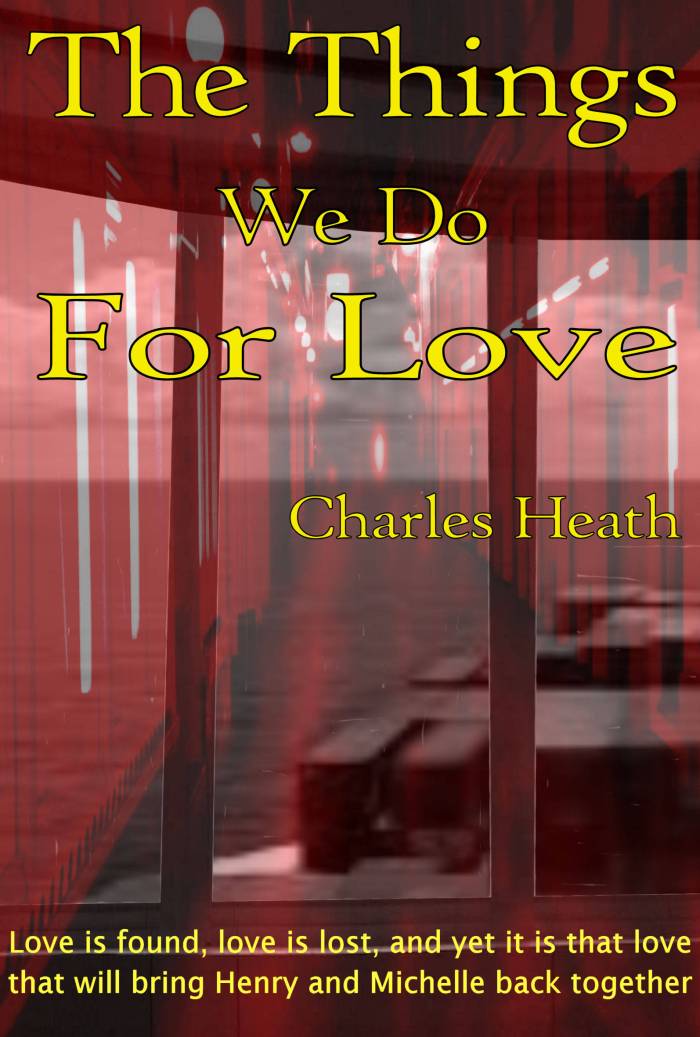
“The Things We Do For Love”

Would you give up everything to be with the one you love?

Is love the metaphorical equivalent to ‘walking the plank’; a dive into uncharted waters?

For Henry, the only romance he was interested in was a life at sea, and when away from it, he strived to find sanctuary from his family and perhaps life itself.  It takes him to a small village by the sea, a place he never expected to find another just like him, Michelle, whom he soon discovers is as mysterious as she is beautiful.

Henry had long since given up the notion of finding romance, and Michelle couldn’t get involved for reasons she could never explain, but in the end, both acknowledge that something happened the moment they first met.  

Plans were made, plans were revised, and hopes were shattered.

A chance encounter causes Michelle’s past to catch up with her, and whatever hope she had of having a normal life with Henry, or anyone else, is gone.  To keep him alive she has to destroy her blossoming relationship, an act that breaks her heart and shatters his.

But can love conquer all?

It takes a few words of encouragement from an unlikely source to send Henry and his friend Radly on an odyssey into the darkest corners of the red-light district in a race against time to find and rescue the woman he finally realizes is the love of his life.

The cover, at the moment, looks like this:

lovecoverfinal1

Is love the metaphorical equivalent to ‘walking the plank’; a dive into uncharted waters?

For Henry, the only romance he was interested in was a life at sea, and when away from it, he strived to find sanctuary from his family and perhaps life itself.  It takes him to a small village by the sea, s place he never expected to find another just like him, Michelle, whom he soon discovers is as mysterious as she is beautiful.

Henry had long since given up the notion of finding romance, and Michelle couldn’t get involved for reasons she could never explain, but in the end, both acknowledge that something happened the moment they first met.  

Plans were made, plans were revised, and hopes were shattered.

A chance encounter causes Michelle’s past to catch up with her, and whatever hope she had of having a normal life with Henry, or anyone else, is gone.  To keep him alive she has to destroy her blossoming relationship, an act that breaks her heart and shatters his.

But can love conquer all?

It takes a few words of encouragement from an unlikely source to send Henry and his friend Radly on an odyssey into the darkest corners of the red-light district in a race against time to find and rescue the woman he finally realizes is the love of his life.

The cover, at the moment, looks like this:

lovecoverfinal1

“One Last Look”, nothing is what it seems

A single event can have enormous consequences.

A single event driven by fate, after Ben told his wife Charlotte he would be late home one night, he left early, and by chance discovers his wife having dinner in their favourite restaurant with another man.

A single event where it could be said Ben was in the wrong place at the wrong time.

Who was this man? Why was she having dinner with him?

A simple truth to explain the single event was all Ben required. Instead, Charlotte told him a lie.

A single event that forces Ben to question everything he thought he knew about his wife, and the people who are around her.

After a near-death experience and forced retirement into a world he is unfamiliar with, Ben finds himself once again drawn back into that life of lies, violence, and intrigue.

From London to a small village in Tuscany, little by little Ben discovers who the woman he married is, and the real reason why fate had brought them together.

It is available on Amazon here:  http://amzn.to/2CqUBcz

“Trouble in Store” – Short Stories My Way:  The re-write – Part 4

Now that I’ve gone through the story and made quite a few changes, it’s time to look at the story

Annalisa looked at the two men facing her.

Simmo, the boy on the floor, had told her that the shopkeeper would be a pushover, he was an old man who’d just hand over the drugs, rather than cause trouble for himself.

Where Simmo had discovered the shopkeeper’s true vocation, dispensing drugs to the neighbourhood addicts, she didn’t know, but it was not the first place like this they had visited.

She had always known Simmo had a problem, but he had assured her he had it under control.  Until a month ago, when he had tried something new.

It had changed him.

The breaking point came earlier that day when seeing how sick he was, she threatened to leave.  It brought out the monster within him, and he threatened to kill her.  Not long after he had changed into a whimpering child pleading with her to stay, that he hadn’t meant anything he’d said before.

All he needed was one more ‘score’ to get his ‘shit’ together, and he would do as she asked, and find help.

She believed him.

He said he knew a place not far from the apartment, a small shop where what he needed was available, and said he had the money.

That should have been the first sign he was not telling the truth because she had been funding his habit until her parents cut off the money supply.  She suspected her father had put a private detective on to find her, had, and reported back, and rather than make a scene, just cut her off so she would have to come home or starve.  Her father was no better than Simmo.

And, as soon as they stepped into the shop, Simmo pulled out the gun,

Instead of the shopkeeper cowering like Simmo said he would, he had laughed at them and told them to get out.  Simmo started ranting and waving the gun around, then all of a sudden collapsed.

There was a race for the gun which spilled out of Simmo’s hand, and she won.

That was just before the customer burst into the shop.

It had been shortly before closing time.  Simmo had said there would be no one else around.

Wrong again.

Now she had another problem to deal with, a man who was clearly as scared shitless as she was.

This was worse than any bad hair day or getting out of the wrong side of bed day, this was, she was convinced, the last day of her life.

She heard a strange sound come from beside her and looked down.  There was a trickle of blood coming out of his mouth and Simmo was making strange sounds like he was choking.

Any other time she might have been concerned, but the hard reality of it was, that Simmo was never going to change.  She was only surprised at the fact it took so long for her to realise it.

As for the man standing in front of her, she was safe from the shopkeeper with him around, so he would have to stay.

“No.  Stay.”

Another glance at the shopkeeper told her she had made the right decision; his expression said it all.  Gun or no gun, the moment she was alone with him, he would kill her.

© Charles Heath 2016-2024

The cinema of my dreams – I always wanted to see the planets – Episode 44

Back on the alien vessel

I was surprised the alien captain was not getting impatient with the way this matter was dragging on. 

If this was back on earth and we were dealing with an alien incursion, there would be a lot of shooting by short-tempered small-minded fools who only knew one way of dealing with seemingly insurmountable problems.

In that regard, these aliens were better than us, and I had to wonder if they were dealing with this problem in a manner we would understand, and if that was the case, what would have happened if my ship had not made a timely, or untimely, arrival.

It also begged the question of how either of us could move forward from this point, because the only logical outcome was to hand back the criminals.

I wonder what Nancy was thinking, the fate of diplomatic relations, if they were possible after this, in her hands.

There was also a question of what the Russian captain had been promised in return for trying to save them.  It would have to be significant for him to put his vessel and its crew on the line.

I looked at the Russian Captain, not looking very comfortable, on the end of a weapon he clearly knew could kill him, or worse.

“What did they promise you?”

His mouth moved, an indication to me he was going to say they didn’t, which to me meant that it was not something he wanted to talk about in front of the Aliens.

The alien answered for him.  “Technology, perhaps our secret weapons, the criminals are all people who have worked with or worked on some of our most secret projects.”

Which begged the question, what did they do wrong that they were labelled criminals.

Perhaps the alien could read my mind because he added, “and who had used that technology illegally, or tried to sell it to our enemies.”

So, a new piece of information; the alien has enemies.  It raised another question, what if we had met their enemies first?

“Sir.”  Number one had come back online, hopefully from the location if the so-called criminals.

“What the situation?”

“I’ve spoken to a chap named Midava, who seems to be the spokesperson for a group of seven I can see.  Firstly, they are different from the captain of the vessel you are currently on.  He tells me, and several of his colleagues are from a different world, as are others, who were recruited to work on advanced technology.  It seems their home planets are far more advanced than the captains.”

“OK.  Just hold it there for a minute.”  I looked over at the Captain.  His expression hadn’t changed, but he had been listening intently.

“Would you like to explain your planets existence among what it seems to me, a galaxy of other civilisations.”

“We are just part of a much larger galaxy, yes, though I would question our level of development in their eyes “

“So, these so-called criminals are from different worlds?”

“We do not discriminate, as some others do.”

There was no acrimony or anger in his tone.  He was relating information, and answers to my questions, from their perspective.  I realized that I could not judge these people in the same terms as I would one of my own people, and that was going to be the hardest problem we were going to have in dealing big with new people

Quite simply, they were not us.

And, equally, we had no right to judge them according to our rules.

“Sir.”  Number one again. 

“Yes?”

“Midava tells me they are being held against their will simply because they want to go home.  Apparently, their hosts do not want their homelands to know their level of technology improvement.  I think you can understand the implication.”

I could.  “Thank you, number one.”

“It’s all a matter of perspective,” the alien captain said.  “Other worlds, like other countries on your planet, group together in what you call blocs.  They are more technologically advanced, so they deigned to ignore us, and it has taken a long time for us to become as advanced.  Those people came to us and said they wanted to help us, without the knowledge of their leaders, because it was unjust.  We willingly accepted it and for years the association was mutually beneficial, they got the recognition they would not get on their homeworlds, and we got the technology.  This ship is one of the benefits, along with its weapons.  When they wanted to go home, their work, they said, was done, and they wanted to see their families, the high council decided against it, for security reasons, and when they tried to escape, they were detained.  You would call it political expediency.”

“But in an enlightened and just society such as yours, don’t you think that is wrong to deny them.  I suspect as you might give a bit more thought to the matter, that telling their homeworlds what they’d done would most like condemn them to death, so I’m sure telling anyone anything about their time with you was the last thing on their minds.  It’s food for thought.  However, since is not my objective to interfere in your sovereign right to dispense justice in accordance with your laws, I will have the prisoners returned to you.”

“You can’t do that,” the Russian captain said.

“I can, and you will.  There are far larger implications in play and if necessary, I will enforce our laws upon you, which will, if the Captain desires, hand you over as well.  I suggest, to avoid trouble you give the necessary orders to your crew forthwith.”

To the alien captain, “I expected as a courtesy that you, myself, and the leader of these so-called criminals sit down and have a discussion about their options.”

“I will need to deal with the high council.”

“Then do so now, before we make any arrangements.  And release my fellow captain.  Using force will not give what you want, and sets a bad precedent if you seek to have any sort of relationship with us.”

A nod from the alien captain to his subordinate, and she let him go, and it was hard to tell if she was upset or not.

Both then disappeared, leaving us alone on an empty bridge, if that was what it was.

“You do realize what will happen to them when he gets them back,” the Russian captain said.

“That’s not our problem.  If our roles were reversed, would you want them to weigh in on our affairs?”

“That’s not the point “

“That is the point.  Were not here to tell others what to do but to hopefully forge new relations with people who have the means to help us find a place in a new galaxy.  We’re here to learn and share if that’s what it takes.”

“And if they are the devil instead?”

“I’m sure you will be very well placed to discern whether they are or not, based on your own actions.”

He didn’t seem annoyed at the inference, which to me showed a marked disregard for anyone but themselves, underlying the people who had put him aboard his ship and what their purpose in getting out into the galaxy first was.

The cold war back on earth had just moved out in the galaxy, and if not now, they would eventually be a threat, not only to ourselves but anyone they came across in their travels.

“You’re making a mistake, once they get what they want they will dispense with us.”

It was a possibility, but the problem for the alien people was, we were here, now, and if he did destroy us, they had to know we knew about them and more of our ships would arrive in time, and they would be hostile, especially if we didn’t report back.  And if they had been observing life on earth they’d know we would seek retribution

Perhaps that was the reason why he didn’t destroy us in the first instance.

“How long do you think they will be?”  Nancy had found her voice, finally.

I’d almost forgotten she was there.

“How long do you think it would take to talk to a high council?  If it’s anything like back home, it could take forever.  Any ideas on how, if you get the chance, you’re going to approach setting up diplomatic relations?”

“None whatsoever, sir.”

“Good, a clean slate.  Start thinking about it.”

She looked around.  “You’d think there’d be a chair to at least sit down.”

A second later three chairs appeared.

“You only had to ask!”

© Charles Heath 2021-2022

‘Sunday in New York’ – A beta reader’s view

I’m not a fan of romance novels but …

There was something about this one that resonated with me.

This is a novel about a world generally ruled by perception, and how people perceive what they see, what they are told, and what they want to believe.

I’ve been guilty of it myself as I’m sure we all have at one time or another.

For the main characters Harry and Alison there are other issues driving their relationship.

For Alison, it is a loss of self-worth through losing her job and from losing her mother and, in a sense, her sister.

For Harry, it is the fact he has a beautiful and desirable wife, and his belief she is the object of other men’s desires, and one in particular, his immediate superior.

Between observation, the less than honest motives of his friends, a lot of jumping to conclusions based on very little fact, and you have the basis of one very interesting story.

When it all comes to a head, Alison finds herself in a desperate situation, she realises only the truth will save their marriage.

But is it all the truth?

What would we do in similar circumstances?

Rarely does a book have me so enthralled that I could not put it down until I knew the result. They might be considered two people who should have known better, but as is often the case, they had to get past what they both thought was the truth.

And the moral of this story, if it could be said there is one, nothing is ever what it seems.

Available on Amazon here: amzn.to/2H7ALs8