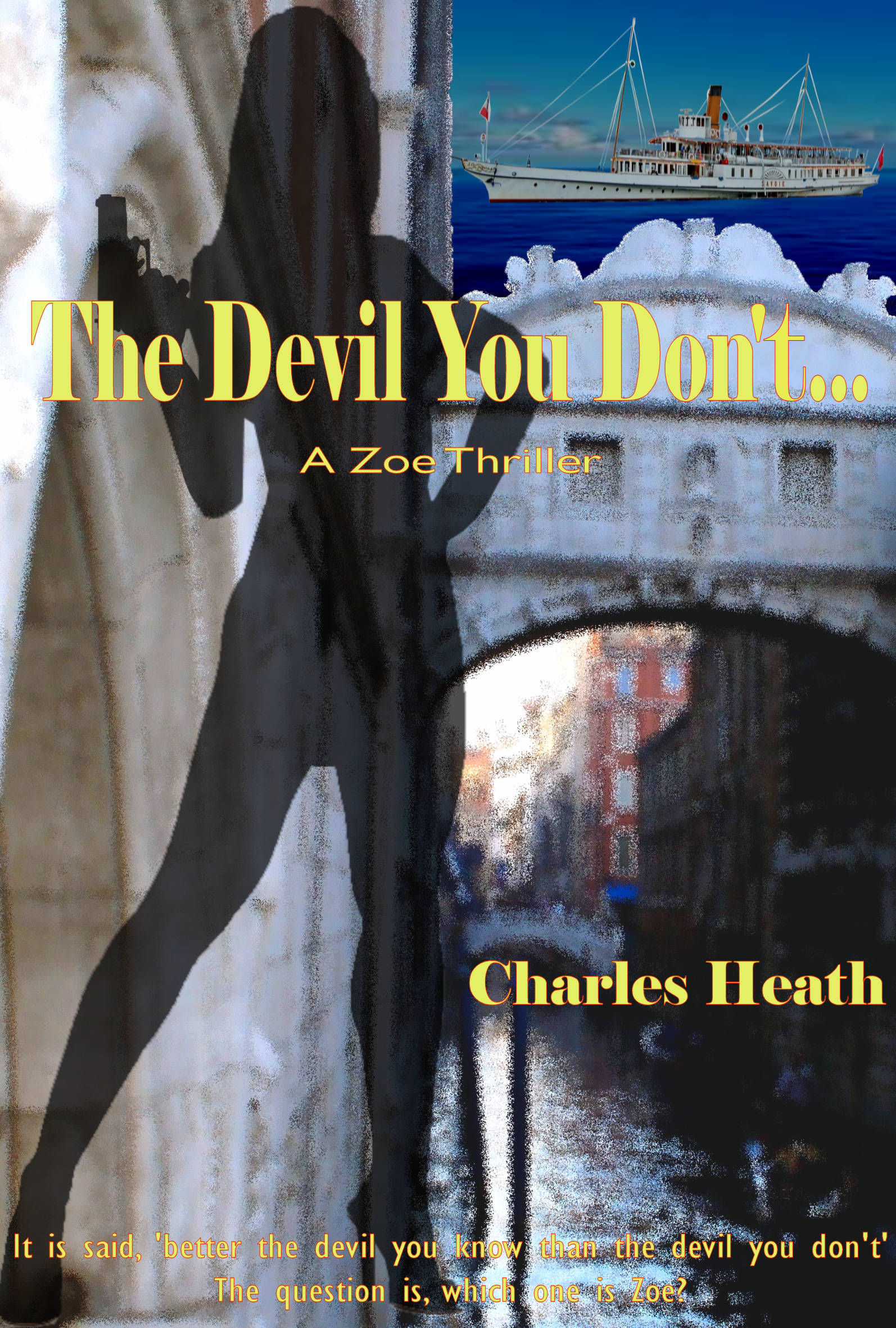
Another excerpt from ‘Betrayal’; a work in progress

My next destination in the quest was the hotel we believed Anne Merriweather had stayed at.

I was, in a sense, flying blind because we had no concrete evidence she had been there, and the message she had left behind didn’t quite name the hotel or where Vladimir was going to take her.

Mindful of the fact that someone might have been following me, I checked to see if the person I’d assumed had followed me to Elizabeth’s apartment was still in place, but I couldn’t see him. Next, I made a mental note of seven different candidates and committed them to memory.

Then I set off to the hotel, hailing a taxi. There was the possibility that the cab driver was one of them, but perhaps I was slightly more paranoid than I should be. I’d been watching the queue, and there were two others before me.

The journey took about an hour, during which time I kept an eye out the back to see if anyone had been following us. If anyone was, I couldn’t see them.

I had the cab drop me off a block from the hotel and then spent the next hour doing a complete circuit of the block the hotel was on, checking the front and rear entrances, the cameras in place, and the siting of the driveway into the underground carpark. There was a camera over the entrance, and one we hadn’t checked for footage. I sent a text message to Fritz to look into it.

The hotel lobby was large and busy, which was exactly what you’d want if you wanted to come and go without standing out. It would be different later at night, but I could see her arriving about mid-afternoon, and anonymous among the clientele the hotel attracted.

I spent an hour sitting in various positions in the lobby simply observing. I had already ascertained where the elevator lobby for the rooms was, and the elevator down to the car park. Fortunately, it was not ‘guarded’, but there was a steady stream of concierge staff coming and going to the lower levels, and, just from time to time, guests.

Then, when there was a commotion at the front door, what seemed to be a collision of guests and free-wheeling bags, I saw one of the seven potential taggers sitting by the front door. Waiting for me to leave? Or were they wondering why I was spending so much time there?

Taking advantage of that confusion, I picked my moment to head for the elevators that went down to the car park, pressed the down button, and waited.

There was no car on the ground level, so I had to wait, watching, like several others, the guests untangling themselves at the entrance, and keeping an eye on my potential surveillance, still absorbed in the confusion.

The doors to the left car opened, and a concierge stepped out, gave me a quick look, then headed back to his desk. I stepped into the car, pressed the first level down, the level I expected cars to arrive on, and waited what seemed like a long time for the doors to close.

As they did, I was expecting to see a hand poke through the gap, a latecomer. Nothing happened, and I put it down to a television moment.

There were three basement levels, and for a moment, I let my imagination run wild and considered the possibility that there were more levels. Of course, there was no indication on the control panel that there were any other floors, and I’d yet to see anything like it in reality.

With a shake of my head to return to reality, the car arrived, the doors opened, and I stepped out.

A car pulled up, and the driver stepped out, went around to the rear of his car, and pulled out a case. I half expected him to throw me the keys, but the instant glance he gave me told him he was not the concierge, and instead he brushed past me like I wasn’t there.

He bashed the up button several times impatiently and cursed when the doors didn’t open immediately. Not a happy man.

Another car drove past on its way down to a lower level.

I looked up and saw the CCTV camera, pointing towards the entrance, visible in the distance. A gate that lifted up was just about back in position, then clunked when it finally closed. The footage from the camera would not prove much, even if it had been working, because it didn’t cover the lift lobby, only what was in the direction of the car entrance.

The doors to the other elevator car opened, and a man in a suit stepped out.

“Can I help you, sir? You seem lost.”

Security, or something else. “It seems that way. I went to the elevator lobby, got in, and it went down rather than up. I must have been in the wrong place.”

“Lost it is, then, sir.” I could hear the contempt for Americans in his tone. “If you will accompany me, please.”

He put out a hand ready to guide me back into the elevator. I was only too happy to oblige him. There had been a sign near the button panel that said the basement levels were only to be accessed by the guests.

Once inside, he turned a key and pressed the lobby button. The doors closed, and we went up. He stood, facing the door, not speaking. A few seconds later, he was ushering me out to the lobby.

“Now, sir, if you are a guest…”

“Actually, I’m looking for one. She called me and said she would be staying in this hotel and to come down and visit her. I was trying to get to the sixth floor.”

“Good. Let’s go over to the desk and see what we can do for you.”

I followed him over to the reception desk, where he signalled one of the clerks, a young woman who looked and acted very efficiently, and told her of my request, but then remained to oversee the proceeding.

“Name of guest, sir?”

“Merriweather, Anne. I’m her brother, Alexander.” I reached into my coat pocket and pulled out my passport to prove that I was who I said I was. She glanced cursorily at it.

She typed the name into the computer, and then we waited a few seconds while it considered what to output. Then, she said, “That lady is not in the hotel, sir.”

Time to put on my best-confused look. “But she said she would be staying here for the week. I made a special trip to come here to see her.”

Another puzzled look from the clerk, then, “When did she call you?”

An interesting question to ask, and it set off a warning bell in my head. I couldn’t say today, it would have to be the day she was supposedly taken.

“Last Saturday, about four in the afternoon.”

Another look at the screen, then, “It appears she checked out Sunday morning. I’m afraid you have made a trip in vain.”

Indeed, I had. “Was she staying with anyone?”

I just managed to see the warning pass from the suited man to the clerk. I thought he had shown an interest when I mentioned the name, and now I had confirmation. He knew something about her disappearance. The trouble was, he wasn’t going to volunteer any information because he was more than just hotel security.

“No.”

“Odd,” I muttered. “I thought she told me she was staying with a man named Vladimir something or other. I’m not too good at pronouncing those Russian names. Are you sure?”

She didn’t look back at the screen. “Yes.”

“OK, now one thing I do know about staying in hotels is that you are required to ask guests with foreign passports their next destination, just in case they need to be found. Did she say where she was going next?” It was a long shot, but I thought I’d ask.

“Moscow. As I understand it, she lives in Moscow. That was the only address she gave us.”

I smiled. “Thank you. I know where that is. I probably should have gone there first.”

She didn’t answer; she didn’t have to, her expression did that perfectly.

The suited man spoke again, looking at the clerk. “Thank you.” He swivelled back to me. “I’m sorry we can’t help you.”

“No. You have more than you can know.”

“What was your name again, sir, just in case you still cannot find her?”

“Alexander Merriweather. Her brother. And if she is still missing, I will be posting a very large reward. At the moment, you can best contact me via the American Embassy.”

Money is always a great motivator, and that thoughtful expression on his face suggested he gave a moment’s thought to it.

I left him with that offer and left. If anything, the people who were holding her would know she had a brother, that her brother was looking for her, and equally that brother had money.

© Charles Heath – 2018-2025

“Sunday in New York”, a romantic adventure that’s not a walk in the park!

“Sunday in New York” is ultimately a story about trust, and what happens when a marriage is stretched to its limits.

When Harry Steele attends a lunch with his manager, Barclay, to discuss a promotion that any junior executive would accept in a heartbeat, it is the fact his wife, Alison, who previously professed her reservations about Barclay, also agreed to attend, that casts a small element of doubt in his mind.

From that moment, his life, in the company, in deciding what to do, his marriage, his very life, spirals out of control.

There is no one big factor that can prove Harry’s worst fears, that his marriage is over, just a number of small, interconnecting events, when piled on top of each other, points to a cataclysmic end to everything he had believed in.

Trust is lost firstly in his best friend and mentor, Andy, who only hints of impending disaster, Sasha, a woman whom he saved, and who appears to have motives of her own, and then in his wife, Alison, as he discovered piece by piece damning evidence she is about to leave him for another man.

Can we trust what we see with our eyes or trust what we hear?

Haven’t we all jumped to conclusions at least once in our lives?

Can Alison, a woman whose self-belief and confidence is about to be put to the ultimate test, find a way of proving their relationship is as strong as it has ever been?

As they say in the classics, read on!

Purchase:

http://tinyurl.com/Amazon-SundayInNewYork

The cinema of my dreams – It all started in Venice – Episode 1

When you least expect it

I was minding my own business, as the saying goes.

Having made my mark on the world, I had retired from a world that I hardly recognized as what had once been.

Pandemics, political games, countries on the brink of disaster, and what could be called a world gone mad seemed to be the new normal, though it was hard to say what the old normal was.

So, I let all flow on past me, like water under the bridge, much the same that I was now standing on, overlooking the Grand Canal in Venice, the second to last whistle-stop on what had been a long respite from the real world.

I’d also been lamenting the death of the only woman I’d ever loved and for a long time the only thing that made sense.

She was with me always, in life and in death, reminding me that she would not want me to simply give up on life.  Sometimes those words fell on deaf ears, but today was a good day.

She had always loved Venice and we always came for the Carnival, but this was the first year I’d missed it.  It would not be the same without her.

After a while I moved on, over the bridge, heading back to the apartment, one of several in the major cities we traveled to often, Paris, London, Istanbul, and Vienna to name a few.

I stopped at a Cafe, one we often did when Violetta was alive, and the owner served me himself.  It was, coincidentally, where Violetta and I first met, a story in itself

Then it was back home.

There were certain instincts I had, acquired when I lived in another world, and one was telling me something was not right.

I looked up and down the street but everything seemed normal.  It was part of the city where cars were permitted, though I chose not to have one.

I shrugged.  Perhaps my instincts were wrong, after all, it had been a long time since I’d needed them.

As I approached the front door to the building, I could see a man come from the opposite side of the street, heading towards the same doorway.  He’d timed it to arrive at the same time.

Normally it wouldn’t bother me, but he did not look like a resident or a visitor.

“Mr. Wallace?”

As I went to put the key in the lock, he called out, his timing not quite getting him to the front door.  Perhaps that was because I’d quickened my pace.

I was going to ignore him, but something told me not to.  He seemed familiar.

I turned, just as he reached me.

“Mr. Wallace?”

“Who wants to Know?”

“Alfie Simkins.  Who I work for is irrelevant, but we need to have a short discussion.”

OK, the irrelevant reference told me everything I needed to know.  It was my past, coming back to haunt me.

“About what?”

“Nothing I would care to utter in the street.”

I gave him one of those long hard stares, the one known to unnerve even the hardest of opponents, but he didn’t flinch.

I knew his sort, and he was the last person I wanted to talk to.  But just to make sure he was who he was intimating he was…

“Who sent you?”

“Rodby.”

And there it was.  That blast from the past, a name I had hoped I’d never hear again.

I opened the door and he followed me in, then up the elevator to the third floor.  At the time I could not afford the top floor, but it was comfortable enough, even if the view was somewhat limited.

He’d barely made it through the door before I asked, “I need some proof…”

“That I’m not an assassin, he said you’d require it.  Two words, Alan McWhirter.”

There was a name I hadn’t heard in a long time, almost twenty years, my original name, lost after becoming so many different people.  There had been times when I hardly knew who I was myself.

Now it was only a matter of what Rodby wanted, usually the impossible.

“How is he?  He must be about a hundred years old by now.”  He was close to that when I first met him, oh so long ago.

“Still comes into the office every day, still sharp as a tack as they say.”

The man would never die or lose his marbles.

“So, what’s this about?”

“A recording a surveillance team made and which they thought held no significance.”

“But Rodby did.”

“One of the analysts, you might remember her, Wendy Tucker, thought it might be relevant so she raised a flag.”

I did remember her, and by now she would be as old as I was and probably the only surviving member of the old team.  But my memories of her were for other reasons.

“Yes, and I’m surprised she’s still there.”

“She heard your name, and another, but perhaps I should play the recording and then comment on it.”

He put his phone on the bench and played it.

A male voice accented, eastern European I thought, spoke first.  “I’m told you knew a man named Egan Watts.”

“There’s a name I never expected to hear again.”  A female voice and one I thought I recognized.

“Then you did know him?”

“Briefly, and not all that well.  He and I went to an industry function once after we met in rather unusual circumstances, but whatever it was, it didn’t last long.  He put work before anything else, so we parted.”

“Amicably?”

“Yes.  For a while after we crossed paths, had dinner, you know.”

It had been a time when I’d been in recovery and retraining and had time for such a relationship.  Nothing permanent, but just fun.  She hadn’t been looking for anything permanent either.

“So you would know him now?”

“God no.  It’s been a long time, and last I heard, he was married and traveling the world.”

“His wife died.  Now he’s in Venice.  We’d like you to pick up where you left off.”

“It doesn’t work that way,” she said.  “Chances are he’s moved on and forgotten all about me.”

“Be that as it may, this isn’t a request.  We ask you to do, or there will be consequences.”

Silence, perhaps a moment to reflect on exactly what those consequences might be, then, “What for?”

“That’s none of your concern.  All you are required to do is rekindle your relationship.  How you do it is your business, but you better go and pack for a long stay.”

Juliet Ambrose. 

I remembered the voice, and the distinctiveness of its soft Irish accent, almost mesmerizing.

She had been one of the doctors supervising my recovery and she seemed to be out of sorts, so I’d asked her out to dinner, and talk if she wanted to.  She didn’t, but one thing led to another…

That’s where Alfie stopped the recording.

“Good to know then,” I said, ” it’s time to leave Venice and move on.”  The expression on Alfie’s face told me that was not what was going to happen.  “Or…”

“The man in the conversation is Larry Pomisor, a key figure in the Waterville organization.”

That said, it all came back to me in a flood.  An assignment that specifically targeted Larry’s brother Andre, and how spectacularly it failed.  Andre had been killed, which was the mission objective, but so had his wife and children, which was not, and Larry had sworn to find his killer.

Apparently, he now had.

“Then if he regards me as the perpetrator, then you and Rodby both know Larry is going to honor a promise he made.  Surely this is all Rodby needs to put him behind bars.”  I knew Rodby could not have Larry ‘removed’ like he could once.

“It’s not that straightforward.  If we were to go in with what we know, it would burn our source, so for the time being Rodby wants you to play along, find out what he intends to do, and we’ll swoop in and round them all up.”

The man had enthusiasm, I’ll give him that, but no idea what might happen if it all went wrong; that there will be a lot of pain and suffering involved.  Larry was not a man to miss hitting the first time.

“All good intentions I’m sure, but both of you seem to forget I don’t work for him, or the government, anymore.”

“He never rescinded your file.  As far as anyone knows you’re still on the active list.  It’s just for a short time until we make all the connections.  Clearly, while the girl is courting you nothing is going to happen, and we’ll have eyes on all the major players.  All he’s asking is for you to play a role.”

It seemed to me my whole life had been one long screenplay.  And it was never that simple.

“If I say no?”

“Then I’m sure he’ll arrive on your doorstep and personally ask you to return the favor”

Yes, I’d expected that.  He may have agreed very reluctantly to my retirement, but it had always come with a caveat.

“Just this once then.”  There would be no getting around it.

“Of course.  I assume that we have permission to install eyes and ears here?”

An inconvenience, but necessary.  I nodded.  “But I am considering going to Paris, and then to New York.  She might ask to come with me.”

“Wouldn’t you simply stay put and make them come to you?  Besides, why would you take anyone actively assisting in a plan to kill you anywhere?”

Good point.  “Perhaps we’ll see what happens,  I have to get back home sometime.”

“Then give us the addresses and we’ll take care of the rest.  Oh, and the plane.  Just in case.”

I shook my head.  I guess I could say goodbye to privacy for the next few weeks.

© Charles Heath 2022

A to Z – April – 2026 – L

Sitting around the table in the lawyer’s conference room were seven very eager faces, and, at the other end, opposite Blanding, my parents’ lawyer.

It was time for the reading of the will.

The seven seated at the other end were, in age order, eldest to youngest: Jacob, John, Jesse, Julian, Judy, Jessica, and Jennifer.

Me, I was named Ferdinand.  Yes, that apparently was a name, but I usually used my middle name of Aloysius, or more often than not, the short form, Al.

There was a reason why I was sitting away from the others.  Technically, I was not a brother, but the only child of my stepfather’s brother, adopted by him after my parents died a year after I was born.

It had remained a well-kept secret until the day my stepmother, who died a few hours earlier than my stepfather, was conscious long enough to tell the eldest son of my adoption.

From that moment, I became persona non grata with nearly all the other siblings. It went from thirty-five years of harmonious sibling rivalry to me instantly becoming an outcast.  I don’t think it was what the mother had intended, but then she hadn’t realised just how greedy and insecure her children were.

I had, though it had taken time.  The two eldest boys thought I was different, not just the fact that my name didn’t start with a j, but the fact that I had red hair and that I had slightly different characteristics.

While the parents were alive, no one really questioned it.  After they died and there was a fortune at stake, it came down to being one less to divvy up the pot of gold.

But here’s the thing.  None but one, Jennifer and I stayed to look after them in their home when neither could look after each other or themselves.  The others left home as soon as they could and only came back for handouts to save them from their stupidity.

For them, the memories of what happened in that house were a stark reminder of everything they should have become.  They had been given every opportunity, but none seemed to like the idea of having to work for it.

Jennifer and I both got the intended message and understood.  I remember the number of times the father had said, if only the others had been like Al.  He made a point of it.  The others blamed me when the father started rejecting their demands for assistance, saying that I had made their lives impossible.  Nothing in that house, as far as they were concerned, had led anywhere for any of them except to catastrophe.

In turn, I never understood them.  From a very young age, they all believed they would be looked after, which is why work or tried to make their mark when, in the end, there would be a fortune waiting for each of them.

Or perhaps I did.  Their parents spoiled and indulged all of them.  Not me.  Perhaps that was the indication I should have seen that I was not really one of them.  The father never gave me anything, often telling me that he expected me to make something of myself, as his brother had.

I never understood what he had meant by that until the mother’s revelation.  Then everything made sense.

More than once, he had said, privately to me, that I was not one of them, that I did not have to be like them, that they, meaning the eldest two boys, would never amount to anything.

He was right.

But it was his fault they turned out that way.  His and their mother.

Now, a greater catastrophe was likely to befall them if the father had carried out his threat to cut them all off.

I was there when he told them they had six months to turn their lives around, during which time they would not be getting their usual allowances.

As far as he was concerned, it was time for all of them to sort themselves out.  His ultimatum had been met with stunned silence and disbelief.  I don’t think any of them had considered the well might run dry.

The fact that the parents died in an accident raised a few questions in my mind, so soon after the ultimatum, and the thought, however unbelievable or insidious, was whether one of them, or all of them together, had ‘arranged’ for their deaths.

Jennifer was more inclined to believe they had.  None had a story that would stand deeper probing. Each was vouching for the others, alibis were shaky, and as far as she was concerned, the police had closed the case too quickly.  As far as they were concerned, it was an accident.

I looked at Blanding and caught his eye.  He had his inscrutable face on.  It was time to begin

“Right,” he said after clearing his throat.  “Shall we start?”

He looked around the table at all the expectant faces.  No one could tell whether he was about to deliver good news or bad.  Even I didn’t know.

All I had was a phone call from the lawyer’s office, a request to be there. The others tried to have me excluded, but Blanding would have none of it.  He simply told them that the reading could only progress if all eight of us attended, an explicit condition stipulated by both parents.

The room went silent.

“Now that the investigation into the untimely deaths of your parents has been concluded and a result of death by misadventure recorded, the will can now be read.  It doesn’t necessarily mean that any benefits will automatically be payable at the conclusion of this reading.  There are formalities, and these will take time.”

Eldest son:  “How much time?”

“As long as it takes.”  That was it.  No more.  Blanding took the will document out of the folder in front of him and removed the first page.  The good stuff presumably started on the next.

The eldest son was going to ask another question, but then decided against it.  I got the impression he was kicked in the shin under the table.

Blanding continued.  “Your mother’s will has been read and wishes executed.  She died before your father, and her wish was for everything to go to her husband and several annuities for friends.  She never thought of her domestics as servants but friends.”

Eldest son:  “But she didn’t leave anything directly to any of us, not even the girls.”

“No.  Her intention was always to leave it to your father.  Had she, in fact, survived him, there was a small lump sum payment of approximately a thousand pounds each and the annuities.”

“What about the estate, the holiday houses, the apartments overseas?”

Yes, the eldest son had been doing his homework, listing all the places we went to, not realising that the property portfolio was largely smoke and mirrors.  I discovered the true nature of what they owned and what they rented, and it didn’t surprise me.

The father had been very clever to hide the fact that they were not as wealthy as most people believed, and having ready cash to give the children meant a gradual depletion of assets over time.

Being who they were didn’t mean they were filthy rich. The trick their father had told me once is to appear rich without anyone guessing what your true financial situation is.

Blanding put down the document and took off his glasses.  I thought he was going to massage his forehead like a person trying to assuage the pain of an oncoming headache.

Maybe he had one already.

He massaged the bridge of his nose. Maybe the glasses were new and weren’t sitting right.

Then he looked at Jacob.  “I’m sure you’ve been compiling a list of everything you believe should be in the estate.  Did you think to also compile a list of the sums of money you borrowed from your father?”

“Borrow?” Jacobs’s expression changed.  “We did nothing of the sort.  He gave us…”

He stopped abruptly when he heard, rather than watched, a thick folder land on the desk with a thud, perhaps more for effect than emphasis.

“Every time your father loaned each of you money, you had to sign a document to say that at the end of a specific period, you would either repay the loan in full or start paying the interest.  I daresay you didn’t read the fine print or look at or listen to anything but simply thought your father would never expect anything in return.  So, back to my original question, did you compile a list of all your borrowings?”

“Of course we didn’t.  Are you stupid?  The man is dead. There’s no one to pay it back to.”  John had the logic all worked out.

“Well, there’s the thing.  It became repayable when he died.  It’s stated very clearly in the documents, very legal documents, I might add.  But just for the sake of clarity, the aggregate sums borrowed by each child are: Jacob, 18 million, John, 9 million, Jesse, 6 million, Julian, 4 million, Judy, 15 million, Jessica, 7 million, Jennifer, zero, and Al, zero.  That’s close to 60 million pounds.  Where do you think that lot came from?”

The siblings were looking at each other, but mostly at Jacob and Judy.  I thought I heard a muttered, “What the hell did you do with 18 million, Jacob?”  If they asked me if would tell them.  Gambling.

“The old man was loaded.  Inherited wealth, he said.”

“I’m sure he said a lot of things to which you chose not to hear.  Giving you all you asked for over the years cost a lot, so much so, he was forced to sell all of the properties, including, in the end, the manor house.  There wasn’t much in the rest, the paintings of forebears were worthless, the furniture and fittings were all very old but not worth a fortune old. The manor house has been given to the new owner, who was gracious enough to allow your parents to remain in it rent-free until they decided to move on.  It was always going to revert back to him.  So, scratch any property off your list of assets.”

“Cash, shares, bonds?”  The confidence in the tone before had gone as the realisation of what had happen sunk on.

It wouldn’t be long before the others turned on Jacob and Judy, even though all of them together caused the problem.

“You know the answer to that question, Jacob,” I said

He turned to me.  I could feel the hostility.  “How come you didn’t get anything.  Bet he knew you weren’t one of us and was never going to give you a penny.”

Jennifer rounded on him.  “Like me, he didn’t seek to burden your father because staying home and looking after him, we knew exactly what the financial situation was.  You all should be ashamed of yourselves.”

Jacob jumped to his feet.  “If that’s all?”

“There is the matter of repayment of the loans.”

Jacob laughed.  “Good luck with that old man.”  Then he left.  The others quickly followed him out the door.

Blanding sighed.  “Well, that went better than I thought it would.”

Were you serious about the loans?” I asked.

“Your father was. We could take them all to court, but they don’t have anything, so it would be a meaningless exercise.  But at least they have no more opportunity to get anything more.  They have to make their own way now.  But, now for the rest of the will.”

“I thought all that was left was the three thousand odd pounds,” Jennifer said.

“After the sales of a few bonds, we found in the bottom drawer of your father’s desk.  No, that’s what your father left you two.  He was very glad you stayed to help.  Both of them were.  It was always his intention to leave the manor house to you, and the proceeds from the sale of a half dozen paintings that used to hang in the Paris apartment, about 40 million pounds.  He set up trust funds for the two of you, so you have somewhere to live, and enough to keep you going.”

“And if the others find out?”

“They can contest it, even get a slice of the proceeds, but the estate has first lien on the money in repayment of their debts, and the proceeds would barely cover the repayments.  No.  There’s no point, and no legal firm would take the case.  Now go and enjoy it.”

He put two sets of keys to the manor house on the table; the same two we’d given him when we arrived.

We shook his hand, and he left the room.  I may have been mistaken, but I think he had a smile on his face.  Jennifer was looking down the street, and I joined her.  Both of us saw the six other siblings exit onto the street, just as the heavens opened and dumped a heavy shower of rain on them.

“I think,” Jennifer said, “Mum and dad just got the last laugh.”

©  Charles Heath  2025-2026

“More or less…” – A short story

It was meant to be time to reacquaint as brothers.

Louis and I had not seen each other for decades, and when he returned, about a week before, I got the impression there was more than just ‘missing his brother’ going on.

But that was Louis. He was never one to say what or how he felt about anything, preferring to be the strong silent type, and it had not fared well for him transitioning from teenager to adult.

As for me, when our parents split up, Louis went with our father, and I stayed with our mother, and, given the amount of acrimony there was attached to the split, it was no surprise to anyone that Louis and I had effectively become estranged.

In fact, when I had tried to find them, about two years after the split and our mother had died suddenly, all I found were loose ends. They had effectively vanished.

With that part of my life effectively over, I had married, had children and watched 30 years disappear before Louis suddenly popped up. He simply knocked on the front door one afternoon, Helen answered it, and within minutes they were the best of friends. I’d had that rapport, once, many years before, but life and circumstances had all but ruined that.

Or perhaps that was just me, worn down by that same life and circumstances we were all supposed to take on the chin.

His arrival was a welcome distraction, and when, after a week, he suggested that he and I go on a hike, the sort our father used to take us on when we were a family, I agreed. Helen was happy to be rid of me, and I guess a week without our arguing would suit everyone.

It was probably fortuitous timing. Helen and I had finally got to the point where divorce lawyers were about to be called in. The children had all moved on and had children and problems of their own, and we, as parents just didn’t gel anymore.

Besides, I said, just before I joined Louis in the truck, ready to embark for the wilderness, it would be time to clear my head.

And by day two, my head was clear, and Louis, taking the lead, led us along the ridgeline, a trek he said, that would take us about seven hours. We’d stopped the previous night in a base camp and then headed out the next morning. We were the only two, it being early in the season with snow still on the ground.

Above was the clear cloudless blue sky and in front of us, trees and mountains. There was snow on the ground but it was not solid and showed no signs of human footsteps, only animals. The air was fresh, and it was good to be away from the city and its pressures.

Approaching noon, I’d asked him if we were about halfway. I knew he was holding back, being the fitter of us.

“More or less.”

“More or less what, more closer or less close than we should be.”

I watched him do a 360-degree turn, scoping out our position. It was a maneuver I was familiar with from my time with the National Guard. I’d used my backcountry experience that I’d learned from my father, as a skill I thought they might be able to, and eventually did, use. I got the feeling Louis was looking for something.

“You get the impression we’re not alone?” I asked. I had that nagging feeling something was not right, not from about two miles back in the forest. It was like my sixth sense being switched on.

“Doesn’t seem so, though there have been a few animals lurking behind us, probably surprised anyone’s about this time of the year. It’s been a while, so I’m just getting a feel for the trail. This is, for now, our mountain.”

There was a time, from a time when we were kids, that I could tell when he was lying. He was better at covering it, but it was still there.

Where we’d stopped was a small clearing, a staging point that would be used by other trekkers, still overgrown because of lack of trekkers. Ahead there were the signs of a trail, and after six months, it would become clear again. In places, as we had made our way from the base camp, sections of the distinctive trail had all but disappeared, but Louis seemed to know where he was going, and it was not long before we had picked up the trail again. This spot was a lookout, giving a spectacular view of the valley below, and a fast running river through it.

I walked to the edge and looked up and down the valley, and at the trail that ran along the cliff for a short distance. I looked down, not the wisest of things to do, but it was long enough to catch sight of several charred pieces of wood. On top of the snow. The thing is, someone had been along this trail before us, and recently, something I thought wise to keep to myself.

Back at the log, I sat for a moment and drank some water, while Louis stood patiently, but impatiently, for me to join him.

“You look like you’ve got somewhere to be.” Probably not the wisest thing to say but it was out before I could stop it.

A flicker of annoyance crossed his face, then it was gone. “If we stop too long, joints will freeze up, especially when it gets colder.”

“Sorry.” I put the container back in the pack and joined him. “Let’s go. The cold and I don’t get along very well, and it’s been a long time since the last time I ventured into the great unknown.”

“Helen said you gave up trekking when you married her.”

“She wasn’t a trekker, Robbie. We all have to give up something, sooner or later.”

Another hour, feeling rather weary, we’d come to another small clearing and a place where I could sit down.

“You always were the weak link, Robbie. Admittedly you were younger, but you never seemed to grasp the concept of exercise and fitness.”

I looked up at him and could see my father, the exact stance, the exact words, the exact same sneer in his voice. It all came rushing back as if it was yesterday, the reasons why I chose to go with our mother, that another day with his bullying would be one too many. And he was a bully. And, in an instant, I could see the apple hadn’t fallen far from the tree.

“Out of shape after languishing in an office, perhaps,” I said, “but I was never the disappointment our father always considered me.”

“You didn’t join the army, follow in his footsteps, as he wanted us to do. I did. Proudly served, too.”

I could see it. Like father, like son. No surprise Robbie had followed in his father’s footsteps. And it was a clue as to what Robbie had been doing since I saw him last.

“So, tell me about it.”

“You wouldn’t understand.”

“No, I probably wouldn’t. Let’s push on.”

I’d also thought, along the way, he might ask questions, delve further into the problems that Helen and I were having, but I knew she had told him all he needed to know. I’d been held up at the office, and had rung to ask her to take him to dinner, get to know him, she might get to learn something of my life before I met her, details of which I hadn’t told her other than that my mother was dead, my father had left and taken Robbie with him. My past, I’d told her from the outset, was not something I would talk about.

I didn’t ask what they talked about, but I could see a change in both of them. Perhaps she had succumbed to Robbie’s charm, back in school all the girls did, but they all soon learned he was not a nice person, not once you got to know him. I didn’t warn her, and perhaps that was regrettable on my part, but it reflected the state in which our relationship had reached.

I’d also tried, once or twice, to find out if our father was still alive, but he deflected it, changing the subject. That meant he was still alive, somewhere, perhaps annoyed at Robbie for coming to see me. If I was a betting man, I’d bet our father would have denied permission for
Robbie to do so, even if he was a grown man and capable of making his own decisions.

Odd, but not surprising. Even now I could remember my father had secrets, and those secrets had fed into the breakup of our parents.

“So, you’ve been dodging it for days now, but you still haven’t told me if dad is alive or dead. He’d be about seventy-odd now.”

He stopped and turned to face me. “Would it matter if he was alive? I doubt you’d want to see him after what mother must have said about him.”

Interesting that he would think so. “She never had a bad word for him, and wouldn’t hear of one spoken, by me or anyone. And I have wondered what became of him, and you. At least now I know you spent time in the Army. If I was to guess what happened, that would be high on my list.”

“No surprise then you became an office wanker.”

Blunt, but, to him, it was a fact. I’d used that expression when telling Helen one time after a very bad day.

“We can’t all be heroes, Robbie.”

I put my hand up. Alarm bells were going off in my head. “You can come out now,” I yelled.

Robbie looked puzzled.

“I know you’re there. You’ve been behind us for about a half-mile now.”

A few seconds passed before the cracking of a twig, and then a person in a camouflage kit came towards us.

He’d aged, hair and beard grey in places but almost white now, but the face was familiar.

“What brings you to this part of the woods, Dad. Or is it just an unlucky coincidence?”

—–

© Charles Heath 2020-2021

A to Z – April – 2026 – L

Sitting around the table in the lawyer’s conference room were seven very eager faces, and, at the other end, opposite Blanding, my parents’ lawyer.

It was time for the reading of the will.

The seven seated at the other end were, in age order, eldest to youngest: Jacob, John, Jesse, Julian, Judy, Jessica, and Jennifer.

Me, I was named Ferdinand.  Yes, that apparently was a name, but I usually used my middle name of Aloysius, or more often than not, the short form, Al.

There was a reason why I was sitting away from the others.  Technically, I was not a brother, but the only child of my stepfather’s brother, adopted by him after my parents died a year after I was born.

It had remained a well-kept secret until the day my stepmother, who died a few hours earlier than my stepfather, was conscious long enough to tell the eldest son of my adoption.

From that moment, I became persona non grata with nearly all the other siblings. It went from thirty-five years of harmonious sibling rivalry to me instantly becoming an outcast.  I don’t think it was what the mother had intended, but then she hadn’t realised just how greedy and insecure her children were.

I had, though it had taken time.  The two eldest boys thought I was different, not just the fact that my name didn’t start with a j, but the fact that I had red hair and that I had slightly different characteristics.

While the parents were alive, no one really questioned it.  After they died and there was a fortune at stake, it came down to being one less to divvy up the pot of gold.

But here’s the thing.  None but one, Jennifer and I stayed to look after them in their home when neither could look after each other or themselves.  The others left home as soon as they could and only came back for handouts to save them from their stupidity.

For them, the memories of what happened in that house were a stark reminder of everything they should have become.  They had been given every opportunity, but none seemed to like the idea of having to work for it.

Jennifer and I both got the intended message and understood.  I remember the number of times the father had said, if only the others had been like Al.  He made a point of it.  The others blamed me when the father started rejecting their demands for assistance, saying that I had made their lives impossible.  Nothing in that house, as far as they were concerned, had led anywhere for any of them except to catastrophe.

In turn, I never understood them.  From a very young age, they all believed they would be looked after, which is why work or tried to make their mark when, in the end, there would be a fortune waiting for each of them.

Or perhaps I did.  Their parents spoiled and indulged all of them.  Not me.  Perhaps that was the indication I should have seen that I was not really one of them.  The father never gave me anything, often telling me that he expected me to make something of myself, as his brother had.

I never understood what he had meant by that until the mother’s revelation.  Then everything made sense.

More than once, he had said, privately to me, that I was not one of them, that I did not have to be like them, that they, meaning the eldest two boys, would never amount to anything.

He was right.

But it was his fault they turned out that way.  His and their mother.

Now, a greater catastrophe was likely to befall them if the father had carried out his threat to cut them all off.

I was there when he told them they had six months to turn their lives around, during which time they would not be getting their usual allowances.

As far as he was concerned, it was time for all of them to sort themselves out.  His ultimatum had been met with stunned silence and disbelief.  I don’t think any of them had considered the well might run dry.

The fact that the parents died in an accident raised a few questions in my mind, so soon after the ultimatum, and the thought, however unbelievable or insidious, was whether one of them, or all of them together, had ‘arranged’ for their deaths.

Jennifer was more inclined to believe they had.  None had a story that would stand deeper probing. Each was vouching for the others, alibis were shaky, and as far as she was concerned, the police had closed the case too quickly.  As far as they were concerned, it was an accident.

I looked at Blanding and caught his eye.  He had his inscrutable face on.  It was time to begin

“Right,” he said after clearing his throat.  “Shall we start?”

He looked around the table at all the expectant faces.  No one could tell whether he was about to deliver good news or bad.  Even I didn’t know.

All I had was a phone call from the lawyer’s office, a request to be there. The others tried to have me excluded, but Blanding would have none of it.  He simply told them that the reading could only progress if all eight of us attended, an explicit condition stipulated by both parents.

The room went silent.

“Now that the investigation into the untimely deaths of your parents has been concluded and a result of death by misadventure recorded, the will can now be read.  It doesn’t necessarily mean that any benefits will automatically be payable at the conclusion of this reading.  There are formalities, and these will take time.”

Eldest son:  “How much time?”

“As long as it takes.”  That was it.  No more.  Blanding took the will document out of the folder in front of him and removed the first page.  The good stuff presumably started on the next.

The eldest son was going to ask another question, but then decided against it.  I got the impression he was kicked in the shin under the table.

Blanding continued.  “Your mother’s will has been read and wishes executed.  She died before your father, and her wish was for everything to go to her husband and several annuities for friends.  She never thought of her domestics as servants but friends.”

Eldest son:  “But she didn’t leave anything directly to any of us, not even the girls.”

“No.  Her intention was always to leave it to your father.  Had she, in fact, survived him, there was a small lump sum payment of approximately a thousand pounds each and the annuities.”

“What about the estate, the holiday houses, the apartments overseas?”

Yes, the eldest son had been doing his homework, listing all the places we went to, not realising that the property portfolio was largely smoke and mirrors.  I discovered the true nature of what they owned and what they rented, and it didn’t surprise me.

The father had been very clever to hide the fact that they were not as wealthy as most people believed, and having ready cash to give the children meant a gradual depletion of assets over time.

Being who they were didn’t mean they were filthy rich. The trick their father had told me once is to appear rich without anyone guessing what your true financial situation is.

Blanding put down the document and took off his glasses.  I thought he was going to massage his forehead like a person trying to assuage the pain of an oncoming headache.

Maybe he had one already.

He massaged the bridge of his nose. Maybe the glasses were new and weren’t sitting right.

Then he looked at Jacob.  “I’m sure you’ve been compiling a list of everything you believe should be in the estate.  Did you think to also compile a list of the sums of money you borrowed from your father?”

“Borrow?” Jacobs’s expression changed.  “We did nothing of the sort.  He gave us…”

He stopped abruptly when he heard, rather than watched, a thick folder land on the desk with a thud, perhaps more for effect than emphasis.

“Every time your father loaned each of you money, you had to sign a document to say that at the end of a specific period, you would either repay the loan in full or start paying the interest.  I daresay you didn’t read the fine print or look at or listen to anything but simply thought your father would never expect anything in return.  So, back to my original question, did you compile a list of all your borrowings?”

“Of course we didn’t.  Are you stupid?  The man is dead. There’s no one to pay it back to.”  John had the logic all worked out.

“Well, there’s the thing.  It became repayable when he died.  It’s stated very clearly in the documents, very legal documents, I might add.  But just for the sake of clarity, the aggregate sums borrowed by each child are: Jacob, 18 million, John, 9 million, Jesse, 6 million, Julian, 4 million, Judy, 15 million, Jessica, 7 million, Jennifer, zero, and Al, zero.  That’s close to 60 million pounds.  Where do you think that lot came from?”

The siblings were looking at each other, but mostly at Jacob and Judy.  I thought I heard a muttered, “What the hell did you do with 18 million, Jacob?”  If they asked me if would tell them.  Gambling.

“The old man was loaded.  Inherited wealth, he said.”

“I’m sure he said a lot of things to which you chose not to hear.  Giving you all you asked for over the years cost a lot, so much so, he was forced to sell all of the properties, including, in the end, the manor house.  There wasn’t much in the rest, the paintings of forebears were worthless, the furniture and fittings were all very old but not worth a fortune old. The manor house has been given to the new owner, who was gracious enough to allow your parents to remain in it rent-free until they decided to move on.  It was always going to revert back to him.  So, scratch any property off your list of assets.”

“Cash, shares, bonds?”  The confidence in the tone before had gone as the realisation of what had happen sunk on.

It wouldn’t be long before the others turned on Jacob and Judy, even though all of them together caused the problem.

“You know the answer to that question, Jacob,” I said

He turned to me.  I could feel the hostility.  “How come you didn’t get anything.  Bet he knew you weren’t one of us and was never going to give you a penny.”

Jennifer rounded on him.  “Like me, he didn’t seek to burden your father because staying home and looking after him, we knew exactly what the financial situation was.  You all should be ashamed of yourselves.”

Jacob jumped to his feet.  “If that’s all?”

“There is the matter of repayment of the loans.”

Jacob laughed.  “Good luck with that old man.”  Then he left.  The others quickly followed him out the door.

Blanding sighed.  “Well, that went better than I thought it would.”

Were you serious about the loans?” I asked.

“Your father was. We could take them all to court, but they don’t have anything, so it would be a meaningless exercise.  But at least they have no more opportunity to get anything more.  They have to make their own way now.  But, now for the rest of the will.”

“I thought all that was left was the three thousand odd pounds,” Jennifer said.

“After the sales of a few bonds, we found in the bottom drawer of your father’s desk.  No, that’s what your father left you two.  He was very glad you stayed to help.  Both of them were.  It was always his intention to leave the manor house to you, and the proceeds from the sale of a half dozen paintings that used to hang in the Paris apartment, about 40 million pounds.  He set up trust funds for the two of you, so you have somewhere to live, and enough to keep you going.”

“And if the others find out?”

“They can contest it, even get a slice of the proceeds, but the estate has first lien on the money in repayment of their debts, and the proceeds would barely cover the repayments.  No.  There’s no point, and no legal firm would take the case.  Now go and enjoy it.”

He put two sets of keys to the manor house on the table; the same two we’d given him when we arrived.

We shook his hand, and he left the room.  I may have been mistaken, but I think he had a smile on his face.  Jennifer was looking down the street, and I joined her.  Both of us saw the six other siblings exit onto the street, just as the heavens opened and dumped a heavy shower of rain on them.

“I think,” Jennifer said, “Mum and dad just got the last laugh.”

©  Charles Heath  2025-2026

‘What Sets Us Apart’ – A beta reader’s view

There’s something to be said for a story that starts like a James Bond movie, throwing you straight in the deep end, a perfect way of getting to know the main character, David, or is that Alistair?

A retired spy, well, not so much a spy as a retired errand boy, David’s rather wry description of his talents, and a woman that most men would give their left arm for, not exactly the ideal couple, but there is a spark in a meeting that may or may not have been a setup.

But as the story progressed, the question I kept asking myself was why he’d bother.

And, page after unrelenting page, you find out.

Susan is exactly the sort of woman to pique his interest.  Then, inexplicably, she disappears.  That might have been the end of it, but Prendergast, that shadowy enigma, David’s ex-boss who loves playing games with real people, gives him an ultimatum: find her or come back to work.

Nothing like an offer that’s a double-edged sword!

A dragon for a mother, a sister he didn’t know about, Susan’s BFF who is not what she seems or a friend indeed, and Susan’s father, who, up till David meets her, couldn’t be less interested, his nemesis proves to be the impossible dream, and he’s always just that one step behind.

When the rollercoaster finally came to a halt, and I could start breathing again, it was an ending that was completely unexpected.

I’ve been told there’s a sequel in the works.

Bring it on!

The book can be purchased here:  http://amzn.to/2Eryfth

The cinema of my dreams – I always wanted to see the planets – Episode 56

Would a Mexican standoff work?

I couldn’t help thinking just how far behind the technological ball we were, and that even if we had to ability to travel far into space, we were always going to find people more advanced than us.

I remembered back to the time, before this mission was to get underway, an almost finished spacecraft waiting for a crew, the round table discussions that were held to talk about what we might expect and how we would react.

I said then that we would not be able to treat them like we would other nationalities on our own planet, which seemed to be the consensus for first contact.

Some thought it unlikely we’d run into anyone else.

And where we were right now was largely uncharted territory.  Of course, there was a whole team aboard whose job was specifically to handle alien encounters, and all of them had been huddled in their meeting room since day one of our first encounter with the Foroi, taking extensive notes, analysing every aspect of each encounter, and contributing information I would find useful in my dealings with them.

It was there I headed now.

I had already been admonished by their leader, Emile Jacques, over my handling of certain situations, particularly when I chose what he called the ‘death or glory’ option.

I told her it was like the nuclear option, where each side held an Armory of weapons at the ready, threatening to use them, but never with intention of doing so.  The old ‘Mexican standoff’.

I told her I based my decision on the fact we were simply dealing with more evolved human beings who’d moved beyond the corporeal life we were still stuck with.  But, for all their advances, the notion of creating a nuclear wasteland still held respect.

I doubted anyone no matter how advanced could get past the finality of a nuclear attack on a home planet.

And if they had been on ours and seen the effect of the one time our leaders had decided on pre-emptive and retaliatory attacks would see the wastelands of what London, New York, and Moscow looked like.

How much we hadn’t learned from our mistakes, beggared belief.

The table was full, a dozen experts with a lot of books, papers, and computers, all talking at once, a half dozen conversations, each trying to be heard above the others.

I came, and the noise subsided.

The leader of the team, Emile Jacques, was down the other end of the table.

I looked at each one of them, experts in fields that related to humans, and not one had any idea what an alien might be like.  They were trying to apply the human factor to the aliens and every decision they made had been based on flawed theory.

The aliens were nothing like us.

We knew nothing about them, but they knew everything about us.

When I looked at Emile, he said, “The consensus is that we should let her people take her back to her homeland.”

“What if she doesn’t want to go?”

“Is it worth possibly sacrificing this ship and crew just to make a stand?  We want to make friends with these people, not enemies.”

“Did you consider the possibility that if we let her people take her, the other group might object?  I get the impression that no matter what we do, it is going to end badly.”

Was that a possibility they hadn’t considered?

“What do you think we should do?”  Alexandra was the crew representative, and not formally a member of the team, but a person who should have a seat at the table when matters were discussed that concerned the crew.

It was a position I had insisted on before we left on this odyssey, with far-reaching authority to make decisions that would resolve crew issues in a fair and balanced manner.  That included discipline and punishment when warranted.  I did not want the crew to think that their fate rested in the hands of the ship’s officers.  I had ultimate authority but rarely intervened in any decision she made.

“She had offered to become a mediator so that we can sit down and discuss their intentions.  She has also requested what back on earth we would call asylum, she wants to not be taken by either group.  Did anyone back on earth before this began ever consider the possibility that we might be asked for asylum?”

“No.”  Jacob was the international law expert, well versed in all matters that related to problems back home, and was sent with the possibility of him learning or creating a set of rules for intergalactic relations.  “My superiors didn’t think we’d meet any alien races, but now we have, all I have as a basis is earth’s international law, and it has provisions for asylum, and as such, we should be able to extend it galactically, I can’t believe I actually said that, but we may have problems in getting these people to agree to anything we propose.”

“But there’s no reason why we can’t grant her asylum if she formally requests it.  Something that might help, these people as I understand it, have spent time on our planet, which means that aliens have been walking among us for a very long time.”

“Did she tell you that?  It might just be a ploy to gain your trust.”

“She’s not the only one.  The captain of the first vessel we encountered said the same.  They know of us, and our ways, and they’ve been watching our evolution over a very long period.”

“Why didn’t they just invade us, then.  We’re obviously technologically inferior.”  The technological expert, the person who was charged with getting his hands on alien technology, if we found any, asked.

“It explains the UFO’s then,” said another.

“You know what we would have done the moment their ships arrived.  Shoot first and ask questions later.  It’s probably what they’re expecting from us now.  We have to be better than that.” To the lawyer, I said, “Start drafting some intergalactic rules for asylum.  Everyone else, start formulating questions to ask the Princess about anything and everything.  I’m going to see the Chief Engineer.”

© Charles Heath 2021-2023

A to Z – April – 2026 – K

K is for Katerina

Sunday lunch could be the best of times or the worst of times.  Any family gathering at my parents’ house was a trial, one that eventually drove me away.

I had stopped turning up at the family residence for the weekly gatherings simply because the ritual cross-examination of why I was not like my brothers and sisters, married with three point two children, got too exhausting.

It meant that I rarely, if ever, got to see my nieces and nephews or my brothers, sisters, brothers-in-law, sisters-in-law, and well-meaning but over-the-top parents.

Moving to the other side of the country had a lot to do with it.  The rest of my family had stayed put, making their lives in the one place they all professed they could never leave.

Only one other sibling had attempted an escape, my younger sister Eileen, but two months after she left, she came home.  I knew something bad had happened, but she never said anything and never left again, except for the odd trip to the state capital for work.

But like all good things that came to an end, it was approaching that time when I would have to go back, if only once, because it was time.

I might have returned home earlier had it not been for an entirely unforeseen event.

I never had any intention of looking for, or becoming involved with, any other person, not to the extent that it would require explanation of my rather odd, to me anyway, circumstances.

Yes, I harboured the same hopes and dreams of meeting ‘the one’ as everyone else had, but the idea of subjecting them to the rigours of the family third degree was the single limiting factor.  I could not say I was an orphan, but then I didn’t think it would be a selling point that I was the second youngest of fourteen children, with twelve of the thirteen others married, with a collective thirty-six nephews and nieces.

What was probably the worst aspect, this group turned up every Sunday for lunch, all sixty-four of them, unless a major calamity prevented their attendance.  As you can see, with odds of sixty-four to one, the Spanish Inquisition would have been a kindergarten outing by comparison.

But to say I missed them may have been the case, but that they missed me more was becoming very hard to ignore or put off.

Perhaps they had missed making my life hell, because over the past three years, there had been many phone calls and messages and one visit by my eldest brother, the self-elected spokesman, he said, the peacemaker, who had come to take me home.

It was the last time we spoke. Civilly, anyway.

That was a year ago.

Things had changed during that year, though I was not sure whether for the better.  I had met someone, yes, a woman named Catherine, Katerina if I wanted to call her by her Russian name, which I didn’t, one who was perhaps as skittish as I was at the whole dating and sharing your life thing.

Our first meeting was fascinating because her Russian accent was intoxicating, and I told her at the end of the night that she could read me War and Peace, and I would listen to it all night.  I think that I realised she used her Russian heritage to put off potential suitors.  I told her it wouldn’t work with me.

We both started out playing the orphan card, and as the dates piled up and the little pieces of our sad lives leaked out, it became apparent we both had suffered the small-town, large family, endless expectations things.  She had been expected to marry her high school sweetheart until she found out he was secretly cheating on her.

When she told her parents, and they confronted him, he denied it and made her look like she was just spiteful because she didn’t want to marry him.  The other girl could have him, and she left on the next bus out.  It was no surprise to learn the other girl hadn’t married him, nor had any other.

From there, with cards on the table, we just clicked.

But like all good things, it, too, should have ended because I was one of those people who never finished what they started.

A Saturday morning, not generally a workday and the day we set aside for everything that couldn’t get done on a weekday, came after an extended evening in the pub.

We rarely stayed beyond a drink or two, but others we knew, just back from a long holiday, dropped in on the off chance we would be there, and it turned into dinner and more drinks.

It never affected Katerina. I was guessing it was something to do with her Russian heritage and vodka, and the explanation I missed when I had to go to the bathroom. I was not so lucky.

She was up and about, and I heard the buzzer, usually someone trying to get in after they forgot to take their key, and I thought no more about it.

Five minutes passed, and then Katerina was standing in the doorway, her half-hostile, annoyed expression glaring at me. It was one of those expressions you could feel.

“Some silly girl at the door says she is your sister.”

“I don’t have a sister.”

“I say this, and she says, ‘Go tell that annoying bastard Eileen is here’.  So, annoying bastard, who is this Eileen?”

“One of the thirteen other siblings I try very hard not to admit I have.  They’re like debt collectors. You can never really escape them.”

I climbed out of bed and went out.  She stayed back at the door but was still visible from the front.

I opened the door, and there was Eileen, my youngest sister, the last born and the most spoiled.  Given the age differences between my other siblings and me, she was the only one I could relate to.

“What the hell, Robert?”

“What the hell, yourself?  Didn’t I make it clear to Prince Walter that I had disappeared through a portal to another dimension?”

It was an attempt at a joke that he couldn’t and wouldn’t understand.  He had no sense of humour at all.

“That dumb shit doesn’t work on me.  Are you going to leave me standing in the passage?”

“I’m thinking about it.”

“Oh, for fucks sake, Robert,” then brushed past inside.

Katerina was watching with a bemused expression.  Perhaps this was her family, too.

I could see Eileen giving her the traditional family female death stare.  “Who is she?”

“She is standing right here, and I can hear and see you.  A warning word, my other job is a bouncer at a nightclub, and you may, depending on what you say next, find out how I treat recalcitrant customers.”

That notion of not wanting to meet her in a dark alley was right.  Katarina was a gym freak.

It was amusing to see Eileen think before she spoke next.

Then, with a glance over my shoulder at Katarina, she said, “As I said at the door, I’m his sister, Eileen.  I’m surprised he didn’t mention me.”

Katerina looked her up and down.  “He mentioned all of you, but I think his description may have been a little harsh.  You only seem a little bit bitch from hell.  I am Katarina.  Bigger bitch from Siberia.”

I smiled.  She could be a fascinating companion, more so after a bottle of vodka, and especially when she related tales of being in the Russian army.  I could never tell if they were true and never dared to ask.

Eileen didn’t know what to do or say at that point. She was a hugger, and for the first time, I saw her hesitate.

Instead, she said, “Wow.  The others are going to shit their pants when they meet Katarina.”

“And you know that’s never going to happen.  That unappreciative, condescending collection of hypocrites doesn’t deserve anything from me and nothing from Katerina.”

She switched her death stare back to me.

“Dad’s dying.  Earlier in the week, the final diagnosis gave him four to six months, if he’s lucky.  We don’t believe he’s lucky.  He must go to the hospital next week, and I honestly believe he won’t be coming out, Robert.  We gave him a wish, the one thing he wanted most of all, no matter what it was, and we would grant it.  He wants to see you one more time before he dies.”

That was saying something. When I left, he told me I could die in purgatory, after hell froze over, before he wanted to see me again.

“You were there when I left?  He was the one who drove me away.  Along with everyone else, including mother, who, I might add, spent every last breath making you the spoilt brat you are.”

“You need to get over it and yourself.  I was not spoiled.  When I left, I made a fool of myself and was raped.  It was the worst experience of my life, and my mother nearly fought a losing battle when I tried to kill myself.  I thought I knew everything, but I knew nothing.  Perhaps I should have told you, and you wouldn’t have left.”

Well, if nothing else, it was typical of how my family handled trouble.  My brother could have explained everything when he came, but he chose not to.  He was the same man as my father, uncompromising and a hard task master.  I was sure that if my father, and in turn my eldest brother, could whip us for our sins, he would have.

I shook my head and looked at Katerina.  She went up to Eileen and hugged her. 

“It is a terrible thing, what men can do to women.  We go find this lowlife and teach lesson, no?”

“Too late.  God has a way of sorting out these problems. He was killed in a crash, chased by the cops while kidnapping an underage girl he had got pregnant.  Leopards and spots, my father says.”

That would be him.  A saying for everything, not a solution.

“There is no God, just karma.  But the story doesn’t change people, as you say, like leopards and spots.  Nor does death. They are still the same people as in life.  You need more compelling reasons.  I have the same family, which is why I left Russia.”

Eileen glared at me.  “Who is this woman?”

Katerina put her angry face on again. “When you live my life, you can dare ask.  You have delivered a message.”  She went to the door and opened it.  “We will discuss; let you know.”

“Robert?”

“Where are you staying?”

“The hotel up the road, not far from here.”

“Good.  I’ll call you.  I assume your cell number hasn’t changed?”

Her annoyance changed to surprise. I was not sure what she was expecting, but it certainly wasn’t the open door.

“Is that it?”

“Like the rest, your expectation is that I would just fall into line. You could have called me.”

“You wouldn’t answer.”

“Perhaps, perhaps not.   But I will call you.”

“We can talk now.”

“No.  You can’t just turn up on my doorstep and expect me to drop everything.  I now have a life, one I like, free of all that obligation and expectation.  I don’t have to meet anyone’s standards other than my own and of Katarina, as it should be.”

“He’ll be very disappointed if you don’t.  Everyone will be.”

“And there’s the emotional blackmail.  Go now before I simply refuse, and you will have wasted your time and money.”

She looked at me with anger and just a little of what my brother had in his eyes the last time I saw him.  Hatred.

“I don’t understand why you hate us so much.”

“You should be asking them, not me.”

A final shake of the head, and she left.  It was not what I wanted, but it was the right thing to do.  Something I had learned while away from home was that decisions were not mine alone when there were others involved, something my father never practised.  It had always been his way or no way.

I leaned against the door and sighed.

“You think her story is true?  She is quite manipulative, as you said.”

“Maybe.  My father taught them well, her especially.”

“What do you want to do?”

“Go back to bed and pretend it didn’t happen.”

“Shopping or bed, I know which I prefer, but it doesn’t resolve the problem.”

“Then I make a call to a friend who will know what’s really going on.  Then bed, then we talk, then we take her to dinner and send her back with the good or bad news.  It’s up to you, too.”

“It is, after all, your family.”

“And yours for better or worse, if or when we decide to make this permanent.”

“Does that mean we have to go to Siberia to see mine? It is not something I would ask of you.”

“I’d love to see Siberia.”

She laughed.  “You are funny, boy Robert.  No one loves to go to Siberia, especially Siberians.  Make the call, and then I will make you forget Siberia exists.”

©  Charles Heath  2025-2026

“Knowledge can be dangerous…” – A short story

It was, perhaps, the saddest week of my life.

It started with a phone call, and then a visit by two police officers.  It was about my parents, but the news could not be imparted over the phone, only in person.  That statement alone told me it was very bad news, so I assumed the worst.

The two police officers, standing at the front door, with grim expressions on their faces, completed the picture.  The news, my parents were dead, killed in a freak car accident.

At first, it didn’t sink in.  They were on their way back from another of their extensive holidays, one of many since my father had retired.  I’d seen them probably six months out of the last five years, and the only reason they were returning this time was that my mother needed an operation.

They hadn’t told me why, not that they ever told me very much any time since the day I’d been born, but that was who they were.  I thought them eccentric, being older when I’d come along, and others thought them, well, eccentric.

And being an only child, they packed me off to boarding school, then university, and then found me a job in London, and set me up so that I would only see them weekends if they were home.

I had once wondered if they ever cared about me, keeping me at arm’s length, but my mother some time ago had taken me aside and explained why.  It was my father’s family tradition.  The only part I’d missed was a nanny.

It most likely explained why I didn’t feel their passing as much as I should.

A week later, after a strange funeral where a great many people I’d never met before, and oddly who knew about me, I found myself sitting in the sunroom, a glass of scotch in one hand, and an envelope with my name on it, in the other.

The solicitor, a man I’d never met before, had given it to me at the funeral.   We had, as far as I knew an elderly fellow, one of my father’s old school friends, as the family solicitor, but he hadn’t shown at the funeral and wasn’t at home when I called in on my way home.

It was all very odd.

I refilled the glass and took another look at the envelope.  It was not new, in fact, it had the yellow tinge of age, with discolouration where the flap was.  The writing was almost a scrawl, but identifiable as my father’s handwriting, perhaps an early version as it was now definitely an illegible scrawl.

I’d compared it with the note he’d left me before they had embarked on their last adventure, everything I had to do while caretaking their house.  The last paragraph was the most interesting, instructing me to be present when the cleaning lady came, he’d all but accused her of stealing the candlesticks.

To be honest, I hadn’t realized there were candlesticks to steal, but there they were, on the mantlepiece over the fire in the dining room.  The whole house was almost like being in an adventure park, with stairs going up to an array of rooms, mostly no longer used, and a staircase to the attic, and then another going down to the cellar.  The attic was locked and had been for as long as I could remember, and the cellar was dank and draughty.

Much like the whole house, but not surprisingly, it was over 200 years old.

And perhaps it was now mine.  The solicitor, a man by the name of Sir Percival Algernon Bridgewater, had intimated that it might be the last will and testament and had asked me to tell him if it was.  I was surprised that Sir Percival didn’t have the document in question.

And equally. so that the man I knew as his solicitor, Lawerence Wellingham, didn’t have a copy of my father’s last will and testament either.

I finished the drink, picked up the envelope, and opened it.

It contained two sheets of paper, the will, and a letter.  A very short letter.

“If you are reading this I have died before my time.  You will need to find Albert Stritching, and ask him to help you find the murderer.”

Even the tenor of that letter didn’t faze me as it should have, because at this point nothing would surprise me.  In fact, as I  unfolded the document that proclaimed it was the will, I was ready for it to say that the whole of his estate and belongings were to be left to some charity, and I would get an annual stipend of a thousand pounds.

In fact, it didn’t.  The whole of his estate was left to my mother should she outlive him, or in the event of her prior decease, to me.

I had to put all of those surprises on hold to answer a knock on the door.

Lawerence Wellingham.

I stood to one side, let him pass, closed the door, and followed him into the front room, the one my mother called the ‘drawing room’ though I never knew why.

He sat in one of the large, comfortable lounge chairs.  I sat in the other.

I showed him the will.  I kept the other back, not knowing what to make of it.

“No surprise there,” Wellingham said.

“Did you have any idea what my father used to do, beyond being, as he put it, a freelance diplomat?”

I thought it a rather odd description but it was better than one he once proffered, ‘I do odd jobs for the government’.

“I didn’t ask.  Knowledge can be dangerous, particularly when associated with your father.  Most of us prefer not to know, but one thing I can tell you.  If anyone tries to tell you what happened to your parents was not an accident, ignore them.  Go live your life, and keep those memories you have of them in the past, and don’t look back.  They were good people, Ken, remember them as such.”

We reminisced for the next hour, making a dent in the scotch, one of my father’s favourite, and he left.

Alone again, the thoughts went back to the second note from my father.  That’s when the house phone rang.

Before I could answer it, a voice said, “My name is Stritching.  Your father might have mentioned me?  We need to talk.”

—-

© Charles Heath 2020-2021