“Sunday in New York”, it’s a bumpy road to love

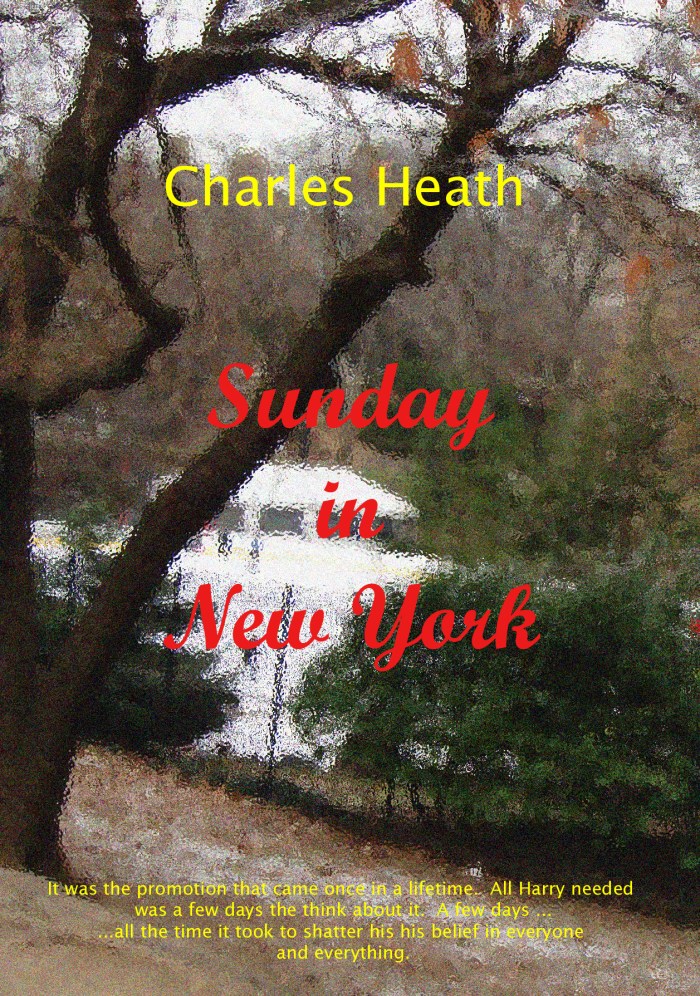
“Sunday in New York” is ultimately a story about trust, and what happens when a marriage is stretched to its limits.

When Harry Steele attends a lunch with his manager, Barclay, to discuss a promotion that any junior executive would accept in a heartbeat, it is the fact his wife, Alison, who previously professed her reservations about Barclay, also agreed to attend, that casts a small element of doubt in his mind.

From that moment, his life, in the company, in deciding what to do, his marriage, his very life, spirals out of control.

There is no one big factor that can prove Harry’s worst fears, that his marriage is over, just a number of small, interconnecting events, when piled on top of each other, points to a cataclysmic end to everything he had believed in.

Trust is lost firstly in his best friend and mentor, Andy, who only hints of impending disaster, Sasha, a woman whom he saved, and who appears to have motives of her own, and then in his wife, Alison, as he discovered piece by piece damning evidence she is about to leave him for another man.

Can we trust what we see with our eyes or trust what we hear?

Haven’t we all jumped to conclusions at least once in our lives?

Can Alison, a woman whose self-belief and confidence is about to be put to the ultimate test, find a way of proving their relationship is as strong as it has ever been?

As they say in the classics, read on!

Purchase:

http://tinyurl.com/Amazon-SundayInNewYork

Sunday In New York

I’ve always wanted to go on a Treasure Hunt – Part 28

Here’s the thing…

Every time I close my eyes, I see something different.

I’d like to think the cinema of my dreams is playing a double feature but it’s a bit like a comedy cartoon night on Fox.

But these dreams are nothing to laugh about.

Once again there’s a new instalment of an old feature, and we’re back on the treasure hunt.


I didn’t get to go wandering into the next ward to see Boggs, if he was there, because the head of ER had decided I was well enough to be discharged.  It seems they had kept me there just in case there might be problems with concussion after being whacked on the head.

I still had a dull ache in my head, but they gave me a few days supply of pain killers and sent me on my way.  After I signed some papers to that said anything happened to me outside the hospital was my fault, and that I’d been duly warned about the possible consequences of concussion.

That list of consequences always ended in death, but that could happen by being run over by an ambulance arriving outside the ER just as I was leaving.

I don’t know why, but I’d expected someone to be there, though I was not sure who.

It was a short walk to the main entrance to the hospital, and then a bit of a puzzle to be solved in trying to find the appropriate person who could tell me where Boggs was.

Twenty minutes later I came to an abrupt woman in a hospital uniform with a clipboard in her hand, and a solemn look on her face.  If the brick wall could be personified, this was it.

Nurse Jamieson.  No first name.  No sense of humour.

She looked up at me with utter disgust that someone would dare interrupt what she was doing, something I had not worked out yet unless staring at a screen saver on her computer could be said doing something.

“Can you tell me where Wiliam Boggs is, please,”  I said it nicely, and politely.

“Are you a relative?”

“No, I’m his best friend.”

“That’s not what I asked.  You can hear properly can you?”

“Yes.”

Then, what did I ask you, just before?”

“Was I a relative?”

“And the answer?” followed by what I thought she said, “not that we don’t already know the answer to that one.”

“No.”

“The go away.  Close relatives only.”

“Then if I can’t see him, can you tell me how he is?”

Too late.  Nurse Jamieson had gone back to the mesmerising screen saver.  Perhaps it was being used by some intergalactic alien to brainwash her.

I shook my head and headed back towards the main entrance.

“Excuse me?”

I heard a voice from behind, approaching quickly but quietly.  Another nurse, a different coloured uniform.  Bad nurse, good nurse, was this the latter?

I turned as she reached me.  “Yes?”

“I heard you were looking for Boggs.”

Last name, only used by friends, not that he had many, and none who were female unless he’d been holding out on me.  No, he didn’t know any girls.

“Yes.  He’s my best friend.  Do you know him?”

“A friend of his cousin, Annabelle.  I can take you to him, but you won’t be able to stay very long.”

Annabelle?  I don’t remember him telling me anything about a cousin called Annabelle, but he did say there were family members he still hadn’t met, but that was because of longstanding feuds.

“Is he alright?”

“Nothing a little rest won’t cure.  He looks worse than he is.”

I followed her back along a passage off the main foyer to an elevator, and then up to the sixth floor.  

A sign on one of the ways pointed to what was called ‘Recovery’.  We walked halfway down that passage then stopped at a room.

“He’s in there.”

The door was open, but there was a screen pulled across the entrance blotting out those who walked past from looking it.  I pushed the screen back a short distance and saw the end of the bed.

When I stepped in and reclosed the screen, I realized the bed was empty, though someone had been in it.  I stepped further into the room, and around the corner, sitting in a chair, was Nadia.

© Charles Heath 2019

Living in another time

I’ve often thought that I should have been born in the early 1900s and lived through what might be called the halcyon days of the ’20s and ’30s.

Of course, it is only a matter of opinion if those days were good or bad, depending on who you were.

If I’d been the heir apparent to become Lord of the manor, or from any part of upper classes with a University education, I have no doubt that I would not have been spared the horrors of war along with rest of the young men who went to serve and never returned.

The only saving grace might be as Officer it might have been easier than being un the ranks, but at that age, I doubt if I’d be as cautious as I should be, as of all youth I’d throw caution to the wind.

But in all likelihood, I would not have been part of the aristocracy but more than likely a clerk or farm worker who might by wit and guile have survived the war, if not a little traumatized by what I had seen and done in the name of defending the Empire.

It had prompted Hemingway to use the phrase ‘the lost generation’ at the end of one of his books, but perhaps it was first used by Gertrude Stein who had said in not many words that these people who survived the war were more content to drink themselves to death.

I guess if the war hadn’t taken you, and you survived the great flu epidemic that followed it, then you would probably believe you were in some way invincible.

So, in those post-war days where writers and others congregated in Paris in those mid-twenties, what some regard as the halcyon years before the great depression and later the next world war.  I suspect a lot of the American writers left because of prohibition and wanted the more liberal lifestyle in Paris during these years.

Certainly there was a group of writers and artists who lived that bohemian lifestyle, perhaps a result of the horrors of war, using alcohol and promiscuity to drown the bad memories.

I doubt if anyone could return from a war like that and not be damaged in some way.  Perhaps the only way to escape the horror was to immerse oneself in a different world, and if I had been back in those days, I know I would be putting pencil to paper making endless notes for later use.

And I prefer to believe if I survived it was because my desire to become a writer would eventually be fulfilled.  Perhaps, in the end, it might be more likely because I had had a lifetime love affair with words, and to me, it would be more than enough to make a reasonable living from it.

Certainly I would have sought out others like me as mentors and compatriots.

It was a time when the likes of F Scott Fitzgerald, Ernest Hemingway, Edith Wharton, and James Joyce, all of whom I have no doubt would be happy to be the role models one needed.

And if you could afford to take a trip to Paris, well, enough said.

It would probably take a lot of luck to be included in their group and no doubt hanging out at the Shakespeare and Company bookshop, owned by Silvia Beach and Adrienne Monnier, might have been a step in the right direction.

But, having not been there at the time, who knows what might have happened.

Perhaps one day when someone invents the time machine, I might be able to go back and find out.

Being Inspired – the book

Over the past year or so I have been selecting photographs I’ve taken on many travels, and put a story to them.

When I reached a milestone of 50 stories, I decided to make them into a book, and, in doing so, I have gone through each and revised them, making some longer and into short stories.

50 photographs, 50 stories.  I’ve called it, “Inspiration, Maybe”

It will be available soon.

InspirationMaybe1v1

Was it just another surveillance job – Episode 18 – Revised

As we all know, writing by the seat of your pants is almost the same as flying by the seat of your pants, a hazardous occupation.

As it happens, I like writing this way because like the reader, I don’t know what to expect next.

And equally, at times, you can write your self into a corner, much like painting, and then have to go back, make a few changes and//or repairs and then move forward.

It’s part of the writing process, only in this case, the changes occur before you’ve finished the novel, if you finish.  Quite often a lot of writers get only so far, then the manuscript hits the bottom drawer, to be brought out on a distant rainy day.

Or your cat has mocked your writing ability one too many times.

Therefore, we’re winding back to Episode 16, and moving forward once again, from there.  This is episode 18 revised…


Ever had the heart-stopping feeling when you’re in the wrong place, and someone has interrupted you?  Especially if you shouldn’t be there, or that you have no right to be there.

I stood quietly on the inside of the door and hoped whoever the visitor was would go away.  No answer meant no one was home, didn’t it?

Unless…

I heard a key in the door, and it turn in the lock.

I moved quickly to the other side of the door so I would be shielded when the person came into the room.  Too late to get out, I was of two minds what to do.  Hit the visitor over the head and flee, or ask them what they were doing, before they asked me that same question.

Then nothing.

Until a few seconds later I heard a voice, a man, say, “Jan, you’re back.  How was the visit to Philadelphia?”

I heard the slight rattle of Jan taking her hand off the handle and moving away from the door.  “Sad, as all funerals are.  Now, we are left with the house, and my father’s stuff; a huge collection of mostly junk over a long period of time.  Seems he never threw anything out.”

Jan?  Did she live here, with O’Connell?

“Yes, “I’m a bit like that.”

Another tenant, or the building super?

“I made sure Herman was looked after while you were away.  I don’t think he missed you at all?”

She laughed.  “He’s a cat, Fred.  We belong to them, not the other way around.”

“True.  Your friend has not been in for a week or so.”

“I know.  The last message I got from him, he was in Prague, lucky bastard.  He was going to take me with him, but at the last moment, they changed his itinerary.  Perhaps next time.  I was just going to make sure everything was OK, before going home myself.”

“I could look in if you want?”

“No.  Thanks anyway, but last time I was here I left a jacket behind.  Thanks, Fred.”

A moment later I could hear his footsteps heading away, and Jan moved back to the door, and opened it.

I heard the light switch, and then, suddenly, the room was filled with bright light.

The girl was unassuming, stepped into the room, and closed the door behind her.  Before she could take a step, I put a hand over her mouth and an arm around her neck and started squeezing.

Instinctively she started to struggle and call out for help.

I whispered in her ear, “I mean you no harm, but if you struggle, or yell out, it could turn out very bad for you.”

We had been taught how to subdue people without killing them, but that always didn’t go to plan.  There was that instinct to fight back in everyone, and it was sometimes hard not to apply excessive pressure which could, depending on the severity of resistance, see the target asphyxiated, or end up with a broken neck.

She was still struggling, which mean I had to exert more force.

“Stop fighting me or you will harm yourself,” I said, this time in a more forceful whisper.

It had an immediate effect, but I don’t think it was her obedience that caused it.  I gently lowered her to the floor and felt for a pulse.  Unconscious, not dead.  I sighed in relief.  I took a good long look at her so that I would remember what she looked like.  At some point, I was going to have to talk to her.

Then footsteps outside the door.  What else could go wrong?

Then knocking on the door.  Short and sharp.  Followed by, “Jan, are you in there?”

Fred, whoever he was.  What did he want?”

Another knock on the door, this time more urgent.  Damn.  O’Connell’s flat was like a busy store.

I looked around for an escape now there would be no going out the front door.  Not unless I had to disable another person, and assuming if he was the building super, he would not be a small man, so it would take a greater, and noisier, effort to subdue him.

A fire escape, all buildings usually had one down the side of the building, in case of fire.  I went over and checked the windows and found it.  The window needed a little force to open it, but the sound of a key in the door motivated me.

Out the window, close the window again, I made it down the stairs far enough that when I looked up, no one was following me.

That was close.  Too close.


© Charles Heath 2019

On the research trail…

Or as it might more commonly be known as, spending a few hours in a historical museum. which just happens to cover some of the material you need for a school project.

I brought up the subject of living history yesterday after we all packed off to have an hour ride on a steam train and accompanying equally aged carriages.

Since these trains have been missing for nearly fifty years, there is basically two generations of people who have never had the chance to travel in such a manner in their lifetime, unless, of course, they have found a tourist train like our example, the Mary Valley Rattler.

It’s the same as the early days of finding gold in Gympie, in Queensland, Australia.  It dates back to the 1860s, and one can only imagine what it was like because most of the history is in books.  Yes, they have sketches, and sometimes photographs, but these do not generally date back to the middle of the nineteenth century.

But, visiting a living example of what it was like in ‘the old day’ can give those generations a glimpse of what it was like.

Single room schools, because unlike today when schools now cater to over 1,000 children in varying years, one school held about 20 or 30 in all grades, with a single teacher.

In fact, today, I saw a collection of readers that I remember reading when I was in grade school, a long time ago.  Even the desks and the ink wells brought back interesting memories, one of which when I was ink monitor.

But housed in a number of old-style buildings was the information on the diggings, the mines and the impact of gold in general, and, at the very end, the children got to do a little panning for gold, and found a number of small fragments of real gold.

Once they’d been shown by a panning expert that looked as if he had been transported into this time from the past.

There are similar places elsewhere in this country that preserve the past to show future generations what it was like.

After this weekend, we have more than enough information to work on the project, based around gold mining, and it’s impact on the people, the area, and the government.

And best of all, it has generated an interest in the past, reading more, and perhaps if we’re lucky, an interest in writing, which sometimes is quite difficult when it has to compete with more interesting pastimes like computer games.

Was it just another surveillance job – Episode 17 – Revised

As we all know, writing by the seat of your pants is almost the same as flying by the seat of your pants, a hazardous occupation.

As it happens, I like writing this way because like the reader, I don’t know what to expect next.

And equally, at times, you can write your self into a corner, much like painting, and then have to go back, make a few changes and//or repairs and then move forward.

It’s part of the writing process, only in this case, the changes occur before you’ve finished the novel, if you finish.  Quite often a lot of writers get only so far, then the manuscript hits the bottom drawer, to be brought out on a distant rainy day.

Or your cat has mocked your writing ability one too many times.

Therefore, we’re winding back to Episode 16, and moving forward once again, from there.


Why didn’t it surprise me that Nobbin was playing all ends against the middle if that was the expression?  What really bothered was that he wasn’t prepared to tell me the truth or trust me to help find the missing information.  But he had known I might become interested and do some investigating of my own.

Perhaps Nobbin feared Severin might track me down, as he had, and if I had found the USB, run the list of losing it to his foe.

Nor was it a surprise that someone else, namely Severin, was after the information, and he would have access to everything Nobbin did, and he was equally disadvantaged.  It was either Severin or one of his agents, that was caught in O’Connell’s flat and found ‘Josephine’ there.

I didn’t believe her name was Josephine, or that she lived in the flat next door.  And I didn’t think Severin had found anything going by the way the flat had been turned over, and the fact it looked like no one had lived there.

Having now dealt with both men, I was still on the fence about who was on the right side and who was on the wrong side, or whether they were both of questionable character.  What made it difficult to understand was how Severin could run an operation inside the organisation.  Surely someone knew about it, or from a high level, sanctioned it?

Knowing I would not be interrupted this time, I went back up to the third floor, and into O’Connell’s flat, a simple job since the front door was still unlocked.  The girl had assumed it was no value to them which told me she had already searched the place before being attacked.

Just in case anyone was likely to return, or there was another party interested in O’Connell, I locked the door from the inside.  At least no one had yet crashed through the door, smashing the lock and timber.

I stood in the middle of the main room, and did a slow 360-degree turn, looking at everything intently.  The thing with searches like this, it was more likely the object of any search was hidden in plain sight.  The usual places, such as the freezer, sections of fridges, stashed in bottles or packets in the pantry, under beds, inside mattresses, pillows, or under blankets, or with a form of glue on the inside of televisions or computers would prove fruitless.

We were taught to hide things such as USB sticks where they would be least expected to be found, such as a toy on a keyring, tossed in a bowl of pens, pins, clips, or other small insignificant items that all looked uninteresting.

My first thought was in the pocket of a coat in the closet, but all his clothes were strewn over the floor in the bedroom showing signs of being turned out.  Perhaps the searcher or searchers had thought like me.

There was no keyring in the kitchen or the bedroom, no was there any sort of stand inside the door, a place to put mail, and other items such as keys.  If there were any, they would have been on him when Severin had him killed.  I had not found, not felt, any in his pockets, not unusual for an agent in the field.  If you were captured or killed, you wanted nothing on you that could identify you or what you were doing.

Next I thought, a hidden compartment.  I was not going to predict he had a safe in the flat, but just in case, I did search thoroughly where one might be located.  The cheap watercolour on the wall hid nothing but some discoloured wallpaper.

I checked all the skirting boards, and inside walls of the robes, but there was nothing.  I also checked the robes thoroughly for false backs, or sides, or compartments hidden in the roof.  The floor was made from wood, so I checked to see if there were any loose boards, but in the end, considered that was a ruse used only in the movies and on television.

An hour later, I was no wiser as to where it could be, if at all, in the flat, but, looking around, it was certainly now a little more organised because in checking everything in case the previous searchers had missed anything, I’d put everything neatly in stacks.

And, no, there was nothing under the bed.  The previous searchers had thought of that too.

But, in one corner of the main room, there was a desk that had been completely turned out, papers were strewn everywhere.  There had been a computer, now missing, because there was a cable running from the printer, and a power cable in the wall, both running into thin air.

The papers yielded nothing of interest, other than he was researching a holiday to Russia and Poland. 

For two.

A break.  There was a significant other.  I made a more serious search of the papers that I’d gathered up off the floor and found a shred of a quickly torn up piece of paper, of which only this piece remained.  A name:  Jan, scribbled on it, with half another word ‘ord’.

Did this Jan also live in this block?  Did she work at the same place?  There were a hundred variations of that theme, but it was a start.  He might have trusted the USB to her safekeeping without telling her what it was, and it was possible she didn’t know he was dead.

I’d noticed that O’Connell’s death had been reported as a John Doe on the wrong end of an alleged mugging, the small dismissive paragraph on page seven reported the body was missing when police went to investigate a pool of blood in an alley, along with several other crimes of which police were seeking further information.  That alley hadn’t any CCTV cameras, so Severin knew he could easily shoot O’Connell without anyone knowing it was him.

There was nothing else of interest in the documents, other than the holiday, if it was a holiday, was to be in a month’s time.

My work was done.  I had a lead.  It was time to leave.

Except for one small problem.  Someone was knocking on the door.


© Charles Heath 2019

Was it just another surveillance job – Episode 16 – Revised

As we all know, writing by the seat of your pants is almost the same as flying by the seat of your pants, a hazardous occupation.

As it happens, I like writing this way because like the reader, I don’t know what to expect next.

And equally, at times, you can write your self into a corner, much like painting, and then have to go back, make a few changes and//or repairs and then move forward.

It’s part of the writing process, only in this case, the changes occur before you’ve finished the novel if you finish.  Quite often a lot of writers get only so far, then the manuscript hits the bottom drawer, to be brought out on a distant rainy day.

Or your cat has mocked your writing ability one too many times.

Therefore, we’re winding back to Episode 16, and moving forward once again, from there.


O’Connor seemed to be more affluent than I because he was living in a flat located in an upmarket building.  Getting into the ground floor required a passkey, one I suspect might also be needed to get in the front door of his flat, but I’d worry about that later.

My first problem was that front door, and it was not until a tradesman exited that I took the opportunity to appear to arrive at the same time, pretending to find my card, and brushing past him as he was exiting.  He ignored me, his hands full, being in a hurry.

It took a day and a half of watching the building, waiting for an opportunity.  His flat was on the third floor and although there was an elevator, I took the stairs, hoping that I wouldn’t run into anyone.

Quickly and quietly, and thankfully without seeing another resident, I came out into the passageway, and it was about ten steps to his front door.  Number 37.  Not far away, in one direction, the end of the passage, and numbers 38, 39, and 40.  In the other, four more flats and the end of the corridor.  Windows at either end, perhaps an escape route.  I would not use the elevator if I had to leave in a hurry.

There were two elevators and one staircase.  Both elevators were stationary on the ground floor.

I knocked lightly on the door to number 37.

No answer.

I knocked a little harder on the door.  It was quite solid, and I had to wonder if the knocking sound penetrated the solid wood.

I checked the lock.  Simple to open.  We’d been given instruction by a master locksmith, and I’d brought my tools.

I waited a minute, checked to see if the elevators were still on the ground floor, then picked the lock and was inside within a minute.

Silence.

I felt along the wall for a light switch, usually by the door, and found it, and flicked it on.  The sudden light was almost blinding, but then my eyes adjusted.

Trashed, much the same as my flat.

But, with a difference.

A woman was stretched out on the floor, unmoving.  I could see, from where I was standing, she had been hit on the back of the head and could see the wound, and a trickle of blood through her hair.

Five steps to reach her, I reached down to check for a pulse.

Yes, she was alive.

I shook her gently.  She didn’t react.  I shook her a little more roughly and she stirred, then, as expected, lashed out.

I caught her hands, saying, “I just found you.  I’m not your enemy.”

Of course, considering I was a stranger in what could be her flat without permission, I was not surprised she continued to struggle until I tried being reassuring.  Then she stopped and asked, “Who are you?”

“A friend of O’Connor.  I worked with him.  Something happened to him at work and he said if that happened, I was to come here.  He didn’t say anything about you, though.”

“I live here, in the flat next door.  I heard a noise and came to investigate.  That’s all I remember.”

I helped her up into a sitting position, and, holding her head in her hands, looked around.  “Did you do this?”

“No.  Just got here.  But it’s the same at my place.  The people who did this are looking for something.  By the look of it, they didn’t find it here either.”

“I’ll get a damp cloth for your head.  It doesn’t look serious but there might be a slight concussion that might need attention.”

She felt the back of her head, and, when she touched the wound, gasped, “It hurts though.”

I stood and went over to the kitchenette.  O’Connor was not much of a cook, the benches looked new, and there was nothing out.  I looked in a draw near the sink and found a cloth, still with the price tag on it.  So were several utensils in the drawer.  I ran it under the water, then went back to her, now off the floor and sitting on one of the two chairs.  I handed her the wet cloth and she put it against the injured part of her head.

I made a mental note, it didn’t look like O’Connor had been here long, if at all.  Something was not right here, and if that was the case, I should take care when saying anything to this woman.

“Who are you again?” she asked.

“I worked with him.  My name is irrelevant.  It’s unlikely that he mentioned me to you, or anyone.  It’s the nature of our work.”

“Why should I believe you?  You could be my attacker.”

“If that were the case, why would I still be here trying to be helpful.”

A good question that elicited a curious expression.

“What do you do, what did Oliver do?”

Alarm bells were going off.  Oliver was not O’Connor’s first name.

“Nothing very interesting, I can assure you, and definitely nothing that would warrant this happening.  If it had only been me, I would have not thought any more of it, but since we worked together, and this has also happened to him, it seems we are mixed up in something bad.”

“Where is he, by the way?”

“I was hoping you could tell me.  If you live next door and know him well enough to be here, he might have told you.”

“No.  He never spoke about work.”

She was trying to stand so I helped her up and held on when it looked like she was about to collapse.  Last time I had a knock to the head, I had dizziness for a minute of two.  Her knock had been a lot harder.”

“Are you alright?”  She didn’t look it.

“I will be, I’m sure.”

I let her go, and she took several steps, then gave me a rather hard look.  “Why are you here again?”

“Trying to find my friend.”

“How did you get in here?”

Rather than make her disorientated, the knock must have sharpened her senses.  Time to test a theory. 

“I think we should call the police now, and report the break-in.”

I pulled out my phone.

“Look, I don’t want to get mixed up in this.  You go, and I report this when I get back home.  And, if you find him, tell him Josephine is looking for him.”

As I thought.  She was not able to explain to the authorities why she was in this flat, as I’m sure she believed I couldn’t either.

She started walking towards the door.  My staying any longer would raise her suspicions about me, and any search I was going to do would have to wait.  I opened the door, she walked out, and I followed shutting the door after me.

I left her standing outside the door and headed for the stairs.  A last glance back showed her still where I left her.  I went down to the first landing, then stopped.  It was part of the training, to treat everyone as suspicious.

Then I heard her voice, as she passed the top of the staircase, on her way back to her flat.  “He was here, looking for the files.  No, he’s gone.”  A minute’s silence, then “On my way.”

Another minute, I heard the elevator car arrive on the third floor.

I quickly ran down the stairs to the ground floor and waited at the door until she came out of the elevator, heading for the door.

Then as she passed through the front door, I came out into the foyer just in time to see a car stop out the front, and a familiar face out through the rear window.

Nobbin.


© Charles Heath 2019
Conversations with my cat – 53

20160921_071443

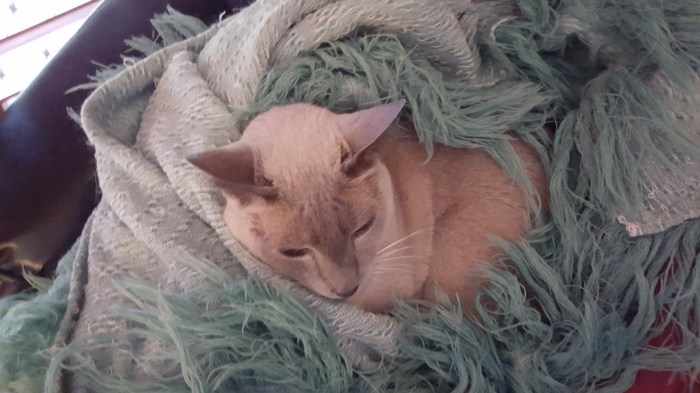
This is Chester.  He’s feeling poorly today.

When I used this expression, he looked at me quizzically, which is not bad for a cat with a constant poker face.

Where did you get that from?

It’s a favourite expression of my mother’s when she wasn’t feeling very well.  She had another, ‘not feeling elegant’ today.

It stops and makes me wonder where these expressions come from, and I suspect, because my mother’s mother was of German descent, that it was one of those translation to English things.

Chester seems disinterested.  I’m beginning to think there may be something wrong with him because he’s not his usual sardonic self.

Perhaps, I say, it’s time to go to the vet, get checked out.  You’re not getting any younger.

His head pops up at the mention of the vet.  He knows what this means.  The cat basket.

He leaps up with newfound energy and heads for the door.

I get out of my chair to follow, and he’s gone, moving quickly up the passage to one of his hiding spots.

Maybe he’s not that bad.  I’ll monitor the situation.

“You’re safe,” I yell out.  “For now.”

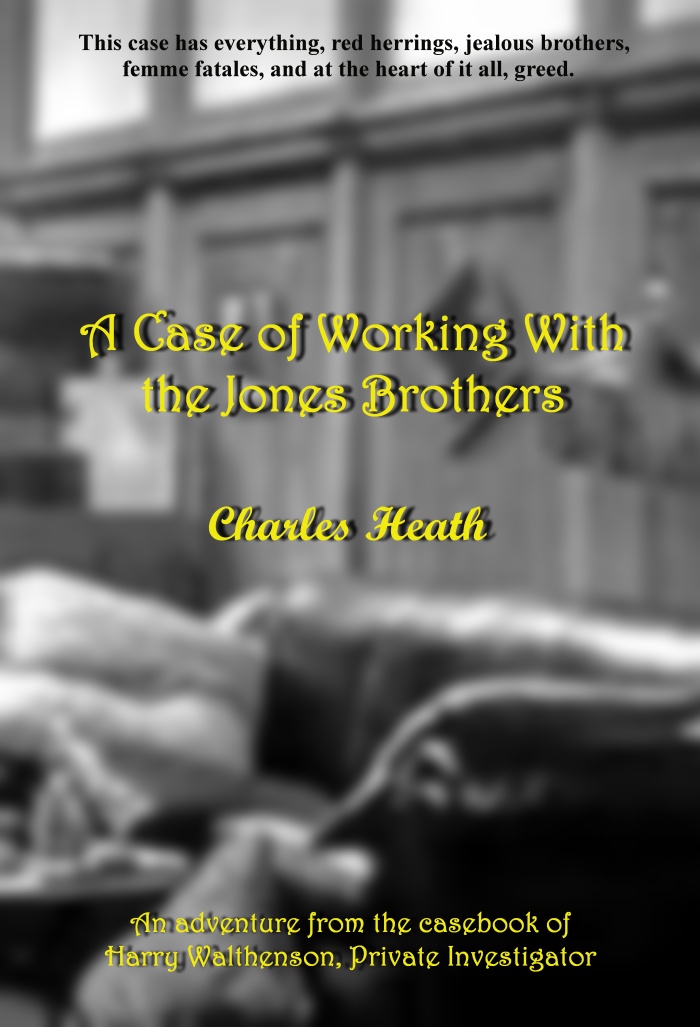
The first case of PI Walthenson – “A Case of Working With the Jones Brothers”

This case has everything, red herrings, jealous brothers, femme fatales, and at the heart of it all, greed.

Coming soon!

PIWalthJones1