An excerpt from “Betrayal” – a work in progress

It could have been anywhere in the world, she thought, but it wasn’t.  It was in a city where if anything were to go wrong…

She sighed and came away from the window and looked around the room.  It was quite large and expensively furnished.  It was one of several she had been visiting in the last three months.

Quite elegant too, as the hotel had its origins dating back to before the revolution in 1917.  At least, currently, there would not be a team of KGB agents somewhere in the basement monitoring everything that happened in the room.

There was no such thing as the KGB anymore, though there was an FSB, but such organisations were of no interest to her.

She was here to meet with Vladimir.

She smiled to herself when she thought of him, such an interesting man whose command of English was as good as her command of Russian, though she had not told him of that ability.

All her knew of her was that she was American, worked in the Embassy as a clerk, nothing important, who life both at work and at home was boring.  Not that she had blurted that out the first tie she met, or even the second.

That first time, at a function in the Embassy, was a chance meeting, a catching of his eye as he looked around the room, looking, as he had told her later, for someone who might not be as boring as the function itself.

It was a celebration, honouring one of the Embassy officials on his service in Moscow, and the fact he was returning home after 10 years.  She had been there one, and still hadn’t met all the staff.

They had talked, Vladimir knew a great deal about England, having been stationed there for a year or two, and had politely asked questions about where she lived, her family, and of course what her role was, all questions she fended off with an air of disinterested interest.

It fascinated him, as she knew it would, a sort of mental sparring as one would do with swords, if this was a fencing match.

They had said they might or might not meet again when the party was over, but she suspected there would be another opportunity.  She knew the signs of a man who was interested in her, and Vladimir was interested.

The second time came in the form of an invitation to an art gallery, and a viewing of the works of a prominent Russian artist, an invitation she politely declined.  After all, invitations issued to Embassy staff held all sorts of connotations, or so she was told by the Security officer when she told him.

Then, it went quiet for a month.  There was a party at the American embassy and along with several other staff members, she was invited.  She had not expected to meet Vladimir, but it was a pleasant surprise when she saw him, on the other side of the room, talking to several military men.

A pleasant afternoon ensued.

And it was no surprise that they kept running into each other at the various events on the diplomatic schedule.

By the fifth meeting, they were like old friends.  She had broached the subject of being involved in a plutonic relationship with him with the head of security at the embassy.  Normally for a member of her rank it would not be allowed, but in this instance it was.

She did not work in any sensitive areas, and, as the security officer had said, she might just happen upon something that might be useful.  In that regard, she was to keep her eyes and ears open, and file a report each time she met him.

After that discussion she got the impression her superiors considered Vladimir more than just a casual visitor on the diplomatic circuit.  She also formed the impression the he might consider her an ‘asset’, a word that had been used at the meeting with security and the ambassador.

It was where the word ‘spy’ popped into her head and sent a tingle down her spine.  She was not a spy, but the thought of it, well, it would be fascinating to see what happened.

A Russian friend.  That’s what she would call him.

And over time, that relationship blossomed, until, after a visit to the ballet, late and snowing, he invited her to his apartment not far from the ballet venue.  It was like treading on thin ice, but after champagne and an introduction to caviar, she felt like a giddy schoolgirl.

Even so, she had made him promise that he remain on his best behaviour.  It could have been very easy to fall under the spell of a perfect evening, but he promised, showed her to a separate bedroom, and after a brief kiss, their first, she did not see him until the next morning.

So, it began.

It was an interesting report she filed after that encounter, one where she had expected to be reprimanded.

She wasn’t.

It wasn’t until six weeks had passed when he asked her if she would like to take a trip to the country.  It would involve staying in a hotel, that they would have separate rooms.  When she reported the invitation, no objection was raised, only a caution; keep her wits about her.

Perhaps, she had thought, they were looking forward to a more extensive report.  After all, her reports on the places, and the people, and the conversations she overheard, were no doubt entertaining reading for some.

But this visit was where the nature of the relationship changed, and it was one that she did not immediately report.  She had realised at some point before the weekend away, that she had feelings for him, and it was not that he was pushing her in that direction or manipulating her in any way.

It was just one of those moments where, after a grand dinner, a lot of champagne, and delightful company, things happen.  Standing at the door to her room, a lingering kiss, not intentional on her part, and it just happened.

And for not one moment did she believe she had been compromised, but for some reason she had not reported that subtle change in the relationship to the powers that be, and so far, no one had any inkling.

She took off her coat and placed it carefully of the back of one of the ornate chairs in the room.  She stopped for a moment to look at a framed photograph on the wall, one representing Red Square.

Then, after a minute or two, she went to the mini bar and took out the bottle of champagne that had been left there for them, a treat arranged by Vladimir for each encounter.

There were two champagne flutes set aside on the bar, next to a bowl of fruit.  She picked up the apple and thought how Eve must have felt in the garden of Eden, and the temptation.

Later perhaps, after…

She smiled at the thought and put the apple back.

A glance at her watch told her it was time for his arrival.  It was if anything, the one trait she didn’t like, and that was his punctuality.  A glance at the clock on the room wall was a minute slow.

The doorbell to the room rang, right on the appointed time.

She put the bottle down and walked over to the door.

A smile on her face, she opened the door.

It was not Vladimir.  It was her worst nightmare.

…

© Charles Heath 2020

Life’s little experiences seem to have disappeared

I’m on a riverboat, sailing slowly down the Nile, ahead of us the Pyramids, a sight, I’m told, to behold despite the ravages of time.

There are others, a curious bunch of people, drawn from all over the globe, and from different classes, in a time when that seemed to matter.

Of course, it’s 1935.

And it’s all in my head.  Something I’d seen somewhere, or read perhaps, and now that I come to think of it, it was an Agatha Christie murder mystery.

Even now, nearly a hundred years later, it may have been possible to replicate it, only a world war, British Empire aspirations and later abandonment, and civil rife made it difficult but not impossible.

COVID 19 did that.

For someone who likes to travel the world, looking for locations, and inspiration, for my stories, the current travel ban has made life far more unbearable than just having to remain locked up for fear of catching it.

It’s the same as sitting at an outside cafe overlooking the main piazza in San Gimignano, having a pizza, an authentic pizza, and a bottle of Moretti.

Or like wandering the narrow cobbled streets of Florence, staying in what was once a 12th-century monastery, having wild boar pasta, and just a short distance away, a gelato.

Or wandering around similarly narrow and cobbled laneways in Montmartre, stopping at a corner crepe restaurant, where the crepes are to die for.

Taking that away is like taking away a hand, or a leg.

How long will it be before the world returns to normal, or will it?

In my conspiracy theory mind it seems to me there is more going on than just a virus spreading, it has overtones of world domination, or worse, watching the destruction of the world economy, and capitalism for want of a better word, at the same pace that climate change is changing the planet.

Neither occurrence is new, it’s happened time and time again over many millennia, it’s just we don’t seem to learn from it.   Well, maybe not in my lifetime.  Let’s hope generations to come do.

“The Things We Do For Love” – Coming soon

Is love the metaphorical equivalent to ‘walking the plank’; a dive into uncharted waters?

For Henry the only romance he was interested in was a life at sea, and when away from it, he strived to find sanctuary from his family and perhaps life itself.  It takes him to a small village by the sea, s place he never expected to find another just like him, Michelle, whom he soon discovers is as mysterious as she is beautiful.

Henry had long since given up the notion of finding romance, and Michelle couldn’t get involved for reasons she could never explain, but in the end both acknowledge that something happened the moment they first met.  

Plans were made, plans were revised, and hopes were shattered.

A chance encounter causes Michelle’s past to catch up with her, and whatever hope she had of having a normal life with Henry, or anyone else, is gone.  To keep him alive she has to destroy her blossoming relationship, an act that breaks her heart and shatters his.

But can love conquer all?

It takes a few words of encouragement from an unlikely source to send Henry and his friend Radly on an odyssey into the darkest corners of the red light district in a race against time to find and rescue the woman he finally realizes is the love of his life.

The cover, at the moment, looks like this:

lovecoverfinal1

An excerpt from “Sunday in New York”

Now available on Amazon at:  https://amzn.to/2H7ALs8


Williams’ Restaurant, East 65th Street, New York, Saturday, 8:00 p.m.


We met the Blaine’s at Williams’, a rather upmarket restaurant that the Blaine’s frequently visited, and had recommended.

Of course, during the taxi ride there, Alison reminded me that with my new job, we would be able to go to many more places like Williams’.  It was, at worst, more emotional blackmail, because as far as Alison was concerned, we were well on our way to posh restaurants, the Trump Tower Apartments, and the trappings of the ‘executive set’.

It would be a miracle if I didn’t strangle Elaine before the night was over.  It was she who had filled Alison’s head with all this stuff and nonsense.

Aside from the half frown half-smile, Alison was looking stunning.  It was months since she had last dressed up, and she was especially wearing the dress I’d bought her for our 5th anniversary that cost a month’s salary.  On her, it was worth it, and I would have paid more if I had to.  She had adored it, and me, for a week or so after.

For tonight, I think I was close to getting back on that pedestal.

She had the looks and figure to draw attention, the sort movie stars got on the red carpet, and when we walked into the restaurant, I swear there were at least five seconds silence, and many more gasps.

Even I had a sudden loss of breath earlier in the evening when she came out of the dressing room.  Once more I was reminded of how lucky I was that she had agreed to marry me.  Amid all those self-doubts, I couldn’t believe she had loved me when there were so many others ‘out there’ who were more appealing.

Elaine was out of her seat and came over just as the Head Waiter hovered into sight.  She personally escorted Alison to the table, allowing me to follow like the Queen’s consort, while she and Alison basked in the admiring glances of the other patrons.

More than once I heard the muted question, “Who is she?”

Jimmy stood, we shook hands, and then we sat together.  It was not the usual boy, girl, boy, girl seating arrangement.  Jimmy and I on one side and Elaine and Alison on the other.

The battle lines were drawn.

Jimmy was looking fashionable, with the permanent blade one beard, unkempt hair, and designer dinner suit that looked like he’d slept in it.  Alison insisted I wear a tuxedo, and I looked like the proverbial penguin or just a thinner version of Alfred Hitchcock.

The bow tie had been slightly crooked, but just before we stepped out she had straightened it.  And took the moment to look deeply into my soul.  It was one of those moments when words were not necessary.

Then it was gone.

I relived it briefly as I sat and she looked at me.  A penetrating look that told me to ‘behave’.

When we were settled, Elaine said, in that breathless, enthusiastic manner of hers when she was excited, “So, Harry, you are finally moving up.”  It was not a question, but a statement.

I was not sure what she meant by ‘finally’ but I accepted it with good grace.  Sometimes Elaine was prone to using figures of speech I didn’t understand.  I guessed she was talking about the new job.  “It was supposed to be a secret.”

She smiled widely.  “There are no secrets between Al and I, are there Al?”

I looked at ‘Al’ and saw a brief look of consternation.

I was not sure Alison liked the idea of being called Al.  I tried it once and was admonished.  But it was interesting her ‘best friend forever’ was allowed that distinction when I was not.  It was, perhaps, another indicator of how far I’d slipped in her estimation.

Perhaps, I thought, it was a necessary evil.  As I understood it, the Blaine’s were our mentors at the Trump Tower, because they didn’t just let ‘anyone’ in.  I didn’t ask if the Blaine’s thought we were just ‘anyone’ before I got the job offer.

And then there was that look between Alison and Elaine, quickly stolen before Alison realized I was looking at both of them.  I was out of my depth, in a place I didn’t belong, with people I didn’t understand.  And yet, apparently, Alison did.  I must have missed the memo.

“No,” Alison said softly, stealing a glance in my direction, “No secrets between friends.”

No secrets.  Her look conveyed something else entirely.

The waiter brought champagne, Krug, and poured glasses for each of us.  It was not the cheap stuff, and I was glad I brought a couple of thousand dollars with me.  We were going to need it.

Then, a toast.

To a new job and a new life.

“When did you decide?”  Elaine was effusive at the best of times, but with the champagne, it was worse.

Alison had a strange expression on her face.  It was obvious she had told Elaine it was a done deal, even before I’d made up my mind.  Perhaps she’d assumed I might be ‘refreshingly honest’ in front of Elaine, but it could also mean she didn’t really care what I might say or do.

Instead of consternation, she looked happy, and I realized it would be churlish, even silly if I made a scene.  I knew what I wanted to say.  I also knew that it would serve little purpose provoking Elaine, or upsetting Alison.  This was not the time or the place.  Alison had been looking forward to coming here, and I was not going to spoil it.

Instead, I said, smiling, “When I woke up this morning and found Alison missing.  If she had been there, I would not have noticed the water stain on the roof above our bed, and decide there and then how much I hated the place.” I used my reassuring smile, the one I used with the customers when all hell was breaking loose, and the forest fire was out of control.  “It’s the little things.  They all add up until one day …”  I shrugged.  “I guess that one day was today.”

I saw an incredulous look pass between Elaine and Alison, a non-verbal question; perhaps, is he for real?  Or; I told you he’d come around.

I had no idea the two were so close.

“How quaint,” Elaine said, which just about summed up her feelings towards me.  I think, at that moment, I lost some brownie points.  It was all I could come up with at short notice.

“Yes,” I added, with a little more emphasis than I wanted.  “Alison was off to get some study in with one of her friends.”

“Weren’t the two of you off to the Hamptons, a weekend with some friends?” Jimmy piped up, and immediately got the ‘shut up you fool’ look, that cut that line of conversation dead.  Someone forgot to feed Jimmy his lines.

It was followed by the condescending smile from Elaine, and “I need to powder my nose.  Care to join me, Al?”

A frown, then a forced smile for her new best friend.  “Yes.”

I watched them leave the table and head in the direction of the restroom, looking like they were in earnest conversation.  I thought ‘Al’ looked annoyed, but I could be wrong.

I had to say Jimmy looked more surprised than I did.

There was that odd moment of silence between us, Jimmy still smarting from his death stare, and for me, the Alison and Elaine show.  I was quite literally gob-smacked.

I drained my champagne glass gathering some courage and turned to him.  “By the way, we were going to have a weekend away, but this legal tutorial thing came up.  You know Alison is doing her law degree.”

He looked startled when he realized I had spoken.  He was looking intently at a woman several tables over from us, one who’d obviously forgotten some basic garments when getting dressed.  Or perhaps it was deliberate.  She’d definitely had some enhancements done.

He dragged his eyes back to me.  “Yes.  Elaine said something or other about it.  But I thought she said the tutor was out of town and it had been postponed until next week.  Perhaps I got it wrong.  I usually do.”

“Perhaps I’ve got it wrong.”  I shrugged, as the dark thoughts started swirling in my head again.  “This week or next, what does it matter?”

Of course, it mattered to me, and I digested what he said with a sinking heart.  It showed there was another problem between Alison and me; it was possible she was now telling me lies.  If what he said was true and I had no reason to doubt him, where was she going tomorrow morning, and had she really been with a friend studying today?

We poured some more champagne, had a drink, then he asked, “This promotion thing, what’s it worth?”

“Trouble, I suspect.  Definitely more money, but less time at home.”

“Oh,” raised eyebrows.  Obviously, the women had not talked about the job in front of him, or, at least, not all the details.  “You sure you want to do that?”

At last the voice of reason.  “Me?  No.”

“Yet you accepted the job.”

I sucked in a breath or two while I considered whether I could trust him.  Even if I couldn’t, I could see my ship was sinking, so it wouldn’t matter what I told him, or what Elaine might find out from him.  “Jimmy, between you and me I haven’t as yet decided one way or another.  To be honest, I won’t know until I go up to Barclay’s office and he asks me the question.”

“Barclay?”

“My boss.”

“Elaine’s doing a job for a Barclay that recently moved in the tower a block down from us.  I thought I recognized the name.”

“How did Elaine get the job?”

“Oh, Alison put him onto her.”

“When?”

“A couple of months ago.  Why?”

I shrugged and tried to keep a straight face, while my insides were churning up like the wake of a supertanker.  I felt sick, faint, and wanting to die all at the same moment.  “Perhaps she said something about it, but it didn’t connect at the time.  Too busy with work I expect.  I think I seriously need to get away for a while.”

I could hardly breathe, my throat was constricted and I knew I had to keep it together.  I could see Elaine and Alison coming back, so I had to calm down.  I sucked in some deep breaths, and put my ‘manage a complete and utter disaster’ look on my face.

And I had to change the subject, quickly, so I said, “Jimmy, Elaine told Alison, who told me, you were something of a guru of the cause and effects of the global economic meltdown.  Now, I have a couple of friends who have been expounding this theory …”

Like flicking a switch, I launched into the well-worn practice of ‘running a distraction’, like at work when we needed to keep the customer from discovering the truth.  It was one of the things I was good at, taking over a conversation and pushing it in a different direction.  It was salvaging a good result from an utter disaster, and if ever there was a time that it was required, it was right here, right now.

When Alison sat down and looked at me, she knew something had happened between Jimmy and I.  I might have looked pale or red-faced, or angry or disappointed, it didn’t matter.  If that didn’t seal the deal for her, the fact I took over the dining engagement did.  She knew well enough the only time I did that was when everything was about to go to hell in a handbasket.  She’d seen me in action before and had been suitably astonished.

But I got into gear, kept the champagne flowing and steered the conversation, as much as one could from a seasoned professional like Elaine, and, I think, in Jimmy’s eyes, he saw the battle lines and knew who took the crown on points.  Neither Elaine nor Jimmy suspected anything, and if the truth be told, I had improved my stocks with Elaine.  She was at times both surprised and interested, even willing to take a back seat.

Alison, on the other hand, tried poking around the edges, and, once when Elaine and Jimmy had got up to have a cigarette outside, questioned me directly.  I chose to ignore her, and pretend nothing had happened, instead of telling her how much I was enjoying the evening.

She had her ‘secrets’.  I had mine.

At the end of the evening, when I got up to go to the bathroom, I was physically sick from the pent up tension and the implications of what Jimmy had told me.  It took a while for me to pull myself together; so long, in fact, Jimmy came looking for me.  I told him I’d drunk too much champagne, and he seemed satisfied with that excuse.  When I returned, both Alison and Elaine noticed how pale I was but neither made any comment.

It was a sad way to end what was supposed to be a delightful evening, which to a large degree it was for the other three.  But I had achieved what I set out to do, and that was to play them at their own game, watching the deception, once I knew there was a deception, as warily as a cat watches its prey.

I had also discovered Jimmy’s real calling; a professor of economics at the same University Alison was doing her law degree.  It was no surprise in the end, on a night where surprises abounded, that the world could really be that small.

We parted in the early hours of the morning, a taxi whisking us back to the Lower East Side, another taking the Blaine’s back to the Upper West Side.  But, in our case, as Alison reminded me, it would not be for much longer.  She showed concern for my health, asked me what was wrong.  It took all the courage I could muster to tell her it was most likely something I ate and the champagne, and that I would be fine in the morning.

She could see quite plainly it was anything other than what I told her, but she didn’t pursue it.  Perhaps she just didn’t care what I was playing at.

And yet, after everything that had happened, once inside our ‘palace’, the events of the evening were discarded, like her clothing, and she again reminded me of what we had together in the early years before the problems had set in.

It left me confused and lost.

I couldn’t sleep because my mind had now gone down that irreversible path that told me I was losing her, that she had found someone else, and that our marriage was in its last death throes.

And now I knew it had something to do with Barclay.


© Charles Heath 2015-2020

Sunday In New York


The story behind the story: A Case of Working With the Jones Brothers

To write a private detective serial has always been one of the items at the top of my to-do list, though trying to write novels and a serial, as well as a blog, and maintain a social media presence, well, you get the idea.

But I made it happen, from a bunch of episodes I wrote a long, long time ago, used these to start it, and then continue on, then as now, never having much of an idea where it was going to end up, or how long it would take to tell the story.

That, I think is the joy of ad hoc writing, even you, as the author, have as much idea of where it’s going as the reader does.

It’s basically been in the mill since 1990, and although I finished it last year, it looks like the beginning to end will have taken exactly 30 years.  Had you asked me 30 years ago if I’d ever get it finished, the answer would be maybe?

My private detective, Harry Walthenson

I’d like to say he’s from that great literary mold of Sam Spade, or Mickey Spillane, or Phillip Marlow, but he’s not.

But, I’ve watched Humphrey Bogart play Sam Spade with much interest, and modeled Harry and his office on it.  Similarly, I’ve watched Robert Micham play Phillip Marlow with great panache, if not detachment, and added a bit of him to the mix.

Other characters come into play, and all of them, no matter what period they’re from, always seem larger than life.  I’m not above stealing a little of Mary Astor, Peter Lorre or Sidney Greenstreet, to breathe life into beguiling women and dangerous men alike.

Then there’s the title, like

The Case of the Unintentional Mummy – this has so many meanings in so many contexts, though I image back in Hollywood in the ’30s and ’40s, this would be excellent fodder for Abbott and Costello

The Case of the Three-Legged Dog – Yes, I suspect there may be a few real-life dogs with three legs, but this plot would involve something more sinister.  And if made out of plaster, yes, they’re always something else inside.

But for mine, to begin with, it was “The Case of the …”, because I had no idea what the case was going to be about, well, I did, but not specifically.

Then I liked the idea of calling it “The Case of the Brother’s Revenge” because I began to have a notion there was a brother no one knew about, but that’s stuff for other stories, not mine, so then went the way of the others.

Now it’s called ‘A Case of Working With the Jones Brothers’, finished the first three drafts, and at the editor for the last.

I have high hopes of publishing it in early 2021.  It even has a cover.

PIWalthJones1

What’s it like from the other side of the desk?

I’ve been sitting at the desk staring at the screen thinking of what to write that might interest other people.

Seems I’m not too good at it.

So, I moved seats, to sit opposite the writer’s chair and took a good long hard look at the person, the so-called writer, conjuring up in my mind, if I was someone I’d just dragged in off the street, what would I ask?

Would I bother?

I mean most of of walk down the street trying to avoid everyone else, and anything bad that might happen.

But I’m here now, so for a free cup of tea and a Doubletree cookie, I consider myself bribed.

Question 1:  Why on earth would you want to write when there’s a billion other books out there?  Seems a complete waste of time to me.

[Answer] Good point, most days when I get out of bed, or rather stare at the ceiling from under the covers, I wonder why I bother to get up.

OK that’s the borderline manic depressive speaking, and most likely suffering from a hangover, trying to get those last 1,000 words for the day done.

Question 2: You write when you’re drunk?  That must make a lot of sense, not!

This person has found me out in two questions.

[Answer] No, a little Scotch helps oil the wheels on the mind.

Question 3:  What do you do for inspiration?

[Answer] Thinking up new and novel ways of killing off people I drag in off the street to ask me questions about myself.  No, sorry, didn’t mean that.  I haven’t a mean bone in my body.  Inspiration you say?

Look around.

The inquisitor does.  There are seven floor to ceiling bookcases full of my favorite authors, about 4,000 or so books, aside from the reference library that is mostly in e-book format which run to about 10,000.

Question 4:  You read all of these?

[Picks up a copy of ‘Kill Me If You Can’ by James Patterson]  This one.

I nod yes.  I have read most of them.  I tell him writers must read.  Someone told me that a long time ago.  Not only thrillers and crime, but the classics.  I found War and Peace heavy going, but not so much as Madame Bovary, or Vanity Fair.

You can ask one more question.

Question 5:  Can I borrow this book [James Patterson]

As always the answer is yes.  I encourage people to read.  It doesn’t have to be my work.  It would be nice but I;m realistic enough to know there’s a billion other books out there I have to compete with.

Maybe tomorrow.

Inspiration, maybe – Volume 1

50 photographs, 50 stories, of which there is one of the 50 below.

They all start with –

A picture paints … well, as many words as you like.  For instance:

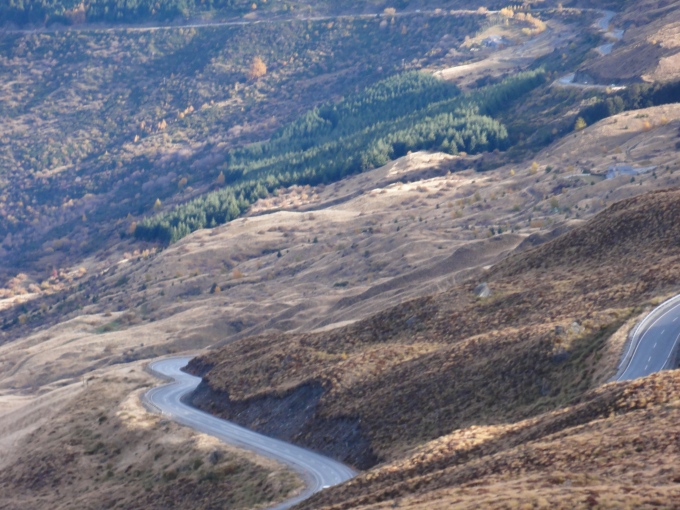
lookingdownfromcoronetpeak

And the story:

It was once said that a desperate man has everything to lose.

The man I was chasing was desperate, but I, on the other hand, was more desperate to catch him.

He’d left a trail of dead people from one end of the island to the other.

The team had put in a lot of effort to locate him, and now his capture was imminent.  We were following the car he was in, from a discrete distance, and, at the appropriate time, we would catch up, pull him over, and make the arrest.

There was nowhere for him to go.

The road led to a dead-end, and the only way off the mountain was back down the road were now on.  Which was why I was somewhat surprised when we discovered where he was.

Where was he going?

“Damn,” I heard Alan mutter.  He was driving, being careful not to get too close, but not far enough away to lose sight of him.

“What?”

“I think he’s made us.”

“How?”

“Dumb bad luck, I’m guessing.  Or he expected we’d follow him up the mountain.  He’s just sped up.”

“How far away?”

“A half-mile.  We should see him higher up when we turn the next corner.”

It took an eternity to get there, and when we did, Alan was right, only he was further on than we thought.”

“Step on it.  Let’s catch him up before he gets to the top.”

Easy to say, not so easy to do.  The road was treacherous, and in places just gravel, and there were no guard rails to stop a three thousand footfall down the mountainside.

Good thing then I had the foresight to have three agents on the hill for just such a scenario.

Ten minutes later, we were in sight of the car, still moving quickly, but we were going slightly faster.  We’d catch up just short of the summit car park.

Or so we thought.

Coming quickly around another corner we almost slammed into the car we’d been chasing.

“What the hell…” Aland muttered.

I was out of the car, and over to see if he was in it, but I knew that it was only a slender possibility.  The car was empty, and no indication where he went.

Certainly not up the road.  It was relatively straightforward for the next mile, at which we would have reached the summit.  Up the mountainside from here, or down.

I looked up.  Nothing.

Alan yelled out, “He’s not going down, not that I can see, but if he did, there’s hardly a foothold and that’s a long fall.”

Then where did he go?

Then a man looking very much like our quarry came out from behind a rock embedded just a short distance up the hill.

“Sorry,” he said quite calmly.  “Had to go if you know what I mean.”

I’d lost him.

It was as simple as that.

I had been led a merry chase up the hill, and all the time he was getting away in a different direction.

I’d fallen for the oldest trick in the book, letting my desperation blind me to the disguise that anyone else would see through in an instant.

It was a lonely sight, looking down that road, knowing that I had to go all that way down again, only this time, without having to throw caution to the wind.

“Maybe next time,” Alan said.

“We’ll get him.  It’s just a matter of time.”

© Charles Heath 2019-2021

Find this and other stories in “Inspiration, maybe”  available soon.

InspirationMaybe1v1

An excerpt from “The Things We Do For Love”

In the distance he could hear the dinner bell ringing and roused himself.  Feeling the dampness of the pillow, and fearing the ravages of pent up emotion, he considered not going down but thought it best not to upset Mrs. Mac, especially after he said he would be dining.

In the event, he wished he had reneged, especially when he discovered he was not the only guest staying at the hotel.

Whilst he’d been reminiscing, another guest, a young lady, had arrived.  He’d heard her and Mrs. Mac coming up the stairs, and then shown to a room on the same floor, perhaps at the other end of the passage.

Henry caught his first glimpse of her when she appeared at the door to the dining room, waiting for Mrs. Mac to show her to a table.

She was about mid-twenties, slim, long brown hair, and the grace and elegance of a woman associated with countless fashion magazines.  She was, he thought, stunningly beautiful with not a hair out of place, and make-up flawlessly applied.  Her clothes were black, simple, elegant, and expensive, the sort an heiress or wife of a millionaire might condescend to wear to a lesser occasion than dinner.

Then there was her expression; cold, forbidding, almost frightening in its intensity.  And her eyes, piercingly blue and yet laced with pain.  Dracula’s daughter was his immediate description of her.

All in all, he considered, the only thing they had in common was, like him, she seemed totally out of place.

Mrs. Mac came out of the kitchen, wiping her hands on her apron.  She was, she informed him earlier, chef, waitress, hotelier, barmaid, and cleaner all rolled into one.  Coming up to the new arrival she said, “Ah, Miss Andrews, I’m glad you decided to have dinner.  Would you like to sit with Mr. Henshaw, or would you like to have a table of your own?”

Henry could feel her icy stare as she sized up his appeal as a dining companion, making the hair on the back on his neck stand up.  He purposely didn’t look back.  In his estimation, his appeal rating was minus six.  Out of a thousand!

“If Mr. Henshaw doesn’t mind….”  She looked at him, leaving the query in mid-air.

He didn’t mind and said so.  Perhaps he’d underestimated his rating.

“Good.”  Mrs. Mac promptly ushered her over.  Henry stood, made sure she was seated properly and sat.

“Thank you.  You are most kind.”  The way she said it suggested snobbish overtones.

“I try to be when I can.”  It was supposed to nullify her sarcastic tone but made him sound a little silly, and when she gave him another of her icy glares, he regretted it.

Mrs. Mac quickly intervened, asking, “Would you care for the soup?”

They did, and, after writing the order on her pad, she gave them each a look, imperceptibly shook her head, and returned to the kitchen.

Before Michelle spoke to him again, she had another quick look at him, trying to fathom who and what he might be.  There was something about him.

His eyes, they mirrored the same sadness she felt, and, yes, there was something else, that it looked like he had been crying?  There was a tinge of redness.

Perhaps, she thought, he was here for the same reason she was.

No.  That wasn’t possible.

Then she said, without thinking, “Do you have any particular reason for coming here?”  Seconds later she realized she’s spoken it out loud, had hadn’t meant to actually ask, it just came out.

It took him by surprise, obviously not the first question he was expecting her to ask of him.

“No, other than it is as far from civilization, and home, as I could get.”

At least we agree on that, she thought.

It was obvious he was running away from something as well.

Given the isolation of the village and lack of geographic hospitality, it was, from her point of view, ideal.  All she had to do was avoid him, and that wouldn’t be difficult.

After getting through this evening first.

“Yes,” she agreed.  “It is that.”

A few seconds passed, and she thought she could feel his eyes on her and wasn’t going to look up.

Until he asked, “What’s your reason?”

Slight abrupt in manner, perhaps as a result of her question, and the manner in which she asked it.

She looked up.  “Rest.  And have some time to myself.”

She hoped he would notice the emphasis she had placed on the word ‘herself’ and take due note.  No doubt, she thought,  she had completely different ideas of what constituted a holiday than he, not that she had actually said she was here for a holiday.

Mrs. Mac arrived at a fortuitous moment to save them from further conversation.


Over the entree, she wondered if she had made a mistake coming to the hotel.  Of course, there had been no possible way she could know than anyone else might have booked the same hotel, but realized it was foolish to think she might end up in it by herself.

Was that what she was expecting?

Not a mistake then, but an unfortunate set of circumstances, which could be overcome by being sensible.

Yet, there he was, and it made her curious, not that he was a man, by himself, in the middle of nowhere, hiding like she was, but for very different reasons.

On discreet observance whilst they ate, she gained the impression his air of light-heartedness was forced and he had no sense of humor.

This feeling was engendered by his looks, unruly dark hair, and permanent frown.  And then there was his abysmal taste in clothes on a tall, lanky frame.  They were quality but totally unsuited to the wearer.

Rebellion was written all over him.

The only other thought crossing her mind, and rather incongruously, was he could do with a decent feed.  In that respect, she knew now from the mountain of food in front of her, he had come to the right place.

“Mr. Henshaw?”

He looked up.  “Henshaw is too formal.  Henry sounds much better,” he said, with a slight hint of gruffness.

“Then my name is Michelle.”

Mrs. Mac came in to take their order for the only main course, gather up the entree dishes, then return to the kitchen.

“Staying long?” she asked.

“About three weeks.  Yourself?”

“About the same.”

The conversation dried up.

Neither looked at the other, rather at the walls, out the window, towards the kitchen, anywhere.  It was, she thought, almost unbearably awkward.


Mrs. Mac returned with a large tray with dishes on it, setting it down on the table next to theirs.

“Not as good as the usual cook,” she said, serving up the dinner expertly, “but it comes a good second, even if I do say so myself.  Care for some wine?”

Henry looked at Michelle.  “What do you think?”

“I’m used to my dining companions making the decision.”

You would, he thought.  He couldn’t help but notice the cutting edge of her tone.  Then, to Mrs. Mac, he named a particular White Burgundy he liked and she bustled off.

“I hope you like it,” he said, acknowledging her previous comment with a smile that had nothing to do with humor.

“Yes, so do I.”

Both made a start on the main course, a concoction of chicken and vegetables that were delicious, Henry thought, when compared to the bland food he received at home and sometimes aboard my ship.

It was five minutes before Mrs. Mac returned with the bottle and two glasses.  After opening it and pouring the drinks, she left them alone again.

Henry resumed the conversation.  “How did you arrive?  I came by train.”

“By car.”

“Did you drive yourself?”

And he thought, a few seconds later, that was a silly question, otherwise she would not be alone, and certainly not sitting at this table. With him.

“After a fashion.”

He could see that she was formulating a retort in her mind, then changed it, instead, smiling for the first time, and it served to lighten the atmosphere.

And in doing so, it showed him she had another more pleasant side despite the fact she was trying not to look happy.

“My father reckons I’m just another of ‘those’ women drivers,” she added.

“Whatever for?”

“The first and only time he came with me I had an accident.  I ran up the back of another car.  Of course, it didn’t matter to him the other driver was driving like a startled rabbit.”

“It doesn’t help,” he agreed.

“Do you drive?”

“Mostly people up the wall.”  His attempt at humor failed.  “Actually,” he added quickly, “I’ve got a very old Morris that manages to get me where I’m going.”

The apple pie and cream for dessert came and went and the rapport between them improved as the wine disappeared and the coffee came.  Both had found, after getting to know each other better, their first impressions were not necessarily correct.

“Enjoy the food?” Mrs. Mac asked, suddenly reappearing.

“Beautifully cooked and delicious to eat,” Michelle said, and Henry endorsed her remarks.

“Ah, it does my heart good to hear such genuine compliments,” she said, smiling.  She collected the last of the dishes and disappeared yet again.

“What do you do for a living,” Michelle asked in an off-hand manner.

He had a feeling she was not particularly interested and it was just making conversation.

“I’m a purser.”

“A what?”

“A purser.  I work on a ship doing the paperwork, that sort of thing.”

“I see.”

“And you?”

“I was a model.”

“Was?”

“Until I had an accident, a rather bad one.”

“Oh, I’m sorry.”

So that explained the odd feeling he had about her.

As the evening had worn on, he began to think there might be something wrong, seriously wrong with her because she didn’t look too well.  Even the carefully applied makeup, from close up, didn’t hide the very pale, and tired look, or the sunken, dark ringed eyes.

“I try not to think about it, but it doesn’t necessarily work.  I’ve come here for peace and quiet, away from doctors and parents.”

“Then you will not have to worry about me annoying you.  I’m one of those fall-asleep-reading-a-book types.”

Perhaps it would be like ships passing in the night and then smiled to himself about the analogy.

Dinner now over, they separated.

Henry went back to the lounge to read a few pages of his book before going to bed, and Michelle went up to her room to retire for the night.

But try as he might, he was unable to read, his mind dwelling on the unusual, yet the compellingly mysterious person he would be sharing the hotel with.

Overlaying that original blurred image of her standing in the doorway was another of her haunting expressions that had, he finally conceded, taken his breath away, and a look that had sent more than one tingle down his spine.

She may not have thought much of him, but she had certainly made an impression on him.


© Charles Heath 2015-2020

lovecoverfinal1

Nostalgia

Ever hear someone say it was better in the old days?

I have.

I’ve been guilty of saying it myself.

But, was it?

When I was a child there was no such thing as personal computers and calculators.  Everything came out of books, and maths had to be done in your head.

Holidays were about joining up with other neighbourhood children and making your own entertainment.  I remember for a long time, as a child, we didn’t have television.

It was down to the meadows near the creek to pick blackberries, swim in the water, or raiding new housing estates for offcuts to build a cubby house.

Not like today with television, video players, movies-on-demand, personal computers, game boys, and a plethora of other entertainment choices.

Were we better off back in the old days?

We were in the sun with no idea that sunburn led to cancer and death.  Sunscreen was unheard of, so in that regard maybe not.

In the old days, the only telephones were in the house and were expensive to use.  You could have a coloured phone so long as it was black and made of Bakelite.

It was a long time before we had plastic coloured phones or even wall phones.  Those were also the days of telephone boxes, the only way they make a call when away from home.

Now every man and his dog has a mobile phone/computer while on the move.  I know, their dogs keep crashing into me on the street.

And then I also remember my father saying it’s not like the old days, so I had to wonder what he meant.

Perhaps it is an oft-used but less understood lament for a time when we remember we were happy and carefree, those days before mortgages, children, maxed out credit cards, and the children’s mobile phone bills.

Whatever happened to pre-dinner drinks and a chat about your day?

There’s nothing more I like to do at the end of a day than sit down and have a drink, usually Scotch and Soda or Bacardi and Coke.

But that’s the problem.

What is your definition of the end of the day?

No doubt for most it is probably that time when they get home from work, and take some time between then and dinner.  From my memories of American sitcoms of the 1950s, it was over Sherry and included a summary from every one of their day.

It was a time when women, apparently, preferred to stay home than go to work.  Odd, for some reason, that Hollywood would ignore the hard-won rights of women to have jobs, though some might argue out of necessity because of the war.

There were no computer games, contrary children, and that period, for the children was between coming home from school (doing homework) and going outside to play.

Yes, none of this disappearing into dark rooms for secret conversations on mobile phones or playing games on computers, or, dare I say it, being stuck in front of a television, pigging out on snack foods.

Any man these days who thought the 1950s sitcom scenario might be a social norm would be vilified by all and sundry.  His children would be in a permanent battle to be left alone, his wife would divorce him if he even remotely suggested she stay home or have dinner on the table when he got home, and that peaceful hour or so before the expected dinner, well, that disappeared a long time ago.

If it ever existed in any era.

So much for American sitcom stereotypes.

Now, in similar sitcoms these days, the children are obnoxious to their parent, yes, every family it seems in the USA is broken, and the mother is the long-suffering one stuck with the children and having to work, whilst the ex is out having a great time with his new girlfriend/trophy wife.

Hollywood is still stereotyping, but it’s much more dark and gloomy.

This is added to the continual threat of online predators, online pornography further reducing women’s hard-won right to be seen as more than just a sex object, bullying, not only at school and online but in the workplace, and above all that it seems men still treat women as second class citizens, not the least of which are corporate entities, and government.

Oh, and the mention of having a drink before dinner in this day and age would be associated with alcoholism, or a drinking problem, caused by excessive stress, and almost always added to an apparent addiction to painkillers or antidepressants.

What might also be worse is the alarming statistics of the number of women now drinking wine by the gallon rather than a few drinks in that period between picking up the children from school and dinner, driven by, take your choice of, obnoxious children or absent-minded or chauvinistic husband.

Damn, have I stirred up a hornet’s nest?

Sorry, I think I’d better cancel the notion of having after-work drinks, and since I do the cooking, so there’s no expectation for someone else getting dinner on the table.

At least we are still married, and the children never had to deal with a broken marriage and two warring parents, but if any of the reports on why children are the way they are, I guess mine missed out on playing one parent off against the other, or get to live in different houses, or tolerate parents other boy or girlfriends, and live on junk food, well not all of the time.

Are they normal?

Perhaps when someone defines normal I will probably tell you.

I ceased being so-called chauvinistic a long time ago, and I had to have an attitude readjustment along with it, because, I’m told, we live in a different world now.

Perhaps I will have that drink or three; it’s certainly a necessity in order to watch the increasingly bad news, the antics of our politicians, and to watch the world gradually go to hell in a handbasket.

Whilst being politely told that I drink too much!