Inspiration, maybe – Volume 1

50 photographs, 50 stories, of which there is one of the 50 below.

They all start with –

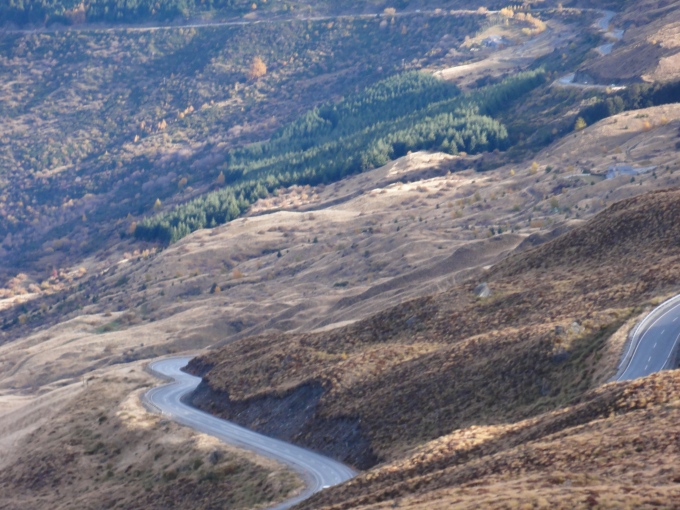
A picture paints … well, as many words as you like.  For instance:

lookingdownfromcoronetpeak

And the story:

It was once said that a desperate man has everything to lose.

The man I was chasing was desperate, but I, on the other hand, was more desperate to catch him.

He’d left a trail of dead people from one end of the island to the other.

The team had put in a lot of effort to locate him, and now his capture was imminent.  We were following the car he was in, from a discrete distance, and, at the appropriate time, we would catch up, pull him over, and make the arrest.

There was nowhere for him to go.

The road led to a dead-end, and the only way off the mountain was back down the road were now on.  Which was why I was somewhat surprised when we discovered where he was.

Where was he going?

“Damn,” I heard Alan mutter.  He was driving, being careful not to get too close, but not far enough away to lose sight of him.

“What?”

“I think he’s made us.”

“How?”

“Dumb bad luck, I’m guessing.  Or he expected we’d follow him up the mountain.  He’s just sped up.”

“How far away?”

“A half-mile.  We should see him higher up when we turn the next corner.”

It took an eternity to get there, and when we did, Alan was right, only he was further on than we thought.”

“Step on it.  Let’s catch him up before he gets to the top.”

Easy to say, not so easy to do.  The road was treacherous, and in places just gravel, and there were no guard rails to stop a three thousand footfall down the mountainside.

Good thing then I had the foresight to have three agents on the hill for just such a scenario.

Ten minutes later, we were in sight of the car, still moving quickly, but we were going slightly faster.  We’d catch up just short of the summit car park.

Or so we thought.

Coming quickly around another corner we almost slammed into the car we’d been chasing.

“What the hell…” Aland muttered.

I was out of the car, and over to see if he was in it, but I knew that it was only a slender possibility.  The car was empty, and no indication where he went.

Certainly not up the road.  It was relatively straightforward for the next mile, at which we would have reached the summit.  Up the mountainside from here, or down.

I looked up.  Nothing.

Alan yelled out, “He’s not going down, not that I can see, but if he did, there’s hardly a foothold and that’s a long fall.”

Then where did he go?

Then a man looking very much like our quarry came out from behind a rock embedded just a short distance up the hill.

“Sorry,” he said quite calmly.  “Had to go if you know what I mean.”

I’d lost him.

It was as simple as that.

I had been led a merry chase up the hill, and all the time he was getting away in a different direction.

I’d fallen for the oldest trick in the book, letting my desperation blind me to the disguise that anyone else would see through in an instant.

It was a lonely sight, looking down that road, knowing that I had to go all that way down again, only this time, without having to throw caution to the wind.

“Maybe next time,” Alan said.

“We’ll get him.  It’s just a matter of time.”

© Charles Heath 2019-2021

Find this and other stories in “Inspiration, maybe”  available soon.

InspirationMaybe1v1

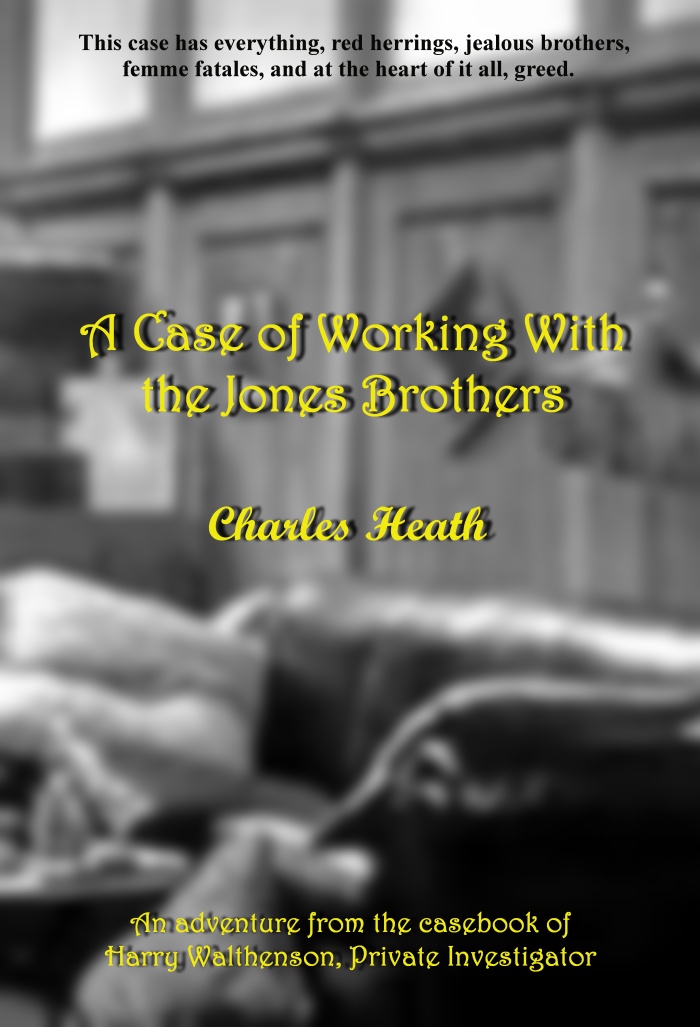
The first case of PI Walthenson – “A Case of Working With the Jones Brothers”

This case has everything, red herrings, jealous brothers, femme fatales, and at the heart of it all, greed.

See below for an excerpt from the book…

Coming soon!

PIWalthJones1

An excerpt from the book:

When Harry took the time to consider his position, a rather uncomfortable position at that, he concluded that he was somehow involved in another case that meant very little to him.

Not that it wasn’t important in some way he was yet to determine, it was just that his curiosity had got the better of him, and it had led to this: sitting in a chair, securely bound, waiting for someone one of his captors had called Doug.

It was not the name that worried him so much, it was the evil laugh that had come after the name was spoken.

Doug what? Doug the ‘destroyer’, Doug the ‘dangerous’, Doug the ‘deadly’; there was any number of sinister connotations, and perhaps that was the point of the laugh, to make it more frightening than it was.

But there was no doubt about one thing in his mind right then: he’d made a mistake. A very big. and costly, mistake. Just how big the cost, no doubt he would soon find out.

His mother, and his grandmother, the wisest person he had ever known, had once told him never to eavesdrop.

At the time he couldn’t help himself and instead of minding his own business, listening to a one-sided conversation which ended with a time and a place. The very nature of the person receiving the call was, at the very least, sinister, and, because of the cryptic conversation, there appeared to be, or at least to Harry, criminal activity involved.

For several days he had wrestled with the thought of whether he should go. Stay on the fringe, keep out of sight, observe and report to the police if it was a crime. Instead, he had willingly gone down the rabbit hole.

Now, sitting in an uncomfortable chair, several heat lamps hanging over his head, he was perspiring, and if perspiration could be used as a measure of fear, then Harry’s fear was at the highest level.

Another runnel of sweat rolled into his left eye, and, having his hands tied, literally, it made it impossible to clear it. The burning sensation momentarily took his mind off his predicament. He cursed and then shook his head trying to prevent a re-occurrence. It was to no avail.

Let the stinging sensation be a reminder of what was right and what was wrong.

It was obvious that it was the right place and the right time, but in considering his current perilous situation, it definitely was the wrong place to be, at the worst possible time.

It was meant to be his escape, an escape from the generations of lawyers, what were to Harry, dry, dusty men who had been in business since George Washington said to the first Walthenson to step foot on American soil, ‘Why don’t you become a lawyer?” when asked what he could do for the great man.

Or so it was handed down as lore, though Harry didn’t think Washington meant it literally, the Walthenson’s, then as now, were not shy of taking advice.

Except, of course, when it came to Harry.

He was, Harry’s father was prone to saying, the exception to every rule. Harry guessed his father was referring to the fact his son wanted to be a Private Detective rather than a dry, dusty lawyer. Just the clothes were enough to turn Harry off the profession.

So, with a little of the money Harry inherited from one of his aunts, he leased an office in Gramercy Park and had it renovated to look like the Sam Spade detective agency, you know the one, Spade and Archer, and The Maltese Falcon.

There’s a movie and a book by Dashiell Hammett if you’re interested.

So, there it was, painted on the opaque glass inset of the front door, ‘Harold Walthenson, Private Detective’.

There was enough money to hire an assistant, and it took a week before the right person came along, or, more to the point, didn’t just see his business plan as something sinister. Ellen, a tall cool woman in a long black dress, or so the words of a song in his head told him, fitted in perfectly.

She’d seen the movie, but she said with a grin, Harry was no Humphrey Bogart.

Of course not, he said, he didn’t smoke.

Three months on the job, and it had been a few calls, no ‘real’ cases, nothing but missing animals, and other miscellaneous items. What he really wanted was a missing person. Or perhaps a beguiling, sophisticated woman who was as deadly as she was charming, looking for an errant husband, perhaps one that she had already ‘dispatched’.

Or for a tall, dark and handsome foreigner who spoke in riddles and in heavily accented English, a spy, or perhaps an assassin, in town to take out the mayor. The man was such an imbecile Harry had considered doing it himself.

Now, in a back room of a disused warehouse, that wishful thinking might be just about to come to a very abrupt end, with none of the romanticized trappings of the business befalling him. No beguiling women, no sinister criminals, no stupid policemen.

Just a nasty little man whose only concern was how quickly or how slowly Harry’s end was going to be.

© Charles Heath 2019

Short Story Writing – Don’t try this at home! – Part 4

This is not a treatise, but a tongue in cheek, discussion on how to write short stories.   Suffice to say this is not the definitive way of doing it, just mine.  It works for me – it might not work for you.

…

You’ve got the place, now you want the who.

My main characters are quite often me.

Not the real me, because I’m boring.  No, those characters are what I would like to be, that imaginary superhuman that can do everything.

Until, of course, reality sets in, and the bullets start flying.  When that happens, we should be looking to run or at the very least get under cover, not walk into a hail of bullets, with a huge grin, staring down the enemy.

Hang on, that never happens except in superman comics.

What’s really needed here is a little vulnerability, a little humility and a lot of understanding, qualities at times I don’t have.

So, in order to create a more believable character, I start dragging traits from others I’ve met, or know, or really don’t want to know.  

In a writer’s environment, there are a plethora of people out there that you can draw on for inspiration.  I once spent and afternoon at a railway station just observing people.  Even now, I make observations, some of which are true, and others, wildly off course. 

I once tried to convince my other half that I could pick people’s traits, and we sat at a café outside a church in Venice.  I was lucky, I got more than 75% correct.

Other characters in my stories I have met along the way.

Like a piano player in a restaurant.  It was not so much the playing was bad, it was the way he managed to draw people into his orbit and keep them there.  The man has charisma, but sadly no talent for the instrument.

Like an aunt I met only twice in a lifetime, and who left a lasting impression.  Severe, angry looking, speaking a language I didn’t understand, even though it was English.  It was where I learned we came from England, and she was the closest thing I came to as an example of nineteenth-century prim and proper.  And, no, she didn’t have a sense of humour or time for silly little boys.

Like one of my bosses, a man of indeterminate age, but it had to be over 100, or so it seemed to my sixteen-year-old brain, who spoke and dressed impeccably, and yes, he did once say that I would be the death of him.

I can only hope I wasn’t.

Like a Captain of a ship I once met, a man who didn’t seem to have time for the minions, and a man who reeked authority and respect.  I’ve always wanted to be like him, but unfortunately, it was not in the genes.

Those are only a few, there are thousands of others over the years, a built-in library, if you will, of characters waiting to be taken off the shelf and used where necessary or appropriate.  We all have one of these banks.

You just have to know when to use them.

Writing about writing a book – Day 4

Of course, by this time, a lot has changed and what I had discussed before now needs a few changes, so I have made the necessary amendments where required to the narrative, but that doesn’t mean I won’t revisit it sometime in the future.


It was a late night last night, reading and rereading, considering plot lines, new characters, and demolishing a six-pack.

It’s debatable if it is helping the creative process.  It has left me with a slight headache.

I drag myself out of bed and look out the window.  Bright sunshine, blue sky, slight breeze.

11:00 am.  Half the day is gone.

My stomach rumbles, I need something to eat.  I stagger out to the kitchen and look in the fridge.  OK, too busy to go shopping, time to make time.  A writer has to eat!


Three hours have passed and it’s mid-afternoon.  A new plan is required.  I need to make sure I don’t waste the day and write a certain number of words, otherwise, this book will never get written.

Bed: midnight

Rise: 7:00 am, go for a run to clear the head

Breakfast: 8:00 am

Writing: 9:00 am to ??

Let’s just see if that works tomorrow.


I sit down and stare at the pad.

Plotting:  Our main character is an IT department manager, whose main responsibility from the start, and at that time, he was alone and not the manager of anything, was setting up and keeping the network running.  These were the early days of Ethernet, token ring, and 3-Com, in moving from mainframes to desktops and servers.

I remember it well, and my first client/server network was 3-Com and Ethernet.

In the story scenario, Bill literally is indispensable because the job he performs is single point sensitive, even though Benton refuses to act on employing another network engineer.  This is art imitating life because so many places have similar situations.

So the reason why Benton is calling Bill; there is a crisis.

Some accountant is found shot dead at his desk, novel but not unheard of.  I know a few accountants who deserve just that.

That’s not the problem though, it’s the fact the network is down, and Benton is almost hysterical (after he makes a promise to his superiors that he can’t keep!).  Nothing unusual there with the sort of person he is, and like many in similar situations.


Scribble, scribble …


Another five minutes, then the phone began its shrill insistence again.  Before it rang again, I’d moved it from the floor to the bed.  I counted the rings, to ten, and then picked up the receiver.

“Bill?  Don’t hang up.”  Almost pleading.

“Why?  You said I should go, away from work, away from the phones, away to recharge my batteries, I believe you said.”

“That was Friday.  This is Monday. You’re needed.  Richardson has been found shot dead by his desk.  All hell has broken loose!”  Benton rarely used adjectives, so I assumed when he said all hell had broken loose, it meant something had happened he couldn’t fix.  His flowery language and telegram style had momentarily distracted my attention from Richardson’s fate.

Harold Richardson was an accountant, rather stuffy, but good at his job.  I’d spoken to him probably twice in as many years, and he didn’t strike me as the sort who would kill himself.  So why did I think that?  Benton had only said he was shot.

Benton’s voice went up an octave, a sure sign he was going into meltdown.  “It’s a circus down here.  Jennifer is missing, Giles is not in yet, the network is down, and that bunch of nincompoops you call support staff are running around the office like headless chooks.”

It all came out in a nonstop sentence, followed by a gasp for air.  It gave me time to sift the facts.  Jennifer, the Assistant Manager, and responsible for data entry and accounts maintenance, was not there, which in itself was unusual, because she kept longer hours than me, Peter Giles, my youthful assistant, just out of university and still being beaten into shape was also not in, and that was usual, so it could only mean one thing.

The network was down.

It was my responsibility since I’d recommended it and then won the support of management over his objections, and following that it had become a point of continual contention, a petty war neither of us was going to win.

I tried to keep the joy out of my voice. 

He’d also vetoed my recommendation for an extra full-time network engineer as my alternative, and in doing so Benton had made my job become single point sensitive.  There was no one to replace me if anything went wrong.


Richardson has nothing to do with the plot, he just happened to be in the wrong place at the wrong time, but someone else further up the chain of command will be.  That’s something to look forward to, though I’ve yet to decide what happens.

As for Benton, he will linger around for a while, but has no real part to play, except perhaps as the comic light relief.  He will get a rude awakening at the end.

Try not to make it too technical, no one really wants to know about computer systems, just the machinations of the people who are creating the problems and why.


© Charles Heath 2016 – 2020

An excerpt from “Echoes from the Past”

Available on Amazon Kindle here:  https://amzn.to/2CYKxu4

…

With my attention elsewhere, I walked into a man who was hurrying in the opposite direction.  He was a big man with a scar running down the left side of his face from eye socket to mouth, and who was also wearing a black shirt with a red tie.

That was all I remembered as my heart almost stopped.

He apologized as he stepped to one side, the same way I stepped, as I also muttered an apology.

I kept my eyes down.  He was not the sort of man I wanted to recognize later in a lineup.  I stepped to the other side and so did he.  It was one of those situations.  Finally getting out of sync, he kept going in his direction, and I towards the bus, which was now pulling away from the curb.

Getting my breath back, I just stood riveted to the spot watching it join the traffic.  I looked back over my shoulder, but the man I’d run into had gone.  I shrugged and looked at my watch.  It would be a few minutes before the next bus arrived.

Wait, or walk?  I could also go by subway, but it was a long walk to the station.  What the hell, I needed the exercise.

At the first intersection, the ‘Walk’ sign had just flashed to ‘Don’t Walk’.  I thought I’d save a few minutes by not waiting for the next green light.  As I stepped onto the road, I heard the screeching of tires.

A yellow car stopped inches from me.

It was a high powered sports car, perhaps a Lamborghini.  I knew what they looked like because Marcus Bartleby owned one, as did every other junior executive in the city with a rich father.

Everyone stopped to look at me, then the car.  It was that sort of car.  I could see the driver through the windscreen shaking his fist, and I could see he was yelling too, but I couldn’t hear him.  I stepped back onto the sidewalk, and he drove on.  The moment had passed and everyone went back to their business.

My heart rate hadn’t come down from the last encounter.   Now it was approaching cardiac arrest, so I took a few minutes and several sets of lights to regain composure.

At the next intersection, I waited for the green light, and then a few seconds more, just to be sure.  I was no longer in a hurry.

At the next, I heard what sounded like a gunshot.  A few people looked around, worried expressions on their faces, but when it happened again, I saw it was an old car backfiring.  I also saw another yellow car, much the same as the one before, stopped on the side of the road.  I thought nothing of it, other than it was the second yellow car I’d seen.

At the next intersection, I realized I was subconsciously heading towards Harry’s new bar.   It was somewhere on 6th Avenue, so I continued walking in what I thought was the right direction.

I don’t know why I looked behind me at the next intersection, but I did.  There was another yellow car on the side of the road, not far from me.  It, too, looked the same as the original Lamborghini, and I was starting to think it was not a coincidence.

Moments after crossing the road, I heard the roar of a sports car engine and saw the yellow car accelerate past me.  As it passed by, I saw there were two people in it, and the blurry image of the passenger; a large man with a red tie.

Now my imagination was playing tricks.

It could not be the same man.  He was going in a different direction.

In the few minutes I’d been standing on the pavement, it had started to snow; early for this time of year, and marking the start of what could be a long cold winter.  I shuddered, and it was not necessarily because of the temperature.

I looked up and saw a neon light advertising a bar, coincidentally the one Harry had ‘found’ and, looking once in the direction of the departing yellow car, I decided to go in.  I would have a few drinks and then leave by the back door if it had one.

Just in case.

© Charles Heath 2015-2020

newechocover5rs

An excerpt from “The Devil You Don’t”

Available on Amazon Kindle here:  https://amzn.to/2Xyh1ow


By the time I returned to the Savoie, the rain had finally stopped, and there was a streak of blue sky to offer some hope the day would improve.

The ship was not crowded, the possibility of bad weather perhaps holding back potential passengers.  Of those I saw, a number of them would be aboard for the lunch by Phillippe Chevrier.  I thought about it, but the Concierge had told me about several restaurants in Yvoire and had given me a hand-drawn map of the village.  I think he came from the area because he spoke with the pride and knowledge of a resident.

I was looking down from the upper deck observing the last of the boarding passengers when I saw a woman, notable for her red coat and matching shoes, making a last-minute dash to get on board just before the gangway was removed.  In fact, her ungainly manner of boarding had also captured a few of the other passenger’s attention.  Now they would have something else to talk about, other than the possibility of further rain.

I saw her smile at the deckhand, but he did not smile back.  He was not impressed with her bravado, perhaps because of possible injury.  He looked at her ticket then nodded dismissively, and went back to his duties in getting the ship underway.  I was going to check the departure time, but I, like the other passengers, had my attention diverted to the woman in red.

From what I could see there was something about her.  It struck me when the light caught her as she turned to look down the deck, giving me a perfect profile.  I was going to say she looked foreign, but here, as in almost anywhere in Europe, that described just about everyone.  Perhaps I was just comparing her to Phillipa, so definitively British, whereas this woman was very definitely not.

She was perhaps in her 30’s, slim or perhaps the word I’d use was lissom, and had the look and manner of a model.  I say that because Phillipa had dragged me to most of the showings, whether in Milan, Rome, New York, London, or Paris.  The clothes were familiar, and in the back of my mind, I had a feeling I’d seen her before.

Or perhaps, to me, all models looked the same.

She looked up in my direction, and before I could divert my eyes, she locked on.  I could feel her gaze boring into me, and then it was gone as if she had been looking straight through me.  I remained out on deck as the ship got underway, watching her disappear inside the cabin.  My curiosity was piqued, so I decided to keep an eye out for her.

I could feel the coolness of the air as the ship picked up speed, not that it was going to be very fast.  With stops, the trip would take nearly two hours to get to my destination.  It would turn back almost immediately, but I was going to stay until the evening when it returned at about half eight.  It would give me enough time to sample the local fare, and take a tour of the medieval village.

Few other passengers ventured out on the deck, most staying inside or going to lunch.  After a short time, I came back down to the main deck and headed forward.  I wanted to clear my head by concentrating on the movement of the vessel through the water, breathing in the crisp, clean air, and let the peacefulness of the surroundings envelope me.

It didn’t work.

I knew it wouldn’t be long before I started thinking about why things hadn’t worked, and what part I played in it.  And the usual question that came to mind when something didn’t work out.  What was wrong with me?

I usually blamed it on my upbringing.

I had one of those so-called privileged lives, a nanny till I was old enough to go to boarding school, then sent to the best schools in the land.  There I learned everything I needed to be the son of a Duke, or, as my father called it in one of his lighter moments, nobility in waiting.

Had this been five or six hundred years ago, I would need to have sword and jousting skills, or if it had been a few hundred years later a keen military mind.  If nothing else I could ride a horse, and go on hunts, or did until they became not the thing to do.

I learned six languages, and everything I needed to become a diplomat in the far-flung British Empire, except the Empire had become the Commonwealth, and then, when no-one was looking, Britain’s influence in the world finally disappeared.  I was a man without a cause, without a vocation, and no place to go.

Computers were the new vogue and I had an aptitude for programming.  I guess that went hand in hand with mathematics, which although I hated the subject, I excelled in.  Both I and another noble outcast used to toss ideas around in school, but when it came to the end of our education, he chose to enter the public service, and I took a few of those ideas we had mulled over and turned them into a company.

About a year ago, I was made an offer I couldn’t refuse.  There were so many zeroes on the end of it I just said yes, put the money into a very grateful bank, and was still trying to come to terms with it.

Sadly, I still had no idea what I was going to do with the rest of my life.  My parents had asked me to come back home and help manage the estate, and I did for a few weeks.  It was as long as it took for my parents to drive me insane.

Back in the city, I spent a few months looking for a mundane job, but there were very few that suited the qualifications I had, and the rest, I think I intimidated the interviewer simply because of who I was.  In that time I’d also featured on the cover of the Economist, and through my well-meaning accountant, started involving myself with various charities, earning the title ‘philanthropist’.

And despite all of this exposure, even making one of those ubiquitous ‘eligible bachelor’ lists, I still could not find ‘the one’, the woman I wanted to spend the rest of my life with.  Phillipa seemed to fit the bill, but in time she proved to be a troubled soul with ‘Daddy’ issues.  I knew that in building a relationship compromise was necessary, but with her, in the end, everything was a compromise and what had happened was always going to be the end result.

It was perhaps a by-product of the whole nobility thing.  There was a certain expectation I had to fulfill, to my peers, contemporaries, parents and family, and those who either liked or hated what it represented.  The problem was, I didn’t feel like I belonged.  Not like my friend from schooldays, and now obscure acquaintance, Sebastian.  He had been elevated to his Dukedom early when his father died when he was in his twenties.  He had managed to fade from the limelight and was rarely mentioned either in the papers or the gossip columns.  He was one of the lucky ones.

I had managed to keep a similarly low profile until I met Phillipa.  From that moment, my obscurity disappeared.  It was, I could see now, part of a plan put in place by Phillipa’s father, a man who hogged the limelight with his daughter, to raise the profile of the family name and through it their businesses.  He was nothing if not the consummate self-advertisement.

Perhaps I was supposed to be the last piece of the puzzle, the attachment to the establishment, that link with a class of people he would not normally get in the front door.  There was nothing refined about him or his family, and more than once I’d noticed my contemporaries cringe at the mention of his name, or any reference of my association with him.

Yet could I truthfully say I really wanted to go back to the obscurity I had before Phillipa?  For all her faults, there were times when she had been fun to be with, particularly when I first met her when she had a certain air of unpredictability.  That had slowly disappeared as she became part of her father’s plan for the future.  She just failed to see how much he was using her.

Or perhaps, over time, I had become cynical.

I thought about calling her.  It was one of those moments of weakness when I felt alone, more alone than usual.

I diverted my attention back to my surroundings and the shoreline.  Out of the corner of my eye, I could see the woman in the red coat, making a move.  The red coat was like a beacon, a sort of fire engine red.  It was not the sort of coat most of the women I knew would wear, but on her, it looked terrific.  In fact, her sublime beauty was the one other attribute that was distinctly noticeable, along with the fact her hair was short, rather than long, and jet black.

I had to wrench my attention away from her.

A few minutes later several other passengers came out of the cabin for a walk around the deck, perhaps to get some exercise, perhaps checking up on me, or perhaps I was being paranoid.  I waited till they passed on their way forward, and I turned and headed aft.

I watched the wake sluicing out from under the stern for a few minutes, before retracing my steps to the front of the ship and there I stood against the railing, watching the bow carve its way through the water.  It was almost mesmerizing.  There, I emptied my mind of thoughts about Phillipa, and thoughts about the woman in the red coat.

Until a female voice behind me said, “Having a bad day?”

I started, caught by surprise, and slowly turned.  The woman in the red coat had somehow got very close me without my realizing it.  How did she do that?  I was so surprised I couldn’t answer immediately.

“I do hope you are not contemplating jumping.  I hear the water is very cold.”

Closer up, I could see what I’d missed when I saw her on the main deck.  There was a slight hint of Chinese, or Oriental, in her particularly around the eyes, and of her hair which was jet black.  An ancestor twice or more removed had left their mark, not in a dominant way, but more subtle, and easily missed except from a very short distance away, like now.

Other than that, she was quite possibly Eastern European, perhaps Russian, though that covered a lot of territory.  The incongruity of it was that she spoke with an American accent, and fluent enough for me to believe English was her first language.

Usually, I could ‘read’ people, but she was a clean slate.  Her expression was one of amusement, but with cold eyes.  My first thought, then, was to be careful.

“No.  Not yet.”  I coughed to clear my throat because I could hardly speak.  And blushed, because that was what I did when confronted by a woman, beautiful or otherwise.

The amusement gave way to a hint of a smile that brightened her demeanor as a little warmth reached her eyes.  “So that’s a maybe.  Should I change into my lifesaving gear, just in case?”

It conjured up a rather interesting image in my mind until I reluctantly dismissed it.

“Perhaps I should move away from the edge,” I said, moving sideways until I was back on the main deck, a few feet further away.  Her eyes had followed me, and when I stopped she turned to face me again.  She did not move closer.

I realized then she had removed her beret and it was in her left side coat pocket.  “Thanks for your concern …?”

“Zoe.”

“Thanks for your concern, Zoe.  By the way, my name is John.”

She smiled again, perhaps in an attempt to put me at ease.  “I saw you earlier, you looked so sad, I thought …”

“I might throw myself overboard?”

“An idiotic notion I admit, but it is better to be safe than sorry.”

Then she tilted her head to one side then the other, looking intently at me.  “You seem to be familiar.  Do I know you?”

I tried to think of where I may have seen her before, but all I could remember was what I’d thought earlier when I first saw her; she was a model and had been at one of the showings.  If she was, it would be more likely she would remember Phillipa, not me.  Phillipa always had to sit in the front row.

“Probably not.”  I also didn’t mention the fact she may have seen my picture in the society pages of several tabloid newspapers because she didn’t look the sort of woman who needed a daily dose of the comings and goings, and, more often than not, scandal associated with so-called celebrities.

She gave me a look, one that told me she had just realized who I was.  “Yes, I remember now.  You made the front cover of the Economist.  You sold your company for a small fortune.”

Of course.  She was not the first who had recognized me from that cover.  It had raised my profile considerably, but not the Sternhaven’s.  That article had not mentioned Phillipa or her family.  I suspect Grandmother had something to do with that, and it was, now I thought about it, another nail in the coffin that was my relationship with Phillipa.

“I wouldn’t say it was a fortune, small or otherwise, just fortunate.”  Each time, I found myself playing down the wealth aspect of the business deal.

“Perhaps then, as the journalist wrote, you were lucky.  It is not, I think, a good time for internet-based companies.”

The latter statement was an interesting fact, one she read in the Financial Times which had made that exact comment recently.

“But I am boring you.”  She smiled again.  “I should be minding my own business and leaving you to your thoughts.  I am sorry.”

She turned to leave and took a few steps towards the main cabin.

“You’re not boring me,” I said, thinking I was letting my paranoia get the better of me.  It had been Sebastian on learning of my good fortune, who had warned me against ‘a certain element here and abroad’ whose sole aim would be to separate me from my money.  He was not very subtle when he described their methods.

But I knew he was right.  I should have let her walk away.

She stopped and turned around.  “You seem nothing like the man I read about in the Economist.”

A sudden and awful thought popped into my head.  Those words were part of a very familiar opening gambit.  “Are you a reporter?”

I was not sure if she looked surprised, or amused.  “Do I look like one?”

I silently cursed myself for speaking before thinking, and then immediately ignored my own admonishment.  “People rarely look like what they are.”

I saw the subtle shake of the head and expected her to take her leave.  Instead she astonished me.

“I fear we have got off on the wrong foot.  To be honest, I’m not usually this forward, but you seemed like you needed cheering up when probably the opposite is true.  Aside from the fact this excursion was probably a bad idea.  And,” she added with a little shrug, “perhaps I talk too much.”

I was not sure what I thought of her after that extraordinary admission. It was not something I would do, but it was an interesting way to approach someone and have them ignoring their natural instinct.  I would let Sebastian whisper in my ear for a little longer and see where this was going.

“Oddly enough, I was thinking the same thing.  I was supposed to be traveling with my prospective bride.  I think you can imagine how that turned out.”

“She’s not here?”

“No.”

“She’s in the cabin?”  Her eyes strayed in that direction for a moment then came back to me.  She seemed surprised I might be traveling with someone.

“No.  She is back in England, and the wedding is off.  So is the relationship.  She dumped me by text.”

OK, why was I sharing this humiliating piece of information with her?  I still couldn’t be sure she was not a reporter.

She motioned to an empty seat, back from the edge.  No walking the plank today.  She moved towards it and sat down.  She showed no signs of being cold, nor interested in the breeze upsetting her hair.  Phillipa would be having a tantrum about now, being kept outside, and freaking out over what the breeze might be doing to her appearance.

I wondered, if only for a few seconds if she used this approach with anyone else.  I guess I was a little different, a seemingly rich businessman alone on a ferry on Lake Geneva, contemplating the way his life had gone so completely off track.

She watched as I sat at the other end of the bench, leaving about a yard between us.  After I leaned back and made myself as comfortable as I could, she said, “I have also experienced something similar, though not by text message.  It is difficult, the first few days.”

“I saw it coming.”

“I did not.”  She frowned, a sort of lifeless expression taking over, perhaps brought on by the memory of what had happened to her.  “But it is done, and I moved on.  Was she the love of your life?”

OK, that was unexpected.

When I didn’t answer, she said, “I am sorry.  Sometimes I ask personal questions without realizing what I’m doing.  It is none of my business.”  She shivered.  “Perhaps we should go back inside.”

She stood, and held out her hand.  Should I take it and be drawn into her web?  I thought of Sebastian.  What would he do in this situation?

I took her hand in mine and let her pull me gently to my feet.  “Wise choice,” she said, looking up at the sky.

It just started to rain.


© Charles Heath 2015-2020

newdevilcvr6

NaNoWriMo 2021 – Day 5

A score to settle

…

Today is another day for character development, and this time it is Inspector Delacrat.

The question is, how do you maintain that air of honesty and integrity in a country that is run by a cruel and murderous military junta.

How do you explain the disappearance of ordinary citizens during the night, when they are reported as missing?

There is, of course, something about the man that makes you think twice about whether he is to be tarred with the same brush as that of the military, or he’s just an Inspector in the police trying to do his job to the best of his ability, without running foul of the junta.

We’ll just have to wait and see.

Something else to be aware of, there are rebels, dissidents, and revolutionaries, all lurking in the background, some overt, some invisible, all working towards the removal of the junta.

The conference is a means to get an international eye on the plight of the country, so will something happen?

Will the rebels make their move?

Will Delacrat find out, and will he try to stop it?

Is our main character’s real reason for being in the country to aid the rebels, or just ensure the safety of one of the delegates?

These are all questions that will be looked at as the story progresses.

…

Today’s word count: 2,829 words, for the running total of 10,724.

Inspiration, maybe – Volume 1

50 photographs, 50 stories, of which there is one of the 50 below.

They all start with –

A picture paints … well, as many words as you like.  For instance:

lookingdownfromcoronetpeak

And the story:

It was once said that a desperate man has everything to lose.

The man I was chasing was desperate, but I, on the other hand, was more desperate to catch him.

He’d left a trail of dead people from one end of the island to the other.

The team had put in a lot of effort to locate him, and now his capture was imminent.  We were following the car he was in, from a discrete distance, and, at the appropriate time, we would catch up, pull him over, and make the arrest.

There was nowhere for him to go.

The road led to a dead-end, and the only way off the mountain was back down the road were now on.  Which was why I was somewhat surprised when we discovered where he was.

Where was he going?

“Damn,” I heard Alan mutter.  He was driving, being careful not to get too close, but not far enough away to lose sight of him.

“What?”

“I think he’s made us.”

“How?”

“Dumb bad luck, I’m guessing.  Or he expected we’d follow him up the mountain.  He’s just sped up.”

“How far away?”

“A half-mile.  We should see him higher up when we turn the next corner.”

It took an eternity to get there, and when we did, Alan was right, only he was further on than we thought.”

“Step on it.  Let’s catch him up before he gets to the top.”

Easy to say, not so easy to do.  The road was treacherous, and in places just gravel, and there were no guard rails to stop a three thousand footfall down the mountainside.

Good thing then I had the foresight to have three agents on the hill for just such a scenario.

Ten minutes later, we were in sight of the car, still moving quickly, but we were going slightly faster.  We’d catch up just short of the summit car park.

Or so we thought.

Coming quickly around another corner we almost slammed into the car we’d been chasing.

“What the hell…” Aland muttered.

I was out of the car, and over to see if he was in it, but I knew that it was only a slender possibility.  The car was empty, and no indication where he went.

Certainly not up the road.  It was relatively straightforward for the next mile, at which we would have reached the summit.  Up the mountainside from here, or down.

I looked up.  Nothing.

Alan yelled out, “He’s not going down, not that I can see, but if he did, there’s hardly a foothold and that’s a long fall.”

Then where did he go?

Then a man looking very much like our quarry came out from behind a rock embedded just a short distance up the hill.

“Sorry,” he said quite calmly.  “Had to go if you know what I mean.”

I’d lost him.

It was as simple as that.

I had been led a merry chase up the hill, and all the time he was getting away in a different direction.

I’d fallen for the oldest trick in the book, letting my desperation blind me to the disguise that anyone else would see through in an instant.

It was a lonely sight, looking down that road, knowing that I had to go all that way down again, only this time, without having to throw caution to the wind.

“Maybe next time,” Alan said.

“We’ll get him.  It’s just a matter of time.”

© Charles Heath 2019-2021

Find this and other stories in “Inspiration, maybe”  available soon.

InspirationMaybe1v1

The first case of PI Walthenson – “A Case of Working With the Jones Brothers”

This case has everything, red herrings, jealous brothers, femme fatales, and at the heart of it all, greed.

See below for an excerpt from the book…

Coming soon!

PIWalthJones1

An excerpt from the book:

When Harry took the time to consider his position, a rather uncomfortable position at that, he concluded that he was somehow involved in another case that meant very little to him.

Not that it wasn’t important in some way he was yet to determine, it was just that his curiosity had got the better of him, and it had led to this: sitting in a chair, securely bound, waiting for someone one of his captors had called Doug.

It was not the name that worried him so much, it was the evil laugh that had come after the name was spoken.

Doug what? Doug the ‘destroyer’, Doug the ‘dangerous’, Doug the ‘deadly’; there was any number of sinister connotations, and perhaps that was the point of the laugh, to make it more frightening than it was.

But there was no doubt about one thing in his mind right then: he’d made a mistake. A very big. and costly, mistake. Just how big the cost, no doubt he would soon find out.

His mother, and his grandmother, the wisest person he had ever known, had once told him never to eavesdrop.

At the time he couldn’t help himself and instead of minding his own business, listening to a one-sided conversation which ended with a time and a place. The very nature of the person receiving the call was, at the very least, sinister, and, because of the cryptic conversation, there appeared to be, or at least to Harry, criminal activity involved.

For several days he had wrestled with the thought of whether he should go. Stay on the fringe, keep out of sight, observe and report to the police if it was a crime. Instead, he had willingly gone down the rabbit hole.

Now, sitting in an uncomfortable chair, several heat lamps hanging over his head, he was perspiring, and if perspiration could be used as a measure of fear, then Harry’s fear was at the highest level.

Another runnel of sweat rolled into his left eye, and, having his hands tied, literally, it made it impossible to clear it. The burning sensation momentarily took his mind off his predicament. He cursed and then shook his head trying to prevent a re-occurrence. It was to no avail.

Let the stinging sensation be a reminder of what was right and what was wrong.

It was obvious that it was the right place and the right time, but in considering his current perilous situation, it definitely was the wrong place to be, at the worst possible time.

It was meant to be his escape, an escape from the generations of lawyers, what were to Harry, dry, dusty men who had been in business since George Washington said to the first Walthenson to step foot on American soil, ‘Why don’t you become a lawyer?” when asked what he could do for the great man.

Or so it was handed down as lore, though Harry didn’t think Washington meant it literally, the Walthenson’s, then as now, were not shy of taking advice.

Except, of course, when it came to Harry.

He was, Harry’s father was prone to saying, the exception to every rule. Harry guessed his father was referring to the fact his son wanted to be a Private Detective rather than a dry, dusty lawyer. Just the clothes were enough to turn Harry off the profession.

So, with a little of the money Harry inherited from one of his aunts, he leased an office in Gramercy Park and had it renovated to look like the Sam Spade detective agency, you know the one, Spade and Archer, and The Maltese Falcon.

There’s a movie and a book by Dashiell Hammett if you’re interested.

So, there it was, painted on the opaque glass inset of the front door, ‘Harold Walthenson, Private Detective’.

There was enough money to hire an assistant, and it took a week before the right person came along, or, more to the point, didn’t just see his business plan as something sinister. Ellen, a tall cool woman in a long black dress, or so the words of a song in his head told him, fitted in perfectly.

She’d seen the movie, but she said with a grin, Harry was no Humphrey Bogart.

Of course not, he said, he didn’t smoke.

Three months on the job, and it had been a few calls, no ‘real’ cases, nothing but missing animals, and other miscellaneous items. What he really wanted was a missing person. Or perhaps a beguiling, sophisticated woman who was as deadly as she was charming, looking for an errant husband, perhaps one that she had already ‘dispatched’.

Or for a tall, dark and handsome foreigner who spoke in riddles and in heavily accented English, a spy, or perhaps an assassin, in town to take out the mayor. The man was such an imbecile Harry had considered doing it himself.

Now, in a back room of a disused warehouse, that wishful thinking might be just about to come to a very abrupt end, with none of the romanticized trappings of the business befalling him. No beguiling women, no sinister criminals, no stupid policemen.

Just a nasty little man whose only concern was how quickly or how slowly Harry’s end was going to be.

© Charles Heath 2019

“Chance Encounter”, A short story

The afternoon rush hour jammed the exit roads, particularly those to the beach.  Nearly everyone was heading for relief from the heat wave, now in its tenth consecutive day.  What had started out a novelty was now just tiresome, with no forecast respite.

A light breeze tried to fan away the afternoon heat, but it had little impact.  The temperature was still hovering in the high 30’s when Bill left the office at 6:30 that evening.

On the road it was little better, and hotter in the car than out.  There was no point running the air conditioner in those conditions, as both he and many others had discovered.  The stop-start traffic made it worse, and people who had already suffered enough were close to breaking point.

Once again, the traffic stopped, and tempers frayed to the point of blowing horns and yelling forlorn abuse at some unseen driver or cause.  It was a no-win situation, and to Bill, a waste of time and energy.  His time and energy, he thought, was best directed at analysis.  Yet how different had the afternoon been to what was currently happening?

In charge of the Customer Service centre for the area’s electricity supplier, it had been difficult to say the least.  That afternoon had seen the highest consumption of electricity since the heat wave began, since time immemorial for that matter, and had started to affect the functionality of the grid, with the first failures occurring. 

It had been predicted, but was not expected quite this early, and as parts of the city were beginning to feel the effect of temporary blackouts, his, and his staff’s work had begun to receive the full effect of the community’s contempt and hatred. 

The traffic disaster was not a patch on the abuse both he and members of his staff had received that afternoon, and he instinctively knew it was not going to improve.

Normally he would stay on and help the incoming supervisor.  This time, someone else could handle the problems.  Doing the usual Friday afternoon desk clean up, he’d found the invitation to Wally’s stag party and as best man, he was obligated to go.  One of the other and more compelling reasons was to see which of his colleagues would make a fool of themselves.

…

It didn’t take long to get home and change into what he considered proper party attire.  He smiled at the thought of being an anachronism from a bygone age, and of what others thought of him.  He was too old to change.

Before leaving, he lingered over several glasses of champagne, and strawberries, trying to get into the mood.  At the same time, he surveyed the ravages of middle management pressures.  Just a year in the job had aged him five, and a tinges of grey beginning to appear at the sides.

A wave of tiredness came over him.  The thought of staying home and immersing himself in classical music and another bottle of champagne crossed his mind, but he said he would go.  Wally was one of the few he could call a true friend.  He would go, but not stay long.

…

As usual, he was late.

Groups had spilled out onto the front veranda, and onto the front lawn.  He knew most of the partygoers by sight, if not by name.  Acquaintances, not friends.  Not the sort of people he usually mingled with.  He exchanged greetings, accepted drinks, and tried to maintain appearances.

It didn’t take long to realise it was a mistake.  The carnival atmosphere and good cheer all around him made him feel melancholier, as a wave of loneliness closed around him like the night air.

He knew only too well what the problem was but had no idea how to deal with it.  Neither his upbringing, nor experience was of any use.  It would require outside help; the sort Wally had already offered.  Just when would he do something about it, if at all?  If the truth were known, Bill was too frightened of the consequences, of getting hurt.  Perhaps a few more drinks…

Making his way through the crowded rooms towards the back of the house, he felt the deadening effect of the alcohol beginning to fight off the empty feeling within.

He made desultory conversation with a secretary he knew was high on the dating list for most junior executives, deriving some pleasure in the thought she talked to him, then to another young lady who worked his shift, whom he thought both intelligent and charming, and whose behaviour didn’t shatter his assumptions as some others had.

As the night wore on. it became evident few had noticed his arrival, even fewer his sudden disappearance to the back veranda, overlooking the ocean.  He had seen Wally on one occasion when he was trying to drink about 10 gallons of beer in one attempt and thought it wise not to interrupt.

It was, he thought, all part of the game, to drink so much he would forget how it was when he was single, though Bill doubted he could do it in a single night.  Bill could hardly wait till the wedding the next afternoon.

…

He looked back momentarily at the apparent abandon of the other guests, hearing the muted murmur of endless conversations, and loud music.  Everyone was having a good time, as it should be.

The gentle, soothing, lapping of the tide on the beach beckoned him.  He put his empty glass on a ledge and went quietly down the stairs onto the sand.  A refreshing, cool breeze rolled in with the tide, immediately improving his mood.

At the water’s edge, he paused momentarily to soak in the calming atmosphere, then put his hands in his pockets and headed for the pier.  A leisurely stroll there and back would be sufficient break to enable him to endure the rest of the evening.  Yes, he would stay, if only to see that Wally didn’t overindulge.  After all, some duties did fall on the incumbent best man.

Occasionally he kicked the sand with the toe of his shoe, once for a thoroughly detestable human relations consultant, and another for a particularly annoying assistant.  It scuffed the high polish, but he didn’t care.  This was a time where near impeccable would be good enough.

He was alone, and in more ways than one, he thought, but it was more by design than by accident.  He had recently been involved in a relationship that was doomed before it began.  Work had always pushed that side of his life into second place because he let it.

Now, having thought about it rationally for the first time, he realised it was time to place less importance on work, and more to giving any sort of relationship a chance.

Wally had offered to find him someone, but knowing Wally as he did, Bill had declined.  Of course, to Wally ‘no’ really meant go ahead anyway.  While at the party, he had surveyed those he thought Wally might have invited as potential matches, some voluptuous, some half-naked, some painted, some all three.

There was no doubting their intent, and he had seen the same in the singles bars when on the town with Wally when they had nothing better to do with a Friday night.  Yet, none of those he’d seen, then or now, matched his criteria.  Were his standards set too high?  Wally never said it, but the fact he didn’t said more than if he had said it out loud.

Bill sighed.  Perhaps he was too set in his ways and unable to change.

…

Adjoining the pier was the old amusement centre, burnt down several years before.  It was the reason for the closing of the beach, and its recent exclusivity to those nearby backing onto the beach.  All that remained was the scorched concrete floor and parts of the walls.  It was these remains he had just gone under.

Beneath them, the sounds of the sea and the night were more pronounced, creating an eerie, sinister feeling.  The smell of the burnt timber still hung in the air, despite the intervening years.

“Hi!”  A feminine voice came out from the shadows, behind one of the pylons nearby.

He started violently, not expecting anyone else.  It took a moment to collect his thoughts, then turn to see who she was. 

“Oh,” was all he could say to the now visible girl’s outline etched against the distant city lights.

Both came out the other side together into the half-light, leaving the gloom behind.  She began, “I hope I didn’t scare you back there?”

“Only half to death.”  He brushed the non-existent wrinkles out of his dinner suit, more a reflex action, then put his hands back in his pockets, composure regained.

“I’m awfully sorry.  I didn’t mean to.”

He was a little angry, and turning to her, said quietly, “Then what was….” He stopped suddenly, surprised at what he saw.  Tall, well proportioned, dressed in expensive eveningwear, much the same as he was.  He instantly realised she could almost pass as an exact replica of Venus except for the untidyish, waist length hair.

“I don’t know.  I guess I wanted to talk to someone, you were handy, so I just said ‘hi’.”  Her tone was apprehensive, with a slight tremor in it. 

She smiled nervously, yet in a way, he noticed it totally changed her appearance, and his heart missed a beat.

“Oh,” he said again, subconsciously feeling she had put him in his place.  He shook his head and looked again, disbelieving what he saw.

“I hope you don’t mind?”

“Don’t mind what?”  He’d lost track of the conversation, and realised he was quickly moving towards looking and sounding like a gibbering idiot.  It was, he realised, just like every other time when faced with a beautiful woman.

“Me talking to you.”

He took a deep breath and tried to remain calm.  He could feel a runnel of sweat slide down the side of his face, “No.  Not really.  It’s just the diversion I need”.  He looked at the sand, the sea, then her.  “I have a feeling I’ve seen you before.” 

He moved on, and so did she, both in unison.

“Staring at you from the pages of magazines?”

“I guess so.  What did you do?  Rob a bank?  Divorce a Prince, or millionaire?”

“As if.  Nothing quite as exotic, or exciting, I’m afraid.  Just draped in clothes or plastered in make-up.  Boring huh?”

“No.  Not really.”

“You’re a bit hard up for new lines?”

He shrugged.  It was difficult talking to this woman, and, lacking in confidence, he was starting to feel a little embarrassed.

She changed the subject.  “Do you live here?”

“No….”

“Don’t say it, not really!” she interrupted.

He sighed, trying to regain composure.  “OK.  I was at a party.”

“Aha.  Now we’re getting somewhere.”  Then she gave him a curious look.  “Was?”  Then, after he didn’t answer, “How come you’re not with the others, having a good time?”

“Perhaps I’m not cut out to ‘have a good time’.  Actually, I thought I’d take a time out from the frenetic pace and get some fresh air.”

“And now the fresh air had lost its appeal?”

“I didn’t say that.”  Did that come out sounding flustered?  It was how he felt inside.  He was going to have to try harder if he was to keep her interest.  “It’s beginning to get interesting.  And I still can’t place where I’ve seen you before.”  He shook his head.  “No matter.  What brings you here?”

“Someone told me about this place a long time ago.  I thought I’d come and check it out.”

He turned and headed back, deciding the diversion had exceeded the time limit he’d set, and it had now become an elongated absence.  She did the same.

“And what do you think?” he asked.

“About what?”

This conversation would sound very strange if anyone else was nearby listening to them.  Luckily, there wasn’t.  “This place.”

“Very peaceful, secluded, interesting, as you said.”

“Interesting in what way?”  Damn, had he asked that already?

“Well …”  She shrugged, then asked, “Do you always walk around with your hands in your pockets?”

Simple answer, yes.  “Can’t think of where else to put them.” 

What did it have to do with her anyway?  And, in that instant, he realised that it he who was the problem here, not her.

“What if you were to hold a girl’s hand?”

“I don’t know of any who would want me to.”

“Would you like to hold mine?”

“Why?  Is it going to run away?”

She smiled.  “More than likely.”

He stopped.  She stopped.  He surveyed her with a critical eye.

“Aha.  The eye that asks, ‘Who is the disreputable and outrageous person who dares to ask such a thing?’

He smiled and took her hand in his.  It was soft and warm, and sent a slight tingle up his spine.

“I talk too much. Don’t I?” she asked suddenly, after they started walking again.

“No.”

She sighed.  “Here we go again.”

…

On the other side of the pier there was an old car park, no longer used.  Along the beach front was a long, low stone wall, and they headed towards it.  Once there, they sat down to watch darkness finally settle in, the last of the sun’s rays melting in a glorious display of reds, oranges, and yellows.

Without speaking, they were content to listen to the waves, feel the cooling breeze, and watch the sea glisten in the moonlight. 

Nothing happened for an indeterminable length of time, during which he nearly forgot she was there.  He suddenly snapped out of it when he heard a match rasping.

He turned to see her trying to light a cigarette, but her hand was shaking so much, the match went out.  She tried again, but the same thing happened.  She savagely threw the cigarette away and pounded her hand on the cement as though it was something she hated.

He took a pack of cigarettes and a lighter out of his coat pocket and offered her one.

“No.  It’s reason enough to try to give it up,” she said quietly.

He returned the items to his pocket and took her hand in his, looked carefully at it, then kissed it.  “Trying to dent cement is not wise unless you are superman or Supergirl.  I know.  I tried once and broke three fingers.  Fortunately, nothing is broken.”

She moved closer.  “Thanks.”

“For what?”

“Making me feel silly.”

“But … I didn’t mean to … I mean …”

She leaned towards him and kissed his lips.  “Hush.”

He held her hand up and looked at it, rather than her, trying to get a grip on his emotions, and saying, a good dead steadier than he felt, “I need a third hand.  Do you think I could have it?”

“With pleasure.  It’s apparently no good to me anymore.”

“Why?”

“Shakes too much.”

“Perhaps I could use it to massage my face.”  He gently moved her hand down the side of his face and again felt a tingle up his spine.  Again, he kissed it gently where she had hit it, not knowing why, just that it seemed like the right thing to do.

“Perhaps not.  Seems to me you have a case of bad nerves.  These are familiar symptoms.  You need a rest, perhaps a holiday, and complete relaxation.  That will be a five-dollar consultation fee.”

She smiled.  “Will you stop it.”

“Why?  It makes you smile.”

“Your right, of course.  I need a rest.  The last six months have been horrible, working day and night, and a failed relationship on top of it.”  She sighed.  “I feel sleepy.”  She leaned against him, putting her arms around him for balance.

“Hey, no.  You can’t do that.”  He fended her off gently.  “I’ve got a party to get back to, and by now I think I should be missed.  God knows what Wally will think.”

He stood and she rolled sideways.  “Oh, come on.”  He looked up towards the sky.  “Why did you make some women like this for,” he muttered.  Then he put his arms around her and lifted her to her feet.  She leaned back against him and he could feel how warm and soft she was.  It was a battle just to make sure he kept his hands in the right places, and she wasn’t making it easy for him.

He held her up then moved around to the front and caught her just as she began to fall forward.  It was exasperating, and yet amusing.  He let her go and she began to fall down, so he caught her again.

She was smiling.

“Beware the smile on the face of the tiger,” he muttered.  His face was level with hers and just then an idea came to him.  He kissed her forehead, nose, chin, then finally her lips, and she came to life.

It was just what she was hoping would happen.  Instead of surprising her, she surprised him by responding in kind; leaving him with a feeling he’d never experienced before.  And a heart rate that was off the chart.

“Now, if only you’d tried that earlier,” she said.

He looked her straight in the eye.  “Just who are you?”

“Me.”

“Does ‘me’ have a name?”

“Do you want ‘me’ to have name?”

“Yes.”

“Claire.”

“Then you may call me Bill.  Do you often pick up strange lonely men on secluded beaches?”

“No.”

“Infuse life into otherwise dead souls?”

“No.”

“Just happened to be the one thing I needed right now?”

She smiled; a smile that made his heart do double somersaults.

“Perhaps a yes.”

“Can I see you again?  I have to see you again.”

“Have to?”

“Like to, then.”

“Perhaps.”

“When?”

“Soon, perhaps sooner than you think.  Do you have to go back?”

“Yes.  If I don’t, Wally will be mad at me.”  He pulled out a notebook and pencil he always carried with him.  “Where do you live?”

She told him.

“If I come by Sunday may I take you out, a drive, somewhere up the coast.  Fresh sea air, total relaxation.”

“Part of the therapy I’m paying five dollars for?”

He brushed a few strands of hair out of her eyes, feeling her warm soft skin under his hand, then kissed her.  “Until the next time.” 

She smiled again. “Until the next time.”

He turned and headed back to the party, not looking back.

…

No one noticed his absence; despite the fact over an hour had lapsed.  He resumed his place on the veranda, new drink in hand looking vacantly towards the pier, wondering if he would see her again, if she were just a figment of his imagination.  It was just too good to be true.

“Ah, Bill.  I thought I would find you here.  Thinking about a walk.  No, I see you’ve already been.”  Wally sounded sober and looked it.  Perhaps this was all just a dream.

He looked down.  His shoes still had sand on them.  He looked at Wally and smiled.  “Fresh air.  Contemplating the human condition.  You know what I’m like at parties.”

“Better than you think.  What did you think of her?”

“Her?”

“The so-called blind date.  I didn’t think a formal introduction would work.”

Bill shrugged.  “Very nice, but a little…”

Wally smiled the same unique smile of hers.

“Your sister?”

Wally nodded.  “Take exceptionally good care of her my friend.  She’s very vulnerable at the moment, and I couldn’t think of anyone better to look after her.”  He held up his glass.  “Cheers.”

…

© Charles Heath 2020