“Sunday in New York”, a romantic adventure that’s not a walk in the park!

“Sunday in New York” is ultimately a story about trust, and what happens when a marriage is stretched to its limits.

When Harry Steele attends a lunch with his manager, Barclay, to discuss a promotion that any junior executive would accept in a heartbeat, it is the fact his wife, Alison, who previously professed her reservations about Barclay, also agreed to attend, that casts a small element of doubt in his mind.

From that moment, his life, in the company, in deciding what to do, his marriage, his very life, spirals out of control.

There is no one big factor that can prove Harry’s worst fears, that his marriage is over, just a number of small, interconnecting events, when piled on top of each other, points to a cataclysmic end to everything he had believed in.

Trust is lost firstly in his best friend and mentor, Andy, who only hints of impending disaster, Sasha, a woman whom he saved, and who appears to have motives of her own, and then in his wife, Alison, as he discovered piece by piece damning evidence she is about to leave him for another man.

Can we trust what we see with our eyes or trust what we hear?

Haven’t we all jumped to conclusions at least once in our lives?

Can Alison, a woman whose self-belief and confidence is about to be put to the ultimate test, find a way of proving their relationship is as strong as it has ever been?

As they say in the classics, read on!

Purchase:

http://tinyurl.com/Amazon-SundayInNewYork

Betwixt metaphorical houses

It’s like working in two offices, one uptown, and one downtown.

I have two blogs, this one, and another which is purely for writing, and generally, a lot of starts and not a lot of finishes. I get ideas, and it’s a place to store them, and give a few people some amusement at my, sometimes, improbable situations and far-fetched stories.

Here I try to be more serious.

I have the ceiling, the cinema of my dreams. Here anything is possible, like jumping from a helicopter about to explode, and survive, and get out of a sinking ship, like Houdini. Of course, there is always one time when it doesn’t work, and Houdini knows that all too well.

Over there, I have a series which I started here, long ago, where I take a photograph and write a story inspired by it. The interesting thing about that is I could probably use the same photograph over and over, and it would inspire a different tale.

I know, if I was running a writing class, everyone would see that photograph differently.

But what amazes me sometimes is the fact the story is not directly related to the theme. It got me thinking about how we view our experiences, and what triggers memories. I’ve discovered that it doesn’t necessarily happen by correlation, say, for instance, a memory of being in New York might be triggered by a visit to a cafe in Cloncurry.

I try to do one of these every day, but sometimes it’s hard work. Writing itself can be some days, particularly when the words are lurking there, behind that invisible, impenetrable, rock wall.

OK, so I’m stuck in the middle of writing a piece over there, and I’ve come over here to whinge.

But, enough. I’ll let you know what the cinema of my dreams is showing, later.

Writing about writing a book – Day 29

It is hard sometimes to keep the lid on what might be called justification of your position in a company where there are many naysayers, and little support from those who are supposed to be working together towards a single conclusion.

Not work against you, or to have their own agenda, not only in furthering their career on the back of your mistakes but take the credit for all your hard work.

Every company has them.

I’ve worked in a few where this has happened, but the deciding factor of whether they’re successful or not is when they have to stand on their own two feet when the source of their reputed good work suddenly is unavailable, and the shit hits the proverbial fan.

What is it called?  Art imitates life.

Benton is the proverbial leader who takes credit, but when it comes to the crunch, can’t pull the rabbit out of the hat.

I guess in writing this little piece, I was subconsciously getting back at someone from a real, but now distant, past.

Perhaps there might be a little more about one of the places I worked cropping up from time to time.

It’s not so much writing about what you know, but writing about what happened, and what you might have wanted to happen.  Invariably it never did, because these credit takers are a cunning lot, and sometimes lay the foundations for getting out from under when there is a disaster.

Unfortunately, I’ve been there too.

It’s called cutting your nose off to spite your face.

Be that as it may, I let this little vent run and see where it goes.

It was my responsibility since I’d recommended it and then won the support of management over his objections, and following that it had become a point of continual contention, a petty war neither of us was going to win.

I tried to keep the joy out of my voice.  He’d also vetoed my recommendation for a full-time network engineer as my alternative, making my job become single point sensitive.  There was no one to replace me if anything went wrong.

“Sounds like you’re having fun.”  I had to work hard to keep the amusement out of my tone.

“Fun nothing.”  His tone was reaching that exasperation point.  “There is no one else.”

“Why did you approve my holiday if I can’t have one?” I’d stretch his patience just a little more.

“You promised me the network was stable.”

“It is, and has been for the last six months.  I’ve said so in my last six-monthly reports.  You have been reading them, haven’t you?”

Silence.  It said all I needed to know.

I had a choice sentence to deliver, but an ignominious thought popped into my head.  He could probably use this against me, and would if I gave him the opportunity.  Perhaps I should shelve my differences with him for this morning.

Aside from that, there was a shooting, and we didn’t get one of those every day.  Not that it would probably amount to very much.  During the previous week, the office grapevine had been working overtime on the rumor Richardson was having a relationship with one of the ladies in the Accounts department.  It was just the sort of scandal the data entry staff thrived on.

A shooting and a network failure.  I didn’t know which was worse.  Perhaps if it was Benton they’d shot, there might be some justice…

I decided not to argue with him.  “Give me an hour.”

“Half.  Aitchison wants to see you.”

Werner Aitchison was head of Internal Security and a man who took his job seriously.  Enough, that is, to annoy my staff, and me.  He was ex-military intelligence, so ‘they’ said, but he appeared to me like a man out of his depth in this new age of communications.  Computers had proliferated in our company over the last few years, and the technology to go with them spiraling out of control.

We dealt in billions via financial transactions processed on computers, computers which, we were told often enough, was insecure, and easily taken control of outside their environment.  Aitchison was paranoid, and rightly so, but he had a strange way of going about his business.  He and I had butted heads on many occasions, and we may have had our disagreements, but we were good friends and colleagues outside work.

Just in case Benton was accusing me, I said, as sincerely as I could, “I didn’t do it.”

“Of that, I have no doubt.  He has requested a meeting with you at 10 am.  You will be there.”

“I said I would come in to look at the problem.  I didn’t say I was staying.”

“Let me know when you get in.”  That was it.  No ifs.  No buts.  Just a simple, ‘Let me know…’

I seriously considered ignoring him, but somewhere within me, there was that odd sense of loyalty.  Not to Benton, not to the Company, but to someone else, the man who had given me the job in the first place, who had given me every opportunity.

I was doing it for him and would tell him.

When I found out who it was!

© Charles Heath 2016-2021

‘What Sets Us Apart’ – A beta readers view

There’s something to be said for a story that starts like a James Bond movie, throwing you straight in the deep end, a perfect way of getting to know the main character, David, or is that Alistair?

A retired spy, well not so much a spy as a retired errand boy, David’s rather wry description of his talents, and a woman that most men would give their left arm for, not exactly the ideal couple, but there is a spark in a meeting that may or may not have been a set up.

But as the story progressed, the question I kept asking myself was why he’d bother.

And, page after unrelenting page, you find out.

Susan is exactly the sort of woman the pique his interest. Then, inexplicably, she disappears. That might have been the end to it, but Prendergast, that shadowy enigma, David’s ex boss who loves playing games with real people, gives him an ultimatum, find her or come back to work.

Nothing like an offer that’s a double edged sword!

A dragon for a mother, a sister he didn’t know about, Susan’s BFF who is not what she seems or a friend indeed, and Susan’s father who, up till David meets her, couldn’t be less interested, his nemesis proves to be the impossible dream, and he’s always just that one step behind.

When the rollercoaster finally came to a halt, and I could start breathing again, it was an ending that was completely unexpected.

I’ve been told there’s a sequel in the works.

Bring it on!

…

The book can be purchased here: http://amzn.to/2Eryfth

…

That helicopter story that kept me awake – Episode 47

Our hero knows he’s in serious trouble.

The problem is, there are familiar faces and a question of who is a friend and who is foe made all the more difficult because of the enemy, if it was the enemy, simply because it didn’t look or sound or act like the enemy.

Now, it appears, his problems stem from another operation he participated in, and because of it, he has now been roped into what might be called a suicide mission.

…

At least the helicopter pilot hadn’t hit the fuel tanks or any of the control wires.

Because of the holes in the fuselage, we couldn’t fly any higher than between two and five thousand feet or go as fast as Davies would like, but the plane settled into a routine and got us where we wanted to go.

Just a few miles from the base, fuel almost exhausted, we got a fighter escort.

At first, I thought the base commander thought we were an unidentified flying object, mainly because something else had been hit, our communications. We couldn’t tell the base we were coming, and they only had the Colonel’s transmission of an approximate arrival time, much earlier than the actual time we were supposed to arrive.

On the ground, we were met with fire trucks, and a military escort, with weapons that could take out a mouse at one thousand yards. Just in case we were terrorists, I suppose.

We were parked in a bay away from the main terminal area and had to wait for a half-hour before we were met by Lallo. Monroe’s comment, that he was probably finishing his lunch which would be more important than meeting us, had kept us waiting.

The two abductees were the first to leave the aircraft, then Shurl’s body was removed after the doctor certified he was dead.

Then the rest of us were allowed to leave the aircraft. A bus was waiting, and everyone bar Monroe and I had boarded and been taken away. Under guard. Perhaps their service had not mitigated their prison sentences. I didn’t ask Lallo why; I’d probably not get the truth anyway.

“Good job,” he said, after watching the bus depart. “Pity, it wasn’t done right the first time.”

A compliment followed by disparagement.

“Next time you can do the job yourself,” Monroe said. “And until you’ve been in the field and actually got shot at, you’d do well to keep that trap of yours shut.”

“May I …”

“…remind me you’re my superior officer? No. I’m sure that status won’t last much longer. I’m applying for a transfer.”

He looked at me. “What about you?”

“Nothing to say, except I don’t blame her. Now, since all you’ve done is prove to me you’re an idiot, I’ll take my leave.”

In the distance I could see a large American car, the sort that proliferated in the 1950s and 1960s before petrol prices were a problem, cutting across the runway at speed. Was it the owner of the DC3 coming to see the damage?

No. When it got closer I could see Bamfield, cigar in mouth, beaming. I suppose no one felt they had the authority to tell him not to.

The car stopped behind Lallo’s jeep and Bamfield got out, then leaned against the driver’s side door and looked at us over the roof.

“James, Monroe. Still alive I see. Pity about the plane; I know the chap who owns it. He’s going to be pissed when he sees the cannon holes. What happened?”

“Bad guys,” Monroe said.

“Of course. Get in, I’ll give you a ride back to the terminal. We can talk on the way.”

Neither of us moved. If Monroe wasn’t going to suffer fools gladly, neither was I.

“Well…”

“I’d rather walk,” I said.

“We’d rather walk, sir.” With a heavy emphasis on the ‘sir’.

“Look, you did a great job, minimal losses, and we got two assets back. Everyone is happy. But, we have a small problem down in South America…”

…

© Charles Heath 2020-2021

An excerpt from “Mistaken Identity” – a work in progress

The odds of any one of us having a doppelganger are quite high. Whether or not you got to meet him or her, or be confronted by them was significantly lower. Except of course, unless you are a celebrity.

It was a phenomenon remarkable only for the fact, at times, certain high profile people, notorious or not, had doubles if only to put off enemies or the general public. Sometimes we see people in the street, people who look like someone we knew, and made the mistake of approaching them like a long lost friend, only to discover an embarrassed individual desperately trying to get away for what they perceive is a stalker or worse.

And then sometimes in is a picture that looms up on a TV screen, an almost exact likeness of you. At first you are fascinated, and then according to the circumstances, and narrative that is attached to that picture, either flattered or horrified.

For me one turned to the other when I saw an almost likeness of me flash up on the screen when I turned the TV on in my room. What looked to be my photo, with only minor differences, was in the corner of the screen, the news reader speaking in rapid Italian, so fast I could only translate every second or third word.

But the one word I did recognize was murder. The photo of the man up on the screen was the subject of an extensive manhunt. The crime, murder of woman in the very same hotel I was staying, and it was being played out live several floors above me. The gist of the story, the woman had been seen with, and staying with the man who was my double, and, less than an hour ago, the body had been discovered by a chambermaid.

The killer, the announcer said, was believed to be still in the hotel because the woman had died shortly before she had been discovered.

I watched, at first fascinated at that I was seeing. I guess I should have been horrified, but at that moment it didn’t register that I might be mistaken for that man.

Not until an another five minutes had passed, and I was watching the police in full riot gear, with a camera crew following behind, coming up a passage towards a room. Live action of the arrest of the suspected killer the breathless commentator said.

Then, suddenly, there was a pounding on the door. On the TV screen, plain to see, was the number of my room.
I looked through the peep hole and saw an army of police officers. It didn’t take much to realize what had happened. The hotel staff had identified me as the man in the photograph on the TV and called the police.

Horrified wasn’t what I was feeling right then.

It was fear.

My last memory was the door crashing open, the wood splintering, and men rushing into the room, screaming at me, waving guns, and when I put my hands up to defend myself, I heard a gunshot.

And in one very confused and probably near death experience, I thought I saw my mother, and thinking what was she doing in Rome?

…

I was the archetypal nobody.

I lived in a small flat, I drove a nondescript car, had an average job in a low profile travel agency, was single, and currently not involved in a relationship, no children, and according to my workmates, no life.

They were wrong. I was one of those people who preferred their own company, I had a cat, and travelled whenever I could. And I did have a ‘thing’ for Rosalie, one of the reasons why I stayed at the travel agency. I didn’t expect anything to come of it, but one could always hope.

I was both pleased and excited to be going to the conference. It was my first, and the glimpse I had seen of it had whetted my appetite for more information about the nuances of my profession.

Some would say that a travel agent wasn’t much of a job, but to me, it was every bit as demanding as being an accountant or a lawyer. You were providing a customer with a service, and arguably more people needed a travel agent than a lawyer. At least that was what I told myself, as I watched more and more people start using the internet, and our relevance slowly dissipating.

This conference was about countering that trend.

The trip over had been uneventful. I was met at the airport and taken to the hotel where the conference was being held with a number of other delegates who had arrived on the same plane. I had mingled with a number of other delegates at the pre conference get together, including one whose name was Maryanne.

She was an unusual young woman, not the sort that I usually met, because she was the one who was usually surrounded by all the boys, the life of the party. In normal circumstances, I would not have introduced myself to her, but she had approached me. Why did I think that may have been significant? All of this ran through my mind, culminating in the last event on the highlight reel, the door bursting open, men rushing into my room, and then one of the policemen opened fire.

I replayed that last scene again, trying to see the face of my assailant, but it was just a sea of men in battle dress, bullet proof vests and helmets, accompanied by screaming and yelling, some of which I identified as “Get on the floor”.

Then came the shot.

Why ask me to get on the floor if all they were going to do was shoot me. I was putting my hands up at the time, in surrender, not reaching for a weapon.

Then I saw the face again, hovering in the background like a ghost. My mother. Only the hair was different, and her clothes, and then the image was going, perhaps a figment of my imagination brought on by pain killing drugs. I tried to imagine the scene again, but this time it played out, without the image of my mother.

I opened my eyes took stock of my surroundings. What I felt in that exact moment couldn’t be described. I should most likely be dead, the result of a gunshot wound. I guess I should be thankful the shooter hadn’t aimed at anything vital, but that was the only item on the plus side.

I was in a hospital room with a policeman by the door. He was reading a newspaper, and sitting uncomfortably on a small chair. He gave me a quick glance when he heard me move slightly, but didn’t acknowledge me with either a nod, or a greeting, just went back to the paper.

If I still had a police guard, then I was still considered a suspect. What was interesting was that I was not handcuffed to the bed. Perhaps that only happened in TV shows. Or maybe they knew I couldn’t run because my injuries were too serious. Or the guard would shoot me long before my feet hit the floor. I knew the police well enough now to know they would shoot first and ask questions later.

On the physical side, I had a large bandage over the top left corner of my chest, extending over my shoulder. A little poking and prodding determined the bullet had hit somewhere between the top of my rib cage and my shoulder. Nothing vital there, but my arm might be somewhat useless for a while, depending on what the bullet hit on the way in, or through.

It didn’t feel like there were any broken or damaged bones.

That was the good news.

On the other side of the ledger, my mental state, there was only one word that could describe it. Terrified. I was looking at a murder charge and jail time, a lot of it. Murder usually had a long time in jail attached to it.

Whatever had happened, I didn’t do it. I know I didn’t do it, but I had to try and explain this to people who had already made up their minds. I searched my mind for evidence. It was there, but in the confused state brought on by the medication, all I could think about was jail, and the sort of company I was going to have.

I think death would have been preferable.

…

Half an hour later, maybe longer, I was drifting in an out of consciousness, a nurse, or what I thought was a nurse, came into the room. The guard stood, checked her ID card, and then stood by the door.

She came over and stood beside the bed. “How are you?” she asked, first in Italian, and when I pretended I didn’t understand, she asked the same question in accented English.

“Alive, I guess,” I said. “No one has come and told what my condition is yet. You are my first visitor. Can you tell me?”

“Of course. You are very lucky to be alive. You will be fine and make a full recovery. The doctors here are excellent at their work.”

“What happens now?”

“I check you, and then you have a another visitor. He is from the British Embassy I think. But he will have to wait until I have finished my examination.”

I realized then she was a doctor, not a nurse.

…

My second visitor was a man, dressed in a suit the sort of which I associated with the British Civil Service.  He was not very old which told me he was probably a recent graduate on his first posting, the junior officer who drew the short straw.

The guard checked his ID but again did not leave the room, sitting back down and going back to his newspaper.

My visitor introduced himself as Alex Jordan from the British Embassy in Rome and that he had been asked by the Ambassador to sort out what he labelled a tricky mess.

For starters, it was good to see that someone cared about what happened to me.  But, equally, I knew the mantra, get into trouble overseas, and there is not much we can do to help you.  So, after that lengthy introduction, I had to wonder why he was here.

I said, “They think I am an international criminal by the name of Jacob Westerbury, whose picture looks just like me, and apparently for them it is an open and shut case.”  I could still hear the fragments of the yelling as the police burst through the door, at the same time telling me to get on the floor with my hands over my head.

“It’s not.  They know they’ve got the wrong man, which is why I’m here.  There is the issue of what had been described as excessive force, and the fact you were shot had made it an all-round embarrassment for them.”

“Then why are you here?  Shouldn’t they be here apologizing?”

“That is why you have another visitor.  I only took precedence because I insisted I speak with you first.  I have come, basically to ask you for a favour.  This situation has afforded us with an opportunity.  We would like you to sign the official document which basically indemnifies them against any legal proceedings.”

Curious.  What sort of opportunity was he talking about?  Was this a matter than could get difficult and I could be charged by the Italian Government, even if I wasn’t guilty, or was it one of those hush hush type deals, you do this for us, we’ll help you out with that.  “What sort of opportunity?”

“We want to get our hands on Jacob Westerbury as much as they do.  They’ve made a mistake, and we’d like to use that to get custody of him if or when he is arrested in this country.  I’m sure you would also like this man brought into custody as soon as possible so you will stop being confused with him.  I can only imagine what it was like to be arrested in the manner you were.  And I would not blame you if you wanted to get some compensation for what they’ve done.  But.  There are bigger issues in play here, and you would be doing this for your country.”

I wondered what would happen if I didn’t agree to his proposal.  I had to ask, “What if I don’t?”

His expression didn’t change.  “I’m sure you are a sensible man Mr Pargeter, who is more than willing to help his country whenever he can.  They have agreed to take care of all your hospital expenses, and refund the cost of the Conference, and travel.  I’m sure I could also get them to pay for a few days at Capri, or Sorrento if you like, before you go home.  What do you say?”

There was only one thing I could say.  Wasn’t it treason if you went against your country’s wishes?

“I’m not an unreasonable man, Alex.  Go do your deal, and I’ll sign the papers.”

“Good man.”

…

After Alex left, the doctor came back to announce the arrival of a woman, by the way she had announced herself, the publicity officer from the Italian police. When she came into the room, she was not dressed in a uniform.

The doctor left after giving a brief report to the civilian at the door. I understood the gist of it, “The patient has recovered excellently and the wounds are healing as expected. There is no cause for concern.”

That was a relief.

While the doctor was speaking to the civilian, I speculated on who she might be. She was young, not more than thirty, conservatively dressed so an official of some kind, but not necessarily with the police. Did they have prosecutors? I was unfamiliar with the Italian legal system.

She had long wavy black hair and the sort of sultry looks of an Italian movie star, and her presence made me more curious than fearful though I couldn’t say why.

The woman then spoke to the guard, and he reluctantly got up and left the room, closing the door behind him.
She checked the door, and then came back towards me, standing at the end of the bed. Now alone, she said, “A few questions before we begin.” Her English was only slightly accented. “Your name is Jack Pargeter?”

I nodded. “Yes.”

“You are in Rome to attend the Travel Agents Conference at the Hilton Hotel?”

“Yes.”

“You attended a preconference introduction on the evening of the 25th, after arriving from London at approximately 4:25 pm.”

“About that time, yes. I know it was about five when the bus came to collect me, and several others, to take us to the hotel.”

She smiled. It was then I noticed she was reading from a small notepad.

“It was ten past five to be precise. The driver had been held up in traffic. We have a number of witnesses who saw you on the plane, on the bus, at the hotel, and with the aid of closed circuit TV we have established you are not the criminal Jacob Westerbury.”

She put her note book back in her bag and then said, “My name is Vicenza Andretti and I am with the prosecutor’s office. I am here to formally apologize for the situation that can only be described as a case of mistaken identity. I assure you it is not the habit of our police officers to shoot people unless they have a very strong reason for doing so. I understand that in the confusion of the arrest one of our officers accidentally discharged his weapon. We are undergoing a very thorough investigation into the circumstances of this event.”

I was not sure why, but between the time I had spoken to the embassy official and now, something about letting them off so easily was bugging me. I could see why they had sent her. It would be difficult to be angry or annoyed with her.

But I was annoyed.

“Do you often send a whole squad of trigger happy riot police to arrest a single man?” It came out harsher than I intended.

“My men believed they were dealing with a dangerous criminal.”

“Do I look like a dangerous criminal?” And then I realized if it was mistaken identity, the answer would be yes.

She saw the look on my face, and said quietly, “I think you know the answer to that question, Mr. Pargeter.”

“Well, it was overkill.”

“As I said, we are very sorry for the circumstances you now find yourself in. You must understand that we honestly believed we were dealing with an armed and dangerous murderer, and we were acting within our mandate. My department will cover your medical expenses, and any other amounts for the inconvenience this has caused you. I believe you were attending a conference at your hotel. I am very sorry but given the medical circumstances you have, you will have to remain here for a few more days.”

“I guess, then, I should thank you for not killing me.”

Her expression told me that was not the best thing I could have said in the circumstances.

“I mean, I should thank you for the hospital and the care. But a question or two of my own. May I?”

She nodded.

“Did you catch this Jacob Westerbury character?”

“No. In the confusion created by your arrest he escaped. Once we realized we had made a mistake and reviewed the close circuit TV, we tracked him leaving by a rear exit.”

“Are you sure it was one of your men who shot me?”

I watched as her expression changed, to one of surprise.

“You don’t think it was one of my men?”

“Oddly enough no. But don’t ask me why.”

“It is very interesting that you should say that, because in our initial investigation, it appeared none of our officer’s weapons had been discharged. A forensic investigation into the bullet tells us it was one that is used in our weapons, but…”

I could see their dilemma.

“Have you any enemies that would want to shoot you Mr Pargeter?”

That was absurd because I had no enemies, at least none that I knew of, much less anyone who would want me dead.

“Not that I’m aware of.”

“Then it is strange, and will perhaps remain a mystery. I will let you know if anything more is revealed in our investigation.”

She took an envelope out of her briefcase and opened it, pulling out several sheets of paper.

I knew what it was. A verbal apology was one thing, but a signed waiver would cover them legally. They had sent a pretty girl to charm me. Perhaps using anyone else it would not have worked. There was potential for a huge litigation payout here, and someone more ruthless would jump at the chance of making a few million out of the Italian Government.

“We need a signature on this document,” she said.

“Absolving you of any wrong doing?”

“I have apologized. We will take whatever measures are required for your comfort after this event. We are accepting responsibility for our actions, and are being reasonable.”

They were. I took the pen from her and signed the documents.

“You couldn’t add dinner with you on that list of benefits?” No harm in asking.

“I am unfortunately unavailable.”

I smiled. “It wasn’t a request for a date, just dinner. You can tell me about Rome, as only a resident can. Please.”

She looked me up and down, searching for the ulterior motive. When she couldn’t find one, she said, “We shall see once the hospital discharges you in a few days.”

“Then I’ll pencil you in?”

She looked at me quizzically. “What is this pencil me in?”

“It’s an English colloquialism. It means maybe. As when you write something in pencil, it is easy to erase it.”

A momentary frown, then recognition and a smile. “I shall remember that. Thank-you for your time and co-operation Mr. Pargeter. Good morning.”

…

© Charles Heath 2015-2021
If only something made sense…

It seems rather fortuitous that we have a holiday at the end of the year.

I mean, who sat around a table however many years ago and decided that holidays like Christmas should be at the end of the year.  And who decided one half of the world could freeze to death on their holidays, and the other half burn?

At the end of a long year at that, you know, 52 weeks, 12 months, 365 days, where even when some of us get a weekend off once in a blue moon, it still seems like we’re working 7 days a week, 52 weeks a year.

So, who decided a week would have seven days, a year would have 12 months, and while we’re at it, who decided to give each month a different name?  And who named names?

Was it Father Time.  As children, we all learn about father time, or has political correctness stepped in and we now call ‘father time’, ‘person time’.

Anyway…

Who do we blame for this mess, we have to blame someone.  It’s not our fault.  If it were up to me I’d have Christmas in September when there’s more temperate weather in both halves of the world.

And who decided that Christmas should be attached to Winter and not Summer?

It’s like the whole mess was designed by a group of academics majoring in philosophy sitting in a back room and fed Coca Cola and Pizzas until they came up with an answer, which was probably to send it all to a parliamentary committee made up from candidates from Bellevue Asylum.

The same people, by the way, who are responsible for coordinating traffic lights.

And then there’s that other mystery I’ve never quite understood.

If you work for the FBI your first name suddenly becomes ‘Agent’.  Everyone gets that name change whether you like it or not.

Which is much the same as all Russians once upon a time calling each other ‘comrade’.  Beats the hell, I suppose, out of remembering peoples first names, especially in Russia where, to us, they’re unpronounceable.

Sorry.

You can tell it’s getting close to Chrismas.

I’ve become a gibbering idiot.

Writing about writing a book – Day 28

So after that rather undramatic ‘off with the fairies’ moment, it’s time to come back to earth.  Holiday or not, there’s always something that can go wrong.

Even when you’ve been told to take some vacation days, and reluctantly stayed home.  The notion that vacation meant going away somewhere doesn’t enter Bill’s mind.

Perhaps he’s like a lot of workaholics, using their job as an excuse to forget about life outside work.

Maybe he was hoping something would go wrong.  Maybe he had considered manufacturing a problem so that he would have to go back.

Maybe not, but that was the sort of employee he was, not one that could willingly take a day away, just in case.

Like now.


I’d almost managed to doze off again when the phone rang.

I jumped to its equally shrill sound cutting through the silence.  It had to be a wrong number because no one at work would call me, and I didn’t have many friends, so I let it ring out.  As far as I could remember, it was only the third time it had rung since I’d moved in, four years ago.

Blissful silence.  I looked at the bedside clock.  7 am.  Who called anyone at that hour?

It rang again.

Ignore it, I thought.  If it was anyone, it would be someone from the office.  I’d told them all not to call me, not unless the building was burning down and they were all trapped in it.

And even then, I’d have to think about it.

Burying my head under the pillow didn’t shut out the insistent ringing, compelling me to answer.  Almost reluctantly I rolled back, pulled the telephone out from under the bed, and lifted the receiver to my ear.

“Bill?”

It was Carl Benton, my immediate superior; an insipid, loathsome, irritating little man, the last person I would want to speak to.  He’d insisted I take this leave, that the office could survive without me, adding in his most condescending manner that I needed the break.

I slammed the receiver down in anger.  It was a forlorn gesture.  Seconds later, it rang again.

“I seem to remember you were the one to tell me to go on holiday, that I needed a holiday.  I’m off the roster.  It can’t be that important.  Call someone else.”  I wasn’t going to give him the opportunity to speak.  Not this morning.  I was not in the mood to listen to that squeaky, falsetto voice of his, one that always turned into a whine when he didn’t get his way.

And hung up again.

Not that it would do any good.  I knew that even if I was in Tibet, he would still call.  Then I realized it was too early for him to be in the office, and if he was, he would have been dragged out of bed and put in a position where if he didn’t produce results, they might realize just how incompetent he was.

At last, my holiday had some meaning and smiled to myself.  I’d make the bastard sweat.

He left it a few minutes before he rang again.  And I let it ring out.  I could see the expression on his face, bewilderment, changing slowly into suffused anger.  How dare I ignore him!

Another five minutes, then the phone began its shrill insistence again.  Before it rang again, I’d moved it from the floor to the bed.  I counted the rings, to ten, and then picked up the receiver.

“Bill?  Don’t hang up.”  Almost pleading.

“Why?  You said I should go, away from work, away from the phones, away to recharge my batteries, I believe you said.”

“That was Friday.  This is Monday. You’re needed.  Richardson has been found shot dead by his desk.  All hell has broken loose!”  Benton rarely used adjectives, so I assumed when he said all hell had broken loose, it meant something had happened he couldn’t fix.  His flowery language and telegram style had momentarily distracted my attention from Richardson’s fate.

Harold Richardson was an accountant, rather stuffy, but good at his job.  I’d spoken to him probably twice in as many years, and he didn’t strike me as the sort who would kill himself.  So why did I think that?  Benton had only said he was shot.

Benton’s voice went up an octave, a sure sign he was going into meltdown.  “It’s a circus down here.  Jennifer is missing, Giles is not in yet, the network is down, and that bunch of nincompoops you call support staff are running around the office like headless chooks.”

It all came out in a nonstop sentence, followed by a gasp for air.  It gave me time to sift the facts.  Jennifer, my sometime assistant, and responsible for data entry and accounts maintenance, was not there, which in itself was unusual, because she kept longer hours than me, Peter Giles, my youthful assistant, just out of university and still being beaten into shape was not in, and that was usual, so it could only mean one thing.

The network was down.


© Charles Heath 2016-2020


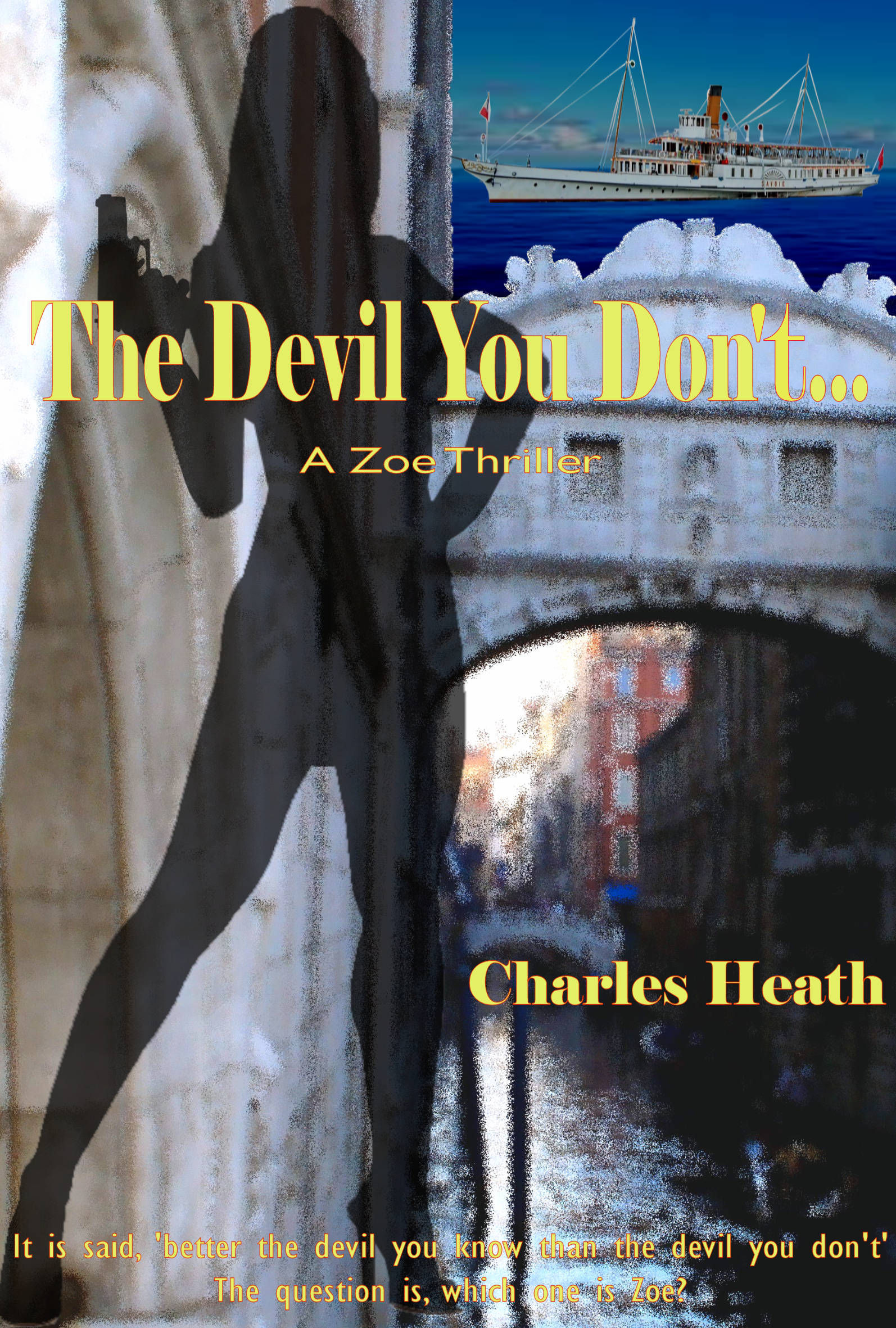
‘The Devil You Don’t’ – A beta reader’s view

It could be said that of all the women one could meet, whether contrived or by sheer luck, what are the odds it would turn out to be the woman who was being paid a very large sum to kill you.

John Pennington is a man who may be lucky in business, but not so lucky in love. He has just broken up with Phillipa Sternhaven, the woman he thought was the one, but relatives and circumstances, and perhaps because she was a ‘princess’, may also have contributed to the end result.

So, what do you do when you are heartbroken?

That is a story that slowly unfolds, from the first meeting with his nemesis on Lake Geneva, all the way to a hotel room in Sorrento, where he learns the shattering truth.

What should have been solace after disappointment, turns out to be something else entirely, and from that point, everything goes to hell in a handbasket.

He suddenly realizes his so-called friend Sebastian has not exactly told him the truth about a small job he asked him to do, the woman he is falling in love with is not quite who she says she is, and he is caught in the middle of a war between two men who consider people becoming collateral damage as part of their business.

The story paints the characters cleverly displaying all their flaws and weaknesses. The locations add to the story at times taking me back down memory lane, especially to Venice where, in those back streets I confess it’s not all that hard to get lost.

All in all a thoroughly entertaining story with, for once, a satisfying end.

…

Available on Amazon here: https://amzn.to/2Xyh1ow

…

A photograph from the inspirational bin – 1

We think of tropical Queensland having pristine white beaches and azure sparkling seas.

Not necessarily so.

This used to be a mangrove swamp.

Perhaps this is what happens when you mess with the natural environment, you’re left with something that’s not very nice.

There’s no beach, no sand, and sometimes not a very pleasant odor.

We can imagine what this might have looked like before man turned up to urbanize the area. In the background, there is an inlet and on either side lush vegetation.

It must have looked very inviting once upon a time. Now the shoreline is completely built on, the vegetation that was once there completely cleared, and the inlet leads to a marina.

Perhaps the story here might be about greedy destructive property developers who care not for anything but profits.  But in their quest to destroy, there is always someone else aiding and abetting, someone in government.

But what if there was an even darker secret hiding just below the surface, and about to be uncovered.  How far would someone go to preserve that secret?