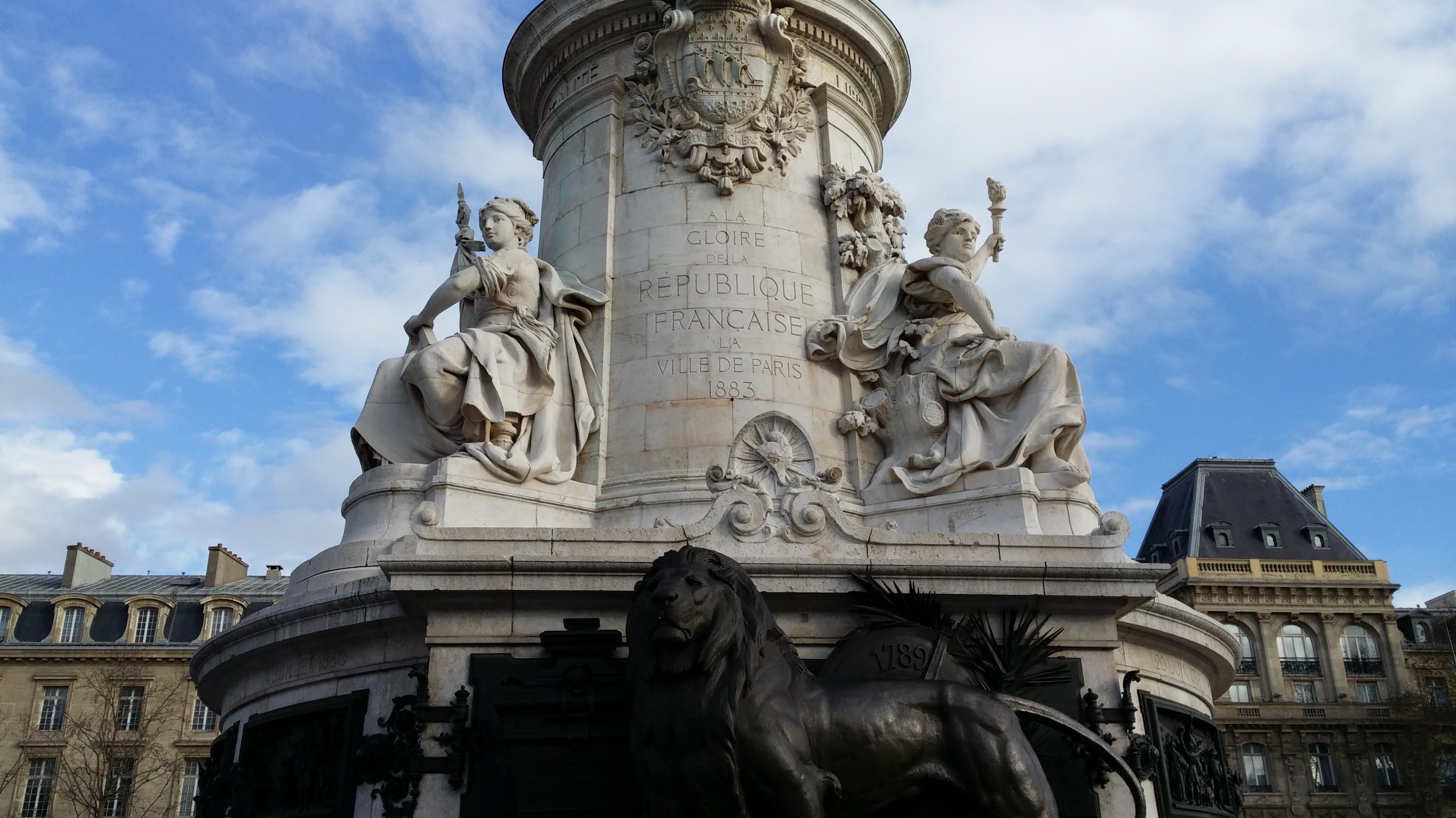
Searching for locations: Paris, France: Place de la Republique

Whilst a rather important place for the French, for us visitors, it has a convenient hotel located just behind the square, and an underground, or Metro station, underneath.

2014-01-07 11.43.05

Added to that was equally convenient cafes, one of which, The Cafe Republique, we had dinner every night.  The service and food were excellent, and we had no problems with the language barriers.

At the top of the monument is a bronze statue of Marianne, said to be the personification of France.

2014-01-07 11.43.41

Surrounding Marianne is three more statues, representing liberty, equality, and fraternity.

2014-01-07 11.43.32

At the base is a lion guarding what is said to be a ballot box.

Not your average to be read list

A long time ago, when I was 17 or 18, I used to do a lot of reading.  It was a long ride in on the train from home to work, and back again, and I did, then, have the time to read.

Having my own money, I was able to buy my own books, and these generally ran to mysteries and thriller, and naval stories.  The later took my interest for a while because I had notions of becoming an Ensign until I realized I needed better educational qualifications and a higher level of fitness.

So much for those aspirations, so I just read about what it would be like.

However…

I worked with a number of interesting characters, including one, a chap who was about 25, really old and wise to a 17-year-old, who deplored my reading choices.

It seemed Agatha Christie, Ngaio Marsh, Brian Callison, Hammond Innes, and Alistair Maclean didn’t quite fit the reading profile he thought I should follow.

Well, I hadn’t been to university, and I hadn’t realized there was such a thing as English, or any other, literature.  He was adamant that if I wanted to call myself a ‘man of books’ I had to read ‘proper’ books.

So, what eventuated, was a reading list.

If I wanted to converse with him on literature, I had to read every book on the list.

And I wanted to appear, at least, slightly more sophisticated, that the reader of penny dreadfuls.  I didn’t know what that meant, and in those days there was no internet, so it remained for a long time a phrase of mystery.

But, the reading list,

‘Hard Times,’ and ‘Bleak House’ by Charles Dickens

‘Seven Pillars of Wisdom’ by T.E. Lawrence, yes, that famous man who was better known as Lawrence of Arabia

‘Tess of the D’Urbervilles’ by Thomas Hardy, which fuelled a desire to read most of Hardy’s books

‘The Day of the Triffids’, by John Wyndham, a rather strange addition to the list since it was science fiction.  I suspect he was a closet Trekker.

‘To the Lighthouse’, by Virginia Wolff

‘Pride and Prejudice’ by Jane Austen

‘And Quietly Flows the Don’ by Mikhail Alexandrovich Sholokhov.  I had great fears that I would have to learn Russian, but that wasn’t the only shock, so was the size of the book

‘War and Peace’, talking about long books, by Leo Tolstoy

‘One Day in the Life of Ivan Denisovich’ by Aleksandr Solzhenitsyn, and thereby concluding the Russian classics

Of course, your definition of literature can change, and as a result of reading all of these books, and it took quite some time, and this led to selecting a more interesting collection of books to read, which he, in some small measure, took the credit for.

I discovered R.F Delderfield, and the trilogy, ‘A Horseman Riding By’, which led to ‘The Headmaster’, ‘The Avenue’, and ‘God is an Englishman’

C.S. Forester and the Hornblower series, but who also wrote several mysteries

F. Scott Fitzgerald and ‘The Great Gatsby’ as well as several other classics

Eric Ambler, master of thrillers from the ’30s and ’50s, particularly spy novels, and was probably the one who introduced me to the world of espionage

and last but not least, Dashiell Hammett’s ‘The Maltese Falcon’.


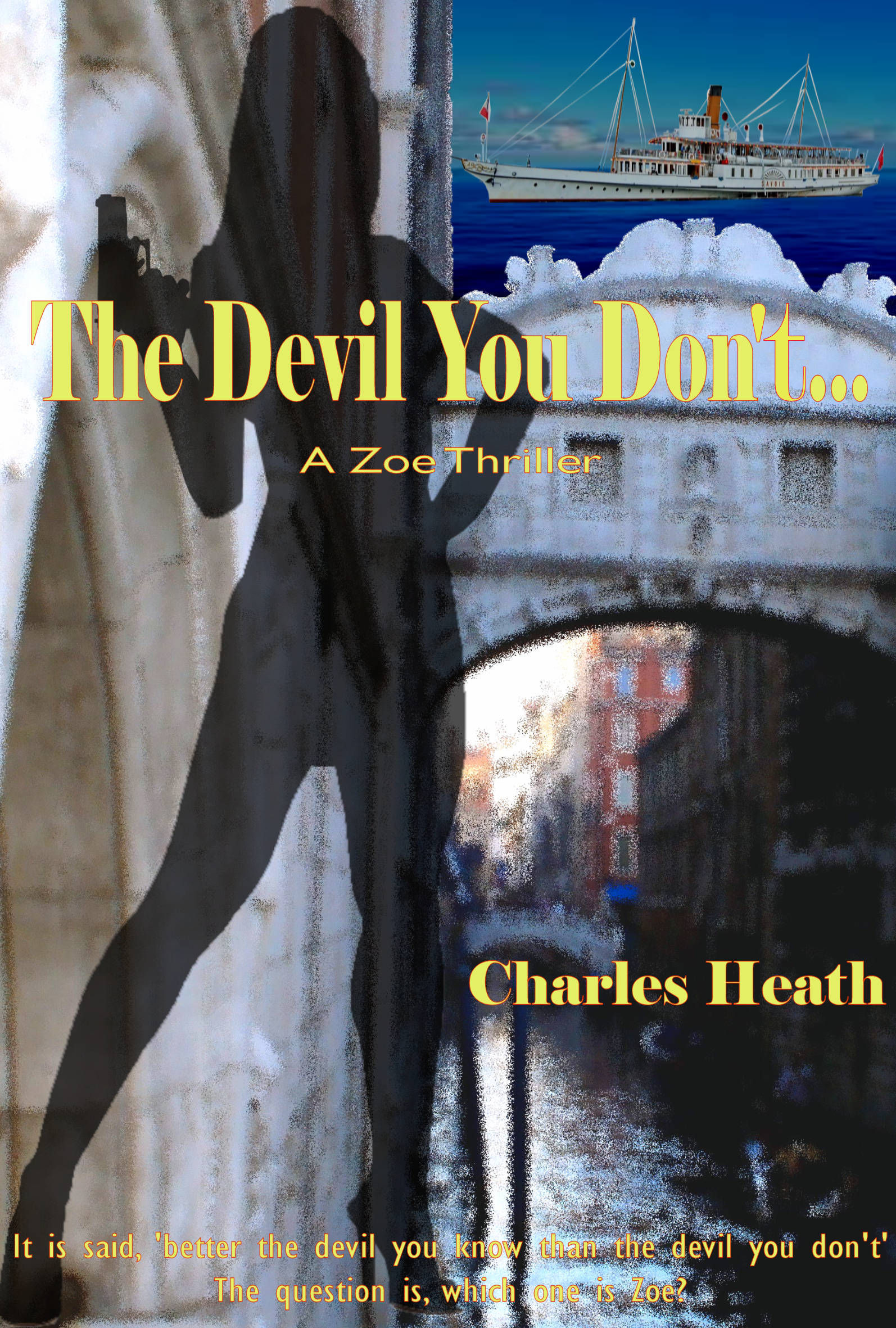
“The Devil You Don’t” – A beta readers view

It could be said that of all the women one could meet, whether contrived or by sheer luck, what are the odds it would turn out to be the woman who was being paid a very large sum to kill you.

John Pennington is a man who may be lucky in business, but not so lucky in love. He has just broken up with Phillipa Sternhaven, the woman he thought was the one, but relatives and circumstances, and perhaps because she was a ‘princess’, may also have contributed to the end result.

So, what do you do when you are heartbroken?

That is a story that slowly unfolds, from the first meeting with his nemesis on Lake Geneva, all the way to a hotel room in Sorrento, where he learns the shattering truth.

What should have been a high turns out to be something else entirely, and from that point every thing goes to hell in a handbasket.

He suddenly realises his so-called friend Sebastian has not exactly told him the truth about a small job he asked him to do, the woman he is falling in love with is not quite who she says she is, and he is caught in the middle of a war between two men who consider people becoming collateral damage as part of their business.

The story paints the characters cleverly displaying all their flaws and weaknesses. The locations add to the story at times taking me back down memory lane, especially to Venice where in those back streets I confess it’s not all that hard to get lost.

All in all a thoroughly entertaining story with, for once, a satisfying end.

…

Available on Amazon here: https://amzn.to/2Xyh1ow

…

The cinema of my dreams – I always wanted to see the planets – Episode 37

Could it be an alien spaceship?

…

“We’re being hailed,” the communications officer said in her matter-of-fact tone.

“Not an alien then?”

The moment I said it, it sounded inappropriate.

“Definitely human, with an accent.”

I was not sure what I was expected to make of that.

“On screen.”

A bridge, not dissimilar to ours appeared, with the captain, or the person I assumed to be captain, standing in front of his chair.

“Whom am I addressing?” He asked.

I gave him my name, the ship, who we were, standard name, rank, and serial number stuff as per regulations.

“Where is the previous Captain?”

He seemed to have information about us, if not recent.

“Dead.”

“I’m sorry to hear that.”

OK, I didn’t think he was coming just to make small talk.

“Ship slowing, no signs of weapons charging,” I saw pop up on the screen.  In situations like this, best not to communicate when there’s an open communication session.

Then, a new notice, “second ship following the first, moving at the same spot, arrival time 18 minutes.”

I looked at the inset on the master screen, and even at that distance and low-quality magnification, it definitely didn’t look like anything in our fleet.

It begged the question, were they running away?

“Are you alone?”

“No.  But it’s not one of our ships.”

Not very helpful.

“I suggest you turn around and go back,” he added.

I saw him turn, as if someone beside him had spoken, or gestured.

“Sorry.  We have to go.  Don’t say we didn’t warn you.”

“Who are they?”

“People you don’t want to meet.”

The screen went back to being a window, and the vessel we’d just been in communication with came clearly into view, then vanished.

It was larger than our ship, but more streamlined, my first thought, like a sleek racing car.

“It seems we’re about to have our first encounter.  Number one, stay on the highest alert, the rest of the crew, battle stations, quick as you can.”

To the navigator, “Did we get anything on that ship, scans, personnel, weapons, engines, anything?”

“A little.  We can go through it later.  If we’re still in one piece.”

If the oncoming ship was alien, it was an unknown quantity, and the navigator could be forgiven for thinking we might not be able to defend ourselves.  Questions we should have asked the other ship were plentiful, and the surprise it caused caught us all offside when I should have been the exception.

There would be time later to analyze everything we did wrong, what I did wrong

Hopefully.

The alien ship was no longer a blurry blob in the distance, but an oddly shaped ship that bore similarities to our own.

I could only guess at the lifeforms aboard if there were any.  It was a moment of thrill, fear, and intense expectation.

Those last few minutes of waiting disappeared as though they were seconds, and suddenly it was opposite us, in space, on station maintaining its distance.  I had us brought to a stop after the other ship left, but in a state of instant readiness to depart just in case we were fired upon.

I was banking on the fact the aliens might be as curious about us as we were about them.

“Can we communicate with that vessel,” I asked, turning the senior communications officer, now on the bridge at the comms station.

“You can speak to them; we have all means of external communication open.”

He didn’t add that they might not understand what I said.

I shrugged.  “We are from the planet Earth on a voyage of exploration and discovery with no other agenda other than to meet and talk to other civilizations.”

It sounded quite strange listening to a somewhat stumbling and unrehearsed greeting that was to be our first words to an alien species.  I hoped that our credibility didn’t rest of those words.”

Silence.

“Any detectable activity aboard their ship?”

“Our scanners can’t penetrate their hull.  Nothing noteworthy outside the hull, but, then, if we don’t know what we’re looking for…”

“We know where you are from and who you are.”

It was a crackling rendition, the sort of sounds I’d expect from a vintage radio broadcast.”

I looked at the comms officer.

“An ancient radio frequency once associated with AM radio, sir, 812 megahertz.”

Did that mean we were more advanced than them?  I didn’t think so.

“Who am I addressing?”

This time the silence was broken by crackling, and what sounded like a tape recorder fast-forwarding.  This went on for about five minutes.

Then, much stronger, and clearer, “Who I am is irrelevant.  If you have similar intentions as the vessel before you, I strongly suggest you turn around and go back to your own galaxy.”

“They’ve moved to FM sir, not sure why they’re using such old technology”, the comms officer said quietly.

Two things popped into my head; from that proverbial left field, I once heard a language professor once pontificate on. The first, was from a scientist at the space training facility on what an alien race mighttry to communicate with us on, and that in his opinion would be the band waves we had been sending out into space for years. AM and FM in that context made perfect sense.

The second: how did an alien speak such good English?

“We have not, though I suspect that will not allay your fears.  All humans, which is what we call ourselves, are not the same.”

“Yet your ship carries weapons.”

“For defense.  If we are attacked, we will respond.  I would expect no less from you.”

There was a minute or so of silence, time I was guessing for my counterpart to formulate his next move.

It came sooner than I expected.

A humanoid form appeared, not exactly like us, but much the same as the early humanoid robots we created at the start of our foray into robotics and for that matter AI.

“We have had much interaction with your kind, one way or another, and it has always ended badly.  If you have no ill intentions towards up, will you accompany me back to my ship?  I assure you, and your crew I have no ill intentions.”

It would be a huge leap of faith.

 Number one, you have the ship.  I’m going to take a short trip to the other vessel.”

“You should take a crew member, as per protocol.”

Yes, the instruction. If we were to were to meet an alien, it was not to go with them without one or more crew members.

“Unfortunately, he’s a stickler for regulations.  I must go with another crew member, just in case.”

I didn’t add the ‘harm cones to me, and retribution will be meted out.’  I didn’t think at this delicate stage that would fly.

“No weapons then.”

“No weapons.  Nancy Woolmer to the bridge immediately.”

She arrived within five minutes, and the moment she was in proximity, we were, I assumed, beamed aboard his ship.

…

© Charles Heath 2021-2022

An excerpt from “The Things We Do For Love”; In love, Henry was all at sea!

In the distance he could hear the dinner bell ringing and roused himself.  Feeling the dampness of the pillow, and fearing the ravages of pent up emotion, he considered not going down but thought it best not to upset Mrs. Mac, especially after he said he would be dining.

In the event, he wished he had reneged, especially when he discovered he was not the only guest staying at the hotel.

Whilst he’d been reminiscing, another guest, a young lady, had arrived.  He’d heard her and Mrs. Mac coming up the stairs, and then shown to a room on the same floor, perhaps at the other end of the passage.

Henry caught his first glimpse of her when she appeared at the door to the dining room, waiting for Mrs. Mac to show her to a table.

She was about mid-twenties, slim, long brown hair, and the grace and elegance of a woman associated with countless fashion magazines.  She was, he thought, stunningly beautiful with not a hair out of place, and make-up flawlessly applied.  Her clothes were black, simple, elegant, and expensive, the sort an heiress or wife of a millionaire might condescend to wear to a lesser occasion than dinner.

Then there was her expression; cold, forbidding, almost frightening in its intensity.  And her eyes, piercingly blue and yet laced with pain.  Dracula’s daughter was his immediate description of her.

All in all, he considered, the only thing they had in common was, like him, she seemed totally out of place.

Mrs. Mac came out of the kitchen, wiping her hands on her apron.  She was, she informed him earlier, chef, waitress, hotelier, barmaid, and cleaner all rolled into one.  Coming up to the new arrival she said, “Ah, Miss Andrews, I’m glad you decided to have dinner.  Would you like to sit with Mr. Henshaw, or would you like to have a table of your own?”

Henry could feel her icy stare as she sized up his appeal as a dining companion, making the hair on the back on his neck stand up.  He purposely didn’t look back.  In his estimation, his appeal rating was minus six.  Out of a thousand!

“If Mr. Henshaw doesn’t mind….”  She looked at him, leaving the query in mid-air.

He didn’t mind and said so.  Perhaps he’d underestimated his rating.

“Good.”  Mrs. Mac promptly ushered her over.  Henry stood, made sure she was seated properly and sat.

“Thank you.  You are most kind.”  The way she said it suggested snobbish overtones.

“I try to be when I can.”  It was supposed to nullify her sarcastic tone but made him sound a little silly, and when she gave him another of her icy glares, he regretted it.

Mrs. Mac quickly intervened, asking, “Would you care for the soup?”

They did, and, after writing the order on her pad, she gave them each a look, imperceptibly shook her head, and returned to the kitchen.

Before Michelle spoke to him again, she had another quick look at him, trying to fathom who and what he might be.  There was something about him.

His eyes, they mirrored the same sadness she felt, and, yes, there was something else, that it looked like he had been crying?  There was a tinge of redness.

Perhaps, she thought, he was here for the same reason she was.

No.  That wasn’t possible.

Then she said, without thinking, “Do you have any particular reason for coming here?”  Seconds later she realized she’s spoken it out loud, had hadn’t meant to actually ask, it just came out.

It took him by surprise, obviously not the first question he was expecting her to ask of him.

“No, other than it is as far from civilization, and home, as I could get.”

At least we agree on that, she thought.

It was obvious he was running away from something as well.

Given the isolation of the village and lack of geographic hospitality, it was, from her point of view, ideal.  All she had to do was avoid him, and that wouldn’t be difficult.

After getting through this evening first.

“Yes,” she agreed.  “It is that.”

A few seconds passed, and she thought she could feel his eyes on her and wasn’t going to look up.

Until he asked, “What’s your reason?”

Slight abrupt in manner, perhaps as a result of her question, and the manner in which she asked it.

She looked up.  “Rest.  And have some time to myself.”

She hoped he would notice the emphasis she had placed on the word ‘herself’ and take due note.  No doubt, she thought,  she had completely different ideas of what constituted a holiday than he, not that she had actually said she was here for a holiday.

Mrs. Mac arrived at a fortuitous moment to save them from further conversation.


Over the entree, she wondered if she had made a mistake coming to the hotel.  Of course, there had been no possible way she could know than anyone else might have booked the same hotel, but realized it was foolish to think she might end up in it by herself.

Was that what she was expecting?

Not a mistake then, but an unfortunate set of circumstances, which could be overcome by being sensible.

Yet, there he was, and it made her curious, not that he was a man, by himself, in the middle of nowhere, hiding like she was, but for very different reasons.

On discreet observance whilst they ate, she gained the impression his air of light-heartedness was forced and he had no sense of humor.

This feeling was engendered by his looks, unruly dark hair, and permanent frown.  And then there was his abysmal taste in clothes on a tall, lanky frame.  They were quality but totally unsuited to the wearer.

Rebellion was written all over him.

The only other thought crossing her mind, and rather incongruously, was he could do with a decent feed.  In that respect, she knew now from the mountain of food in front of her, he had come to the right place.

“Mr. Henshaw?”

He looked up.  “Henshaw is too formal.  Henry sounds much better,” he said, with a slight hint of gruffness.

“Then my name is Michelle.”

Mrs. Mac came in to take their order for the only main course, gather up the entree dishes, then return to the kitchen.

“Staying long?” she asked.

“About three weeks.  Yourself?”

“About the same.”

The conversation dried up.

Neither looked at the other, rather at the walls, out the window, towards the kitchen, anywhere.  It was, she thought, almost unbearably awkward.


Mrs. Mac returned with a large tray with dishes on it, setting it down on the table next to theirs.

“Not as good as the usual cook,” she said, serving up the dinner expertly, “but it comes a good second, even if I do say so myself.  Care for some wine?”

Henry looked at Michelle.  “What do you think?”

“I’m used to my dining companions making the decision.”

You would, he thought.  He couldn’t help but notice the cutting edge of her tone.  Then, to Mrs. Mac, he named a particular White Burgundy he liked and she bustled off.

“I hope you like it,” he said, acknowledging her previous comment with a smile that had nothing to do with humor.

“Yes, so do I.”

Both made a start on the main course, a concoction of chicken and vegetables that were delicious, Henry thought, when compared to the bland food he received at home and sometimes aboard my ship.

It was five minutes before Mrs. Mac returned with the bottle and two glasses.  After opening it and pouring the drinks, she left them alone again.

Henry resumed the conversation.  “How did you arrive?  I came by train.”

“By car.”

“Did you drive yourself?”

And he thought, a few seconds later, that was a silly question, otherwise she would not be alone, and certainly not sitting at this table. With him.

“After a fashion.”

He could see that she was formulating a retort in her mind, then changed it, instead, smiling for the first time, and it served to lighten the atmosphere.

And in doing so, it showed him she had another more pleasant side despite the fact she was trying not to look happy.

“My father reckons I’m just another of ‘those’ women drivers,” she added.

“Whatever for?”

“The first and only time he came with me I had an accident.  I ran up the back of another car.  Of course, it didn’t matter to him the other driver was driving like a startled rabbit.”

“It doesn’t help,” he agreed.

“Do you drive?”

“Mostly people up the wall.”  His attempt at humor failed.  “Actually,” he added quickly, “I’ve got a very old Morris that manages to get me where I’m going.”

The apple pie and cream for dessert came and went and the rapport between them improved as the wine disappeared and the coffee came.  Both had found, after getting to know each other better, their first impressions were not necessarily correct.

“Enjoy the food?” Mrs. Mac asked, suddenly reappearing.

“Beautifully cooked and delicious to eat,” Michelle said, and Henry endorsed her remarks.

“Ah, it does my heart good to hear such genuine compliments,” she said, smiling.  She collected the last of the dishes and disappeared yet again.

“What do you do for a living,” Michelle asked in an off-hand manner.

He had a feeling she was not particularly interested and it was just making conversation.

“I’m a purser.”

“A what?”

“A purser.  I work on a ship doing the paperwork, that sort of thing.”

“I see.”

“And you?”

“I was a model.”

“Was?”

“Until I had an accident, a rather bad one.”

“Oh, I’m sorry.”

So that explained the odd feeling he had about her.

As the evening had worn on, he began to think there might be something wrong, seriously wrong with her because she didn’t look too well.  Even the carefully applied makeup, from close up, didn’t hide the very pale, and tired look, or the sunken, dark ringed eyes.

“I try not to think about it, but it doesn’t necessarily work.  I’ve come here for peace and quiet, away from doctors and parents.”

“Then you will not have to worry about me annoying you.  I’m one of those fall-asleep-reading-a-book types.”

Perhaps it would be like ships passing in the night and then smiled to himself about the analogy.

Dinner now over, they separated.

Henry went back to the lounge to read a few pages of his book before going to bed, and Michelle went up to her room to retire for the night.

But try as he might, he was unable to read, his mind dwelling on the unusual, yet the compellingly mysterious person he would be sharing the hotel with.

Overlaying that original blurred image of her standing in the doorway was another of her haunting expressions that had, he finally conceded, taken his breath away, and a look that had sent more than one tingle down his spine.

She may not have thought much of him, but she had certainly made an impression on him.


© Charles Heath 2015-2020

lovecoverfinal1

The cinema of my dreams – Was it just another surveillance job – Episode 18

As we all know, writing by the seat of your pants is almost the same as flying by the seat of your pants, a hazardous occupation.

As it happens, I like writing this way because like the reader, I don’t know what to expect next.

And equally, at times, you can write your self into a corner, much like painting, and then have to go back, make a few changes and//or repairs and then move forward.

It’s part of the writing process, only in this case, the changes occur before you’ve finished the novel, if you finish.  Quite often a lot of writers get only so far, then the manuscript hits the bottom drawer, to be brought out on a distant rainy day.

Or your cat has mocked your writing ability one too many times.

Therefore, we’re winding back to Episode 16, and moving forward once again, from there.  This is episode 18 revised…

Ever had the heart-stopping feeling when you’re in the wrong place, and someone has interrupted you?  Especially if you shouldn’t be there, or that you have no right to be there.

I stood quietly on the inside of the door and hoped whoever the visitor was would go away.  No answer meant no one was home, didn’t it?

Unless…

I heard a key in the door, and it turn in the lock.

I moved quickly to the other side of the door so I would be shielded when the person came into the room.  Too late to get out, I was of two minds what to do.  Hit the visitor over the head and flee, or ask them what they were doing, before they asked me that same question.

Then nothing.

Until a few seconds later I heard a voice, a man, say, “Jan, you’re back.  How was the visit to Philadelphia?”

I heard the slight rattle of Jan taking her hand off the handle and moving away from the door.  “Sad, as all funerals are.  Now, we are left with the house, and my father’s stuff; a huge collection of mostly junk over a long period of time.  Seems he never threw anything out.”

Jan?  Did she live here, with O’Connell?

“Yes, “I’m a bit like that.”

Another tenant, or the building super?

“I made sure Herman was looked after while you were away.  I don’t think he missed you at all?”

She laughed.  “He’s a cat, Fred.  We belong to them, not the other way around.”

“True.  Your friend has not been in for a week or so.”

“I know.  The last message I got from him, he was in Prague, lucky bastard.  He was going to take me with him, but at the last moment, they changed his itinerary.  Perhaps next time.  I was just going to make sure everything was OK, before going home myself.”

“I could look in if you want?”

“No.  Thanks anyway, but last time I was here I left a jacket behind.  Thanks, Fred.”

A moment later I could hear his footsteps heading away, and Jan moved back to the door, and opened it.

I heard the light switch, and then, suddenly, the room was filled with bright light.

The girl was unassuming, stepped into the room, and closed the door behind her.  Before she could take a step, I put a hand over her mouth and an arm around her neck and started squeezing.

Instinctively she started to struggle and call out for help.

I whispered in her ear, “I mean you no harm, but if you struggle, or yell out, it could turn out very bad for you.”

We had been taught how to subdue people without killing them, but that always didn’t go to plan.  There was that instinct to fight back in everyone, and it was sometimes hard not to apply excessive pressure which could, depending on the severity of resistance, see the target asphyxiated, or end up with a broken neck.

She was still struggling, which mean I had to exert more force.

“Stop fighting me or you will harm yourself,” I said, this time in a more forceful whisper.

It had an immediate effect, but I don’t think it was her obedience that caused it.  I gently lowered her to the floor and felt for a pulse.  Unconscious, not dead.  I sighed in relief.  I took a good long look at her so that I would remember what she looked like.  At some point, I was going to have to talk to her.

Then footsteps outside the door.  What else could go wrong?

Then knocking on the door.  Short and sharp.  Followed by, “Jan, are you in there?”

Fred, whoever he was.  What did he want?”

Another knock on the door, this time more urgent.  Damn.  O’Connell’s flat was like a busy store.

I looked around for an escape now there would be no going out the front door.  Not unless I had to disable another person, and assuming if he was the building super, he would not be a small man, so it would take a greater, and noisier, effort to subdue him.

A fire escape, all buildings usually had one down the side of the building, in case of fire.  I went over and checked the windows and found it.  The window needed a little force to open it, but the sound of a key in the door motivated me.

Out the window, close the window again, I made it down the stairs far enough that when I looked up, no one was following me.

That was close.  Too close.

© Charles Heath 2019-2022

Sayings: Going on a wild goose chase

Who hasn’t been on one of these, particularly if you have an older brother or sister, and they have nothing better to do than give you a hard time.

You know what I mean, going on a mission to find or do something, knowing full well that you won’t find it, or complete it because it was a lost cause to start with.

Yes, it goes very well with another saying, a dog chasing its tail.

We’ve seen that, too, watching the poor dog go round and round without ever achieving anything.

Sounds like my day today.

And it doesn’t stop there, the pointless search could also be described as ‘searching for a needle in a haystack’.

That is, to my mind the very definition of a living nightmare.

The origin of the idiom, well that’s a little more complicated because there isn’t just one definition.

The first:

Coined by William Shakespeare, but not necessarily in the sort of language we can read easily – it’s a bit like my ability to translate Spanish to English. It does, however, refer to a ‘wild goose chase’.

The second:

Refers to, of all things 16th Century horseracing, and because I don’t have a time machine I can’t go back to fact-check. However, it refers to the other riders following the leader around the course, in much the same formation as geese flying through the air.

…

My little story to go with it:

…

If you are good at your job, and that is beginning to be noticed, your boss will find one of these ‘wild goose chases’ just for you, in an effort to make you look bad.

It happened to me once: my task was to search the basement, where old records were stored, for a folder that a former employee had thought they had filed it in the wrong storage box, a supposition supported by the fact the folder was now needed to clear up a clerical error and the file wasn’t in the specifically marked storage box.

My job was to search every one of the other 765 boxes stored haphazardly in the basement until I found it.

It was, I was told later, sitting on his desk the whole time, and when I couldn’t find it, was going to swoop in and say he’d found it.

Of course, it went missing before he could, so he got a bollicking for not storing the files properly, and I got the job to clean up the basement. I’m not sure who got the worst punishment.

“The Things We Do For Love” – Coming soon

Is love the metaphorical equivalent to ‘walking the plank’; a dive into uncharted waters?

For Henry the only romance he was interested in was a life at sea, and when away from it, he strived to find sanctuary from his family and perhaps life itself.  It takes him to a small village by the sea, s place he never expected to find another just like him, Michelle, whom he soon discovers is as mysterious as she is beautiful.

Henry had long since given up the notion of finding romance, and Michelle couldn’t get involved for reasons she could never explain, but in the end both acknowledge that something happened the moment they first met.  

Plans were made, plans were revised, and hopes were shattered.

A chance encounter causes Michelle’s past to catch up with her, and whatever hope she had of having a normal life with Henry, or anyone else, is gone.  To keep him alive she has to destroy her blossoming relationship, an act that breaks her heart and shatters his.

But can love conquer all?

It takes a few words of encouragement from an unlikely source to send Henry and his friend Radly on an odyssey into the darkest corners of the red light district in a race against time to find and rescue the woman he finally realizes is the love of his life.

The cover, at the moment, looks like this:

lovecoverfinal1

“One Last Look”, nothing is what it seems

A single event can have enormous consequences.

A single event driven by fate, after Ben told his wife Charlotte he would be late home one night, he left early, and by chance discovers his wife having dinner in their favourite restaurant with another man.

A single event where it could be said Ben was in the wrong place at the wrong time.

Who was this man? Why was she having dinner with him?

A simple truth to explain the single event was all Ben required. Instead, Charlotte told him a lie.

A single event that forces Ben to question everything he thought he knew about his wife, and the people who are around her.

After a near-death experience and forced retirement into a world he is unfamiliar with, Ben finds himself once again drawn back into that life of lies, violence, and intrigue.

From London to a small village in Tuscany, little by little Ben discovers who the woman he married is, and the real reason why fate had brought them together.

It is available on Amazon here:  http://amzn.to/2CqUBcz

The story behind the story: A Case of Working With the Jones Brothers

To write a private detective serial has always been one of the items at the top of my to-do list, though trying to write novels and a serial, as well as a blog, and maintain a social media presence, well, you get the idea.

But I made it happen, from a bunch of episodes I wrote a long, long time ago, used these to start it, and then continue on, then as now, never having much of an idea where it was going to end up, or how long it would take to tell the story.

That, I think is the joy of ad hoc writing, even you, as the author, have as much idea of where it’s going as the reader does.

It’s basically been in the mill since 1990, and although I finished it last year, it looks like the beginning to end will have taken exactly 30 years.  Had you asked me 30 years ago if I’d ever get it finished, the answer would be maybe?

My private detective, Harry Walthenson

I’d like to say he’s from that great literary mold of Sam Spade, or Mickey Spillane, or Phillip Marlow, but he’s not.

But, I’ve watched Humphrey Bogart play Sam Spade with much interest, and modeled Harry and his office on it.  Similarly, I’ve watched Robert Micham play Phillip Marlow with great panache, if not detachment, and added a bit of him to the mix.

Other characters come into play, and all of them, no matter what period they’re from, always seem larger than life.  I’m not above stealing a little of Mary Astor, Peter Lorre or Sidney Greenstreet, to breathe life into beguiling women and dangerous men alike.

Then there’s the title, like

The Case of the Unintentional Mummy – this has so many meanings in so many contexts, though I image back in Hollywood in the ’30s and ’40s, this would be excellent fodder for Abbott and Costello

The Case of the Three-Legged Dog – Yes, I suspect there may be a few real-life dogs with three legs, but this plot would involve something more sinister.  And if made out of plaster, yes, they’re always something else inside.

But for mine, to begin with, it was “The Case of the …”, because I had no idea what the case was going to be about, well, I did, but not specifically.

Then I liked the idea of calling it “The Case of the Brother’s Revenge” because I began to have a notion there was a brother no one knew about, but that’s stuff for other stories, not mine, so then went the way of the others.

Now it’s called ‘A Case of Working With the Jones Brothers’, finished the first three drafts, and at the editor for the last.

I have high hopes of publishing it in early 2021.  It even has a cover.

PIWalthJones1