To write a private detective serial has always been one of the items at the top of my to-do list, though trying to write novels and a serial, as well as a blog, and maintain a social media presence, well, you get the idea.
But I made it happen, from a bunch of episodes I wrote a long, long time ago, used these to start it, and then continue on, then as now, never having much of an idea where it was going to end up, or how long it would take to tell the story.
That, I think is the joy of ad hoc writing, even you, as the author, have as much idea of where it’s going as the reader does.
It’s basically been in the mill since 1990, and although I finished it last year, it looks like the beginning to end will have taken exactly 30 years. Had you asked me 30 years ago if I’d ever get it finished, the answer would be maybe?
My private detective, Harry Walthenson
I’d like to say he’s from that great literary mold of Sam Spade, or Mickey Spillane, or Phillip Marlow, but he’s not.
But, I’ve watched Humphrey Bogart play Sam Spade with much interest, and modeled Harry and his office on it. Similarly, I’ve watched Robert Micham play Phillip Marlow with great panache, if not detachment, and added a bit of him to the mix.
Other characters come into play, and all of them, no matter what period they’re from, always seem larger than life. I’m not above stealing a little of Mary Astor, Peter Lorre or Sidney Greenstreet, to breathe life into beguiling women and dangerous men alike.
Then there’s the title, like
The Case of the Unintentional Mummy – this has so many meanings in so many contexts, though I image back in Hollywood in the ’30s and ’40s, this would be excellent fodder for Abbott and Costello
The Case of the Three-Legged Dog – Yes, I suspect there may be a few real-life dogs with three legs, but this plot would involve something more sinister. And if made out of plaster, yes, they’re always something else inside.
But for mine, to begin with, it was “The Case of the …”, because I had no idea what the case was going to be about, well, I did, but not specifically.
Then I liked the idea of calling it “The Case of the Brother’s Revenge” because I began to have a notion there was a brother no one knew about, but that’s stuff for other stories, not mine, so then went the way of the others.
Now it’s called ‘A Case of Working With the Jones Brothers’, finished the first three drafts, and at the editor for the last.
I have high hopes of publishing it in early 2021. It even has a cover.
The problem is, there are familiar faces and a question of who is a friend and who is foe made all the more difficult because of the enemy, if it was the enemy, simply because it didn’t look or sound or act like the enemy.
Now, it appears, his problems stem from another operation he participated in.
It took almost an hour to recover. Monroe didn’t come looking for me, so I think they knew it would take some time for me to get my legs back.
And it felt good to stand under the hot shower for twenty-odd minutes, letting the warmth of the water sink into my bones and clear my head.
And think.
How long had Bamfield have an eye on me? It was a question that sprung to mind the moment I saw him in the desert camp. I’d heard if you were transferred to one of his commands, at some point, it was not because it was another posting, it was because he wanted you there.
I’d been specially selected by Bamfield personally, out of the preliminary training camp, to further my military career under his oversight. I’d made it very clear from the outset that I was not interested in a commission, that I preferred the lower ranks. Officers were a different breed, and I’d not been cut from that cloth. Bamfield had admitted as much when I was first interviewed by him, and several other’s on what I soon discovered was his selection panel.
They were charged by him to find the best of the best.
And at that first interview, I’d disagreed with his assessment. I’d been in trouble before, and the military was the only place I could go if I didn’t want to serve a stretch in jail. Perhaps it was that innate ability of mine to seek out and become embroiled in trouble that caught his attention.
Certainly over time he and his instructors had honed those skills to a more refined set that, in civilian life, would set me up for a long stay in prison. It begged the question of what I was going to do with myself after the military had finished with me, a question I hadn’t really thought about until I’d been shunted to my last post in a training school of sorts.
I realised now that it had been Bamfield sidelining me until an operation crying out for my particular talents came along.
That disastrous operation with Treen.
Was it his? Or was it someone else who pulled it together, and he just provided the manpower. It had been the first major active offshore operation I’d been on. There’d been a few skirmishes along the way, but that was the first, and in a zone where I don’t think we were meant to be operating.
That had, I thought, been the sole purview of the CIA, and if I looked back on what had happened, there was no doubt the two agents we were supposed to pull out were CIA operatives, it had got too hot for them to stay, and they had clandestinely called for help.
It begged another question, was Bamfield CIA or working with the CIA, with or without the military hierarchy knowing?
The thing is, if it had been pulled off, as expected, no one would be any the wiser in that country, but once they found out, by whatever means it happened, the proverbial had hit the fan. It goes hand in hand with trusting people on the ground who were purportedly working against their country’s regime, for better or worse.
That country had a ‘friendly’ government, that had been ‘supported’ and then been deposed in the usual coup by the military, and, afterwards, the new hardliners got the benefit of those times when the country was a friendly and had military hardware and knowledge to wage war clandestinely or otherwise with its neighbours, given willingly.
Lessons hadn’t been learned after a particular middle east debacle. Maybe lessons would never be learned. Just look at the number of times had relations turned sour after a coup and agents had to hastily withdraw. It seems that my visit had been at the end of another of those ‘diplomatic’ missions that had gone wrong.
Mondays were usually a slow day to start the week, a brief few hours after the storm the was every Friday. Some chose to come in late, others gathered on arrival to have a team debriefing.
Our department chose to have a debriefing, and it was my job to analyze all the data and turn it into a graphical representation that basically said the business was heading in the right direction – up.
But, this Monday morning, the circumstances were slightly different.
The head of the company had personally sent both an email and a memo to every employee, an event that had never happened before.
In fact, for most of us, it was an eye-opening discovery, one where had the company not become engulfed in a scandal of international proportions, his identity might have remained a secret.
Not that it mattered to the 15,000 odd people who worked for the company, because the bottom line was that it would not affect us, or our employment. Well, that was the message the email and the memo was primarily about.
Was it too little too late?
The problem was that the morning’s paper’s headlines screamed scandal in large letters and then went on to describe how the company was basically a front for laundering money associated with various criminal activities. It stopped short of accusing the company’s upper management of being criminals, but it was clear, reading between the lines, they had to know something was wrong.
I walked into the meeting room where all of the Department’s staff were seated, talking among themselves, that dying down the moment I closed the door behind me. On the desk in front of each was one of the three morning papers, all with basically the same story.
I didn’t bring a paper in with me, nor a copy of the email, or the memo. I was hoping the meeting was not going to be about the scandal.
I was wrong.
It was one of those companies where everyone knew everyone. I knew everyone in the room, and regarded most as friends as well as workmates. The company promoted from within and on merit, and with this, I had the respect of everyone who worked under me.
I could see by the mood, and looks of expectation, that trust was going to be tested.
“I suspect that everyone has seen the news, and hopefully read both missives from management regarding the situation the company finds itself.”
That was met with a murmur of agreement.
“It was also, for some, a surprise.”
For others, it was not. Our department was basically in place to ensure that all transactions were conducted properly and that clients’ accounts were managed within the guidelines set by the company, and the various government institutions responsible for financial affairs.
Several of the senior officers had come to me with what they regarded as anomalies, and I have given them the authority to investigate. It was also within my remit to advise the relevant government authority. Most of the anomalies had simply been oversights by the account manager, except for one, which as far as I was aware, had been cleared.
Or not.
“Can we safely assume that Wally Anderson’s somewhat abrupt was not as described?”
Wally Anderson’s abrupt departure had been described to me in a one-line email, ‘taking some personal time to work through some family issues’. In the week leading up to his departure he had become increasingly agitated, and one call one of the others had taken in his absence was from a reporter.
It was one of his accounts that remained doubtful, until shortly after he left when an external investigator was brought in.
But I had a difficult line to walk, trying to placate both sides of the spectrum and management, and as a leader. Respect could be won or lost in a matter of words.
“That might or might not be the case, but the odds are, given what we’re reading, that there may be room for doubt. However, despite what we may conclude, or deduce, it is better for all of us to keep an open mind. I suspect, at some point, again based on what I read, we might be approached by the police or representatives of a number of regulatory organizations for information.”
It was as far as I got.
The side door swung open, and my superior, the Chief Accountant, strode in, along with the mystery man who was, the papers said, the Owner, followed by the harried personal assistant.
“Mr. Nelson…”
The Chief Accountant stood front and center to the group. I thought it wise to stand off to one side, the opposite, in fact, the Owner, now standing just inside the door, next to his PA who was quietly talking into her cell phone.
“I’ll take over from here, Max.”
He switched his attention back to the group and took a few seconds to run his eye over all over them, almost as if he was looking for someone or something.
“I have spent the last 48 hours in rather tedious discussions with the regulators who insist that they received information about the Ridley investigation. Unfortunately, without consulting the company, he took part of the results of the investigation to them. Was anyone here aware of his actions?”
Another eye cast over the group, and, in the end, a glance at me.
I felt responsible to answer for the group.
“Investigations are conducted by individuals, and as far as I was concerned, the Ridley investigation was his. As equally that after he departed, that investigation was completed and cleared. Are you intimating that it wasn’t?”
I knew as much about it as the others.
“It was, until someone else reopened it, and reported it. We believe it was someone in this room.”
“That’s not possible,” I said. “I have oversight of all the officers in this room, and the ability to monitor everything they do and everything they look at. You know the security protocols in place in the software itself.”
“An investigation into the software has been implemented, and it shows that certain log files were altered so that the user log wouldn’t show who looked at the records. Someone with database experience.”
“We’re basically auditors not database managers.”
“Well, someone apparently is. Everyone is on notice. We will find out who it was, and believe me when I say we will leave no stone unturned in the process.”
An almost imperceptible not from the Owner, the harried PA was still on the cell phone, the Chief Accountant gave the group another steely look, then glared at me, said, “My office, one hour,” then left pulling the other two along in his wake.
I cast an eye over the group, picking out those whom I suspected were capable of performing such a search and destroy operation. Three.
“My door is open for anyone who might have any information, with the promise of anonymity.”
I left them with that and also left.
What should have been a quiet morning’s discussion just became a witch hunt where someone would be burnt at the stake. Whether they were guilty or not.
There’s always the necessity for creating backstories so that the reader doesn’t come across a part of the story that doesn’t make sense.
Perhaps one of my failings is that I have to go over what I’ve already written, sometimes to make sure there is continuity and that what I’ve written makes sense.
This collection of memories our main character is having serves the purpose of setting up later plot points, but more importantly, is supposed to give the reader an idea of what the main character has gone through before arriving at the start of the story.
This part will serve to provide a little more information on the relationship between Bill and Barry, though I rather like the nickname I gave him.
“Bastards,” Killer muttered.
We called him ‘Killer’ because it was the nickname the Army had given him. We were sharing the guard duty and had spoken briefly over the watch, but up till then, the silence had stretched over an hour or so. It didn’t take long for anyone to realize he was a man of few words.
He’d been in the regular army for years and asked for the posting. He’d made Sergeant several times, only to lose those same stripes for fighting, usually after R&R and a bout of heavy drinking. Now assigned to our platoon to lend his experience, the conscripts were expecting him to ‘look after’ them. Other than myself and the Lieutenant, he was the only other regular soldier. Unfortunately for them, he hated both conscripts and the Viet Cong in varying degrees, and depending on his mood there was little tolerance left for the rest of us.
“The people who sent us here or the people trying to kill us?” I asked before I realized I’d spoken.
I didn’t hear the reply, the skies opening up with another torrential downpour that lasted for about five minutes, and going as fast as it came. When the sun finally came up, it would make the atmosphere steamy, hot, and unbearable. It was quite warm now, and I was feeling both uncomfortable, and fatigued.
Killer looked just as stoic as he had before the rain. He looked at me. “Damn weather. Worse than home.”
“Scotland?”
“Scapa Flow, Kirkwall. I should have been an engineer on ships like my father, but I was too stupid. Joined the Army, finished up here. What’s your excuse?”
“Square peg in a round hole. The army seems to handle us in its stride.” It was more or less the truth. I joined the Army to get away from my parents.
“That it does. That it does.”
The rain came and went, during which the rest of the camp roused and went about its business. It had been a long night for some, still getting over the shock of the attack, and the ever-pervading thought the enemy was still out there, biding their time. It would be, for them, a waiting game, waiting for the conditions to wear us down, and lose concentration as inevitably we would.
Certainly, by the time we were relieved from sentry duty, I felt I was in no condition to match wits with a donkey, let alone the enemy on his own home ground. When I stumbled over to the mess area and looked at the tired and haggard looks on the faces of the platoon, I realized that went for all of us.
Killer and I managed to get about an hour’s rest before the call came to move out, rain or no rain, and after a breakfast to make anyone ill, we left. For hours it rained. No one spoke as we strained to listen over the rain spattering on the undergrowth, all the time expecting the unexpected. That was the benefit of the surprise attack; we no longer took for granted we would be safe.
Water gathered in pools along the trail, hiding any chance of seeing landmines. Rainwater and sweat ran into our eyes, making it difficult to see. Water leaked everywhere, making it very uncomfortable. This was not war. This was utter stupidity.
I was about to remark on the futility of it all to the Lieutenant, who had taken the lead, when one second he was talking to me and the next he crashed to the ground, a sniper’s bullet killing him instantly. Someone yelled “Contact” and we hit the ground, bullets flying all around us.
Too late, I thought, as I felt the hit of what seemed to be a large rock, then the searing pain in my leg, just as I hit the ground…
There was something about this one that resonated with me.
This is a novel about a world generally ruled by perception, and how people perceive what they see, what they are told, and what they want to believe.
I’ve been guilty of it myself as I’m sure we all gave one time or another.
For the the main characters Harry and Alison there is others issues driving their relationship.
For Alison, it is a loss of self worth through losing her job and from losing her mother and, in a sense, her sister.
For Harry it is the fact he has a beautiful and desirable wife, and his belief she is the object of other men’s desires, and one in particular, his immediate superior.
Between observation, the less than honest motives of his friends, a lot of jumping to conclusions based on very little fact, and you have the basis of one very interesting story.
When it all come to a head, Alison finds herself in a desperate situation, she realises only the truth will save their marriage.
But is it all the truth?
What would we do in similar circumstances?
Rarely does a book have me so enthralled that I could not put it down until I knew the result. They might be considered two people who should have known better, but as is often the case, they had to get past what they both thought was the truth.
And the moral of this story, if it could be said there is one, nothing is ever what it seems.
How many people do you know have their front door smashed in at the crack of dawn, followed by a swat team, armed to the teeth, swarming through the house ready to put down any resistance?
Just the suddenness of the cacophony of noise, the shouting, and the sheer threat of death, left me firstly shattered, and secondly, in fear of being accidentally killed, especially when there were six guns trained on me.
When the all-clear came, when no one else was discovered in the house, one of the suited men came back and motioned the six to take a step back and raise their weapons.
“Get up.”
If I was expected a ‘please’, or an apology, both would be a long time coming.
“Where is she?”
I barely had time to catch my breath and try to stop shaking. Six guns were still pointing in my direction, and those holding them no less wanted to shoot me for any reason whatsoever.
“Who?” There were two girls in this house.
“Don’t be obtuse, Mr. Jacobs. Obstruction will get you nothing but a stretch in prison with some very unsavoury characters. Where is she?”
The notion that they could be looking for Liz was as preposterous as the day was long. I had known her for five years, since we both left the same company, unhappy with the pay and conditions, and moved to a new company, deciding to stay together, first as a team, and then I was hoping would be something more intimate.
It had to be someone else, like the odd woman who had ingratiated herself with the group I was with, and ostensibly left the bar with me, but only as far as the car park. Perhaps, if we were being observed, it might have been construed as something else.
“Can you give me a name, at least?”
“Elizabeth Morgan.”
Liz? She designed computer games, and I helped with the programming. Other than that, she went to church every Sunday and visited her folks in the next county every second Saturday. I’d met them on numerous occasions, and they were just ordinary people.
“Why on earth would you be looking for her?”
“That’s classified, Mr. Jacobs. All you need to do is tell me where she is.”
“I don’t know. The last time we spoke, she was heading off to the market to get groceries.”
“Which was?”
“About an hour ago.”
A woman put her head in the door, and said, “she’s nowhere on the property, sir.”
I recognized her immediately as the woman in the bar, and suddenly realized she had been subtly interrogating me about Liz, trying to find out where she was, and why she wasn’t there with me.
She glared at me, then disappeared.
“Who are you?” I asked. “FBI, CIA, NSA?”
“Why would you assume that I’m from any of those agencies?”
“Your friend who put her head in the door. I might not have realized who she was last night, but I do now. You think Liz has committed some sort of cybercrime, don’t you?”
“So, you do know what she’s been up to?”
“No. But you just told me. And I suspect a man by the name of Champion has been feeding you scurrilous lies, but you don’t need to say anything more. You’re right, I do know what this is about, but I know whatever he said to you to get here isn’t true, but, then, he has more money or more low friends in even lower places than we have, so do your worst.”
Liz wasn’t a criminal, nor was she guilty of anything except claiming the rights to her property. Champion, though, always maintained that anything she created while working for him was his. True enough, we all signed the contract. But what she created was after she resigned and we were working on a new project together. Now, to get around that, he was claiming her work would be a violation of national security. It would, if it was in his hands, and that was never going to happen.
“It would be good for everyone if she just surrendered and pleaded her case if what you say is true.”
An interesting change in tactics.
I looked him up and down. Just the sort of man who would sell out to the highest bidder. Champion was good only at one thing, knowing how much a person would sell out his principles for, even his mother if it came down to it. Everyone had a price. Unfortunately for us, it would seem, he didn’t know ours.
He shrugged. “Perhaps so time in a dark hole might loosen your tongue.”
Dark hold indeed.
To be honest, I thought he was joking, but he was not.
I was put in a small room with no furniture or anything to sit or lie on. There was just a cold, damp and hard concrete floor, designed to make you so uncomfortable, you’d sell your soul just to get away from it.
There would be some hard choices to be made here. Would I sell out Liz, would I do everything I could to stop Champion who was intent, now that he had what he wanted, in getting rid of anyone who might have a claim.
She had said this was what would happen, and I didn’t believe her. No surprise then she was gone and didn’t tell me.
But if they were to ask me, and I was in that frame of mind to tell them everything I knew, there wasn’t much I could tell them. I think that’s what she had once told me was plausible deniability.
She had been trying to keep me safe, but didn’t realize that my captors didn’t really care whether I knew anything or nothing, they wouldn’t believe me and were going to extract the information they wanted by any and all means available.
Something I definitely wasn’t looking forward to.
It was impossible to stay awake. I was trying to, just in case they came and took me away while I was unconscious.
Despite the hard, uncomfortable floor, I fell into a fitful sleep, and it was appropriate that I would dream of Elizabeth.
I remembered the first time I met her, being introduced as an assistant programmer, the look of contempt she gave me, and the messenger. I’d never seen anyone that focussed on their work.
It took a month before she would let me look at the code, and then only small sections at a time. It was complex, and way beyond anything I had been involved with, which surprised me how it was I got the job.
She said, one morning, and I agreed, that a more experienced programmer was required.
Until I told her five lines of code needed a slight change otherwise there would be a rather interesting result. I was not only a programmer, I had once worked with a scientist whose field was space and time, not exactly time travel, but he theorized that we could move from one place to another through what were essentially wormholes.
I thought he was working on a script for a television show.
My job was to create a data warehouse, and while doing so, did some reading on the side.
I had also seen the coding behind a prototype machine that was supposed to create the wormhole, but it was too complex for me to understand.
But the code Elizabeth had was almost identical but mixed up. When I told her, she said I was an idiot who wouldn’t know what day it was, and demanded I leave.
Two days later she came to my apartment, apologized, asked me to return, and on the way asked a thousand questions.
At that time, I learned the scientist I worked for was her mentor, and that he was dead, ostensibly from a heart attack. She didn’t believe it, and that’s where I got my introduction to the arch-villain Champion.
From there it evolved into something more special, but the constraints of work and her idea of romance seemed to make it more like a rollercoaster ride and I didn’t press.
So, I was, for the time being, content with my dreams, one of which was playing in my head now.
She had appeared, coming through a sort of haze or distortion, and was standing above me, smiling.
It couldn’t be true, and yet it seemed so lifelike.
She knelt down and took my hand in hers, and whispered. “Wake up, sleepyhead, it’s time to go.”
I could smell the aroma of her perfume enveloping me.
When I went to open my eyes I found they were already open. I gently squeezed her hand, and it was real.
“Elizabeth?”
“Yes. Now. We really have to go.”
“Where?”
“Stand up, and I’ll show you.”
I let her pull me to my feet and she gave me a hug, and whispered in my ear, “I love you,”
Now I knew it was a dream. She had never intimated such feelings before.
I’d play along. “It’s impossible to escape this cell.”
“Is it?” She took a step towards the distortion, “Come.”
I followed. Then, the next moment, I was in the dining room of her apartment”
“What just happened?”
Before she could answer, I lost consciousness. Last thought, it was too good to be true.
It could have been anywhere in the world, she thought, but it wasn’t. It was in a city where if anything were to go wrong…
She sighed and came away from the window and looked around the room. It was quite large and expensively furnished. It was one of several she had been visiting in the last three months.
Quite elegant too, as the hotel had its origins dating back to before the revolution in 1917. At least, currently, there would not be a team of KGB agents somewhere in the basement monitoring everything that happened in the room.
There was no such thing as the KGB anymore, though there was an FSB, but such organisations were of no interest to her.
She was here to meet with Vladimir.
She smiled to herself when she thought of him, such an interesting man whose command of English was as good as her command of Russian, though she had not told him of that ability.
All her knew of her was that she was American, worked in the Embassy as a clerk, nothing important, who life both at work and at home was boring. Not that she had blurted that out the first tie she met, or even the second.
That first time, at a function in the Embassy, was a chance meeting, a catching of his eye as he looked around the room, looking, as he had told her later, for someone who might not be as boring as the function itself.
It was a celebration, honouring one of the Embassy officials on his service in Moscow, and the fact he was returning home after 10 years. She had been there one, and still hadn’t met all the staff.
They had talked, Vladimir knew a great deal about England, having been stationed there for a year or two, and had politely asked questions about where she lived, her family, and of course what her role was, all questions she fended off with an air of disinterested interest.
It fascinated him, as she knew it would, a sort of mental sparring as one would do with swords, if this was a fencing match.
They had said they might or might not meet again when the party was over, but she suspected there would be another opportunity. She knew the signs of a man who was interested in her, and Vladimir was interested.
The second time came in the form of an invitation to an art gallery, and a viewing of the works of a prominent Russian artist, an invitation she politely declined. After all, invitations issued to Embassy staff held all sorts of connotations, or so she was told by the Security officer when she told him.
Then, it went quiet for a month. There was a party at the American embassy and along with several other staff members, she was invited. She had not expected to meet Vladimir, but it was a pleasant surprise when she saw him, on the other side of the room, talking to several military men.
A pleasant afternoon ensued.
And it was no surprise that they kept running into each other at the various events on the diplomatic schedule.
By the fifth meeting, they were like old friends. She had broached the subject of being involved in a plutonic relationship with him with the head of security at the embassy. Normally for a member of her rank it would not be allowed, but in this instance it was.
She did not work in any sensitive areas, and, as the security officer had said, she might just happen upon something that might be useful. In that regard, she was to keep her eyes and ears open, and file a report each time she met him.
After that discussion she got the impression her superiors considered Vladimir more than just a casual visitor on the diplomatic circuit. She also formed the impression the he might consider her an ‘asset’, a word that had been used at the meeting with security and the ambassador.
It was where the word ‘spy’ popped into her head and sent a tingle down her spine. She was not a spy, but the thought of it, well, it would be fascinating to see what happened.
A Russian friend. That’s what she would call him.
And over time, that relationship blossomed, until, after a visit to the ballet, late and snowing, he invited her to his apartment not far from the ballet venue. It was like treading on thin ice, but after champagne and an introduction to caviar, she felt like a giddy schoolgirl.
Even so, she had made him promise that he remain on his best behaviour. It could have been very easy to fall under the spell of a perfect evening, but he promised, showed her to a separate bedroom, and after a brief kiss, their first, she did not see him until the next morning.
So, it began.
It was an interesting report she filed after that encounter, one where she had expected to be reprimanded.
She wasn’t.
It wasn’t until six weeks had passed when he asked her if she would like to take a trip to the country. It would involve staying in a hotel, that they would have separate rooms. When she reported the invitation, no objection was raised, only a caution; keep her wits about her.
Perhaps, she had thought, they were looking forward to a more extensive report. After all, her reports on the places, and the people, and the conversations she overheard, were no doubt entertaining reading for some.
But this visit was where the nature of the relationship changed, and it was one that she did not immediately report. She had realised at some point before the weekend away, that she had feelings for him, and it was not that he was pushing her in that direction or manipulating her in any way.
It was just one of those moments where, after a grand dinner, a lot of champagne, and delightful company, things happen. Standing at the door to her room, a lingering kiss, not intentional on her part, and it just happened.
And for not one moment did she believe she had been compromised, but for some reason she had not reported that subtle change in the relationship to the powers that be, and so far, no one had any inkling.
She took off her coat and placed it carefully of the back of one of the ornate chairs in the room. She stopped for a moment to look at a framed photograph on the wall, one representing Red Square.
Then, after a minute or two, she went to the mini bar and took out the bottle of champagne that had been left there for them, a treat arranged by Vladimir for each encounter.
There were two champagne flutes set aside on the bar, next to a bowl of fruit. She picked up the apple and thought how Eve must have felt in the garden of Eden, and the temptation.
Later perhaps, after…
She smiled at the thought and put the apple back.
A glance at her watch told her it was time for his arrival. It was if anything, the one trait she didn’t like, and that was his punctuality. A glance at the clock on the room wall was a minute slow.
The doorbell to the room rang, right on the appointed time.
She put the bottle down and walked over to the door.
It’s a recap of how John and Zoe survived the first year of their relationship. Zoe could take only so much downtime, so it was back to work – for different people, she just had to find them.
And, so far, those who are seeking her are still out there.
Fast forward three months: John is trying to figure out what he wants to do next because the easy life is getting to him too.
There’s the possibility of getting a job with Sebastian, after all, he didn’t do that badly the first time around.
There’s languishing with his grandmother, but two visits in a year were one too many.
And yes, he has a seminal moment!
Start a private investigation agency, with himself the first client – he is beginning to believe Zoe will not be coming back so he was going to find her and find out once and for all if they were over.
How hard could it be?
…
appropriateToday’s writing, with John searching the property market for approapriate offices, 1,666 words, for a total of 13,587.
50 photographs, 50 stories, of which there is one of the 50 below.
They all start with –
A picture paints … well, as many words as you like. For instance:
And the story:
It was once said that a desperate man has everything to lose.
The man I was chasing was desperate, but I, on the other hand, was more desperate to catch him.
He’d left a trail of dead people from one end of the island to the other.
The team had put in a lot of effort to locate him, and now his capture was imminent. We were following the car he was in, from a discrete distance, and, at the appropriate time, we would catch up, pull him over, and make the arrest.
There was nowhere for him to go.
The road led to a dead-end, and the only way off the mountain was back down the road were now on. Which was why I was somewhat surprised when we discovered where he was.
Where was he going?
“Damn,” I heard Alan mutter. He was driving, being careful not to get too close, but not far enough away to lose sight of him.
“What?”
“I think he’s made us.”
“How?”
“Dumb bad luck, I’m guessing. Or he expected we’d follow him up the mountain. He’s just sped up.”
“How far away?”
“A half-mile. We should see him higher up when we turn the next corner.”
It took an eternity to get there, and when we did, Alan was right, only he was further on than we thought.”
“Step on it. Let’s catch him up before he gets to the top.”
Easy to say, not so easy to do. The road was treacherous, and in places just gravel, and there were no guard rails to stop a three thousand footfall down the mountainside.
Good thing then I had the foresight to have three agents on the hill for just such a scenario.
Ten minutes later, we were in sight of the car, still moving quickly, but we were going slightly faster. We’d catch up just short of the summit car park.
Or so we thought.
Coming quickly around another corner we almost slammed into the car we’d been chasing.
“What the hell…” Aland muttered.
I was out of the car, and over to see if he was in it, but I knew that it was only a slender possibility. The car was empty, and no indication where he went.
Certainly not up the road. It was relatively straightforward for the next mile, at which we would have reached the summit. Up the mountainside from here, or down.
I looked up. Nothing.
Alan yelled out, “He’s not going down, not that I can see, but if he did, there’s hardly a foothold and that’s a long fall.”
Then where did he go?
Then a man looking very much like our quarry came out from behind a rock embedded just a short distance up the hill.
“Sorry,” he said quite calmly. “Had to go if you know what I mean.”
I’d lost him.
It was as simple as that.
I had been led a merry chase up the hill, and all the time he was getting away in a different direction.
I’d fallen for the oldest trick in the book, letting my desperation blind me to the disguise that anyone else would see through in an instant.
It was a lonely sight, looking down that road, knowing that I had to go all that way down again, only this time, without having to throw caution to the wind.
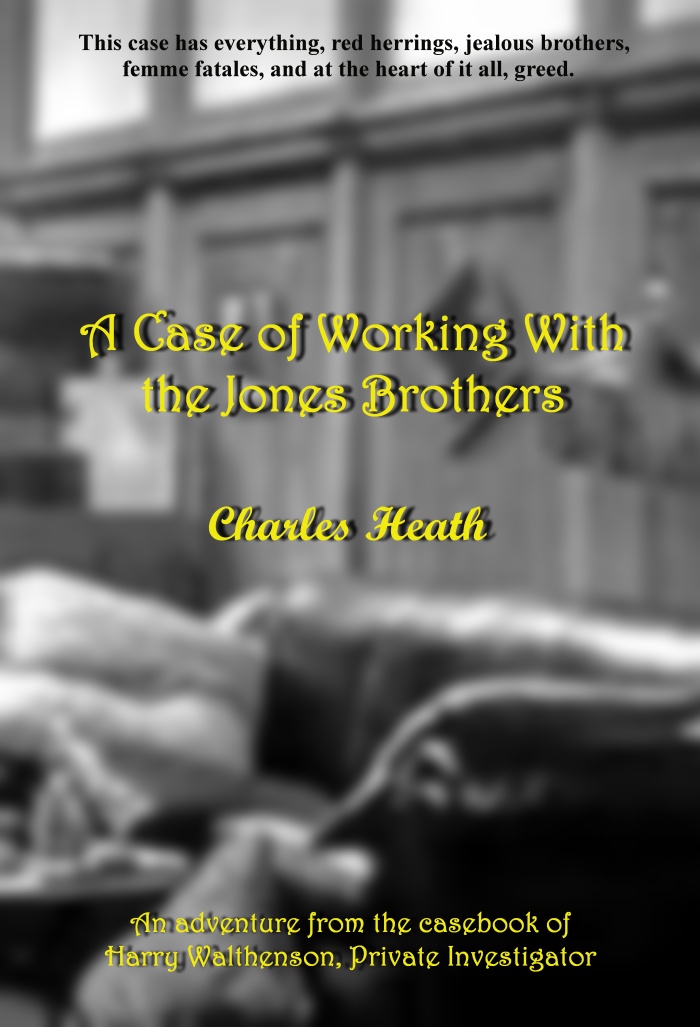
This case has everything, red herrings, jealous brothers, femme fatales, and at the heart of it all, greed.
See below for an excerpt from the book…
Coming soon!
An excerpt from the book:
When Harry took the time to consider his position, a rather uncomfortable position at that, he concluded that he was somehow involved in another case that meant very little to him.
Not that it wasn’t important in some way he was yet to determine, it was just that his curiosity had got the better of him, and it had led to this: sitting in a chair, securely bound, waiting for someone one of his captors had called Doug.
It was not the name that worried him so much, it was the evil laugh that had come after the name was spoken.
Doug what? Doug the ‘destroyer’, Doug the ‘dangerous’, Doug the ‘deadly’; there was any number of sinister connotations, and perhaps that was the point of the laugh, to make it more frightening than it was.
But there was no doubt about one thing in his mind right then: he’d made a mistake. A very big. and costly, mistake. Just how big the cost, no doubt he would soon find out.
His mother, and his grandmother, the wisest person he had ever known, had once told him never to eavesdrop.
At the time he couldn’t help himself and instead of minding his own business, listening to a one-sided conversation which ended with a time and a place. The very nature of the person receiving the call was, at the very least, sinister, and, because of the cryptic conversation, there appeared to be, or at least to Harry, criminal activity involved.
For several days he had wrestled with the thought of whether he should go. Stay on the fringe, keep out of sight, observe and report to the police if it was a crime. Instead, he had willingly gone down the rabbit hole.
Now, sitting in an uncomfortable chair, several heat lamps hanging over his head, he was perspiring, and if perspiration could be used as a measure of fear, then Harry’s fear was at the highest level.
Another runnel of sweat rolled into his left eye, and, having his hands tied, literally, it made it impossible to clear it. The burning sensation momentarily took his mind off his predicament. He cursed and then shook his head trying to prevent a re-occurrence. It was to no avail.
Let the stinging sensation be a reminder of what was right and what was wrong.
It was obvious that it was the right place and the right time, but in considering his current perilous situation, it definitely was the wrong place to be, at the worst possible time.
It was meant to be his escape, an escape from the generations of lawyers, what were to Harry, dry, dusty men who had been in business since George Washington said to the first Walthenson to step foot on American soil, ‘Why don’t you become a lawyer?” when asked what he could do for the great man.
Or so it was handed down as lore, though Harry didn’t think Washington meant it literally, the Walthenson’s, then as now, were not shy of taking advice.
Except, of course, when it came to Harry.
He was, Harry’s father was prone to saying, the exception to every rule. Harry guessed his father was referring to the fact his son wanted to be a Private Detective rather than a dry, dusty lawyer. Just the clothes were enough to turn Harry off the profession.
So, with a little of the money Harry inherited from one of his aunts, he leased an office in Gramercy Park and had it renovated to look like the Sam Spade detective agency, you know the one, Spade and Archer, and The Maltese Falcon.
There’s a movie and a book by Dashiell Hammett if you’re interested.
So, there it was, painted on the opaque glass inset of the front door, ‘Harold Walthenson, Private Detective’.
There was enough money to hire an assistant, and it took a week before the right person came along, or, more to the point, didn’t just see his business plan as something sinister. Ellen, a tall cool woman in a long black dress, or so the words of a song in his head told him, fitted in perfectly.
She’d seen the movie, but she said with a grin, Harry was no Humphrey Bogart.
Of course not, he said, he didn’t smoke.
Three months on the job, and it had been a few calls, no ‘real’ cases, nothing but missing animals, and other miscellaneous items. What he really wanted was a missing person. Or perhaps a beguiling, sophisticated woman who was as deadly as she was charming, looking for an errant husband, perhaps one that she had already ‘dispatched’.
Or for a tall, dark and handsome foreigner who spoke in riddles and in heavily accented English, a spy, or perhaps an assassin, in town to take out the mayor. The man was such an imbecile Harry had considered doing it himself.
Now, in a back room of a disused warehouse, that wishful thinking might be just about to come to a very abrupt end, with none of the romanticized trappings of the business befalling him. No beguiling women, no sinister criminals, no stupid policemen.
Just a nasty little man whose only concern was how quickly or how slowly Harry’s end was going to be.