Inspiration, maybe – Volume 1

50 photographs, 50 stories, of which there is one of the 50 below.

They all start with –

A picture paints … well, as many words as you like.  For instance:

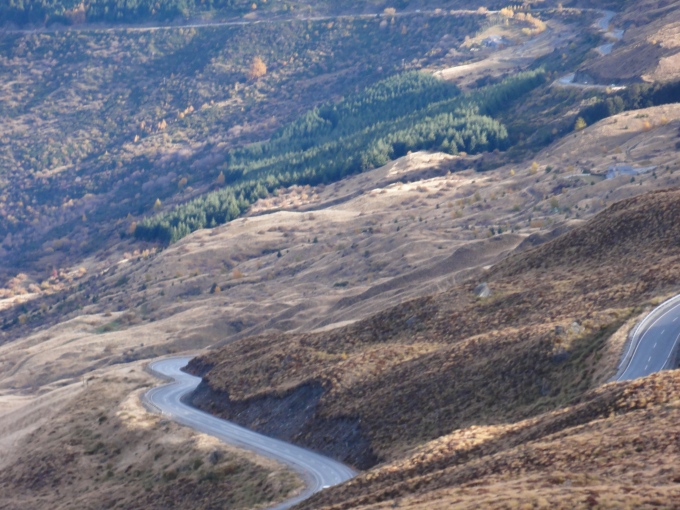
lookingdownfromcoronetpeak

And the story:

It was once said that a desperate man has everything to lose.

The man I was chasing was desperate, but I, on the other hand, was more desperate to catch him.

He’d left a trail of dead people from one end of the island to the other.

The team had put in a lot of effort to locate him, and now his capture was imminent.  We were following the car he was in, from a discrete distance, and, at the appropriate time, we would catch up, pull him over, and make the arrest.

There was nowhere for him to go.

The road led to a dead-end, and the only way off the mountain was back down the road were now on.  Which was why I was somewhat surprised when we discovered where he was.

Where was he going?

“Damn,” I heard Alan mutter.  He was driving, being careful not to get too close, but not far enough away to lose sight of him.

“What?”

“I think he’s made us.”

“How?”

“Dumb bad luck, I’m guessing.  Or he expected we’d follow him up the mountain.  He’s just sped up.”

“How far away?”

“A half-mile.  We should see him higher up when we turn the next corner.”

It took an eternity to get there, and when we did, Alan was right, only he was further on than we thought.”

“Step on it.  Let’s catch him up before he gets to the top.”

Easy to say, not so easy to do.  The road was treacherous, and in places just gravel, and there were no guard rails to stop a three thousand footfall down the mountainside.

Good thing then I had the foresight to have three agents on the hill for just such a scenario.

Ten minutes later, we were in sight of the car, still moving quickly, but we were going slightly faster.  We’d catch up just short of the summit car park.

Or so we thought.

Coming quickly around another corner we almost slammed into the car we’d been chasing.

“What the hell…” Aland muttered.

I was out of the car, and over to see if he was in it, but I knew that it was only a slender possibility.  The car was empty, and no indication where he went.

Certainly not up the road.  It was relatively straightforward for the next mile, at which we would have reached the summit.  Up the mountainside from here, or down.

I looked up.  Nothing.

Alan yelled out, “He’s not going down, not that I can see, but if he did, there’s hardly a foothold and that’s a long fall.”

Then where did he go?

Then a man looking very much like our quarry came out from behind a rock embedded just a short distance up the hill.

“Sorry,” he said quite calmly.  “Had to go if you know what I mean.”

I’d lost him.

It was as simple as that.

I had been led a merry chase up the hill, and all the time he was getting away in a different direction.

I’d fallen for the oldest trick in the book, letting my desperation blind me to the disguise that anyone else would see through in an instant.

It was a lonely sight, looking down that road, knowing that I had to go all that way down again, only this time, without having to throw caution to the wind.

“Maybe next time,” Alan said.

“We’ll get him.  It’s just a matter of time.”

© Charles Heath 2019-2021

Find this and other stories in “Inspiration, maybe”  available soon.

InspirationMaybe1v1

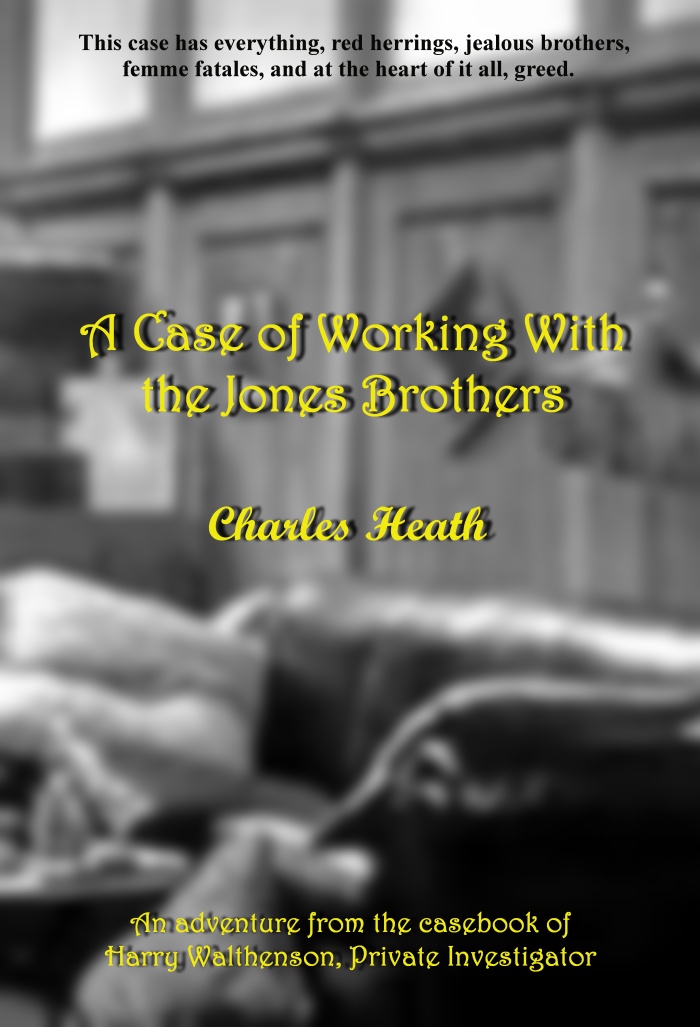
The first case of PI Walthenson – “A Case of Working With the Jones Brothers”

This case has everything, red herrings, jealous brothers, femme fatales, and at the heart of it all, greed.

See below for an excerpt from the book…

Coming soon!

PIWalthJones1

An excerpt from the book:

When Harry took the time to consider his position, a rather uncomfortable position at that, he concluded that he was somehow involved in another case that meant very little to him.

Not that it wasn’t important in some way he was yet to determine, it was just that his curiosity had got the better of him, and it had led to this: sitting in a chair, securely bound, waiting for someone one of his captors had called Doug.

It was not the name that worried him so much, it was the evil laugh that had come after the name was spoken.

Doug what? Doug the ‘destroyer’, Doug the ‘dangerous’, Doug the ‘deadly’; there was any number of sinister connotations, and perhaps that was the point of the laugh, to make it more frightening than it was.

But there was no doubt about one thing in his mind right then: he’d made a mistake. A very big. and costly, mistake. Just how big the cost, no doubt he would soon find out.

His mother, and his grandmother, the wisest person he had ever known, had once told him never to eavesdrop.

At the time he couldn’t help himself and instead of minding his own business, listening to a one-sided conversation which ended with a time and a place. The very nature of the person receiving the call was, at the very least, sinister, and, because of the cryptic conversation, there appeared to be, or at least to Harry, criminal activity involved.

For several days he had wrestled with the thought of whether he should go. Stay on the fringe, keep out of sight, observe and report to the police if it was a crime. Instead, he had willingly gone down the rabbit hole.

Now, sitting in an uncomfortable chair, several heat lamps hanging over his head, he was perspiring, and if perspiration could be used as a measure of fear, then Harry’s fear was at the highest level.

Another runnel of sweat rolled into his left eye, and, having his hands tied, literally, it made it impossible to clear it. The burning sensation momentarily took his mind off his predicament. He cursed and then shook his head trying to prevent a re-occurrence. It was to no avail.

Let the stinging sensation be a reminder of what was right and what was wrong.

It was obvious that it was the right place and the right time, but in considering his current perilous situation, it definitely was the wrong place to be, at the worst possible time.

It was meant to be his escape, an escape from the generations of lawyers, what were to Harry, dry, dusty men who had been in business since George Washington said to the first Walthenson to step foot on American soil, ‘Why don’t you become a lawyer?” when asked what he could do for the great man.

Or so it was handed down as lore, though Harry didn’t think Washington meant it literally, the Walthenson’s, then as now, were not shy of taking advice.

Except, of course, when it came to Harry.

He was, Harry’s father was prone to saying, the exception to every rule. Harry guessed his father was referring to the fact his son wanted to be a Private Detective rather than a dry, dusty lawyer. Just the clothes were enough to turn Harry off the profession.

So, with a little of the money Harry inherited from one of his aunts, he leased an office in Gramercy Park and had it renovated to look like the Sam Spade detective agency, you know the one, Spade and Archer, and The Maltese Falcon.

There’s a movie and a book by Dashiell Hammett if you’re interested.

So, there it was, painted on the opaque glass inset of the front door, ‘Harold Walthenson, Private Detective’.

There was enough money to hire an assistant, and it took a week before the right person came along, or, more to the point, didn’t just see his business plan as something sinister. Ellen, a tall cool woman in a long black dress, or so the words of a song in his head told him, fitted in perfectly.

She’d seen the movie, but she said with a grin, Harry was no Humphrey Bogart.

Of course not, he said, he didn’t smoke.

Three months on the job, and it had been a few calls, no ‘real’ cases, nothing but missing animals, and other miscellaneous items. What he really wanted was a missing person. Or perhaps a beguiling, sophisticated woman who was as deadly as she was charming, looking for an errant husband, perhaps one that she had already ‘dispatched’.

Or for a tall, dark and handsome foreigner who spoke in riddles and in heavily accented English, a spy, or perhaps an assassin, in town to take out the mayor. The man was such an imbecile Harry had considered doing it himself.

Now, in a back room of a disused warehouse, that wishful thinking might be just about to come to a very abrupt end, with none of the romanticized trappings of the business befalling him. No beguiling women, no sinister criminals, no stupid policemen.

Just a nasty little man whose only concern was how quickly or how slowly Harry’s end was going to be.

© Charles Heath 2019

The cinema of my dreams – I never wanted to go to Africa – Episode 28

Our hero knows he’s in serious trouble.

The problem is, there are familiar faces and a question of who is a friend and who is foe made all the more difficult because of the enemy, if it was the enemy, simply because it didn’t look or sound or act like the enemy.

Now, it appears, his problems stem from another operation he participated in.

…

I was escorted to a small room that adjoined the interview room, and I was separated from the main event by a one-way mirror.

It was a cliché, but not surprising.

The interrogation room was much the same as an office, with a table, two chairs, and on the side, a cabinet, closed up, an interesting addition to what might be called a boring room.

It was currently empty, and I was the only one in this small room, sitting at a counter, looking in.  In front of me was a stack of writing pads, pens and pencils.  I wondered if I was the only party that was about to observe Lallo and the new arrival.

Five minutes passed before the door to the room next door opened and a hooded man was led in.  His hands were cuffed, and his legs had chains, standard prisoner gear.  

From the man’s manner and body language, it appeared to me as though he was surprised he was being treated so badly, and was not forcefully resistant, but wasn’t making it easy for his captors.

He was asked to sit, and when he didn’t he was forced to sit, with some force, and then his hands were locked onto the metal bar at the table.  His legs were locked to a lower bar.  A precaution in case he decided to attack his interrogator.

One thing I knew for sure, this man would not give up information willingly.

Once he was secured, one guard took up station inside the door, and the other left.  That’s when Lallo made his appearance.  He came in, put a file on the desk, nodded to the guard who remove3d the hood, and then he sat.

I’d expected to see Lallo in full uniform.  He was not.  He was, if anything, dressed casually.  The man on the other side was in a cream suit, very crumpled and slightly stained as if he had not changed during the entire journey from capture to this room.

No doubt part of his conditioning.

“Mr Jacobi, that is your name isn’t it?”

The man stared at him sullenly.  I got the impression he was usually the one asking the questions, not the other way around.

The man lifted his head and stared straight at Lallo.  It was not a look I’d want to be on the end of, but Lallo, I suspect, had been on the end of a lot worse.  And a closer inspection of his face, and features, I noticed that someone had already started the harsher form of interrogation.

“You know this already.  I am an employee of the United States Government, your Government, and you will regret treating me like this.”

“That may be so, but you have failed to define what part of the Government it is you work for.  Is it the CIA?”

Another withering stare, followed by, “You people are so incompetent, the left-hand does not know what the right hand is doing.  I require a telephone so that I can contact my liaison, and this farce will stop, and you will be reprimanded very severely.”

“I seriously doubt anyone knows you are missing yet.  Maybe after a week or so, but we know you keep to yourself, and very few people know your business, a situation, I assure you, benefits us more than it benefits you.  So I will assume you are Jacobi.”

There was a knock on the door, and Monroe came in with a small box, handed it to Lallo, and then left again.

Lallo looked in the box, then pulled out a plastic evidence bag with a mobile phone in it, and put it on the table.  “This is the phone you use to call General Bahti, your contact inside the current government.  It seems it is not registered with a telephone network in your country, but another, shall we say neutral, country.

He reached into the box and pulled out another plastic evidence bag also with mobile phone in it.  “This phone,” he held it up, “is the one you use to talk to the, shall we call them the local resistance.  It’s so much nicer than calling them rebels.”

The man’s eyes followed each bag from the box to the table.  He was almost expressionless.

Then Lallo pulled out another bag, with another phone, “This is the phone which you make and receive calls from your American contact.  It is what we call a burner phone, and was given to you, we think, on a recent visit to this country, by that contact.  I am assuming this is the person you wish to call and who will stop this farce.”

If Lallo was expecting the man to break down there and then, he was sadly mistaken.  There was little if any movement in his expression, perhaps just enough for Lallo to assume he’d got the men behind the phones correct.  That he was basically unmoved at Lallo’s revelations told me this man had a resolve Lallo was going to find hard to shake.

Lallo took the third phone out of the evidence bag and pushed it across the table towards the man.  “You can call your contact now, and you can tell him I would like to speak to him.”

…

© Charles Heath 2019-2022

Knowledge can be dangerous… – A short story

It was, perhaps, the saddest week of my life.

It started with a phone call, then a visit by two police officers.  It was about my parents, but the news could not be imparted over the phone, only in person.  That statement alone told me it was very bad news, so I assumed the worst.

The two police officers, standing at the front door, grim expressions on their faces, completed the picture.  The news, my parents were dead, killed in a freak car accident.

At first, it didn’t sink in.  They were on their way back from another of their extensive holidays, one of many since my father had retired.  I’d seen them probably six months out of the last five years, and the only reason they were returning this time was that my mother needed an operation.

They hadn’t told me why, not that they ever told me very much any time since the day I’d been born, but that was who they were.  I thought them eccentric, being older when I’d come along, and others thought them, well, eccentric.

And being an only child, they packed me off to boarding school, then university, and then found me a job in London, and set me up so that I would only see them weekends if they were home.

I had once wondered if they ever cared about me, keeping me at arm’s length, but my mother some time ago had taken me aside and explained why.  It was my father’s family tradition.  The only part I’d missed was a nanny.

It most likely explained why I didn’t feel their passing as much as I should.

A week later, after a strange funeral where a great many people I’d never met before, and oddly who knew about me, I found myself sitting in the sunroom, a glass of scotch in one hand, and an envelope with my name on it, in the other.

The solicitor, a man I’d never met before, had given it to me at the funeral.   We had, as far as I knew an elderly fellow, one of my father’s old school friends, as the family solicitor, but he hadn’t shown at the funeral and wasn’t at home when I called in on my way home.

It was all very odd.

I refilled the glass and took another look at the envelope.  It was not new, in fact, it had the yellow tinge of age, with discoloration where the flap was.  The writing was almost a scrawl, but identifiable as my father’s handwriting, perhaps an early version as it was now definitely an illegible scrawl.

I’d compared it with the note he’d left me before they had embarked on their last adventure, everything I had to do while caretaking their house.  The last paragraph was the most interesting, instructing me to be present when the cleaning lady came, he’d all but accused her of stealing the candlesticks.

To be honest, I hadn’t realized there were candlesticks to steal, but there they were, on the mantlepiece over the fire in the dining room.  The whole house was almost like being in an adventure park, stairs going up to an array of rooms, mostly no longer used, and staircase to the attic, and then another going down to the cellar.  The attic was locked and had been for as long as I could remember, and the cellar was dank and draughty.

Much like the whole house, but not surprising, it was over 200 years old.

And perhaps it was now mine.  The solicitor, a man by the name of Sir Percival Algernon Bridgewater, had intimated that it might be the last will and testament and had asked me to tell him if it was.  I was surprised that Sir Percival didn’t have the document in question.

And equally. so that the man I knew as his solicitor, Lawerence Wellingham, didn’t have a copy of my father’s last will and testament either.

I finished the drink, picked up the envelope, and opened it.

It contained two sheets of paper, the will, and a letter.  A very short letter.

“If you are reading this I have died before my time.  You will need to find Albert Stritching, and ask him to help you find the murderer.”

Even the tenor of that letter didn’t faze me as it should have, because at this point nothing would surprise me.  In fact, as I  unfolded the document that proclaimed it was the will, I was ready for it to say that whole of his estate and belongings were to be left to some charity, and I would get an annual stipend of a thousand pounds.

In fact, it didn’t.  The whole of his estate was left to my mother should she outlive him, or in the event of her prior decease, to me.

I had to put all of those surprises on hold to answer a knock on the door.

Lawerence Wellingham.

I stood too e side, let him pass, closed the door, and followed him into the front room, the one my mother called the ‘drawing room’ though I never knew why.

He sat in one of the large, comfortable lounge chairs.  I sat in the other.

I showed him the will.  I kept the other back, not knowing what to make of it.

“No surprise there,” Wellingham said.

“Did you have any idea what my father used to do, beyond being, as he put it, a freelance diplomat?”

I thought it a rather odd description but it was better than one he once proffered, ‘I do odd jobs for the government’.

“I didn’t ask.  Knowledge can be dangerous, particularly when associated with your father.  Most of us preferred not to know, but one thing I can tell you.  If anyone tries to tell you what happened to your parents was not an accident, ignore them.  Go live your life, and keep those memories you have of them in the past, and don’t look back.  They were good people, Ken, remember them as such.”

We reminisced for the next hour, making a dent in the scotch, one of my father’s favorite, and he left.

Alone again, the thoughts went back to the second note from my father.  That’s when the house phone rang.

Before I could answer it, a voice said, “My name is Stritching.  Your father might have mentioned me?  We need to talk.”

—-

© Charles Heath 2020-2021

Writing about writing a book – Day 25

We’ve been given the introduction to who Barry McDougall is, or the man otherwise known as ‘Brainless’, and after three days of trying to get it straight, this is the first rough draft of his start in the story.

Barry, whose daring selfless deeds earned him the nickname Brainless because that was the only way to describe the motivation behind them, was one of the regular soldiers, and, for a long time, had been my only true friend.  His was a reputation both friends and foes alike considered awesome.  He’d been in Vietnam, and later just turned up at Davenport’s camp, reporting for duty.

Davenport was more surprised than I was at his arrival, but obviously, after checking his credentials, he was impressed because he let him stay.  And it would be true to say, if he had not, I would not be here now.

So Barry was just the sort of person I needed to help me.

That was the good news.

The bad news was Barry, at the best of times, either on one of his ‘benders’ using drugs or alcohol, whatever was easier to get at the time, lost to everyone, or locked up in a mental institution, having admitted himself.  He had no interest in participating in life, hadn’t worked in years, and often said, in moments when he was at his lowest, that he did not care if he lived or died.  It had not always been that way, but his demons had all but taken him over, and despite the help, I tried to give him, nothing could shake him out of this lethargy.  He said once he envied me that I could not remember the dark days, and, now those memories had returned, I knew what he meant.

For a long time, I could not understand why he didn’t try harder to help himself, and I guess he humored me by accepting the jobs I’d found him, and the help I offered.  I owed him a great deal, but that was probably the one honorable thing about him, he never expected, nor wanted, anything in return.

He tried to make a go of being a police officer and lasted several years before he resigned over an incident that didn’t reach the papers.  There was, he said, no place for heroics in modern society.  I hadn’t got to the bottom of it, but I heard he shot some thieves at a time when the police were trying to promote a pacifist image.

He tried a few other occupations with an equal lack of success, so now he survived on whatever money I gave him.  He lived on the street, and when he was not there, I knew he could be found in a bar, in one of the more seedier parts of the city, a ubiquitous underground bar called Jackson’s, named after a man who had a salubrious reputation that hovered between load shark and saint, and who was reputed to be buried under the storeroom floor.  The present owner, or what I assumed to be the owner, was a large, gruff, ex-prizefighter, who had the proverbial heart of gold, most of the time, and who took my money and looked after Barry without making it look like he was.

I’d called the bartender in advance, and he said he was in his usual spot, and that it was at the start of the next cycle, having just discharged himself from the hospital after a bout of pneumonia.  It was, he said, getting worse, and taking longer to recover.

It was probably only a matter of time before it took him, so perhaps this time I would have to try harder to convince him to give up his nomadic lifestyle.

When I walked in, the aroma of spilled beer, stale sweat, and vomit, mingled with the industrial-strength carbolic cleaner almost took my breath away.  In the corner, two construction workers were sitting, quietly smoking and drinking large glasses of beer.  In the other, Barry was being held up by the table, an untouched double scotch sitting in front of him.  Sitting at the bar was a woman of indeterminate age, badly made up, and thin to the point of emaciation.  I was not sure what she was drinking, or what it was she was smoking, but I could smell it from the front doorway.

The bartender, Ogilvy, no first name given, was pretending to polish glasses, standing at the end of the bar, looking at the television, playing some daytime soap.  He didn’t look over when I came in, but I knew he didn’t miss anything.  I saw him flick a glance at Barry, and then shake his head.  I think he cared as much about Barry as I did, but could recognize the sadness within him.  As much as Ogilvy said, which wasn’t much, he too had seen service in Vietnam, and it had affected him too.

I ordered an orange juice, caught the glances from the construction workers, and a steely look from the woman then went over to Barry’s table and sat down.  Despite the loud scraping noise when I moved the chair, or the creaking as I sat in it, Barry didn’t move.

Whilst the bar had that seedy aroma, Barry was showing the signs of having spent time on the street.  It was one of the disadvantages of having no permanent residence and though there was a shower at the bar which Ogilvy let Barry use from time to time, he obviously hadn’t for a few days.

Getting all of this background in shape is hard work, and having toiled long and hard, tomorrow I’ll have a go at getting Barry back.

…

© Charles Heath 2016-2021

Writing about writing a book – Day 24, a missing piece of the puzzle

There’s always the necessity for creating backstories so that the reader doesn’t come across a part of the story that doesn’t make sense.

Perhaps one of my failings is that I have to go over what I’ve already written, sometimes to make sure there is continuity and that what I’ve written makes sense.

This collection of memories our main character is having serves the purpose of setting up later plot points, but more importantly, is supposed to give the reader an idea of what the main character has gone through before arriving at the start of the story.

This part will serve to provide a little more information on the relationship between Bill and Barry, though I rather like the nickname I gave him.

“Bastards,” Killer muttered.

We called him ‘Killer’ because it was the nickname the Army had given him.  We were sharing the guard duty and had spoken briefly over the watch, but up till then, the silence had stretched over an hour or so.  It didn’t take long for anyone to realize he was a man of few words.

He’d been in the regular army for years and asked for the posting.  He’d made Sergeant several times, only to lose those same stripes for fighting, usually after R&R and a bout of heavy drinking.  Now assigned to our platoon to lend his experience, the conscripts were expecting him to ‘look after’ them.  Other than myself and the Lieutenant, he was the only other regular soldier.  Unfortunately for them, he hated both conscripts and the Viet Cong in varying degrees, and depending on his mood there was little tolerance left for the rest of us.

“The people who sent us here or the people trying to kill us?” I asked before I realized I’d spoken.

I didn’t hear the reply, the skies opening up with another torrential downpour that lasted for about five minutes, and going as fast as it came.  When the sun finally came up, it would make the atmosphere steamy, hot, and unbearable.  It was quite warm now, and I was feeling both uncomfortable, and fatigued.

Killer looked just as stoic as he had before the rain.  He looked at me.  “Damn weather.  Worse than home.”

“Scotland?”

“Scapa Flow, Kirkwall.  I should have been an engineer on ships like my father, but I was too stupid.  Joined the Army, finished up here.  What’s your excuse?”

“Square peg in a round hole.  The army seems to handle us in its stride.”  It was more or less the truth.  I joined the Army to get away from my parents.

“That it does.  That it does.”

The rain came and went, during which the rest of the camp roused and went about its business.  It had been a long night for some, still getting over the shock of the attack, and the ever-pervading thought the enemy was still out there, biding their time.  It would be, for them, a waiting game, waiting for the conditions to wear us down, and lose concentration as inevitably we would.

Certainly, by the time we were relieved from sentry duty, I felt I was in no condition to match wits with a donkey, let alone the enemy on his own home ground.  When I stumbled over to the mess area and looked at the tired and haggard looks on the faces of the platoon, I realized that went for all of us.

Killer and I managed to get about an hour’s rest before the call came to move out, rain or no rain, and after a breakfast to make anyone ill, we left.  For hours it rained.  No one spoke as we strained to listen over the rain spattering on the undergrowth, all the time expecting the unexpected.  That was the benefit of the surprise attack; we no longer took for granted we would be safe.

Water gathered in pools along the trail, hiding any chance of seeing landmines.  Rainwater and sweat ran into our eyes, making it difficult to see.  Water leaked everywhere, making it very uncomfortable.  This was not war.  This was utter stupidity.

I was about to remark on the futility of it all to the Lieutenant, who had taken the lead, when one second he was talking to me and the next he crashed to the ground, a sniper’s bullet killing him instantly.   Someone yelled “Contact” and we hit the ground, bullets flying all around us. 

Too late, I thought, as I felt the hit of what seemed to be a large rock, then the searing pain in my leg, just as I hit the ground…


© Charles Heath 2015-2021

The A to Z Challenge – F is for – “Fortune favours the brave”

It had been a last-minute decision to move from the city to the suburbs.

Of course, the benefits far outweighed the minor inconvenience of the extra commute, but there was room to grow, and for the same money, instead of a cramped two-bedroom apartment, we had a four-bedroom three-bathroom two-story residence with land, a garage with a workspace, a lawn to more and a garden to tend.

And half a street away, the ocean, so near I could sometimes hear the waves, and certainly when the wind was blowing in off the sea, the aroma of salt in the air.

Every morning I woke up and said a silent prayer to the Gods that had made our wishes come true

I woke up to the sun streaming through the bedroom windows, another morning in paradise.  I looked sideways, but Tiana was already up and about, more than likely on her early morning run.

I didn’t have the same enthusiasm, for rising early and exercising.  I went out onto the balcony and looked in the direction of the ocean, a cloudless sky indicating another hot day was coming.

I went downstairs, and the first thing I noticed, Tiana’s computer was missing.  Another check showed she had gone to work, apparently forsaking her usual exercise regime, something she rarely did, and not in the time I’d known her, which was coming up to five years.

I turned on the TV to get the morning news as I did. Every morning while making and drinking that first cup of coffee, and some muesli.

A breaking story.

Tiana worked at the TV station, but her role was to work on the evening news stories, after giving up the morning news role and the 3am starts when we got married.  Less pay she said, but less stress, it was one of the reasons we moved to the suburbs.

I hadn’t heard her phone, but she must have been called in, her experience a factor, she was the best in the business, and other stations had tried to lure her away.

The screen was frozen on the words, breaking the story, as if they were building tension.

Then the power shut down.

We’d been having intermittent issues with fuses, and it was probably just another fuse.  I went out to the garage where the fuse box was, but all the fuses were intact.

I went out to the street, where Larry, the next-door neighbor was looking first one way, then the other, trying to locate a cause.  A few of the other neighbors were doing the same.

I was reminded of a report that was passed on to us to read, about what to expect I’d there was a sudden loss of services, fuel, and food.  Each premise preceding such an event was unrealistic, oil supplies stopped, electricity power stations were sabotaged, being attacked by foreign missiles since the latter items were now capable of traveling long distances.

But what was predicted to happen after that was even more unbelievable, that society as we know it would start showing cracks after two weeks, then if nothing improved, two months before complete anarchy would reign?  I had faith in mankind and wrote it off as scaremongering.

“What do you think is going on, Dave?” He asked me.  “Your station should have some idea.”

Larry thought, because I was a policeman, I had the answers to everything.  The fact I was a beat cop held no significance.

“Not a clue.  It’s probably just the power station struggling to deal with the heatwave.  I suspect it’s probably a brownout.  I’m sure you got the same letter from the power company as we did saying supplies might be cut off from time to time.”

“I don’t think it’s that.  It’s a bit bigger than just in this neighborhood, my brother just called, and it’s the same thing 30 miles away.  This is big.”

Which in my mind had bigger ramifications?  With no power, and no communication, especially between police officers, the propensity to commit crime was huge.  Was there a crime syndicate behind this?  A few months before an attack on a power station stopped supply for a short time, after which it was discovered there had been a spate of robberies.

Criminals were getting more inventive.

“I’ll find out,” I said, heading back inside, hoping my mobile phone still had a signal.

The house was eerily silent without anything running, and it felt weird knowing there was no power anywhere. 

Unlike most people, I had a survival kit, all the items we had been trained to set aside in case of a disaster, one we hoped would never happen.  Medical supplies, torch, battery-operated radio, and long-life food in the form of bars and cans.

I kept it on the back of a cupboard in the garage, the torch, and radio the most accessible items.  I checked my phone and there was no signal.  The towers were down.

I put the batteries in the radio and turned it on.  The first station I tuned into was in the middle of an announcement.

“…there is a city-wide blackout with all power stations temporarily off-line.  The repair crews are on-site and expect the power will be restored imminently.  Those with radios who can hear this announcement, please tell everyone to get a battery-operated radio and listen for further instructions.

All police, medical, first responders, fire services, and military should stand by on their respective communication devices for further instructions.”

I hadn’t given that a thought. 

Something else I hadn’t remembered was that some time ago I had given Tiana a device similar to the two-way radio I used for work, that used a spare frequency that no one knew about.  Yet.  I’d found it by accident, tinkering.

I went into the house and up to the clinic in the bedroom where the two devices were kept.  If she had left it at home, it wouldn’t be much use, but being called in like she had, I wonder if she suspected something more sinister was developing.

I looked in the box and Tiana’s was missing.

Now I was worried.

When I went back out to the street, I could hear the sound of emergency service vehicles’ sirens, in the distance, and getting closer.

There was a scratchy sound on my device, an indication someone was about to talk.

Then, a voice, Tiana’s.  “David, I know you’re there?”

When I turned my device on, it sent a signal to others on that frequency.

“I am.  What’s going on, do you know?”

“From what we’re being told, and, at the moment, can’t tell anyone, is there’s been a highly coordinated attack on a dozen powers stations and sub-stations effectively blacking out the city.  No one knows why yet, but there’s a chance one of the saboteurs is going to escape the way he came, by sea, near where we live of all places.  They tracked his arrival, one the got a photo of him.”

The FBI was very good at tracking people, but I imagine it was a concerted effort between the CIA, the FBI, and local police forces.  I guess, being my day off, they thought it best to leave me in peace.

She gave me a description of the man and signed off because someone was coming, and she would get into trouble, or worse.

I also had a gun stashed in the same place as the radios, checked it, and, safety on, put it in my pocket.

Just in case.

A saboteur was on the loose.

It explained why the sirens were so close.  Were they chasing him, or just heading to where he was expected to leave?

Was he in a car, or on foot?

I heard what sounded like someone stifling calling out, just the start of a word.  Coming from next door, I wondered if Larry had hurt himself.  He was, by his own admission a handyman, but according to everyone who knew him, he was not that handy.

I went next door, down the side towards his workshop in a large barn-type building in the yard.  The sliding doors were slightly ajar, he was probably inside and hurt.

It wouldn’t be the first time.

I put my head in and saw him with another man at the back where Larry was fumbling with a set of keys trying to unlock the back doors.

On the other side was a pickup with a boat and trailer, ready to head out fishing, when he got the time.  I’d been once with him, and the boat was borderline seaworthy.

He’d been tinkering with it a few days before.

“Everything all right Larry?”

“We’re fine.  Larry asked me to go fishing with him, and now seemed like a good day,” the man answered for him.

Larry looked panic-stricken.

I’d seen people like that before, usually with a gun or knife prodded into their ribs.

A closer look at the man, he could be the one Tiana described.  Certainly, the height, and the look of a construction worker or tradesman.

“Perhaps I might join you since it’s my day off.”

Larry turned, and his expression told me exactly what was going on.  “We’re in a hurry, Dave.  Just room for the two of us.  Another time.”

With the unwritten ‘please leave’ on his face.

I shrugged.  “OK.  Catch you later.”

I had about a minute, possibly two, before the man realized, I was not going to leave.  He knew it looked suspicious.

It just depended on how long it took Larry to open the doors.

I dodged abound the side, and under the window, as I passed it to the other end of the barn.

Just as I reached the end, I heard one of the two doors open, but no talking.

A sixth sense perhaps, told me the man might have come back to the front, and suspecting I hadn’t left, was about to come around the corner.  If he did, there was nowhere to hide.

Gun out, safety off, pointing in that direction, I waited.

Nothing.

If he wasn’t…

The sound of a crumpling aluminum can from behind gave me just enough time to turn, make sure it was the man, and shoot.

Not to kill, but to stop.  Only after he fell to the ground did I realize he had been holding Larry as a shield, and it was he who stepped on the can.

How he managed to get that fraction of separation, I don’t know, and he probably would never be able to explain it, but there wasn’t time for analysis right then, or for me to realize how stupid I’d just been.

And not a story I was going to tell Tiana.


© Charles Heath 2022

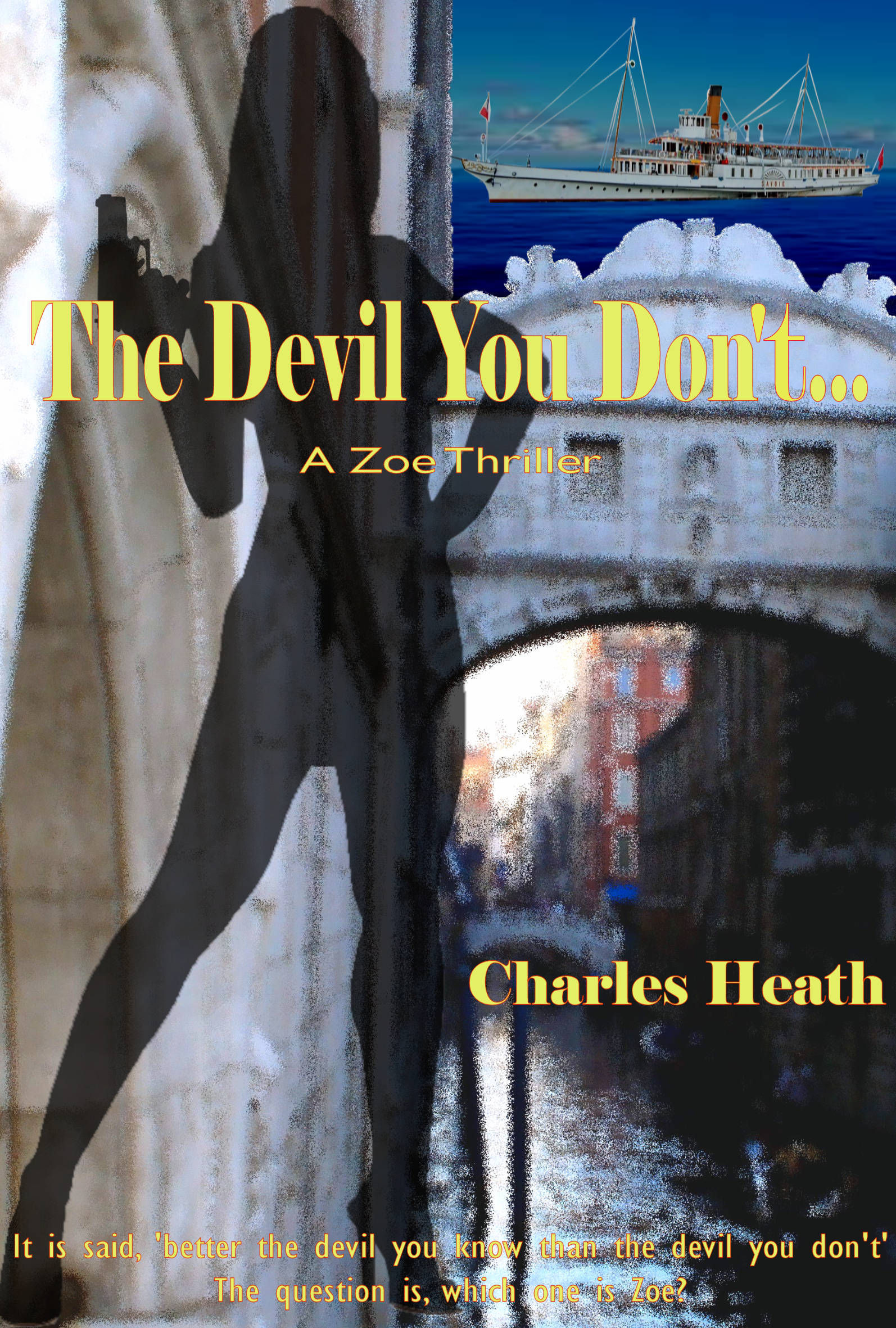
“The Devil You Don’t” – A beta readers view

It could be said that of all the women one could meet, whether contrived or by sheer luck, what are the odds it would turn out to be the woman who was being paid a very large sum to kill you.

John Pennington is a man who may be lucky in business, but not so lucky in love. He has just broken up with Phillipa Sternhaven, the woman he thought was the one, but relatives and circumstances, and perhaps because she was a ‘princess’, may also have contributed to the end result.

So, what do you do when you are heartbroken?

That is a story that slowly unfolds, from the first meeting with his nemesis on Lake Geneva, all the way to a hotel room in Sorrento, where he learns the shattering truth.

What should have been a high turns out to be something else entirely, and from that point every thing goes to hell in a handbasket.

He suddenly realises his so-called friend Sebastian has not exactly told him the truth about a small job he asked him to do, the woman he is falling in love with is not quite who she says she is, and he is caught in the middle of a war between two men who consider people becoming collateral damage as part of their business.

The story paints the characters cleverly displaying all their flaws and weaknesses. The locations add to the story at times taking me back down memory lane, especially to Venice where in those back streets I confess it’s not all that hard to get lost.

All in all a thoroughly entertaining story with, for once, a satisfying end.

…

Available on Amazon here: https://amzn.to/2Xyh1ow

…

NaNoWriMo – April 2022 – Day 7

First Dig Two Graves, the second Zoe thriller.

…

With Zoe gone and not looking like she will be coming back, John has to get back into the mainstream of life.

Or he could do something a little more positive, try and find Zoe and seek out her intentions. To that end, he comes up with an idea, phone an old friend, Rupert, who once had aspirations of being a private investigator, and employ him to find her.

But, as he quickly remembers, Rupert has a sister named Isobel who hates him, and despite her, John hires them, though when Rupert learns he’s looking for a Russian/Chinese assassin, he has momentary second thoughts.

Money always speaks the right language.

But, lurking in the background, Sebastian now had a tail on John, almost knowing that he was never going to take his advice and leave Zoe alone.

And, like John, he knew of Rupert, and his sister, yet another of Sebastian’s once upon a time hot dates that failed, and of her situation, which means he was about to kill two birds with one stone.

Find out what John was up to.

Isobel is about to liven their lives up considerably.

…

Today’s writing, with Isobel about to torment two very different men, 4,474 words, for a total of 18,055.

An excerpt from “Mistaken Identity” – a work in progress

The odds of any one of us having a doppelganger are quite high. Whether or not you got to meet him or her, or be confronted by them was significantly lower. Except of course, unless you are a celebrity.

It was a phenomenon remarkable only for the fact, at times, certain high profile people, notorious or not, had doubles if only to put off enemies or the general public. Sometimes we see people in the street, people who look like someone we knew, and made the mistake of approaching them like a long lost friend, only to discover an embarrassed individual desperately trying to get away for what they perceive is a stalker or worse.

And then sometimes in is a picture that looms up on a TV screen, an almost exact likeness of you. At first you are fascinated, and then according to the circumstances, and narrative that is attached to that picture, either flattered or horrified.

For me one turned to the other when I saw an almost likeness of me flash up on the screen when I turned the TV on in my room. What looked to be my photo, with only minor differences, was in the corner of the screen, the news reader speaking in rapid Italian, so fast I could only translate every second or third word.

But the one word I did recognize was murder. The photo of the man up on the screen was the subject of an extensive manhunt. The crime, murder of woman in the very same hotel I was staying, and it was being played out live several floors above me. The gist of the story, the woman had been seen with, and staying with the man who was my double, and, less than an hour ago, the body had been discovered by a chambermaid.

The killer, the announcer said, was believed to be still in the hotel because the woman had died shortly before she had been discovered.

I watched, at first fascinated at that I was seeing. I guess I should have been horrified, but at that moment it didn’t register that I might be mistaken for that man.

Not until an another five minutes had passed, and I was watching the police in full riot gear, with a camera crew following behind, coming up a passage towards a room. Live action of the arrest of the suspected killer the breathless commentator said.

Then, suddenly, there was a pounding on the door. On the TV screen, plain to see, was the number of my room.
I looked through the peep hole and saw an army of police officers. It didn’t take much to realize what had happened. The hotel staff had identified me as the man in the photograph on the TV and called the police.

Horrified wasn’t what I was feeling right then.

It was fear.

My last memory was the door crashing open, the wood splintering, and men rushing into the room, screaming at me, waving guns, and when I put my hands up to defend myself, I heard a gunshot.

And in one very confused and probably near death experience, I thought I saw my mother, and thinking what was she doing in Rome?

…

I was the archetypal nobody.

I lived in a small flat, I drove a nondescript car, had an average job in a low profile travel agency, was single, and currently not involved in a relationship, no children, and according to my workmates, no life.

They were wrong. I was one of those people who preferred their own company, I had a cat, and travelled whenever I could. And I did have a ‘thing’ for Rosalie, one of the reasons why I stayed at the travel agency. I didn’t expect anything to come of it, but one could always hope.

I was both pleased and excited to be going to the conference. It was my first, and the glimpse I had seen of it had whetted my appetite for more information about the nuances of my profession.

Some would say that a travel agent wasn’t much of a job, but to me, it was every bit as demanding as being an accountant or a lawyer. You were providing a customer with a service, and arguably more people needed a travel agent than a lawyer. At least that was what I told myself, as I watched more and more people start using the internet, and our relevance slowly dissipating.

This conference was about countering that trend.

The trip over had been uneventful. I was met at the airport and taken to the hotel where the conference was being held with a number of other delegates who had arrived on the same plane. I had mingled with a number of other delegates at the pre conference get together, including one whose name was Maryanne.

She was an unusual young woman, not the sort that I usually met, because she was the one who was usually surrounded by all the boys, the life of the party. In normal circumstances, I would not have introduced myself to her, but she had approached me. Why did I think that may have been significant? All of this ran through my mind, culminating in the last event on the highlight reel, the door bursting open, men rushing into my room, and then one of the policemen opened fire.

I replayed that last scene again, trying to see the face of my assailant, but it was just a sea of men in battle dress, bullet proof vests and helmets, accompanied by screaming and yelling, some of which I identified as “Get on the floor”.

Then came the shot.

Why ask me to get on the floor if all they were going to do was shoot me. I was putting my hands up at the time, in surrender, not reaching for a weapon.

Then I saw the face again, hovering in the background like a ghost. My mother. Only the hair was different, and her clothes, and then the image was going, perhaps a figment of my imagination brought on by pain killing drugs. I tried to imagine the scene again, but this time it played out, without the image of my mother.

I opened my eyes took stock of my surroundings. What I felt in that exact moment couldn’t be described. I should most likely be dead, the result of a gunshot wound. I guess I should be thankful the shooter hadn’t aimed at anything vital, but that was the only item on the plus side.

I was in a hospital room with a policeman by the door. He was reading a newspaper, and sitting uncomfortably on a small chair. He gave me a quick glance when he heard me move slightly, but didn’t acknowledge me with either a nod, or a greeting, just went back to the paper.

If I still had a police guard, then I was still considered a suspect. What was interesting was that I was not handcuffed to the bed. Perhaps that only happened in TV shows. Or maybe they knew I couldn’t run because my injuries were too serious. Or the guard would shoot me long before my feet hit the floor. I knew the police well enough now to know they would shoot first and ask questions later.

On the physical side, I had a large bandage over the top left corner of my chest, extending over my shoulder. A little poking and prodding determined the bullet had hit somewhere between the top of my rib cage and my shoulder. Nothing vital there, but my arm might be somewhat useless for a while, depending on what the bullet hit on the way in, or through.

It didn’t feel like there were any broken or damaged bones.

That was the good news.

On the other side of the ledger, my mental state, there was only one word that could describe it. Terrified. I was looking at a murder charge and jail time, a lot of it. Murder usually had a long time in jail attached to it.

Whatever had happened, I didn’t do it. I know I didn’t do it, but I had to try and explain this to people who had already made up their minds. I searched my mind for evidence. It was there, but in the confused state brought on by the medication, all I could think about was jail, and the sort of company I was going to have.

I think death would have been preferable.

…

Half an hour later, maybe longer, I was drifting in an out of consciousness, a nurse, or what I thought was a nurse, came into the room. The guard stood, checked her ID card, and then stood by the door.

She came over and stood beside the bed. “How are you?” she asked, first in Italian, and when I pretended I didn’t understand, she asked the same question in accented English.

“Alive, I guess,” I said. “No one has come and told what my condition is yet. You are my first visitor. Can you tell me?”

“Of course. You are very lucky to be alive. You will be fine and make a full recovery. The doctors here are excellent at their work.”

“What happens now?”

“I check you, and then you have a another visitor. He is from the British Embassy I think. But he will have to wait until I have finished my examination.”

I realized then she was a doctor, not a nurse.

…

My second visitor was a man, dressed in a suit the sort of which I associated with the British Civil Service.  He was not very old which told me he was probably a recent graduate on his first posting, the junior officer who drew the short straw.

The guard checked his ID but again did not leave the room, sitting back down and going back to his newspaper.

My visitor introduced himself as Alex Jordan from the British Embassy in Rome and that he had been asked by the Ambassador to sort out what he labelled a tricky mess.

For starters, it was good to see that someone cared about what happened to me.  But, equally, I knew the mantra, get into trouble overseas, and there is not much we can do to help you.  So, after that lengthy introduction, I had to wonder why he was here.

I said, “They think I am an international criminal by the name of Jacob Westerbury, whose picture looks just like me, and apparently for them it is an open and shut case.”  I could still hear the fragments of the yelling as the police burst through the door, at the same time telling me to get on the floor with my hands over my head.

“It’s not.  They know they’ve got the wrong man, which is why I’m here.  There is the issue of what had been described as excessive force, and the fact you were shot had made it an all-round embarrassment for them.”

“Then why are you here?  Shouldn’t they be here apologizing?”

“That is why you have another visitor.  I only took precedence because I insisted I speak with you first.  I have come, basically to ask you for a favour.  This situation has afforded us with an opportunity.  We would like you to sign the official document which basically indemnifies them against any legal proceedings.”

Curious.  What sort of opportunity was he talking about?  Was this a matter than could get difficult and I could be charged by the Italian Government, even if I wasn’t guilty, or was it one of those hush hush type deals, you do this for us, we’ll help you out with that.  “What sort of opportunity?”

“We want to get our hands on Jacob Westerbury as much as they do.  They’ve made a mistake, and we’d like to use that to get custody of him if or when he is arrested in this country.  I’m sure you would also like this man brought into custody as soon as possible so you will stop being confused with him.  I can only imagine what it was like to be arrested in the manner you were.  And I would not blame you if you wanted to get some compensation for what they’ve done.  But.  There are bigger issues in play here, and you would be doing this for your country.”

I wondered what would happen if I didn’t agree to his proposal.  I had to ask, “What if I don’t?”

His expression didn’t change.  “I’m sure you are a sensible man Mr Pargeter, who is more than willing to help his country whenever he can.  They have agreed to take care of all your hospital expenses, and refund the cost of the Conference, and travel.  I’m sure I could also get them to pay for a few days at Capri, or Sorrento if you like, before you go home.  What do you say?”

There was only one thing I could say.  Wasn’t it treason if you went against your country’s wishes?

“I’m not an unreasonable man, Alex.  Go do your deal, and I’ll sign the papers.”

“Good man.”

…

After Alex left, the doctor came back to announce the arrival of a woman, by the way she had announced herself, the publicity officer from the Italian police. When she came into the room, she was not dressed in a uniform.

The doctor left after giving a brief report to the civilian at the door. I understood the gist of it, “The patient has recovered excellently and the wounds are healing as expected. There is no cause for concern.”

That was a relief.

While the doctor was speaking to the civilian, I speculated on who she might be. She was young, not more than thirty, conservatively dressed so an official of some kind, but not necessarily with the police. Did they have prosecutors? I was unfamiliar with the Italian legal system.

She had long wavy black hair and the sort of sultry looks of an Italian movie star, and her presence made me more curious than fearful though I couldn’t say why.

The woman then spoke to the guard, and he reluctantly got up and left the room, closing the door behind him.
She checked the door, and then came back towards me, standing at the end of the bed. Now alone, she said, “A few questions before we begin.” Her English was only slightly accented. “Your name is Jack Pargeter?”

I nodded. “Yes.”

“You are in Rome to attend the Travel Agents Conference at the Hilton Hotel?”

“Yes.”

“You attended a preconference introduction on the evening of the 25th, after arriving from London at approximately 4:25 pm.”

“About that time, yes. I know it was about five when the bus came to collect me, and several others, to take us to the hotel.”

She smiled. It was then I noticed she was reading from a small notepad.

“It was ten past five to be precise. The driver had been held up in traffic. We have a number of witnesses who saw you on the plane, on the bus, at the hotel, and with the aid of closed circuit TV we have established you are not the criminal Jacob Westerbury.”

She put her note book back in her bag and then said, “My name is Vicenza Andretti and I am with the prosecutor’s office. I am here to formally apologize for the situation that can only be described as a case of mistaken identity. I assure you it is not the habit of our police officers to shoot people unless they have a very strong reason for doing so. I understand that in the confusion of the arrest one of our officers accidentally discharged his weapon. We are undergoing a very thorough investigation into the circumstances of this event.”

I was not sure why, but between the time I had spoken to the embassy official and now, something about letting them off so easily was bugging me. I could see why they had sent her. It would be difficult to be angry or annoyed with her.

But I was annoyed.

“Do you often send a whole squad of trigger happy riot police to arrest a single man?” It came out harsher than I intended.

“My men believed they were dealing with a dangerous criminal.”

“Do I look like a dangerous criminal?” And then I realized if it was mistaken identity, the answer would be yes.

She saw the look on my face, and said quietly, “I think you know the answer to that question, Mr. Pargeter.”

“Well, it was overkill.”

“As I said, we are very sorry for the circumstances you now find yourself in. You must understand that we honestly believed we were dealing with an armed and dangerous murderer, and we were acting within our mandate. My department will cover your medical expenses, and any other amounts for the inconvenience this has caused you. I believe you were attending a conference at your hotel. I am very sorry but given the medical circumstances you have, you will have to remain here for a few more days.”

“I guess, then, I should thank you for not killing me.”

Her expression told me that was not the best thing I could have said in the circumstances.

“I mean, I should thank you for the hospital and the care. But a question or two of my own. May I?”

She nodded.

“Did you catch this Jacob Westerbury character?”

“No. In the confusion created by your arrest he escaped. Once we realized we had made a mistake and reviewed the close circuit TV, we tracked him leaving by a rear exit.”

“Are you sure it was one of your men who shot me?”

I watched as her expression changed, to one of surprise.

“You don’t think it was one of my men?”

“Oddly enough no. But don’t ask me why.”

“It is very interesting that you should say that, because in our initial investigation, it appeared none of our officer’s weapons had been discharged. A forensic investigation into the bullet tells us it was one that is used in our weapons, but…”

I could see their dilemma.

“Have you any enemies that would want to shoot you Mr Pargeter?”

That was absurd because I had no enemies, at least none that I knew of, much less anyone who would want me dead.

“Not that I’m aware of.”

“Then it is strange, and will perhaps remain a mystery. I will let you know if anything more is revealed in our investigation.”

She took an envelope out of her briefcase and opened it, pulling out several sheets of paper.

I knew what it was. A verbal apology was one thing, but a signed waiver would cover them legally. They had sent a pretty girl to charm me. Perhaps using anyone else it would not have worked. There was potential for a huge litigation payout here, and someone more ruthless would jump at the chance of making a few million out of the Italian Government.

“We need a signature on this document,” she said.

“Absolving you of any wrong doing?”

“I have apologized. We will take whatever measures are required for your comfort after this event. We are accepting responsibility for our actions, and are being reasonable.”

They were. I took the pen from her and signed the documents.

“You couldn’t add dinner with you on that list of benefits?” No harm in asking.

“I am unfortunately unavailable.”

I smiled. “It wasn’t a request for a date, just dinner. You can tell me about Rome, as only a resident can. Please.”

She looked me up and down, searching for the ulterior motive. When she couldn’t find one, she said, “We shall see once the hospital discharges you in a few days.”

“Then I’ll pencil you in?”

She looked at me quizzically. “What is this pencil me in?”

“It’s an English colloquialism. It means maybe. As when you write something in pencil, it is easy to erase it.”

A momentary frown, then recognition and a smile. “I shall remember that. Thank-you for your time and co-operation Mr. Pargeter. Good morning.”

…

© Charles Heath 2015-2021