There’s something to be said for a story that starts like a James Bond movie, throwing you straight in the deep end, a perfect way of getting to know the main character, David, or is that Alistair?
A retired spy, well not so much a spy as a retired errand boy, David’s rather wry description of his talents, and a woman that most men would give their left arm for, not exactly the ideal couple, but there is a spark in a meeting that may or may not have been a set up.
But as the story progressed, the question I kept asking myself was why he’d bother.
And, page after unrelenting page, you find out.
Susan is exactly the sort of woman the pique his interest. Then, inexplicably, she disappears. That might have been the end to it, but Prendergast, that shadowy enigma, David’s ex boss who loves playing games with real people, gives him an ultimatum, find her or come back to work.
Nothing like an offer that’s a double edged sword!
A dragon for a mother, a sister he didn’t know about, Susan’s BFF who is not what she seems or a friend indeed, and Susan’s father who, up till David meets her, couldn’t be less interested, his nemesis proves to be the impossible dream, and he’s always just that one step behind.
When the rollercoaster finally came to a halt, and I could start breathing again, it was an ending that was completely unexpected.
This is not a treatise, but a tongue in cheek, discussion on how to write short stories. Suffice to say this is not the definitive way of doing it, just mine. It works for me – it might not work for you.
…
Now, there’s this thing called continuity, but it covers a whole range of writing sins, most of which I eventually get caught out. Films sometimes miss a few items, like back in the roman days, there are plane trails in the sky, in a 1920’s period piece, there’s a mobile phone sitting on a desk.
Like one minute the hero has a gun, and the next he’s fighting for his life with a knife, and, hey presto, there’s that gun again. The error might not be that big but you can’t pull out a weapon you don’t have or wasn’t there in the first place.
Similarly, the hero pulls out a mobile phone, but there’s only one problem, it’s 1980, and there are no mobile phones. Our problem might be that we are so used to doing and using certain things that we might forget, for a minute or two, that were not available in the past.
Then there’s places like hotels and restaurants, both of which change hands and close and reopen with a different owner like someone changes their socks. There’s no substitute for checking, on the internet of course, whether a Hilton Hotel was in 6th Avenue, New York, in 1920.
The answer is no. The first Hilton Hotel was in Waco in 1927. The New York Hilton opened in 1963.
The same goes for the fashion of the day.
I’m no fashion guru, but I have to rely on Google once again to fill in the gaps.
And my all-time favourite, getting the right make and model of car.
Oh, and just for good measure, back in the old days they used acoustic couplers to attach to phones via a serial port to dial-up not a server, but a BBS, Bulletin Board Service, at a rate of 300 baud, or a little while later, 1,200 baud.
There was no internet in general use. If you wanted to call the office when out, use a telephone box. Or carrier pigeon.
And the use of language, there’s a lot of stuff relevant today that was not used back then, and there was a lot of stuff back then that isn’t tolerated now. Some of it might be hard to get your head around.
It isn’t for me, because I can remember the 1970s and 1980s, but I’m not too sure about allowing some of what happened then to creep into my work.
So, you get the picture. Try to use the past as the past, or leave it in the past.
Unless it’s a book about time travel, then all bets are off.
With my attention elsewhere, I walked into a man who was hurrying in the opposite direction. He was a big man with a scar running down the left side of his face from eye socket to mouth, and who was also wearing a black shirt with a red tie.
That was all I remembered as my heart almost stopped.
He apologized as he stepped to one side, the same way I stepped, as I also muttered an apology.
I kept my eyes down. He was not the sort of man I wanted to recognize later in a lineup. I stepped to the other side and so did he. It was one of those situations. Finally getting out of sync, he kept going in his direction, and I towards the bus, which was now pulling away from the curb.
Getting my breath back, I just stood riveted to the spot watching it join the traffic. I looked back over my shoulder, but the man I’d run into had gone. I shrugged and looked at my watch. It would be a few minutes before the next bus arrived.
Wait, or walk? I could also go by subway, but it was a long walk to the station. What the hell, I needed the exercise.
At the first intersection, the ‘Walk’ sign had just flashed to ‘Don’t Walk’. I thought I’d save a few minutes by not waiting for the next green light. As I stepped onto the road, I heard the screeching of tires.
A yellow car stopped inches from me.
It was a high powered sports car, perhaps a Lamborghini. I knew what they looked like because Marcus Bartleby owned one, as did every other junior executive in the city with a rich father.
Everyone stopped to look at me, then the car. It was that sort of car. I could see the driver through the windscreen shaking his fist, and I could see he was yelling too, but I couldn’t hear him. I stepped back onto the sidewalk, and he drove on. The moment had passed and everyone went back to their business.
My heart rate hadn’t come down from the last encounter. Now it was approaching cardiac arrest, so I took a few minutes and several sets of lights to regain composure.
At the next intersection, I waited for the green light, and then a few seconds more, just to be sure. I was no longer in a hurry.
At the next, I heard what sounded like a gunshot. A few people looked around, worried expressions on their faces, but when it happened again, I saw it was an old car backfiring. I also saw another yellow car, much the same as the one before, stopped on the side of the road. I thought nothing of it, other than it was the second yellow car I’d seen.
At the next intersection, I realized I was subconsciously heading towards Harry’s new bar. It was somewhere on 6th Avenue, so I continued walking in what I thought was the right direction.
I don’t know why I looked behind me at the next intersection, but I did. There was another yellow car on the side of the road, not far from me. It, too, looked the same as the original Lamborghini, and I was starting to think it was not a coincidence.
Moments after crossing the road, I heard the roar of a sports car engine and saw the yellow car accelerate past me. As it passed by, I saw there were two people in it, and the blurry image of the passenger; a large man with a red tie.
Now my imagination was playing tricks.
It could not be the same man. He was going in a different direction.
In the few minutes I’d been standing on the pavement, it had started to snow; early for this time of year, and marking the start of what could be a long cold winter. I shuddered, and it was not necessarily because of the temperature.
I looked up and saw a neon light advertising a bar, coincidentally the one Harry had ‘found’ and, looking once in the direction of the departing yellow car, I decided to go in. I would have a few drinks and then leave by the back door if it had one.
For a story that was conceived during those long boring hours flying in a steel cocoon, striving to keep away the thoughts that the plane and everyone in it could just simply disappear as planes have in the past, it has come a long way.
Whilst I have always had a fascination with what happened during the second world war, not the battles or fighting, but in the more obscure events that took place, I decided to pen my own little sidebar to what was a long and bitter war.
And, so, it continues…
——
Jackerby trusted no one. He had been given orders by someone further up the ranks than Wallace and his people, someone who suspected that some or all of the Englishmen turned German turned Englishmen were traitors.
The only men he could trust fully were those who had come with him in the glider, a dozen at most. It’s why he had just completed a secret briefing with his second in command who would take over the operation if anything happened to him.
Not that it would, but he liked the idea of being prepared, and humoring the others into believing they were essential to the operation. Eckhardt would be a good man in a crisis, battle scarred from the Russian front, and glad to be on this operation for obvious reasons.
He would do anything Jackerby asked, even kill Wallace and Johannsen if he was required to.
That might yet be necessary because Wallace didn’t seem interested in going after Atherton which made him think that Wallace wasn’t all that he appeared to be. Atherton was a thorn in their operation and had to be eliminated. The fact Wallace and Johannsen didn’t agree with him raised suspicions as to their motives.
Was there ultimately going to be a triple cross?
He had been lurking in the shadows when Wallace gave the drunken fool Leonardo his orders to go down to the village. More defectors. Jackerby couldn’t understand why anyone would want to leave the Reich, especially when they were winning the war, and, if it were up to him, he’d executer the lot of them not send them back.
But, orders were orders.
He went back to Eckhardt and told him he was going down to the village to observe Leonardo and his team in action, and that he was in charge of the men in his absence.
Eckhardt, on the other hand, knew that Jackerby, if he could find a way that would not cause them trouble, was going to eliminate Leonardo because they were a liability. The plan was once Leonardo and his men were gone, Jackerby would take over rounding up the defectors. Or, more to the point, they would go missing before reaching the castle. There was only one that mattered, the rest were dead weight. And once the prize had been captured, Jackerby would escort him home and collect the kudos for himself and his men.
The ultimate prize; leave to reunite briefly with their families and a cushy job in Berlin, away from the horrors of war in the trenches.
Leonardo and the five others that made up the resistance left the castle by one of the underground tunnels. Leonardo knew of two, both of them shown to him by Carlo. He knew that Carlo knew where more were, but Carlo was not particularly helpful at the best of times.
He also knew Carlo might be stupid enough to storm the castle, especially after what Leonardo had done to Martina, and, when it hadn’t happened, he suspected Atherton had appealed to him to wait.
Atherton, too, he knew had some idea of the layout of the castle, have been told to keep an eye on Atherton when he first arrived because he was reportedly an archaeologist. Leonardo had, and reported back to Wallace that it appeared Atherton had been surveying the castle. He had simply been told to keep Atherton under surveillance, and make notes of any discoveries, and particularly what Atherton was doing.
He had, not that it amounted to much. Not when he realized Leonardo was following him. Leonardo decided not to tell Wallace Atherton had rumbled him, just that he was roaming the passages looking for something.
It had worked so far and kept Wallace off his back, but it wasn’t going to last.
Bottom line, Leonardo had to find and kill Atherton before any trouble started, otherwise, it would be his neck on the block.
Jackerby followed.
It wasn’t hard to follow Leonardo because he and his man were the last people to know what stealth was. He could hear them crashing through the forest between the castle and the village up to 250 meters away, he was making so much noise.
But, Jackerby thought, perhaps Leonardo didn’t need to worry about alerting his presence to Atherton, not if he was already working with him.
To Jackerby and his paranoia, it made sense. Maybe he was going to meet with Atherton right now and do a deal with the defectors. How many others had turned up at the village in the last week or so, and never made it to the castle?
He was right, Jackerby told himself, not to trust them. Everyone, in the end, was an enemy of the Reich.
It took 20 minutes to reach the outskirts of the village, and when Jackerby could see the edge of the woods, and the barn and remains of the farmhouse just the other side of the tree line, he dropped back, found a suitable observation point, and waited.
Leonardo and his men had stopped at the back of the barn, and one of his men was about to go find the defectors. The rest of Leonardo’s men would wait with him, and surprise their guests, before taking them back to the castle.
As far as “Jackerby was concerned, they would never reach the castle, and this time, he would take care of Leonardo, and the others.
It would be easy to say that Atherton had killed all the members of the resistance, and then got killed himself in a shootout with Jackerby. It was a plausible reason for all the deaths, though he would have to come up with a suitable excuse for leaving the castle and following Leonardo and his men when Wallace had expressly forbidden it.
Wallace.
Perhaps if he got his hands on Atherton he’d ask him if Wallace was a traitor.
I’m back to writing, sitting at the desk, pad in front of me, pen in hand.
The only thing lacking is an idea.
It’s 9:03 am, too early to start on a six-pack.
I need a distraction.
Blogging, websites, Twitter, and Facebook, all of these social media problems are swirling around in my mind.
The more I read the more it bothers me that if I don’t have the right social media presence if I do not start to build an email list, all of my efforts in writing a book will come to naught.
Then I start trawling the internet for information on marketing and found a plethora of people offering any amount of advice for anything between a ‘small amount’ to a rather large amount that gives comprehensive coverage of most social media platforms for periods of a day, a week or a month. I don’t have a book so it’s a bit early to be worrying about that.
I move on to the people who offer advice for a cost on how to build a following, how to build a web presence, how to get a thousand Twitter followers, and how to get thousands of email followers before the launch.
The trouble is I’m writing a novel, not a nonfiction book, or have some marvellous 30 page ebook on how to do something, for free just to drive people to my site.
I’m a novelist, not a handyman so those ideas while good are not going to help me.
Yet another problem to wrestle with along with actually creating a product to sell in the first place.
Except I’m supposed to be writing for the love of it without the premeditated idea of writing for gain or getting rich quick.
What am I missing here?
So should l be writing short stories and offering them for free to drive people to my site? These would have to be genre-specific so it needs time and effort and fit into a convenient size story that will highlight or showcase my talent.
Or should I create a website for the novel and set up pages for the characters and get some interaction going that way?
It will be difficult without giving the whole plot away so if I do it will have to be carefully managed.
I don’t think I will have a good night’s sleep again with all of these social media problems I’m going to have.
Oh well, back to the book. It’s time to have a nightmare of a different sort!
I guess the point is that I have at least crystallised my thoughts on paper so that I can do something with them. After all, anything is better than nothing, isn’t it?
Sometimes I wonder. I look back on a lot of the stuff I wrote forty or fifty years ago and it looks bad. The thing is, then, I thought it was great, and that I was destined to do great things with the written word.
Pity, all this time later, I’ve turned into a self-critical monster, where it seems nothing I write is any good.
So, does that mean we need to be less critical of our work? After all, through the years, when I’ve shared novels and short stories with others, they have all universally said they’re quite good.
So…
Ut’s time to go back to the previous day’s work and rework it. Yes, the idea that I wanted to write about is where I wanted the story to go, it’s just the execution.
The problem is, since then a few other ideas have been running around in the back of my head, and these could be added or used to further the current plotline.
The other problem is, it is one of the six stories that I’m writing by the seat of my pants, you know, the way some pilots like to fly a plane, without all that computer backup. Similarly, this is the way I sometimes like to write.
It’s as much a surprise to me is it is to the reader.
There’s good arguments for having planned the story from start to finish, but with these, I like to write it and see where it takes me. They’re episodic, so sometimes I get to write three of four episodes at a time, and these would most likely in a book become a chapter.
Last night I wrote two episodes, but it seems that it might need pointers back in previous episodes, because we all like to leave a trail of crumbs for the reader so when they get to the denouement, they remember, ah yes, back in chapter two such and such happened, but why am I only remembering it now?
Ok, enough convincing myself I’m a good writer, it’s time to get back to work…
Every time I close my eyes, I see something different.
I’d like to think the cinema of my dreams is playing a double feature but it’s a bit like a comedy cartoon night on Fox.
But these dreams are nothing to laugh about.
Once again there’s a new installment of an old feature, and we’re back on the treasure hunt.
…
A dark look crossed Boggs’ face telling me the name Ormiston wasn’t associated with anything good. I was still wondering how I had never heard anything about the family.
“How did you stumble across Fredrich Ormiston?”
“I told you I was keeping an eye on Alex. He and some chap who was, coincidentally, one of the guards we saw at the mall yesterday, they were talking about Ormiston. I’ve never heard of him.”
“That’s because the Ormiston’s disappeared from around here before the second world war. What did Alex have to say about him?”
“From what I overheard, he owned a large tract of land near Patterson’s Reach, that it stretched back to something called the fault line, that he sold the coastal area to the Navy and that’s where they put the dockyard, and other than that, not much. That guard had been doing some investigating for Alex and said he went to the library to ask Gwen. She’s still there by the way. She didn’t tell him very much, and even if she did know anything, she hates Alex and his friends as much as we do so she wouldn’t tell him.”
“She’d know of him. But she would be only one of a few, and those that do would be in the old folks’ home or dead.”
“And yet the name lights up your face, Boggs. How do you know about him?”
“Not me personally. My family. He and my grandfather were friends back in the day. He sold our family a large block near the river to run some cattle. My father wasn’t the first to have information about the treasure, and in fact, according to my dad’s diary, that original map we have was my grandfather’s.”
“How come you didn’t tell me about this before?”
“Not relevant. The map has always been in my family’s possession. My grandfather had made several attempts to find the treasure, and, one day, in a moment of forgetfulness, he told Ormiston about it. Well, you know how the thought of finding treasure can turn heads, Ormiston persuaded my grandfather to provide him with a copy of the map, and in return, he would fund a proper search party to see if they could find it. After all, he said, fifty percent of a trove was better than zero percent of nothing. By that time my grandfather was getting old, and the idea of finding the treasure was slipping through his fingers, so he agreed. Worst days work he ever did.”
“But Ormiston never found the treasure, did he?”
“That’s not the point. He did as he promised in the first instance, and they found nothing. It was a lot of money in pursuit of what could be compared to the holy grail. When my grandfather died, Ormiston decided he was no longer bound to any agreement, and mounted several more treasure hunts, and when my father tried to get him to adhere to the original agreement, Ormiston just brushed him off.”
“He still didn’t find anything. In the end, he lost his fortune and had to sell the land, hence the Naval Base. Do you know who got the rest?”
“Ormiston died on the last treasure hunt, and left massive debts behind, and a widow. They had several kids but no one knows where they went, and it was a long time ago. They had to sell the property to repay the debts. It went to property developers and then the Cossatino’s bought it. They moved in after Ormiston moved out. It’s why Patterson’s Reach is basically a no-go zone.”
I’d often wondered how the Cossatino’s came to town, and why it was they camped in Patterson’s Reach, away from the Benderby’s.
“Alex’s mate was talking about looking for relatives, though I’m not sure why.”
“There are no relatives, not according to my mother, but there were rumors that Ormiston had made extensive notes on all of his hunts, so from that perspective, if the documents existed, it would be useful to align what he knew with what my father says in his journal.”
A good point, and it might be still a possibility if the documents held at the library were to contain any journals. It also made sense, in my mind, why the Cossatino’s decided to run a map scam; had they come across Ormiston’s journals, and maps, and got Boggs father to base his fakes around those? It was starting to throw a giant cold shadow over the whole of this project, and that Boggs was simply missing the point.
If Ormiston couldn’t find anything, and he had money to burn when he mounted the searches, perhaps it was just a myth. And who’s to say that Boggs’s grandfather didn’t make the whole thing up himself?
Just the same, until I was certain, I was going to keep the existence of the papers in the library to myself for the time being.
But, something else just occurred to me. “Do you have anything from your grandfather, in particular about the searches he made, with or without Ormiston?”
“Only that one with Ormiston. In the end, he concluded that it was his belief that Ormiston had deliberately set the wrong course, which was why they never found anything. He had used two different river heads as his basis, to which my grandfather tried to convince him otherwise. Of course, there were considerable differences of opinion, and after they returned, never spoke to each other again.”
Not surprising.
“Well, that adds some more background to the quest. Are you sure you have the right rivers as markers? I mean there are quite a few rivers and streams as well as a few lakes up and down the coastline?”
“My father was certain, and his father was before him. As am I. Let me know when you free next so we can continue the quest.”
I should not have doubted him, but the more he talked about Ormiston, the darker he was looking. It was probably for the best I left him alone for the afternoon if only to calm down.
“Sunday in New York” is ultimately a story about trust, and what happens when a marriage is stretched to its limits.
When Harry Steele attends a lunch with his manager, Barclay, to discuss a promotion that any junior executive would accept in a heartbeat, it is the fact his wife, Alison, who previously professed her reservations about Barclay, also agreed to attend, that casts a small element of doubt in his mind.
From that moment, his life, in the company, in deciding what to do, his marriage, his very life, spirals out of control.
There is no one big factor that can prove Harry’s worst fears, that his marriage is over, just a number of small, interconnecting events, when piled on top of each other, points to a cataclysmic end to everything he had believed in.
Trust is lost firstly in his best friend and mentor, Andy, who only hints of impending disaster, Sasha, a woman whom he saved, and who appears to have motives of her own, and then in his wife, Alison, as he discovered piece by piece damning evidence she is about to leave him for another man.
Can we trust what we see with our eyes or trust what we hear?
Haven’t we all jumped to conclusions at least once in our lives?
Can Alison, a woman whose self-belief and confidence is about to be put to the ultimate test, find a way of proving their relationship is as strong as it has ever been?
When it came to holidays, I preferred to get as far away from everyone as possible.
I saw my parents, and sister who lived with them, every week on Sunday, for lunch and cross-examination of why I was not married with children yet.
Explaining I was only 27 was not a reason because, “your brother married at 21 and he’s got three children, a great job, his own house..” and in and on it went.
And I saw my brother every other Saturday just to tell him that I was Ok. He was considerate in one sense, it was just the matchmaking wife always inviting what she considered suitable women for me.
That fortnight off work was an oasis in a desert full of well-meaning people.
I’d tried dating several girls at work, but they never got past the family inquisition. If I had been in their shoes I’d just say it was all too much too. The lesson I learned there was to never take a girlfriend home.
But, for now, I was footloose and fancy-free. The most recent girl I’d met had decided to return home, no it was nothing I’d done wrong, but I guess it was. Perhaps asking to go with me to Hawaii was a bit too forward too soon. Another lesson learned.
I think I’d probably get it right by the time I was fifty.
So here I was, a history buff, looking to further my knowledge of the events surrounding Pearl Harbour. I’d read a great many history books on the subject, and now, it was a matter of going there, and getting a feel for the place.
More than once I had lamented the fact I could not go back in time and live through the event. I had mentioned this once to a friend, and he asked if I was stark staring mad.
Of course, he was right. Who would want to be in the middle of such a violent attack, especially when it came largely by surprise?
Since my work required mt to fly a lot I had sufficient frequent flyer points to upgrade to first class. I was hoping after flying coach for so long, I’d notice the difference.
Certainly, the initial service after being shown my seat, and the champagne soon after as a welcome onboard, set the tone.
When the door closed, and everyone was on board, only half the seats in first class were taken. A glance at those who were fellow travelers showed an interesting cross-section. A husband and wife who definitely upgraded from coach like me, but were a little m less refined. An executive and his personal assistant, who, judging by the way she looked after him, there was more to that relationship, a woman in her sixties, definitely born to money, and casting somewhat distasteful stares at the upgrade couple, and a woman about my age, who looked very unhappy.
I managed to fit in another glass of champagne before the plane reached the runway.
Then, with a roar of the engines, we were off.
Halfway through the 13-hour flight, I found it impossible to sleep, even with the luxury first-class provided me. I just couldn’t sleep on planes. Instead, I sat up, found a book of crosswords, one of three or four I always had with me and usually got to solve one or two puzzles.
It was quiet and still except for the noise of the air rushing past outside the plane. In that almost soundless atmosphere, I thought I could detect any changes in engine speed or the gentle movement of a change of course. The ride was quite smooth, except for some turbulence and the pilot took us up another 2,000 feet to escape it. We’d been slowly coming back down over the last hour. I’d been monitoring it on the flight path screen. It might be a larger screen, but watching movies was, to me, boring, except in a cinema.
“Can’t sleep either?”
It was the soft voice of the girl from two seats across. She had several revolutions of the plane, exercising I heard her explain to the cabin crew because she couldn’t sit down for long periods.
“Not on planes, no. Trains, yes, ships yes.”
“Crossword fanatic?”
I saw her glance down towards the book. “Not really. This has been floating around for about 10 years, and I drag it out as a last resort.”
“I try reading. It doesn’t help. Where are you going, if you don’t mind me asking?”
“Oahu. Doing the whole Pearl Harbor history experience. And just laze around for a few days before going back to work.”
“New York?”
“Yonkers, upstate. Are you from New York?”
“My family is. I work in San Francisco, come over once a year, but this year I got sick of them early, so I just jumped on the first plane out that had a first-class berth. It was this one. I’ll let you get back to your crossword.”
I was going to say it wasn’t a problem, but she had gone back to her seat. A moment later our cabin attendant, Lucy, came over to deliver a glass of champagne, then came over to me. I hadn’t seen the second glass on the tray. “Miranda thought you might like a glass too.”
I looked over to nod a thankyou, but she was looking out the window. There wasn’t much to see as it was dark and most of the passengers had the shades down.
Then, just as Lucy turned to leave, the plane hit more turbulence. A second, maybe two, later the seatbelt sign went on, just as the co-pilot came on the speaker system to advise all cabin crew to sit down and belt up.
A minute later what sounded like a large bang, one I would have said was an engine exploding, made everyone jump in their seats, to be quickly followed by a sudden jerk to the right that was almost instantly corrected, but that was not the worst of it, equally suddenly the plane started to descend. Very quickly.
At the same moment, the masks dropped down from overhead, I grabbed it and fumbled putting it on, realizing that panic was setting in. It took a minute, but then it didn’t seem like there was any air flowing through it.
Not that any of that mattered. Starved of oxygen, I could feel myself losing consciousness. A minute or so later, I think the plane had started to level off, and a look at the flight path showed we were down to 10,000 feet, in the middle of the ocean. My last thought, how long we would survive if we ditched.
I felt a hand on my shoulder shaking me.
“Sir, sir, are you alright?”
I opened my eyes and blinked several times. I had to be in the middle of a nightmare.
The first thing I noticed was the engine noise, it was very loud, the loudness that came from propeller engines. The second, I was no longer on an Airbus A330. This was more like a Boeing 314, a flying boat. The third, the man shaking me awake was a steward in a white coat, with PanAm on it.
Where the hell was I. No, when the hell was I. What the hell had happened?
“Sir, there’s a message for you.” He handed me a folded sheet of paper. “The captain asked me to tell you we’ll be landing in an hour, and that you, we all, should be prepared. It’s a mess.”
“What is?”
“Pearl Harbour. It was attacked yesterday morning by the Japs. Bastards came in and practically blew everything up.”
All of a sudden there was a roaring sound outside the plane, followed by what had to be the chatter of a machine gun, followed by the sound of bullets hitting the fuselage. One minute the steward was standing next to me, the next he was a bloody heap on the floor. Above my head was a line of bullet holes. More machine gun chatter, then an explosion, followed by a cry behind me of, “got the zero.”
I got out of the seat and went to the steward, staring at me with lifeless eyes. A quick check for a pulse told me he was dead. When I looked behind me there were a dozen or so military men, army, and navy. Two sailors came up and gently maneuvered the steward towards the rear of the aircraft. He had been the only casualty. Turning back towards my seat I caught a reflection of myself in the window, that of a Lieutenant in the Navy. How, and why was I here, now?
I remembered the note the steward had given me, sat down, and unfolded it.
The receipt date was 3:00 pm on 8th December 1941. It was addressed to me, that is, a man with my exact name. Orders to report to an Admiral who would reassign me, the ship I was being sent to had been sunk, and likely not to see service again.
We’d been in the air at the time of the attack, and I guessed news would have been sent to the plane, just in case it was not safe to land. Perhaps they hadn’t counted on try Japanese Zero fighters hanging around for just such a flight as ours.
Whatever the reason I was here, however it had happened, I would have to make the most of it.
Only then did I remember what I had once said, ‘if only I could go back’.
Once again I felt a hand on my shoulder, and a voice, this time of a woman, gently shaking me awake.
“We’re arriving in Honolulu in about 40 minutes. You need to prepare for landing.”
At the same time, I heard a change in the engines as we began to descend. I looked around. More familiar surroundings, back on the A330, the quiet hum of jet engines, and the sight of familiar faces.
“Did something happen to the plane or was I imagining it?”
“Just a lightning strike. We had to go down for a bit, but these planes are designed to handle just about anything. You slept through it, the best thing to do in situations like that.”
OK. It had to be a dream. That’s all I could put it down to. Except for one small detail. My grandfather’s name was the same as mine, he was in the Navy during World War 2, and he had been sent out to Pearl Harbour and was en-route when it happened. But there was only one slight difference. He had been killed when the lone zero had struck, not the steward.
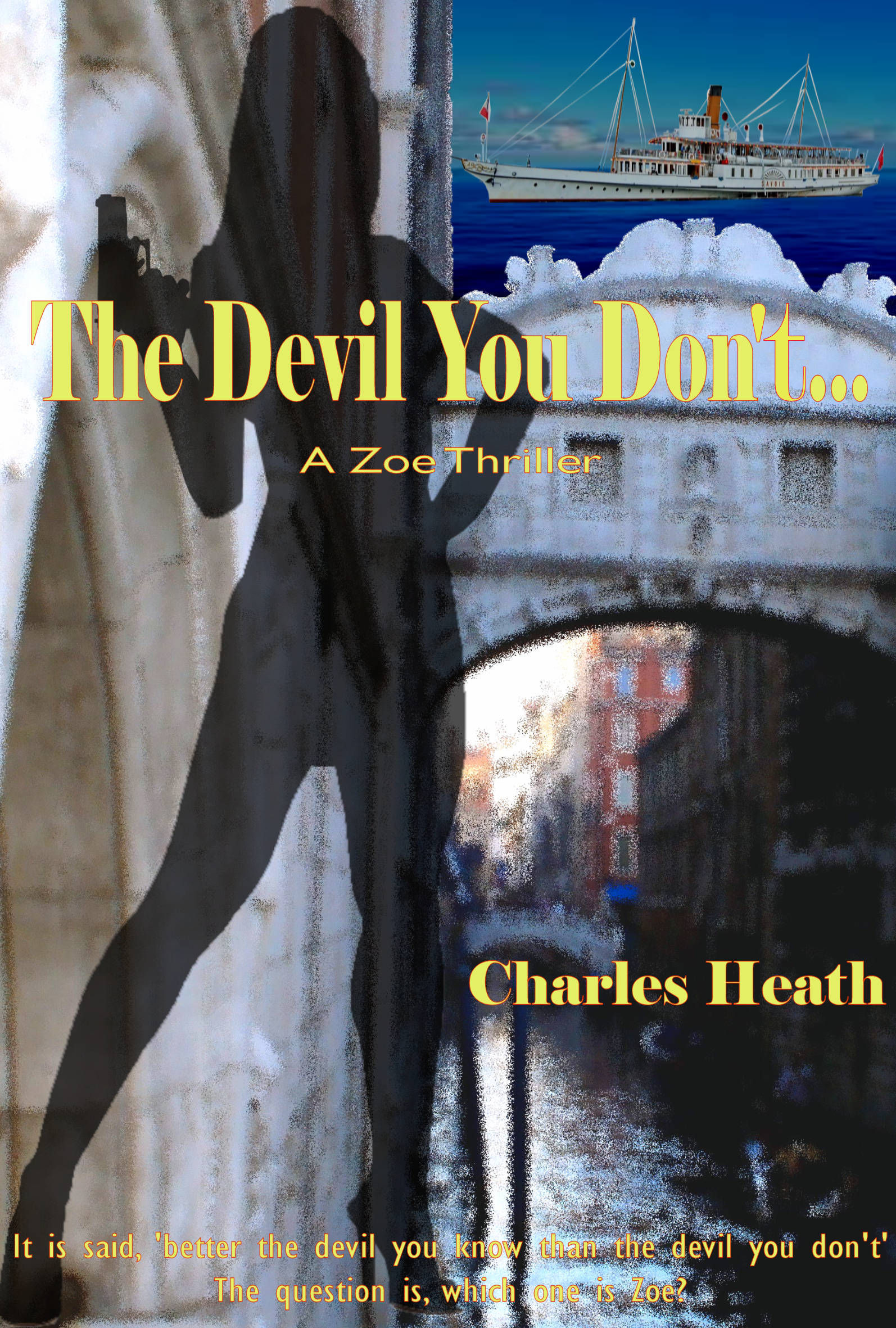
It could be said that of all the women one could meet, whether contrived or by sheer luck, what are the odds it would turn out to be the woman who was being paid a very large sum to kill you.
John Pennington is a man who may be lucky in business, but not so lucky in love. He has just broken up with Phillipa Sternhaven, the woman he thought was the one, but relatives and circumstances, and perhaps because she was a ‘princess’, may also have contributed to the end result.
So, what do you do when you are heartbroken?
That is a story that slowly unfolds, from the first meeting with his nemesis on Lake Geneva, all the way to a hotel room in Sorrento, where he learns the shattering truth.
What should have been a high turns out to be something else entirely, and from that point every thing goes to hell in a handbasket.
He suddenly realises his so-called friend Sebastian has not exactly told him the truth about a small job he asked him to do, the woman he is falling in love with is not quite who she says she is, and he is caught in the middle of a war between two men who consider people becoming collateral damage as part of their business.
The story paints the characters cleverly displaying all their flaws and weaknesses. The locations add to the story at times taking me back down memory lane, especially to Venice where in those back streets I confess it’s not all that hard to get lost.
All in all a thoroughly entertaining story with, for once, a satisfying end.