“Chance Encounter”, A short story

The afternoon rush hour jammed the exit roads, particularly those to the beach.  Nearly everyone was heading for relief from the heat wave, now in its tenth consecutive day.  What had started out a novelty was now just tiresome, with no forecast respite.

A light breeze tried to fan away the afternoon heat, but it had little impact.  The temperature was still hovering in the high 30’s when Bill left the office at 6:30 that evening.

On the road it was little better, and hotter in the car than out.  There was no point running the air conditioner in those conditions, as both he and many others had discovered.  The stop-start traffic made it worse, and people who had already suffered enough were close to breaking point.

Once again, the traffic stopped, and tempers frayed to the point of blowing horns and yelling forlorn abuse at some unseen driver or cause.  It was a no-win situation, and to Bill, a waste of time and energy.  His time and energy, he thought, was best directed at analysis.  Yet how different had the afternoon been to what was currently happening?

In charge of the Customer Service centre for the area’s electricity supplier, it had been difficult to say the least.  That afternoon had seen the highest consumption of electricity since the heat wave began, since time immemorial for that matter, and had started to affect the functionality of the grid, with the first failures occurring. 

It had been predicted, but was not expected quite this early, and as parts of the city were beginning to feel the effect of temporary blackouts, his, and his staff’s work had begun to receive the full effect of the community’s contempt and hatred. 

The traffic disaster was not a patch on the abuse both he and members of his staff had received that afternoon, and he instinctively knew it was not going to improve.

Normally he would stay on and help the incoming supervisor.  This time, someone else could handle the problems.  Doing the usual Friday afternoon desk clean up, he’d found the invitation to Wally’s stag party and as best man, he was obligated to go.  One of the other and more compelling reasons was to see which of his colleagues would make a fool of themselves.

…

It didn’t take long to get home and change into what he considered proper party attire.  He smiled at the thought of being an anachronism from a bygone age, and of what others thought of him.  He was too old to change.

Before leaving, he lingered over several glasses of champagne, and strawberries, trying to get into the mood.  At the same time, he surveyed the ravages of middle management pressures.  Just a year in the job had aged him five, and a tinges of grey beginning to appear at the sides.

A wave of tiredness came over him.  The thought of staying home and immersing himself in classical music and another bottle of champagne crossed his mind, but he said he would go.  Wally was one of the few he could call a true friend.  He would go, but not stay long.

…

As usual, he was late.

Groups had spilled out onto the front veranda, and onto the front lawn.  He knew most of the partygoers by sight, if not by name.  Acquaintances, not friends.  Not the sort of people he usually mingled with.  He exchanged greetings, accepted drinks, and tried to maintain appearances.

It didn’t take long to realise it was a mistake.  The carnival atmosphere and good cheer all around him made him feel melancholier, as a wave of loneliness closed around him like the night air.

He knew only too well what the problem was but had no idea how to deal with it.  Neither his upbringing, nor experience was of any use.  It would require outside help; the sort Wally had already offered.  Just when would he do something about it, if at all?  If the truth were known, Bill was too frightened of the consequences, of getting hurt.  Perhaps a few more drinks…

Making his way through the crowded rooms towards the back of the house, he felt the deadening effect of the alcohol beginning to fight off the empty feeling within.

He made desultory conversation with a secretary he knew was high on the dating list for most junior executives, deriving some pleasure in the thought she talked to him, then to another young lady who worked his shift, whom he thought both intelligent and charming, and whose behaviour didn’t shatter his assumptions as some others had.

As the night wore on. it became evident few had noticed his arrival, even fewer his sudden disappearance to the back veranda, overlooking the ocean.  He had seen Wally on one occasion when he was trying to drink about 10 gallons of beer in one attempt and thought it wise not to interrupt.

It was, he thought, all part of the game, to drink so much he would forget how it was when he was single, though Bill doubted he could do it in a single night.  Bill could hardly wait till the wedding the next afternoon.

…

He looked back momentarily at the apparent abandon of the other guests, hearing the muted murmur of endless conversations, and loud music.  Everyone was having a good time, as it should be.

The gentle, soothing, lapping of the tide on the beach beckoned him.  He put his empty glass on a ledge and went quietly down the stairs onto the sand.  A refreshing, cool breeze rolled in with the tide, immediately improving his mood.

At the water’s edge, he paused momentarily to soak in the calming atmosphere, then put his hands in his pockets and headed for the pier.  A leisurely stroll there and back would be sufficient break to enable him to endure the rest of the evening.  Yes, he would stay, if only to see that Wally didn’t overindulge.  After all, some duties did fall on the incumbent best man.

Occasionally he kicked the sand with the toe of his shoe, once for a thoroughly detestable human relations consultant, and another for a particularly annoying assistant.  It scuffed the high polish, but he didn’t care.  This was a time where near impeccable would be good enough.

He was alone, and in more ways than one, he thought, but it was more by design than by accident.  He had recently been involved in a relationship that was doomed before it began.  Work had always pushed that side of his life into second place because he let it.

Now, having thought about it rationally for the first time, he realised it was time to place less importance on work, and more to giving any sort of relationship a chance.

Wally had offered to find him someone, but knowing Wally as he did, Bill had declined.  Of course, to Wally ‘no’ really meant go ahead anyway.  While at the party, he had surveyed those he thought Wally might have invited as potential matches, some voluptuous, some half-naked, some painted, some all three.

There was no doubting their intent, and he had seen the same in the singles bars when on the town with Wally when they had nothing better to do with a Friday night.  Yet, none of those he’d seen, then or now, matched his criteria.  Were his standards set too high?  Wally never said it, but the fact he didn’t said more than if he had said it out loud.

Bill sighed.  Perhaps he was too set in his ways and unable to change.

…

Adjoining the pier was the old amusement centre, burnt down several years before.  It was the reason for the closing of the beach, and its recent exclusivity to those nearby backing onto the beach.  All that remained was the scorched concrete floor and parts of the walls.  It was these remains he had just gone under.

Beneath them, the sounds of the sea and the night were more pronounced, creating an eerie, sinister feeling.  The smell of the burnt timber still hung in the air, despite the intervening years.

“Hi!”  A feminine voice came out from the shadows, behind one of the pylons nearby.

He started violently, not expecting anyone else.  It took a moment to collect his thoughts, then turn to see who she was. 

“Oh,” was all he could say to the now visible girl’s outline etched against the distant city lights.

Both came out the other side together into the half-light, leaving the gloom behind.  She began, “I hope I didn’t scare you back there?”

“Only half to death.”  He brushed the non-existent wrinkles out of his dinner suit, more a reflex action, then put his hands back in his pockets, composure regained.

“I’m awfully sorry.  I didn’t mean to.”

He was a little angry, and turning to her, said quietly, “Then what was….” He stopped suddenly, surprised at what he saw.  Tall, well proportioned, dressed in expensive eveningwear, much the same as he was.  He instantly realised she could almost pass as an exact replica of Venus except for the untidyish, waist length hair.

“I don’t know.  I guess I wanted to talk to someone, you were handy, so I just said ‘hi’.”  Her tone was apprehensive, with a slight tremor in it. 

She smiled nervously, yet in a way, he noticed it totally changed her appearance, and his heart missed a beat.

“Oh,” he said again, subconsciously feeling she had put him in his place.  He shook his head and looked again, disbelieving what he saw.

“I hope you don’t mind?”

“Don’t mind what?”  He’d lost track of the conversation, and realised he was quickly moving towards looking and sounding like a gibbering idiot.  It was, he realised, just like every other time when faced with a beautiful woman.

“Me talking to you.”

He took a deep breath and tried to remain calm.  He could feel a runnel of sweat slide down the side of his face, “No.  Not really.  It’s just the diversion I need”.  He looked at the sand, the sea, then her.  “I have a feeling I’ve seen you before.” 

He moved on, and so did she, both in unison.

“Staring at you from the pages of magazines?”

“I guess so.  What did you do?  Rob a bank?  Divorce a Prince, or millionaire?”

“As if.  Nothing quite as exotic, or exciting, I’m afraid.  Just draped in clothes or plastered in make-up.  Boring huh?”

“No.  Not really.”

“You’re a bit hard up for new lines?”

He shrugged.  It was difficult talking to this woman, and, lacking in confidence, he was starting to feel a little embarrassed.

She changed the subject.  “Do you live here?”

“No….”

“Don’t say it, not really!” she interrupted.

He sighed, trying to regain composure.  “OK.  I was at a party.”

“Aha.  Now we’re getting somewhere.”  Then she gave him a curious look.  “Was?”  Then, after he didn’t answer, “How come you’re not with the others, having a good time?”

“Perhaps I’m not cut out to ‘have a good time’.  Actually, I thought I’d take a time out from the frenetic pace and get some fresh air.”

“And now the fresh air had lost its appeal?”

“I didn’t say that.”  Did that come out sounding flustered?  It was how he felt inside.  He was going to have to try harder if he was to keep her interest.  “It’s beginning to get interesting.  And I still can’t place where I’ve seen you before.”  He shook his head.  “No matter.  What brings you here?”

“Someone told me about this place a long time ago.  I thought I’d come and check it out.”

He turned and headed back, deciding the diversion had exceeded the time limit he’d set, and it had now become an elongated absence.  She did the same.

“And what do you think?” he asked.

“About what?”

This conversation would sound very strange if anyone else was nearby listening to them.  Luckily, there wasn’t.  “This place.”

“Very peaceful, secluded, interesting, as you said.”

“Interesting in what way?”  Damn, had he asked that already?

“Well …”  She shrugged, then asked, “Do you always walk around with your hands in your pockets?”

Simple answer, yes.  “Can’t think of where else to put them.” 

What did it have to do with her anyway?  And, in that instant, he realised that it he who was the problem here, not her.

“What if you were to hold a girl’s hand?”

“I don’t know of any who would want me to.”

“Would you like to hold mine?”

“Why?  Is it going to run away?”

She smiled.  “More than likely.”

He stopped.  She stopped.  He surveyed her with a critical eye.

“Aha.  The eye that asks, ‘Who is the disreputable and outrageous person who dares to ask such a thing?’

He smiled and took her hand in his.  It was soft and warm, and sent a slight tingle up his spine.

“I talk too much. Don’t I?” she asked suddenly, after they started walking again.

“No.”

She sighed.  “Here we go again.”

…

On the other side of the pier there was an old car park, no longer used.  Along the beach front was a long, low stone wall, and they headed towards it.  Once there, they sat down to watch darkness finally settle in, the last of the sun’s rays melting in a glorious display of reds, oranges, and yellows.

Without speaking, they were content to listen to the waves, feel the cooling breeze, and watch the sea glisten in the moonlight. 

Nothing happened for an indeterminable length of time, during which he nearly forgot she was there.  He suddenly snapped out of it when he heard a match rasping.

He turned to see her trying to light a cigarette, but her hand was shaking so much, the match went out.  She tried again, but the same thing happened.  She savagely threw the cigarette away and pounded her hand on the cement as though it was something she hated.

He took a pack of cigarettes and a lighter out of his coat pocket and offered her one.

“No.  It’s reason enough to try to give it up,” she said quietly.

He returned the items to his pocket and took her hand in his, looked carefully at it, then kissed it.  “Trying to dent cement is not wise unless you are superman or Supergirl.  I know.  I tried once and broke three fingers.  Fortunately, nothing is broken.”

She moved closer.  “Thanks.”

“For what?”

“Making me feel silly.”

“But … I didn’t mean to … I mean …”

She leaned towards him and kissed his lips.  “Hush.”

He held her hand up and looked at it, rather than her, trying to get a grip on his emotions, and saying, a good dead steadier than he felt, “I need a third hand.  Do you think I could have it?”

“With pleasure.  It’s apparently no good to me anymore.”

“Why?”

“Shakes too much.”

“Perhaps I could use it to massage my face.”  He gently moved her hand down the side of his face and again felt a tingle up his spine.  Again, he kissed it gently where she had hit it, not knowing why, just that it seemed like the right thing to do.

“Perhaps not.  Seems to me you have a case of bad nerves.  These are familiar symptoms.  You need a rest, perhaps a holiday, and complete relaxation.  That will be a five-dollar consultation fee.”

She smiled.  “Will you stop it.”

“Why?  It makes you smile.”

“Your right, of course.  I need a rest.  The last six months have been horrible, working day and night, and a failed relationship on top of it.”  She sighed.  “I feel sleepy.”  She leaned against him, putting her arms around him for balance.

“Hey, no.  You can’t do that.”  He fended her off gently.  “I’ve got a party to get back to, and by now I think I should be missed.  God knows what Wally will think.”

He stood and she rolled sideways.  “Oh, come on.”  He looked up towards the sky.  “Why did you make some women like this for,” he muttered.  Then he put his arms around her and lifted her to her feet.  She leaned back against him and he could feel how warm and soft she was.  It was a battle just to make sure he kept his hands in the right places, and she wasn’t making it easy for him.

He held her up then moved around to the front and caught her just as she began to fall forward.  It was exasperating, and yet amusing.  He let her go and she began to fall down, so he caught her again.

She was smiling.

“Beware the smile on the face of the tiger,” he muttered.  His face was level with hers and just then an idea came to him.  He kissed her forehead, nose, chin, then finally her lips, and she came to life.

It was just what she was hoping would happen.  Instead of surprising her, she surprised him by responding in kind; leaving him with a feeling he’d never experienced before.  And a heart rate that was off the chart.

“Now, if only you’d tried that earlier,” she said.

He looked her straight in the eye.  “Just who are you?”

“Me.”

“Does ‘me’ have a name?”

“Do you want ‘me’ to have name?”

“Yes.”

“Claire.”

“Then you may call me Bill.  Do you often pick up strange lonely men on secluded beaches?”

“No.”

“Infuse life into otherwise dead souls?”

“No.”

“Just happened to be the one thing I needed right now?”

She smiled; a smile that made his heart do double somersaults.

“Perhaps a yes.”

“Can I see you again?  I have to see you again.”

“Have to?”

“Like to, then.”

“Perhaps.”

“When?”

“Soon, perhaps sooner than you think.  Do you have to go back?”

“Yes.  If I don’t, Wally will be mad at me.”  He pulled out a notebook and pencil he always carried with him.  “Where do you live?”

She told him.

“If I come by Sunday may I take you out, a drive, somewhere up the coast.  Fresh sea air, total relaxation.”

“Part of the therapy I’m paying five dollars for?”

He brushed a few strands of hair out of her eyes, feeling her warm soft skin under his hand, then kissed her.  “Until the next time.” 

She smiled again. “Until the next time.”

He turned and headed back to the party, not looking back.

…

No one noticed his absence; despite the fact over an hour had lapsed.  He resumed his place on the veranda, new drink in hand looking vacantly towards the pier, wondering if he would see her again, if she were just a figment of his imagination.  It was just too good to be true.

“Ah, Bill.  I thought I would find you here.  Thinking about a walk.  No, I see you’ve already been.”  Wally sounded sober and looked it.  Perhaps this was all just a dream.

He looked down.  His shoes still had sand on them.  He looked at Wally and smiled.  “Fresh air.  Contemplating the human condition.  You know what I’m like at parties.”

“Better than you think.  What did you think of her?”

“Her?”

“The so-called blind date.  I didn’t think a formal introduction would work.”

Bill shrugged.  “Very nice, but a little…”

Wally smiled the same unique smile of hers.

“Your sister?”

Wally nodded.  “Take exceptionally good care of her my friend.  She’s very vulnerable at the moment, and I couldn’t think of anyone better to look after her.”  He held up his glass.  “Cheers.”

…

© Charles Heath 2020

‘Sunday in New York’ – A beta reader’s view

I’m not a fan of romance novels but …

There was something about this one that resonated with me.

This is a novel about a world generally ruled by perception, and how people perceive what they see, what they are told, and what they want to believe.

I’ve been guilty of it myself as I’m sure we all gave one time or another.

For the the main characters Harry and Alison there is others issues driving their relationship.

For Alison, it is a loss of self worth through losing her job and from losing her mother and, in a sense, her sister.

For Harry it is the fact he has a beautiful and desirable wife, and his belief she is the object of other men’s desires, and one in particular, his immediate superior.

Between observation, the less than honest motives of his friends, a lot of jumping to conclusions based on very little fact, and you have the basis of one very interesting story.

When it all come to a head, Alison finds herself in a desperate situation, she realises only the truth will save their marriage.

But is it all the truth?

What would we do in similar circumstances?

Rarely does a book have me so enthralled that I could not put it down until I knew the result. They might be considered two people who should have known better, but as is often the case, they had to get past what they both thought was the truth.

And the moral of this story, if it could be said there is one, nothing is ever what it seems.

…

Available on Amazon here: amzn.to/2H7ALs8

…

The cinema of my dreams – Was it just another surveillance job – Episode 33

I’m back home and this story has been sitting on a back burner for a few months, waiting for some more to be written.

The trouble is, there are also other stories to write, and I’m not very good at prioritizing.

But, here we are, a few minutes opened up and it didn’t take long to get back into the groove.

Chasing leads, maybe


Monica, from the last interrogation, had brought a file.  It looked the same as the last one she brought with her, the one with my name on it.

This time it was thicker.

Intelligence gathering at its finest.  There’d be stuff in there that even I didn’t know about me.

She didn’t open it, just looked at me.

“What have you been doing?”

“Working?”

“For whom?”

“Nobbin, of course.  I am now assigned to his section.  Did you do that?”

“He did.  He tells me you’re working on the O’Connell investigation.”

“Is that what it’s called.  He never told me that.  And I had to find out where I’d been assigned by logging onto a computer.  An email or letter would have made my life a little easier.”

“You’re just lucky you’re still working here.  Now, tell me more about this Severin character.”

“I told you everything I knew the last time you spoke to me.  Apparently, you seemed to know who it was.  Perhaps you might tell me, too.”

“It’s…”

“And,” I interrupted, “don’t tell me it’s above my pay grade.  I was potentially working for traitors and could have finished up in jail for treason.”

“You might still get there.”

Then why hadn’t she had me arrested and thrown in a dungeon the last time we met?  There was an easy answer to that question.  She needed me out in the field.  Nobbin needed me in the field.  They presumably needed me to remain available to Severin for whatever reason.

“What do you want?”

She opened the file, turned a few pages, and stopped at a yellow sheet of paper.  I wasn’t able to read it upside down, but it had very small spidery writing on it.

Then she looked at me again.

“Some secret documents appear to have gone missing.  We believe that is to say Director Dobbin thinks these may have been on a USB drive that was in the possession of O’Connell at the time of his death.  You were there at the time of his death.  You can see where this is going…”

No matter which answers I gave it was the wrong one, which led to do not pass go and do not collect two hundred dollars, or pounds as the case may be.

“I haven’t got it, and he didn’t tell me where it was, and I saw him die.”

“If you say so.”  She went back to the file and turned some more pagers.

“What do you mean?”

She looked up.  “So far, there’s no body been recovered, or any evidence there was a shooting where you said it was.”

“Are you trying to tell me he’s alive, because if you are, then I must be a very poor judge of people who have no pulse.  He was not about to get up and walk away.”

“Did you see the body removed?”

Now there’s an interesting point.  I had done as I was told and left when told to.  I assumed Severin would sort the problem out, in fact, hadn’t he called in the cleaners?  I saw a white van.

Actually, when I thought about it, I had no idea what happened after I left.  And, now that I remember, I didn’t see anyone get out of the white van.

Could bodies get up and walk?

I was beginning to think they could.

© Charles Heath 2020

A photograph from the inspirational bin – 39

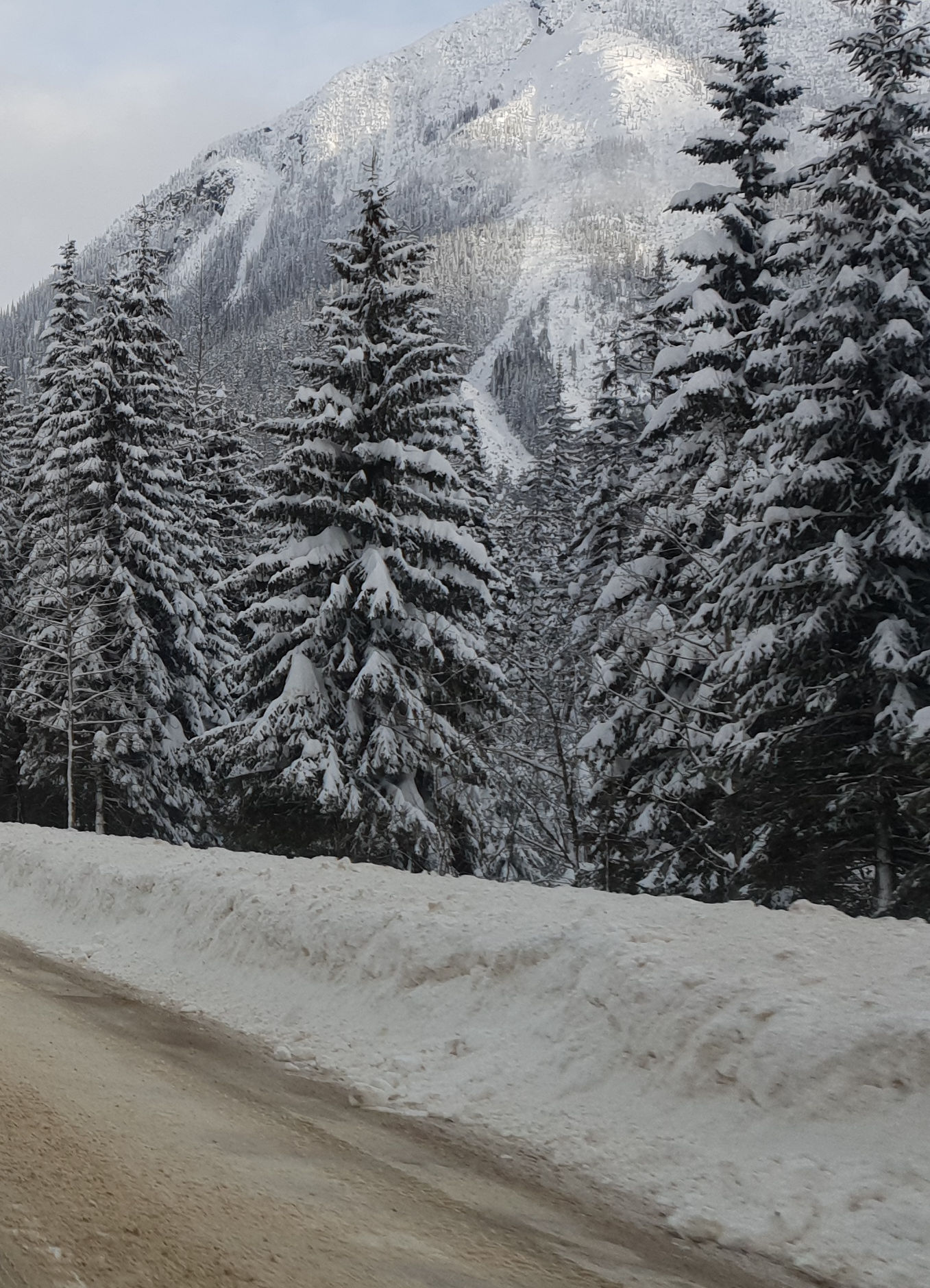
This is what we saw driving along the Coquihalla Highway in Canada, a rather infamous stretch of road featured on the Discovery Channel, and yes, we saw a number of cars and trucks off the side of the road, and not in a good way

The road was iced over in place, and driving was difficult, but on the plus side the scenery was spectacular, and it was hard not to be distracted when driving.

But, inspiration for a story? It might go something like this:

…

Arty was adamant that he knew the best where man in the business.

That might gave been true if he was in the middle of the city where there were endless tests and turns that could be used to lost chasing police vehicles.

But that didn’t apply to the open road, and one that was think with ice and snow, even if it had recently been cleared.

But that wasn’t as bad as the fact that we had got free of the city, lost the pursuing cars, changed vehicles, and got away free.

All he had to fo was follow the road.

Except Arty had a temper, and getting stuck behind an old van going ever so slowly on the road, caused him to first blast them with horn, then start doing dangerous accelations up behind them, and then attempt to overtake on a bend in the road.

That might not have been so bad if there had not been an oncoming car, but there was.

Even that might not have been so bad if the car had not been a police vehicle.

But the real kicker: Arty lost control of the car and we went sailing off the edge of the road into a ravine, landing on soft ice which after a minute started cracking and then gave way.

The last place I wanted to be was to be sinking into a freezing cold river, but there we were, all frantically trying to get out.

Fortunately, I did, but not before I was soaking wet, and almost frozen. The rest didn’t make it.

The cinema of my dreams – I always wanted to see the planets – Episode 39

Talk fast, and hope like hell!

…

Oh, to be back on a cargo ship with three other crew members and a robot that wasn’t trying to destroy ships and murder crew members.

On the cargo ship, the captain could hide in his or her cabin behind the bridge and never come out except to tell the robot he or she was doing a good job.

Sometimes you’d see the crew in the mess hall.

No major life-changing decisions.  It was point A to point B without drama, hold-ups, or anything really.

Not like being the captain of a brand-new class of explorer’s vessels with over 2,000 crewmen on the outer edges of our galaxy, on the verge of being destroyed.

“So, for the benefit of a human without the resources of countless generations of knowledge, and experience of countless alien entities, who or what are you that can make such a life-changing decision?  Especially after you said that we would be safe.”

“If you are inferring that I am a robot programmed to not look rationally at the pros and cons of any case you put to me, or that I am devoid of any empathy, you’re wrong.  That I should make such a threat, in our experience, you humans tend to do one of two possible actions, you retaliate with violence, or you make a rational argument. As for who I am, I have a living body that requires nourishment and ages not unlike your own, hosting a fully cognisant member of our race.  The only difference is that I do not appear in my true form, in deference to making your interaction simpler.  I could take any one of a hundred different forms, depending on whom we hold discussions.”

That cleared several questions that had formed in my mind.  This race was very advanced, being able to put their consciousness into another, or any, body.  Did that mean they never died?  Not the time to ask.  The fact they had found a way to assess human reaction to stress, or life or death situations so simply showed they had been observing us a long time.

“We chose not to shoot first.  You will see we might be at a battle state, but that’s only for our protection.  You cannot hold us responsible for the actions of that other ship because as far as the whole of our planet is concerned, we were the first to come here, and as the first, our mission is not to shoot first and ask questions later, as much as it is to explore, and learn.  The keyword is learning.”

“These are words, and our experiences with humans have taught us that what you say and what you do are quite often two entirely different things.”

My experience too, and it was an all too familiar scenario.  I suspect that the motives of my masters might equally be received with some skeptics, because not everyone in the alliance was on the same page, and decisions were sometimes based on possible shifting alliances.

Space travel still had a gloss on it, and everyone was looking to get a seat at the table.  I had no doubt my new friend, I’d I could call him that, would be equally aware of the situation, as it appeared he did, and it spoke volumes about the levels of their penetration in our world.

“I think, then, our best course of action is to prove we mean what we say.  You were chasing that other vessel, the one you say the occupants committed crimes upon people in your galaxy.”

“They did.  We were, but there was a measured reluctance on the part of the other crew members to pursue them beyond the limits of our galaxy.  Exploration is one thing, an offense that might cause conflict is something else.”

So, they had problems with being the instigators of actions that might be misinterpreted.

“Then let us apprehend them, and we will render the justice together.  I have no trouble bringing people who have criminal intentions to justice.  I would prefer it to be ours, but for the sake of creating at least an initial relationship between our worlds, I will accept the responsibility.”

I could see Nancy looking at me with a look that would kill mortal men and understood her concern.  This was going to be a tough sell all round

“It would be acceptable as a preliminary basis for discussions.  My people would consider your input if or when any or all of those responsible for crimes were arraigned.”

Good enough, for the moment.

“Excellent.  Now, could you lift the block you have on our communications so I can get the first officer on to finding where their ship is “

“You may have a hard job catching them.  Their ship is, as far as we are aware, the fastest your galaxy has.”

“Not quite, but that’s a discussion for another day.”

The green bar on my communicator returned.

“Number one.”

A moment later he came back with, Sir, you are OK?”

“Fine.  Have you been monitoring that Russian vessel?”

“Yes, sir.  It’s about a half-hour from here.”

“Good.  Ready the ship for pursuit.  We have a few questions that need answering.  I’ll explain more when I get back.”

“You can come with us, on our ship, or in yours.  I will communicate your existence with my superiors, just not the fact you’ve infiltrated us in deference to your people if you want to get them out, or declare their presence, a situation we can control if you agree to sit down and talk about it.  I suspect that they’ve been helping more than hindering, other than just keeping you informed of our progress.”

I didn’t get a smile, but that invisible change in expression was an interesting indicator.

“I’ll stay, we’ll follow discreetly.  Your actions will be judged, Captain.”

“No pressure then.  Could you send the names, or if not, photos, of the offenders?  How many are there?”

“Six.  We shall.  Good luck.”

The next instant I was back on the deck of my own ship.

…

© Charles Heath 2021-2022

The cinema of my dreams – I always wanted to go on a treasure hunt – Episode 89

Here’s the thing…

Every time I close my eyes, I see something different.

I’d like to think the cinema of my dreams is playing a double feature but it’s a bit like a comedy cartoon night on Fox.

But these dreams are nothing to laugh about.

Once again there’s a new installment of an old feature, and we’re back on the treasure hunt.

…

We have a situation

…

Home wasn’t home anymore.

I stood inside the front door, as I had many times in the past, but this time it was different.

Maybe it was the near-death experience, maybe I hadn’t been there for a few days, maybe I had irrevocably changed in those few short days.

It seemed that I was someone else, that the old Sam had gone away, and a new version had replaced him.  Had I finally grown up, or was I still reeling from the ordeal and, more likely, mourning the loss of what had been my one true friend.

Right then, it felt like Boggs had never existed, and that Nadia had invaded that space.

Nadia.

Until now, right this moment, I hadn’t really thought about what I was about to do.  Since being in the hospital, every movement I’d made felt mechanical, and someone else was manipulating the controls.

Wanting to leave was a knee-jerk reaction, and one that failed to recognize others may have a role in what happened, like my mother.  I gad completely discounted her because of her association with Benderby, but what if that was no longer the case.

With Alex off the hook, they no longer had to worry about Nadia or what I might say or do, not that there was anything we could do.  I felt for Charlene who literally was between a rock and a hard place, having to compromise her principles to uphold justice and her disappointment in her father.

To be honest, his actions came as a surprise, despite the rumors of corruption.  It didn’t occur to me that it might have been the lesser of the evils, getting Vince off the streets, nobbling the Cossatinos, and to a lesser extent, using the situation as a bargaining chip with the Benderby’s.

But all of that was moot.  Another rumor circulating, according to the newspaper I’d seen at the hotel, was that a third term for the current sheriff was looking unlikely.  It was joined by an interview with Benderby on the construction of a new resort on the mall site.  Noticeably absent were any reports on Boggs, the treasure, or Cossatino.

I considered briefly whether I should go to the newspaper and tell them the whole story.  If he considered it had any element of truth, he’d publish it and be damned, but the thought of how his wife, an Ormiston, would take the news of finding her father, only for the body to disappear, would serve no purpose.  If there was a body, I would not hesitate.

But, now, it was enough to make a decision on what I would do next.  Pack a bag, tell my mother I was leaving, and call Nadia.

It was impossible to fit a lifetime into a bag.  It was fortunate, perhaps, that my situation had not afforded me the luxury of too many possessions, or anything of value.

Even so, what fitted wasn’t much.  I wanted to believe it was going to be a new start, but it seemed like I was just running away, that the problems I was running from would just come with me. 

And, then, there was Nadia.  I was today’s flavor of the month, but would I be in a month, or two? 

That thought was interrupted by the sound of the front door opening.  I stepped onto the passage just as my mother closed the door.

“Sam.  Where have you been?  I’ve been calling, and leaving messages.”

She wasn’t angry, but there was an edge to her tone.  I should have at the very least sent a message to say I was OK.  It didn’t help my phone battery had died.  I’d put it in the recharge, and minutes later continually dinged with missed messages

“I had to get away.  Either that or I would have done something I regretted.  I thought you’d moved in with Benderby.”

“You thought wrong.  This business with Alex.  I remember you told me he was responsible for what happened to you and Nadia, and when I overheard him arguing with his father, I realised you were telling me the truth, and neither of them could be trusted.  I just told him I needed some time to sort out some issues.”

“You’re not going back?”

“No.  What are you going to do?”

“There’s nothing for me here.  I’m not going back to the warehouse, nor do I want to be here anymore.  Not while Alex is put and about.  It’s only a matter of time before he comes after Nadia and I.”

“Then you’re still going to Italy with her.”

“For a while, see how it works out.  You should come too, at least for a holiday, think about what you’re going to do.  Personally, I think you should also leave, start fresh somewhere else.”

“Maybe you’re…”

We both heard the screeching tires of a car coming to a sudden stop outside, followed by the slamming of doors.

Alex not waiting to clean up his mess?

A sudden pounding on the door revised that assessment, if anyone was here to do us harm they would have kicked the door down.

I moved my mother behind me, and the protection of the door as I opened it.

The sheriff.

“We have a situation,” he said in his most serious tone

Warning us the Benderby’s were coming for us?

When neither of us responded, he added, “Elsie Boggs has the Benderby’s at gunpoint at the Blue Circle, and she will only talk to you.”

…

© Charles Heath 2020-2022

An excerpt from “One Last Look”: Charlotte is no ordinary girl

This is currently available at Amazon here:  http://amzn.to/2CqUBcz


I’d read about out of body experiences, and like everyone else, thought it was nonsense.  Some people claimed to see themselves in the operating theatre, medical staff frantically trying to revive them, and being surrounded by white light.

I was definitely looking down, but it wasn’t me I was looking at.

It was two children, a boy and a girl, with their parents, in a park.

The boy was Alan.  He was about six or seven.  The girl was Louise, and she was five years old.  She had long red hair and looked the image of her mother.

I remember it now, it was Louise’s birthday and we went down to Bournemouth to visit our Grandmother, and it was the last time we were all together as a family.

We were flying homemade kites our father had made for us, and after we lay there looking up at the sky, making animals out of the clouds.  I saw an elephant, Louise saw a giraffe.

We were so happy then.

Before the tragedy.


When I looked again ten years had passed and we were living in hell.  Louise and I had become very adept at survival in a world we really didn’t understand, surrounded by people who wanted to crush our souls.

It was not a life a normal child had, our foster parents never quite the sort of people who were adequately equipped for two broken-hearted children.  They tried their best, but their best was not good enough.

Every day it was a battle, to avoid the Bannister’s and Archie in particular, every day he made advances towards Louise and every day she fended him off.

Until one day she couldn’t.

Now I was sitting in the hospital, holding Louise’s hand.  She was in a coma, and the doctors didn’t think she would wake from it.  The damage done to her was too severe.

The doctors were wrong.

She woke, briefly, to name her five assailants.  It was enough to have them arrested.  It was not enough to have them convicted.

Justice would have to be served by other means.


I was outside the Bannister’s home.

I’d made my way there without really thinking, after watching Louise die.  It was like being on autopilot, and I had no control over what I was doing.  I had murder in mind.  It was why I was holding an iron bar.

Skulking in the shadows.  It was not very different from the way the Bannister’s operated.

I waited till Archie came out.  I knew he eventually would.  The police had taken him to the station for questioning, and then let him go.  I didn’t understand why, nor did I care.

I followed him up the towpath, waiting till he stopped to light a cigarette, then came out of the shadows.

“Wotcha got there Alan?” he asked when he saw me.  He knew what it was, and what it was for.

It was the first time I’d seen the fear in his eyes.  He was alone.

“Justice.”

“For that slut of a sister of yours.  I had nuffing to do with it.”

“She said otherwise, Archie.”

“She never said nuffing, you just made it up.”  An attempt at bluster, but there was no confidence in his voice.

I held up the pipe.  It had blood on it.  Willy’s blood.  “She may or may not have Archie, but Willy didn’t make it up.  He sang like a bird.  That’s his blood, probably brains on the pipe too, Archie, and yours will be there soon enough.”

“He dunnit, not me.  Lyin’ bastard would say anything to save his own skin.”  Definitely scared now, he was looking to run away.

“No, Archie.  He didn’t.  I’m coming for you.  All of you Bannisters.  And everyone who touched my sister.”


It was the recurring nightmare I had for years afterwards.

I closed my eyes and tried to shut out the thoughts, the images of Louise, the phone call, the visit to the hospital and being there when she succumbed to her injuries.  Those were the very worst few hours of my life.

She had asked me to come to the railway station and walk home with her, and I was running late.  If I had left when I was supposed to, it would never have happened and for years afterwards, I blamed myself for her death.

If only I’d not been late…

When the police finally caught the rapists, I’d known all along who they’d be; antagonists from school, the ring leader, Archie Bannister, a spurned boyfriend, a boy whose parents, ubiquitously known to all as ‘the Bannister’s, dealt in violence and crime and who owned the neighbourhood.  The sins of the father had been very definitely passed onto the son.

At school, I used to be the whipping boy, Archie, a few grades ahead of me, made a point of belting me and a few of the other boys, to make sure the rest did as they were told.  He liked Louise, but she had no time for a bully like him, even when he promised he would ‘protect’ me.

I knew the gang members, the boys who tow-kowed to save getting beaten up, and after the police couldn’t get enough information to prosecute them because everyone was too afraid to speak out, I went after Willy.  There was always a weak link in a group, and he was it.

He worked in a factory, did long hours on a Wednesday and came home after dark alone.  It was a half mile walk, through a park.  The night I approached him, I smashed the lights and left it in darkness.  He nearly changed his mind and went the long way home.

He didn’t.

It took an hour and a half to get the names.  At first, when he saw me, he laughed.  He said I would be next, and that was four words more than he knew he should have said.

When I found him alone the next morning I showed him the iron bar and told him he was on the list.  I didn’t kill him then, he could wait his turn, and worry about what was going to happen to him.

When the police came to visit me shortly after that encounter, no doubt at the behest of the Bannister’s, the neighbourhood closed ranks and gave me an ironclad alibi.  The Bannister’s then came to visit me and threatened me.  I told them their days were numbered and showed them the door.

At the trial, he and his friends got off on a technicality.  The police had failed to do their job properly, but it was not the police, but a single policeman, corrupted by the Bannisters.

Archie could help but rub it in my face.  He was invincible.

Joe Collins took 12 bullets and six hours to bleed out.  He apologized, he pleaded, he cried, he begged.  I didn’t care.

Barry Mills, a strong lad with a mind to hurting people, Archie’s enforcer, almost got the better of me.  I had to hit him more times than I wanted to, and in the end, I had to be satisfied that he died a short but agonizing death.

I revisited Willy in the hospital.  He’d recovered enough to recognize me, and why I’d come.  Suffocation was too good for him.

David Williams, second in command of the gang, was as tough and nasty as the Bannisters.  His family were forging a partnership with the Bannister’s to make them even more powerful.  Outwardly David was a pleasant sort of chap, affable, polite, and well mannered.  A lot of people didn’t believe he could be like, or working with, the Bannisters.

He and I met in the pub.  We got along like old friends.  He said Willy had just named anyone he could think of, and that he was innocent of any charges.  We shook hands and parted as friends.

Three hours later he was sitting in a chair in the middle of a disused factory, blindfolded and scared.  I sat and watched him, listened to him, first threatening me, and then finally pleading with me.  He’d guessed who it was that had kidnapped him.

When it was dark, I took the blindfold off and shone a very bright light in his eyes.  I asked him if the violence he had visited upon my sister was worth it.  He told me he was just a spectator.

I’d read the coroner’s report.  They all had a turn.  He was a liar.

He took nineteen bullets to die.

Then came Archie.

The same factory only this time there were four seats.  Anna Bannister, brothel owner, Spike Bannister, head of the family, Emily Bannister, sister, and who had nothing to do with their criminal activities.  She just had the misfortune of sharing their name.

Archie’s father told me how he was going to destroy me, and everyone I knew.

A well-placed bullet between the eyes shut him up.

Archie’s mother cursed me.  I let her suffer for an hour before I put her out of her misery.

Archie remained stony-faced until I came to Emily.  The death of his parents meant he would become head of the family.  I guess their deaths meant as little to him as they did me.

He was a little more worried about his sister.

I told him it was confession time.

He told her it was little more than a forced confession and he had done nothing to deserve my retribution.

I shrugged and shot her, and we both watched her fall to the ground screaming in agony.  I told him if he wanted her to live, he had to genuinely confess to his crimes.  This time he did, it all poured out of him.

I went over to Emily.  He watched in horror as I untied her bindings and pulled her up off the floor, suffering only from a small wound in her arm.  Without saying a word she took the gun and walked over to stand behind him.

“Louise was my friend, Archie.  My friend.”

Then she shot him.  Six times.

To me, after saying what looked like a prayer, she said, “Killing them all will not bring her back, Alan, and I doubt she would approve of any of this.  May God have mercy on your soul.”


Now I was in jail.  I’d spent three hours detailing the deaths of the five boys, everything I’d done; a full confession.  Without my sister, my life was nothing.  I didn’t want to go back to the foster parents; I doubt they’d take back a murderer.

They were not allowed to.

For a month I lived in a small cell, in solitary, no visitors.  I believed I was in the queue to be executed, and I had mentally prepared myself for the end.

Then I was told I had a visitor, and I was expecting a priest.

Instead, it was a man called McTavish. Short, wiry, and with an accent that I could barely understand.

“You’ve been a bad boy, Alan.”

When I saw it was not the priest I told the jailers not to let him in, I didn’t want to speak to anyone.  They ignored me.  I’d expected he was a psychiatrist, come to see whether I should be shipped off to the asylum.

I was beginning to think I was going mad.

I ignored him.

“I am the difference between you living or dying Alan, it’s as simple as that.  You’d be a wise man to listen to what I have to offer.”

Death sounded good.  I told him to go away.

He didn’t.  Persistent bugger.

I was handcuffed to the table.  The prison officers thought I was dangerous.  Five, plus two, murders, I guess they had a right to think that.  McTavish sat opposite me, ignoring my request to leave.

“Why’d you do it?”

“You know why.”  Maybe if I spoke he’d go away.

“Your sister.  By all accounts, the scum that did for her deserved what they got.”

“It was murder just the same.  No difference between scum and proper people.”

“You like killing?”

“No-one does.”

“No, I dare say you’re right.  But you’re different, Alan.  As clean and merciless killing I’ve ever seen.  We can use a man like you.”

“We?”

“A group of individuals who clean up the scum.”

I looked up to see his expression, one of benevolence, totally out of character for a man like him.  It looked like I didn’t have a choice.


Trained, cleared, and ready to go.

I hadn’t realized there were so many people who were, for all intents and purposes, invisible.  People that came and went, in malls, in hotels, trains, buses, airports, everywhere, people no one gave a second glance.

People like me.

In a mall, I became a shopper.

In a hotel, I was just another guest heading to his room.

On a bus or a train, I was just another commuter.

At the airport, I became a pilot.  I didn’t need to know how to fly; everyone just accepted a pilot in a pilot suit was just what he looked like.

I had a passkey.

I had the correct documents to get me onto the plane.

That walk down the air bridge was the longest of my life.  Waiting for the call from the gate, waiting for one of the air bridge staff to challenge me, stepping onto the plane.

Two pilots and a steward.  A team.  On the plane early before the rest of the crew.  A group that was committing a crime, had committed a number of crimes and thought they’d got away with it.

Until the judge, the jury and their executioner arrived.

Me.

Quick, clean, merciless.  Done.

I was now an operational field agent.


I was older now, and I could see in the mirror I was starting to go grey at the sides.  It was far too early in my life for this, but I expect it had something to do with my employment.

I didn’t recognize the man who looked back at me.

It was certainly not Alan McKenzie, nor was there any part of that fifteen-year-old who had made the decision to exact revenge.

Given a choice; I would not have gone down this path.

Or so I kept telling myself each time a little more of my soul was sold to the devil.

I was Barry Gamble.

I was Lenny Buckman.

I was Jimmy Hosen.

I was anyone but the person I wanted to be.

That’s what I told Louise, standing in front of her grave, and trying to apologize for all the harm, all the people I’d killed for that one rash decision.  If she was still alive she would be horrified, and ashamed.

Head bowed, tears streamed down my face.

God had gone on holiday and wasn’t there to hand out any forgiveness.  Not that day.  Not any day.


New York, New Years Eve.

I was at the end of a long tour, dragged out of a holiday and back into the fray, chasing down another scumbag.  They were scumbags, and I’d become an automaton hunting them down and dispatching them to what McTavish called a better place.

This time I failed.

A few drinks to blot out the failure, a blonde woman who pushed my buttons, a room in a hotel, any hotel, it was like being on the merry-go-round, round and round and round…

Her name was Silvia or Sandra, or someone I’d met before, but couldn’t quite place her.  It could be an enemy agent for all I knew or all I cared right then.

I was done.

I’d had enough.

I gave her the gun.

I begged her to kill me.

She didn’t.

Instead, I simply cried, letting the pent up emotion loose after being suppressed for so long, and she stayed with me, holding me close, and saying I was safe, that she knew exactly how I felt.

How could she?  No one could know what I’d been through.

I remembered her name after she had gone.

Amanda.

I remembered she had an imperfection in her right eye.

Someone else had the same imperfection.

I couldn’t remember who that was.

Not then.


I had a dingy flat in Kensington, a place that I rarely stayed in if I could help it.  After five-star hotel rooms, it made me feel shabby.

The end of another mission, I was on my way home, the underground, a bus, and then a walk.

It was late.

People were spilling out of the pub after the last drinks.  Most in good spirits, others slightly more boisterous.

A loud-mouthed chap bumped into me, the sort who had one too many, and was ready to take on all comers.

He turned on me, “Watch where you’re going, you fool.”

Two of his friends dragged him away.  He shrugged them off, squared up.

I punched him hard, in the stomach, and he fell backwards onto the ground.  I looked at his two friends.  “Take him home before someone makes mincemeat out of him.”

They grabbed his arms, lifted him off the ground and took him away.

Out of the corner of my eye, I could see a woman, early thirties, quite attractive, but very, very drunk.  She staggered from the bar, bumped into me, and finished up sitting on the side of the road.

I looked around to see where her friends were.  The exodus from the pub was over and the few nearby were leaving to go home.

She was alone, drunk, and by the look of her, unable to move.

I sat beside her.  “Where are your friends?”

“Dunno.”

“You need help?”

She looked up, and sideways at me.  She didn’t look the sort who would get in this state.  Or maybe she was, I was a terrible judge of women.

“Who are you?” she asked.

“Nobody.”  I was exactly how I felt.

“Well Mr Nobody, I’m drunk, and I don’t care.  Just leave me here to rot.”

She put her head back between her knees, and it looked to me she was trying to stop the spinning sensation in her head.

Been there before, and it’s not a good feeling.

“Where are your friends?” I asked again.

“Got none.”

“Perhaps I should take you home.”

“I have no home.”

“You don’t look like a homeless person.  If I’m not mistaken, those shoes are worth more than my weekly salary.”  I’d seen them advertised, in the airline magazine, don’t ask me why the ad caught my attention.

She lifted her head and looked at me again.  “You a smart fucking arse are you?”

“I have my moments.”

“Have them somewhere else.”

She rested her head against my shoulder.  We were the only two left in the street, and suddenly in darkness when the proprietor turned off the outside lights.

“Take me home,” she said suddenly.

“Where is your place?”

“Don’t have one.  Take me to your place.”

“You won’t like it.”

“I’m drunk.  What’s not to like until tomorrow.”

I helped her to her feet.  “You have a name?”

“Charlotte.”


The wedding was in a small church.  We had been away for a weekend in the country, somewhere in the Cotswolds, and found this idyllic spot.  Graves going back to the dawn of time, a beautiful garden tended by the vicar and his wife, an astonishing vista over hills and down dales.

On a spring afternoon with the sun, the flowers, and the peacefulness of the country.

I had two people at the wedding, the best man, Bradley, and my boss, Watkins.

Charlotte had her sisters Melissa and Isobel, and Isobel’s husband Giovanni, and their daughter Felicity.

And one more person who was as mysterious as she was attractive, a rather interesting combination as she was well over retirement age.  She arrived late and left early.

Aunt Agatha.

She looked me up and down with what I’d call a withering look.  “There’s more to you than meets the eye,” she said enigmatically.

“Likewise I’m sure,” I said.  It earned me an elbow in the ribs from Charlotte.  It was clear she feared this woman.

“Why did you come,” Charlotte asked.

“You know why.”

Agatha looked at me.  “I like you.  Take care of my granddaughter.  You do not want me for an enemy.”

OK, now she officially scared me.

She thrust a cheque into my hand, smiled, and left.

“Who is she,” I asked after we watched her depart.

“Certainly not my fairy godmother.”

Charlotte never mentioned her again.


Zurich in summer, not exactly my favourite place.

Instead of going to visit her sister Isobel, we stayed at a hotel in Beethovenstrasse and Isobel and Felicity came to us.  Her husband was not with her this time.

Felicity was three or four and looked very much like her mother.  She also looked very much like Charlotte, and I’d remarked on it once before and it received a sharp rebuke.

We’d been twice before, and rather than talk to her sister, Charlotte spent her time with Felicity, and they were, together, like old friends.  For so few visits they had a remarkable rapport.

I had not broached the subject of children with Charlotte, not after one such discussion where she had said she had no desire to be a mother.  It had not been a subject before and wasn’t once since.

Perhaps like all Aunts, she liked the idea of playing with a child for a while and then give it back.

Felicity was curious as to who I was, but never ventured too close.  I believed a child could sense the evil in adults and had seen through my facade of friendliness.  We were never close.

But…

This time, when observing the two together, something quite out of left field popped into my head.  It was not possible, not by any stretch of the imagination, but I thought she looked like my mother.

And Charlotte had seen me looking in their direction.  “You seem distracted,” she said.

“I was just remembering my mother.  Odd moment, haven’t done so for a very long time.”

“Why now?”  I think she had a look of concern on her face.

“Her birthday, I guess,” I said, the first excuse I could think of.

Another look and I was wrong.  She looked like Isobel or Charlotte, or if I wanted to believe it possible, Melissa too.


I was crying, tears streaming down my face.

I was in pain, searing pain from my lower back stretching down into my legs, and I was barely able to breathe.

It was like coming up for air.

It was like Snow White bringing Prince Charming back to life.  I could feel what I thought was a gentle kiss and tears dropping on my cheeks, and when I opened my eyes, I saw Charlotte slowly lifting her head, a hand gently stroking the hair off my forehead.

And in a very soft voice, she said, “Hi.”

I could not speak, but I think I smiled.  It was the girl with the imperfection in her right eye.  Everything fell into place, and I knew, in that instant that we were irrevocably meant to be together.

“Welcome back.”


© Charles Heath 2016-2019

onelastlookcoverfinal2

Writing about writing a book – Day 17

There is more, and it has been forming in my mind overnight after I read, and re-read yesterday’s work.


This operation was led by two ex American army lieutenants who had served in the Vietnam war and afterward searching for lost comrades.  The Colonel told me they had spent a few years looking for lost POW’s held in camps just over the border in Cambodia or Laos and had a good track record in the jungle.  He trusted them and said I could too.

I thought it odd he felt the need to reassure me.

He said they’d had marginal success, but my own impression was that they were ex CIA, gone rogue, and were part of the burgeoning drug trade that had sprung up during and after the war had ended.   For all that, I had also begun to suspect the Colonel had sold out and we were more about protecting the criminals rather than trying to catch them, and for me, that unquestioning obedience he demanded was beginning to slip.

They also had the look of men who had spent their time sampling the product, and as such were treading a fine line between sanity and insanity.  Still, at first, they didn’t seem all that different to us.

Thoroughly soaked, we made the camp on schedule, planned the attack, and carried it out.  Only there was no one there, it was empty, and had been for some time.  I turned to question the two ‘experts’.

Pity then I hadn’t noticed his partner coming up from behind.  If I had, my situation may have been very, very, different.


When I woke up, it was not in a nice warm or comfortable bed.  It was a dirt floor.  I looked up and realized I was in a hut.  Daytime, very hot, with sharp, bright shards of light leaking through the cracks in the wall and around the doorway.

My head was hurting, as was just about every other part of me, but a cursory examination showed nothing was broken.  Yet.

It took only a moment for clarity to return, and the realization we were prisoners.  Survivors from the group, the only survivors.

The other occupant, a soldier whom I only knew by his first name, Barry, stirred, and then rolled over.

“Where are we?” he asked.

‘In a hut.”

“Where?”

“Your guess is as good as mine.”

He groaned, and then tried to sit up, only to slowly sink back down again.  Perhaps he had tried harder to escape and paid a heavier price.

“This is not looking good,” he said.

“No.”  An understatement, I thought, but to my knowledge, this was the first time I’d heard they took prisoners.  Usually, everyone was summarily executed, and the bodies set up as an example to others.

I heard the sound of boots on gravel coming towards the hut, then, in an instant, the harsh light coming in, temporarily blinding me as the door was yanked open.

When my eyes adjusted I saw two bulky men holding machine guns standing behind another, a short Chinese, with a very familiar face.

Where?  When?

Then I remembered.  A week ago, in Hong Kong, at a hastily arranged meeting between Davenport and the police who were supposed to be helping us with information on a smuggling group known to be operating in the Vietnam/Cambodia/Laos area.  He was the Chinese liaison, connected with the Government.

Apparently not.

This was bad.  Very, very bad.

“Mr. Chandler.  So nice of you to join us.  Colonel Davenport and I are so disappointed in you.”

© Charles Heath 2015-2021

“Sunday in New York”, a romantic adventure that’s not a walk in the park!

“Sunday in New York” is ultimately a story about trust, and what happens when a marriage is stretched to its limits.

When Harry Steele attends a lunch with his manager, Barclay, to discuss a promotion that any junior executive would accept in a heartbeat, it is the fact his wife, Alison, who previously professed her reservations about Barclay, also agreed to attend, that casts a small element of doubt in his mind.

From that moment, his life, in the company, in deciding what to do, his marriage, his very life, spirals out of control.

There is no one big factor that can prove Harry’s worst fears, that his marriage is over, just a number of small, interconnecting events, when piled on top of each other, points to a cataclysmic end to everything he had believed in.

Trust is lost firstly in his best friend and mentor, Andy, who only hints of impending disaster, Sasha, a woman whom he saved, and who appears to have motives of her own, and then in his wife, Alison, as he discovered piece by piece damning evidence she is about to leave him for another man.

Can we trust what we see with our eyes or trust what we hear?

Haven’t we all jumped to conclusions at least once in our lives?

Can Alison, a woman whose self-belief and confidence is about to be put to the ultimate test, find a way of proving their relationship is as strong as it has ever been?

As they say in the classics, read on!

Purchase:

http://tinyurl.com/Amazon-SundayInNewYork

The cinema of my dreams – Was it just another surveillance job – Episode 32

I’m back home and this story has been sitting on a back burner for a few months, waiting for some more to be written.

The trouble is, there are also other stories to write, and I’m not very good at prioritizing.

But, here we are, a few minutes opened up and it didn’t take long to get back into the groove.

Chasing leads, maybe


I ordered breakfast to be brought to my room, then sat back and read the paper, culminating in a second cup of coffee and a half-hearted attempt at the crossword.

My mind was not sufficiently clear of all the implications of what I’d seen last night, and before that.

The first task was to go back to the office and get onto the computer to track down the address the car was registered to.  It was not the flat.  My guess that it was a sort of safe house.  He may not have had reservations about Jan, or who she worked for, not until he became the prey.

Then it occurred to me that if Jan didn’t know where the USB was, then she had to realize he might have rumbled her perfidy.  Maybe he was not as easily fooled as I first thought.

But it didn’t explain why Nobbin was in the dark over the USB’s whereabouts, as he had told me to give Nobbin a message.  Perhaps there’s been a secret message behind that message.

Now, my mind was spinning out of control.

Like O’Connell/Quinley, and in accordance with more lessons on tradecraft, I too, had what I would like to have called a safe house, a small flat on the outskirts of Wimbledon.  

I also had an off-site parking space that was a reasonable distance from the flat, so that if I was being hunted, the car would not lead them to my hiding spot.

There I had a shower, changed, and headed for the underground.

I took the train to Charing Cross, getting there around nine, to take the short walk to the hotel.

Not expecting to find her in the room, I used my key to let myself in.

I was wrong.

She was in bed, still asleep.  Or was until I let the door slam shut.

She didn’t exactly come out from under the covers with a gun pointing at me, but I would be willing to be there was one under her pillow and her hand was on it.

“Sam?”  It was uttered sleepily, the sort that would normally send a shiver down my spine.  Not now.

“I hope you’re not intending to shoot me?”

“No.”

I could see her hand moving slowly withdrawing, and then watched her sit up and swing her legs over the side.

Still in basic clothes.  Obviously, no time to go and get some pyjamas then.

“What happened to you?”

“Got side-tracked on what I thought might be a lead, and it wasn’t.  Just a waste of time and a long night.  Thought I’d come here and get some shuteye.  Perhaps not.  Are you going to order breakfast?”

“Of course.”

“I’ll have a pot of coffee and a paper, preferably one with a crossword.”

She rang down a breakfast order, full English, then said she was having a quick shower.  I heard the water running and wondered if she was giving Severin a short report.  Old trick, running water hides conversations.

Breakfast arrived at the same time as she came out of the bathroom, hair up in a towel, and in one of the hotel dressing gowns.  My imagination got a five-second workout before I grabbed the paper and the coffee and sat in the corner.

She could have the desk.

“Do we know where Maury is?” I asked suddenly.

“Who?”

She hesitated before answering, a moment to give herself time to process the question, and if there were any hidden meanings.

“You know?  You dropped a tracker on him.”

“Oh, him.  He must have found and dumped it.  It was pinging about 100 yards from the flat.”

Of course.  There probably wasn’t one in the first place.

“Pity.  I’d like to turn up unannounced, give him a bit of a scare.”

I went back to the crossword, keeping an eye on her, noticing every now and then giving me a sideways glance.

“Did you go anywhere after the flat?”  Again sudden, out of left field.

“No.  Just come straight back here.  Do you want to keep the room for a few days?  See what happens.”

“Sounds like a good idea.  Look, I have to run an errand this morning, unfortunately, it’s not a work matter, so I’ll give you a call on my way back.  You must want to talk to your people and let them know what’s happening if you haven’t already.”

I finished the coffee, folded the paper, and stood.

“At the very least,” I added, “I have to go back into the office and report to Nobbin.  I’m sure he’ll be impressed with the lack of progress.”

“Won’t you run into that other fellow, what’s his name?”

“Severin?”

“Him, yes.”

“I don’t think so.  His name will probably be very high on the ‘we’d like to talk to you’ list if he shows his face.  Anyway, I’ve got your number.”

I deliberately waved the phone where she could see it, and the implication she could probably use it to track my movements.  That might have been the case if there was a sim card in it, and it was similar to the phone she last saw me with.

It was not.

Where I was going, no one was going to follow me or find me.

© Charles Heath 2020