More or less… – A short story

It was meant to be time to reacquaint as brothers.

Louis and I had not seen each other for decades, and when he returned, about a week before, I got the impression there was more than just ‘missing his brother’ going on.

But that was Louis. He was never one to say what or how he felt about anything, preferring to be the strong silent type, and it had not fared well for him transitioning from teenager to adult.

As for me, when our parents split up, Louis went with our father, and I stayed with our mother, and, given the amount of acrimony there was attached to the split, it was no surprise to anyone that Louis and I had effectively become estranged.

In fact, when I had tried to find them, about two years after the split and our mother had died suddenly, all I found were loose ends. They had effectively vanished.

With that part of my life effectively over, I had married, had children and watched 30 years disappear before Louis suddenly popped up. He simply knocked on the front door one afternoon, Helen answered it, and within minutes they were the best of friends. I’d had that rapport, once, many years before, but life and circumstances had all but ruined that.

Or perhaps that was just me, worn down by that same life and circumstances we were all supposed to take on the chin.

His arrival was a welcome distraction, and when, after a week, he suggested that he and I go on a hike, the sort our father used to take us on when we were a family, I agreed. Helen was happy to be rid of me, and I guess a week without our arguing would suit everyone.

It was probably fortuitous timing. Helen and I had finally got to the point where divorce lawyers were about to be called in. The children had all moved on and had children and problems of their own, and we, as parents just didn’t gel anymore.

Besides, I said, just before I joined Louis in the truck, ready to embark for the wilderness, it would be time to clear my head.

And by day two, my head was clear, and Louis, taking the lead, led us along the ridgeline, a trek he said, that would take us about seven hours. We’d stopped the previous night in a base camp and then headed out the next morning. We were the only two, it being early in the season with snow still on the ground.

Above was the clear cloudless blue sky and in front of us, trees and mountains. There was snow on the ground but it was not solid and showed no signs of human footsteps, only animals. The air was fresh, and it was good to be away from the city and its pressures.

Approaching noon, I’d asked him if we were about halfway. I knew he was holding back, being the fitter of us.

“More or less.”

“More or less what, more closer or less close than we should be.”

I watched him do a 360-degree turn, scoping out our position. It was a maneuver I was familiar with from my time with the National Guard. I’d used my backcountry experience that I’d learned from my father, as a skill I thought they might be able to, and eventually did, use. I got the feeling Louis was looking for something.

“You get the impression we’re not alone?” I asked. I had that nagging feeling something was not right, not from about two miles back in the forest. It was like my sixth sense being switched on.

“Doesn’t seem so, though there have been a few animals lurking behind us, probably surprised anyone’s about this time of the year. It’s been a while, so I’m just getting a feel for the trail. This is, for now, our mountain.”

There was a time, from a time when we were kids, that I could tell when he was lying. He was better at covering it, but it was still there.

Where we’d stopped was a small clearing, a staging point that would be used by other trekkers, still overgrown because of lack of trekkers. Ahead there were the signs of a trail, and after six months, it would become clear again. In places, as we had made our way from the base camp, sections of the distinctive trail had all but disappeared, but Louis seemed to know where he was going, and it was not long before we had picked up the trail again. This spot was a lookout, giving a spectacular view of the valley below, and a fast running river through it.

I walked to the edge and looked up and down the valley, and at the trail that ran along the cliff for a short distance. I looked down, not the wisest of things to do, but it was long enough to catch sight of several charred pieces of wood. On top of the snow. The thing is, someone had been along this trail before us, and recently, something I thought wise to keep to myself.

Back at the log, I sat for a moment and drank some water, while Louis stood patiently, but impatiently, for me to join him.

“You look like you’ve got somewhere to be.” Probably not the wisest thing to say but it was out before I could stop it.

A flicker of annoyance crossed his face, then it was gone. “If we stop too long, joints will freeze up, especially when it gets colder.”

“Sorry.” I put the container back in the pack and joined him. “Let’s go. The cold and I don’t get along very well, and it’s been a long time since the last time I ventured into the great unknown.”

“Helen said you gave up trekking when you married her.”

“She wasn’t a trekker, Robbie. We all have to give up something, sooner or later.”

Another hour, feeling rather weary, we’d come to another small clearing and a place where I could sit down.

“You always were the weak link, Robbie. Admittedly you were younger, but you never seemed to grasp the concept of exercise and fitness.”

I looked up at him and could see my father, the exact stance, the exact words, the exact same sneer in his voice. It all came rushing back as if it was yesterday, the reasons why I chose to go with our mother, that another day with his bullying would be one too many. And he was a bully. And, in an instant, I could see the apple hadn’t fallen far from the tree.

“Out of shape after languishing in an office, perhaps,” I said, “but I was never the disappointment our father always considered me.”

“You didn’t join the army, follow in his footsteps, as he wanted us to do. I did. Proudly served, too.”

I could see it. Like father, like son. No surprise Robbie had followed in his father’s footsteps. And it was a clue as to what Robbie had been doing since I saw him last.

“So, tell me about it.”

“You wouldn’t understand.”

“No, I probably wouldn’t. Let’s push on.”

I’d also thought, along the way, he might ask questions, delve further into the problems that Helen and I were having, but I knew she had told him all he needed to know. I’d been held up at the office, and had rung to ask her to take him to dinner, get to know him, she might get to learn something of my life before I met her, details of which I hadn’t told her other than that my mother was dead, my father had left and taken Robbie with him. My past, I’d told her from the outset, was not something I would talk about.

I didn’t ask what they talked about, but I could see a change in both of them. Perhaps she had succumbed to Robbie’s charm, back in school all the girls did, but they all soon learned he was not a nice person, not once you got to know him. I didn’t warn her, and perhaps that was regrettable on my part, but it reflected the state in which our relationship had reached.

I’d also tried, once or twice, to find out if our father was still alive, but he deflected it, changing the subject. That meant he was still alive, somewhere, perhaps annoyed at Robbie for coming to see me. If I was a betting man, I’d bet our father would have denied permission for
Robbie to do so, even if he was a grown man and capable of making his own decisions.

Odd, but not surprising. Even now I could remember my father had secrets, and those secrets had fed into the breakup of our parents.

“So, you’ve been dodging it for days now, but you still haven’t told me if dad is alive or dead. He’d be about seventy-odd now.”

He stopped and turned to face me. “Would it matter if he was alive? I doubt you’d want to see him after what mother must have said about him.”

Interesting that he would think so. “She never had a bad word for him, and wouldn’t hear of one spoken, by me or anyone. And I have wondered what became of him, and you. At least now I know you spent time in the Army. If I was to guess what happened, that would be high on my list.”

“No surprise then you became an office wanker.”

Blunt, but, to him, it was a fact. I’d used that expression when telling Helen one time after a very bad day.

“We can’t all be heroes, Robbie.”

I put my hand up. Alarm bells were going off in my head. “You can come out now,” I yelled.

Robbie looked puzzled.

“I know you’re there. You’ve been behind us for about a half-mile now.”

A few seconds passed before the cracking of a twig, and then a person in a camouflage kit came towards us.

He’d aged, hair and beard grey in places but almost white now, but the face was familiar.

“What brings you to this part of the woods, Dad. Or is it just an unlucky coincidence?”

—–

© Charles Heath 2020-2021
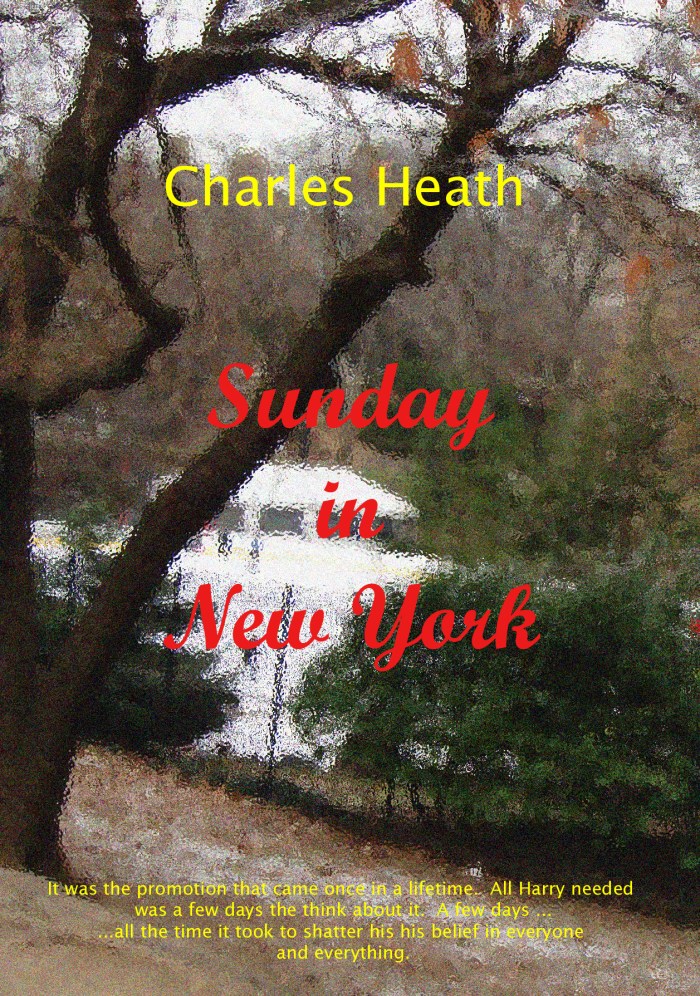
“Sunday in New York”, a romantic adventure that’s not a walk in the park!

“Sunday in New York” is ultimately a story about trust, and what happens when a marriage is stretched to its limits.

When Harry Steele attends a lunch with his manager, Barclay, to discuss a promotion that any junior executive would accept in a heartbeat, it is the fact his wife, Alison, who previously professed her reservations about Barclay, also agreed to attend, that casts a small element of doubt in his mind.

From that moment, his life, in the company, in deciding what to do, his marriage, his very life, spirals out of control.

There is no one big factor that can prove Harry’s worst fears, that his marriage is over, just a number of small, interconnecting events, when piled on top of each other, points to a cataclysmic end to everything he had believed in.

Trust is lost firstly in his best friend and mentor, Andy, who only hints of impending disaster, Sasha, a woman whom he saved, and who appears to have motives of her own, and then in his wife, Alison, as he discovered piece by piece damning evidence she is about to leave him for another man.

Can we trust what we see with our eyes or trust what we hear?

Haven’t we all jumped to conclusions at least once in our lives?

Can Alison, a woman whose self-belief and confidence is about to be put to the ultimate test, find a way of proving their relationship is as strong as it has ever been?

As they say in the classics, read on!

Purchase:

http://tinyurl.com/Amazon-SundayInNewYork

The cinema of my dreams – Was it just another surveillance job – Episode 41

I’m back home and this story has been sitting on the back burner for a few months, waiting for some more to be written.

The trouble is, there are also other stories to write, and I’m not very good at prioritizing.

But, here we are, a few minutes opened up and it didn’t take long to get back into the groove.

Chasing leads, maybe

—

I gave it about five minutes before I think I started breathing again and then headed back to Jennifer.

Or where I thought I had left her.

She wasn’t there. I think, in the end, it didn’t surprise me. She had been reluctant from the start so if I had to guess, she had done a bunk. This was not her fight, nor mine, but she had a ticket out. Why would you want to come back after being betrayed by the likes of Severin and Maury?

I hope she left the car behind.

Now that I was here there was no point leaving, so I took a few minutes to search the surrounding area, just in case she was still here, just someplace else, and when she wasn’t, I quickly and silently made my way back to the side of the house with the open door from a different direction.

There was another set of French doors, these curtained, and with an overhead light above the doorway, so I kept my distance in case there was a movement activator, another which looked to be a servant’s entrance at the back. Neither door looked to be an easy viable entrance.

The original side door was still unlocked, with no lights or movement inside.

I waited, then opened the door wide enough to slip through. Again, I waited in case there was a silent alarm, then when nothing stirred, slipped through and closed the door behind me.

On the other side of the door, it was quite dark, except now I could see, on one wall, the dying embers of a fire. Someone had been in the room earlier and most likely gone to bed.

It meant the house was occupied.

It also meant I had to be careful.

On the other side of the doors, it was a lot warmer. Again I waited a few minutes, just in case someone came, and, when they didn’t, I pulled out a small torch and turned it on.

In front of me were two chairs and a table, one I would have walked into without a light. The walls had shelves and those shelves were filled with books. Some behind glass doors, others not. There was another chair by the fire, and beside it, a stack of cooks, and a table with had an empty glass and a bottle, and a pair of reading glasses.

The downstairs reading room.

I cross the room slowly, hoping there were no squeaky floorboards, to be expected in an old house like this one. The timber flooring was exposed only at the edges of the room, the rest of the floor covered in a large, discolored, and fraying carpet square.

It was old, like everything else in the room.

I was tempted to have a look at how far the books dated back to but resisted the urge. I was looking for information on the owner.

At the doorway to what looked like a passage, I turned off the torch and peered out. It was not exactly dark, my eyes had adjusted to the low-level light from low wattage lights about a foot above the floor.

Lights to help guide the way at night.

Left, rooms, right, rooms, at the end of the passage a wide doorway leading towards the other side of the house. Larger rooms perhaps.

I turned right and headed towards the front, and they stopped at the doorway to the next room. I’d deliberately walked on the carpet runner in the middle of the passage, and just managed to catch my foot when one part of the floor creaked softly.

The room next door was almost the same as the one I’d entered by, with chairs and shelves but only on two sides. This room had a long window and no French doors.

On one side there was a writing desk, open, with papers scatted on the writing surface. I quickly crossed the room to it, switched on the light, and checked.

Bills. In the name of Mrs. Marianne Quigley. This had to be Adam Quigley’s mother, and by deduction, O’Connell’s mother.

Proof I was in the right place.

Then I heard the squeak of a floorboard followed by the clicking sound of a gun being cocked.

“Don’t move, or I’ll shoot. Hands in the air. And don’t make me ask twice.”

Hands up it was.

—

© Charles Heath 2020-2022

Short Story writing – don’t try this at home! – Part 1

This is not a treatise, but a tongue in cheek, discussion on how to write short stories.   Suffice to say this is not the definitive way of doing it, just mine.  It works for me – it might not work for you.

Everyone has one in them, possibly more, and me, well, it’s how I keep the wolves from the door.

Yes, I read my stories to them and they fall asleep.

Or maybe not, I’m never quite sure what effect anything I write has on anyone.  And, reading a lot of the posts on how to handle bad reviews and rejection, such a recurrent theme, I don’t think I want to.

Ignorance is bliss, is it not?

Well, one day I’m sure something will happen.  It’s probably in the seven stages of writing:

Euphoria

Planning

Research

Writing

Failure

Search for the guilty

Distinction for the uninvolved

I guess you don’t fail if you don’t put it out there.  Searching for the guilty, well, there’s only one person to blame, the editor, and distinction for the uninvolved, didn’t your friend, relation, confidente, significant other, say it wasn’t going to work?

But, despite everything, I like writing short stories and try to produce one in a single sitting.  I try to keep the word count down, but the stories, somehow they just evolve in my head and don’t want to end the main character’s story.

In reality, there is no end to the story unless they die, and then, of course, the story branches off, just like a family tree,

Some stories are so intricate, they need another story to fill in the gaps, and then another because the plot is running through your head at a thousand miles an hour and your fingers won’t stop typing, because if you do, it will all dissipate into thin air like smoke.

Stories can, you know, dissipate like smoke, one minute your mining a rich vein the next, you’ve hit a ton of worthless quartz.

Then all the constraints come into play, nagging at the back of your mind, and you find yourself waking up in a bath of sweat crying out, I didn’t do it, the crime that is, not lose the best 2,000 words you’ve ever written.

But that’s all of those words you write, isn’t it?

But I digress, and I’ll write some more on the subject, what was it again?

Sayings: Going on a wild goose chase

Who hasn’t been on one of these, particularly if you have an older brother or sister, and they have nothing better to do than give you a hard time.

You know what I mean, going on a mission to find or do something, knowing full well that you won’t find it, or complete it because it was a lost cause to start with.

Yes, it goes very well with another saying, a dog chasing its tail.

We’ve seen that, too, watching the poor dog go round and round without ever achieving anything.

Sounds like my day today.

And it doesn’t stop there, the pointless search could also be described as ‘searching for a needle in a haystack’.

That is, to my mind the very definition of a living nightmare.

The origin of the idiom, well that’s a little more complicated because there isn’t just one definition.

The first:

Coined by William Shakespeare, but not necessarily in the sort of language we can read easily – it’s a bit like my ability to translate Spanish to English. It does, however, refer to a ‘wild goose chase’.

The second:

Refers to, of all things 16th Century horseracing, and because I don’t have a time machine I can’t go back to fact-check. However, it refers to the other riders following the leader around the course, in much the same formation as geese flying through the air.

…

My little story to go with it:

…

If you are good at your job, and that is beginning to be noticed, your boss will find one of these ‘wild goose chases’ just for you, in an effort to make you look bad.

It happened to me once: my task was to search the basement, where old records were stored, for a folder that a former employee had thought they had filed it in the wrong storage box, a supposition supported by the fact the folder was now needed to clear up a clerical error and the file wasn’t in the specifically marked storage box.

My job was to search every one of the other 765 boxes stored haphazardly in the basement until I found it.

It was, I was told later, sitting on his desk the whole time, and when I couldn’t find it, was going to swoop in and say he’d found it.

Of course, it went missing before he could, so he got a bollicking for not storing the files properly, and I got the job to clean up the basement. I’m not sure who got the worst punishment.

The fourth attempt, let’s look at the main character

So there are words on paper, and three times I’ve tried to fix it, or, perhaps just make it sound better because reading it in my head, there’s too little background and too many questions.

The flow of the story isn’t working for me, so I guess it’s time to sit down and work out what it is I’m trying to say.

The notion that our main character, Graham, is a loser seems to shine through, and that’s not what I’m trying to portray him as.  No, far from it, it’s been a lifetime of bad choices that have put him where he is, and he knows it.

So, in part, this is about owning your mistakes, and it’s my job to make him come across as a hero in waiting.  There’s good in him, perhaps too much, but there is also that attitude that led to all those bad choices, the one that can get him into trouble, and a sort of intransigence inherited from his father, that has more or less got him ostracised from the family. 

I want this character to be a chop off the old block, both of whom are the type not to back down, not to say sorry, and, to quote a rather apt allegory, would cut their nose off to spite their face.

Graham’s intransigence led to his refusal to follow his father into business, refusal to go to University despite having the necessary qualifications, and just to round out the defiance, his choice of women whom he knew would meet with family disapproval.

And these factors, over a period of time, saw him bounce from a low-paying job to jobs with no prospects, and a string of failed relationships, until this moment in time, where he was basically on his own, working the graveyard shift as a security guard.  The sort of job where qualifications weren’t looked for and workmates looked like and probably were ex-cons.

There are a few more details like the older brother, Jackson, politician and schemer, the same as his father before him (the seat was passed down through the family), like the younger sister who is a highly successful surgeon, married into immense wealth.  His brother had been less successful in the marital stakes but what he lacked in a wife was more than made up with a string of highly eligible and beautiful women.

And, no, he doesn’t resent the fact they’re rich, or that his parents were, too, just that they treated him with contempt.

It was almost five years since the last time he had seen any of them, that last time he attended the family Christmas in Martha’s Vineyard, the ‘Stockdale Residence’ an ostentatious sprawling fifty-room mansion that, in a drunken rage, he’s tried to burn down.

Once again, he had not received an invitation to the next, due in a few days, and it was not entirely unexpected.

Graham has his faults, but that even, five years ago, had pulled him off the road to self-destruction, helped along by a year stint in jail where he learned a great many lessons about life itself, and survival.

The four years since?

A lot of regrets, and a lot of repentance.  Life after jail was a lot worse than life trying to defy the family and the system.  There were two roads he could have gone down, and thankfully for him, it was not the wrong one.

So, he’s back on the path, a whole lot wiser, a whole lot tougher.

That might not have been exactly what I was thinking for him over the first three attempts.  I don’t think any character really begins to shine until halfway through, as you find him meeting various challenges in ways even you, as the writer, find quite unexpected.

Is that the end result of being a pantser over being a planner?

I don’t think, even as a planner, you can create a character that’s not going to change, or even surprise you, as the story evolves.

And somehow I don’t think I’m about to change from one to the other.

Well, not completely.

But there’s more, and no, it’s not steak knives!

…

© Charles Heath 2020-2021

‘What Sets Us Apart’ – A beta readers view

There’s something to be said for a story that starts like a James Bond movie, throwing you straight in the deep end, a perfect way of getting to know the main character, David, or is that Alistair?

A retired spy, well not so much a spy as a retired errand boy, David’s rather wry description of his talents, and a woman that most men would give their left arm for, not exactly the ideal couple, but there is a spark in a meeting that may or may not have been a set up.

But as the story progressed, the question I kept asking myself was why he’d bother.

And, page after unrelenting page, you find out.

Susan is exactly the sort of woman the pique his interest. Then, inexplicably, she disappears. That might have been the end to it, but Prendergast, that shadowy enigma, David’s ex boss who loves playing games with real people, gives him an ultimatum, find her or come back to work.

Nothing like an offer that’s a double edged sword!

A dragon for a mother, a sister he didn’t know about, Susan’s BFF who is not what she seems or a friend indeed, and Susan’s father who, up till David meets her, couldn’t be less interested, his nemesis proves to be the impossible dream, and he’s always just that one step behind.

When the rollercoaster finally came to a halt, and I could start breathing again, it was an ending that was completely unexpected.

I’ve been told there’s a sequel in the works.

Bring it on!

…

The book can be purchased here: http://amzn.to/2Eryfth

…

Writing about writing a book – Day 23

I’ve been thinking a lot about Bill’s service, and the characters he meets along the way, some of whom shape the man he became, others he remained friends with after he was discharged, and those that were killed.

Several have a direct bearing in the main story, for instance, Brainless, a rather ubiquitous nickname, given to him because of his actions, that is to say, he acts without thinking, sometimes when in great peril, a man who never quite recovered, but is, for all intents and purposes Bill’s friend and someone he feels responsible to look after, perhaps because of how many times he saved Bill from death, or worse.

There is also Manilow, but we’ll save him for later.

So, this is where ‘Brainless’ get’s his introduction:


It was the first time I’d been hit by a bullet, and it hurt.  It was a steep learning curve, realizing you have been hit, and then the brain going into overdrive to tell you first it going to hurt like hell, and then begin to assess the damage, running every scenario from ‘it’s a flesh wound’ to ‘Oh God, I’m going to die’.

At least, that was what had happened to me for my first time.

Seconds, or minutes, or hours later, a man who doubled as a Medic came scrabbling over to me and looked at the wound.  A silly thought, how did he know I’d been shot?  Had I screamed?  He made a quick assessment, told me I’d live, and dressed it as good and as quickly as he could.

There were other casualties.

I lasted until I was brought into a clearing some miles further on, after the enemy had been killed, or had retreated, and loaded onto a helicopter.  There I was told everything would be OK and then the lights went out.


My first visit to a mobile army hospital, after being hit, was a novelty.  It was nothing like a real hospital.  Nor was the staff.  It took a different sort of medical personnel to man a front-line hospital where you were just as likely to become a casualty yourself.

The doctor was quite jovial about the whole matter saying I would be back out again in no time, not exactly a prospect I was looking forward to.  It was almost a mend job without anesthetic and the memory of it remained with me for some time.  Facilities were not primitive, but they just appeared that way.

I was one of the less needy casualties that day.  After being stitched up, a nurse took me to a bed in a ward with a mixture of serious and not so seriously wounded.

The nurse, whose name was Wendy, had the same sense of humor I had.  She insisted we be on first name terms from the start.  How she kept her humor was a mystery, for most noticeable was her tired look as if she had been doing the same thing for too long.

The bed was comfortable, the temperature bearable, and the food edible.  Being, and remaining, injured had its good points.

I slept well the first night.  I presumed the injection she’d given me was to ensure I had a restful sleep.  It was long overdue and much needed.

The next morning the numbers had thinned.  Two men had died, several others returned to duty.  To my left was a sad and distant private, who, from time to time, would start moaning.  He’d been in the middle of a mortar attack and was both deaf and had serious psychological problems.

To my right, there was a large man who barely fit in the bed.  He was a perpetually unhappy person, with only minor injuries, a bullet wound to his upper leg.  Nothing serious, he said, and just wanted to leave as soon as possible.  Brainless, the nurse called him.  Always wanted to get back to the war and kill some more of the enemy.  An obsession, she said.

He was staring morosely at the ceiling when I woke.  It took a few minutes to regain full consciousness, a sign I’d been in a drugged sleep.

“What are you in for?” he asked.

“Leg wound.  Nothing serious.”  You?”

“Leg.  Bastards snuck up on me.  And the useless rearguard didn’t do his job properly.”

“Landmine?”

“Sniper.”

I’d seen both.  Tread in the wrong place, and you didn’t do it again.  Sniper’s fire came from almost anywhere, taking out soldiers and civilians indiscriminately.  You could never hear the bullet, just feel it.

“Mongrel,” I said with feeling.

“Yours?”

“Probably the same.  I didn’t see it coming.  I hate it when you can’t see the bastards.  There ought to be some law they send you a message first.  Give you a chance….”

“Chap other side killed himself.  Had enough.  It was written all over his face.  What kind of sooks are we bringing over here?”

“National service,” I said quietly.

“You?” he asked.

I could feel his contempt for ‘Nashos’ and to be glad I was not one.  “I believe I volunteered.”

He didn’t ask what I meant, and even if he had, I probably would have made up a lie.  I hardly thought if I said my father in law hated me that much he would send me here, would make any sense, particularly to this man beside me.

He snorted.  “More the fool you, then.”


We were both released on the same day.  His unit had suffered major casualties, and the story he gave me in the hospital was not quite true.  He’d gone down trying to save what men he could in an ambush.  Heroics came to mind, but his selfless actions were much more than that.  Without a unit, he joined ours.

Wendy remained in my mind for some time after that visit.  When I returned the next time, my injuries being more serious, I enquired as to her whereabouts, only to discover she was dead too, a victim of her own hand, simply because she could not cope with the death, mutilation, and waste.

There was no doubt it affected all of us in different ways.  Some didn’t like the idea of going back out into the jungle and found their own peace.  Others, like Wendy, needed something more, but all too often, no-one recognized what the solution was until it was too late.


Now that I have paved the way, I must get back to the main story and write the part where Brainless enters the picture.


© Charles Heath 2016-2020

An excerpt from “Echoes from the Past”

Available on Amazon Kindle here:  https://amzn.to/2CYKxu4

…

With my attention elsewhere, I walked into a man who was hurrying in the opposite direction.  He was a big man with a scar running down the left side of his face from eye socket to mouth, and who was also wearing a black shirt with a red tie.

That was all I remembered as my heart almost stopped.

He apologized as he stepped to one side, the same way I stepped, as I also muttered an apology.

I kept my eyes down.  He was not the sort of man I wanted to recognize later in a lineup.  I stepped to the other side and so did he.  It was one of those situations.  Finally getting out of sync, he kept going in his direction, and I towards the bus, which was now pulling away from the curb.

Getting my breath back, I just stood riveted to the spot watching it join the traffic.  I looked back over my shoulder, but the man I’d run into had gone.  I shrugged and looked at my watch.  It would be a few minutes before the next bus arrived.

Wait, or walk?  I could also go by subway, but it was a long walk to the station.  What the hell, I needed the exercise.

At the first intersection, the ‘Walk’ sign had just flashed to ‘Don’t Walk’.  I thought I’d save a few minutes by not waiting for the next green light.  As I stepped onto the road, I heard the screeching of tires.

A yellow car stopped inches from me.

It was a high powered sports car, perhaps a Lamborghini.  I knew what they looked like because Marcus Bartleby owned one, as did every other junior executive in the city with a rich father.

Everyone stopped to look at me, then the car.  It was that sort of car.  I could see the driver through the windscreen shaking his fist, and I could see he was yelling too, but I couldn’t hear him.  I stepped back onto the sidewalk, and he drove on.  The moment had passed and everyone went back to their business.

My heart rate hadn’t come down from the last encounter.   Now it was approaching cardiac arrest, so I took a few minutes and several sets of lights to regain composure.

At the next intersection, I waited for the green light, and then a few seconds more, just to be sure.  I was no longer in a hurry.

At the next, I heard what sounded like a gunshot.  A few people looked around, worried expressions on their faces, but when it happened again, I saw it was an old car backfiring.  I also saw another yellow car, much the same as the one before, stopped on the side of the road.  I thought nothing of it, other than it was the second yellow car I’d seen.

At the next intersection, I realized I was subconsciously heading towards Harry’s new bar.   It was somewhere on 6th Avenue, so I continued walking in what I thought was the right direction.

I don’t know why I looked behind me at the next intersection, but I did.  There was another yellow car on the side of the road, not far from me.  It, too, looked the same as the original Lamborghini, and I was starting to think it was not a coincidence.

Moments after crossing the road, I heard the roar of a sports car engine and saw the yellow car accelerate past me.  As it passed by, I saw there were two people in it, and the blurry image of the passenger; a large man with a red tie.

Now my imagination was playing tricks.

It could not be the same man.  He was going in a different direction.

In the few minutes I’d been standing on the pavement, it had started to snow; early for this time of year, and marking the start of what could be a long cold winter.  I shuddered, and it was not necessarily because of the temperature.

I looked up and saw a neon light advertising a bar, coincidentally the one Harry had ‘found’ and, looking once in the direction of the departing yellow car, I decided to go in.  I would have a few drinks and then leave by the back door if it had one.

Just in case.

© Charles Heath 2015-2020

newechocover5rs

Lost and Found, a short story

I had once said that Grand Central Station, in New York, was large enough you could get lost in it. Especially if you were from out of town.

I know, I was from out of town, and though I didn’t quite get lost, back then I had to ask directions to go where I needed to.

It was also an awe-inspiring place, and whenever I had a spare moment, usually at lunchtime, I would go there and just soak in the atmosphere. It was large enough to make a list of places to visit, or find, or get a photograph from some of the more obscure places.

Today, I was just there to work off a temper. Things had gone badly at work, and even though I hadn’t done anything wrong, I still felt bad about it.

I came in the 42nd street entrance and went up to the balcony that overlooked the main concourse. A steady stream of people was coming and going, most purposefully, a few were loitering, and several police officers were attempting to move on a vagrant. It was not the first time.

But one person caught my eye, a young woman who had made a circuit of the hall, looked at nearly every destination board, and appeared to be confused. It was the same as I had felt when I first arrived.

Perhaps I could help.

The problem was, a man approaching a woman from out of left field would have a very creepy vibe to it, so it was probably best left alone.

Another half-hour of watching the world go by, I had finally got past the bad mood and headed back to work. I did a wide sweep of the main concourse, perhaps more for the exercise than anything else, and had reached the clock in the centre of the concourse when someone turned suddenly, and I crashed into them.

Not badly, like ending up on the floor, but enough for a minor jolt. Of course, it was my fault because I was in another world at that particular moment.

“Oh, I am sorry.” A woman’s voice, very apologetic.

I was momentarily annoyed, then, when I saw who it was, it passed. It was the lost woman I’d seen earlier.

“No. Not your fault, but mine entirely. I have a habit of wandering around with my mind elsewhere.”

Was it fate that we should meet like this?

I noticed she was looking around, much the same as she had before.

“Can I help you?”

“Perhaps you can. There’s supposed to be a bar that dates back to the prohibition era here somewhere. Campbell’s Apartment, or something like that. I was going to ask…”

“Sure. It’s not that hard to find if you know where it is. I’ll take you.”

It made for a good story, especially when I related it to the grandchildren, because the punch line was, “and that’s how I met your grandmother.”


© Charles Heath 2020