Writing about writing a book – Day 29

It is hard sometimes to keep the lid on what might be called justification of your position in a company where there are many naysayers, and little support from those who are supposed to be working together towards a single conclusion.

Not work against you, or to have their own agenda, not only in furthering their career on the back of your mistakes but take the credit for all your hard work.

Every company has them.

I’ve worked in a few where this has happened, but the deciding factor of whether they’re successful or not is when they have to stand on their own two feet when the source of their reputed good work suddenly is unavailable, and the shit hits the proverbial fan.

What is it called?  Art imitates life.

Benton is the proverbial leader who takes credit, but when it comes to the crunch, can’t pull the rabbit out of the hat.

I guess in writing this little piece, I was subconsciously getting back at someone from a real, but now distant, past.

Perhaps there might be a little more about one of the places I worked cropping up from time to time.

It’s not so much writing about what you know, but writing about what happened, and what you might have wanted to happen.  Invariably it never did, because these credit takers are a cunning lot, and sometimes lay the foundations for getting out from under when there is a disaster.

Unfortunately, I’ve been there too.

It’s called cutting your nose off to spite your face.

Be that as it may, I let this little vent run and see where it goes.

It was my responsibility since I’d recommended it and then won the support of management over his objections, and following that it had become a point of continual contention, a petty war neither of us was going to win.

I tried to keep the joy out of my voice.  He’d also vetoed my recommendation for a full-time network engineer as my alternative, making my job become single point sensitive.  There was no one to replace me if anything went wrong.

“Sounds like you’re having fun.”  I had to work hard to keep the amusement out of my tone.

“Fun nothing.”  His tone was reaching that exasperation point.  “There is no one else.”

“Why did you approve my holiday if I can’t have one?” I’d stretch his patience just a little more.

“You promised me the network was stable.”

“It is, and has been for the last six months.  I’ve said so in my last six-monthly reports.  You have been reading them, haven’t you?”

Silence.  It said all I needed to know.

I had a choice sentence to deliver, but an ignominious thought popped into my head.  He could probably use this against me, and would if I gave him the opportunity.  Perhaps I should shelve my differences with him for this morning.

Aside from that, there was a shooting, and we didn’t get one of those every day.  Not that it would probably amount to very much.  During the previous week, the office grapevine had been working overtime on the rumor Richardson was having a relationship with one of the ladies in the Accounts department.  It was just the sort of scandal the data entry staff thrived on.

A shooting and a network failure.  I didn’t know which was worse.  Perhaps if it was Benton they’d shot, there might be some justice…

I decided not to argue with him.  “Give me an hour.”

“Half.  Aitchison wants to see you.”

Werner Aitchison was head of Internal Security and a man who took his job seriously.  Enough, that is, to annoy my staff, and me.  He was ex-military intelligence, so ‘they’ said, but he appeared to me like a man out of his depth in this new age of communications.  Computers had proliferated in our company over the last few years, and the technology to go with them spiraling out of control.

We dealt in billions via financial transactions processed on computers, computers which, we were told often enough, was insecure, and easily taken control of outside their environment.  Aitchison was paranoid, and rightly so, but he had a strange way of going about his business.  He and I had butted heads on many occasions, and we may have had our disagreements, but we were good friends and colleagues outside work.

Just in case Benton was accusing me, I said, as sincerely as I could, “I didn’t do it.”

“Of that, I have no doubt.  He has requested a meeting with you at 10 am.  You will be there.”

“I said I would come in to look at the problem.  I didn’t say I was staying.”

“Let me know when you get in.”  That was it.  No ifs.  No buts.  Just a simple, ‘Let me know…’

I seriously considered ignoring him, but somewhere within me, there was that odd sense of loyalty.  Not to Benton, not to the Company, but to someone else, the man who had given me the job in the first place, who had given me every opportunity.

I was doing it for him and would tell him.

When I found out who it was!

© Charles Heath 2016-2021

‘What Sets Us Apart’ – A beta readers view

There’s something to be said for a story that starts like a James Bond movie, throwing you straight in the deep end, a perfect way of getting to know the main character, David, or is that Alistair?

A retired spy, well not so much a spy as a retired errand boy, David’s rather wry description of his talents, and a woman that most men would give their left arm for, not exactly the ideal couple, but there is a spark in a meeting that may or may not have been a set up.

But as the story progressed, the question I kept asking myself was why he’d bother.

And, page after unrelenting page, you find out.

Susan is exactly the sort of woman the pique his interest. Then, inexplicably, she disappears. That might have been the end to it, but Prendergast, that shadowy enigma, David’s ex boss who loves playing games with real people, gives him an ultimatum, find her or come back to work.

Nothing like an offer that’s a double edged sword!

A dragon for a mother, a sister he didn’t know about, Susan’s BFF who is not what she seems or a friend indeed, and Susan’s father who, up till David meets her, couldn’t be less interested, his nemesis proves to be the impossible dream, and he’s always just that one step behind.

When the rollercoaster finally came to a halt, and I could start breathing again, it was an ending that was completely unexpected.

I’ve been told there’s a sequel in the works.

Bring it on!

…

The book can be purchased here: http://amzn.to/2Eryfth

…

“Because it’s not me” – a short story

If the was one fault I had, it was prevarication.

For a long time, I had always been afraid of making a mistake, after I had done exactly that.  They said our mistakes didn’t define us, but that one had.  I had lost the trust of everyone, from my parents to friends.

It was only a small lie, or so I told myself, but it had far-reaching ramifications, and almost cost someone their life.  But whilst I believed it was not all that bad, and the police had agreed that anyone who had been put in the same position would have done the same, there were those who didn’t agree.

It was a moment in time I often relived in my mind, over and over, and eventually led to several outcomes.

The first, I left home, the town where up till then I’d lived all of my life, walking away from family and those who used to be friends, knowing that what they said and what they felt were two entirely different things.  For all concerned, it was better that I left, cutting all ties, and make a fresh start, away from those whom I knew would never forget, even though they forgave me.

The second, and most dire, I changed my name, and my history, even how I looked.  Today, I was a very different person to that of thirty years ago.

The third, I moved to another country and vowed never to return, always looking constantly over my shoulder, expecting someone from the past to find me.  I instinctively knew that I would never escape, that one day a stark reminder would come back and destroy everything.

I picked the one occupation that would keep me both occupied and invisible.

Journalist.

I had started at the bottom, literally writing death notices, and worked my way up to what is ubiquitously known as ‘foreign correspondent’, going to places where no one else would go, those hotbeds of unrest, and war zones, reporting from both sides.

Perhaps it could say I had a death wish, a statement my editor had once said when he came to see me in hospital back in London after I’d been caught up in a rocket attack and repatriated.  He had come to offer me a job back home, to tell me my tour was over.

I declined the opportunity, and he left, shaking his head.

But that was not the only visitor that came to the hospital that day.  The other visitor was an elderly man, immaculately dressed in a pinstripe suit and bowler hat.  It screamed public servant, and the moment I saw him wandering up the passage, a chill ran down my spine.

Although he looked like he was looking for someone else, I knew he would eventually finish up in my doorway.

Five minutes after I first saw him.

When he appeared at the door, I thought about ignoring him, but realized that wasn’t going to change anything.  Besides that, I guess I wanted to know why he would want to see me.

“James Wilson?”

“Would it make any difference if I said no?”  Well, it didn’t mean I couldn’t spar with him, just a little.  “Who are you.”

“Do you mind if I come in?”

I got the impression he would do it anyway, irrespective of what I said.  I said no, and as I suspected he came in anyway, closing the door behind him, then took a minute or two to make himself comfortable in the visitor’s chair, which was an impossible task.

Then, settled, he said, “I understand you have just been repatriated from Syria.”

“I was in the wrong place at the wrong time.”

It wasn’t common knowledge where I’d come from, so this person knew something about me, which was immediate cause for concern.

“The bane of a reporter trying to cover a dangerous situation,” he said, with just the right amount of levity in his tone.  “I get it, by the way.  I once had that devil may care attitude you need to get the story.  I was chasing a Pulitzer, believe it or not, and used a few of those nine lives in the process.  Which one are you up to?”

I was going to say that awards didn’t matter but among those who made up the press pack in those God-forsaken places, there was an unwritten desire to be rewarded other than by pay.  For me, though, it was not a defining factor.

“Lost count.  But why would that interest you, or whoever it is you represent?  By the way, just who do you represent?”

Second attempt at finding out who this man was.  If he was dodging and weaving, it would suggest a clandestine organization.

“People who would like to use your unique talent in getting into trouble spots around the world.  We’re not asking you to come work for us exclusively, rather piggyback on the job that you already do so well.”

An unnamed man from an unnamed organization.  What he was offering wasn’t unheard of, and I had been warned, more than once, that jobs, like he was suggesting, were more often than not offered to people like me.  With that came one line of advice, turn around and run like hell.

But, with nothing to amuse me in hospital, I was curious.  “Doing what exactly?”

The fact his expression changed indicated my response had taken him by surprise.  Perhaps he was used to being told where to go.  Not yet.  I had this fanciful notion in the back of my mind that what he might offer might get me closer to the story.

“Keeping your eyes and ears open.  We’ll tell you what to look for, all you’ll be doing is looking for evidence.  There will be no need to go looking for trouble, if there’s evidence we ask you to report it, if not, no harm done.”

Not so hard.  If that was all it was.  The trouble was, if something sounds simple, which that did, but inevitably, it was going to be anything but.  I’d heard stories and the consequences.

“You’re presuming that my editor will send me back.  He just offered me a job at home.”

“I think both of us know you’re not interested in domesticity.  If he isn’t willing to adhere to your wishes, I’m sure we could find someone else who would be willing to take you on.  You have had several offers recently, have you not?”

So, without a doubt, he knew a lot about me, especially if he asked around.  I had had several offers, but I was happy where I was.  I liked the no questions about your past that my current employer had promised.

Yes, looking at the determination on this man’s face, I had no doubt they or he could do what he said.  No one comes to a meeting like this without holding all the cards.  Also, not that I wanted it to be so, It told me that my agreement was not necessarily going to be optional.

But I was happy to dither and find out.  “Since I’m not sure when the hospital is going to discharge me, and the fact I’m not exactly very mobile at the moment, can I consider the proposal.  Right now, as you can imagine, getting back to work is not exactly a priority.”

“Of course.”  He took a card out of his coat pocket and put it on the bedside table.  “By all means.  Call me on that number when you’ve decided.”

He stood.  “It will be a great opportunity.  Thank you for your time.”

Of course, the two impressions I was left with were, one, he had me mixed up with someone else, and two, that I would never see him again.

It was an impossible task, for me at least, because I did not have a poker face, and could barely carry a lie.  I would be the last person they’d want for the job.

And thinking that, I rolled over, put it out of my mind, and went back to sleep.


© Charles Heath 2021

An excerpt from “Echoes from the Past”

Available on Amazon Kindle here:  https://amzn.to/2CYKxu4

…

With my attention elsewhere, I walked into a man who was hurrying in the opposite direction.  He was a big man with a scar running down the left side of his face from eye socket to mouth, and who was also wearing a black shirt with a red tie.

That was all I remembered as my heart almost stopped.

He apologized as he stepped to one side, the same way I stepped, as I also muttered an apology.

I kept my eyes down.  He was not the sort of man I wanted to recognize later in a lineup.  I stepped to the other side and so did he.  It was one of those situations.  Finally getting out of sync, he kept going in his direction, and I towards the bus, which was now pulling away from the curb.

Getting my breath back, I just stood riveted to the spot watching it join the traffic.  I looked back over my shoulder, but the man I’d run into had gone.  I shrugged and looked at my watch.  It would be a few minutes before the next bus arrived.

Wait, or walk?  I could also go by subway, but it was a long walk to the station.  What the hell, I needed the exercise.

At the first intersection, the ‘Walk’ sign had just flashed to ‘Don’t Walk’.  I thought I’d save a few minutes by not waiting for the next green light.  As I stepped onto the road, I heard the screeching of tires.

A yellow car stopped inches from me.

It was a high powered sports car, perhaps a Lamborghini.  I knew what they looked like because Marcus Bartleby owned one, as did every other junior executive in the city with a rich father.

Everyone stopped to look at me, then the car.  It was that sort of car.  I could see the driver through the windscreen shaking his fist, and I could see he was yelling too, but I couldn’t hear him.  I stepped back onto the sidewalk, and he drove on.  The moment had passed and everyone went back to their business.

My heart rate hadn’t come down from the last encounter.   Now it was approaching cardiac arrest, so I took a few minutes and several sets of lights to regain composure.

At the next intersection, I waited for the green light, and then a few seconds more, just to be sure.  I was no longer in a hurry.

At the next, I heard what sounded like a gunshot.  A few people looked around, worried expressions on their faces, but when it happened again, I saw it was an old car backfiring.  I also saw another yellow car, much the same as the one before, stopped on the side of the road.  I thought nothing of it, other than it was the second yellow car I’d seen.

At the next intersection, I realized I was subconsciously heading towards Harry’s new bar.   It was somewhere on 6th Avenue, so I continued walking in what I thought was the right direction.

I don’t know why I looked behind me at the next intersection, but I did.  There was another yellow car on the side of the road, not far from me.  It, too, looked the same as the original Lamborghini, and I was starting to think it was not a coincidence.

Moments after crossing the road, I heard the roar of a sports car engine and saw the yellow car accelerate past me.  As it passed by, I saw there were two people in it, and the blurry image of the passenger; a large man with a red tie.

Now my imagination was playing tricks.

It could not be the same man.  He was going in a different direction.

In the few minutes I’d been standing on the pavement, it had started to snow; early for this time of year, and marking the start of what could be a long cold winter.  I shuddered, and it was not necessarily because of the temperature.

I looked up and saw a neon light advertising a bar, coincidentally the one Harry had ‘found’ and, looking once in the direction of the departing yellow car, I decided to go in.  I would have a few drinks and then leave by the back door if it had one.

Just in case.

© Charles Heath 2015-2020

newechocover5rs

The cinema of my dreams – Was it just another surveillance job – Episode 47

I’m back home and this story has been sitting on the back burner for a few months, waiting for some more to be written.

The trouble is, there are also other stories to write, and I’m not very good at prioritizing.

But, here we are, a few minutes opened up and it didn’t take long to get back into the groove.

Chasing leads, maybe


When the room was empty and only Richards and I remained, he cut the ties that bound my hands and legs.

“Bad business,” he said.

I sat again, and flexed the muscles that had begun to stiffen up whilst tightly bound.

“I’m assuming you know a woman by the name of Jan?” I said. “She told me she was working for MI6 so I’m assuming you’re her handler.”

“When she chooses to be handled, yes.  Jan is just one of her names.  She’s currently missing, and I think we now know why?”

“Her work,” I nodded towards the body.

“God no.  She’s charged with chasing down leads and then calling the cavalry.  We had a tracker on this chap, found him, and had him in a safe facility awaiting interrogation, what we thought was safe at any rate, and Jan and another agent watching over him until the interrogation team arrived.  When the interrogation team got there everyone was gone, but with enough blood on the floor to paint a pretty clear picture.  Maury had been interrogated and killed there, dumped here, with no indication of the whereabouts of our agents.  She told me this guy and another trained you, and others, in rather strange circumstances.  A bogus operation. To what end?”

“From what I could tell, a single surveillance operation.  Me and a dozen others.  Cut loose after it failed, those of us that survived, that is.”

“A lot of effort to achieve nothing.”

“Pity we can’t ask him what it was about?”  I looked over at the body.  Maury was hardly recognizable.  Whoever carried out the interrogation had been either in a hurry or in a bad mood.

“Indeed.  She told me this chap called O’Connell was involved.  Now so?”

Another rule that popped into my head from the training: never share information with other agencies unless you absolutely had to.  I had no doubt if Dobbin was here, he would agree, but he wasn’t.

I wondered if I should tell him she had allegiance to another branch of the secret services, or mention Dobbin.

“He was the surveillance target.  We were charged with observing him, but not what he was suspected of.  I followed him as far as the exploding shop, got temporarily disorientated after the blast,, but managed to reacquire the target, following him to an alley where I spoke briefly to him before Maury and Severin arrived, and he was shot, apparently killed.”

“Either he was or he wasn’t.”

“The body disappeared.  My view is he is still alive, somewhere.”

“That explosion was supposed to be caused by a gas leak.”

“Standard operational doubletalk.  A journalist was killed, apparently in the shop waiting for the target.  It went up after the target passed, I’m assuming his tradecraft was to check first then go back.  Never got a chance.  I think now given the circumstances, the journalist was going to hand something off.  I’ve been asked a number of times by various people about a USB drive.  You know anything about it?”

“This is the first I’m hearing about anything about a USB drive.  You know what was on it?”

“Above my pay grade, I was told.”

“OK.  What about this Severin character?:

“All I have is a phone number, and that, I think we can both agree, will be a burner.”

“Agreed, but it might be useful.”

I gave it to him and he put it on his phone.

A new team of men in white suits arrived at the door, no doubt MI5 forensic specialists, and two more agents, bigger and tougher, what I would call the muscle.

“I’m afraid you’re going to have to come back to the office to answer a few more questions.  It’s not custody, but mandatory co-operation.”

“And if I refuse?”

“It might make their day if you know what I mean.”

I shrugged.  One I might be able to take, but not the both of them.  And they both looked like they would be happy to teach me the error of my ways if I tried to escape/

“That won’t be necessary.  I’m taking him with me.”

“Dobbin just came to the door, flashing an MI6 warrant card.

“I’ve been charged with cleaning this mess up.”

“And so you shall, but not including this agent.  Orders from above, reasons why, as they say, are above your pay grade.

I suspect the warrant card said Dobbin outranked him.  Did our people have fake MI6 IDs?

“This is highly irregular.”

“Call your boss, if you don’t like it.  I can wait.”

I could see the reluctance in his face.

He glared at me.  “Go, but don’t go too far.  I still might get clearance to have another chat.”

…

© Charles Heath 2020-2022

Short Story writing – don’t try this at home! – Part 7

Putting it all together: the short story

…

I had once said that Grand Central Station, in New York, was large enough you could get lost in it.  Especially if you were from out of town.

I know, I was from out of town, and though I didn’t quite get lost, back then I had to ask directions to go where I needed to.

It was also an awe-inspiring place, and whenever I had a spare moment, usually at lunchtime, I would go there and just soak in the atmosphere. It was large enough to make a list of places to visit, or find, or get a photograph from some of the more obscure places.

Today, I was just there to work off a temper. Things had gone badly at work, and even though I hadn’t done anything wrong, I still felt bad about it.

I came in the 42nd street entrance and went up to the balcony that overlooked the main concourse. A steady stream of people was coming and going, most purposefully, a few were loitering, and several police officers were attempting to move on a vagrant. It was not the first time.

But one person caught my eye, a young woman who had made a circuit of the hall, looked at nearly every destination board, and appeared to be confused. It was the same as I had felt when I first arrived.

Perhaps I could help.

The problem was, a man approaching a woman from out of left field would have a very creepy vibe to it, so it was probably best left alone.

After another half-hour of watching the world go by, I had finally got past the bad mood and headed back to work. I did a wide sweep of the main concourse, perhaps more for the exercise than anything else, and had reached the clock in the center of the concourse when someone turned suddenly, and I crashed into them.

Not badly, like ending up on the floor, but enough for a minor jolt. Of course, it was my fault because I was in another world at that particular moment.

“Oh, I am sorry.” A woman’s voice, very apologetic.

I was momentarily annoyed, then, when I saw who it was, it passed. It was the lost woman I’d seen earlier.

“No. Not your fault, but mine entirely. I have a habit of wandering around with my mind elsewhere.”

Was it fate that we should meet like this?

I noticed she was looking around, much the same as she had before.

“Can I help you?”

“Perhaps you can. There’s supposed to be a bar that dates back to the prohibition era here somewhere. Campbell’s Apartment, or something like that. I was going to ask…”

“Sure. It’s not that hard to find if you know where it is. I’ll take you.”

It made for a good story, especially when I related it to the grandchildren, because the punch line was, “and that’s how I met your grandmother.”

…

© Charles Heath 2022

“Trouble in Store” – Short stories my way: Actions have consequences

It’s time for the policewoman to arrive.

There is such a thing as pure dumb luck.

If she did not walk through the door when she did then Jack would have walked away.

From the policewoman’s perspective:


She crossed the street from the corner instead of remaining on the same side of the street as she did every other night.  When she reached the other sidewalk, she was about 20 yards from the nearest window of the store.

As she crossed, she got a better view of the three people in the store and noticed the woman, or girl, was acting oddly as if she had something in her hand, and, from time to time looked down beside her.

A yard or two from the window she stopped, took a deep breath, and then moved slowly, getting a better view of the scene with each step.

Then she saw the gun in the girl’s hand, and the two men, the shopkeeper and a customer facing her, hands up.

It was a convenience store robbery in progress.

She reached for her radio, but it wasn’t there.  She was off duty.  Instead, she withdrew, and called the station on her mobile phone, and reported the robbery.  The officer at the end of the phone said a car would be there in five minutes.

In five minutes there could be dead bodies.

She had to do something, and reached into her bag and pulled out a gun.  Not her service weapon, but one she carried in case of personal danger.


Guns are dangerous weapons in the hands of professional and amateur alike.  You would expect a professional who has trained to use a gun to not have a problem but consider what might happen in exceptional circumstances.

People freeze under pressure.  Alternately, some shoot first and ask questions later.

We have an edgy and frightened girl with a loaded gun, one bullet or thirteen in a magazine, it doesn’t matter.  It only takes one bullet to kill someone.

Then there’s the trigger pressure, light or heavy, the recoil after the shot and whether it causes the bullet to go into or above the intended target, especially if the person has never used a gun.

The policewoman, with training, will need two hands to take the shot, but in getting into the shop she will need one to open the door, and then be briefly distracted before using that hand to steady the other.

It will take a lifetime, even if it is only a few seconds.

Actions have consequences:


The policewoman crouched below the window shelf line so the girl wouldn’t see her, and made it to the door before straightening.  She was in dark clothes so the chances were the girl would not see her against the dark street backdrop.

Her hand was on the door handle about to push it inwards when she could feel in being yanked hard from the other side, and the momentum and surprise of it caused her to lose balance and crash into the man who was trying to get out.

What the hell…

A second or two later both were on the floor in a tangled mess, her gun hand caught underneath her, and a glance in the direction of the girl with the gun told her the situation had gone from bad to worse.

The girl had swung the gun around and aimed it at her and squeezed the trigger twice.

The two bangs in the small room were almost deafening and definitely disorientating.

Behind her, the glass door disintegrated when the bullet hit it.

Neither she nor the man beside her had been hit.

Yet.

She felt a kick in the back and the tickling of glass then broke free as the man she’d run into rolled out of the way.

Quickly on her feet, she saw the girl had gone, and wasted precious seconds getting up off the floor, then out the door to find she had disappeared.

She could hear a siren in the distance.  They’d find her.


If the policewoman had not picked that precise moment to enter the shop, maybe the man would have got away.

Maybe.

If he’d been aware of the fact he was allowed to leave.

He was lucky not to be shot.

Yet there were two shots, and we know at least one of them broke the door’s glass panel.


Next – the epilog

© Charles Heath 2016-2020

“Sunday in New York”, a romantic adventure that’s not a walk in the park!

“Sunday in New York” is ultimately a story about trust, and what happens when a marriage is stretched to its limits.

When Harry Steele attends a lunch with his manager, Barclay, to discuss a promotion that any junior executive would accept in a heartbeat, it is the fact his wife, Alison, who previously professed her reservations about Barclay, also agreed to attend, that casts a small element of doubt in his mind.

From that moment, his life, in the company, in deciding what to do, his marriage, his very life, spirals out of control.

There is no one big factor that can prove Harry’s worst fears, that his marriage is over, just a number of small, interconnecting events, when piled on top of each other, points to a cataclysmic end to everything he had believed in.

Trust is lost firstly in his best friend and mentor, Andy, who only hints of impending disaster, Sasha, a woman whom he saved, and who appears to have motives of her own, and then in his wife, Alison, as he discovered piece by piece damning evidence she is about to leave him for another man.

Can we trust what we see with our eyes or trust what we hear?

Haven’t we all jumped to conclusions at least once in our lives?

Can Alison, a woman whose self-belief and confidence is about to be put to the ultimate test, find a way of proving their relationship is as strong as it has ever been?

As they say in the classics, read on!

Purchase:

http://tinyurl.com/Amazon-SundayInNewYork

Writing about writing a book – Day 27

Well, it’s been a monumental process to get to the point where I think I can start writing Chapter One.

This, of course, might not be the first chapter, it might finish up somewhere else.

If there was a plan, then this would be chapter one.  In fact, right now, I’m going to sit down and do a plan with as much as I know about where the book is heading.

One, about Bill and his introduction to the reader

Two, a phone call to interrupt the dream

Three, having to go into work – there’s a disaster going on, and he’s the only one who can fix it.

Well, not necessarily others, but this is the nineteen seventies/eighties, and women were still not looked upon or considered as being able to hold the same position as Bill – we’ve certainly come a long way in forty years.

And that, of course, is anther stream in the book, proving that woman, and one in particular is clever and given the recognition she deserves.

I’ve also got to remember that there is no internet, and there are no mobile phones and a lot of other stuff that is now regarded as commonplace and taken for granted.

We had telephone boxes, telephones on desks that connected to a switchboard, dumb terminals connected to mainframes, modems that were bulky and very very slow, and comms ran very differently to those today, and networking was a variety of technologies that mostly don’t exist anymore, like ethernet and token ring, and software like 3Com and Novell.

I know I’m going to forget sometimes because it’s going to be hard not to have the MC pull out his cellphone and call on the spot.

Anyway, here’s the first attempt…


A cool breeze blew briskly across meadows of tall grass, giving the impression of the ocean in a storm.  High above, clouds scudded across the sky, occasionally allowing the sun to shine through to bathe the ground in the sunshine, intensifying the richness of the greens and browns.

It was spring.  Trees were displaying new growth, and flowers were starting to show the promise of summery delight.  An occasional light shower of rain added to the delightful aromas, particularly where the grass had recently been mowed.

I was there, too, with my grandmother, the woman who had, for the most part, brought me up at her country residence.  But, as I got older, the dream changed and sometimes there were storm clouds on the horizon, or I was caught in the rain, alone and frightened, or lost in the woods in the dark.

There were other visions like these from my childhood, now a million years away somewhere in a distant past that was hard to remember or say where and when they belonged.  It was a pity some were now based on images stolen from the start of a movie seen on TV late at night as I was trying to get to sleep.  Or that the psychiatrist had said there was some trauma from my early childhood, trying to work its way out.

Like every other morning, these images came to me as I was hovering somewhere between conscious and unconscious, just before the alarm went off.  Then it did, filling the room with a shrill noise that would have woken the dead.

I cursed, and then dragged myself over to the other side of the bed where I’d put the alarm clock, and hit it, killing the shrill sound.  I’d put it there so I would have to wake up to turn it off.  And, worse, I’d forgotten to turn it off the night before because it was, technically, the first day of my holiday.

Not that I really wanted one because since Ellen left, my life consisted of work, work, and more work.  It kept my mind off being alone, and in an empty apartment except for the books, a bed, a table, and two chairs, a desk, and a well-worn lounge chair.  I’d been there for years and still hadn’t bought any new furniture or anything else for that matter.

And the last holiday I’d gone on had been organized by Ellen fifteen years ago in Italy after our two daughters had finished school and graduated almost top of their class.  We’d been happier then, but happiness was fleeting for me, and soon after the rot had set in, and it was the beginning of the end.

I remembered it only too clearly, coming home, opening a letter addressed to her, and finding proof of what I think I’d known all along.  She was having an affair, had been for quite some time.

It should not have been a surprise given what I had put her through over the years, since my discharge from the Army, and the nightmares active service had fueled, but it was and sent me spiraling to a new low.

But that was five years ago.  I came out of the fog a year after that.  Ellen was gone, the girls came to see me from time to time, and all I had left were memories.

I rolled over and tried to go back to sleep.  I was on holiday.  No work, no pressure, nothing.  I could go back to my grandmother’s house and visit.  I had been promising myself I’d do that soon, even if it was now a country hotel.  From the advertising it had not changed one bit, the house and grounds intact.

Or I could throw a dart at a map and get on the next plane there, though knowing my ability with a dart, it would be in the middle of the ocean.

I could do almost anything I wanted.


It’s not much, just a taste.  But it’s enough for now.  I’ve made a start.  Now, all I have to do is come up with the next 100,000 words or so.


© Charles Heath 2016-2020

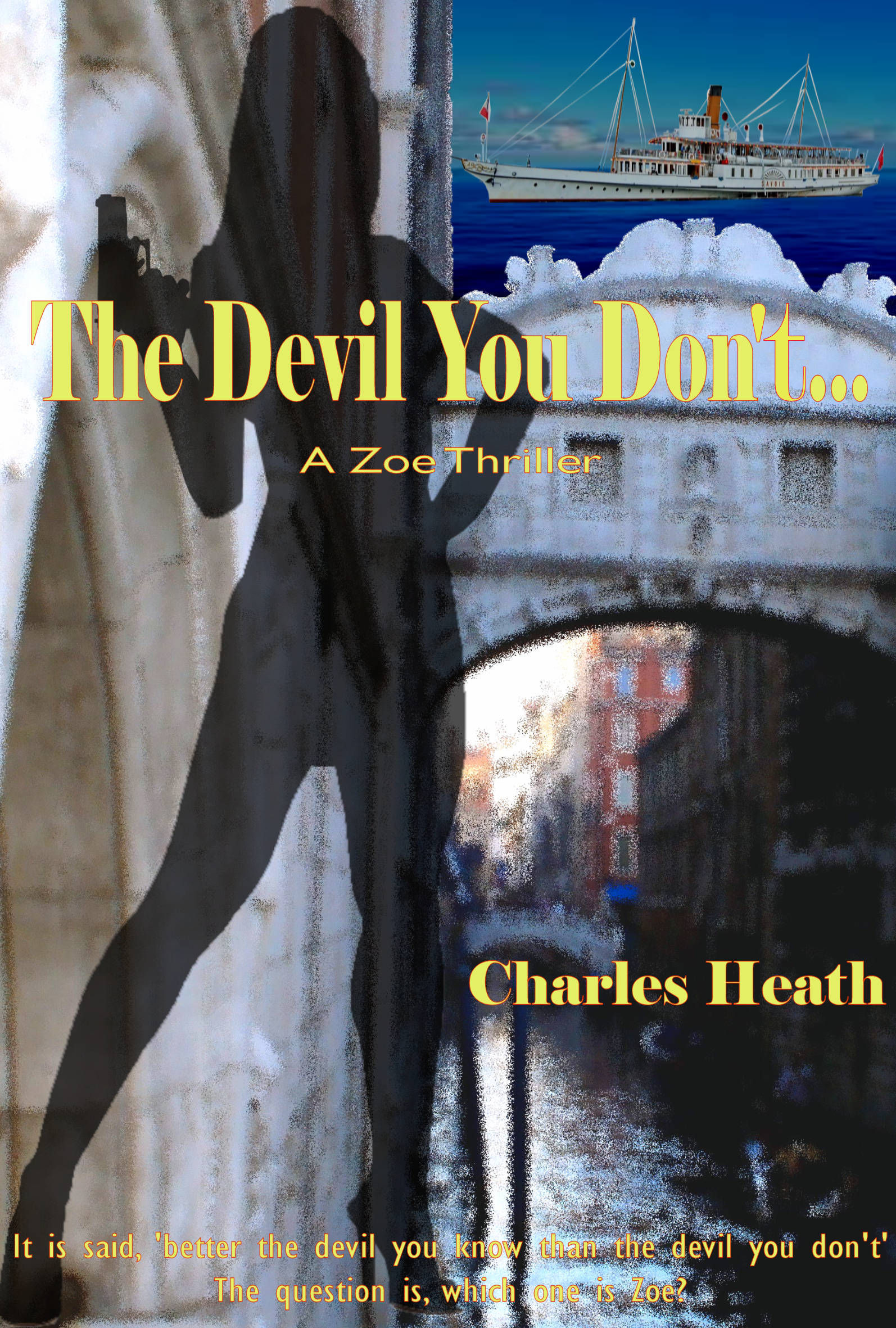
“The Devil You Don’t” – A beta readers view

It could be said that of all the women one could meet, whether contrived or by sheer luck, what are the odds it would turn out to be the woman who was being paid a very large sum to kill you.

John Pennington is a man who may be lucky in business, but not so lucky in love. He has just broken up with Phillipa Sternhaven, the woman he thought was the one, but relatives and circumstances, and perhaps because she was a ‘princess’, may also have contributed to the end result.

So, what do you do when you are heartbroken?

That is a story that slowly unfolds, from the first meeting with his nemesis on Lake Geneva, all the way to a hotel room in Sorrento, where he learns the shattering truth.

What should have been a high turns out to be something else entirely, and from that point every thing goes to hell in a handbasket.

He suddenly realises his so-called friend Sebastian has not exactly told him the truth about a small job he asked him to do, the woman he is falling in love with is not quite who she says she is, and he is caught in the middle of a war between two men who consider people becoming collateral damage as part of their business.

The story paints the characters cleverly displaying all their flaws and weaknesses. The locations add to the story at times taking me back down memory lane, especially to Venice where in those back streets I confess it’s not all that hard to get lost.

All in all a thoroughly entertaining story with, for once, a satisfying end.

…

Available on Amazon here: https://amzn.to/2Xyh1ow

…