The cinema of my dreams – I always wanted to write a war story – Episode 18

For a story that was conceived during those long boring hours flying in a steel cocoon, striving to keep away the thoughts that the plane and everyone in it could just simply disappear as planes have in the past, it has come a long way.

Whilst I have always had a fascination in what happened during the second world war, not the battles or fighting, but in the more obscure events that took place, I decided to pen my own little sidebar to what was a long and bitter war.

And, so, it continues…


It was clear, however, that Marina was familiar with the man and very annoyed with the woman.

When I took a longer look at the man, I realised he was not a man at all, but a boy in his teens, blessed by the fact he looked older than he was.  My guess, about 16.  I was surprised he had not been conscripted into the war, there seemed very few young men in the area.

Marina went straight over to him and snatched the elderly rifle he was holding away from him, the glared at Chiara

“Are you stark staring mad.  Enrico is not supposed to be out in the open, hell, it’s been a battle to keep him hidden away.  What will his parents think when they discover he’s here?”

“Pleased,” Enrico said.  “My father said it’s about time I did something to rid of the Germans, of the English too for that matter.  None of you has any right to be here.”

Fervently spoken, and to the wrong person, it would earn him a bullet to the back of the head.  But I agreed with him.

“All well and good,” Marina said to him, “but now there’s no easy way of doing that.  We must be careful, and you must stay put with your parents.  What we’re doing isn’t a game, you are neither trained or equipped to take anyone on, except perhaps rabbits.”

Back at Chiara.  “Take him home, and never bring him back here.  You don’t want to be the one who has to tell his mother if he gets killed.  Now, both of you go now, before I shoot both of you myself.”

“This is not the end of the matter,” Enrico said.

“And when you’ve taken him back, come back here.  We need to talk.”

Chiara said nothing, just nodded sullenly.  I think she believed the less said the better and did as she was asked, nodding her head in his direction, and adding a few choice phrases in Italian to him that I couldn’t understand.  It also just occurred to me that she had not asked Chiara the questions about the two men from the castle.  I guess that would have to wait until the safety of Enrico was settled, and she returned.

“Make sure they’re safe,” she said to Carlo, and he disappeared, leaving us alone.

“I thought all of the young men had been taken away by the Italian Army.”

“Not all.  We managed to hide a few away, but as you can see, despite our best efforts, they don’t seem to appreciate the trouble they could get into.  We used to have about a hundred young men from 14 through to 20 at the start of the war.  Two have found their way back, casualties of war, the rest, we may never see them again.  Enrico just doesn’t see the trouble he could get into.”

“It’s called youthful enthusiasm.  In the first world war, joining up, or going to war, was a lark.  It was a little less so this time because most of the parents knew from firsthand experience what it was like and tried to shield them.  And if you didn’t join up, questions were asked, and quite often jail, except for some who landed cushy jobs away from the fighting.”

“You were not so lucky?”

“No, I was one of those mad buggers who thought joining up to fight would be an adventure.  That quickly faded when the enemy started shooting at me.”

“And now you’re here, and a spy to boot.  That’s what they’ll hang on you if you get caught.”

“Then I shall try very hard not to get caught.  Again.”


Chiara came back about an hour later.  It seemed to me it was a lot safer to move around at night with the blackout, and I doubted Thompson would spare any men from the castle to check up on the local farmers.

And while I was at the castle, I didn’t hear anything raised about the local resistance, which I thought odd at the time, but now I knew why.  Most of them had joined him.  Better that than be hunted down and killed.

Chiara still looked sullen.  A closer look showed she was not very old herself, barely out of her twenties, and surprising that the Italian army, or Thomson for that matter, had not rounded her up for ‘duties’ at the castle.

There were a number of the local women working up at the castle, but they were mostly staff, or more likely forced labour, though I had thought we, when I believed it to be a British outpost, would be fairer to the locals than either the Germans or their own Italian military.  It’s odd how you tend to look at certain situations because of who you are, and the fact you would not do similar things at home.  The Germans, however, we would always treat differently, because they were the enemy, and because we expected the worst from them.  At that moment, though, wouldn’t the Germans think the same of us if the positions were reversed?

Best not to think about that.  My view of the war and the people in it was clouded enough.

Chiara, however, clearly thought the worst of me, and of those in the castle, and certainly didn’t think I was as neutral as I appeared.  A gun always in hand, I was sure she would shoot me again with the least provocation.

We sat, both Chiara and Marina with their weapons on the table in front of them.  I wasn’t trusted enough to be given a weapon.

Marina’s first question was directed at Chiara, “I’m told there were two men from the castle following Sam, and that he told you about them.”

“He did.  We did not see them.  We didn’t take the path, because, as you know, it’s not safe.”

It was a reasonable answer.  If the men at the castle were unfamiliar with the area, as I’m sure they would be, because they hadn’t been there for very long, and I doubt Thompson would want to advertise the nationality of those at the castle unless he had to, they would stick to the clearly-marked roads and paths.

I had on my way to the castle, from a different direction.  It didn’t explain why I had not been met by the leader of the resistance as arranged, but that was now explained, both by the former leader trying to kill me in a roadside explosion, and then what I learned at the castle in the last few days.

“Even so, there’s not that much distance between the two, and it is possible to shadow them.”

“I keep well away from them.  Perhaps Leonardo saw them.  He doesn’t have to worry about what they might do because they use him to supply food.  Maybe he knows more.”

“Perhaps I shall ask him next time I see him.  We need to know who from the castle is about and when so that we don’t get caught.”

“I’ll remember next time.  Is that all?”

“Yes.”

Chiara picked up her gun, gave me an extra-long sullen stare.  “I don’t trust this one, Marina.  You 

need to be careful.”

“I will.”

We waited a few minutes until after she had departed, and then Marina said, “We should be going too.  This place is a little eerie at night.  There are far too many ghosts for my liking.”

I shuddered, then followed her out.


© Charles Heath 2019

The cinema of my dreams – I always wanted to see the planets – Episode 52

Another discussion with the Princess

…

By definition, a voyage of exploration was about finding new lands and people.  Of course, it would be naive to think that all people would be peaceful but one could generally assume they would make some effort to make a gesture of goodwill, to begin with.

Either we had got off to bad start by starting out on the galactic version of the wrong side of the tracks or everyone in this galaxy was hostile.

Or perhaps I was making the wrong assumption but as number one said, why send three ships when one would suffice?

I decided another short visit to the Princess might clear up a few misconceptions before they became glaring errors in judgement.

She didn’t smile when she saw me.

“Let me guess, they sent a welcoming committee.”

She’d known.  And it looked like if I wanted the right answers I’d have to ask the right questions

“I take it your escape was too easy?”

“I’m surprised you didn’t realise that yourself.”

“I didn’t want to believe it, but that’s just the optimist in me.  Does this mean the people where we left are working with the people we’re going to, and are both conspiring against us?”

“Or perhaps it’s not the world, but just the one.  He knew my history, he’d know who was in power, and if I was to make an educated guess, he is likely a spy for them.  This galaxy has a history of wars, spies, and uneasy peace.  You have to pick your friends wisely.”

I’d participated in a war or two on land, not in space, and a few serious disputes over landing rights in space, but this was a whole new enterprise.

“We’re here to make friends with everyone, being the new kids on the block.”  When I saw her bewildered look, I added, ” an earth expression.  We try to make friends with everyone irrespective of who they are, where they come from, and what they’ve done.”

“I wish you well, but it’s doomed to failure.  You will have to pick a side.”

I shook my head.  “That’s the old way of thinking back home.  I’m not bringing that with us.  This is why we’re here now, mending other people’s bridges; sorry another earth expression.”

“I think I would like living on your planet now; are all the people like you?”

“Sadly no.  Unfortunately, we suffer from the problems you are all too familiar with, and even though there are enough sensible people in our world who are striving to be better, progress is slow.  Watching your planet slowly self-destruct because of greed and ignorance has helped.  It took a long time for everyone to realise we all had to live together whether we liked it or not, and that it was in everyone’s best interest to work together.”

“Everyone except the other ship’s captain.  He had a very different view of your world, one where some people are being marginalised simply because they didn’t want to join the collective.”

“It’s not that they didn’t want to join, it was because they didn’t want to share technology or resources without a cost.  We don’t like people who want to profit at the expense of others, that in itself if allowed to happen would create disproportionate wealth and inevitably power in a single entity.  We’ve been there, done that, and that’s why our world is dying.  I’m sure the first thing the other captain asked for was technology so they could take it back and sell it.”

“Isn’t that what you would also do?”

“No.  I was put here by a unified people who want what we find to be used for the benefit of everyone.  Even those who would not reciprocate if the roles were reversed.”

“Noble indeed, but most here would say misguided.  We have tried in the past to do just that, so I can tell you it will be a hard path.”

“Be that as it may it doesn’t solve our current situation.

“Then perhaps I can give you a solution, but not quite the one you’re looking for.  Maybe I could become the first alien crew member on your ship. As a member of the crew, and not leaving the ship, particularly in these parts of the galaxy, I would not be a threat to one side or used as an example by the other.  I’m sure you could find something for me to do.  It would be, using one of your analogies, a win-win situation?

…

© Charles Heath 2021-2022

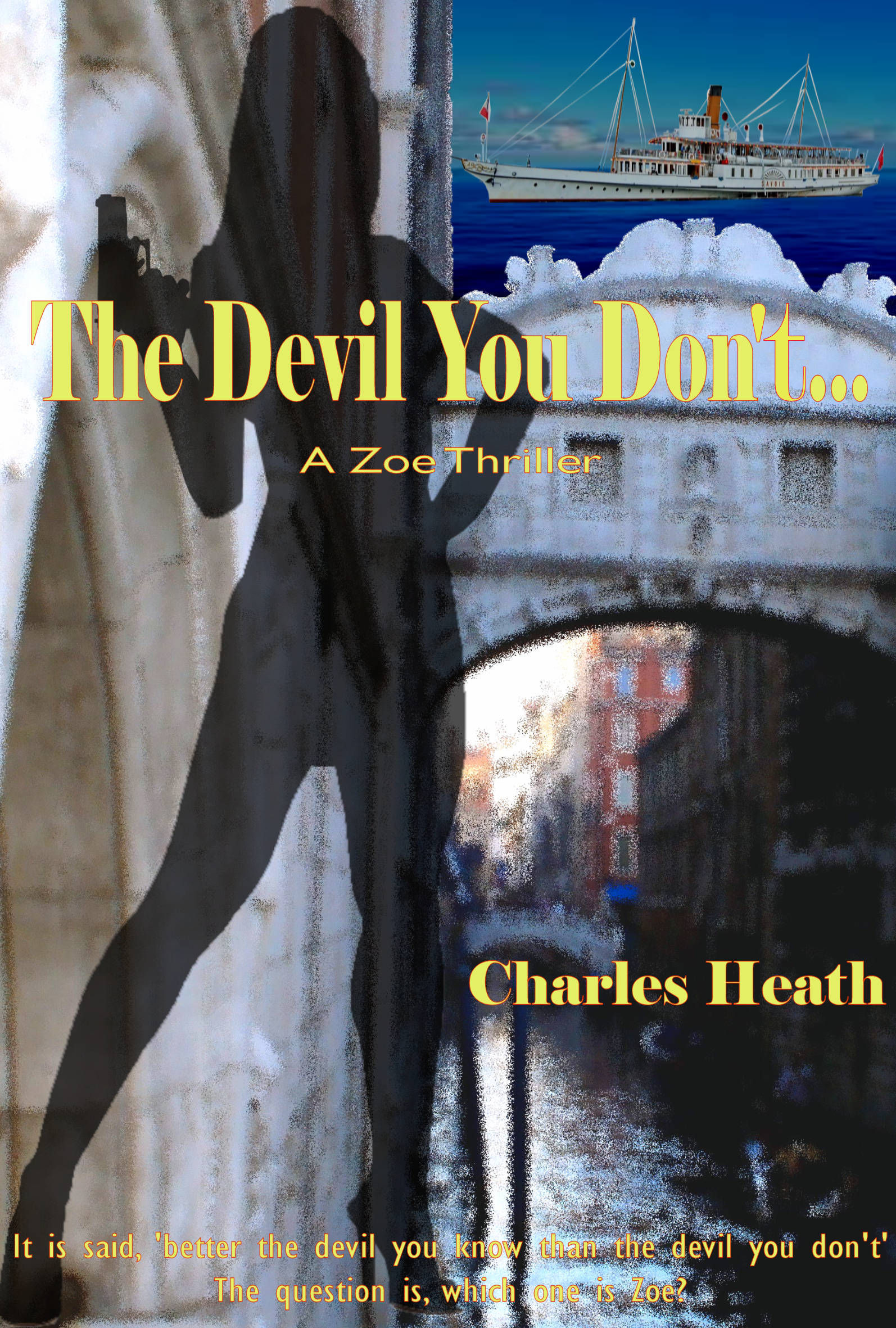
“The Devil You Don’t” – A beta readers view

It could be said that of all the women one could meet, whether contrived or by sheer luck, what are the odds it would turn out to be the woman who was being paid a very large sum to kill you.

John Pennington is a man who may be lucky in business, but not so lucky in love. He has just broken up with Phillipa Sternhaven, the woman he thought was the one, but relatives and circumstances, and perhaps because she was a ‘princess’, may also have contributed to the end result.

So, what do you do when you are heartbroken?

That is a story that slowly unfolds, from the first meeting with his nemesis on Lake Geneva, all the way to a hotel room in Sorrento, where he learns the shattering truth.

What should have been a high turns out to be something else entirely, and from that point every thing goes to hell in a handbasket.

He suddenly realises his so-called friend Sebastian has not exactly told him the truth about a small job he asked him to do, the woman he is falling in love with is not quite who she says she is, and he is caught in the middle of a war between two men who consider people becoming collateral damage as part of their business.

The story paints the characters cleverly displaying all their flaws and weaknesses. The locations add to the story at times taking me back down memory lane, especially to Venice where in those back streets I confess it’s not all that hard to get lost.

All in all a thoroughly entertaining story with, for once, a satisfying end.

…

Available on Amazon here: https://amzn.to/2Xyh1ow

…

An excerpt from “Mistaken Identity” – a work in progress

The odds of any one of us having a doppelganger are quite high. Whether or not you got to meet him or her, or be confronted by them was significantly lower. Except of course, unless you are a celebrity.

It was a phenomenon remarkable only for the fact, at times, certain high profile people, notorious or not, had doubles if only to put off enemies or the general public. Sometimes we see people in the street, people who look like someone we knew, and made the mistake of approaching them like a long lost friend, only to discover an embarrassed individual desperately trying to get away for what they perceive is a stalker or worse.

And then sometimes in is a picture that looms up on a TV screen, an almost exact likeness of you. At first you are fascinated, and then according to the circumstances, and narrative that is attached to that picture, either flattered or horrified.

For me one turned to the other when I saw an almost likeness of me flash up on the screen when I turned the TV on in my room. What looked to be my photo, with only minor differences, was in the corner of the screen, the news reader speaking in rapid Italian, so fast I could only translate every second or third word.

But the one word I did recognize was murder. The photo of the man up on the screen was the subject of an extensive manhunt. The crime, murder of woman in the very same hotel I was staying, and it was being played out live several floors above me. The gist of the story, the woman had been seen with, and staying with the man who was my double, and, less than an hour ago, the body had been discovered by a chambermaid.

The killer, the announcer said, was believed to be still in the hotel because the woman had died shortly before she had been discovered.

I watched, at first fascinated at that I was seeing. I guess I should have been horrified, but at that moment it didn’t register that I might be mistaken for that man.

Not until an another five minutes had passed, and I was watching the police in full riot gear, with a camera crew following behind, coming up a passage towards a room. Live action of the arrest of the suspected killer the breathless commentator said.

Then, suddenly, there was a pounding on the door. On the TV screen, plain to see, was the number of my room.
I looked through the peep hole and saw an army of police officers. It didn’t take much to realize what had happened. The hotel staff had identified me as the man in the photograph on the TV and called the police.

Horrified wasn’t what I was feeling right then.

It was fear.

My last memory was the door crashing open, the wood splintering, and men rushing into the room, screaming at me, waving guns, and when I put my hands up to defend myself, I heard a gunshot.

And in one very confused and probably near death experience, I thought I saw my mother, and thinking what was she doing in Rome?

…

I was the archetypal nobody.

I lived in a small flat, I drove a nondescript car, had an average job in a low profile travel agency, was single, and currently not involved in a relationship, no children, and according to my workmates, no life.

They were wrong. I was one of those people who preferred their own company, I had a cat, and travelled whenever I could. And I did have a ‘thing’ for Rosalie, one of the reasons why I stayed at the travel agency. I didn’t expect anything to come of it, but one could always hope.

I was both pleased and excited to be going to the conference. It was my first, and the glimpse I had seen of it had whetted my appetite for more information about the nuances of my profession.

Some would say that a travel agent wasn’t much of a job, but to me, it was every bit as demanding as being an accountant or a lawyer. You were providing a customer with a service, and arguably more people needed a travel agent than a lawyer. At least that was what I told myself, as I watched more and more people start using the internet, and our relevance slowly dissipating.

This conference was about countering that trend.

The trip over had been uneventful. I was met at the airport and taken to the hotel where the conference was being held with a number of other delegates who had arrived on the same plane. I had mingled with a number of other delegates at the pre conference get together, including one whose name was Maryanne.

She was an unusual young woman, not the sort that I usually met, because she was the one who was usually surrounded by all the boys, the life of the party. In normal circumstances, I would not have introduced myself to her, but she had approached me. Why did I think that may have been significant? All of this ran through my mind, culminating in the last event on the highlight reel, the door bursting open, men rushing into my room, and then one of the policemen opened fire.

I replayed that last scene again, trying to see the face of my assailant, but it was just a sea of men in battle dress, bullet proof vests and helmets, accompanied by screaming and yelling, some of which I identified as “Get on the floor”.

Then came the shot.

Why ask me to get on the floor if all they were going to do was shoot me. I was putting my hands up at the time, in surrender, not reaching for a weapon.

Then I saw the face again, hovering in the background like a ghost. My mother. Only the hair was different, and her clothes, and then the image was going, perhaps a figment of my imagination brought on by pain killing drugs. I tried to imagine the scene again, but this time it played out, without the image of my mother.

I opened my eyes took stock of my surroundings. What I felt in that exact moment couldn’t be described. I should most likely be dead, the result of a gunshot wound. I guess I should be thankful the shooter hadn’t aimed at anything vital, but that was the only item on the plus side.

I was in a hospital room with a policeman by the door. He was reading a newspaper, and sitting uncomfortably on a small chair. He gave me a quick glance when he heard me move slightly, but didn’t acknowledge me with either a nod, or a greeting, just went back to the paper.

If I still had a police guard, then I was still considered a suspect. What was interesting was that I was not handcuffed to the bed. Perhaps that only happened in TV shows. Or maybe they knew I couldn’t run because my injuries were too serious. Or the guard would shoot me long before my feet hit the floor. I knew the police well enough now to know they would shoot first and ask questions later.

On the physical side, I had a large bandage over the top left corner of my chest, extending over my shoulder. A little poking and prodding determined the bullet had hit somewhere between the top of my rib cage and my shoulder. Nothing vital there, but my arm might be somewhat useless for a while, depending on what the bullet hit on the way in, or through.

It didn’t feel like there were any broken or damaged bones.

That was the good news.

On the other side of the ledger, my mental state, there was only one word that could describe it. Terrified. I was looking at a murder charge and jail time, a lot of it. Murder usually had a long time in jail attached to it.

Whatever had happened, I didn’t do it. I know I didn’t do it, but I had to try and explain this to people who had already made up their minds. I searched my mind for evidence. It was there, but in the confused state brought on by the medication, all I could think about was jail, and the sort of company I was going to have.

I think death would have been preferable.

…

Half an hour later, maybe longer, I was drifting in an out of consciousness, a nurse, or what I thought was a nurse, came into the room. The guard stood, checked her ID card, and then stood by the door.

She came over and stood beside the bed. “How are you?” she asked, first in Italian, and when I pretended I didn’t understand, she asked the same question in accented English.

“Alive, I guess,” I said. “No one has come and told what my condition is yet. You are my first visitor. Can you tell me?”

“Of course. You are very lucky to be alive. You will be fine and make a full recovery. The doctors here are excellent at their work.”

“What happens now?”

“I check you, and then you have a another visitor. He is from the British Embassy I think. But he will have to wait until I have finished my examination.”

I realized then she was a doctor, not a nurse.

…

My second visitor was a man, dressed in a suit the sort of which I associated with the British Civil Service.  He was not very old which told me he was probably a recent graduate on his first posting, the junior officer who drew the short straw.

The guard checked his ID but again did not leave the room, sitting back down and going back to his newspaper.

My visitor introduced himself as Alex Jordan from the British Embassy in Rome and that he had been asked by the Ambassador to sort out what he labelled a tricky mess.

For starters, it was good to see that someone cared about what happened to me.  But, equally, I knew the mantra, get into trouble overseas, and there is not much we can do to help you.  So, after that lengthy introduction, I had to wonder why he was here.

I said, “They think I am an international criminal by the name of Jacob Westerbury, whose picture looks just like me, and apparently for them it is an open and shut case.”  I could still hear the fragments of the yelling as the police burst through the door, at the same time telling me to get on the floor with my hands over my head.

“It’s not.  They know they’ve got the wrong man, which is why I’m here.  There is the issue of what had been described as excessive force, and the fact you were shot had made it an all-round embarrassment for them.”

“Then why are you here?  Shouldn’t they be here apologizing?”

“That is why you have another visitor.  I only took precedence because I insisted I speak with you first.  I have come, basically to ask you for a favour.  This situation has afforded us with an opportunity.  We would like you to sign the official document which basically indemnifies them against any legal proceedings.”

Curious.  What sort of opportunity was he talking about?  Was this a matter than could get difficult and I could be charged by the Italian Government, even if I wasn’t guilty, or was it one of those hush hush type deals, you do this for us, we’ll help you out with that.  “What sort of opportunity?”

“We want to get our hands on Jacob Westerbury as much as they do.  They’ve made a mistake, and we’d like to use that to get custody of him if or when he is arrested in this country.  I’m sure you would also like this man brought into custody as soon as possible so you will stop being confused with him.  I can only imagine what it was like to be arrested in the manner you were.  And I would not blame you if you wanted to get some compensation for what they’ve done.  But.  There are bigger issues in play here, and you would be doing this for your country.”

I wondered what would happen if I didn’t agree to his proposal.  I had to ask, “What if I don’t?”

His expression didn’t change.  “I’m sure you are a sensible man Mr Pargeter, who is more than willing to help his country whenever he can.  They have agreed to take care of all your hospital expenses, and refund the cost of the Conference, and travel.  I’m sure I could also get them to pay for a few days at Capri, or Sorrento if you like, before you go home.  What do you say?”

There was only one thing I could say.  Wasn’t it treason if you went against your country’s wishes?

“I’m not an unreasonable man, Alex.  Go do your deal, and I’ll sign the papers.”

“Good man.”

…

After Alex left, the doctor came back to announce the arrival of a woman, by the way she had announced herself, the publicity officer from the Italian police. When she came into the room, she was not dressed in a uniform.

The doctor left after giving a brief report to the civilian at the door. I understood the gist of it, “The patient has recovered excellently and the wounds are healing as expected. There is no cause for concern.”

That was a relief.

While the doctor was speaking to the civilian, I speculated on who she might be. She was young, not more than thirty, conservatively dressed so an official of some kind, but not necessarily with the police. Did they have prosecutors? I was unfamiliar with the Italian legal system.

She had long wavy black hair and the sort of sultry looks of an Italian movie star, and her presence made me more curious than fearful though I couldn’t say why.

The woman then spoke to the guard, and he reluctantly got up and left the room, closing the door behind him.
She checked the door, and then came back towards me, standing at the end of the bed. Now alone, she said, “A few questions before we begin.” Her English was only slightly accented. “Your name is Jack Pargeter?”

I nodded. “Yes.”

“You are in Rome to attend the Travel Agents Conference at the Hilton Hotel?”

“Yes.”

“You attended a preconference introduction on the evening of the 25th, after arriving from London at approximately 4:25 pm.”

“About that time, yes. I know it was about five when the bus came to collect me, and several others, to take us to the hotel.”

She smiled. It was then I noticed she was reading from a small notepad.

“It was ten past five to be precise. The driver had been held up in traffic. We have a number of witnesses who saw you on the plane, on the bus, at the hotel, and with the aid of closed circuit TV we have established you are not the criminal Jacob Westerbury.”

She put her note book back in her bag and then said, “My name is Vicenza Andretti and I am with the prosecutor’s office. I am here to formally apologize for the situation that can only be described as a case of mistaken identity. I assure you it is not the habit of our police officers to shoot people unless they have a very strong reason for doing so. I understand that in the confusion of the arrest one of our officers accidentally discharged his weapon. We are undergoing a very thorough investigation into the circumstances of this event.”

I was not sure why, but between the time I had spoken to the embassy official and now, something about letting them off so easily was bugging me. I could see why they had sent her. It would be difficult to be angry or annoyed with her.

But I was annoyed.

“Do you often send a whole squad of trigger happy riot police to arrest a single man?” It came out harsher than I intended.

“My men believed they were dealing with a dangerous criminal.”

“Do I look like a dangerous criminal?” And then I realized if it was mistaken identity, the answer would be yes.

She saw the look on my face, and said quietly, “I think you know the answer to that question, Mr. Pargeter.”

“Well, it was overkill.”

“As I said, we are very sorry for the circumstances you now find yourself in. You must understand that we honestly believed we were dealing with an armed and dangerous murderer, and we were acting within our mandate. My department will cover your medical expenses, and any other amounts for the inconvenience this has caused you. I believe you were attending a conference at your hotel. I am very sorry but given the medical circumstances you have, you will have to remain here for a few more days.”

“I guess, then, I should thank you for not killing me.”

Her expression told me that was not the best thing I could have said in the circumstances.

“I mean, I should thank you for the hospital and the care. But a question or two of my own. May I?”

She nodded.

“Did you catch this Jacob Westerbury character?”

“No. In the confusion created by your arrest he escaped. Once we realized we had made a mistake and reviewed the close circuit TV, we tracked him leaving by a rear exit.”

“Are you sure it was one of your men who shot me?”

I watched as her expression changed, to one of surprise.

“You don’t think it was one of my men?”

“Oddly enough no. But don’t ask me why.”

“It is very interesting that you should say that, because in our initial investigation, it appeared none of our officer’s weapons had been discharged. A forensic investigation into the bullet tells us it was one that is used in our weapons, but…”

I could see their dilemma.

“Have you any enemies that would want to shoot you Mr Pargeter?”

That was absurd because I had no enemies, at least none that I knew of, much less anyone who would want me dead.

“Not that I’m aware of.”

“Then it is strange, and will perhaps remain a mystery. I will let you know if anything more is revealed in our investigation.”

She took an envelope out of her briefcase and opened it, pulling out several sheets of paper.

I knew what it was. A verbal apology was one thing, but a signed waiver would cover them legally. They had sent a pretty girl to charm me. Perhaps using anyone else it would not have worked. There was potential for a huge litigation payout here, and someone more ruthless would jump at the chance of making a few million out of the Italian Government.

“We need a signature on this document,” she said.

“Absolving you of any wrong doing?”

“I have apologized. We will take whatever measures are required for your comfort after this event. We are accepting responsibility for our actions, and are being reasonable.”

They were. I took the pen from her and signed the documents.

“You couldn’t add dinner with you on that list of benefits?” No harm in asking.

“I am unfortunately unavailable.”

I smiled. “It wasn’t a request for a date, just dinner. You can tell me about Rome, as only a resident can. Please.”

She looked me up and down, searching for the ulterior motive. When she couldn’t find one, she said, “We shall see once the hospital discharges you in a few days.”

“Then I’ll pencil you in?”

She looked at me quizzically. “What is this pencil me in?”

“It’s an English colloquialism. It means maybe. As when you write something in pencil, it is easy to erase it.”

A momentary frown, then recognition and a smile. “I shall remember that. Thank-you for your time and co-operation Mr. Pargeter. Good morning.”

…

© Charles Heath 2015-2021
The second attempt looks a little better, but not much

The process of writing is rewriting editing and more rewriting.

The other day l wrote some words.  I didn’t like them.  But it had laid the groundwork for a second draft.

Here it is:


Growing up I did not believe l had one of those lovable faces.

My brother, known in school as the best looking boy of his graduating class, said it was a face only a mother could love.

He was mean.

Simone, a girl who was a friend, not a girlfriend, said my face had character.

She was charming and polite.

Looking now, in the mirror, l decided I’d aged gracefully.

I could truthfully say my brother had not, but that was as far as the comparison went.

My overachieving brother was the epitome of success in business, a veritable god zillionaire.  Everything he touched turned to gold.

My ultra successful sister, Penelope, had married into the right family perhaps by chance, but she was also a very learned scholar whose life was divided between her chair and the university and her social life with the rich and famous.

Then there was me.

I gave up on my chance at university because l was not the scholarly sort and didn’t last long.  Sadly l was the first of my family to be sent down from Oxford.

Instead, l took on a series of professions such as seasonal laborer, farmhand, factory worker, and lastly, night watchman.  At least now I had a uniform and looked like I’d made something of myself.

It would not be enough for my parents who every year didn’t say it out loud but the disappointment was always there in their expressions.

My brother in his usual blunt manner said l was a loser and would never change.

My sister was not quite so blunt.  She simply said it was disappointing so much potential was going to waste.  I only asked her once what she meant and lost me after the first four-syllable word.

Finally, I’d taken their comments to heart and decided l would not be going home to the family Christmas holiday reunion.

I told my boss l was available to work the night shift over the holidays, the shift no one else wanted.

It was he said the time for reflection.  He hated his family as much as I did so we would be able to lament our bad luck though the long cold hours from dusk till dawn.

It was 3 a.m. and it was like standing on the exact epicenter of the North Pole.  I’d just stepped from the warehouse into the car park.

The car was covered in snow.  The weather was clear now, but more snow was coming.

It was going to be a white Christmas, all I needed.  I hoped I remembered to put the antifreeze in my radiator this time.

As I approached my car, the light went on in an SUV parked next to my car.  The door opened and what looked to be a woman was climbing down from the driver’s seat.

She closed the door and leaned against the side of the car.  “Graham?”

It was a voice I was familiar with, though I hadn’t heard it for a long time, my ultra-successful sister, Penelope.  From what I could see, she didn’t look too well.

“What do you want?”

“Help.”

My help, I was the last person to help her or anyone for that matter.  But curiosity got the better of me.  “Why?”

“Because my husband is trying to kill me.”

The instant the last word left her lips I saw her jerk back into the car, and then start sliding down to the ground.  There was no mistaking the red streak following her as she fell.

She’d been shot from what could be a sniper rifle, which meant …


It still needs work but I’ve got the gist of where I want to go.

The idea is not to make a character so loathsome no one would want to read about him.

This will evolve and you can if you like come along for the ride!


© Charles Heath 2020

An excerpt from “The Things We Do For Love”; In love, Henry was all at sea!

In the distance he could hear the dinner bell ringing and roused himself.  Feeling the dampness of the pillow, and fearing the ravages of pent up emotion, he considered not going down but thought it best not to upset Mrs. Mac, especially after he said he would be dining.

In the event, he wished he had reneged, especially when he discovered he was not the only guest staying at the hotel.

Whilst he’d been reminiscing, another guest, a young lady, had arrived.  He’d heard her and Mrs. Mac coming up the stairs, and then shown to a room on the same floor, perhaps at the other end of the passage.

Henry caught his first glimpse of her when she appeared at the door to the dining room, waiting for Mrs. Mac to show her to a table.

She was about mid-twenties, slim, long brown hair, and the grace and elegance of a woman associated with countless fashion magazines.  She was, he thought, stunningly beautiful with not a hair out of place, and make-up flawlessly applied.  Her clothes were black, simple, elegant, and expensive, the sort an heiress or wife of a millionaire might condescend to wear to a lesser occasion than dinner.

Then there was her expression; cold, forbidding, almost frightening in its intensity.  And her eyes, piercingly blue and yet laced with pain.  Dracula’s daughter was his immediate description of her.

All in all, he considered, the only thing they had in common was, like him, she seemed totally out of place.

Mrs. Mac came out of the kitchen, wiping her hands on her apron.  She was, she informed him earlier, chef, waitress, hotelier, barmaid, and cleaner all rolled into one.  Coming up to the new arrival she said, “Ah, Miss Andrews, I’m glad you decided to have dinner.  Would you like to sit with Mr. Henshaw, or would you like to have a table of your own?”

Henry could feel her icy stare as she sized up his appeal as a dining companion, making the hair on the back on his neck stand up.  He purposely didn’t look back.  In his estimation, his appeal rating was minus six.  Out of a thousand!

“If Mr. Henshaw doesn’t mind….”  She looked at him, leaving the query in mid-air.

He didn’t mind and said so.  Perhaps he’d underestimated his rating.

“Good.”  Mrs. Mac promptly ushered her over.  Henry stood, made sure she was seated properly and sat.

“Thank you.  You are most kind.”  The way she said it suggested snobbish overtones.

“I try to be when I can.”  It was supposed to nullify her sarcastic tone but made him sound a little silly, and when she gave him another of her icy glares, he regretted it.

Mrs. Mac quickly intervened, asking, “Would you care for the soup?”

They did, and, after writing the order on her pad, she gave them each a look, imperceptibly shook her head, and returned to the kitchen.

Before Michelle spoke to him again, she had another quick look at him, trying to fathom who and what he might be.  There was something about him.

His eyes, they mirrored the same sadness she felt, and, yes, there was something else, that it looked like he had been crying?  There was a tinge of redness.

Perhaps, she thought, he was here for the same reason she was.

No.  That wasn’t possible.

Then she said, without thinking, “Do you have any particular reason for coming here?”  Seconds later she realized she’s spoken it out loud, had hadn’t meant to actually ask, it just came out.

It took him by surprise, obviously not the first question he was expecting her to ask of him.

“No, other than it is as far from civilization, and home, as I could get.”

At least we agree on that, she thought.

It was obvious he was running away from something as well.

Given the isolation of the village and lack of geographic hospitality, it was, from her point of view, ideal.  All she had to do was avoid him, and that wouldn’t be difficult.

After getting through this evening first.

“Yes,” she agreed.  “It is that.”

A few seconds passed, and she thought she could feel his eyes on her and wasn’t going to look up.

Until he asked, “What’s your reason?”

Slight abrupt in manner, perhaps as a result of her question, and the manner in which she asked it.

She looked up.  “Rest.  And have some time to myself.”

She hoped he would notice the emphasis she had placed on the word ‘herself’ and take due note.  No doubt, she thought,  she had completely different ideas of what constituted a holiday than he, not that she had actually said she was here for a holiday.

Mrs. Mac arrived at a fortuitous moment to save them from further conversation.


Over the entree, she wondered if she had made a mistake coming to the hotel.  Of course, there had been no possible way she could know than anyone else might have booked the same hotel, but realized it was foolish to think she might end up in it by herself.

Was that what she was expecting?

Not a mistake then, but an unfortunate set of circumstances, which could be overcome by being sensible.

Yet, there he was, and it made her curious, not that he was a man, by himself, in the middle of nowhere, hiding like she was, but for very different reasons.

On discreet observance whilst they ate, she gained the impression his air of light-heartedness was forced and he had no sense of humor.

This feeling was engendered by his looks, unruly dark hair, and permanent frown.  And then there was his abysmal taste in clothes on a tall, lanky frame.  They were quality but totally unsuited to the wearer.

Rebellion was written all over him.

The only other thought crossing her mind, and rather incongruously, was he could do with a decent feed.  In that respect, she knew now from the mountain of food in front of her, he had come to the right place.

“Mr. Henshaw?”

He looked up.  “Henshaw is too formal.  Henry sounds much better,” he said, with a slight hint of gruffness.

“Then my name is Michelle.”

Mrs. Mac came in to take their order for the only main course, gather up the entree dishes, then return to the kitchen.

“Staying long?” she asked.

“About three weeks.  Yourself?”

“About the same.”

The conversation dried up.

Neither looked at the other, rather at the walls, out the window, towards the kitchen, anywhere.  It was, she thought, almost unbearably awkward.


Mrs. Mac returned with a large tray with dishes on it, setting it down on the table next to theirs.

“Not as good as the usual cook,” she said, serving up the dinner expertly, “but it comes a good second, even if I do say so myself.  Care for some wine?”

Henry looked at Michelle.  “What do you think?”

“I’m used to my dining companions making the decision.”

You would, he thought.  He couldn’t help but notice the cutting edge of her tone.  Then, to Mrs. Mac, he named a particular White Burgundy he liked and she bustled off.

“I hope you like it,” he said, acknowledging her previous comment with a smile that had nothing to do with humor.

“Yes, so do I.”

Both made a start on the main course, a concoction of chicken and vegetables that were delicious, Henry thought, when compared to the bland food he received at home and sometimes aboard my ship.

It was five minutes before Mrs. Mac returned with the bottle and two glasses.  After opening it and pouring the drinks, she left them alone again.

Henry resumed the conversation.  “How did you arrive?  I came by train.”

“By car.”

“Did you drive yourself?”

And he thought, a few seconds later, that was a silly question, otherwise she would not be alone, and certainly not sitting at this table. With him.

“After a fashion.”

He could see that she was formulating a retort in her mind, then changed it, instead, smiling for the first time, and it served to lighten the atmosphere.

And in doing so, it showed him she had another more pleasant side despite the fact she was trying not to look happy.

“My father reckons I’m just another of ‘those’ women drivers,” she added.

“Whatever for?”

“The first and only time he came with me I had an accident.  I ran up the back of another car.  Of course, it didn’t matter to him the other driver was driving like a startled rabbit.”

“It doesn’t help,” he agreed.

“Do you drive?”

“Mostly people up the wall.”  His attempt at humor failed.  “Actually,” he added quickly, “I’ve got a very old Morris that manages to get me where I’m going.”

The apple pie and cream for dessert came and went and the rapport between them improved as the wine disappeared and the coffee came.  Both had found, after getting to know each other better, their first impressions were not necessarily correct.

“Enjoy the food?” Mrs. Mac asked, suddenly reappearing.

“Beautifully cooked and delicious to eat,” Michelle said, and Henry endorsed her remarks.

“Ah, it does my heart good to hear such genuine compliments,” she said, smiling.  She collected the last of the dishes and disappeared yet again.

“What do you do for a living,” Michelle asked in an off-hand manner.

He had a feeling she was not particularly interested and it was just making conversation.

“I’m a purser.”

“A what?”

“A purser.  I work on a ship doing the paperwork, that sort of thing.”

“I see.”

“And you?”

“I was a model.”

“Was?”

“Until I had an accident, a rather bad one.”

“Oh, I’m sorry.”

So that explained the odd feeling he had about her.

As the evening had worn on, he began to think there might be something wrong, seriously wrong with her because she didn’t look too well.  Even the carefully applied makeup, from close up, didn’t hide the very pale, and tired look, or the sunken, dark ringed eyes.

“I try not to think about it, but it doesn’t necessarily work.  I’ve come here for peace and quiet, away from doctors and parents.”

“Then you will not have to worry about me annoying you.  I’m one of those fall-asleep-reading-a-book types.”

Perhaps it would be like ships passing in the night and then smiled to himself about the analogy.

Dinner now over, they separated.

Henry went back to the lounge to read a few pages of his book before going to bed, and Michelle went up to her room to retire for the night.

But try as he might, he was unable to read, his mind dwelling on the unusual, yet the compellingly mysterious person he would be sharing the hotel with.

Overlaying that original blurred image of her standing in the doorway was another of her haunting expressions that had, he finally conceded, taken his breath away, and a look that had sent more than one tingle down his spine.

She may not have thought much of him, but she had certainly made an impression on him.


© Charles Heath 2015-2020

lovecoverfinal1

The cinema of my dreams – I always wanted to write a war story – Episode 17

For a story that was conceived during those long boring hours flying in a steel cocoon, striving to keep away the thoughts that the plane and everyone in it could just simply disappear as planes have in the past, it has come a long way.

Whilst I have always had a fascination in what happened during the second world war, not the battles or fighting, but in the more obscure events that took place, I decided to pen my own little sidebar to what was a long and bitter war.

And, so, it continues…


Jack was the first to realise that Marina was coming back, hearing her outside long before I did.  He stood up and looked in the direction of where he expected to see her.

A minute later she appeared, looking and sounding out of breath, as if she had been in a hurry? 

Chased, or had some urgent news?

“Is everything OK?” I asked, waiting till she came in and shut the door behind her.

The building we were in used to be a factory or a repair shop.  The strange smell I’d picked up a few hours ago was that of machine oil.

“We need to have a chat with the two who picked you up.”

“Where are they now?”

“I’ve organised to meet them at another facility we have.  Not everyone comes here.  It’s why we are still here.  Francesco nor any of the resistance he took with him were aware of this location.

I considered myself lucky to be among the few.

“Is there a reason why I need to be there?”

“Yes.  But it’ll wait until we get there.  Let’s go.”

She had barely got in the door, nor caught her breath.  It was just enough time to collect a spare clip of ammunition for a gun she had on her, but I couldn’t see.

I followed her out into the darkness, not realising it was night, for the first time since I’d arrived, and once outside, realised that it was an underground bunker rather than a building on an allotment, so it couldn’t be easily seen from any direction.  It was surrounded by trees and bushes, looking as though they had not been tended properly for some time.

It was as much as I could see, close by because it was a moonless night.

We went up some stairs and came out in a clump of bushes, and walked several yards where there was a disguised walkway zig-zagging through the bushes.  It, too, would be hard to see from a distance.  When we came out the other side, I could just barely see a car parked under a tree, looking rather worse for wear, and I thought it had been abandoned there. 

When Marina told me to get in, I realised it was, like everything else, well disguised.

The surrounding area was that of forest and farms.  It was hard to imagine that this part of the world was in the grip of a world war, and not too far away, there was the castle, and further north, the Germans and what was left of the Italian military forces dug in for a last-ditch effort.  The tide was turning, but ever so slowly.

It was hard to imagine just how dangerous it was for those defectors to try and get through without being shot.

And, just for good measure, Marina said, there were quite a few soldiers, disguised as ordinary workers who had infiltrated the villages, and surrounding farms, and reporting back what they saw and heard.

We were, in going about in the vehicle, attracting unwanted attention, but it was why we were doing this at night, she said, perhaps gleaning from my expression the fact I was worried about getting caught.

“The people at the castle tend not to go out at night for fear of being picked off.  I’m surprised you didn’t learn this when you were there.”

“I suspect the suspended any activities from the moment I arrived.  One of the prisoners told me that all movements of people had stopped, and they were waiting to be shipped out.  Obviously, they thought I might discover what was going on.  They definitely stopped me from going below the main floor.”

“I was told you have some knowledge of the castle layout?”

“Some.  We have old plans back in London, but I suspect those would be out of date now and since the German occupation.  The only time I got to look downstairs was when I tried to escape and found an old below ground exit, then when they locked me in a cell, and then when I was set free.  It matched much of what I remember seeing on the plans.  But, I suspect there’s more because I didn’t get to see the holding cells with the other prisoners.”

“Perhaps Carlo can help you with that.”

“We spoke about it.  I think he’s going to pay them a visit and exact revenge.”

“I told him we have to wait for some reinforcements.”

“No word from London?”

“Not yet.”

We stopped and parked the car between a church and what was left of what might have been a rectory, set aside from some other buildings that looked like part of a village.  It was not that dark that I couldn’t see that several of the buildings had been bombed, minus roofs, and one had the front section reduced to rubble.  No attempt had been made to clean it up.

“German tanks,” Marina said.  “An early landing party of your army parachuted in about a kilometre behind the church.  The local commander mobilised his forces and chased them into those buildings, which, at the time, housed four families.  They were given the option to surrender.  They didn’t, so the commander gave the order to raze the buildings to the ground, with them in there.  Along with the four innocent families.  No one survived.”

“The church?”

“The commander thought it would be bad luck to destroy the house of God.  The soldiers should have hidden in there.  They shot the priest anyway.”

It seemed odd to me that any sort of group would parachute into this part of Italy for any reason, castle withstanding.  There was, as far as I knew, nothing of interest or importance here.  Perhaps I’d ask when I made it back to London.  If I made it back.

I followed her through the rubble and in through a side entrance to the church.  Inside it was dark, and Marina was using her torchlight sparingly in case someone was watching.  From what I could see, the inside of the church was untouched, but everything was covered in dust from disuse.

“No one thought to send another priest?” I asked.

“No.  When they heard what happened to the last one, they decided to wait until the war was over.  Besides, with everything that’s happened, the people around here believe God has abandoned them.”

Perhaps he had.  I know that I wasn’t all that religious to begin with, but a lot of people I knew had lost their faith in a God that allowed such tragedies to happen.

We passed through a door at the back of the church, behind the nave, and into what looked like the vestment room.  To one side was another door, and then steps down.  The church had a cellar.

At the bottom of the stairs, there was a large storage area lit by a portable lantern.

Carlo was standing to one side, his weapon ready to use.

Opposite him were a man and a woman, the woman I’d seen before, she was the one who shot me with the tranquilizer.  The man, I’d not seen him before.


© Charles Heath 2019

The cinema of my dreams – I always wanted to see the planets – Episode 51

We have a possible situation

…

I was walking slowly along the passage leading to the elevator on my way back to the bridge when the First Officer’s voice broke my thoughts.

“Captain?”

“Number one?”

“Could you come to the bridge; we have a possible situation.”

“On my way.”

A ‘possible situation’ for Number One that could mean almost anything, from an engineering calamity to a standoff with 100 alien battleships.  I was hoping for the calamity in engineering.

When I arrived on the bridge it was calm.  Was I expecting panic?

Number one stood, relinquishing the captain’s chair.

“On screen,” he said as I crossed the deck to join him.

A magnified vision of three alien spaceships appeared ahead.

“Between us and the Princesses home planet.  If we can see them, they can see us.  I suspect they knew we were coming.  I’ve slowed down to give us some preparation time.”

Of course.  Given her reservations about going home, the time she’d been away, the fact she had been living with the enemy, and the changing of power, it was not dissimilar to events that had happened through history on our own homework.

Was it too much to expect things would be different, and better than what we had?

“What do you think, friendly or hostile?”

“We should treat every encounter as hostile until proven otherwise.  A friendly response would not be three ships blocking our path.”

My sentiments exactly.  “General and team to the bridge.”

A few seconds later, “Acknowledged.”

“How far away are they?”

“We could be there in 30 minutes,” the navigator said.

“Can we scan for life signs, weapons, anything?”

“Not until we’re closer.  From here all we can see is their ships.”

The General and three others that made up his bridge attack team arrived on the bridge.

“What do we have?” He asked as he crossed to his station.

“Three ships waiting for us.”

“Same as the last vessel we encountered?”

“We have to get closer.  You better get ready for a fight.  I don’t think these people are going to be as friendly as the others.”

“You have information on these people.”

“Only from what the princess told me.  They have been constantly at war with themselves and others, with ever-changing governments.”  It had painted an interesting picture and one that might leave them battle-hardened or battle weary.

“Same old same old then.” 

It was, at times, no different from where we came.  Even with lessons learned from the past we still had pockets of war between stronger and weaker countries, these days mostly over dwindling resources.

“Let’s just hope their weapons are not superior to ours.”  It was a thought that I should have kept to myself.

“I’m sure we are as well-equipped as we possibly can be, given we had no idea if or what we would or could be up against.  The weapons are far superior to anything we have back home.”

Which had been the reason why in the first instance we didn’t know about, and once out here, could not get close enough back in each orbit to use them.  Our masters had theoretically considered everything.

Those weapons included nuclear-tipped torpedoes designed to travel through space, high-intensity laser beams that would cut through almost anything, including the alien alloy that this ship was constructed of, and a defensive tool, the ability to absorb shock waves and explosions and laser beams, what might be called shields.

The limited tests back home showed they worked, but out here in space against aliens with superior technology, w we were you to prove their worth.

Perhaps today would be the day.

“You have the bridge Number one.  Stay on course and speed and let me know when we are either hailing range.”

That would give me about a half hour.  I had more questions for the princess.

…

© Charles Heath 2021-2022

An excerpt from “Strangers We’ve Become” – Coming Soon

I wandered back to my villa.

It was in darkness.  I was sure I had left several lights on, especially over the door so I could see to unlock it.

I looked up and saw the globe was broken.

Instant alert.

I went to the first hiding spot for the gun, and it wasn’t there.  I went to the backup and it wasn’t there either.  Someone had found my carefully hidden stash of weapons and removed them.

Who?

There were four hiding spots and all were empty.  Someone had removed the weapons.  That could only mean one possibility.

I had a visitor, not necessarily here for a social call.

But, of course, being the well-trained agent I’d once been and not one to be caught unawares, I crossed over to my neighbor and relieved him of a weapon that, if found, would require a lot of explaining.

Suitably armed, it was time to return the surprise.

There were three entrances to the villa, the front door, the back door, and a rather strange escape hatch.  One of the more interesting attractions of the villa I’d rented was its heritage.  It was built in the late 1700s, by a man who was, by all accounts, a thief.  It had a hidden underground room which had been in the past a vault but was now a wine cellar, and it had an escape hatch by which the man could come and go undetected, particularly if there was a mob outside the door baying for his blood.

It now gave me the means to enter the villa without my visitors being alerted, unless, of course, they were near the vicinity of the doorway inside the villa, but that possibility was unlikely.  It was not where anyone could anticipate or expect a doorway to be.

The secret entrance was at the rear of the villa behind a large copse, two camouflaged wooden doors built into the ground.  I move aside some of the branches that covered them and lifted one side.  After I’d discovered the doors and rusty hinges, I’d oiled and cleaned them, and cleared the passageway of cobwebs and fallen rocks.  It had a mildew smell, but nothing would get rid of that.  I’d left torches at either end so I could see.

I closed the door after me, and went quietly down the steps, enveloped in darkness till I switched on the torch.  I traversed the short passage which turned ninety degrees about halfway to the door at the other end.  I carried the key to this door on the keyring, found it and opened the door.  It too had been oiled and swung open soundlessly.

I stepped in the darkness and closed the door.

I was on the lower level under the kitchen, now the wine cellar, the ‘door’ doubling as a set of shelves which had very little on them, less to fall and alert anyone in the villa.

Silence, an eerie silence.

I took the steps up to the kitchen, stopping when my head was level with the floor, checking to see if anyone was waiting.  There wasn’t.  It seemed to me to be an unlikely spot for an ambush.

I’d already considered the possibility of someone coming after me, especially because it had been Bespalov I’d killed, and I was sure he had friends, all equally as mad as he was.  Equally, I’d also considered it nigh on impossible for anyone to find out it was me who killed him because the only people who knew that were Prendergast, Alisha, a few others in the Department, and Susan.

That raised the question of who told them where I was.

If I was the man I used to be, my first suspect would be Susan.  The departure this morning, and now this was too coincidental.  But I was not that man.

Or was I?

I reached the start of the passageway that led from the kitchen to the front door and peered into the semi-darkness.  My eyes had got used to the dark, and it was no longer an inky void.  Fragments of light leaked in around the door from outside and through the edge of the window curtains where they didn’t fit properly.  A bone of contention upstairs in the morning, when first light shone and invariably woke me up hours before I wanted to.

Still nothing.

I took a moment to consider how I would approach the visitor’s job.  I would get a plan of the villa in my head, all entrances, where a target could be led to or attacked where there would be no escape.

Coming in the front door.  If I was not expecting anything, I’d just open the door and walk-in.  One shot would be all that was required.

Contract complete.

I sidled quietly up the passage staying close to the wall, edging closer to the front door.  There was an alcove where the shooter could be waiting.  It was an ideal spot to wait.

Crunch.

I stepped on some nutshells.

Not my nutshells.

I felt it before I heard it.  The bullet with my name on it.

And how the shooter missed, from point-blank range, and hit me in the arm, I had no idea.  I fired off two shots before a second shot from the shooter went wide and hit the door with a loud thwack.

I saw a red dot wavering as it honed in on me and I fell to the floor, stretching out, looking up where the origin of the light was coming and pulled the trigger three times, evenly spaced, and a second later I heard the sound of a body falling down the stairs and stopping at the bottom, not very far from me.

Two assassins.

I’d not expected that.

The assassin by the door was dead, a lucky shot on my part.  The second was still breathing.

I checked the body for any weapons and found a second gun and two knives.  Armed to the teeth!

I pulled off the balaclava; a man, early thirties, definitely Italian.  I was expecting a Russian.

I slapped his face, waking him up.  Blood was leaking from several slashes on his face when his head had hit the stairs on the way down.  The awkward angle of his arms and legs told me there were broken bones, probably a lot worse internally.  He was not long for this earth.

“Who employed you?”

He looked at me with dead eyes, a pursed mouth, perhaps a smile.  “Not today my friend.  You have made a very bad enemy.”  He coughed and blood poured out of his mouth.  “There will be more …”

Friends of Bespalov, no doubt.

I would have to leave.  Two unexplainable bodies, I’d have a hard time explaining my way out of this mess.  I dragged the two bodies into the lounge, clearing the passageway just in case someone had heard anything.

Just in case anyone was outside at the time, I sat in the dark, at the foot of the stairs, and tried to breathe normally.  I was trying not to connect dots that led back to Susan, but the coincidence was worrying me.

A half-hour passed and I hadn’t moved.  Deep in thought, I’d forgotten about being shot, unaware that blood was running down my arm and dripping onto the floor.

Until I heard a knock on my front door.

Two thoughts, it was either the police, alerted by the neighbors, or it was the second wave, though why would they be knocking on the door?

I stood, and immediately felt a stabbing pain in my arm.  I took out a handkerchief and turned it into a makeshift tourniquet, then wrapped a kitchen towel around the wound.

If it was the police, this was going to be a difficult situation.  Holding the gun behind my back, I opened the door a fraction and looked out.

No police, just Maria.  I hoped she was not part of the next ‘wave’.

“You left your phone behind on the table.  I thought you might be looking for it.”  She held it out in front of her.

When I didn’t open the door any further, she looked at me quizzically, and then asked, “Is anything wrong?”

I was going to thank her for returning the phone, but I heard her breathe in sharply, and add, breathlessly, “You’re bleeding.”

I looked at my arm and realized it was visible through the door, and not only that, the towel was soaked in blood.

“You need to go away now.”

Should I tell her the truth?  It was probably too late, and if she was any sort of law-abiding citizen she would go straight to the police.

She showed no signs of leaving, just an unnerving curiosity.  “What happened?”

I ran through several explanations, but none seemed plausible.  I went with the truth.  “My past caught up with me.”

“You need someone to fix that before you pass out from blood loss.  It doesn’t look good.”

“I can fix it.  You need to leave.  It is not safe to be here with me.”

The pain in my arm was not getting any better, and the blood was starting to run down my arm again as the tourniquet loosened.  She was right, I needed it fixed sooner rather than later.

I opened the door and let her in.  It was a mistake, a huge mistake, and I would have to deal with the consequences.  Once inside, she turned on the light and saw the pool of blood just inside the door and the trail leading to the lounge.  She followed the trail and turned into the lounge, turned on the light, and no doubt saw the two dead men.

I expected her to scream.  She didn’t.

She gave me a good hard look, perhaps trying to see if I was dangerous.  Killing people wasn’t something you looked the other way about.  She would have to go to the police.

“What happened here?”

“I came home from the cafe and two men were waiting for me.  I used to work for the Government, but no longer.  I suspect these men were here to repay a debt.  I was lucky.”

“Not so much, looking at your arm.”

She came closer and inspected it.

“Sit down.”

She found another towel and wrapped it around the wound, retightening the tourniquet to stem the bleeding.

“Do you have medical supplies?”

I nodded.  “Upstairs.”  I had a medical kit, and on the road, I usually made my own running repairs.  Another old habit I hadn’t quite shaken off yet.

She went upstairs, rummaged, and then came back.  I wondered briefly what she would think of the unmade bed though I was not sure why it might interest her.

She helped me remove my shirt, and then cleaned the wound.  Fortunately, she didn’t have to remove a bullet.  It was a clean wound but it would require stitches.

When she’d finished she said, “Your friend said one day this might happen.”

No prizes for guessing who that friend was, and it didn’t please me that she had involved Maria.

“Alisha?”

“She didn’t tell me her name, but I think she cares a lot about you.  She said trouble has a way of finding you, gave me a phone and said to call her if something like this happened.”

“That was wrong of her to do that.”

“Perhaps, perhaps not.  Will you call her?”

“Yes.  I can’t stay here now.  You should go now.  Hopefully, by the time I leave in the morning, no one will ever know what happened here, especially you.”

She smiled.  “As you say, I was never here.”

© Charles Heath 2018-2022

strangerscover9

You learn something new every day (1)

And it’s not necessarily something that might be good. To be honest, I didn’t know what to think, but in a strange sort of way it put a few things into perspective.

My brother and I have been delving into the family history, or at least my brother is throwing everything at it, and I’m along for the ride.

I did have a trove of stuff that we found when cleaning out my parent’s house when they moved into aged care, and at the time I didn’t think much of it. It was more about getting them settled than figuring out what was kept.

Now, four or so years later, and having finally received an interim output of the family tree, it’s not so much the forebears that interested me, as it was my parents.

It seems that our looking at our immediate family’s potted lives is like walking through a minefield, riddled with contradictions, rumors, and anecdotal evidence that doesn’t, for the moment, have any hard evidence to back it up. Or at least some have, but that’s not the interesting part.

So, picture this. The extent of my knowledge of my immediate family was that my father is Australian, his mother English, and I’m a second-generation Australian with an English grandparent. It doesn’t sound much, but not so long ago I could have applied for and got an English passport and had dual nationality. Unfortunately, that cannot happen anymore, you have to be one or the other.

My mother’s mother was of English descent and her husband of German descent. It was understood that my grandfather on this side died not long after I was born, though for a long time we were never told how. Only recently it came to light that he had committed suicide, and my brother has a copy of the suicide note he wrote. Morbid, eh? It turns out he thought he had cancer, but didn’t and mistakenly ended his life thinking he might have been a burden on my grandmother.

But now we started digging, getting dates of birth, easy, dates of death, easy, marriage certificates, and parents’ names for this limited dip into history, relatively simple.

But the story, the real aspects of genealogy, is where they went to school, their first job, what the did in the war, that fascinating story of their lives at different times, that’s where I’m more interested. My brother has the facts, I want to give them a story entwining those facts.

Something that adds some flesh to the story is letters.

Another recent addition to the pile of family documents are the letters between my mother and father before they were married, and the fact my mother had another boyfriend, something we never knew until the great clean up. I have those letters, or some of them too.

Those letters, from him, unfortunately, we don’t have hers, are fascinating, as are those from my father. There is no indication of why there was a breakup with the first boyfriend, but I did learn that my father had gone to an introduction agent by the name of Mrs. J Phillips who gave him her name. What factors had led him down this path?

It was, to me, very Dolly Levi-ish.

I discovered my father worked as a projectionist at the Snowy River hydro-electric project after the war., around 1948. He had spoken of showing pictures at the Athenaeum Theatre in Flinders Street, and the King’s Theatre in Melbourne, but not exactly when, which accounted for his amazing knowledge of Hollywood movie stars. It was, however, as much as he had shared for a long time.

I also discovered that he was in Perth, Western Australia immediately after the war, and then went overseas to England by ship 13th August 1947, arriving in London on 12th September, and stayed at Middlesex with relatives.

Ok, now it gets a little weird because when in Bedfordshire he became engaged to an English girl that he had (apparently) known for 10 years. How this came to pass is still a mystery awaiting an answer. The wedding was supposed to be on 21st December 1947 but never happened, because the marriage was forbidden by her parents because they did not want their daughter to move to Australia, and equally forbidden by his parents because she was Catholic.

Yes. Religion was a breaking point in those days because he was a protestant. He returned, perhaps heartbroken, a year after he left, in April 1948.

I found that for a period of two years, there would be enough speculative material to fuel a very lively account of their lives, particularly his.

My mother, by the way, spent the war years attending Dandenong High School, a steam train ride down from Pakenham to Dandenong. After that, she gained employment in Melbourne, and spend the weekdays at a Lady’s Boarding House called Chalmers Hall, in Parliament Place, and went home to Pakenham on the weekends. From a note or two, it seems she was something of a ‘wild’ child who craved doing something with her evenings other than ‘staying in’, with references to her going out with her friends.

My father confessed that he was the family’s black sheep, that he didn’t get along with any of the family, and which was why he was never home and always travelling. He wrote, in one letter of October 1948, that when he got into an argument he got mad and walked out on them, and came back when calm had returned. I assume that meant it might take days, weeks, or even months for the dust to settle.

There were disputes between my father with both his brothers and his parents over marrying my mother, and there were problems between my mother and her parents, to the extent they might not attend the wedding. After a few months of tense silence, there might not have been a wedding at all, but eventually, this happened at Trinity Church, Camberwell, on the 28th of June, 1949.

Wow! It shows that illusions of what might have been their happy day turned out to be moments of high dudgeon. Oh, to have been a fly on the wall.

I still have no idea what split her and the original boyfriend, a man she’d known since she was 14 and was from her hometown area, Pakenham. It might have been something she said because there are indications on one of two draft letters that she was prone to speaking her mind and had a temper which would not have helped in using discretion. I’m guessing a few years of war would make a man lose interest in a high minded, and perhaps a sharp-tongued woman. I suspect we’ll never know.

She is now 93 and has Alzheimer’s and dementia, and unlikely to remember back then.

Similarly, my father is 97 and I doubt sitting down with him would elicit much in the way of a sensible discussion. He was always irascible at best and oddly suffers from PTSD from his war service if that’s still possible. Over the years he was never prone to sharing his past life, except in snippets, and that, some of it was about the war. I guess war did terrible things to the participants back them

And, as for his war service, we have the physical documentation of where and when, but only a potted history of his own account of his service. But even that is a story and a half in itself.

More on that later.