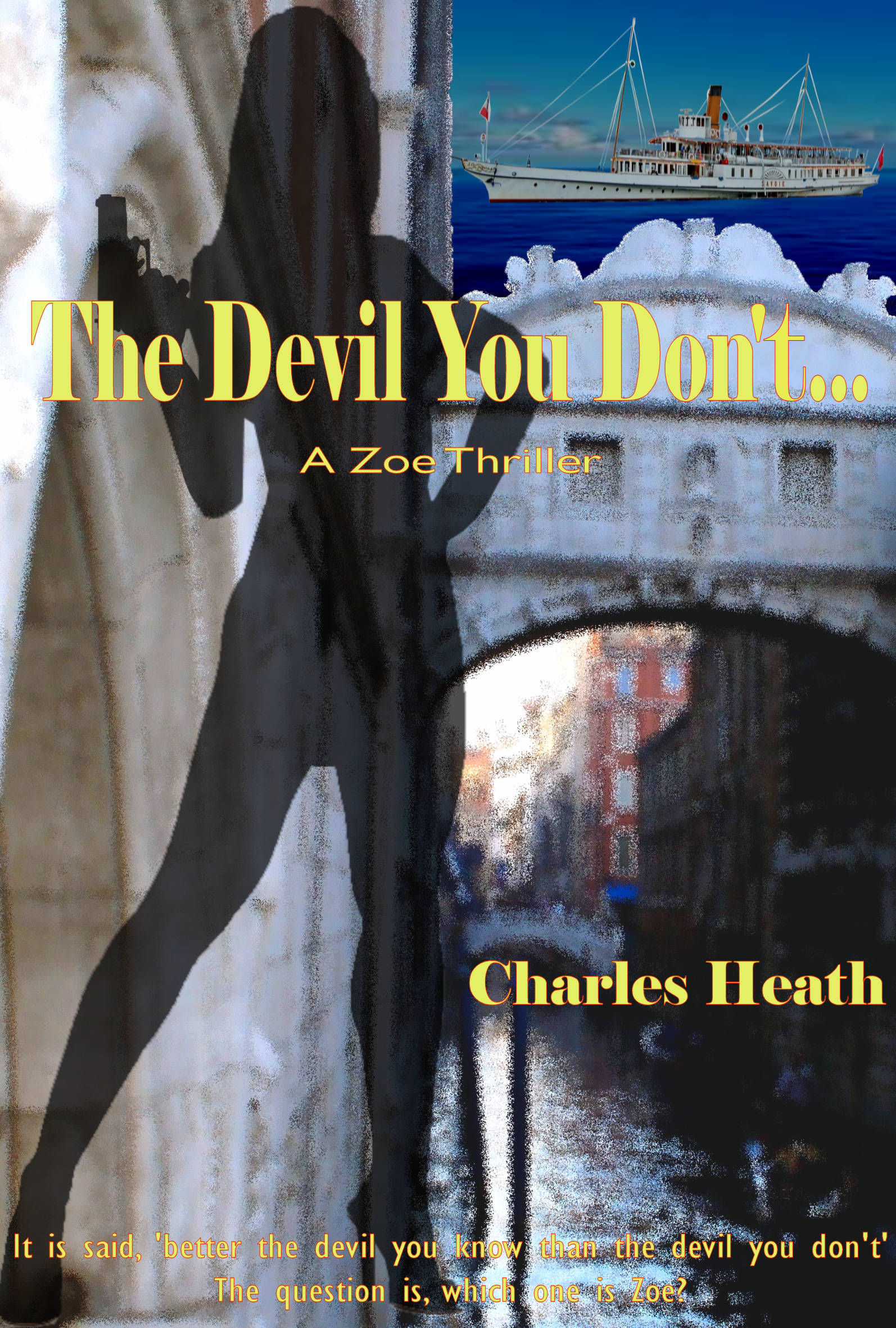
An excerpt from “The Devil You Don’t”

Available on Amazon Kindle here:  https://amzn.to/2Xyh1ow

By the time I returned to the Savoie, the rain had finally stopped, and there was a streak of blue sky to offer some hope that the day would improve.

The ship was not crowded, the possibility of bad weather perhaps holding back potential passengers.  Of those I saw, a number of them would be aboard for the lunch by Phillippe Chevrier.  I thought about it, but the Concierge had told me about several restaurants in Yvoire and had given me a hand-drawn map of the village.  I think he came from the area because he spoke with the pride and knowledge of a resident.

I was looking down from the upper deck observing the last of the boarding passengers when I saw a woman, notable for her red coat and matching shoes, making a last-minute dash to get on board just before the gangway was removed.  In fact, her ungainly manner of boarding had also captured a few of the other passengers’ attention.  Now they would have something else to talk about, other than the possibility of further rain.

I saw her smile at the deckhand, but he did not smile back.  He was not impressed with her bravado, perhaps because of possible injury.  He looked at her ticket, then nodded dismissively and went back to his duties in getting the ship underway.  I was going to check the departure time, but I, like the other passengers, had my attention diverted to the woman in red.

From what I could see, there was something about her.  It struck me when the light caught her as she turned to look down the deck, giving me a perfect profile.  I was going to say she looked foreign, but here, as in almost anywhere in Europe, that described just about everyone.  Perhaps I was just comparing her to Phillipa, so definitively British, whereas this woman was very definitely not.

She was perhaps in her 30’s, slim or perhaps the word I’d use was lissom, and had the look and manner of a model.  I say that because Phillipa had dragged me to most of the showings, whether in Milan, Rome, New York, London, or Paris.  The clothes were familiar, and in the back of my mind, I had a feeling I’d seen her before.

Or perhaps, to me, all models looked the same.

She looked up in my direction, and before I could divert my eyes, she locked on.  I could feel her gaze boring into me, and then it was gone as if she had been looking straight through me.  I remained out on deck as the ship got underway, watching her disappear inside the cabin.  My curiosity was piqued, so I decided to keep an eye out for her.

I could feel the coolness of the air as the ship picked up speed, not that it was going to be very fast.  With stops, the trip would take nearly two hours to get to my destination.  It would turn back almost immediately, but I was going to stay until the evening when it returned at about half eight.  It would give me enough time to sample the local fare and take a tour of the medieval village.

Few other passengers ventured out on the deck, most staying inside or going to lunch.  After a short time, I came back down to the main deck and headed forward.  I wanted to clear my head by concentrating on the movement of the vessel through the water, breathing in the crisp, clean air, and letting the peacefulness of the surroundings envelope me.

It didn’t work.

I knew it wouldn’t be long before I started thinking about why things hadn’t worked and what part I played in it.  And the usual question that came to mind when something didn’t work out.  What was wrong with me?

I usually blamed it on my upbringing.

I had one of those so-called privileged lives, a nanny till I was old enough to go to boarding school, then sent to the best schools in the land.  There I learned everything I needed to be the son of a Duke, or, as my father called it in one of his lighter moments, nobility in waiting.

Had this been five or six hundred years ago, I would have needed to have sword and jousting skills, or if it had been a few hundred years later, a keen military mind.  If nothing else, I could ride a horse and go on hunts, or did until they became not the thing to do.

I learned six languages, and everything I needed to become a diplomat in the far-flung British Empire, except the Empire had become the Commonwealth, and then, when no one was looking, Britain’s influence in the world finally disappeared.  I was a man without a cause, without a vocation, and no place to go.

Computers were the new vogue, and I had an aptitude for programming.  I guess that went hand in hand with mathematics, which, although I hated the subject, I excelled in.  Both I and another noble outcast used to toss ideas around in school, but when it came to the end of our education, he chose to enter the public service, and I took a few of those ideas we had mulled over and turned them into a company.

About a year ago, I was made an offer I couldn’t refuse.  There were so many zeroes on the end of it I just said yes, put the money into a very grateful bank, and was still trying to come to terms with it.

Sadly, I still had no idea what I was going to do with the rest of my life.  My parents had asked me to come back home and help manage the estate, and I did for a few weeks.  It was as long as it took for my parents to drive me insane.

Back in the city, I spent a few months looking for a mundane job, but there were very few that suited my qualifications, and the rest I think I intimidated simply because of who I was.  In that time, I’d also featured on the cover of the Economist and, through my well-meaning accountant, started involving myself with various charities, earning the title ‘philanthropist’.

And despite all of this exposure, even making one of those ubiquitous ‘eligible bachelor’ lists, I still could not find ‘the one’, the woman I wanted to spend the rest of my life with.  Phillipa seemed to fit the bill, but in time, she proved to be a troubled soul with ‘Daddy’ issues.  I knew that in building a relationship, compromise was necessary, but with her, in the end, everything was a compromise, and what had happened was always going to be the end result.

It was perhaps a by-product of the whole nobility thing.  There was a certain expectation I had to fulfil, to my peers, contemporaries, parents and family, and those who either liked or hated what it represented.  The problem was, I didn’t feel like I belonged.  Not like my friend from schooldays, and now obscure acquaintance, Sebastian.  He had been elevated to his Dukedom early when his father died when he was in his twenties.  He had managed to fade from the limelight and was rarely mentioned either in the papers or the gossip columns.  He was one of the lucky ones.

I had managed to keep a similarly low profile until I met Phillipa.  From that moment, my obscurity disappeared.  It was, I could see now, part of a plan put in place by Phillipa’s father, a man who hogged the limelight with his daughter, to raise the profile of the family name and through it their businesses.  He was nothing if not the consummate self-advertisement.

Perhaps I was supposed to be the last piece of the puzzle, the attachment to the establishment, that link with a class of people he would not normally get in the front door.  There was nothing refined about him or his family, and more than once I’d noticed my contemporaries cringe at the mention of his name, or any reference of my association with him.

Yet could I truthfully say I really wanted to go back to the obscurity I had before Phillipa?  For all her faults, there were times when she had been fun to be with, particularly when I first met her, when she had a certain air of unpredictability.  That had slowly disappeared as she became part of her father’s plan for the future.  She just failed to see how much he was using her.

Or perhaps, over time, I had become cynical.

I thought about calling her.  It was one of those moments of weakness when I felt alone, more alone than usual.

I diverted my attention back to my surroundings and the shoreline.  Out of the corner of my eye, I could see the woman in the red coat, making a move.  The red coat was like a beacon, a sort of fire engine red.  It was not the sort of coat most of the women I knew would wear, but on her, it looked terrific.  In fact, her sublime beauty was the other attribute that was distinctly noticeable, along with the fact that her hair was short rather than long and jet-black.

I had to wrench my attention away from her.

A few minutes later, several other passengers came out of the cabin for a walk around the deck, perhaps to get some exercise, perhaps checking up on me, or perhaps I was being paranoid.  I waited till they passed on their way forward, and I turned and headed aft.

I watched the wake sluicing out from under the stern for a few minutes before retracing my steps to the front of the ship, and there I stood against the railing, watching the bow carve its way through the water.  It was almost mesmerising.  There, I emptied my mind of thoughts about Phillipa and thoughts about the woman in the red coat.

Until a female voice behind me said, “Having a bad day?”

I started, caught by surprise, and slowly turned.  The woman in the red coat had somehow got very close to me without my realising it.  How did she do that?  I was so surprised I couldn’t answer immediately.

“I do hope you are not contemplating jumping.  I hear the water is very cold.”

Closer up, I could see what I’d missed when I saw her on the main deck.  There was a slight hint of Chinese, or Oriental, in her, particularly around the eyes, and of her hair, which was jet black.  An ancestor twice or more removed had left their mark, not in a dominant way, but more subtly, and easily missed except from a very short distance away, like now.

Other than that, she was quite possibly Eastern European, perhaps Russian, though that covered a lot of territory.  The incongruity of it was that she spoke with an American accent and was fluent enough for me to believe English was her first language.

Usually, I could ‘read’ people, but she was a clean slate.  Her expression was one of amusement, but with cold eyes.  My first thought, then, was to be careful.

“No.  Not yet.”  I coughed to clear my throat because I could hardly speak.  And blushed, because that was what I did when confronted by a woman, beautiful or otherwise.

The amusement gave way to a hint of a smile that brightened her demeanour as a little warmth reached her eyes.  “So that’s a maybe.  Should I change into my lifesaving gear, just in case?”

It conjured up a rather interesting image in my mind until I reluctantly dismissed it.

“Perhaps I should move away from the edge,” I said, moving sideways until I was back on the main deck, a few feet further away.  Her eyes had followed me, and when I stopped, she turned to face me again.  She did not move closer.

I realised then she had removed her beret and it was in her left side coat pocket.  “Thanks for your concern …?”

“Zoe.”

“Thanks for your concern, Zoe.  By the way, my name is John.”

She smiled again, perhaps in an attempt to put me at ease.  “I saw you earlier, you looked so sad, I thought …”

“I might throw myself overboard?”

“An idiotic notion, I admit, but it is better to be safe than sorry.”

Then she tilted her head to one side, then the other, looking intently at me.  “You seem to be familiar.  Do I know you?”

I tried to think of where I may have seen her before, but all I could remember was what I’d thought earlier when I first saw her; she was a model and had been at one of the showings.  If she were, it would be more likely she would remember Phillipa, not me.  Phillipa always had to sit in the front row.

“Probably not.”  I also didn’t mention the fact that she may have seen my picture in the society pages of several tabloid newspapers because she didn’t look the sort of woman who needed a daily dose of the comings and goings, and, more often than not, scandal associated with so-called celebrities.

She gave me a look, one that told me she had just realised who I was.  “Yes, I remember now.  You made the front cover of the Economist.  You sold your company for a small fortune.”

Of course.  She was not the first who had recognised me from that cover.  It had raised my profile considerably, but not Sternhaven’s.  That article had not mentioned Phillipa or her family.  I suspect Grandmother had something to do with that, and it was, now I thought about it, another nail in the coffin that was my relationship with Phillipa.

“I wouldn’t say it was a fortune, small or otherwise, just fortunate.”  Each time, I found myself playing down the wealth aspect of the business deal.

“Perhaps then, as the journalist wrote, you were lucky.  It is not, I think, a good time for internet-based companies.”

The latter statement was an interesting fact, one she read in the Financial Times, which had made that exact comment recently.

“But I am boring you.”  She smiled again.  “I should be minding my own business and leaving you to your thoughts.  I am sorry.”

She turned to leave and took a few steps towards the main cabin.

“You’re not boring me,” I said, thinking I was letting my paranoia get the better of me.  It had been Sebastian, on learning of my good fortune, who had warned me against ‘a certain element here and abroad’ whose sole aim would be to separate me from my money.  He was not very subtle when he described their methods.

But I knew he was right.  I should have let her walk away.

She stopped and turned around.  “You seem nothing like the man I read about in the Economist.”

A sudden and awful thought popped into my head.  Those words were part of a very familiar opening gambit.  “Are you a reporter?”

I was not sure if she looked surprised or amused.  “Do I look like one?”

I silently cursed myself for speaking before thinking, and then immediately ignored my own admonishment.  “People rarely look like what they are.”

I saw the subtle shake of the head and expected her to take her leave.  Instead, she astonished me.

“I fear we have got off on the wrong foot.  To be honest, I’m not usually this forward, but you seemed like you needed cheering up when probably the opposite is true.  Aside from the fact that this excursion was probably a bad idea.  And,” she added with a little shrug, “perhaps I talk too much.”

I was not sure what I thought of her after that extraordinary admission. It was not something I would do, but it was an interesting way to approach someone and have them ignore their natural instinct.  I would let Sebastian whisper in my ear for a little longer and see where this was going.

“Oddly enough, I was thinking the same thing.  I was supposed to be travelling with my prospective bride.  I think you can imagine how that turned out.”

“She’s not here?”

“No.”

“She’s in the cabin?”  Her eyes strayed in that direction for a moment, then came back to me.  She seemed surprised I might be travelling with someone.

“No.  She is back in England, and the wedding is off.  So is the relationship.  She dumped me by text.”

OK, why was I sharing this humiliating piece of information with her?  I still couldn’t be sure she was not a reporter.

She motioned to an empty seat, back from the edge.  No walking the plank today.  She moved towards it and sat down.  She showed no signs of being cold, nor interested in the breeze upsetting her hair.  Phillipa would be having a tantrum about now, being kept outside, and freaking out over what the breeze might be doing to her appearance.

I wondered, if only for a few seconds, if she used this approach with anyone else.  I guess I was a little different, a seemingly rich businessman alone on a ferry on Lake Geneva, contemplating the way his life had gone so completely off track.

She watched as I sat at the other end of the bench, leaving about a yard between us.  After I leaned back and made myself as comfortable as I could, she said, “I have also experienced something similar, though not by text message.  It is difficult, the first few days.”

“I saw it coming.”

“I did not.”  She frowned, a sort of lifeless expression taking over, perhaps brought on by the memory of what had happened to her.  “But it is done, and I moved on.  Was she the love of your life?”

OK, that was unexpected.

When I didn’t answer, she said, “I am sorry.  Sometimes I ask personal questions without realising what I’m doing.  It is none of my business.”  She shivered.  “Perhaps we should go back inside.”

She stood and held out her hand.  Should I take it and be drawn into her web?  I thought of Sebastian.  What would he do in this situation?

I took her hand in mine and let her pull me gently to my feet.  “Wise choice,” she said, looking up at the sky.

It just started to rain.

© Charles Heath 2015-2023

newdevilcvr6

The cinema of my dreams – It all started in Venice – Episode 21

An Invitation to Dinner

I did not go back to the hotel, but instead went home from the airport, half expecting to find Cecilia still there.

She wasn’t, but the lingering scent of her perfume hung in the air as a reminder.  I entered if it might stir up Violetta’s ghost because more than once I thought I heard her moving about the house.

It was, of course, my imagination, but just the same it was a slim possibility.  I guess talking to her even though she was not there didn’t help.

I had no intention of seeing or talking to Juliet lest she alerted Larry to my visit.  It needed to stay anonymous for it to be effective.

A shower, a change of clothes and into the anonymous car that looked like a million others on the road.

Oh, and a little deft driving to lose the car that followed me away from the garage.  The Frenchman was persistent, I’ll give him that.

Larry’s mother lived in a mansion overlooking the Mediterranean, and I’d spent a few afternoons on the patio sampling the energy and cheese of a country that knew how to excel in both.

When Violetta first got sick, we had been invited to stay for a few months and she had loved it.  It had made her feel better, but in the end, there was no beating cancer that was very aggressively attacking her.

Perhaps it was fitting she took her last breath in the place she loved so much.

I hadn’t been back since, and passing through the gates brought back a flood of sad memories and a tear or two.

Not enough to blur my sight, and take down the two guards Larry had lurking near the gate, supposedly in hiding, with a tranquilizer gun.

I dragged the bodies deeper into the hedgerow.  They wouldn’t be waking up for at least 12 hours, time enough to do what I had to.

It was a pleasant but invigoration walk up the hill keeping to the cover the garden provided until I stepped out just in front of the patio, and beyond the open doors the dining room where five people were seated.

“What, not waiting for the guest of honor?” I said, stepping out into full view of the diners.

Two men on the door turned swiftly and both were tranquilized before they could take a step.  I turned and looked over my shoulder at the site I thought Cecilia would take, then turned back to see both Larry and his mother out of their seats.

First observation, I didn’t know Larry had three children only two.  The son was a replica of him, the girls, both more than ten, were identical twins and like their mother.  Once again, I had to wonder why a woman like Brenda would be interested in a man like him.

“What are you doing here?” Larry growled, stopping short of approaching me, eyes on the tranquilizing gun.

The thought crossed my mind that I should just put him to sleep, taken away, to have a less civilized conversation, something he would understand.

“I invited him to dinner.  He is an old friend, and you know him as well as I do.”

Her eyes were on the bodyguards on the ground, and Larry, waiting for his reaction.  She came over and hugged me.  “So nice to see you again.”

“You were in London,” he said tonelessly.  It was a statement, not a question.

“Marvels of modern transport.  You should stop using leaking rowboats to come and go and embrace the jet age.  Sit down Larry, you’re making a scene in front of your family.”

“Who is he dear,” his wife asked as he threw himself back in the chair next to her.  The three children looked me over like they would a new toy, the son in particular, with a trademark scowl on his face.

“A policeman of sorts.”

“I didn’t know you were working with the police.”

It was an interesting statement, and if I didn’t know better, it seemed to me she was pushing a button.  The look she gave him was priceless.

“Perhaps you and the children should leave the table and let me sort this small problem out.”

“No dear.  I want to hear what he has to say.”

He turned to glare at her, a particularly dark expression, whether it was the result of my unexpected arrival or her defiance which I thought was brave under the circumstances, whatever the reason, it showed her to be vastly different from the description of her in the department’s files.

“I told you…”

“You do not raise your voice at me, or anyone, at the dinner table.  You also apparently have some explaining to do because when I asked you what happened to your brother, Trevor, you told me the police killed him.  I’m assuming that by police you mean in the form of our dining companion who just arrived.”

He looked surprised, no I would say that he was shocked.  “You seem remarkably well-informed about something you really know nothing about.”  He was showing remarkable restraint because I knew if it was anyone else, they’d be all but dead.

“I know that Trevor told you several times he wanted nothing to do with the business.  We used to spend time talking about what he wanted to do with his life and lament the fact you wouldn’t let him.  I know you coerced him into running that errand for you because he rang and told me, no asked me, to intervene on his behalf.  It seems he knew that there was a traitor in your organization, that he told you his suspicions, but you said it couldn’t possibly be that person.  Then when it all went, as he said, to hell in a handbasket, he called me to tell me what happened, and then called your mother, at the behest of your so-called police assassin, and she was talking to her when you arrived.  So, Larry, the key question here is, what did you do that took a brother who was alive when you arrived, to dead on arrival at the hospital?  You were there, so only you know what happened.”

“I did nothing.  He was alive when I put him in the ambulance.”

“Who went with him to the hospital?”

“Jimmy.”

“The person he told you was the traitor.  The person you said couldn’t possibly be one.  He didn’t go with Trevor to the drop-off, so how did he get there?”

I’ll be honest, I was fascinated, if not hanging on every word.  One nuance I did pick up on, was the way she spoke about Trevor told me they had more than just conversations.  Had Larry known that also?

“He was not a traitor.”

“And yet you have no explanation as to why he disappeared shortly after Trevor died.  Convenient, don’t you think?”

She sat there, face to face, with the man she had married twenty years before, then a relatively naive young woman who knew who he was, but not what he was to become.  She didn’t rate highly in the files simply because she purposely stayed out of the limelight, and distanced herself from the business, and Larry’s business associates.  I suspected it was to shield her children from the uglier side of the criminal world.  Now, I got the impression Larry was trying to induct his son into the business, although only 16, and she was not happy with it or with him.

“You have no idea what you’re talking about.”  Less bluster, it was odd to see Larry in a situation where he wasn’t in charge.

“You mean, for once in your life, you don’t have the lies at your fingertips.  Let’s leave that for the moment and move on to Jaime Meyers.”

Now he was truly shocked, like a man who just received an umpteen-volt jolt.

“How do you know…”  He turned and glared at me.

“Don’t look at me, Larry.  I haven’t told anyone about our conversation in London, as per the agreement I made with her.  I think you might want to consider the possibility that your wife is not the dumb blonde you tell your friends she is.”

A cat among the pigeons’ statement drew a very dark look from her.  “Trevor told me you called me a dumb blonde and I didn’t want to think that was true, but when Elaine told me she overheard Lorenzo talking to his friends using those exact words, I was disappointed.”

That was when Cecilia crashed the party.

© Charles Heath 2022

Just one of many reading lists – part 2

**Please don’t assume that you have to, nor would I ever expect you to, read any or all of these books.  You don’t.**

Everyone, it seems, will publish what they call the top 100 books that you should read.  Some are voted on, some belong to the opinion of the editor of the book review section of a newspaper, and, as you know, there are a lot of newspapers, a lot of editors, and a lot of opinions.

I’m not a newspaper, I’m not an editor, but I have a list, based on personal experience, and many, many years of reading.

It’s in no particular order.

21.  Passage of Arms by Eric Ambler, I have to say I have read most of his novels and they are very good

22.  Jane Eyre by Charlotte Bronte, a very powerful story of a courageous, independent woman

23.  The Riddle of the Sands by Erskine Childers, a 1903 secret service story, and a good example of an early espionage novel

24.  The Father Brown stories by G. K. Chesterton, which features a Roman Catholic priest who is also an amateur detective

25.  The Grantchester Mysteries by James Runcie, similar to the above, but featuring an Anglican vicar Sidney Chambers and set in the 1950s.  Recently brought to life on television.

26.  The High Commissioner by Jon Cleary, an Australian author, this novel introduces Sargeant Scobie Malone, in the first of many adventures

27.  A Tale of Two Cities by Charles Dickens, the first Dickens book I read, possibly because it was one of the shortest, and paved the way to read all of his books.  Who could forget Madame Defarge

28.  Brideshead Revisited by Evelyn Waugh, another of those delightful but depressing stories of the 20s through to the 40s, perhaps for some, the golden age.  What could be said, in the end, about the Flytes?

29.  The Godfather by Mario Puzo, is the story of the Corleone mafia family, and for me, the most interesting part was that of the horse’s head, and of course, the death and mayhem

30.  The Shipping News by Annie Prouix, a Pulitzer Prize winner, and a story about a man, Quoyle, who against all odds puts his life slowly back together

31.  Detection Unlimited by Georgette Heyer, noted mostly for her Regency romances, she also wrote a series of detective novels.  This was her last detective novel, published in 1953

32.  Poldark by Winston Graham, a series of stories about the Poldark’s and Cornwall, and his arch-nemesis, George Warleggan

33.  Our Man in Havana by Graham Greene, one of many very interesting novels, this is the first I read, followed by The Quiet American and Travels with My Aunt.  Seeing movies of some didn’t enhance the reading experience.

34.  The Mayor of Casterbridge by Thomas Hardy is another of his interesting but sometimes hard-to-read novels of rural England.  This led to Jude the Obscure and others in the ‘series’.  It all started with Tess of the D’Urbervilles.

35.  A Farewell to Arms by Ernest Hemingway, set during the Italian campaign of World War 1.  He also wrote The Old Man of the Sea

36.  Lucky Jim by Kingsley Amis, I don’t think he was all that lucky

37.  Whiskey Galore by Compton MacKenzie, the story of the ‘rescue’ of several hundred cases of whiskey and the locals’ efforts to hide it.  Also famous for writing Monarch of the Glen, later a television series

38.  The Expedition of Humphry Clinker by Tobias Smollett, a collection of satirical observations of English life in the 1700s in spa towns and seaside resorts

39.  Barchester Towers by Anthony Trollope, part of the series known as The Chronicles of Barsetshire and features the unpopular Bishop Proudie and Mrs. Proudie

40. The Mysterious Affair at Styles by Agatha Christie, Christie’s first book published in 1920, and introduced Poirot, Arthur Hastings, and Inspector Japp.  Who knew so many books would follow

The list continues

An excerpt from “The Things We Do for Love”; In love, Henry was all at sea!

In the distance, he could hear the dinner bell ringing and roused himself.  Feeling the dampness of the pillow and fearing the ravages of pent-up emotion, he considered not going down but thought it best not to upset Mrs Mac, especially after he said he would be dining.

In the event, he wished he had reneged, especially when he discovered he was not the only guest staying at the hotel.

Whilst he’d been reminiscing, another guest, a young lady, had arrived.  He’d heard her and Mrs Mac coming up the stairs and then shown to a room on the same floor, perhaps at the other end of the passage.

Henry caught his first glimpse of her when she appeared at the door to the dining room, waiting for Mrs Mac to show her to a table.

She was in her mid-twenties, slim, with long brown hair, and the grace and elegance of a woman associated with countless fashion magazines.  She was, he thought, stunningly beautiful with not a hair out of place, and make-up flawlessly applied.  Her clothes were black, simple, elegant, and expensive, the sort an heiress or wife of a millionaire might condescend to wear to a lesser occasion than dinner.

Then there was her expression; cold, forbidding, almost frightening in its intensity.  And her eyes, piercingly blue and yet laced with pain.  Dracula’s daughter was his immediate description of her.

All in all, he considered, the only thing they had in common was, like him, she seemed totally out of place.

Mrs Mac came out of the kitchen, wiping her hands on her apron.  She was, she informed him earlier, chef, waitress, hotelier, barmaid, and cleaner all rolled into one.  Coming up to the new arrival, she said, “Ah, Miss Andrews, I’m glad you decided to have dinner.  Would you like to sit with Mr Henshaw, or would you like to have a table of your own?”

Henry could feel her icy stare as she sized up his appeal as a dining companion, making the hair on the back of his neck stand up.  He purposely didn’t look back.  In his estimation, his appeal rating was minus six.  Out of a thousand!

“If Mr Henshaw doesn’t mind….”  She looked at him, leaving the query in mid-air.

He didn’t mind and said so.  Perhaps he’d underestimated his rating.

“Good.”  Mrs Mac promptly ushered her over.  Henry stood, made sure she was seated properly and sat.

“Thank you.  You are most kind.”  The way she said it suggested snobbish overtones.

“I try to be when I can.”  It was supposed to nullify her sarcastic tone, but it made him sound a little silly, and when she gave him another of her icy glares, he regretted it.

Mrs Mac quickly intervened, asking, “Would you care for the soup?”

They did, and, after writing the order on her pad, she gave them each a look, imperceptibly shook her head, and returned to the kitchen.

Before Michelle spoke to him again, she had another quick look at him, trying to fathom who and what he might be.  There was something about him.

His eyes mirrored the same sadness she felt, and, yes, there was something else, that it looked like he had been crying.  There was a tinge of redness.

Perhaps, she thought, he was here for the same reason she was.

No.  That wasn’t possible.

Then she said, without thinking, “Do you have any particular reason for coming here?”  Seconds later, she realised she’d spoken it out loud, hadn’t meant to actually ask, it just came out.

It took him by surprise, obviously not the first question he was expecting her to ask of him.

“No, other than it is as far from civilisation, and home as I could get.”

At least we agree on that, she thought.

It was obvious he was running away from something as well.

Given the isolation of the village and lack of geographic hospitality, it was, from her point of view, ideal.  All she had to do was avoid him, and that wouldn’t be difficult.

After getting through this evening first.

“Yes,” she agreed.  “It is that.”

A few seconds passed, and she thought she could feel his eyes on her and wasn’t going to look up.

Until he asked, “What’s your reason?”

Slightly abrupt in manner, perhaps, because of her question and how she asked it.

She looked up.  “Rest.  And have some time to myself.”

She hoped he would notice the emphasis she had placed on the word ‘herself’ and take due note.  No doubt, she thought, she had completely different ideas of what constituted a holiday than he, not that she had said she was here for a holiday.

Mrs Mac arrived at a fortuitous moment to save them from further conversation.

Over the entree, she wondered if she had made a mistake coming to the hotel.  Of course, there had been no conceivable way she could know that anyone else might have booked the same hotel, but she realised it was foolish to think she might end up in it by herself.

Was that what she was expecting?

Not a mistake then, but an unfortunate set of circumstances, which could be overcome by being sensible.

Yet, there he was, and it made her curious, not that he was a man, by himself, in the middle of nowhere, hiding like she was, but for quite varied reasons.

On discreet observation, whilst they ate, she gained the impression his air of light-heartedness was forced, and he had no sense of humour.

This feeling was engendered by his looks, unruly dark hair, and permanent frown.  And then there was his abysmal taste in clothes on a tall, lanky frame.  They were quality but totally unsuited to the wearer.

Rebellion was written all over him.

The only other thought crossing her mind, and incongruously, was that he could do with a decent feed.  In that respect, she knew now from the mountain of food in front of her, he had come to the right place.

“Mr Henshaw?”

He looked up.  “Henshaw is too formal.  Henry sounds much better,” he said, with a slight hint of gruffness.

“Then my name is Michelle.”

Mrs Mac came in to take their order for the only main course, gather up the entree dishes, and then return to the kitchen.

“Staying long?” she asked.

“About three weeks.  Yourself?”

“About the same.”

The conversation dried up.

Neither looked at the other, but rather at the walls, out the window, towards the kitchen, anywhere.  It was, she thought, unbearably awkward.

Mrs Mac returned with a large tray with dishes on it, setting it down on the table next to theirs.

“Not as good as the usual cook,” she said, serving up the dinner expertly, “but it comes a good second, even if I do say so myself.  Care for some wine?”

Henry looked at Michelle.  “What do you think?”

“I’m used to my dining companions making the decision.”

You would, he thought.  He couldn’t help but notice the cutting edge of her tone.  Then, to Mrs Mac, he named a particular White Burgundy he liked, and she bustled off.

“I hope you like it,” he said, acknowledging her previous comment with a smile that had nothing to do with humour.

“Yes, so do I.”

Both made a start on the main course, a concoction of chicken and vegetables that were delicious, Henry thought when compared to the bland food he received at home and sometimes aboard my ship.

It was five minutes before Mrs Mac returned with the bottle and two glasses.  After opening it and pouring the drinks, she left them alone again.

Henry resumed the conversation.  “How did you arrive?  I came by train.”

“By car.”

“Did you drive yourself?”

And he thought, a few seconds later, that was a silly question; otherwise, she would not be alone, and certainly not sitting at this table. With him.

“After a fashion.”

He could see that she was formulating a retort in her mind, then changed it, instead, smiling for the first time, and it served to lighten the atmosphere.

And in doing so, it showed him she had another, more pleasant side despite the fact she was trying not to look happy.

“My father reckons I’m just another of ‘those’ women drivers,” she added.

“Whatever for?”

“The first and only time he came with me, I had an accident.  I ran up the back of another car.  Of course, it didn’t matter to him that the other driver was driving like a startled rabbit.”

“It doesn’t help,” he agreed.

“Do you drive?”

“Mostly people up the wall.”  His attempt at humour failed.  “Actually,” he added quickly, “I’ve got a very old Morris that manages to get me where I’m going.”

The apple pie and cream for dessert came and went, and the rapport between them improved as the wine disappeared and the coffee came.  Both had found, after getting to know each other better, that their first impressions were not necessarily correct.

“Enjoy the food?” Mrs Mac asked, suddenly reappearing.

“Beautifully cooked and delicious to eat,” Michelle said, and Henry endorsed her remarks.

“Ah, it does my heart good to hear such genuine compliments,” she said, smiling.  She collected the last of the dishes and disappeared yet again.

“What do you do for a living?” Michelle asked in an offhand manner.

He had a feeling she was not particularly interested, and it was just making conversation.

“I’m a purser.”

“A what?”

“A purser.  I work on a ship doing the paperwork, that sort of thing.”

“I see.”

“And you?”

“I was a model.”

“Was?”

“Until I had an accident, a rather bad one.”

“Oh, I’m sorry.”

So that explained the odd feeling he had about her.

As the evening wore on, he began to think there might be something wrong, seriously wrong with her because she didn’t look too well.  Even the carefully applied makeup, from close, didn’t hide the very pale, tired look, or the sunken, dark-ringed eyes.

“I try not to think about it, but it doesn’t necessarily work.  I’ve come here for peace and quiet, away from doctors and parents.”

“Then you will not have to worry about me annoying you.  I’m one of those fall-asleep-reading-a-book types.”

Perhaps it would be like ships passing in the night, and then he smiled to himself about the analogy.

Dinner over, they separated.

Henry went back to the lounge to read a few pages of his book before going to bed, and Michelle went up to her room to retire for the night.

But try as he might, he was unable to read, his mind dwelling on the unusual, yet compellingly mysterious person he would be sharing the hotel with.

Overlaying that original blurred image of her standing in the doorway was another of her haunting expressions that had, he finally conceded, taken his breath away, and a look that had sent more than one tingle down his spine.

She may not have thought much of him, but she had certainly made an impression on him.

© Charles Heath 2015-2024

lovecoverfinal1

“One Last Look”, nothing is what it seems

A single event can have enormous consequences.

A single event driven by fate, after Ben told his wife Charlotte he would be late home one night, he left early, and by chance discovered his wife having dinner in their favourite restaurant with another man.

A single event where it could be said Ben was in the wrong place at the wrong time.

Who was this man? Why was she having dinner with him?

A simple truth to explain the single event was all Ben required. Instead, Charlotte told him a lie.

A single event that forces Ben to question everything he thought he knew about his wife and the people who are around her.

After a near-death experience and forced retirement into a world he is unfamiliar with, Ben finds himself once again drawn back into that life of lies, violence, and intrigue.

From London to a small village in Tuscany, little by little, Ben discovers who the woman he married is, and the real reason why fate had brought them together.

It is available on Amazon here:  http://amzn.to/2CqUBcz

Harry Walthenson, Private Detective – the second case – A case of finding the “Flying Dutchman”

What starts as a search for a missing husband soon develops into an unbelievable story of treachery, lies, and incredible riches.

It was meant to remain buried long enough for the dust to settle on what was once an unpalatable truth, when enough time had passed, and those who had been willing to wait could reap the rewards.

The problem was, no one knew where that treasure was hidden or the location of the logbook that held the secret.

At stake, billions of dollars’ worth of stolen Nazi loot brought to the United States in an anonymous tramp steamer and hidden in a specially constructed vault under a specifically owned plot of land on the once docklands of New York.

It may have remained hidden and unknown to only a few, if it had not been for a mere obscure detail being overheard …

… by our intrepid, newly minted private detective, Harry Walthenson …

… and it would have remained buried.

Now, through a series of unrelated events, or are they, that well-kept secret is out there, and Harry will not stop until the whole truth is uncovered.

Even if it almost costs him his life.  Again.

An excerpt from “Mistaken Identity” – a work in progress

The odds of any one of us having a doppelganger are quite high. Whether or not you got to meet them or be confronted by them was significantly lower. Except, of course, unless you are a celebrity.

It was a phenomenon remarkable only for the fact that, at times, certain high-profile people, notorious or not, had doubles if only to put off enemies or the general public. Sometimes we see people in the street who look like someone we knew and make the mistake of approaching them like a long-lost friend, only to discover an embarrassed individual desperately trying to get away from what they perceive as a stalker, or worse.

And then sometimes it is a picture that looms up on a TV screen, an almost exact likeness of you. At first, you are fascinated, and then, according to the circumstances and narrative that is attached to that picture, either flattered or horrified.

For me, one turned to the other when I saw an almost likeness of me flash up on the screen when I turned the TV on in my room. What looked to be my photo, with only minor differences, was in the corner of the screen, the newsreader speaking in rapid Italian, so fast I could only translate every second or third word.

But the one word I did recognise was murder. The photo of the man on the screen was the subject of an extensive manhunt. The crime, the murder of a woman in the very same hotel I was staying, and it was being played out live several floors above me. The gist of the story, the woman had been seen with and staying with the man who was my double, and, less than an hour ago, the body had been discovered by a chambermaid.

The killer, the announcer said, was believed to be still in the hotel because the woman had died shortly before she had been discovered.

I watched, at first fascinated by what I was seeing. I guess I should have been horrified, but at that moment it didn’t register that I might be mistaken for that man.

Not until another five minutes had passed, and I was watching the police in full riot gear, with a camera crew following behind, coming up a passage towards a room. Live action of the arrest of the suspected killer, the breathless commentator said.

Then, suddenly, there was a pounding on the door. On the TV screen, plain to see, was the number of my room. I looked through the peephole and saw an army of police officers. It didn’t take much to realise what had happened. The hotel staff identified me as the man in the photograph on the TV and called the police.

Horrified wasn’t what I was feeling right then.

It was fear.

My last memory was the door crashing open, the wood splintering, and men rushing into the room, screaming at me, waving guns, and when I put my hands up to defend myself, I heard a gunshot.

And in one very confused and probably near-death experience, I thought I saw my mother and thought what was she doing in Rome?

I was the archetypal nobody.

I lived in a small flat, I drove a nondescript car, had an average job in a low-profile travel agency, was single, and currently not involved in a relationship, had no children, and, according to my workmates, no life.

They were wrong. I was one of those people who preferred their own company; I had a cat, and travelled whenever I could. And I did have a ‘thing’ for Rosalie, one of the reasons why I stayed at the travel agency. I didn’t expect anything to come of it, but one could always hope.

I was both pleased and excited to be going to the conference. It was my first, and the glimpse I had seen of it had whetted my appetite for more information about the nuances of my profession.

Some would say that a travel agent wasn’t much of a job, but to me, it was every bit as demanding as being an accountant or a lawyer. You were providing a customer with a service, and arguably, more people needed a travel agent than a lawyer. At least that was what I told myself as I watched more and more people start using the internet, and our relevance slowly dissipating.

This conference was about countering that trend.

The trip over had been uneventful. I was met at the airport and taken to the hotel where the conference was being held with several other delegates who had arrived on the same plane. I had mingled with several other delegates at the pre-conference get-together, including one whose name was Maryanne.

She was an unusual young woman, not the sort that I usually met, because she was the one who was usually surrounded by all the boys, the life of the party. In normal circumstances, I would not have introduced myself to her, but she had approached me. Why did I think that may have been significant? All of this ran through my mind, culminating in the last event on the highlight reel, the door bursting open, men rushing into my room, and then one of the policemen opened fire.

I replayed that last scene again, trying to see the face of my assailant, but it was just a sea of men in battle dress, bulletproof vests and helmets, accompanied by screaming and yelling, some of which I identified as “Get on the floor”.

Then came the shot.

Why ask me to get on the floor if all they were going to do was shoot me? I was putting my hands up at the time, in surrender, not reaching for a weapon.

Then I saw the face again, hovering in the background like a ghost. My mother. Only the hair was different, and her clothes, and then the image was going, perhaps a figment of my imagination brought on by pain-killing drugs. I tried to imagine the scene again, but this time it played out without the image of my mother.

I opened my eyes and took stock of my surroundings. What I felt in that exact moment couldn’t be described. I should most likely be dead, the result of a gunshot wound. I guess I should be thankful the shooter hadn’t aimed at anything vital, but that was the only item on the plus side.

I was in a hospital room with a policeman by the door. He was reading a newspaper and sitting uncomfortably on a small chair. He gave me a quick glance when he heard me move slightly, but didn’t acknowledge me with either a nod or a greeting, just went back to the paper.

If I still had a police guard, then I would still be considered a suspect. What was interesting was that I was not handcuffed to the bed. Perhaps that only happened in TV shows. Or maybe they knew I couldn’t run because my injuries were too serious. Or the guard would shoot me long before my feet hit the floor. I knew the police well enough now to know they would shoot first and ask questions later.

On the physical side, I had a large bandage over the top left corner of my chest, extending over my shoulder. A little poking and prodding determined the bullet had hit somewhere between the top of my rib cage and my shoulder. Nothing vital there, but my arm might be somewhat useless for a while, depending on what the bullet hit on the way in or through.

It didn’t feel like there were any broken or damaged bones.

That was the good news.

On the other side of the ledger, my mental state, there was only one word that could describe it. Terrified. I was looking at a murder charge and jail time, a lot of it. Murder usually had a long time in jail attached to it.

Whatever had happened, I didn’t do it. I know I didn’t do it, but I had to try to explain this to people who had already made up their minds. I searched my mind for evidence. It was there, but in the confused state brought on by the medication, all I could think about was jail, and the sort of company I was going to have.

I think death would have been preferable.

Half an hour later, maybe longer, I was drifting in and out of consciousness. A nurse, or what I thought was a nurse, came into the room. The guard stood, checked her ID card, and then stood by the door.

She came over and stood beside the bed. “How are you?” she asked, first in Italian, and when I pretended I didn’t understand, she asked the same question in accented English.

“Alive, I guess,” I said. “No one has come and told me what my condition is yet. You are my first visitor. Can you tell me?”

“Of course. You are very lucky to be alive. You will be fine and make a full recovery. The doctors here are excellent at their work.”

“What happens now?”

“I check you, and then you have another visitor. He is from the British Embassy, I think. But he will have to wait until I have finished my examination.”

I realised then she was a doctor, not a nurse.

My second visitor was a man, dressed in a suit, the sort of which I associated with the British Civil Service.  He was not very old, which told me he was probably a recent graduate on his first posting, the junior officer who drew the short straw.

The guard checked his ID but again did not leave the room, sitting back down and going back to his newspaper.

My visitor introduced himself as Alex Jordan from the British Embassy in Rome, and he had been asked by the Ambassador to sort out what he labelled a tricky mess.

For starters, it was good to see that someone cared about what happened to me.  But, equally, I knew the mantra, get into trouble overseas, and there is not much we can do to help you.  So, after that lengthy introduction, I had to wonder why he was here.

I said, “They think I am an international criminal by the name of Jacob Westerbury, whose picture looks just like me, and apparently, for them, it is an open and shut case.”  I could still hear the fragments of the yelling as the police burst through the door, at the same time telling me to get on the floor with my hands over my head.

“It’s not.  They know they’ve got the wrong man, which is why I’m here.  There is the issue of what had been described as excessive force, and the fact that you were shot had made it an all-around embarrassment for them.”

“Then why are you here?  Shouldn’t they be here apologising?”

“That is why you have another visitor.  I only took precedence because I insisted on speaking with you first.  I have come, basically, to ask you for a favour.  This situation has afforded us an opportunity.  We would like you to sign the official document, which basically indemnifies them against any legal proceedings.”

Curious.  What sort of opportunity was he talking about?  Was this a matter that could get difficult and I could be charged by the Italian Government, even if I wasn’t guilty, or was it one of those hush-hush type deals, you do this for us, we’ll help you out with that?  “What sort of opportunity?”

“We want to get our hands on Jacob Westerbury as much as they do.  They’ve made a mistake, and we’d like to use that to get custody of him if or when he is arrested in this country.  I’m sure you would also like this man brought into custody as soon as possible, so you will stop being confused with him.  I can only imagine what it was like to be arrested in the manner you were.  And I would not blame you if you wanted to get some compensation for what they’ve done.  But.  There are bigger issues in play here, and you would be doing this for your country.”

I wondered what would happen if I didn’t agree to his proposal.  I had to ask, “What if I don’t?”

His expression didn’t change.  “I’m sure you are a sensible man, Mr Pargeter, who is more than willing to help his country whenever he can.  They have agreed to take care of all your hospital expenses, refund the cost of the Conference, and travel.  I’m sure I could also get them to pay for a few days at Capri or Sorrento, if you like, before you go home.  What do you say?”

There was only one thing I could say.  Wasn’t it treason if you went against your country’s wishes?

“I’m not an unreasonable man, Alex.  Go do your deal, and I’ll sign the papers.”

“Good man.”

After Alex left, the doctor came back to announce the arrival of a woman, who had announced herself as the publicity officer from the Italian police. When she came into the room, she was not dressed in a uniform.

The doctor left after giving a brief report to the civilian at the door. I understood the gist of it: “The patient has recovered excellently, and the wounds are healing as expected. There is no cause for concern.”

That was a relief.

While the doctor was speaking to the civilian, I speculated on who she might be. She was young, not more than thirty, conservatively dressed, so an official of some kind, but not necessarily with the police. Did they have prosecutors? I was unfamiliar with the Italian legal system.

She had long, wavy black hair and the sort of sultry looks of an Italian movie star, and her presence made me more curious than fearful, though I couldn’t say why.

The woman then spoke to the guard, and he reluctantly got up and left the room, closing the door behind him. She checked the door and then came back towards me, standing at the end of the bed. Now alone, she said, “A few questions before we begin.” Her English was only slightly accented. “Your name is Jack Pargeter?”

I nodded. “Yes.”

“You are in Rome to attend the Travel Agents Conference at the Hilton Hotel?”

“Yes.”

“You attended a preconference introduction on the evening of the 25th, after arriving from London at approximately 4:25 pm.”

“About that time, yes. I know it was about five when the bus came to collect me, and several others, to take us to the hotel.”

She smiled. It was then that I noticed she was reading from a small notepad.

“It was ten past five to be precise. The driver had been held up in traffic. We have several witnesses who saw you on the plane, on the bus, at the hotel, and with the aid of closed-circuit TV, we have established you are not the criminal Jacob Westerbury.”

She put her notebook back in her bag and then said, “My name is Vicenza Andretti, and I am with the prosecutor’s office. I am here to formally apologise for the situation that can only be described as a case of mistaken identity. I assure you, it is not the habit of our police officers to shoot people unless they have a very strong reason for doing so. I understand that in the confusion of the arrest, one of our officers accidentally discharged his weapon. We are undergoing a very thorough investigation into the circumstances of this event.”

I was not sure why, but between the time I had spoken to the embassy official and now, something about letting them off so easily was bugging me. I could see why they had sent her. It would be difficult to be angry or annoyed with her.

But I was annoyed.

“Do you often send a whole squad of trigger-happy riot police to arrest a single man?” It came out harsher than I intended.

“My men believed they were dealing with a dangerous criminal.”

“Do I look like a dangerous criminal?” And then I realised if it was mistaken identity, the answer would be yes.

She saw the look on my face and said quietly, “I think you know the answer to that question, Mr Pargeter.”

“Well, it was overkill.”

“As I said, we are very sorry for the circumstances you now find yourself in. You must understand that we honestly believed we were dealing with an armed and dangerous murderer, and we were acting within our mandate. My department will cover your medical expenses and any other amounts for the inconvenience this has caused you. I believe you were attending a conference at your hotel. I am very sorry, but given the medical circumstances you have, you will have to remain here for a few more days.”

“I guess, then, I should thank you for not killing me.”

Her expression told me that was not the best thing I could have said in the circumstances.

“I mean, I should thank you for the hospital and the care. But a question or two of my own. May I?”

She nodded.

“Did you catch this Jacob Westerbury character?”

“No. In the confusion created by your arrest, he escaped. Once we realised we had made a mistake and reviewed the closed-circuit TV, we tracked him leaving by a rear exit.”

“Are you sure it was one of your men who shot me?”

I watched as her expression changed to one of surprise.

“You don’t think it was one of my men?”

“Oddly enough, no. But don’t ask me why.”

“It is very interesting that you should say that, because in our initial investigation, it appeared none of our officers’ weapons had been discharged. A forensic investigation into the bullet tells us it was one that is used in our weapons, but…”

I could see their dilemma.

“Have you any enemies that would want to shoot you, Mr Pargeter?”

That was absurd because I had no enemies, at least none that I knew of, much less anyone who would want me dead.

“Not that I’m aware of.”

“Then it is strange, and will perhaps remain a mystery. I will let you know if anything more is revealed in our investigation.”

She took an envelope out of her briefcase and opened it, pulling out several sheets of paper.

I knew what it was. A verbal apology was one thing, but a signed waiver would cover them legally. They had sent a pretty girl to charm me. Perhaps using anyone else would not have worked. There was potential for a huge litigation payout here, and someone more ruthless would jump at the chance of making a few million out of the Italian Government.

“We need a signature on this document,” she said.

“Absolving you of any wrongdoing?”

“I have apologised. We will take whatever measures are required for your comfort after this event. We are accepting responsibility for our actions and are being reasonable.”

They were. I took the pen from her and signed the documents.

“You couldn’t add dinner with you on that list of benefits?” No harm in asking.

“I am unfortunately unavailable.”

I smiled. “It wasn’t a request for a date, just dinner. You can tell me about Rome, as only a resident can. Please.”

She looked me up and down, searching for the ulterior motive. When she couldn’t find one, she said, “We shall see once the hospital discharges you in a few days.”

“Then I’ll pencil you in?”

She looked at me quizzically. “What is this pencil me in?”

“It’s an English colloquialism. It means maybe. As when you write something in pencil, it is easy to erase it.”

A momentary frown, then recognition and a smile. “I shall remember that. Thank you for your time and cooperation, Mr Pargeter. Good morning.”

© Charles Heath 2015-2021

The cinema of my dreams – It all started in Venice – Episode 20

More Plans

Rodby’s generosity did not extend to the Citation taking me back to Venice, but he did fund a business class seat on a commercial flight the next morning.

I was in no hurry to go back, the overnight sojourn giving me time to make a plan of sorts.  A few hours after I left the police, I received a message from Alfie with an attached sound file.

A recording of a phone call between Jaime and Larry.

“Your enemy just arranged for me to be dragged off to a police station and interrogated.”

An interesting start to a conversation.

“Which enemy?”

Good to know he had more than one.

“You know who.  He was supposed to be in Venice, not London, and he’s not supposed to be working with anyone, yet it seems he is.”

“On what pretext did they take you in?”

“That C4 you left in your crates in my warehouse.  They think it’s mine “

“Did you tell them about me?”

“Didn’t have to, you left your name all over the crates.  They’ll be looking for you.”

“Let them look.  What did he have to say?”

“Annoyed that you’re going after him.”

“How does he know that?”

“How does he know anything, Larry.  He does.  He says his ex-boss is the one who wants you, not him, and that story you told me about him killing your brother, it’s not true.”

“He’s lied to you, just like I said he would.”

“Then that means your mother is lying too, because I called her, and she had a different version of events.  I can’t trust you, and you are now very hot property, and I can’t afford to be involved with you.  The police have taken the crates away, so as far as I’m concerned, it’s the last I want to see of them, and you.  Don’t try to contact me again.”

The phone went dead.

Good.  She did the right thing, though it was as expected.  She could also quite easily contact him another way, but for the time being, I’d give her the benefit of the doubt.

Next, I called Larry’s mother.

Same background noise, it seemed she didn’t want to go home.  Larry must be ingratiating himself.

“I spoke to Jaime, the woman Larry is purported to be romancing.  He is not, or not as far as I can tell.”

“She has since then.”

“She does now.  What would Larry want with C4?”

“What’s C4?”

“Explosive.”

“Vaults. His father used to specialise in blowing safes and tried to teach the son, but Larry nearly blew both of them to the afterlife.”

“It’d have to be a very big safe.”

“You could always ask him yourself.  He’s going to be around for dinner tomorrow night.  Just be wary of the bodyguards.  There are three of them.”

“Things might get a little rough. Do you really want that in your house?”

“Someone needs to teach the bastard a lesson.  By the way, a good call from that Jaime woman, asking me about your role with my sons.  She seemed surprised.”

“I wasn’t very nice to her.”

“She’s a criminal,  not a thoroughly bad one like Larry, but one nonetheless.  You don’t have to be nice to them.  Let’s hope she doesn’t have to worry about her sons like I had to.”

That was the problem with that sort of family business.  The children really have nowhere to go but join or disappear.  Then it became a battle for survival, especially if you had a parent running the organisation.  Then there were always expectations, and then that first kill.

Larry’s brother had never wanted that life; he wanted to live on his terms, but neither the father nor the eldest son and successor saw it that way.

“I thought I could escape all of this cloak-and-dagger stuff, but Larry seems to have put that on hold.  Perhaps if we have a little chat, he might change his mind.”

“I think it would be better than what you had in mind.  He increased their guards too when he was not here, and it’s unsettling for her, and especially me.  I’ll see you tomorrow.”

It couldn’t be easy for her with a son like him, especially now that the police were looking for him.  He was not going to get back into the country because his name would be on an alert list, so it would be interesting to see how he got back home.

He had the means, simply because he had turned up in Sorrento using none of the known methods of transportation.  And he didn’t own a private jet, or at least, one that I knew of.  Something else to investigate.

I called Alfie.

“Got the message.  Interesting call.”

“Do you believe her?”

“Not really.  But we’ll know soon enough.  I’m having dinner at his mother’s tomorrow night and he will be there.”

“Then plan C is off the table for the moment?”

Plan C was to take his wife and child to use as leverage.  It might still be needed, depending on the upcoming meeting.

“Backburner.  Where’s Cecilia?”

“I moved her to your place.  Seemed the best option.”

“She will need a sniper rifle and get herself to Sorrento tomorrow morning.  Give the address.  She’ll need a site that gives a good view of the dining room.  And needless to say, no advertising her presence.”

“Have you got a plan?”

“Not really.  He’s not going to do a lot with his wife and daughter there, but, again, it’s Larry, and he is unpredictable.”

“I hope you know what you’re doing “

“Never.  Now, it seems the C4 was to crack a safe or create a diversion.  You need to get the team to find out what he’s planning.  You might want to go through ex-partners and associates in case he’s on a revenge kick.”

“Rodby said he wouldn’t be unhappy if you just shot him.”

“We’re not allowed to.”

“There are ways and means.”

“Then we’re no better than they are.  We’ve had this conversation a few times.”

“We’re not winning the war, and people are getting restless.  There’s talk that Rodby will be replaced by a more aggressive department head.”

That was all the department needed, someone to hasten its demise.  It was already vastly limited in what it could do, and in recent years reduced to little more than intelligence gathering and a few side missions. After I left, it had lost its sting in the tail.  I thought Rodby was marking time for his retirement.

Now it seemed that it might come earlier than expected.  Was this why he was pushing the Larry project, one last hurrah?

“It won’t happen, they can’t possibly get rid of institutions like him.”

“I hope you’re right.”

© Charles Heath 2022

Just one of many reading lists – part 1

**Please don’t assume that you have to, nor would I ever expect you to, read any or all of these books.  You don’t.**

Everyone, it seems, will publish what they call the top 100 books that you should read.  Some are voted on, some belong to the opinion of the editor of the book review section of a newspaper, and, as you know, there are a lot of newspapers, a lot of editors, and a lot of opinions.

I’m not a newspaper, I’m not an editor, but I have a list, based on personal experience, and many, many years of reading.

It’s in no particular order.

  1.  The Life and Opinions of Tristram Shandy, Gentleman by Laurence Sterne.  Don’t ask me why but I found this an interesting slice of life in England in the 1700s
  2. Vanity Fair by William Thackeray.  I met a direct descendant of him in England on a research visit which fuelled an interest in the book.  Another large tome recently brought to life by the mini-series on television.
  3. The Moonstone by Wilkie Collins.  Arguably the first detective novel, it was fuel for the imagination of any budding detective novel author.  He also wrote The Woman in White.
  4. Middlemarch by George Eliot, a remarkable novel, and famous for the fact it was written by a woman who thought it was best to use a male name in order to get recognition.
  5. Any of the Sherlock Holmes stories by Arthur Conan Doyle
  6. New Grub Street by George Gissing, very, very gritty
  7. The Thirty-Nine Steps by John Buchan, another of those incredibly well-written spy stories
  8. A Passage to India by E.M. Forster, a novel that brings up the subject of the British Empire
  9. The Great Gatsby by F. Scott Fitgerald, a story from the jazz age and the mysterious Jay Gatsby whom no one could figure out
  10. The Maltese Falcon by Dashiell Hammett, one of the few books that opened up the world of the Private Detective, and fostered a brilliant movie with Humprey Bogart as Sam Spade.
  11. The Big Sleep by Raymond Chandler, the author who introduced us to Philip Marlowe, with two definitive characterizations by Humprey Bogart and Robert Mitchum
  12. The Grapes of Wrath by John Steinbeck, the classic about a family in the Great Depression, and my first introduction to Henry Fonda in the movie version of the book
  13. To Kill a Mockingbird by Harper Lee.  I had to read this when I was at school and probably a time when I didn’t understand it’s importance.  Seeing the film with Gregory Peck much later helped.
  14. Catch 22 by Joseph Heller.  A friend recommended this and after I read it, I wondered what the hell it was about.  Only now do I understand it’s anti-war undertones
  15. Far from the Madding Crowd by Thomas Hardy was the novel that introduced me to Hardy
  16. Rural Rides by William Cobbett is a slice of life in the southern English countryside in the 1800s
  17. Pride and Prejudice by Jane Austen, the first book of hers I read and found it fascinating.  Of course, when Mr. Darcy was brought to life in the television series, it found a whole new generation of readers
  18. Great Expectations by Charles Dickens, the remarkable story of Pip, Miss Havisham, and the mysterious benefactor
  19. Fahrenheit 451 by Ray Bradbury, apparently the temperature that paper burns, but this is more about Guy Montag and the saving of books rather than burning them
  20. Madame Bovary by Gustave Flaubert, probably the most depressing novel I’ve ever read, about a woman married to a mediocre doctor and seeks to escape to a fantasy world that leads to disappointment and devastating consequences

The list continues …

The first case of PI Walthenson – “A Case of Working With the Jones Brothers”

This case has everything, red herrings, jealous brothers, femme fatales, and at the heart of it all, greed.

See below for an excerpt from the book…

Coming soon!

PIWalthJones1

An excerpt from the book:

When Harry took the time to consider his position, a rather uncomfortable position at that, he concluded that he was somehow involved in another case that meant very little to him.

Not that it wasn’t important in some way he was yet to determine, it was just that his curiosity had got the better of him, and it had led to this: sitting in a chair, securely bound, waiting for someone one of his captors had called Doug.

It was not the name that worried him so much, it was the evil laugh that had come after the name was spoken.

Doug what? Doug the ‘destroyer’, Doug the ‘dangerous’, Doug the ‘deadly’; there was any number of sinister connotations, and perhaps that was the point of the laugh, to make it more frightening than it was.

But there was no doubt about one thing in his mind right then: he’d made a mistake. A very big. and costly, mistake. Just how big the cost, no doubt he would soon find out.

His mother, and his grandmother, the wisest person he had ever known, had once told him never to eavesdrop.

At the time he couldn’t help himself and instead of minding his own business, listening to a one-sided conversation which ended with a time and a place. The very nature of the person receiving the call was, at the very least, sinister, and, because of the cryptic conversation, there appeared to be, or at least to Harry, criminal activity involved.

For several days he had wrestled with the thought of whether he should go. Stay on the fringe, keep out of sight, observe and report to the police if it was a crime. Instead, he had willingly gone down the rabbit hole.

Now, sitting in an uncomfortable chair, several heat lamps hanging over his head, he was perspiring, and if perspiration could be used as a measure of fear, then Harry’s fear was at the highest level.

Another runnel of sweat rolled into his left eye, and, having his hands tied, literally, it made it impossible to clear it. The burning sensation momentarily took his mind off his predicament. He cursed and then shook his head trying to prevent a re-occurrence. It was to no avail.

Let the stinging sensation be a reminder of what was right and what was wrong.

It was obvious that it was the right place and the right time, but in considering his current perilous situation, it definitely was the wrong place to be, at the worst possible time.

It was meant to be his escape, an escape from the generations of lawyers, what were to Harry, dry, dusty men who had been in business since George Washington said to the first Walthenson to step foot on American soil, ‘Why don’t you become a lawyer?” when asked what he could do for the great man.

Or so it was handed down as lore, though Harry didn’t think Washington meant it literally, the Walthenson’s, then as now, were not shy of taking advice.

Except, of course, when it came to Harry.

He was, Harry’s father was prone to saying, the exception to every rule. Harry guessed his father was referring to the fact his son wanted to be a Private Detective rather than a dry, dusty lawyer. Just the clothes were enough to turn Harry off the profession.

So, with a little of the money Harry inherited from one of his aunts, he leased an office in Gramercy Park and had it renovated to look like the Sam Spade detective agency, you know the one, Spade and Archer, and The Maltese Falcon.

There’s a movie and a book by Dashiell Hammett if you’re interested.

So, there it was, painted on the opaque glass inset of the front door, ‘Harold Walthenson, Private Detective’.

There was enough money to hire an assistant, and it took a week before the right person came along, or, more to the point, didn’t just see his business plan as something sinister. Ellen, a tall cool woman in a long black dress, or so the words of a song in his head told him, fitted in perfectly.

She’d seen the movie, but she said with a grin, Harry was no Humphrey Bogart.

Of course not, he said, he didn’t smoke.

Three months on the job, and it had been a few calls, no ‘real’ cases, nothing but missing animals, and other miscellaneous items. What he really wanted was a missing person. Or perhaps a beguiling, sophisticated woman who was as deadly as she was charming, looking for an errant husband, perhaps one that she had already ‘dispatched’.

Or for a tall, dark and handsome foreigner who spoke in riddles and in heavily accented English, a spy, or perhaps an assassin, in town to take out the mayor. The man was such an imbecile Harry had considered doing it himself.

Now, in a back room of a disused warehouse, that wishful thinking might be just about to come to a very abrupt end, with none of the romanticized trappings of the business befalling him. No beguiling women, no sinister criminals, no stupid policemen.

Just a nasty little man whose only concern was how quickly or how slowly Harry’s end was going to be.

© Charles Heath 2019-2024