Questions, sometimes without answers

At what point does a writer become a journalist?

Quite often journalists become writers because of their vast experience in observing and writing about the news, sometimes in the category of ‘truth is stranger than fiction’.

I did journalism at University and thought I would never get to use it.  I had to interview people, write articles, and act as an editor.  The hardest part was the headlines.

How much does that resemble the job of coming up with a title for your book?

Well, several opportunities arose over the last few months to dig out the journalist hat, put it on, and go to work.

Where?

Hospital.  I’ve had to go there a few times more in the last few months than I have in recent years.

And I’d forgotten just how hospitals are interesting places, especially the waiting room in Emergency.

After the second or third visit, I started to observe the people who were waiting and ran through various scenarios as to the reason for their visit.  None may have been true, but it certainly was an exercise in creative writing and would make an excellent article.

Similarly, once we got inside the inner sanctum, where the real work is done, there is any number of crises and operations going on, and plenty of material for when I might need to include a hospital scene in one of my stories.

Or I could write a volume in praise of the people who work there and what they have to endure.  Tending the sick, injured and badly injured is not a job for the faint-hearted.

Research, if it could be called that, turns up in the unlikeliest of places.  Doctors who answer questions, not necessarily about the malady, nurses who tell you about what it’s like in Emergency on nights you really don’t want to be there, and other patients and their families, all of whom have a story to tell, or just wait patiently for a diagnosis and then treatment so they can go home.

We get to go this time at about four in the morning.  Everyone is tired.  More people are waiting.  Outside it is cool and the first rays of light are coming over the horizon as dawn is about to break.

I ponder the question without an answer, a question one of the nurses asked a youngish doctor, tossed out in conversation, but was there a more intent to it; what he was doing on Saturday night.

He didn’t answer.  Another crisis, another patient.

I suspect he was on duty in Emergency.

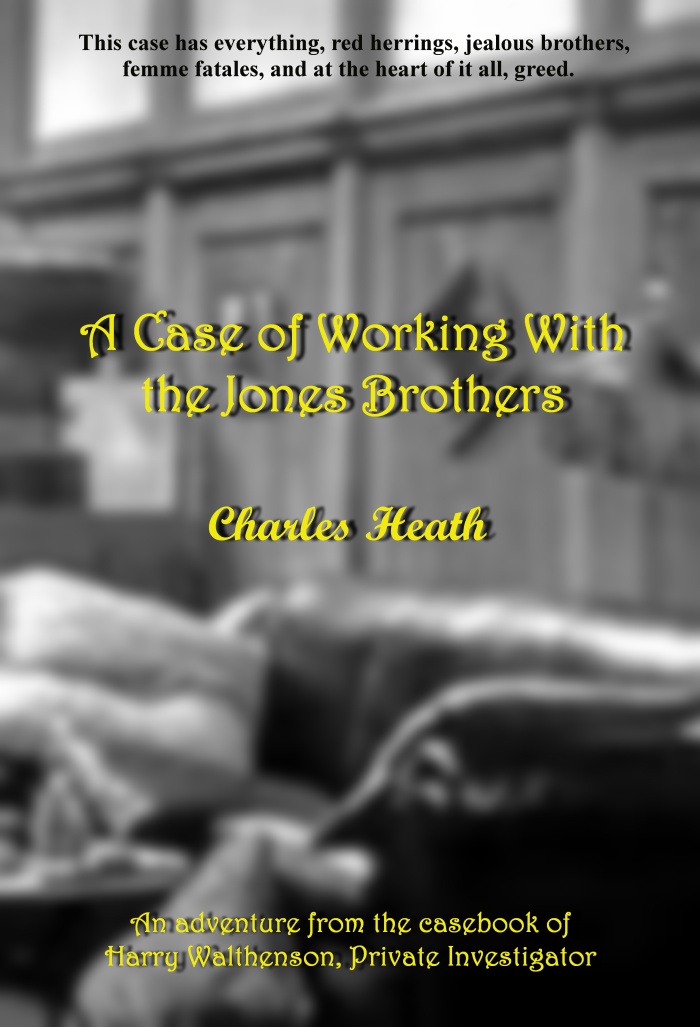
The story behind the story: A Case of Working With the Jones Brothers

To write a private detective serial has always been one of the items at the top of my to-do list, though trying to write novels and a serial, as well as a blog, and maintain a social media presence, well, you get the idea.

But I made it happen, from a bunch of episodes I wrote a long, long time ago, used these to start it, and then continue on, then as now, never having much of an idea where it was going to end up, or how long it would take to tell the story.

That, I think is the joy of ad hoc writing, even you, as the author, have as much idea of where it’s going as the reader does.

It’s basically been in the mill since 1990, and although I finished it last year, it looks like the beginning to end will have taken exactly 30 years.  Had you asked me 30 years ago if I’d ever get it finished, the answer would be maybe?

My private detective, Harry Walthenson

I’d like to say he’s from that great literary mold of Sam Spade, or Mickey Spillane, or Phillip Marlow, but he’s not.

But, I’ve watched Humphrey Bogart play Sam Spade with much interest, and modeled Harry and his office on it.  Similarly, I’ve watched Robert Micham play Phillip Marlow with great panache, if not detachment, and added a bit of him to the mix.

Other characters come into play, and all of them, no matter what period they’re from, always seem larger than life.  I’m not above stealing a little of Mary Astor, Peter Lorre or Sidney Greenstreet, to breathe life into beguiling women and dangerous men alike.

Then there’s the title, like

The Case of the Unintentional Mummy – this has so many meanings in so many contexts, though I image back in Hollywood in the ’30s and ’40s, this would be excellent fodder for Abbott and Costello

The Case of the Three-Legged Dog – Yes, I suspect there may be a few real-life dogs with three legs, but this plot would involve something more sinister.  And if made out of plaster, yes, they’re always something else inside.

But for mine, to begin with, it was “The Case of the …”, because I had no idea what the case was going to be about, well, I did, but not specifically.

Then I liked the idea of calling it “The Case of the Brother’s Revenge” because I began to have a notion there was a brother no one knew about, but that’s stuff for other stories, not mine, so then went the way of the others.

Now it’s called ‘A Case of Working With the Jones Brothers’, finished the first three drafts, and at the editor for the last.

I have high hopes of publishing it in early 2021.  It even has a cover.

PIWalthJones1

The cinema of my dreams – Was it just another surveillance job – Episode 6

I’m back home and this story has been sitting on a back burner for a few months, waiting for some more to be written.

The trouble is, there are also other stories to write, and I’m not very good at prioritising.

But, here we are, a few minutes opened up and it didn’t take long to get back into the groove.

Did he just witness an execution?

…

I could see the cogs in his mind turning over.  Calculating what it would take to get past me.

Running would only help me.

Walking, well, he wasn’t going to get far.

A fight?  He might be more experienced, but I was more angry, now controlled anger aided by rational thinking.  There would be no blindly lashing out.

Reconnaissance, Surveillance, and Self defence.

We were ten yards apart when he stopped, moving to one side near the wall.  I’d seen him looking for a weapon, but luckily none were on offer.  Someone kept this laneway very clean.

A car had been parked at the end, and I’d seen him try the doors.  Locked.  It would not be available for his escape.

He glared at me.  “You’re Jackson, right?”

A brief moment of shock.  How did he know my name?

“Who I am is irrelevant.”

“So you say.  But I can assure you this is all wrong.”

Rule number seventy, or something like that, the target will say anything to get you offside.

“You harmed my friends.”

“Then, you’re in big trouble if you regard them as friends.  In this business, we don’t have friends.”

He was right in one respect.  Having friends gave out enemies leverage.  But without friends, the loneliness of the job could break you.

But, right then I wasn’t interested in his opinion.

When I didn’t answer he said, “This is a setup.  I’m not the enemy, I’m one of you.  I made a mistake, and now they’ve set the dogs on me.”

I didn’t ask why we were following him, that was above my pay grade, added to the fact I didn’t want to know.  Knowing the perfidy of the target could compromise how I treated him.

“You’re the target, why I don’t care.”

“Look, I haven’t got much time.  Find a man called Alfred Nobbin.  I work for him.  I found something I shouldn’t, which is why you are here, now.  Tell him the evidence is ….”

I didn’t hear the bullet that killed him, but it came from behind me, hit him in the chest, its force sending him backwards, and he was dead before he hit the ground.”

I turned but there was no one there.

…

© Charles Heath 2019-2022

An excerpt from “Strangers We’ve Become” – Coming Soon

I wandered back to my villa.

It was in darkness.  I was sure I had left several lights on, especially over the door so I could see to unlock it.

I looked up and saw the globe was broken.

Instant alert.

I went to the first hiding spot for the gun, and it wasn’t there.  I went to the backup and it wasn’t there either.  Someone had found my carefully hidden stash of weapons and removed them.

Who?

There were four hiding spots and all were empty.  Someone had removed the weapons.  That could only mean one possibility.

I had a visitor, not necessarily here for a social call.

But, of course, being the well-trained agent I’d once been and not one to be caught unawares, I crossed over to my neighbor and relieved him of a weapon that, if found, would require a lot of explaining.

Suitably armed, it was time to return the surprise.

There were three entrances to the villa, the front door, the back door, and a rather strange escape hatch.  One of the more interesting attractions of the villa I’d rented was its heritage.  It was built in the late 1700s, by a man who was, by all accounts, a thief.  It had a hidden underground room which had been in the past a vault but was now a wine cellar, and it had an escape hatch by which the man could come and go undetected, particularly if there was a mob outside the door baying for his blood.

It now gave me the means to enter the villa without my visitors being alerted, unless, of course, they were near the vicinity of the doorway inside the villa, but that possibility was unlikely.  It was not where anyone could anticipate or expect a doorway to be.

The secret entrance was at the rear of the villa behind a large copse, two camouflaged wooden doors built into the ground.  I move aside some of the branches that covered them and lifted one side.  After I’d discovered the doors and rusty hinges, I’d oiled and cleaned them, and cleared the passageway of cobwebs and fallen rocks.  It had a mildew smell, but nothing would get rid of that.  I’d left torches at either end so I could see.

I closed the door after me, and went quietly down the steps, enveloped in darkness till I switched on the torch.  I traversed the short passage which turned ninety degrees about halfway to the door at the other end.  I carried the key to this door on the keyring, found it and opened the door.  It too had been oiled and swung open soundlessly.

I stepped in the darkness and closed the door.

I was on the lower level under the kitchen, now the wine cellar, the ‘door’ doubling as a set of shelves which had very little on them, less to fall and alert anyone in the villa.

Silence, an eerie silence.

I took the steps up to the kitchen, stopping when my head was level with the floor, checking to see if anyone was waiting.  There wasn’t.  It seemed to me to be an unlikely spot for an ambush.

I’d already considered the possibility of someone coming after me, especially because it had been Bespalov I’d killed, and I was sure he had friends, all equally as mad as he was.  Equally, I’d also considered it nigh on impossible for anyone to find out it was me who killed him because the only people who knew that were Prendergast, Alisha, a few others in the Department, and Susan.

That raised the question of who told them where I was.

If I was the man I used to be, my first suspect would be Susan.  The departure this morning, and now this was too coincidental.  But I was not that man.

Or was I?

I reached the start of the passageway that led from the kitchen to the front door and peered into the semi-darkness.  My eyes had got used to the dark, and it was no longer an inky void.  Fragments of light leaked in around the door from outside and through the edge of the window curtains where they didn’t fit properly.  A bone of contention upstairs in the morning, when first light shone and invariably woke me up hours before I wanted to.

Still nothing.

I took a moment to consider how I would approach the visitor’s job.  I would get a plan of the villa in my head, all entrances, where a target could be led to or attacked where there would be no escape.

Coming in the front door.  If I was not expecting anything, I’d just open the door and walk-in.  One shot would be all that was required.

Contract complete.

I sidled quietly up the passage staying close to the wall, edging closer to the front door.  There was an alcove where the shooter could be waiting.  It was an ideal spot to wait.

Crunch.

I stepped on some nutshells.

Not my nutshells.

I felt it before I heard it.  The bullet with my name on it.

And how the shooter missed, from point-blank range, and hit me in the arm, I had no idea.  I fired off two shots before a second shot from the shooter went wide and hit the door with a loud thwack.

I saw a red dot wavering as it honed in on me and I fell to the floor, stretching out, looking up where the origin of the light was coming and pulled the trigger three times, evenly spaced, and a second later I heard the sound of a body falling down the stairs and stopping at the bottom, not very far from me.

Two assassins.

I’d not expected that.

The assassin by the door was dead, a lucky shot on my part.  The second was still breathing.

I checked the body for any weapons and found a second gun and two knives.  Armed to the teeth!

I pulled off the balaclava; a man, early thirties, definitely Italian.  I was expecting a Russian.

I slapped his face, waking him up.  Blood was leaking from several slashes on his face when his head had hit the stairs on the way down.  The awkward angle of his arms and legs told me there were broken bones, probably a lot worse internally.  He was not long for this earth.

“Who employed you?”

He looked at me with dead eyes, a pursed mouth, perhaps a smile.  “Not today my friend.  You have made a very bad enemy.”  He coughed and blood poured out of his mouth.  “There will be more …”

Friends of Bespalov, no doubt.

I would have to leave.  Two unexplainable bodies, I’d have a hard time explaining my way out of this mess.  I dragged the two bodies into the lounge, clearing the passageway just in case someone had heard anything.

Just in case anyone was outside at the time, I sat in the dark, at the foot of the stairs, and tried to breathe normally.  I was trying not to connect dots that led back to Susan, but the coincidence was worrying me.

A half-hour passed and I hadn’t moved.  Deep in thought, I’d forgotten about being shot, unaware that blood was running down my arm and dripping onto the floor.

Until I heard a knock on my front door.

Two thoughts, it was either the police, alerted by the neighbors, or it was the second wave, though why would they be knocking on the door?

I stood, and immediately felt a stabbing pain in my arm.  I took out a handkerchief and turned it into a makeshift tourniquet, then wrapped a kitchen towel around the wound.

If it was the police, this was going to be a difficult situation.  Holding the gun behind my back, I opened the door a fraction and looked out.

No police, just Maria.  I hoped she was not part of the next ‘wave’.

“You left your phone behind on the table.  I thought you might be looking for it.”  She held it out in front of her.

When I didn’t open the door any further, she looked at me quizzically, and then asked, “Is anything wrong?”

I was going to thank her for returning the phone, but I heard her breathe in sharply, and add, breathlessly, “You’re bleeding.”

I looked at my arm and realized it was visible through the door, and not only that, the towel was soaked in blood.

“You need to go away now.”

Should I tell her the truth?  It was probably too late, and if she was any sort of law-abiding citizen she would go straight to the police.

She showed no signs of leaving, just an unnerving curiosity.  “What happened?”

I ran through several explanations, but none seemed plausible.  I went with the truth.  “My past caught up with me.”

“You need someone to fix that before you pass out from blood loss.  It doesn’t look good.”

“I can fix it.  You need to leave.  It is not safe to be here with me.”

The pain in my arm was not getting any better, and the blood was starting to run down my arm again as the tourniquet loosened.  She was right, I needed it fixed sooner rather than later.

I opened the door and let her in.  It was a mistake, a huge mistake, and I would have to deal with the consequences.  Once inside, she turned on the light and saw the pool of blood just inside the door and the trail leading to the lounge.  She followed the trail and turned into the lounge, turned on the light, and no doubt saw the two dead men.

I expected her to scream.  She didn’t.

She gave me a good hard look, perhaps trying to see if I was dangerous.  Killing people wasn’t something you looked the other way about.  She would have to go to the police.

“What happened here?”

“I came home from the cafe and two men were waiting for me.  I used to work for the Government, but no longer.  I suspect these men were here to repay a debt.  I was lucky.”

“Not so much, looking at your arm.”

She came closer and inspected it.

“Sit down.”

She found another towel and wrapped it around the wound, retightening the tourniquet to stem the bleeding.

“Do you have medical supplies?”

I nodded.  “Upstairs.”  I had a medical kit, and on the road, I usually made my own running repairs.  Another old habit I hadn’t quite shaken off yet.

She went upstairs, rummaged, and then came back.  I wondered briefly what she would think of the unmade bed though I was not sure why it might interest her.

She helped me remove my shirt, and then cleaned the wound.  Fortunately, she didn’t have to remove a bullet.  It was a clean wound but it would require stitches.

When she’d finished she said, “Your friend said one day this might happen.”

No prizes for guessing who that friend was, and it didn’t please me that she had involved Maria.

“Alisha?”

“She didn’t tell me her name, but I think she cares a lot about you.  She said trouble has a way of finding you, gave me a phone and said to call her if something like this happened.”

“That was wrong of her to do that.”

“Perhaps, perhaps not.  Will you call her?”

“Yes.  I can’t stay here now.  You should go now.  Hopefully, by the time I leave in the morning, no one will ever know what happened here, especially you.”

She smiled.  “As you say, I was never here.”

…

© Charles Heath 2018-2022
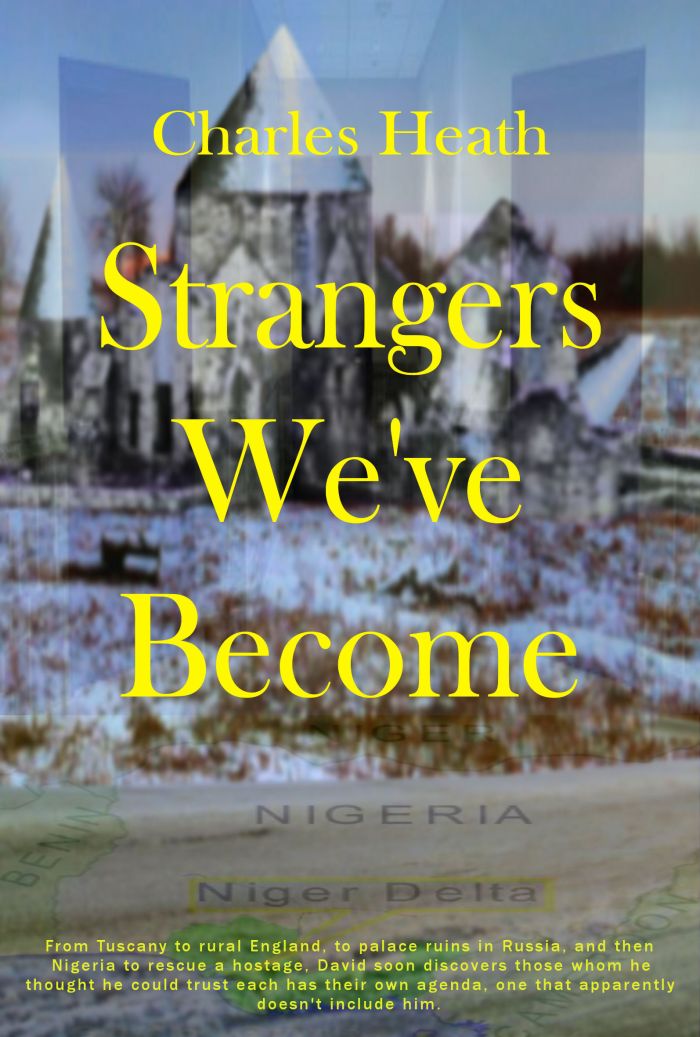
strangerscover9

Skeletons in the closet, and doppelgangers

A story called “Mistaken Identity”

…

How many of us have skeletons in the closet that we know nothing about? The skeletons we know about generally stay there, but those we do not, well, they have a habit of coming out of left field when we least expect it.

In this case, when you see your photo on a TV screen with the accompanying text that says you are wanted by every law enforcement agency in Europe, you’re in a state of shock, only to be compounded by those same police, armed and menacing, kicking the door down.

I’d been thinking about this premise for a while after I discovered my mother had a boyfriend before she married my father, a boyfriend who was, by all accounts, the man who was the love of her life.

Then, in terms of coming up with an idea for a story, what if she had a child by him that we didn’t know about, which might mean I had a half brother or sister I knew nothing about. It’s not an uncommon occurrence from what I’ve been researching.

There are many ways of putting a spin on this story.

Then, in the back of my mind, I remembered a story an acquaintance at work was once telling us over morning tea, that a friend of a friend had a mother who had a twin sister and that each of the sisters had a son by the same father, without each knowing of the father’s actions, both growing up without the other having any knowledge of their half brother, only to meet by accident on the other side of the world.

It was an encounter that in the scheme of things might never have happened, and each would have remained oblivious of the other.

For one sister, the relationship was over before she discovered she was pregnant, and therefore had not told the man he was a father. It was no surprise the relationship foundered when she discovered he was also having a relationship with her sister, a discovery that caused her to cut all ties with both of them and never speak to either from that day.

It’s a story with more twists and turns than a country lane!

And a great idea for a story.

That story is called ‘Mistaken Identity’.

The cinema of my dreams – I always wanted to write a war story – Episode 43

For a story that was conceived during those long boring hours flying in a steel cocoon, striving to keep away the thoughts that the plane and everyone in it could just simply disappear as planes have in the past, it has come a long way.

Whilst I have always had a fascination with what happened during the second world war, not the battles or fighting, but in the more obscure events that took place, I decided to pen my own little sidebar to what was a long and bitter war.

And, so, it continues…

——

Mayer fought the urge to panic, and then consider giving himself up.  He remembered what the Standartenfuhrer said, and knew that it was not an option.

He slid back into the forest, then far enough back, stood, and ran, the thick snow not only hampering his speed but also covering the sound of his flight. 

He stopped and listened for the sound of the following soldiers, but all he could hear was the sound of a locomotive and his breathing.  His heart was pounding, not used to such exercise or fear.

The soldiers must have stopped where the running person had fallen, and then on the verge of the tree line when the Standartenfuhrer had been shot.

He kneeled down and struggled to catch his breath.  He had the bad the Standartenfuhrer had thrust upon him as they got out of the car, and hoped it had a map, but it was too dark to look now.

From earlier, he remembered the other side of the railway tracks had trees too, and the road that led to the border, the village, if there was one, and the railway station.  There would also be a small shunting area, freight sheds, or something else to hide in, maybe even a signal tower.

Somewhere warm, and with some light, so he could plan his next move.  He was not sure what the Standartenfuhrer Had planned, but it certainly could not be by car the whole way, and they would not make the rendezvous by walking.

The plan had to include going by train.

Brenner pass was along the main track from Austria to the south of Italy, and from an earlier look at a map, the train would go through F, Verona, Bologna, to Florence where he would find the next guide.

Details of that guide hopefully were in the bag, a bag that he would have to hide or lose if he was captured because it would give away the escape route and resistance members who helped those fleeing Germany.

If he had the time or could think straight.  The cold was making that very difficult.  And there was the shock of losing the Standartenfuhrer.

It took five minutes to regain a certain amount of calm and be able to think. 

First, he had to get back to the tree line and see where he was, in proximity to the village, and the railway tracks.

That took about ten minutes carefully picking his way through the trees.  There was no path, it was dark, and he kept hitting low branches and getting covered in snow. There was enough down the back of his neck to make him very uncomfortable.

When he reached the tree line he looked back from where he had been, about a kilometer, and he could see the torches of the soldiers milling around where he and the Standartenfuhrer had been.  The train was still there, the locomotive’s light blazing in front, lighting a short distance of the track in front of it, almost blindingly bright. 

He was not sure why it was waiting on the track.

Looking the other way, there were two sets of tracks, a wide clear area, then another track with several flat cars and a guards van sitting in darkness, all of which were covered in snow.  They were not being used, so the van might provide some shelter.

He just had to get over there, about 100 meters distant.  The problem was there were lights, not very bright, at regular distances, but short enough that a man might present a shadowy outline if anyone was looking.

If he stayed low and run fast, it might just work.

A train whistle in the distance, coming from Italy caused him to shrink back into the cover of the trees.  Another train was coming.  It was oddly busy at a very late hour.

The locomotive also had a bright light that lit up the edge of the tree line, so he had to go further back to get away from it, and wait until the train passed.  It had a lot of flat cars with tanks and troop carriers on it, going back to Germany.  There were no soldiers so perhaps the equipment was needed elsewhere, maybe that final push to England he kept hearing about.

Once that train passed, the one that had been waiting finally restarted its journey south and slowly rumbled past him.  It was almost like a passenger train with no priority had had to wait until essential war trains passed.

When that train had gone, the surrounding area descended into a quiet, also silent field.  The snow had begun to fall heavier, which would be advantageous, and after several long looks in both directions, he ran, crossing the tracks, the empty space, and then to the guard van where he hid between it and the freight car until he caught his breath.

And see if anyone had seen him, expecting whistles and shouting coming from up the track.

Another look showed that only two torches remained back where there had been frenetic activity.  He hoped they considered they had caught the people they were looking for.

He went down the side of the guard’s van to the door, climbed the ladder, and tried the door.  It was unlocked.  There was no reason why it would be locked.

He went in and shut the door, and immediately it was warmer, and certainly dryer.  IT was impossibly dark inside, so he felt around in the bag and found a torch.  Someone had been clever enough to add a torch, some first aid equipment.  The papers included a map.

He checked the cabin for windows and found the shutters were closed, so he didn’t have to stifle the torches light.  A further check showed a bed at the end of the cabin, with a blanket, musty but dry.

There was a stove, a kettle with water, and a tin of tea leaves.  He wasn’t going to start a fire, so no tea.  There was no food, so the hunger would have to remain for a while longer.  The water tasted alright, but he could melt some snow if he needed more.

A place to stay, at least until daybreak when it would be wise to get into the forest on the roadside, and head towards the village, or perhaps wait for a train and see if he could hide on it for the trip south.

First, he needed some rest.

——-

© Charles Heath 2020-2022

Writing about writing a book – Day 21 continues

I’m still working on Bill’s backstory, and how he got mixed up in the war, and as a general background to his situation, and life before Davenport.

This is still in his own words:


But whether we were stupid or naive, or completely mad, we were all eager to get into battle, filled with the sort of hate only Army propaganda films could fill you with.  They were our enemy, and they deserved to concede or die.

A fresh face in a hardened platoon, I was eager to get on with it.  They looked knowingly, having seen it all before.  No idea of the reality, and no time to tell us.  Have a few beers to celebrate, and then, the next morning, go out on patrol.  No problem.

There was camaraderie, but it was subdued.  We walked single file, the seasoned campaigners in front and at the rear, treading carefully, demanding quiet, and a general cautiousness.  In the middle of nowhere, where only the sound of rain, or the animals and birds for company, we were naive enough to think this was going to be a doddle.

Then it happened, six hours out, and just before we reached a small clearing.  I thought to myself it was odd there should be such a clear space with jungle all around it.  There must be a reason.

There was.

We had walked into an ambush, and everyone hit the ground.  I was bringing up the rear with another soldier, a veteran not much older than myself whose name was Scotty, a little farther back from the main group.  Bullets sprayed the undergrowth, pinging off trees and leaves.  I buried my face in the dirt, praying I would not die on my first patrol.

We became separated from the others, lying in a hollow, with no idea how far away help was.  He was muttering to himself.  “God, I hate this.  You can never see the bastards.  They’re out there, but you can never bloody well see them.”  Then he crawled up the embankment, gun first.

He let off a few rounds, causing a return of machine-gun fire, spattering the dirt at the top.  Next thing I knew he was sliding down the hill with half his face shot away.  Dead.  I threw up there and then.  What an initiation.

Then one of the enemy soldiers came over the hill to check on his ‘kill’.  I saw him at the same time he saw me and aimed my gun and shot.  It was instinct more than anything else, and I hadn’t stopped to think of the consequences.  He fell down, finishing up next to me, staring at me from black, lifeless eyes. 

Dead. 

I’ll never forget those lifeless eyes.  I just got up and ran, making it back to the rest of the group without getting hit.  No one could explain how I made it safely through the hail of gunfire, from our side and theirs.

Back in the camp later, the veterans remarked on how unlucky Scotty was and how lucky I was to shoot one of the enemies, and not be killed myself.  They all thought it was worth a celebration.

Before we went out the next day to do it all again.

I spent the night vomiting, unable to sleep, haunted look on his face, one I finally realized that reflected complete astonishment.


There will be more, as the story develops.


© Charles Heath 2016-2020

“Do you believe in g..g..ghosts…?”, a short story

Inside the old building, it was very quiet and almost cold.

Strange, perhaps, because outside the temperature was bordering on the record hottest day ever, nearly 45 degrees centigrade.

The people who’d built this building nearly a hundred years before must have known how to keep that heat at bay, using sandstone.

Back then, the sandstone would have looked very impressive, but now after many years of being closed off and left abandoned, the outside was stained by modern-day pollutants giving it a black streaky look, and inside layers of dust, easily stirred up as we walked slowly into the main foyer.

It was huge, the roof, ornate, with four huge chandelier lights hanging down, and wood panelling, giving way to a long counter with brass serving cages highlighting its former use; a bank.

In its day it would have conveyed power and wealth so that its customers could trust their money to. Of course, that was before the global economy, online banking, and a raft of new and different institutions all vying for that same money.

Then it was a simple choice of a few, now it was a few thousand.

“How many years had this been closed up?” I asked.

“Close to twenty, maybe twenty-five. It was supposed to be pulled down, but someone got it on the heritage list, and that put an end to it. “

Phil was the history nut. He’s spent a month looking into the building, finding construction plans, and correspondence dating back to before and during the construction.

Building methods, he said, that didn’t exist today and were far in advance of anything of its type for the period. It was the reason we were standing in the foyer now.

We were budding civil engineers, and the university had managed to organize a visit, at our own risk. The owner of the building had made sure we’d signed a health and safety waiver before granting access.

And the caretaker only took us as far as the front door. He gave us his cell number to call when we were finished. When we asked him why he didn’t want to come in with us, he didn’t say but it was clear to me he was afraid of something.

But neither of us believed in ghosts.

“You can see aspects of cathedrals in the design,” Phil said. ” You could quite easily turn this space into a church.”

“Or a very large wine cellar.” I brought a thermometer with me, and inside where we were standing it was the ideal temperature to store wine.

Behind the teller cages were four large iron doors to the vaults. They were huge, and once contained a large amount of cash, gold, and whatever else was deemed valuable.

They were all empty now, the shelves and floor had scattered pieces of bank stationery, and in a corner, several cardboard boxes were covered in even more dust.

Behind the vaults were offices, half-height with glass dividers, the desks and chairs still in place, and some with wooden filing cabinets with drawers half-open.

Others had benches, and one, set in the corner, was very large, and looked like the manager’s office. Unlike the other office which had linoleum tiles, this one had carpet. In a corner was a large mirror-backed cabinet, with several half-empty bottles on it.

“Adds a whole new meaning to aged whiskey, don’t you think.” Phil looked at it but didn’t pick it up.

“I wonder why they left it,” I muttered. The place had the feel of having been left in a hurry, not taking everything with them.

I shivered, but it was not from the cold.

We went back to the foyer and the elevator lobby. They were fine examples of the sort of caged elevators that belonged at that time, and there were very few working examples these days.

The elevators would have a driver, who would pull back an inner and outer door when the car arrived on a floor, and close both again when everyone was aboard.

Both cars were on the ground floor, with the shutter doors closed, and when I tried to open one, I found it had been welded shut. The other car was not sitting level with the floor and the reason for that, the cable that raised and lowered it was broken.

Restoring them would be a huge job and would not be in their original condition due to occupational health and safety issues.

The staircase wound around the elevator cage, going up to the mezzanine floor or down to the basement.

“Up or down?” He asked.

“Where do you want to go first?”

“Down. There’s supposed to be a large vault, probably where the safety deposit boxes are.”

And the restrooms I thought. Not that I was thinking of going.

As we descended the stairs it was like going down into a mine shaft, getting darker, and the rising odour of dampness, and mustiness. I suspect it would have been the same back when it was first built being so close to the shoreline of the bay, not more than half a mile away.

The land this building and a number of others in a similar style, was built on was originally a swamp, and it was thought that the seawater still found its way this far inshore. But the foundations were incredibly strong and extensive which was why there’d been no shifting or cracking anywhere in the ten-story structure.

At the bottom, there was a huge arch, with built-in brass caging with two huge gates, both open. It was like the entrance to a mythical Aladdin’s cave.

There was also an indefinable aura coming from the depths of that room. That, and a movement of cold air. Curiously, the air down there was not musty but had a tinge of saltiness to it.

Was there a natural air freshener effect coming from somewhere within that vault?

“Are we going in?”

I checked my torch beam, still very bright. I pointed it into the blackness and after a minute of checking, I said, “We’re here, so why not.”

We had to walk down a dozen steps and then pass under through the open gates into the room. There was a second set of gates, the same as the first, about thirty feet from the first, and, in between, a number of cubicles where customers collected their boxes.

Beyond the second set of gates was a large circular reinforced safe door high enough for us to walk through.

This cavernous space stretched back quite a distance, and along the walls, rows, and rows of safety deposit boxes, some half hanging out of their housing, and a lot more stacked haphazardly on the floor.

I checked a few but they were all empty.

I shivered again. It felt like there was a presence in the room. I turned to ask Phil, but he wasn’t there. I hadn’t heard him walk away, and there were only two sets of footprints on the floor, his and mine, and both ended where I was standing.

It was as if he had disappeared into thin air.

I called out his name, and it echoed off the walls in the confined space. No answer from him.

I went further into the room, thinking he might have ventured towards the end while my back was turned, but he hadn’t. Nor had he left because there were only footprints coming in, not going out.

I turned to retrace my steps and stopped suddenly. An old man, in clothes that didn’t belong to this era, was standing where Phil had last been.

He was looking at me, but not inclined to talk.

“Hello. I didn’t see you come down.”

Seconds later the figure dissolved in front of me and there was no one but me standing in the room.

“Joe.”

Phil, from behind me. I turned and there he was large as life.

“Where were you?”

“I’ve been here all the time. Who were you just talking to?”

“There was an old man, standing just over there,” I said pointing to somewhere between Phil and the entrance.

“I didn’t see anyone. Are you sure you’re not having me on?”

“No. He’s right behind you.” The old man had reappeared.

Phil shook his head, believing I was trying to fool him.

That changed when the man touched his shoulder, and Phil shrieked.

And almost ran out of the room. It took a few minutes for him to catch his breath and steady his palpitating heart.

“Are you real?” I asked, not quite sure what to say.

“To me, I am. To anyone else, let’s just say you are the first not to faint, or run away.”

“Are you a ghost?” Phil wasn’t exactly sure what he was saying.

“Apparently I am and will be until you find out who killed me “

Ok, so what was it called, stuck in the afterlife or limbo until closure?

“When?”

“25 years ago, just before the bank closed. It’s the reason why it’s empty now.”

“And you’re saying we find the killer and you get to leave?”

“Exactly. Now shoo. Go and find him.”

We looked at each other in surprise, or more like shock, then back to the man. Only he was no longer there.

“What the…” Phil sail. “It’s time to go.”

“What about the man and finding his killer?”

“What man? We saw nothing. We’re done here.”

I shrugged. Phil turned to leave, but only managed to take three steps before the gates at the entrance closed with a loud clang.

When he crossed the room to stand in front, he tried pulling them open.

“Locked,” he said. Flat, and without panic, he added, “I guess it looks like we have a murder to solve.”

…

© Charles Heath 2019-2020

“Strangers We’ve Become” – Countdown to publishing in 2 Days

All’s well …

…

After an uneventful trip back home with some friendly Russians, it’s back to business for David and Alisha.

There’s the compound in rural England, the one with the fence that would normally be impenetrable.  David and the team, forced into action because of a basic mistake, take the fortress by storm, and discover … nothing.

The birds have flown the coop.

Well, they think they have.

Then there’s the castle, and discreet movements at night mean something’s afoot, and there’s yet another fortress to be stormed.

And, in the process, David is reunited with an old acquaintance.

But, a search of the new buildings finds something David never expected to find.

Back in London, David goes to visit Prendergast, not so well protected these days, at his private residence.  After a meaningful chat, the association between them is over, and Prendergast has played his last game with David.

Then it’s simply a matter of going to pick up Susan from the airport, and Boris getting the word she can come home.

They, too, have a meaningful chat in the car back to the London residence, and then the Castle, where Boris has accepted an invitation from David for a short stay.

Skeet shooting is only one of the things David has lined up.

Then, after a few months, life returns to normal in an unusual place, far, far away on the other side of the world.

…

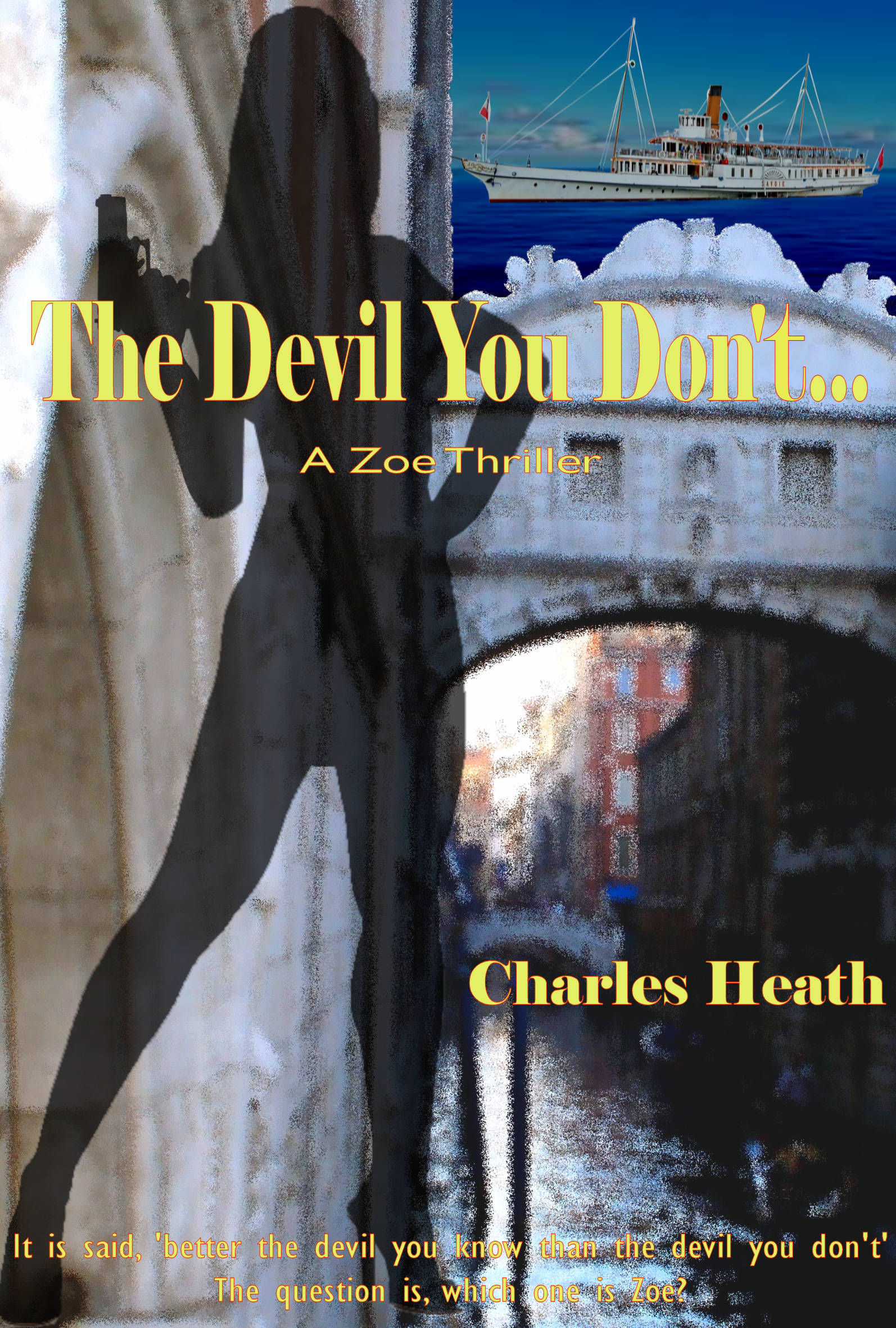
“The Devil You Don’t” – A beta readers view

It could be said that of all the women one could meet, whether contrived or by sheer luck, what are the odds it would turn out to be the woman who was being paid a very large sum to kill you.

John Pennington is a man who may be lucky in business, but not so lucky in love. He has just broken up with Phillipa Sternhaven, the woman he thought was the one, but relatives and circumstances, and perhaps because she was a ‘princess’, may also have contributed to the end result.

So, what do you do when you are heartbroken?

That is a story that slowly unfolds, from the first meeting with his nemesis on Lake Geneva, all the way to a hotel room in Sorrento, where he learns the shattering truth.

What should have been a high turns out to be something else entirely, and from that point every thing goes to hell in a handbasket.

He suddenly realises his so-called friend Sebastian has not exactly told him the truth about a small job he asked him to do, the woman he is falling in love with is not quite who she says she is, and he is caught in the middle of a war between two men who consider people becoming collateral damage as part of their business.

The story paints the characters cleverly displaying all their flaws and weaknesses. The locations add to the story at times taking me back down memory lane, especially to Venice where in those back streets I confess it’s not all that hard to get lost.

All in all a thoroughly entertaining story with, for once, a satisfying end.

…

Available on Amazon here: https://amzn.to/2Xyh1ow

…