The cinema of my dreams – Was it just another surveillance job – Episode 10

I’m back home and this story has been sitting on a back burner for a few months, waiting for some more to be written.

The trouble is, there are also other stories to write, and I’m not very good at prioritising.

But, here we are, a few minutes opened up and it didn’t take long to get back into the groove.

An interrogation continues


“So, take it from the top, give me a detailed rundown on the operation, from the briefing to coming here.”

That was an interesting request.  My usual report would not go into so much detail, and I had been compiling it on the go because if left until the end, crucial details were always omitted.

And, with the explosion, a lot of details had been mislaid in my mind, with more important or over-arching problems, getting a more prominent place in my memory.  It was a valuable lesson learned on reporting, we’d received from a man who most of my classmates thought odd, to the point of paranoid.

“I received the text message the night before to report to the midtown office for the briefing.  The code word was Chancellor and it was recognised at the security station.  If it was bogus I would not have made it in the building.”

“You go there for all your briefings?”

“Yes.”

“Same team?”

“For the previous five, yes.  This last one, a different team.  “One of us asked what happened to the previous team and we were told that it was none of our business.  We were given orders and sent out into the field to do a job.  That job, we were reminded, was not to ask irrelevant questions.”

“The leader told you that?”

“In no uncertain terms.”

“Go on.”

“We were given a photograph of the man that I have just given to you.  No mention was made of what he had done to warrant surveillance, only that we were to not lose him and to note everything he did.

“We were told where he might be found at a particular time, and a particular place, information that was correct.”

“Your team members?”

“Fiona Davis, Jack Venables, Walter Arbon, and me.”

“I take it you had the target under surveillance, ready to hand off to the next team member?”

“Before the explosion, yes, it was my leg.”

“You’re referring to the explosion in Church Street?”

“Yes.  I’d just past it when there was an explosion, and I was caught in the aftermath, and narrowly avoided the shrapnel raining down.  Others were not so lucky.”

“That’s where you lost him?”

“He was in front of me, thus avoiding the fallout.  It took a minute or so to get my bearings, and even then it was very hazy with the dust and carnage around me, but I did manage to see him in the distance heading towards the next person’s tag point.”

“You didn’t resume surveillance?”

“Couldn’t.  Too disoriented.  I put out an alert on the comms, but no one answered, not straight away.”

“You didn’t suspect anything?”

“Not then.,  I put it down to a malfunction from the blast.”

“You said ‘not straight away’?”

“About five minutes had passed when a voice came in my ear, asking for an update.  I didn’t think much about it at the time, because of the temporary disorientation, but it was about the time for the next team to take over.  There were two rolling teams of four.”

“Why did you think it odd?”

“Because they would know about the explosion.  Everyone within a mile radius would.  But at the time I simply said I was caught up in the aftermath and that the target was last seen heading towards the takeover point.  Then I was told the target was sighted.”

“I assume you then considered your role had ended?”

“Yes.  I’d been told to follow the advice of the medical staff on site.”

“Which was?”

“Go to the hospital for a check-up.”

“But you didn’t.”

“No.  I was heading away from the blast site when I saw the target again.  I stopped, watched, got out of sight, and waited.  He was coming back in my direction.”

“Was that an expected scenario, that he might backtrack?”

“No.  In the briefing we were told it was possible he would be moving from the point where we found him, to another for a clandestine meeting, away from the blast site.”

What did you do then?”

“Checked the position of the next member of the surveillance team. C I found him, and he was dead.  I made an assumption that the other two may have suffered a similar fate, and resumed surveillance on the target.”

“Did you report it?”

“Over the comms, yes.”

“What happened?”

“Nothing, no one answered.”

“Not even the director?”

“No.”

She made a note, crossed it out and wrote another with an underline.  A thick black line repeatedly, expressing her anger.

“You maintained surveillance?”

“Yes.”

“Until?”

“I’d cornered him in an alley, near a railway station.  I suspected he might head for it.  He’s seen me, and nearly dispatched me in the same manner as the others.  Luckily it was only a scratch.”

It was more than that and required 12 stitches but they didn’t need to know that.

“Then, Severin arrived, and out of nowhere, he was shot dead.”

“Did you speak to him?”

“Only to ask what he had done with the other members of my team.  He never answered.”

“Did you report that you’d caught him?”

“No.  Didn’t have to.  Severin arrived just after I had.”

“And that’s all of it?”

“In my report.  Yes.  When I get to write it, but I’ll need my phone.  It has the relevant details, except for the last part where I’d found him.”

“No name?”

“No.”

“You didn’t know he was one of ours?”

“No.  That fact only came to my attention when he told me.  When you’re given a target, you don’t ask what the relevance is, or what he’s done.  I’m sure you’re fully aware of the current practices and procedures.”

That last sentence slipped out, and by the look on her face, wasn’t well received.  I’d forgotten the golden rule.  Stick to the facts.  No embellishment, no emotion.

She made another note, closed the book, and got up.  “I’d like you to stay, just for the time being while we sort through the details.”

Then she left.


© Charles Heath 2019

An excerpt from “The Devil You Don’t”

Available on Amazon Kindle here:  https://amzn.to/2Xyh1ow

…

By the time I returned to the Savoie, the rain had finally stopped, and there was a streak of blue sky to offer some hope the day would improve.

The ship was not crowded, the possibility of bad weather perhaps holding back potential passengers.  Of those I saw, a number of them would be aboard for the lunch by Phillippe Chevrier.  I thought about it, but the Concierge had told me about several restaurants in Yvoire and had given me a hand-drawn map of the village.  I think he came from the area because he spoke with the pride and knowledge of a resident.

I was looking down from the upper deck observing the last of the boarding passengers when I saw a woman, notable for her red coat and matching shoes, making a last-minute dash to get on board just before the gangway was removed.  In fact, her ungainly manner of boarding had also captured a few of the other passenger’s attention.  Now they would have something else to talk about, other than the possibility of further rain.

I saw her smile at the deckhand, but he did not smile back.  He was not impressed with her bravado, perhaps because of possible injury.  He looked at her ticket then nodded dismissively, and went back to his duties in getting the ship underway.  I was going to check the departure time, but I, like the other passengers, had my attention diverted to the woman in red.

From what I could see there was something about her.  It struck me when the light caught her as she turned to look down the deck, giving me a perfect profile.  I was going to say she looked foreign, but here, as in almost anywhere in Europe, that described just about everyone.  Perhaps I was just comparing her to Phillipa, so definitively British, whereas this woman was very definitely not.

She was perhaps in her 30’s, slim or perhaps the word I’d use was lissom, and had the look and manner of a model.  I say that because Phillipa had dragged me to most of the showings, whether in Milan, Rome, New York, London, or Paris.  The clothes were familiar, and in the back of my mind, I had a feeling I’d seen her before.

Or perhaps, to me, all models looked the same.

She looked up in my direction, and before I could divert my eyes, she locked on.  I could feel her gaze boring into me, and then it was gone as if she had been looking straight through me.  I remained out on deck as the ship got underway, watching her disappear inside the cabin.  My curiosity was piqued, so I decided to keep an eye out for her.

I could feel the coolness of the air as the ship picked up speed, not that it was going to be very fast.  With stops, the trip would take nearly two hours to get to my destination.  It would turn back almost immediately, but I was going to stay until the evening when it returned at about half eight.  It would give me enough time to sample the local fare, and take a tour of the medieval village.

Few other passengers ventured out on the deck, most staying inside or going to lunch.  After a short time, I came back down to the main deck and headed forward.  I wanted to clear my head by concentrating on the movement of the vessel through the water, breathing in the crisp, clean air, and let the peacefulness of the surroundings envelope me.

It didn’t work.

I knew it wouldn’t be long before I started thinking about why things hadn’t worked, and what part I played in it.  And the usual question that came to mind when something didn’t work out.  What was wrong with me?

I usually blamed it on my upbringing.

I had one of those so-called privileged lives, a nanny till I was old enough to go to boarding school, then sent to the best schools in the land.  There I learned everything I needed to be the son of a Duke, or, as my father called it in one of his lighter moments, nobility in waiting.

Had this been five or six hundred years ago, I would need to have sword and jousting skills, or if it had been a few hundred years later a keen military mind.  If nothing else I could ride a horse, and go on hunts, or did until they became not the thing to do.

I learned six languages, and everything I needed to become a diplomat in the far-flung British Empire, except the Empire had become the Commonwealth, and then, when no-one was looking, Britain’s influence in the world finally disappeared.  I was a man without a cause, without a vocation, and no place to go.

Computers were the new vogue and I had an aptitude for programming.  I guess that went hand in hand with mathematics, which although I hated the subject, I excelled in.  Both I and another noble outcast used to toss ideas around in school, but when it came to the end of our education, he chose to enter the public service, and I took a few of those ideas we had mulled over and turned them into a company.

About a year ago, I was made an offer I couldn’t refuse.  There were so many zeroes on the end of it I just said yes, put the money into a very grateful bank, and was still trying to come to terms with it.

Sadly, I still had no idea what I was going to do with the rest of my life.  My parents had asked me to come back home and help manage the estate, and I did for a few weeks.  It was as long as it took for my parents to drive me insane.

Back in the city, I spent a few months looking for a mundane job, but there were very few that suited the qualifications I had, and the rest, I think I intimidated the interviewer simply because of who I was.  In that time I’d also featured on the cover of the Economist, and through my well-meaning accountant, started involving myself with various charities, earning the title ‘philanthropist’.

And despite all of this exposure, even making one of those ubiquitous ‘eligible bachelor’ lists, I still could not find ‘the one’, the woman I wanted to spend the rest of my life with.  Phillipa seemed to fit the bill, but in time she proved to be a troubled soul with ‘Daddy’ issues.  I knew that in building a relationship compromise was necessary, but with her, in the end, everything was a compromise and what had happened was always going to be the end result.

It was perhaps a by-product of the whole nobility thing.  There was a certain expectation I had to fulfill, to my peers, contemporaries, parents and family, and those who either liked or hated what it represented.  The problem was, I didn’t feel like I belonged.  Not like my friend from schooldays, and now obscure acquaintance, Sebastian.  He had been elevated to his Dukedom early when his father died when he was in his twenties.  He had managed to fade from the limelight and was rarely mentioned either in the papers or the gossip columns.  He was one of the lucky ones.

I had managed to keep a similarly low profile until I met Phillipa.  From that moment, my obscurity disappeared.  It was, I could see now, part of a plan put in place by Phillipa’s father, a man who hogged the limelight with his daughter, to raise the profile of the family name and through it their businesses.  He was nothing if not the consummate self-advertisement.

Perhaps I was supposed to be the last piece of the puzzle, the attachment to the establishment, that link with a class of people he would not normally get in the front door.  There was nothing refined about him or his family, and more than once I’d noticed my contemporaries cringe at the mention of his name, or any reference of my association with him.

Yet could I truthfully say I really wanted to go back to the obscurity I had before Phillipa?  For all her faults, there were times when she had been fun to be with, particularly when I first met her when she had a certain air of unpredictability.  That had slowly disappeared as she became part of her father’s plan for the future.  She just failed to see how much he was using her.

Or perhaps, over time, I had become cynical.

I thought about calling her.  It was one of those moments of weakness when I felt alone, more alone than usual.

I diverted my attention back to my surroundings and the shoreline.  Out of the corner of my eye, I could see the woman in the red coat, making a move.  The red coat was like a beacon, a sort of fire engine red.  It was not the sort of coat most of the women I knew would wear, but on her, it looked terrific.  In fact, her sublime beauty was the one other attribute that was distinctly noticeable, along with the fact her hair was short, rather than long, and jet black.

I had to wrench my attention away from her.

A few minutes later several other passengers came out of the cabin for a walk around the deck, perhaps to get some exercise, perhaps checking up on me, or perhaps I was being paranoid.  I waited till they passed on their way forward, and I turned and headed aft.

I watched the wake sluicing out from under the stern for a few minutes, before retracing my steps to the front of the ship and there I stood against the railing, watching the bow carve its way through the water.  It was almost mesmerizing.  There, I emptied my mind of thoughts about Phillipa, and thoughts about the woman in the red coat.

Until a female voice behind me said, “Having a bad day?”

I started, caught by surprise, and slowly turned.  The woman in the red coat had somehow got very close me without my realizing it.  How did she do that?  I was so surprised I couldn’t answer immediately.

“I do hope you are not contemplating jumping.  I hear the water is very cold.”

Closer up, I could see what I’d missed when I saw her on the main deck.  There was a slight hint of Chinese, or Oriental, in her particularly around the eyes, and of her hair which was jet black.  An ancestor twice or more removed had left their mark, not in a dominant way, but more subtle, and easily missed except from a very short distance away, like now.

Other than that, she was quite possibly Eastern European, perhaps Russian, though that covered a lot of territory.  The incongruity of it was that she spoke with an American accent, and fluent enough for me to believe English was her first language.

Usually, I could ‘read’ people, but she was a clean slate.  Her expression was one of amusement, but with cold eyes.  My first thought, then, was to be careful.

“No.  Not yet.”  I coughed to clear my throat because I could hardly speak.  And blushed, because that was what I did when confronted by a woman, beautiful or otherwise.

The amusement gave way to a hint of a smile that brightened her demeanor as a little warmth reached her eyes.  “So that’s a maybe.  Should I change into my lifesaving gear, just in case?”

It conjured up a rather interesting image in my mind until I reluctantly dismissed it.

“Perhaps I should move away from the edge,” I said, moving sideways until I was back on the main deck, a few feet further away.  Her eyes had followed me, and when I stopped she turned to face me again.  She did not move closer.

I realized then she had removed her beret and it was in her left side coat pocket.  “Thanks for your concern …?”

“Zoe.”

“Thanks for your concern, Zoe.  By the way, my name is John.”

She smiled again, perhaps in an attempt to put me at ease.  “I saw you earlier, you looked so sad, I thought …”

“I might throw myself overboard?”

“An idiotic notion I admit, but it is better to be safe than sorry.”

Then she tilted her head to one side then the other, looking intently at me.  “You seem to be familiar.  Do I know you?”

I tried to think of where I may have seen her before, but all I could remember was what I’d thought earlier when I first saw her; she was a model and had been at one of the showings.  If she was, it would be more likely she would remember Phillipa, not me.  Phillipa always had to sit in the front row.

“Probably not.”  I also didn’t mention the fact she may have seen my picture in the society pages of several tabloid newspapers because she didn’t look the sort of woman who needed a daily dose of the comings and goings, and, more often than not, scandal associated with so-called celebrities.

She gave me a look, one that told me she had just realized who I was.  “Yes, I remember now.  You made the front cover of the Economist.  You sold your company for a small fortune.”

Of course.  She was not the first who had recognized me from that cover.  It had raised my profile considerably, but not the Sternhaven’s.  That article had not mentioned Phillipa or her family.  I suspect Grandmother had something to do with that, and it was, now I thought about it, another nail in the coffin that was my relationship with Phillipa.

“I wouldn’t say it was a fortune, small or otherwise, just fortunate.”  Each time, I found myself playing down the wealth aspect of the business deal.

“Perhaps then, as the journalist wrote, you were lucky.  It is not, I think, a good time for internet-based companies.”

The latter statement was an interesting fact, one she read in the Financial Times which had made that exact comment recently.

“But I am boring you.”  She smiled again.  “I should be minding my own business and leaving you to your thoughts.  I am sorry.”

She turned to leave and took a few steps towards the main cabin.

“You’re not boring me,” I said, thinking I was letting my paranoia get the better of me.  It had been Sebastian on learning of my good fortune, who had warned me against ‘a certain element here and abroad’ whose sole aim would be to separate me from my money.  He was not very subtle when he described their methods.

But I knew he was right.  I should have let her walk away.

She stopped and turned around.  “You seem nothing like the man I read about in the Economist.”

A sudden and awful thought popped into my head.  Those words were part of a very familiar opening gambit.  “Are you a reporter?”

I was not sure if she looked surprised, or amused.  “Do I look like one?”

I silently cursed myself for speaking before thinking, and then immediately ignored my own admonishment.  “People rarely look like what they are.”

I saw the subtle shake of the head and expected her to take her leave.  Instead she astonished me.

“I fear we have got off on the wrong foot.  To be honest, I’m not usually this forward, but you seemed like you needed cheering up when probably the opposite is true.  Aside from the fact this excursion was probably a bad idea.  And,” she added with a little shrug, “perhaps I talk too much.”

I was not sure what I thought of her after that extraordinary admission. It was not something I would do, but it was an interesting way to approach someone and have them ignoring their natural instinct.  I would let Sebastian whisper in my ear for a little longer and see where this was going.

“Oddly enough, I was thinking the same thing.  I was supposed to be traveling with my prospective bride.  I think you can imagine how that turned out.”

“She’s not here?”

“No.”

“She’s in the cabin?”  Her eyes strayed in that direction for a moment then came back to me.  She seemed surprised I might be traveling with someone.

“No.  She is back in England, and the wedding is off.  So is the relationship.  She dumped me by text.”

OK, why was I sharing this humiliating piece of information with her?  I still couldn’t be sure she was not a reporter.

She motioned to an empty seat, back from the edge.  No walking the plank today.  She moved towards it and sat down.  She showed no signs of being cold, nor interested in the breeze upsetting her hair.  Phillipa would be having a tantrum about now, being kept outside, and freaking out over what the breeze might be doing to her appearance.

I wondered, if only for a few seconds if she used this approach with anyone else.  I guess I was a little different, a seemingly rich businessman alone on a ferry on Lake Geneva, contemplating the way his life had gone so completely off track.

She watched as I sat at the other end of the bench, leaving about a yard between us.  After I leaned back and made myself as comfortable as I could, she said, “I have also experienced something similar, though not by text message.  It is difficult, the first few days.”

“I saw it coming.”

“I did not.”  She frowned, a sort of lifeless expression taking over, perhaps brought on by the memory of what had happened to her.  “But it is done, and I moved on.  Was she the love of your life?”

OK, that was unexpected.

When I didn’t answer, she said, “I am sorry.  Sometimes I ask personal questions without realizing what I’m doing.  It is none of my business.”  She shivered.  “Perhaps we should go back inside.”

She stood, and held out her hand.  Should I take it and be drawn into her web?  I thought of Sebastian.  What would he do in this situation?

I took her hand in mine and let her pull me gently to my feet.  “Wise choice,” she said, looking up at the sky.

It just started to rain.

…

© Charles Heath 2015-2023

newdevilcvr6

‘Sunday in New York’ – A beta reader’s view

I’m not a fan of romance novels but …

There was something about this one that resonated with me.

This is a novel about a world generally ruled by perception, and how people perceive what they see, what they are told, and what they want to believe.

I’ve been guilty of it myself as I’m sure we all have at one time or another.

For the main characters Harry and Alison there are other issues driving their relationship.

For Alison, it is a loss of self-worth through losing her job and from losing her mother and, in a sense, her sister.

For Harry, it is the fact he has a beautiful and desirable wife, and his belief she is the object of other men’s desires, and one in particular, his immediate superior.

Between observation, the less than honest motives of his friends, a lot of jumping to conclusions based on very little fact, and you have the basis of one very interesting story.

When it all comes to a head, Alison finds herself in a desperate situation, she realises only the truth will save their marriage.

But is it all the truth?

What would we do in similar circumstances?

Rarely does a book have me so enthralled that I could not put it down until I knew the result. They might be considered two people who should have known better, but as is often the case, they had to get past what they both thought was the truth.

And the moral of this story, if it could be said there is one, nothing is ever what it seems.

…

Available on Amazon here: amzn.to/2H7ALs8

…

The cinema of my dreams – I always wanted to write a war story – Episode 47

For a story that was conceived during those long boring hours flying in a steel cocoon, striving to keep away the thoughts that the plane and everyone in it could just simply disappear as planes have in the past, it has come a long way.

Whilst I have always had a fascination with what happened during the second world war, not the battles or fighting, but in the more obscure events that took place, I decided to pen my own little sidebar to what was a long and bitter war.

And, so, it continues…

——

Johannesen went to find Wallace.  He had seen Jackerby leave the castle alone, which couldn’t be a good thing.  He had also noticed most of the Resistance members had gone too and had considered going back to the dungeons,

If he had been picking team members, Jackerby would not have been one of them.  He might act British and speak perfect British English, but he was a Nazi at heart, perhaps more Nazi than the Nazis’

It was not unsurprising.  The file Wallace had on him along with one for all of them, wasn’t exactly describing a life of roses.  His grandparents were German, and the British had killed them during the first world war.  There was no doubting he had based his whole life on one day avenging them, and this war had given him the opportunity.

To be a wolf in sheep’s clothing.

Johannesen guessed that was an apt description of him.  He was a devoted follower of Mosley and the English Fascists, openly supporting Hitler until it came to choosing a side.  That was easy, become part of a fifth column, Worthing from within.

And when the Reich became the all-powerful country when they won the war, there would be a position for him, a war hero.

Losing the war hadn’t figured in the story, but despite the successes, there were more failures, and tactical errors, like trying to invade Russia, and he could see that it was going to be the reason Germany lost.  Superior weapons were not going to staunch the losses, and it was only a matter of time.

The time he would use to figure out how not to get shot as a spy and somehow get back on the other side.

But, not today.

Wallace was trying a new wine, have the same thirst for wine, but not as swill as those Resistance members like Leonardo, a deep-colored red.

“You should try a glass, Johannes.  It’s an exceptional vintage.”  He picked up the bottle and looked at the label, then cleaning the dust off the label, said, “1907 no less.  Bastards never sold any of this to us to try.  We should liberate the cellar, and share it with our compatriots after the war.  At a price, of course.”

Like all the soldiers he’d met along the way, always looking to make a profit.  Goering and Hitler steal all the paintings, they were talking about the wine.  What did the people finish up with?

“Not really a red man, sir.”

“That’s because you’ve never had one like this.”

“Why not.”

Wallace poured him a glass.

Johannesen sipped it.  Wallace was right, it was better than any other he had tasted, not that he could really remember the last time he had the opportunity.

“It is quite good, sir.”

“It is.  You know Jackerby says you are a double agent, which is pretty rich coming from him.  Strictly speaking, if wouldn’t be a double agent, but a triple agent, if that was the case.  You’re not, are you?”

The smile on Wallace’s face didn’t extend to the eyes.  He was not amused, or annoyed.

Just fishing.

“That’s the problem with our situation.  We’ve been lying to everyone for so long, that it’s hard t tell what is the truth and what isn’t.  At the moment, the British don’t know where my allegiances lie, they think I’m the sleeper in this group, and Atherton, well, he’s not sure if that’s the case or not.  No doubt Jackerby told you about my trip to the dungeons to get the woman to talk.  Jackerby offers the big stick and that isn’t going to work on these people.  She’ll die before she gives up any secrets.  They all will.  And by all accounts that breute Leonardo was executing her compatriots in front of her to make her talk, and all they are is dead, and we’re no closer to anything.  What do you think I am?”

“Clever.  But that isn’t going to be my problem in,” he looked at his watch, “two hours.  We have a new commander, and a few more people arriving to weed out this elusive Atherton and the few resistance that’s left.  People higher than me want Meyer returned to Germany.  Whatever you are, Johannesen, you might have to plead your case to someone else far less understanding.”  He stood.  “Enjoy the wine.  It might be your last.”

Reading between the lines, Johannesen got the impression Wallace no longer cared what happened.  For all of them, it had been a long war, and it was dragging on with no success in sight.

And it was becoming abundantly clear he picked the wrong side.  Now, all that was going to happen was that he would end up in the crossfire.  Perhaps he had known all along that the German notion that no one could ever be trusted, that everyone should be treated as a traitor first, was going to be the death of all of them.

He had no doubt the new arrivals would be Waffen SS, battle-hardened, and sent on this mission as a sort of holiday.  They would find Atherton and the remnants very quickly and snuff out a problem Jackerby couldn’t.

Or, if Jackerby knew the Waffen SS was coming, had he left, knowing his loyalties would be called into question.  Pure German soldiers versus double agents, Johannesen knew who’d he believe first.

For the first time, Johannesen knew he was not going to see the end of this war, or that Germany had any hope of winning.

He needed a plan of escape, and that woman in the dungeons was the only one who could help him.

——-

© Charles Heath 2020-2022

Writing about writing a book – Day 25

We’ve been given the introduction to who Barry McDougall is, or the man otherwise known as ‘Brainless’, and after three days of trying to get it straight, this is the first rough draft of his start in the story.

…

Barry, whose daring selfless deeds earned him the nickname Brainless because that was the only way to describe the motivation behind them, was one of the regular soldiers, and, for a long time, had been my only true friend.  His was a reputation both friends and foes alike considered awesome.  He’d been in Vietnam, and later just turned up at Davenport’s camp, reporting for duty.

Davenport was more surprised than I was at his arrival, but obviously, after checking his credentials, he was impressed because he let him stay.  And it would be true to say, if he had not, I would not be here now.

So Barry was just the sort of person I needed to help me.

That was the good news.

The bad news was Barry, at the best of times, was either on one of his ‘benders’ using drugs or alcohol, whatever was easier to get at the time, lost to everyone, or locked up in a mental institution, having admitted himself.  He had no interest in participating in life, hadn’t worked in years, and often said, in moments when he was at his lowest, that he did not care if he lived or died.  It had not always been that way, but his demons had all but taken him over, and despite the help, I tried to give him, nothing could shake him out of this lethargy.  He said once he envied me that I could not remember the dark days, and, now those memories had returned, I knew what he meant.

For a long time, I could not understand why he didn’t try harder to help himself, and I guess he humoured me by accepting the jobs I’d found him, and the help I offered.  I owed him a great deal, but that was probably the one honourable thing about him, he never expected, nor wanted, anything in return.

He tried to make a go of being a police officer and lasted several years before he resigned over an incident that didn’t reach the papers.  There was, he said, no place for heroics in modern society.  I hadn’t gotten to the bottom of it, but I heard he shot some thieves at a time when the police were trying to promote a pacifist image.

He tried a few other occupations with an equal lack of success, so now he survived on whatever money I gave him.  He lived on the street, and when he was not there, I knew he could be found in a bar, in one of the more seedier parts of the city, a ubiquitous underground bar called Jackson’s, named after a man who had a salubrious reputation that hovered between load shark and saint, and who was reputed to be buried under the storeroom floor.  The present owner, or what I assumed to be the owner, was a large, gruff, ex-prizefighter, who had the proverbial heart of gold, most of the time, and who took my money and looked after Barry without making it look like he was.

I’d called the bartender in advance, and he said he was in his usual spot, and that it was at the start of the next cycle, having just discharged himself from the hospital after a bout of pneumonia.  It was, he said, getting worse, and taking longer to recover.

It was probably only a matter of time before it took him, so perhaps this time I would have to try harder to convince him to give up his nomadic lifestyle.

When I walked in, the aroma of spilled beer, stale sweat, and vomit, mingled with the industrial-strength carbolic cleaner almost took my breath away.  In the corner, two construction workers were sitting, quietly smoking and drinking large glasses of beer.  In the other, Barry was being held up by the table, an untouched double scotch sitting in front of him.  Sitting at the bar was a woman of indeterminate age, badly made up, and thin to the point of emaciation.  I was not sure what she was drinking, or what it was she was smoking, but I could smell it from the front doorway.

The bartender, Ogilvy, no first name given, was pretending to polish glasses, standing at the end of the bar, looking at the television, and playing some daytime soap.  He didn’t look over when I came in, but I knew he didn’t miss anything.  I saw him flick a glance at Barry, and then shake his head.  I think he cared as much about Barry as I did, but could recognize the sadness within him.  As much as Ogilvy said, which wasn’t much, he too had seen service in Vietnam, and it had affected him too.

I ordered an orange juice, caught glances from the construction workers, and a steely look from the woman, and then went over to Barry’s table and sat down.  Despite the loud scraping noise when I moved the chair, or the creaking as I sat in it, Barry didn’t move.

Whilst the bar had that seedy aroma, Barry was showing the signs of having spent time on the street.  It was one of the disadvantages of having no permanent residence and though there was a shower at the bar which Ogilvy let Barry use from time to time, he obviously hadn’t for a few days.

…

Getting all of this background in shape is hard work, and having toiled long and hard, tomorrow I’ll have a go at getting Barry back.

…

© Charles Heath 2016-2021

Sayings: Going on a wild goose chase

Who hasn’t been on one of these, particularly if you have an older brother or sister, and they have nothing better to do than give you a hard time.

You know what I mean, going on a mission to find or do something, knowing full well that you won’t find it, or complete it because it was a lost cause to start with.

Yes, it goes very well with another saying, a dog chasing its tail.

We’ve seen that, too, watching the poor dog go round and round without ever achieving anything.

Sounds like my day today.

And it doesn’t stop there, the pointless search could also be described as ‘searching for a needle in a haystack’.

That is, to my mind the very definition of a living nightmare.

The origin of the idiom, well that’s a little more complicated because there isn’t just one definition.

The first:

Coined by William Shakespeare, but not necessarily in the sort of language we can read easily – it’s a bit like my ability to translate Spanish to English. It does, however, refer to a ‘wild goose chase’.

The second:

Refers to, of all things 16th Century horseracing, and because I don’t have a time machine I can’t go back to fact-check. However, it refers to the other riders following the leader around the course, in much the same formation as geese flying through the air.

…

My little story to go with it:

…

If you are good at your job, and that is beginning to be noticed, your boss will find one of these ‘wild goose chases’ just for you, in an effort to make you look bad.

It happened to me once: my task was to search the basement, where old records were stored, for a folder that a former employee had thought they had filed it in the wrong storage box, a supposition supported by the fact the folder was now needed to clear up a clerical error and the file wasn’t in the specifically marked storage box.

My job was to search every one of the other 765 boxes stored haphazardly in the basement until I found it.

It was, I was told later, sitting on his desk the whole time, and when I couldn’t find it, was going to swoop in and say he’d found it.

Of course, it went missing before he could, so he got a bollicking for not storing the files properly, and I got the job to clean up the basement. I’m not sure who got the worst punishment.

“Sunday in New York”, a romantic adventure that’s not a walk in the park!

“Sunday in New York” is ultimately a story about trust, and what happens when a marriage is stretched to its limits.

When Harry Steele attends a lunch with his manager, Barclay, to discuss a promotion that any junior executive would accept in a heartbeat, it is the fact his wife, Alison, who previously professed her reservations about Barclay, also agreed to attend, that casts a small element of doubt in his mind.

From that moment, his life, in the company, in deciding what to do, his marriage, his very life, spirals out of control.

There is no one big factor that can prove Harry’s worst fears, that his marriage is over, just a number of small, interconnecting events, when piled on top of each other, points to a cataclysmic end to everything he had believed in.

Trust is lost firstly in his best friend and mentor, Andy, who only hints of impending disaster, Sasha, a woman whom he saved, and who appears to have motives of her own, and then in his wife, Alison, as he discovered piece by piece damning evidence she is about to leave him for another man.

Can we trust what we see with our eyes or trust what we hear?

Haven’t we all jumped to conclusions at least once in our lives?

Can Alison, a woman whose self-belief and confidence is about to be put to the ultimate test, find a way of proving their relationship is as strong as it has ever been?

As they say in the classics, read on!

Purchase:

http://tinyurl.com/Amazon-SundayInNewYork

The cinema of my dreams – Was it just another surveillance job – Episode 11

I’m back home and this story has been sitting on a back burner for a few months, waiting for some more to be written.

The trouble is, there are also other stories to write, and I’m not very good at prioritising.

But, here we are, a few minutes opened up and it didn’t take long to get back into the groove.

Just the person to see next


I couldn’t imagine what those details were.  But if it was a setup, it was a very elaborate one, by people who knew our systems and procedures.  Naturally, the first thought that sprang to mind, someone who was working here, or used to.

Then I had another thought, what if none of us was meant to survive the operation, and hat we had been selected specifically because we were new to field operations.  At the briefing, we had been told this was simple surveillance, observe and report, nothing more.

Usually we had one experienced member and three new team members, the experienced member was there to continue on the job training and evaluation.  What worried me was that an experienced member could be taken out apparently as easy as the others.

And my money was not on the guy I’d cornered.  Of course, I could be wrong, and no doubt circumstantial evidence would go a long way towards proving that, but in my estimation, a cornered man like he was, with a thirst and talent for killing, would not have hesitated to kill me before I’d got three words out.

I believed him.  He was scared and, now that I thought about it, confused.  That was anything but the m.o. of a conscienceless killer.

The wrinkle that hadn’t been accounted for was the explosion.  No one could have predicted that, or its effect on the operation.  It might well have saved him, except that I didn’t play by the rules and reconnected with him.  Maybe he had felt safe after taking out the others, and assuming I’d been taken down by the explosion.

Except, if I didn’t think he did the killing, who did, and why?  Severin?  Just who the hell is this Severin?  There’s been no indication he wasn’t one of us.

I was pondering that question when the woman returned and sat down again.  This time her stare wasn’t quite as glacial.

“Describe this Severin.”

She opened her notebook, and had her pencil ready.  Odd that she should be taking notes in pencil.

I described him.  Five feet eight inches tall, 250 pounds, thinning black hair, making him anywhere between 35 and 50, though I thought he was mid-forties.  He wore a tweed suit, rather an odd choice for the climate, and had the aroma of cigarette smoke hanging about him.

Every free moment I saw him, he had a cigarette, so I thought he was quite possibly a chain smoker, and from that, perhaps a man with bad nerves, or who worried a lot.  Now I knew he was not one of us, that could be interpreted as thinking he might get caught.

But he was confident, and outgoing, which meant he was quite sure he wouldn’t get caught, and that meant, quite possibly there was someone within our department that was working for or with him and had covered his comings and goings.  Either that or he had a universal passcode key to come and go as he pleased.

When I finished the description I could see a flicker of recognition.  IT was possible she knew who he might be, and if so, I was betting she knew him by another name.  I asked if that was the case.

“You know who this man is, don’t you?”

The stern reproving look returned.  “What makes you think that?”

“I read faces.  Yours is not a poker face.”

“Well, that disappoints me because I like to play poker.  Perhaps the people I play with have a different view.”

“I’m usually a good judge of character.”

“It’s let you down this time.”  She stood.  “Before you go, one of the supervisors here would like a word with you.  His name is Nobbin.  He works out of another office and is coming here directly.  After that, you’re free to go.”

She didn’t wait to say goodbye, and I was glad I managed to keep a straight face long enough.

Nobbin.  Just the man I wanted to see.


© Charles Heath 2019

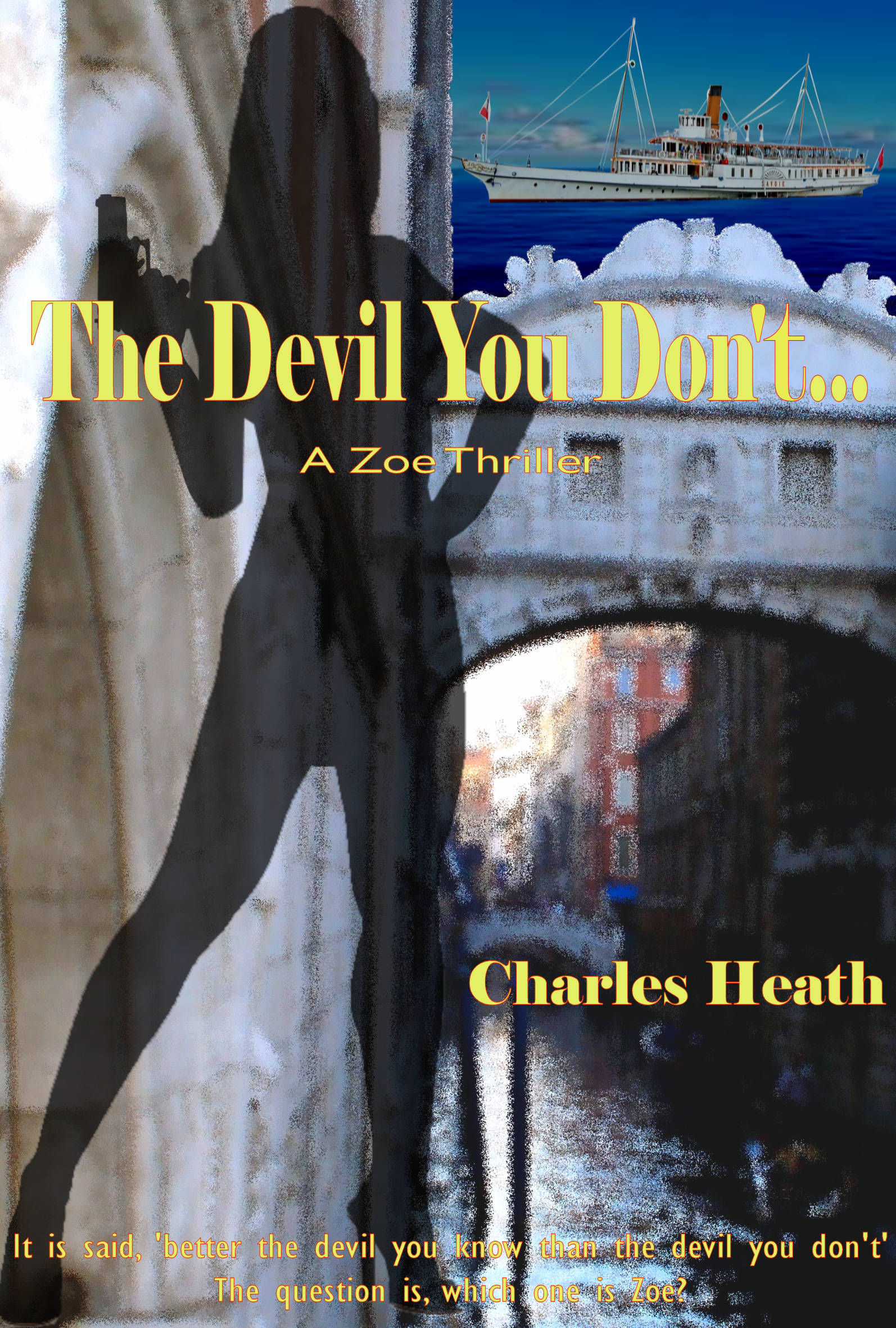
“The Devil You Don’t” – A beta readers view

It could be said that of all the women one could meet, whether contrived or by sheer luck, what are the odds it would turn out to be the woman who was being paid a very large sum to kill you.

John Pennington is a man who may be lucky in business, but not so lucky in love. He has just broken up with Phillipa Sternhaven, the woman he thought was the one, but relatives and circumstances, and perhaps because she was a ‘princess’, may also have contributed to the end result.

So, what do you do when you are heartbroken?

That is a story that slowly unfolds, from the first meeting with his nemesis on Lake Geneva, all the way to a hotel room in Sorrento, where he learns the shattering truth.

What should have been a high turns out to be something else entirely, and from that point every thing goes to hell in a handbasket.

He suddenly realises his so-called friend Sebastian has not exactly told him the truth about a small job he asked him to do, the woman he is falling in love with is not quite who she says she is, and he is caught in the middle of a war between two men who consider people becoming collateral damage as part of their business.

The story paints the characters cleverly displaying all their flaws and weaknesses. The locations add to the story at times taking me back down memory lane, especially to Venice where in those back streets I confess it’s not all that hard to get lost.

All in all a thoroughly entertaining story with, for once, a satisfying end.

…

Available on Amazon here: https://amzn.to/2Xyh1ow

…

Writing about writing a book – Day 24, a missing piece of the puzzle

There’s always the necessity for creating backstories so that the reader doesn’t come across a part of the story that doesn’t make sense.

Perhaps one of my failings is that I have to go over what I’ve already written, sometimes to make sure there is continuity and that what I’ve written makes sense.

This collection of memories our main character is having serves the purpose of setting up later plot points, but more importantly, is supposed to give the reader an idea of what the main character has gone through before arriving at the start of the story.

This part will serve to provide a little more information on the relationship between Bill and Barry, though I rather like the nickname I gave him.

“Bastards,” Killer muttered.

We called him ‘Killer’ because it was the nickname the Army had given him.  We were sharing the guard duty and had spoken briefly over the watch, but up till then, the silence had stretched over an hour or so.  It didn’t take long for anyone to realize he was a man of few words.

He’d been in the regular army for years and asked for the posting.  He’d made Sergeant several times, only to lose those same stripes for fighting, usually after R&R and a bout of heavy drinking.  Now assigned to our platoon to lend his experience, the conscripts were expecting him to ‘look after’ them.  Other than myself and the Lieutenant, he was the only other regular soldier.  Unfortunately for them, he hated both conscripts and the Viet Cong in varying degrees, and depending on his mood there was little tolerance left for the rest of us.

“The people who sent us here or the people trying to kill us?” I asked before I realized I’d spoken.

I didn’t hear the reply, the skies opening up with another torrential downpour that lasted for about five minutes, and going as fast as it came.  When the sun finally came up, it would make the atmosphere steamy, hot, and unbearable.  It was quite warm now, and I was feeling both uncomfortable, and fatigued.

Killer looked just as stoic as he had before the rain.  He looked at me.  “Damn weather.  Worse than home.”

“Scotland?”

“Scapa Flow, Kirkwall.  I should have been an engineer on ships like my father, but I was too stupid.  Joined the Army, finished up here.  What’s your excuse?”

“Square peg in a round hole.  The army seems to handle us in its stride.”  It was more or less the truth.  I joined the Army to get away from my parents.

“That it does.  That it does.”

The rain came and went, during which the rest of the camp roused and went about its business.  It had been a long night for some, still getting over the shock of the attack, and the ever-pervading thought the enemy was still out there, biding their time.  It would be, for them, a waiting game, waiting for the conditions to wear us down, and lose concentration as inevitably we would.

Certainly, by the time we were relieved from sentry duty, I felt I was in no condition to match wits with a donkey, let alone the enemy on his own home ground.  When I stumbled over to the mess area and looked at the tired and haggard looks on the faces of the platoon, I realized that went for all of us.

Killer and I managed to get about an hour’s rest before the call came to move out, rain or no rain, and after a breakfast to make anyone ill, we left.  For hours it rained.  No one spoke as we strained to listen over the rain spattering on the undergrowth, all the time expecting the unexpected.  That was the benefit of the surprise attack; we no longer took for granted we would be safe.

Water gathered in pools along the trail, hiding any chance of seeing landmines.  Rainwater and sweat ran into our eyes, making it difficult to see.  Water leaked everywhere, making it very uncomfortable.  This was not war.  This was utter stupidity.

I was about to remark on the futility of it all to the Lieutenant, who had taken the lead, when one second he was talking to me and the next he crashed to the ground, a sniper’s bullet killing him instantly.   Someone yelled “Contact” and we hit the ground, bullets flying all around us. 

Too late, I thought, as I felt the hit of what seemed to be a large rock, then the searing pain in my leg, just as I hit the ground…


© Charles Heath 2015-2021