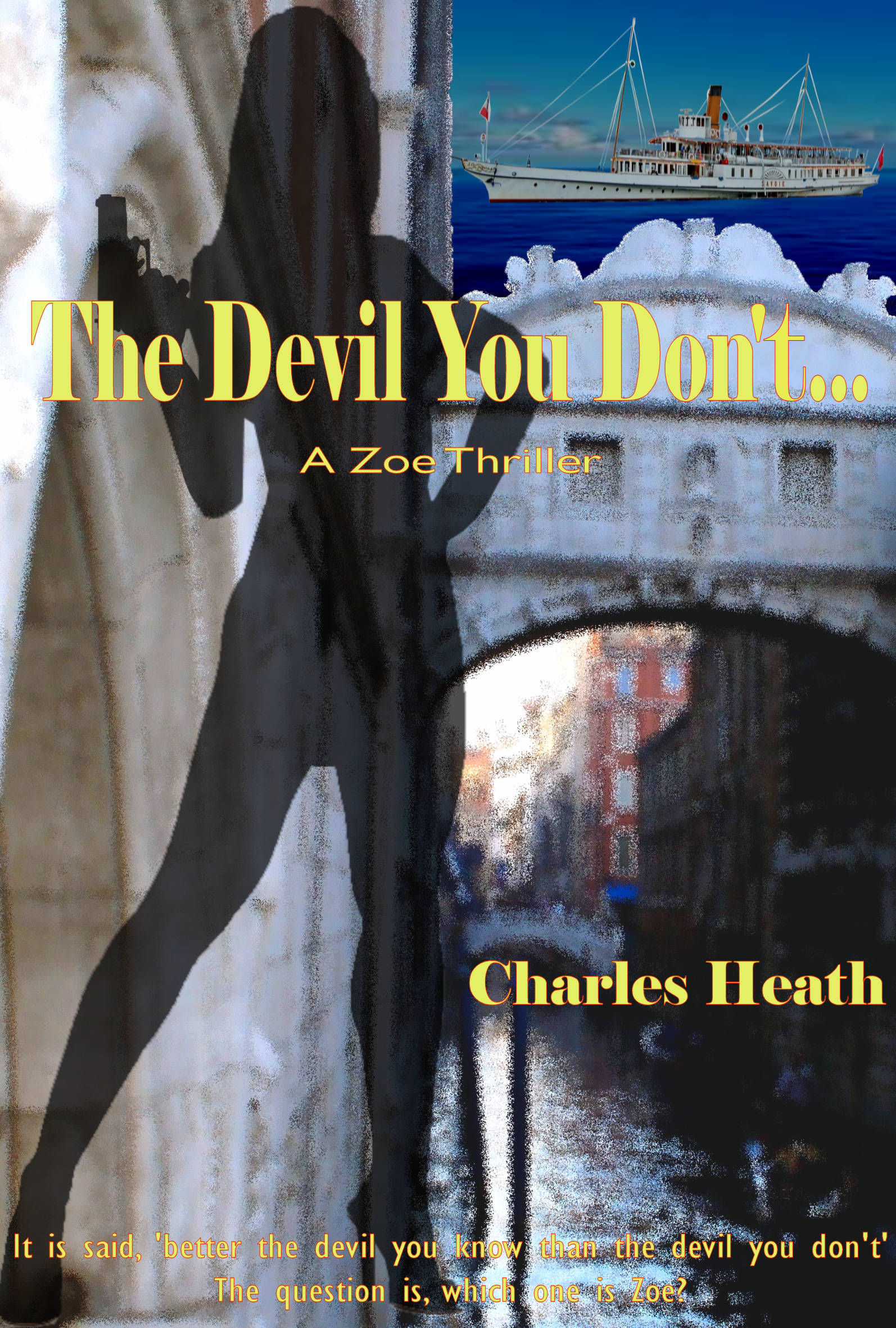
“The Devil You Don’t” – A beta readers view

It could be said that of all the women one could meet, whether contrived or by sheer luck, what are the odds it would turn out to be the woman who was being paid a very large sum to kill you.

John Pennington is a man who may be lucky in business, but not so lucky in love. He has just broken up with Phillipa Sternhaven, the woman he thought was the one, but relatives and circumstances, and perhaps because she was a ‘princess’, may also have contributed to the end result.

So, what do you do when you are heartbroken?

That is a story that slowly unfolds, from the first meeting with his nemesis on Lake Geneva, all the way to a hotel room in Sorrento, where he learns the shattering truth.

What should have been a high turns out to be something else entirely, and from that point every thing goes to hell in a handbasket.

He suddenly realises his so-called friend Sebastian has not exactly told him the truth about a small job he asked him to do, the woman he is falling in love with is not quite who she says she is, and he is caught in the middle of a war between two men who consider people becoming collateral damage as part of their business.

The story paints the characters cleverly displaying all their flaws and weaknesses. The locations add to the story at times taking me back down memory lane, especially to Venice where in those back streets I confess it’s not all that hard to get lost.

All in all a thoroughly entertaining story with, for once, a satisfying end.

…

Available on Amazon here: https://amzn.to/2Xyh1ow

…

Writing about writing a book – Day 33

So, it seems there’s going to be a few problems at work.  People are dying and no one really knows why.

Perhaps it has something to do with the computer systems and the network.  In the time this novel is set, networking personal computers was in its infancy and a veritable rabbit hole to go down.

We need to throw in a bit more background and involve others, but to what extent should these other people have influence over the storyline?

This is why there are puzzling aspects of Richardson’s death, and why is Aitchison so interested?

Says Aitchison…

…

“I knew the man better than most.  But even if he was going through a bad patch, and he was a little down, he would not have killed himself, not the way it was presented in his office.  The gun was in the wrong hand, his left hand.  He was ambidextrous to a certain point, left-handed in some cases, right-handed in others.  I knew for a fact he could only shoot with his right hand.  Same as golf.  But most people here would have seen him use only his left hand.”

I let his words sink in for a moment.  How could he possibly know what hand Richardson used for what purpose?  Perhaps golf because it was open to Company employees of any level, but shooting?

It came out of my mouth before I could stop it.  “How …”

“..do I know about his shooting hand?  I ran into him once at the range.  I used to shoot a few skeets back in the day.  Eyesight has gone to pot these days, so it’s been a while.”  The last part was related more for his own benefit.

Good enough answer.  I didn’t know Aitchison was a shooter.  The office grapevine wasn’t as extensively knowledgeable as it purported to be.

“Then is it possible someone here killed him?”

“Like the woman he was supposedly having an affair or her jealous husband?”  He laughed, and it wasn’t a particularly nice one.  “The mystery woman he was spending time with was his daughter.  He asked me to get her a job, but not to let on that he knew her.  Didn’t want her to think he was meddling in her affairs, and that anyone else would see it as favors from the executive to certain employees.”

Aitchison’s voice shook, and he poured another drink to try and steady his nerves.  He was agitated, I could see that.  And he had evidence that the police would need to help solve this crime.  Yet, by the way, he was talking; I don’t think he believed any of what he had just told me would be deemed as relevant.

And I was yet to see a reason why this would affect him so.

“Have you told the police this?

“Yes, but the detective they sent this morning wasn’t interested.”

Perhaps he was writing more into it than there was.  I didn’t know what to say and tried to look noncommittal.  Then he looked at me with a piercing stare, like the thought had just occurred to him.  “You two clashed, heatedly at times.  Did you do this?

Perhaps not quite the question I was expecting from him or anyone.

I was innocent, but I had one of those faces when someone puts a question to you rather abruptly, that reddened, either with embarrassment or guilt.  I had very little control over it.

But to be accused of murder?

I had an alibi; I was home alone in bed trying to sleep.  OK.  It was shaky but the truth.

“No.  Why would I?”

If I was going to kill anyone in this place, it would be Benton, or even Kowalski, another thorn in my side.  Richardson was not on the list, and never would be.  He was just old and pedantic, set in his ways.  He clashed with everyone at one time or another.  In my case, he was just cranky because I replaced his pen and paper accounting with a new application on that computer he refused to use.

He nodded to himself.  “I thought not, but I had to ask.”

He stood and went over to the window and looked out.  Taking time, I guessed, to collect his thoughts.  He remained there with his back to me for a few minutes.  It didn’t seem to be a long time.

Then he said, quietly, “It appears there’s something else going on, something that none of us in the Executive know anything about.”

I was not sure I liked the sound of that or the fact he was telling me.  This was not something I should be privy to.  But that still didn’t stop me from asking, “Like what for instance?”

“The existence of another network.”

“What do you mean?”  Another network?  There was only one.  I had seen it installed, and went through the teething process of getting it up and running, as every bit as hard as bringing a new baby into the world.

I would know if there was another network.  Wouldn’t I?

“Apparently there is supposedly another network of computers running in this office.  I have only the word of a policeman by the name of Chief Inspector Gator, a computer expert, and a consultant from Interpol.  How the hell did this information get to Interpol, of all people?”

I couldn’t tell him.  This was news to me.

“What evidence have they got that this ‘other network’ exists?”

“Intercepted telephone calls reporting a connection error to a network system by the name of Starburst.  There was a log entry on Richardson’s computer referring to it, about the time of a power failure last night.  The computer expert is down in the server room now looking for this other network.”

He swiveled around and looked down at me with a thunderous expression.  “You didn’t set anything up for Halligan, did you?”

“No.”

I was surprised he asked.  We had a discussion some months ago about the fact most of the AGM’s came directly to me to sort out their computer issues.  Halligan was the worst of all of them, using his position to browbeat me into doing work that could only be described as off-book.  Whilst strictly speaking, as AGM – Information Technology, Halligan was quite within his purview to make such requests; it was the security aspects that had to be signed off on before executing such requests.  It added a new level of pain to the approvals process and had made Halligan an enemy of both Aitchison and myself, even though I had nothing to do with it.

The problem was, like all members of the Executive, Halligan was his own worst enemy.  Each of their areas of responsibility was like fiefdoms, and none of them like the others to encroach on their territory.  Halligan’s was the only area that had a shared responsibility with security.  Soon after the new arrangements were put in place, and the fact I had been left off the list of people to be informed, Halligan had asked me to do some work, and not aware of any change in procedure, did it.

Then, playing the usual game of one-upmanship, Halligan told the Executive of the new initiative and left a smoldering Aitchison in his wake.  In the end, all it did was cause me trouble, a severe reprimand, and no apology for being left off the distribution list informing of the new arrangements.

It was still a raw nerve and he had touched it.

…

© Charles Heath 2015-2021

An excerpt from “Strangers We’ve Become” – Coming Soon

I wandered back to my villa.

It was in darkness.  I was sure I had left several lights on, especially over the door so I could see to unlock it.

I looked up and saw the globe was broken.

Instant alert.

I went to the first hiding spot for the gun, and it wasn’t there.  I went to the backup and it wasn’t there either.  Someone had found my carefully hidden stash of weapons and removed them.

Who?

There were four hiding spots and all were empty.  Someone had removed the weapons.  That could only mean one possibility.

I had a visitor, not necessarily here for a social call.

But, of course, being the well-trained agent I’d once been and not one to be caught unawares, I crossed over to my neighbor and relieved him of a weapon that, if found, would require a lot of explaining.

Suitably armed, it was time to return the surprise.

There were three entrances to the villa, the front door, the back door, and a rather strange escape hatch.  One of the more interesting attractions of the villa I’d rented was its heritage.  It was built in the late 1700s, by a man who was, by all accounts, a thief.  It had a hidden underground room which had been in the past a vault but was now a wine cellar, and it had an escape hatch by which the man could come and go undetected, particularly if there was a mob outside the door baying for his blood.

It now gave me the means to enter the villa without my visitors being alerted, unless, of course, they were near the vicinity of the doorway inside the villa, but that possibility was unlikely.  It was not where anyone could anticipate or expect a doorway to be.

The secret entrance was at the rear of the villa behind a large copse, two camouflaged wooden doors built into the ground.  I move aside some of the branches that covered them and lifted one side.  After I’d discovered the doors and rusty hinges, I’d oiled and cleaned them, and cleared the passageway of cobwebs and fallen rocks.  It had a mildew smell, but nothing would get rid of that.  I’d left torches at either end so I could see.

I closed the door after me, and went quietly down the steps, enveloped in darkness till I switched on the torch.  I traversed the short passage which turned ninety degrees about halfway to the door at the other end.  I carried the key to this door on the keyring, found it and opened the door.  It too had been oiled and swung open soundlessly.

I stepped in the darkness and closed the door.

I was on the lower level under the kitchen, now the wine cellar, the ‘door’ doubling as a set of shelves which had very little on them, less to fall and alert anyone in the villa.

Silence, an eerie silence.

I took the steps up to the kitchen, stopping when my head was level with the floor, checking to see if anyone was waiting.  There wasn’t.  It seemed to me to be an unlikely spot for an ambush.

I’d already considered the possibility of someone coming after me, especially because it had been Bespalov I’d killed, and I was sure he had friends, all equally as mad as he was.  Equally, I’d also considered it nigh on impossible for anyone to find out it was me who killed him because the only people who knew that were Prendergast, Alisha, a few others in the Department, and Susan.

That raised the question of who told them where I was.

If I was the man I used to be, my first suspect would be Susan.  The departure this morning, and now this was too coincidental.  But I was not that man.

Or was I?

I reached the start of the passageway that led from the kitchen to the front door and peered into the semi-darkness.  My eyes had got used to the dark, and it was no longer an inky void.  Fragments of light leaked in around the door from outside and through the edge of the window curtains where they didn’t fit properly.  A bone of contention upstairs in the morning, when first light shone and invariably woke me up hours before I wanted to.

Still nothing.

I took a moment to consider how I would approach the visitor’s job.  I would get a plan of the villa in my head, all entrances, where a target could be led to or attacked where there would be no escape.

Coming in the front door.  If I was not expecting anything, I’d just open the door and walk-in.  One shot would be all that was required.

Contract complete.

I sidled quietly up the passage staying close to the wall, edging closer to the front door.  There was an alcove where the shooter could be waiting.  It was an ideal spot to wait.

Crunch.

I stepped on some nutshells.

Not my nutshells.

I felt it before I heard it.  The bullet with my name on it.

And how the shooter missed, from point-blank range, and hit me in the arm, I had no idea.  I fired off two shots before a second shot from the shooter went wide and hit the door with a loud thwack.

I saw a red dot wavering as it honed in on me and I fell to the floor, stretching out, looking up where the origin of the light was coming and pulled the trigger three times, evenly spaced, and a second later I heard the sound of a body falling down the stairs and stopping at the bottom, not very far from me.

Two assassins.

I’d not expected that.

The assassin by the door was dead, a lucky shot on my part.  The second was still breathing.

I checked the body for any weapons and found a second gun and two knives.  Armed to the teeth!

I pulled off the balaclava; a man, early thirties, definitely Italian.  I was expecting a Russian.

I slapped his face, waking him up.  Blood was leaking from several slashes on his face when his head had hit the stairs on the way down.  The awkward angle of his arms and legs told me there were broken bones, probably a lot worse internally.  He was not long for this earth.

“Who employed you?”

He looked at me with dead eyes, a pursed mouth, perhaps a smile.  “Not today my friend.  You have made a very bad enemy.”  He coughed and blood poured out of his mouth.  “There will be more …”

Friends of Bespalov, no doubt.

I would have to leave.  Two unexplainable bodies, I’d have a hard time explaining my way out of this mess.  I dragged the two bodies into the lounge, clearing the passageway just in case someone had heard anything.

Just in case anyone was outside at the time, I sat in the dark, at the foot of the stairs, and tried to breathe normally.  I was trying not to connect dots that led back to Susan, but the coincidence was worrying me.

A half-hour passed and I hadn’t moved.  Deep in thought, I’d forgotten about being shot, unaware that blood was running down my arm and dripping onto the floor.

Until I heard a knock on my front door.

Two thoughts, it was either the police, alerted by the neighbors, or it was the second wave, though why would they be knocking on the door?

I stood, and immediately felt a stabbing pain in my arm.  I took out a handkerchief and turned it into a makeshift tourniquet, then wrapped a kitchen towel around the wound.

If it was the police, this was going to be a difficult situation.  Holding the gun behind my back, I opened the door a fraction and looked out.

No police, just Maria.  I hoped she was not part of the next ‘wave’.

“You left your phone behind on the table.  I thought you might be looking for it.”  She held it out in front of her.

When I didn’t open the door any further, she looked at me quizzically, and then asked, “Is anything wrong?”

I was going to thank her for returning the phone, but I heard her breathe in sharply, and add, breathlessly, “You’re bleeding.”

I looked at my arm and realized it was visible through the door, and not only that, the towel was soaked in blood.

“You need to go away now.”

Should I tell her the truth?  It was probably too late, and if she was any sort of law-abiding citizen she would go straight to the police.

She showed no signs of leaving, just an unnerving curiosity.  “What happened?”

I ran through several explanations, but none seemed plausible.  I went with the truth.  “My past caught up with me.”

“You need someone to fix that before you pass out from blood loss.  It doesn’t look good.”

“I can fix it.  You need to leave.  It is not safe to be here with me.”

The pain in my arm was not getting any better, and the blood was starting to run down my arm again as the tourniquet loosened.  She was right, I needed it fixed sooner rather than later.

I opened the door and let her in.  It was a mistake, a huge mistake, and I would have to deal with the consequences.  Once inside, she turned on the light and saw the pool of blood just inside the door and the trail leading to the lounge.  She followed the trail and turned into the lounge, turned on the light, and no doubt saw the two dead men.

I expected her to scream.  She didn’t.

She gave me a good hard look, perhaps trying to see if I was dangerous.  Killing people wasn’t something you looked the other way about.  She would have to go to the police.

“What happened here?”

“I came home from the cafe and two men were waiting for me.  I used to work for the Government, but no longer.  I suspect these men were here to repay a debt.  I was lucky.”

“Not so much, looking at your arm.”

She came closer and inspected it.

“Sit down.”

She found another towel and wrapped it around the wound, retightening the tourniquet to stem the bleeding.

“Do you have medical supplies?”

I nodded.  “Upstairs.”  I had a medical kit, and on the road, I usually made my own running repairs.  Another old habit I hadn’t quite shaken off yet.

She went upstairs, rummaged, and then came back.  I wondered briefly what she would think of the unmade bed though I was not sure why it might interest her.

She helped me remove my shirt, and then cleaned the wound.  Fortunately, she didn’t have to remove a bullet.  It was a clean wound but it would require stitches.

When she’d finished she said, “Your friend said one day this might happen.”

No prizes for guessing who that friend was, and it didn’t please me that she had involved Maria.

“Alisha?”

“She didn’t tell me her name, but I think she cares a lot about you.  She said trouble has a way of finding you, gave me a phone and said to call her if something like this happened.”

“That was wrong of her to do that.”

“Perhaps, perhaps not.  Will you call her?”

“Yes.  I can’t stay here now.  You should go now.  Hopefully, by the time I leave in the morning, no one will ever know what happened here, especially you.”

She smiled.  “As you say, I was never here.”

…

© Charles Heath 2018-2022

strangerscover9

The cinema of my dreams – I always wanted to go on a treasure hunt – Episode 16

Here’s the thing…

Every time I close my eyes, I see something different.

I’d like to think the cinema of my dreams is playing a double feature but it’s a bit like a comedy cartoon night on Fox.

But these dreams are nothing to laugh about.

Once again there’s a new instalment of an old feature, and we’re back on the treasure hunt.


Rather tired and bleary eyes, I made it to the fishing store five minutes late.  I had a lot on my mind, woken late, and then had to battle traffic.  I longed for the day I could afford a car, though riding the bike kept me fit.

It also took my mind of the encounter last night, the one that had kept me away, my imagination almost getting the better of me.

Boggs was there, and he didn’t look happy.

“Where were you last night?  I tried to get you, but you weren’t answering.”

I had the phone on silent.  Ringing phones had a way of bringing unwanted attention.

“I had something I had to do.”

“You went to the Lantern without me.”

What?  Does he have a network of spies I knew nothing about?  “So, I heard it went respectable and had to check it out.”  And hoping Boggs didn’t know who was in attendance, other than me.

“We said we would go there together.”

“You apparently had something else on last night.”

“It’s not what you think.  I had to go with my mother to the hospital for her 6 monthly checks.”

It was easy to forget.  She’d had a cancer scare a few years back, and had undergone chemo for a few months, sending it into remission.  But it came with 6 monthly checks, and both Boggs and his mother were constantly worried it might come back.  It seemed it always did when you least expected it.

“And what was the verdict.”

He relented a little.  “Good.”

“Then, I assure you that was more important.”  No point in telling Boggs what I was doing, just in case it backfired, or he disagreed.  “And I can assure you the place is not worth it anymore.  Boring as shit.”

He shook his head.  Not pleased, but at least not angry.

“Has Rico shown his face?” I asked.

“Yes, about an hour back, some of those people he associates with came and they went off together.”

Perhaps he was annoyed that I hadn’t been there because I’m sure Boggs would follow him.

“You’ve been here all this time?”

“He came to our place last night.  I’m sure it was him who searched in my room.  Not much of a professional thief, he left a mess behind.  Went through the outhouse as well.”

“Looking for the map?”

“Seems so.  He didn’t find it.”

No, he wouldn’t, because Boggs had it with him.  At least that was what I thought he intimated a day or two ago.

“Copies?”

He reached for his back pocket and pulled out some folded paper.  “Thought you might like to keep a copy for yourself.”

I tried hard to keep the excitement out of my manner.  It saved me having to make up an excuse as to why I wanted a copy of the map, and I didn’t want to tell him about the plan involving Nadia, not unless I had to.

“Thanks,” I said, and slipped it into my pocket.

“Now, let’s go check out his boat.”


© Charles Heath 2019

Skeletons in the closet, and doppelgangers

A story called “Mistaken Identity”

…

How many of us have skeletons in the closet that we know nothing about? The skeletons we know about generally stay there, but those we do not, well, they have a habit of coming out of left field when we least expect it.

In this case, when you see your photo on a TV screen with the accompanying text that says you are wanted by every law enforcement agency in Europe, you’re in a state of shock, only to be compounded by those same police, armed and menacing, kicking the door down.

I’d been thinking about this premise for a while after I discovered my mother had a boyfriend before she married my father, a boyfriend who was, by all accounts, the man who was the love of her life.

Then, in terms of coming up with an idea for a story, what if she had a child by him that we didn’t know about, which might mean I had a half brother or sister I knew nothing about. It’s not an uncommon occurrence from what I’ve been researching.

There are many ways of putting a spin on this story.

Then, in the back of my mind, I remembered a story an acquaintance at work was once telling us over morning tea, that a friend of a friend had a mother who had a twin sister and that each of the sisters had a son by the same father, without each knowing of the father’s actions, both growing up without the other having any knowledge of their half brother, only to meet by accident on the other side of the world.

It was an encounter that in the scheme of things might never have happened, and each would have remained oblivious of the other.

For one sister, the relationship was over before she discovered she was pregnant, and therefore had not told the man he was a father. It was no surprise the relationship foundered when she discovered he was also having a relationship with her sister, a discovery that caused her to cut all ties with both of them and never speak to either from that day.

It’s a story with more twists and turns than a country lane!

And a great idea for a story.

That story is called ‘Mistaken Identity’.

The cinema of my dreams – Was it just another surveillance job – Episode 19

I’m back home and this story has been sitting on a back burner for a few months, waiting for some more to be written.

The trouble is, there are also other stories to write, and I’m not very good at prioritising.

But, here we are, a few minutes opened up and it didn’t take long to get back into the groove.

Nothing good ever comes of snooping


I jumped down from the first level of the fire escape, halfway down an alley which was empty.  Keeping close to the wall so I couldn’t be seen, I headed back towards the main street, and then to a café not far from the front of the building.

Would Fred call in the police?  Surely at the very least, he would have to call an ambulance, finding an unconscious woman on the floor of a trashed flat.  He would also have to report the break-in, so I waited.

And waited.

No ambulance came.  If she had been unconscious and he’d reported it, there would be an almost instant response.  Unconscious bodies were given high priority.

After an hour passed, and no sign of a police car, or any police on foot, I thought there might be a crime wave going on, and it was taking time for the police to get there.

The fact no ambulance had turned up told me she must have regained consciousness, obviating the need for medical help.

Two hours, still nothing.

Three hours, I was left with the assumption, Jan didn’t want Fred to call the police.  It would be interesting to know what those reasons were.

My plan was to wait until she came out and follow her.  Beyond that, I would be making it up as I went.  After three hours, I had to switch cafes because of the looks the girl who made the coffee was giving me.

Apparently, people didn’t spend three hours drinking four cups of coffee unless they were working on their computer or reading a book, or paper, none of which I had.

It forced a move to another café further away and with an indistinct view of the front door, so I had to be extra vigilant.

As dusk was falling, a man nearer the doorway accidentally dropped his cup, and, when I looked up to see what the commotion was about, I saw what looked like Jan leaving, and, lucky for me, heading my way on the opposite side of the street.

Time to go back into surveillance mode.

She had changed into different clothes, and something else, though I wasn’t quite sure what it was that made her look different.  It almost made me think I’d got it wrong, and it was someone else.

Then, when she walked past me, not 20 feet away, I knew it was her.

What was different, she had suddenly become a brunette with long hair than the original shoulder-length blonde hair.  A change in persona.  Not the sort of thing a normal person did.  Unless, of course, she had a night job, one which she didn’t want anyone to recognise her.

I followed from the other side of the street.

Around a corner, past an underground station entrance, which was a huge bonus because she wasn’t going anywhere by train, not that it would matter to me.  It would if she caught a taxi.

Once or twice she looked behind her, on the same side of the street.  She looked over the other side too, in a careless sort of manner, but I was well hidden in plain sight because she wouldn’t recognise me as her assailant.

Around the corner, down another street, then stopped at a bus stop.  Still not a problem because there was no bus in sight.  On the way, I’d bought a copy of the evening paper and strolled up to the stop and sat down.  She gave me a once over and then ignored me.

The bus came and we got on.  She went upstairs I stayed downstairs, easier to get off at the same stop without raising her suspicions.

It was heading into the city, via Putney.  I had time to read the news, nothing of which was interesting, and keep one eye out for her.  She got off the bus without glancing in my direction at Putney and walked to the railway station.

After she headed for the platform, I checked where she might be going, and the service ended at Waterloo station if she went that far.  I waited a few minutes, then went down to the platform just as a train arrived.

She got on about halfway along, and I remained at the end.  I resisted the urge to move closer to her carriage where I could maintain visual contact, but since there was only one in this surveillance team, I had to be careful she didn’t see me.

The train terminated at Waterloo, and everyone had to get off.  For a few minutes, I thought I’d lost her among the other passengers.  Then I just managed to catch a glimpse of her going through the platform exit gate out into the station.

By the time I had got there, she was gone.

When you lost sight of the target, don’t panic.  And don’t act like someone who just lost a target because that will bring attention to yourself.  Take a long careful look in every direction, then move in the last direction you saw the target heading.

I did everything in accordance with my training.

The problem with Waterloo station?  There are several exits, and an entrance to the underground in the direction she had been heading.

Anyone could lead me in the wrong direction.

I went upstairs to a café, and looked down on the station floor, taking advantage of the height.

Until I felt something prodding me in the back, and a voice behind me saying, “Who are you, and why are you following me?”

Jan.


© Charles Heath 2019

In a word: Mine

Well, that’s his, and this is mine.  Possession is 9 points of the law, or so they say.

What’s mine is mine and what’s his is mine.  Sound like a divorce settlement?  Sure is!

There are often a lot of arguments over the possession of goods, and who they belong to.  Perhaps it’s best to own nothing, then no one can take it from you.

Sound like a lawyer contesting his own divorce?  Probably.

But that’s not the only mine.  Take for instance a land mine or a sea mine.

Devilish things to walk on, or brush up against.  It spawned a new type of ship, a minesweeper, and I’ve read a few books about the exploits of those aboard, and how close they come to death when a ship hits one.

And land mines, the damage they can cause.

Then, of course, you can go underground, way underground, into a mine.

Gold in South Africa, coal in Wales, tin in Sumatra, copper in New Guinea.

And it doesn’t have to be underground.  You can have an open cut mine, which accounts for a lot of coal mines in Australia.

Oddly, you can mine data, the sort that’s stored in databases on computers.  I’ve done a bit of that in a former life.

You can mine talent,

Or you can mine bitcoin, but that’s a whole different ballgame, and everyone seems to be in on some sort of scam when it comes to bitcoin.  It seems to me the only way you would make money out of bitcoin was to buy units the very first day it was released.

It’s not, and never will be, something I’ll dabble in.

Writing about writing a book – Day 32

I used to have these strange ideas about upper management, and in some cases, how they lived in offices up in the clouds.

The perks, I guess, of making it to the top, a combination, sometimes, of good luck and in others hard work.

Perhaps I make too much of it, but it is only an observation from someone who never quite made it to the top of the pile.  Alas, I didn’t have that killer instinct, nor the desire to use others on my way to the top.

But, those notions stuck with me and had found their way into this story.

It also introduces a new character, one that has an idea he might be in trouble though not quite why.

I stopped for a moment to take in the vista   It was like stepping into a different world.  Everything was new, clean and fresh.  Strategically placed flowers, carpets deep piled and clean, expensive landscape paintings adorned the walls, and the support staff tucked away on various nooks and crannies, usually smiling and happy.  And why not?  They were far, far away from the problematic day to day running of the company.  Here the tea, coffee, and sugar didn’t come from tiny paper packets and taste like floor sweepings.

Merrilyn, Aitchison’s personal assistant, had the gift of being able to dress to suit the weather or mood.  This particular day, the bright colors were in deference to the coming of spring.  Added to this was her impeccable manner and attitude.  It was hard to believe she was still in her early twenties.

She smiled as I turned the corner and headed towards Aitchison’s office, in a manner that infused all who came near her with equal joy and enthusiasm.  It brightened my morning.

“How do you di it?” I asked.  It was a standard question.

“Do what?”  It was the standard reply.

“Manage to look so good on a Monday morning.”

“It’s called grooming, Bill.  “What can we do for you?”

“Mr. Aitchison wishes to see me.  Perhaps it will finally be a promotion to these lofty heights.”

“There’s a long queue before you.”

“Sad, but true.”  I shrugged.  “But you never know. I live in hope if only to be near you.”

She smiled again.  “Perhaps one day.”  Then, in an instant, she switched to somber, efficient, business mode, “Go on in.  I’m sure he’s expecting you.”

I knocked on his door, waited for the muffled “Enter”, and went in.

Thick carpet, velvet wallpaper, mahogany furniture, the best examples of comfortable easy chairs arranged around a coffee table, the office was one of the perks of the job.  There was a carefully hidden private bar somewhere in the room, and the subject of much lower floor speculation.  Everyone who lived on the lower floors aspired to this level of luxury and recognition of personal achievement.

He pointed to the chair in front of his desk without looking up from the file he was reading.  On his desk were two glasses and a bottle of Scotch.  He leaned forward, took a sip out of one, and then returned his original position, leaning back as far as the large, leather-covered and padded seat would let him.  He looked agitated, far from his usual self-assured and calm demeanor.

He was one of the very few in the executive who frequently came down to visit us, and always had an amicable manner, whether the news was good or bad.  That amiable manner was missing this morning, replaced by something I’d not seen in him before.

Or in anyone else for a long, long time.  Fear.

He looked up, took his reading glasses off and placed them carefully on the desk.  “Did Benton tell you what happened?”  His tone was constricted, tinged with worry.  Yes.  The eyes gave it away.  I’d seen the look before, in a momentary flash, a detail in memory rising to the surface.

“Yes.  Briefly.  He said it was something to do with Richardson.  Rather melodramatic to be suiciding in his office, or words to that effect.”

“Well, the police might be calling it a suicide, and that fool Benton would like it to be suicide, but in my opinion, it’s a case of murder.”  He emptied the glass and poured another.  The rim of the bottle rattled on the rim of the glass.  He was shaking and trying to keep it under control.  “He’s dead.  Very dead.”

It took a few moments before I realized the importance of his statement.  Dead was serious, very dead was very serious.

“How?”  My voice moved up one octave.  I wondered where this was heading.  Why he was telling me?

“One shot to the head.  He was supposedly holding the gun when they found him, making it look a perfectly normal suicide.”

I quickly reviewed the rest of what I knew about Richardson, albeit second hand.

His wife had walked out on him.  He spent a few months trying to climb into the bottle, came out of it fairly well, and had recently struck up a friendship with one of the many middle-aged women who worked in the office.  Speculation had it she was already married.  It was not a course I would take in similar circumstances, but he was closer to a number of them than most.  Suicide seemed a bit out of character.

Was Aitchison also was suggesting that might be the case?

Or did he know something about Richardson the rest of us didn’t?

“He didn’t seem the type,” I said, expecting a rebuke.  I was not sure if Aitchison was asking for an opinion.

“No he was not, and I agree you.  Everyone seems to have thrown caution to the wind, and want this case settled, and the police out of here.  But, not at the expense of a good man’s name.”

“So, I take it you think otherwise?”

© Charles Heath 2015-2021

“More or less…” – A short story

It was meant to be time to reacquaint as brothers.

Louis and I had not seen each other for decades, and when he returned, about a week before, I got the impression there was more than just ‘missing his brother’ going on.

But that was Louis. He was never one to say what or how he felt about anything, preferring to be the strong silent type, and it had not fared well for him transitioning from teenager to adult.

As for me, when our parents split up, Louis went with our father, and I stayed with our mother, and, given the amount of acrimony there was attached to the split, it was no surprise to anyone that Louis and I had effectively become estranged.

In fact, when I had tried to find them, about two years after the split and our mother had died suddenly, all I found were loose ends. They had effectively vanished.

With that part of my life effectively over, I had married, had children and watched 30 years disappear before Louis suddenly popped up. He simply knocked on the front door one afternoon, Helen answered it, and within minutes they were the best of friends. I’d had that rapport, once, many years before, but life and circumstances had all but ruined that.

Or perhaps that was just me, worn down by that same life and circumstances we were all supposed to take on the chin.

His arrival was a welcome distraction, and when, after a week, he suggested that he and I go on a hike, the sort our father used to take us on when we were a family, I agreed. Helen was happy to be rid of me, and I guess a week without our arguing would suit everyone.

It was probably fortuitous timing. Helen and I had finally got to the point where divorce lawyers were about to be called in. The children had all moved on and had children and problems of their own, and we, as parents just didn’t gel anymore.

Besides, I said, just before I joined Louis in the truck, ready to embark for the wilderness, it would be time to clear my head.

And by day two, my head was clear, and Louis, taking the lead, led us along the ridgeline, a trek he said, that would take us about seven hours. We’d stopped the previous night in a base camp and then headed out the next morning. We were the only two, it being early in the season with snow still on the ground.

Above was the clear cloudless blue sky and in front of us, trees and mountains. There was snow on the ground but it was not solid and showed no signs of human footsteps, only animals. The air was fresh, and it was good to be away from the city and its pressures.

Approaching noon, I’d asked him if we were about halfway. I knew he was holding back, being the fitter of us.

“More or less.”

“More or less what, more closer or less close than we should be.”

I watched him do a 360-degree turn, scoping out our position. It was a maneuver I was familiar with from my time with the National Guard. I’d used my backcountry experience that I’d learned from my father, as a skill I thought they might be able to, and eventually did, use. I got the feeling Louis was looking for something.

“You get the impression we’re not alone?” I asked. I had that nagging feeling something was not right, not from about two miles back in the forest. It was like my sixth sense being switched on.

“Doesn’t seem so, though there have been a few animals lurking behind us, probably surprised anyone’s about this time of the year. It’s been a while, so I’m just getting a feel for the trail. This is, for now, our mountain.”

There was a time, from a time when we were kids, that I could tell when he was lying. He was better at covering it, but it was still there.

Where we’d stopped was a small clearing, a staging point that would be used by other trekkers, still overgrown because of lack of trekkers. Ahead there were the signs of a trail, and after six months, it would become clear again. In places, as we had made our way from the base camp, sections of the distinctive trail had all but disappeared, but Louis seemed to know where he was going, and it was not long before we had picked up the trail again. This spot was a lookout, giving a spectacular view of the valley below, and a fast running river through it.

I walked to the edge and looked up and down the valley, and at the trail that ran along the cliff for a short distance. I looked down, not the wisest of things to do, but it was long enough to catch sight of several charred pieces of wood. On top of the snow. The thing is, someone had been along this trail before us, and recently, something I thought wise to keep to myself.

Back at the log, I sat for a moment and drank some water, while Louis stood patiently, but impatiently, for me to join him.

“You look like you’ve got somewhere to be.” Probably not the wisest thing to say but it was out before I could stop it.

A flicker of annoyance crossed his face, then it was gone. “If we stop too long, joints will freeze up, especially when it gets colder.”

“Sorry.” I put the container back in the pack and joined him. “Let’s go. The cold and I don’t get along very well, and it’s been a long time since the last time I ventured into the great unknown.”

“Helen said you gave up trekking when you married her.”

“She wasn’t a trekker, Robbie. We all have to give up something, sooner or later.”

Another hour, feeling rather weary, we’d come to another small clearing and a place where I could sit down.

“You always were the weak link, Robbie. Admittedly you were younger, but you never seemed to grasp the concept of exercise and fitness.”

I looked up at him and could see my father, the exact stance, the exact words, the exact same sneer in his voice. It all came rushing back as if it was yesterday, the reasons why I chose to go with our mother, that another day with his bullying would be one too many. And he was a bully. And, in an instant, I could see the apple hadn’t fallen far from the tree.

“Out of shape after languishing in an office, perhaps,” I said, “but I was never the disappointment our father always considered me.”

“You didn’t join the army, follow in his footsteps, as he wanted us to do. I did. Proudly served, too.”

I could see it. Like father, like son. No surprise Robbie had followed in his father’s footsteps. And it was a clue as to what Robbie had been doing since I saw him last.

“So, tell me about it.”

“You wouldn’t understand.”

“No, I probably wouldn’t. Let’s push on.”

I’d also thought, along the way, he might ask questions, delve further into the problems that Helen and I were having, but I knew she had told him all he needed to know. I’d been held up at the office, and had rung to ask her to take him to dinner, get to know him, she might get to learn something of my life before I met her, details of which I hadn’t told her other than that my mother was dead, my father had left and taken Robbie with him. My past, I’d told her from the outset, was not something I would talk about.

I didn’t ask what they talked about, but I could see a change in both of them. Perhaps she had succumbed to Robbie’s charm, back in school all the girls did, but they all soon learned he was not a nice person, not once you got to know him. I didn’t warn her, and perhaps that was regrettable on my part, but it reflected the state in which our relationship had reached.

I’d also tried, once or twice, to find out if our father was still alive, but he deflected it, changing the subject. That meant he was still alive, somewhere, perhaps annoyed at Robbie for coming to see me. If I was a betting man, I’d bet our father would have denied permission for
Robbie to do so, even if he was a grown man and capable of making his own decisions.

Odd, but not surprising. Even now I could remember my father had secrets, and those secrets had fed into the breakup of our parents.

“So, you’ve been dodging it for days now, but you still haven’t told me if dad is alive or dead. He’d be about seventy-odd now.”

He stopped and turned to face me. “Would it matter if he was alive? I doubt you’d want to see him after what mother must have said about him.”

Interesting that he would think so. “She never had a bad word for him, and wouldn’t hear of one spoken, by me or anyone. And I have wondered what became of him, and you. At least now I know you spent time in the Army. If I was to guess what happened, that would be high on my list.”

“No surprise then you became an office wanker.”

Blunt, but, to him, it was a fact. I’d used that expression when telling Helen one time after a very bad day.

“We can’t all be heroes, Robbie.”

I put my hand up. Alarm bells were going off in my head. “You can come out now,” I yelled.

Robbie looked puzzled.

“I know you’re there. You’ve been behind us for about a half-mile now.”

A few seconds passed before the cracking of a twig, and then a person in a camouflage kit came towards us.

He’d aged, hair and beard grey in places but almost white now, but the face was familiar.

“What brings you to this part of the woods, Dad. Or is it just an unlucky coincidence?”

—–

© Charles Heath 2020-2021

“Trouble in Store” – Short stories my way: Revisiting the first section

First drafts are always a little messy.  The words spill out onto the page, and it’s rare that any or all of them are perfect.  Sometimes you get lucky, but most of the time you don’t.

That’s why there’s revision, or by the more dreaded name, editing.

Editing conjures up a lot of different images in my mind, from completely re-writing, to cutting the mss down in size.  Or where you discover the main character’s name has changed from Bill to Fred after a bad night.

Usually, though, as stories progress, they go through a number of rewrites, and sometimes because of what follows.  It depends on how long a period the story is written.  Some of mine take days, others quite a lot longer.

This is the rewrite of the first section of the short story I’m undertaking, adding some new details:


Jack was staring down the barrel of a gun.

He had gone down to the corner shop to get a pack of cigarettes.

He had to hustle because he knew the shopkeeper, Alphonse, liked to close at 11:00 pm sharp.  His momentum propelled him through the door, causing the customer warning bell to ring loudly as the door bashed into it, and before the sound had died away, he knew he was in trouble.

It took a second, perhaps three, to sum up the situation. 

Young girl, about 16 or 17, scared, looking sideways at a man on the ground, then Alphonse, and then Jack.  He recognized the gun, a Luger, German, relic of WW2, perhaps her father’s souvenir, now pointing at him then Alphonse, then back to him.

Jack to another second or two to consider if he could disarm her.  No, the distance was too great.  He put his hands out where she could see them.  No sudden movements, try to remain calm, his heart rate up to the point of cardiac arrest.

Pointing with the gun, she said, “Come in, close the door, and move towards the counter.”

Everything but her hand steady as a rock.  The only telltale sign of stress, the beads of perspiration on her brow.  It was 40 degrees Fahrenheit in the shop.

Jack shivered, and then did as he was told.  She was in the unpredictable category.

“What’s wrong with your friend?”  Jack tried the friendly approach, as he took several slow steps sideways towards the counter.

The shopkeeper, Alphonse, seemed calmer than usual, or the exact opposite spoke instead, “I suspect he’s an addict, looking for a score.  At the end of his tether, my guess, and came to the wrong place.”

Wrong time, wrong place, in more ways than one Jack thought, now realizing he had walked into a very dangerous situation.  She didn’t look like a user.  The boy on the ground, he did, and he looked like he was going through the beginnings of withdrawal.

 “Simmo said you sell shit.  You wanna live, ante up.”  She was glaring at Alphonse. 

The language, Jack thought, was not her own, she had been to a better class of school, a good girl going through a bad boy phase. Caught in a situation she was not equipped to deal with.


© Charles Heath 2016-2020